Historically, bitcoin has exhibited relatively low correlations with traditional asset classes over full four-year crypto cycles. While those relationships have evolved as cryptocurrencies have become more integrated into financial markets through futures, exchange-traded funds (ETFs) and ETPs, bitcoin has generally maintained diversification characteristics distinct from many traditional assets.
The question becomes more complicated when investors move beyond bitcoin. Ether and SOL are generally less liquid and more volatile than bitcoin. Since the start of 2026, ether and SOL have exhibited volatility approximately 35% and 44% higher than bitcoin, respectively. Diversification within crypto therefore often increases volatility. Whether that improves diversification depends on correlations. A volatile asset moving in the same direction as the rest of the portfolio may reduce diversification benefits, while one moving differently may enhance them.
Historically, SOL has acted as a better diversifier than ether. Over the four years through April 2026, bitcoin’s correlation with ether was 0.78. By contrast, SOL’s correlation with bitcoin was 0.72. Thus, SOL was slightly less likely to move in the same direction as bitcoin each week. More importantly, when SOL did not move in the same direction as bitcoin, it was historically less likely than ether to move in the same direction as other parts of a traditional portfolio, such as equities. SOL’s correlation with the S&P 500 Index was slightly lower than both bitcoin’s and ether’s. If historical correlations are any guide, SOL might act as a better diversifier than ether.
Harris Oakmark recently released its second-quarter 2026 investor letter for the “Oakmark Fund”. A copy of the letter can be downloaded here. The objective of the fund is to deliver capital appreciation by investing in a diverse set of large-cap US companies. In the quarter, the Fund (investor class) underperformed the S&P 500 Index, returning 2.45% vs. 15.20% for the index. The industrials and financials contributed to performance at the sector level, while information technology and energy detracted. Investing in AI-benefited enterprises kept market leadership narrow during the quarter. In addition, you can check the Fund’s top five holdings to determine its best picks for 2026.
In its Q2 2026 investor letter, Oakmark Fund highlighted Equitable Holdings, Inc. (NYSE:EQH) as a newly added position. Equitable Holdings, Inc. (NYSE:EQH) is a leading diversified financial services company focusing on life insurance, annuities, asset management, and retirement solutions. On July 13, 2026, Equitable Holdings, Inc. (NYSE:EQH) closed at $47.80 per share. One-month return of Equitable Holdings, Inc. (NYSE:EQH) was 5.54%, and its shares lost 7.81% over the past 52 weeks. Equitable Holdings, Inc. (NYSE:EQH) has a market capitalization of $13.05 billion.
Oakmark Fund stated the following regarding Equitable Holdings, Inc. (NYSE:EQH) in its Q2 2026 investor update:
“Equitable Holdings, Inc. (NYSE:EQH) is a U.S.-headquartered diversified financial services company operating across retirement, asset management, and wealth management. The life and retirement industry benefits from recurring, fee-based revenue, scale advantages in distribution, and structural demand from an aging population’s growing reliance on annuity and advisory products. We are drawn to Equitable’s repositioning away from spread-driven insurance earnings toward nonregulated fee businesses, which now places more than half of distributable cash flow in capital-light segments, supported by a management team with a consistent record of returning capital to shareholders. We view the pending merger with Corebridge Financial as a merger of equals with the potential to add scale and to create a leading U.S. retirement, wealth, and asset management franchise, and is expected to be accretive to earnings and cash generation. With the stock at less than 6x our estimate of 2027 distributable cash flow — a valuation we believe understates the earnings quality of the business — we were pleased to initiate a position at a meaningful discount to intrinsic value.”
Equitable Holdings, Inc. (EQH): Among the Top Dividend Challengers in 2025
Equitable Holdings, Inc. (NYSE:EQH) is not on our list of 40 Most Popular Stocks Among Hedge Funds Heading Into 2026. According to our database, 42 hedge fund portfolios held Equitable Holdings, Inc. (NYSE:EQH) at the end of the first quarter, up from 38 in the previous quarter. While we acknowledge the potential of Equitable Holdings, Inc. (NYSE:EQH) as an investment, we believe certain AI stocks offer greater upside potential and carry less downside risk. If you’re looking for an extremely undervalued AI stock that also stands to benefit significantly from Trump-era tariffs and the onshoring trend, see our free report on thebest short-term AI stock.
In another article, we covered Equitable Holdings, Inc. (NYSE:EQH) and shared the list of top extreme value stocks to buy. In addition, please check out our hedge fund investor letters Q2 2026 page for more investor letters from hedge funds and other leading investors.
ZCash [ZEC] rallied 13.85% on Tuesday, July 14. It was up another 1.6% on Wednesday, and its Open Interest has increased by 7.70% in the past 24 hours.
In a recent report, AMBCrypto concluded that swing traders and investors can adopt a cautiously bullish outlook. The $560 level was marked as a key short-term resistance, but it has been breached.
There is yet another hurdle to watch out for, but for now, two out of three key resistances have been reclaimed. These are the round-number $500 supply zone and $560 retracement level.
In other news, there was unusual trading activity towards the end of May, when the critical vulnerability on Orchard was discovered that enabled printing unlimited ZCash.
ZCash resurgence is well underway
Source: ZEC/USDT on TradingView
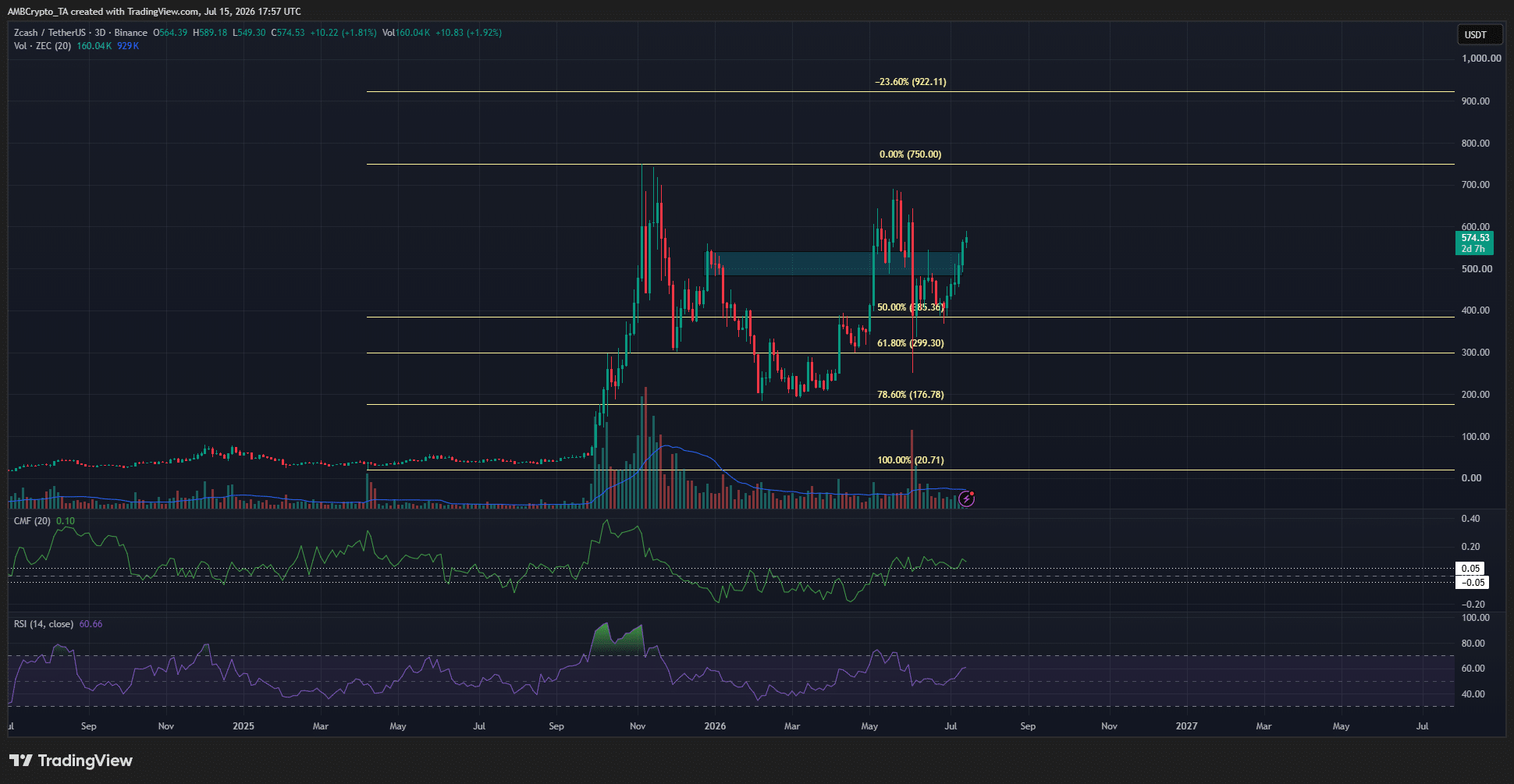
The $176 retracement was respected earlier in the year, a rebound has commenced. The critical vulnerability triggered a deep sell-off, but since early June, the $500 local supply zone has been reclaimed once again.
The CMF on the 3-day chart remained above +0.05 to signal strong buying pressure. The RSI was at 60.6 to indicate the upward momentum was also considerable.
ZCash has made 56.12% in gains in under three weeks, measured from the local low at $368.3. As things stand, further upside remained likely.
Traders’ call to action- Buy
Source: ZEC/USDT on TradingView
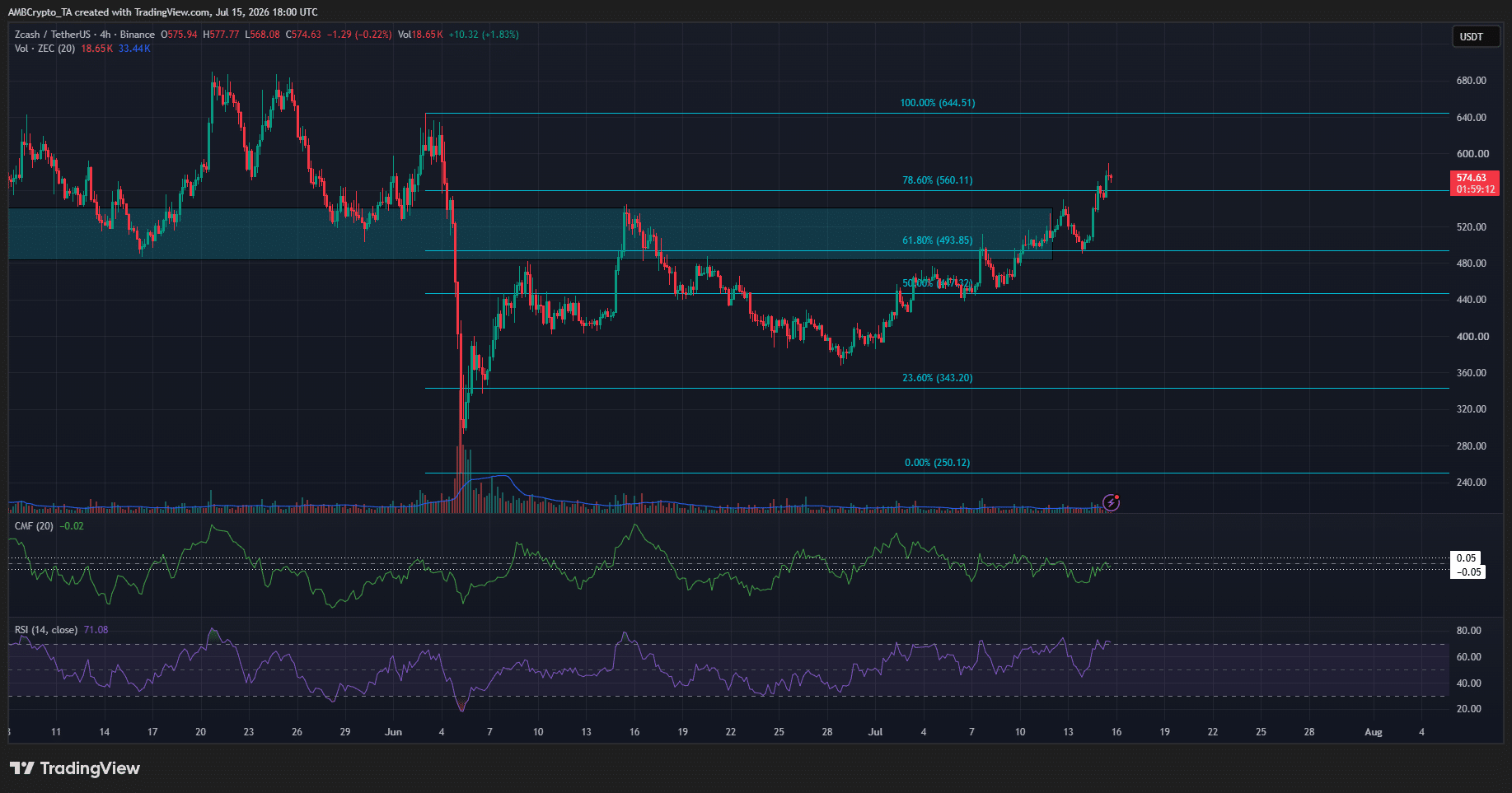
The swing structure on the 4-hour chart was bearish, but the 78.6% retracement level at $560.11 has been breached. It was a slight concern that the CMF was at -0.02 and did not show firm buying pressure.
A price move beyond $644 would flip the ZEC H4 structure bullishly. The next target would be $690, a high made in May, with $750 another bullish target.
Traders can wait for sustained capital inflows and a move past $644 to confirm the bullish turnaround.
Final Summary
The ZCash breakout past the $500 supply zone was accompanied by buying pressure on the higher timeframes.
Zooming in, the lower timeframe charts showcased some doubt around ZEC bulls’ ability to keep the recovery going.
In Utah, which passed State-Endorsed Digital Identity (SEDI) legislation, Cardano Foundation-built Veridian has already shown that digital identity can be delivered in a privacy-preserving way, allowing users to prove that they are over or under a specific age without exposing any other data. It’s a working model of what responsible verification can look like and shows trust does not require unnecessary disclosure. Privacy can be designed into the system from the start.
That is the standard bills like KIDS or KOSA should favor.
If the goal is to protect children, the tools should be narrow, purposeful, and minimally invasive. Broad mandates that push every platform toward more data, more retention, and greater dependence on identity are too blunt and risk creating a multitude of other problems alongside the ones they claim to solve.
A better approach is straightforward. Build for data minimization, limit retention, and use privacy-preserving verification where verification is truly needed. If digital trust can be established without exposing personal data, lawmakers should prefer that path. If safety can be improved without turning the internet into an identity checkpoint, that should be the only option.
Children deserve protection online. But they do not need a policy framework that makes everyone more visible in order to make the internet, and the companies that thrive on it, more accountable.
When you’re traveling abroad, making a payment with the wrong card can be expensive.
If you use a credit card or debit card that charges a foreign transaction fee, you can expect to see an extra fee added to each of your non-U.S. purchases. And in some cases, the fee can be as high as 5% of the transaction amount.
Read on to learn how foreign transaction fees work and how to avoid them.
What is a foreign transaction fee?
A foreign transaction fee is a fee that some credit card and debit card issuers charge when you make purchases in other countries. You can also be charged this fee if you make a purchase in the U.S., but the vendor processes your payment in another country or currency.
Not all cards come with foreign transaction fees, but for those that do, the fee is usually 1% to 3%. This fee is used to cover a variety of costs related to making a foreign purchase, including taxes, shipping, and network fees.
Foreign transaction fees are usually 1% to 3% of the transaction amount. So if you make a $500 purchase, the fee will likely run somewhere between $5 and $15.
With that said, each card issuer sets its own fees. So the only way to know exactly what your foreign transaction fee might be is to look at the details for each card.
Foreign transaction fees on credit cards vs. debit cards
There’s a chance your debit card has a lower foreign transaction fee than your credit cards. However, it’s important to remember that each card issuer is different, so you don’t want to make any assumptions about your card fees. To be sure, check the cardmember agreement for each of your accounts.
Even if your debit card has a lower fee, you may still want to avoid using it while abroad. Most credit cards have added protections like zero-fraud liability, which guarantees you’ll get your money back if someone makes an unauthorized purchase on your card, as long as you report it right away.
In addition to fraud protections, some credit card issuers also offer insurance coverage for certain travel-related purchases, such as flights and car rentals.
Foreign transaction fees vs. currency conversion fees
A foreign transaction fee is just one type of currency conversion fee. There are several other currency conversion fees you might encounter while traveling abroad, when you shop online with vendors who are located outside of the U.S. They include:
Dynamic currency conversion (DCC): You might have to pay a DCC fee if you opt to make a transaction in U.S. dollars instead of the local currency. These fees can range anywhere from 1% to 12% of your transaction amount.
Commission or service fee: Banks and currency exchange services can charge you a commission or service fee to convert your currency. Depending on the company, the fee might range anywhere from 1% to 8%.
Because of all the potential fees, it’s often cheaper to pay with local currency than with a credit or debit card. But if you do want to pay in cash, just make sure you do your research ahead of time to find the safest and most affordable places to exchange your currency.
If you want to avoid unnecessary foreign transaction fees while traveling, here are a few ways you can do so.
Only bring your fee-free cards
You can avoid foreign transaction fees altogether if you exclusively use credit and debit cards that don’t have the fees. If you have a fee-free debit card, you can also avoid charges by withdrawing money from in-network ATMs.
You can find out if your debt and credit cards have foreign transaction fees by reading your cardmember agreements.
To start your search, try comparing travel-focused credit cards, since they have features built specifically for frequent travelers. In addition to having no foreign transaction fees, some also let you earn miles for flights, give you travel insurance, or provide complimentary access to airport lounges.
Pay with local currency
Carrying lots of cash is not ideal in some locations. However, it’s definitely one way to avoid foreign transaction fees. If you want to carry the local currency, you can visit your bank to make an exchange before your trip, or look for ATMs in your bank’s network when you’re abroad.
Another way to avoid fees is to pay in local currency instead of U.S. dollars when you’re swiping a card at checkout. When a vendor offers this option, it might be your instinct to pay in U.S. dollars. But you can often avoid an unnecessary conversion fee if you opt to pay with local currency instead.
Two years ago, Darrick Ramsey and Alexis Jordan were given a challenge: Turn $1 into $100 in a week using all of the resources at their disposal.
Jordan surpassed the goal by providing cleaning work for local small businesses and creating an in-demand snack.
Ramsey offered pressure washing and car detailing services and ended up making $2,065 in a week.
When Darrick Ramsey first held the single dollar bill he’d been given, anxiety hit him hard. “I was very nervous, like I was anxious,” he recalls in an interview with Entrepreneur.
Alexis Jordan had a similar reaction: “For me, I was very nervous,” she says.
In February 2024, a documentary film team tasked these two students, along with about two dozen of their then-high school classmates, with an unusual challenge: Turn $1 into $100 in a week using all of the resources at their disposal. They started the challenge terrified of failing, then used their businesses, networks and hard work to turn $1 into far more than $100 in a week. A documentary film released last month called Learn to Earn: A Student’s Journey From $1 to $100 chronicled their experiences.
Both Ramsey and Jordan initially grappled not just with the math, but with the reality of trying to build something in “this economy,” as Jordan put it, where “what can you get for $1?” is a genuine question. The time frame added pressure: They had roughly a week, layered on top of school, sports and other commitments, to turn $1 into $100. “We had other stuff to do, so it was very time-consuming,” Jordan says.
How Jordan flipped $1: services and Kool-Aid pickles
Once the shock of the $1 challenge wore off, Jordan went directly to the community she knew best. “My strategy was, where do people give the most money?” she says. “So for me, I was raised in a church; my church is like a big family. So I said, let me go to my number one supporters.” With that single dollar and her existing relationships, she offered labor and creativity instead of products she couldn’t afford to buy.
“Usually what I did was I cleaned their yards, I cleaned the church,” she says, describing how she exchanged services for donations and payments.
Then she layered on a homemade snack that became an unexpected hit: Kool-Aid pickles.
“It’s weird,” she says. “But a lot of people bought them. Everybody bought them, like everybody was going crazy over them.”
She explained the process simply: “You get the pickle jar, you pour out the pickle juice and then you just mix Kool-Aid packets and sugar with it, and then pour it back and let it ferment in the refrigerator for like a day or two, and then after that you put them in a Ziploc bag and you just sell them.”
With cleaning work for local small businesses and a snack that turned heads, she surpassed the $100 target.
Where she is now
More than two years later, Jordan, 19, runs a business called Blended Threads LLC, which centers on childhood diabetes, a condition she was diagnosed with in fourth grade.
She wrote a children’s book, Why Did Diabetes Pick Me, chronicling her struggles and how she overcame them. She is now working on a second book, this time a chapter book. She’s also a keynote speaker, turning her lived experience with juvenile diabetes into education and advocacy.
“I wanted to broadcast and bring awareness to it, because you rarely hear anybody talk about childhood diabetes or juvenile diabetes,” she says, adding that people in her community were “shocked” to learn more and “glad” she published the book.
Alexis Jordan
For Ramsey, the turning point came when he realized that the $1 was less important than the relationships he already had. He was part of the CEO program at his high school, and the program had taken students to tour businesses in the community.
“We had a journal, and I wrote down each business owner, their name and their contact,” he says. When the $1-to-$100 challenge arrived, he asked himself: Why can’t I just reach back out to these guys to see if they can help me?
He recorded a simple one-minute video for those contacts: “I tried to keep it real short and simple, explaining, hey, my name is Darrick Ramsey. I talked to you in the CEO program before. I’m just wondering if you had any advice or if I can pressure wash your car or detail it for you,” he says.
He had bought the power washer before the challenge with money from an hourly job.
The response was overwhelming. “I kind of overbooked myself with all the people that we had met and all the people they know,” he says. “I really got to see the community coming together. It was just great.”
He focused first on pressure washing and later added car detailing as demand grew. “It got to the point where I had to pressure wash in the cold, had to pressure wash in the rain; we had the car detail in the freezing cold, like cars were icing over as we were washing them,” he says, describing one of the busiest weeks of his life. By the end of the challenge, he’d far exceeded the target, earning $2,065.
Where he is now
Ramsey, 20, was born in Decatur, Alabama, and moved between Chicago, Atlanta and Alabama before settling back in Decatur. He struggled “academically, financially” in school, which shaped his purpose now: “I feel like one of my life’s purposes has been trying to help the youth with what they do best, and keep excelling,” he says. He is a physical education teacher and mentor who “goes all over Decatur city schools” to connect with kids, pulling them aside to talk through “behavior issues and really just stuff I was struggling with.”
His business, PeerPressure, was born out of personal grief and bad influences in middle and early high school. After a close friend died the summer before ninth grade, he says, “I was peer-pressured into doing a lot of things that I really felt like I wouldn’t have done if I wasn’t around those bad friends.”
In his sophomore year, with the help of teachers, he turned that story into a brand. PeerPressure now offers pressure washing, mobile car detailing, house washing and automotive light work, built over “about four years” and expanded through work with “many business owners within our community and outside of our community,” he says.
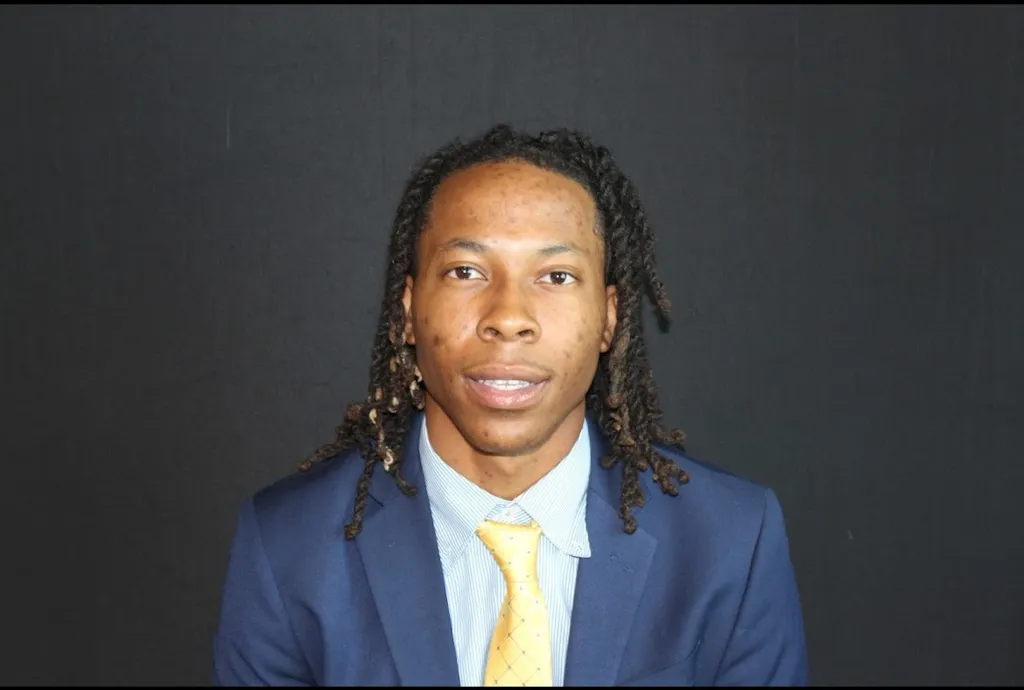
Darrick Ramsey
His biggest challenge was internal
Ramsey says that he was his own “biggest enemy” solely because he didn’t really believe in community or family at the time. Academic and financial struggles left him feeling isolated and under pressure, which “created a lot of self-doubt” during that week.
Reaching out to people changed that perception. “They started showing me that I wasn’t alone,” he says. “Then I started to see a bigger vision.”
The lesson has stayed with him. He endured years of “long nights, a lot of crying, a lot of work.” Those years helped him define his purpose: “If I can change somebody’s life through teaching and mentoring, then I feel like I’ve fulfilled my purpose,” he says.
This article is part of our ongoing Young Entrepreneur® series highlighting the stories, challenges and triumphs of being a young business owner.
Key Takeaways
Two years ago, Darrick Ramsey and Alexis Jordan were given a challenge: Turn $1 into $100 in a week using all of the resources at their disposal.
Jordan surpassed the goal by providing cleaning work for local small businesses and creating an in-demand snack.
Ramsey offered pressure washing and car detailing services and ended up making $2,065 in a week.
When Darrick Ramsey first held the single dollar bill he’d been given, anxiety hit him hard. “I was very nervous, like I was anxious,” he recalls in an interview with Entrepreneur.
Alexis Jordan had a similar reaction: “For me, I was very nervous,” she says.
In February 2024, a documentary film team tasked these two students, along with about two dozen of their then-high school classmates, with an unusual challenge: Turn $1 into $100 in a week using all of the resources at their disposal. They started the challenge terrified of failing, then used their businesses, networks and hard work to turn $1 into far more than $100 in a week. A documentary film released last month called Learn to Earn: A Student’s Journey From $1 to $100 chronicled their experiences.
Coinbase’s Jesse Pollak said he is stepping back from leading the Base app after acknowledging that his bet on an onchain social economy failed to drive crypto adoption as he had expected.
The Base creator said he had spent the last two years betting that builders and onchain-native social experiences, including Farcaster, Zora, mini apps and creator coins, would fuel crypto’s next growth wave. But in a post on X on Wednesday, he said while developers did spur adoption through products like stablecoins, prediction markets and perpetual futures, social applications “disintegrated completely.”
“I was definitively wrong,” Pollak wrote, adding that Base’s focus on social left it behind competitors in key areas including trading, tokenization and payments.
As part of the pivot, Pollak said that the leadership of Base app will return to Coinbase, where popular crypto investor Jordan Fish, also known on X as ‘Cobie,’ will oversee its development. Pollak said Fish will work to make the Base app “the best damn app for onchain,” including expanding beyond the Base ecosystem, while Base itself will prioritize trading, payments and AI agents as it seeks to become infrastructure for global finance.