Home Blog Page 244

Live updates: Bitcoin, ether ETFs draw inflows as majors rise as much as 5%

0
Live updates: Bitcoin is stuck near $64,000 as ETF outflows reach a sixth week

U.S. spot bitcoin ETFs took in about $181 million on Tuesday, a day after shedding roughly $425 million, per SoSoValue data. Ether ETFs added about $58 million.

BlackRock’s IBIT drove almost all of it, pulling in roughly $139 million, with Fidelity’s FBTC adding about $21 million. No bitcoin fund lost money. On the ether side, BlackRock’s ETHA accounted for the entire net figure at about $58 million, with every other fund flat.

The swing tracks the price. Bitcoin ETFs rose close to 4% on the day and ether funds about 6%, the strongest single-session move in weeks.

Total bitcoin ETF assets climbed back to roughly $78 billion from about $75 billion, and ether ETF assets crossed $10 billion.

July’s flows have been choppy rather than directional. Bitcoin ETFs have swung between inflows and outflows nearly every other session this month, with July 13’s $425 million redemption the largest of the run and Tuesday’s rebound the second largest inflow. Neither side has held for more than three days.


Source link

Tether CEO: ‘Demand for dollar settlement is a wages story’ – $7M Pact Labs investment proves it

0
Tether CEO: 'Demand for dollar settlement is a wages story' - $7M Pact Labs investment proves it


Tether is shifting stablecoin adoption from crypto markets toward everyday financial infrastructure. By leading Pact Labs’ $7 million Series A, the company is targeting payroll, earned wage access, and real-time payments through USA₮.

That strategy addresses a U.S. payroll system processing more than $11 trillion annually, where legacy settlement still delays access to earned wages.

Supporting this, Tether CEO Paolo Ardoino noted,

This confirms what our transaction data has shown for years: the demand for dollar-denominated settlement is a wages story.

Source: Tether on X

Rather than competing for trading volume, Tether is pursuing recurring payment flows that generate consistent stablecoin demand. This marks a structural expansion of stablecoin utility beyond speculative markets.

Still, enterprise integrations, payroll adoption, and transaction growth will determine whether USA₮ becomes embedded in mainstream finance or remains a niche payment alternative.

Compliance reinforces Tether’s expansion

On one hand, building payment rails addresses just one-half of the problem. That makes Chainalysis’ support for Stable, a USDT-native Layer 1, more significant than another blockchain integration.

As Tether continues to push stablecoins into payroll and daily transactions, institutions will require continuous monitoring prior to committing larger transactional volume on-chain.

Chainalysis provides this critical layer. This is via real-time transaction screening, entity monitoring, and fund flow analysis.

Source: Chainalysis

Chainalysis’s automatic support for additional ERC-20 and ERC-721 tokens enables Stable to continue to grow. It does so while providing ongoing compliance coverage. Thus, the opportunities for Stable extend far beyond fast settlement.

If payment activity and institutional adoption grow together, compliance could become the catalyst that transforms stablecoins into trusted financial infrastructure.

Payment infrastructure now faces its most important challenge. It must show resilience in generating sustained real-world activity. Faster settlement and strong compliance have removed many of the regulatory hurdles for enterprises to adopt blockchain technology.

Rising enterprise wallets, larger transaction sizes, and expanding payment flows would signal businesses are moving beyond pilot programs.

That momentum gradually shifts blockchain’s role from facilitating digital asset transfers to supporting everyday financial services.

The competitive advantage is also changing. Networks that attract recurring payment activity, rather than simply launching new infrastructure, are increasingly positioning themselves at the center of mainstream finance.


Final Summary

  • Tether is expanding beyond trading by positioning stablecoins as infrastructure for payroll and everyday payments.
  • Stablecoin adoption now depends on recurring payment activity supported by scalable infrastructure and institutional-grade compliance.


Source link

Costco vs. Walmart: 1 Dividend-Paying Retail Giant Stands Above the Other

0
Costco vs. Walmart: 1 Dividend-Paying Retail Giant Stands Above the Other


Blurred food and drink isles by themorningglory via iStock

While artificial intelligence (AI) stocks have taken center stage now, retail stocks have been the reliable ones in times of economic uncertainty. Costco Wholesale (COST) and Walmart (WMT) are two of the world’s largest retailers, both generating billions in annual sales while rewarding shareholders with consistent dividends. But only one company stands out as the stronger long-term investment.

The Case for Costco

Costco Wholesale is a warehouse club retailer that provides members access to a wide range of products at low prices by selling in bulk through large warehouse locations. COST stock has climbed 6% year-to-date (YTD), underperforming the S&P 500 Index ($SPX) gain of 11%.

More News from Barchart

www.barchart.com

Globally, Costco now operates close to 928 warehouses. The company even has plans of opening 30 net new warehouses annually over the coming years. Unlike other retailers, Costco’s business model is unique. It offers its members a selection of high-quality products at low prices by charging a membership fee. Its membership fee income rose 11% in the third quarter of fiscal 2026 to $1.37 billion. This led to a 12% increase in net sales to $69.2 billion, while diluted earnings per share (EPS) jumped 15% to $4.93.

Furthermore, this year higher oil prices and supply disruptions in the Middle East fueled strong consumer demand for lower-priced fuel options. Costco took advantage of this by maintaining inventory and offering competitive pricing, which boosted its gas business. Excluding gasoline sales, comparable sales also increased 6.6% in the quarter, reflecting the strength of its core merchandise business. 

Its membership-based model creates an unusually loyal customer base, with renewal rates remaining above 90% in the U.S. and Canada for years. This competitive advantage has translated into strong comparable sales growth. Recently, the company reported a 10.6% increase in June comparable sales to $29.2 billion.

Costco offers a low forward dividend yield of 0.62% and also pays out just 27% of its profits as dividends. However, the company is on the verge of becoming a Dividend Aristocrat by increasing its dividends for the past 23 years. It recently hiked its quarterly dividend by 13% to $1.47 per share. Occasionally, the company also pays a special dividend to its shareholders, besides its regular dividends. The company paid out $1.1 billion in dividends in the third quarter.


Source link

The $124 trillion Great Wealth Transfer means more businesses are now being inherited than purchased

0
The $124 trillion Great Wealth Transfer means more businesses are now being inherited than purchased

It’s not just the Murdochs or the Arnaults. As family-owned companies change hands, new data shows more American businesses are now being inherited than purchased—part of the broader Great Wealth Transfer marking a shift in how the next generation could shape the economy. 

Bank of America‘s recent Private Bank Study of Wealthy Americans found that in 2026, the share of businesses inherited among wealthy Americans is projected to reach 23% versus 11% that are purchased, a deviation from a previous pattern of more businesses being purchased than inherited. For example, in 2022, 28% of businesses were purchased compared to 5%, which were inherited, according to BofA data. Researchers surveyed 1,400 U.S. adults with at least $3 million in investable assets to look particularly at how high-net-worth individuals were saving and passing down their wealth.

Of course, this is all part of what’s become called the Great Wealth Transfer, the projected inheritance of between $36 trillion and $124 trillion in assets from Baby Boomers to younger generations over the next two decades. Wealthy individuals play an outsized role in this transference, as wealth accumulation is highly concentrated toward the top. The immense amount of wealth moving through generations has raised questions of how the economy will be shaped by the young and the rich. Jonathan Parker, an MIT Sloan School of Management professor of financial economics, said that how assets—in this case businesses—change hands can sometimes offer illumination of broader economic patterns.

What do more inherited businesses say about the economy?

To Parker, a greater share of businesses being inherited was a sign of even greater wealth concentration, a phenomenon that has gained attention amid growing concerns about affordability and the K-shaped economy, in which the rich keep accumulating wealth, even as the poor struggle to make ends meet. According to the Federal Reserve Bank of St. Louis, the top 1% of U.S. households account for nearly one-third of the country’s wealth, equal to about $44 trillion, or as much as the bottom 90% of American households.

“We have a lot of business creation in the U.S.,” Parker told Fortune. “That’s generally a very good thing, and that does tend to generate top skewed wealth distribution for the owners, obviously, who have a lot of resources. An interesting question going forward is, what share of that wealth, when people reach the end of their lives, do they bequeath to their dependents?”

Parker noted that for decades, there has been an inverse pattern between wealth and the number of children one had, such that more affluent individuals had fewer kids. It’s a cycle that emerged during the Industrial Revolution, though economists have struggled to come to a definitive conclusion as to why this is. While there may also now be a breakdown of this trend in some parts of the world, in which wealthier people are beginning to have more children, Parker argues that wealth becomes less distributed in a family with one child versus six.

The increase in inherited businesses could also be part of a trend of companies staying private longer, as private firms are harder to cash out of. Apollo chief economist Torsten Slok, citing economist and “Mr. IPO” Jay Ritter, noted a rise in the median age at which companies go public since 2022, when the Federal Reserve began raising interest rates. This trend has coincided with a boom in private capital, enabling larger-scale firms to raise billions through venture capital funding and private equity instead of public markets.

What questions do more inherited businesses raise?

While wealthier Americans inheriting businesses align with the economic trends of wealth concentration and longer maturity of private firms, Parker noted other factors could be informing this pattern.

“We currently have a very strange situation” regarding the taxation of inherited wealth, he said. Over the last 25 years, the U.S. has essentially overhauled its federal estate tax, most recently raising the exemption to $15 million per person under the One Big Beautiful Bill Act. All the while, the U.S. has kept the step-up in basis on capital gains at death, a provision eliminating capital gains tax on an appreciation of an asset that took place during the lifetime of that asset’s original owner.

“It’s sort of like a tax benefit, a giveaway of taxes to people who pass it on to heirs, rather than the reverse,” Parker said.

The current tax system could further incentivize wealthy Americans to hold onto assets longer before passing them down, prolonging the Great Wealth Transfer to an extent, but maximizing gains for the next generation of heirs. While BofA did not give specific data on for how long original owners were holding onto their businesses and other assets, the report said a “notable portion” of business owners had no plans to transition out of their businesses, and the majority had plans to ultimately transfer or sell ownership to family heirs eventually.

“That might be partly why people are holding on to these businesses for longer, and then handing them down to the heirs,” Parker said. “And the heirs can then either make them public or sell them or keep them.”



Source link

Ripple joins card giants backing x402 as 75 million payments move just $24 million

0
Ripple joins card giants backing x402 as 75 million payments move just $24 million

Coinbase, among others, filled that gap in May 2025. Under x402, a server that wants payment answers a request with a 402 and a price. The client signs a stablecoin transfer, usually USDC, resends the request with the payment attached, and gets the data. The exchange takes seconds and needs no account, no card, and no prior relationship between the two sides.

That is why the AI industry cares. An autonomous agent cannot open a bank account, pass a credit check or sign a SaaS contract, but can sign a transaction. Google has wired x402 into its own agent payments protocol, and Cloudflare ships it in its agent toolkit.

The announcement included no usage figures, though x402 publishes them on its own homepage. The protocol handled about 75 million transactions over the past 30 days, or roughly 29 every second, moving about $24 million between some 94,000 buyers and 22,000 sellers.

That works out to an average payment of about 32 cents, meaning the machine-to-machine thesis works as designed, as no card network can process a such small charges profitably.

Still, $24 million a month is a fraction of what any of x402’s premier members move in a day.


Source link

Bitcoin banking adoption hits 32%, but ‘we’re still early,’ says Strategy’s Saylor

0
Bitcoin banking adoption hits 32%, but 'we're still early,' says Strategy's Saylor


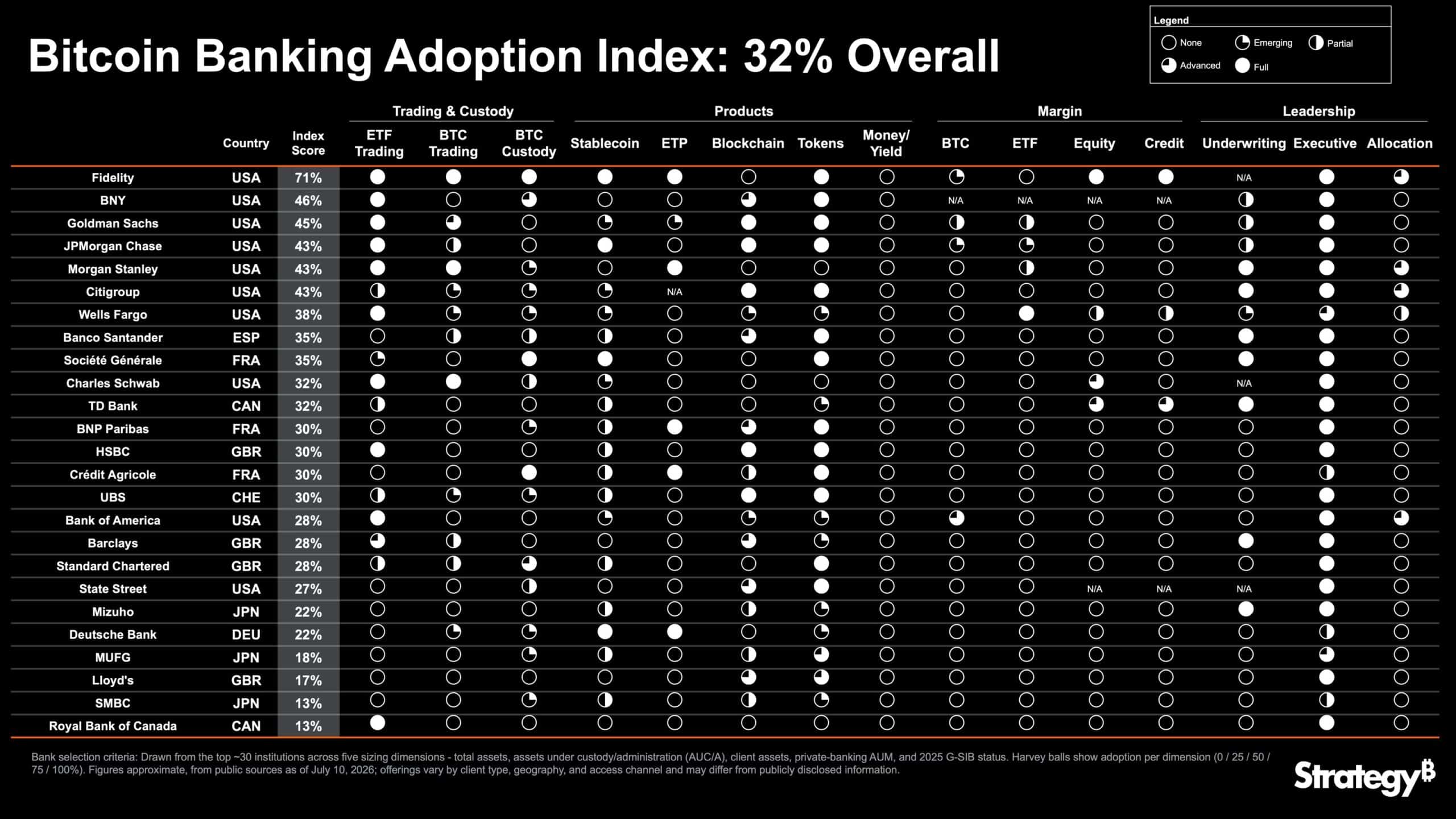
Bitcoin has seen accelerated adoption by major global banks, but the traction is “still early.” This, according to Michael Saylor, founder of Strategy, the world’s largest BTC treasury firm. In a newly released Bitcoin Banking Adoption Index, covering ETF trading, credit and more, Saylor added, 

Major-bank Bitcoin adoption is accelerating, but still early: 32% overall as measured by the index.

Bitcoin banks
Source: Strategy

Fidelity leads in the adoption race with a 71% rating, with a full score for custody, BTC, and ETF trading alongside stablecoin issuance. BNY Mellon comes in second with a 46% score, while Goldman Sachs closed the top three list with a 45% rating. 

Other top-ranking global players were Spain’s Banco Santander, France’s Société Générale, and the UK’s Standard Chartered.

Is Strategy still eyeing ‘Bitcoin bank’ vision?

The most interesting part of the new composite index is the ‘credit’ section, or banks enabling credit against spot BTC or derivatives like BlackRock’s iShares Bitcoin Trust (IBIT). In other words, banks that allow leverage or offer credit using Spot BTC or ETFs as collateral. 

As of 2026, most banks were more inclined towards Spot BTC ETFs for collateral, rather than spot BTC. However, given the empty circles, it meant adoption of BTC or ETF margin was still relatively low. 

This is particularly important because Saylor has floated positioning Strategy as the “world’s first Bitcoin bank.” According to him, the firm could use its vast BTC holdings as collateral to create new credit instruments beyond STRC and partner with leading banks for the same. 

The 32% bank adoption is commendable. However, the adoption index clearly shows that BTC is not fully treated as high-quality collateral, at least as of 2026. By extension, it means its vision of being a “BTC bank” could still be far from being viable. 

Interestingly, Metaplanet is exploring something similar but for the Japanese bond market. 

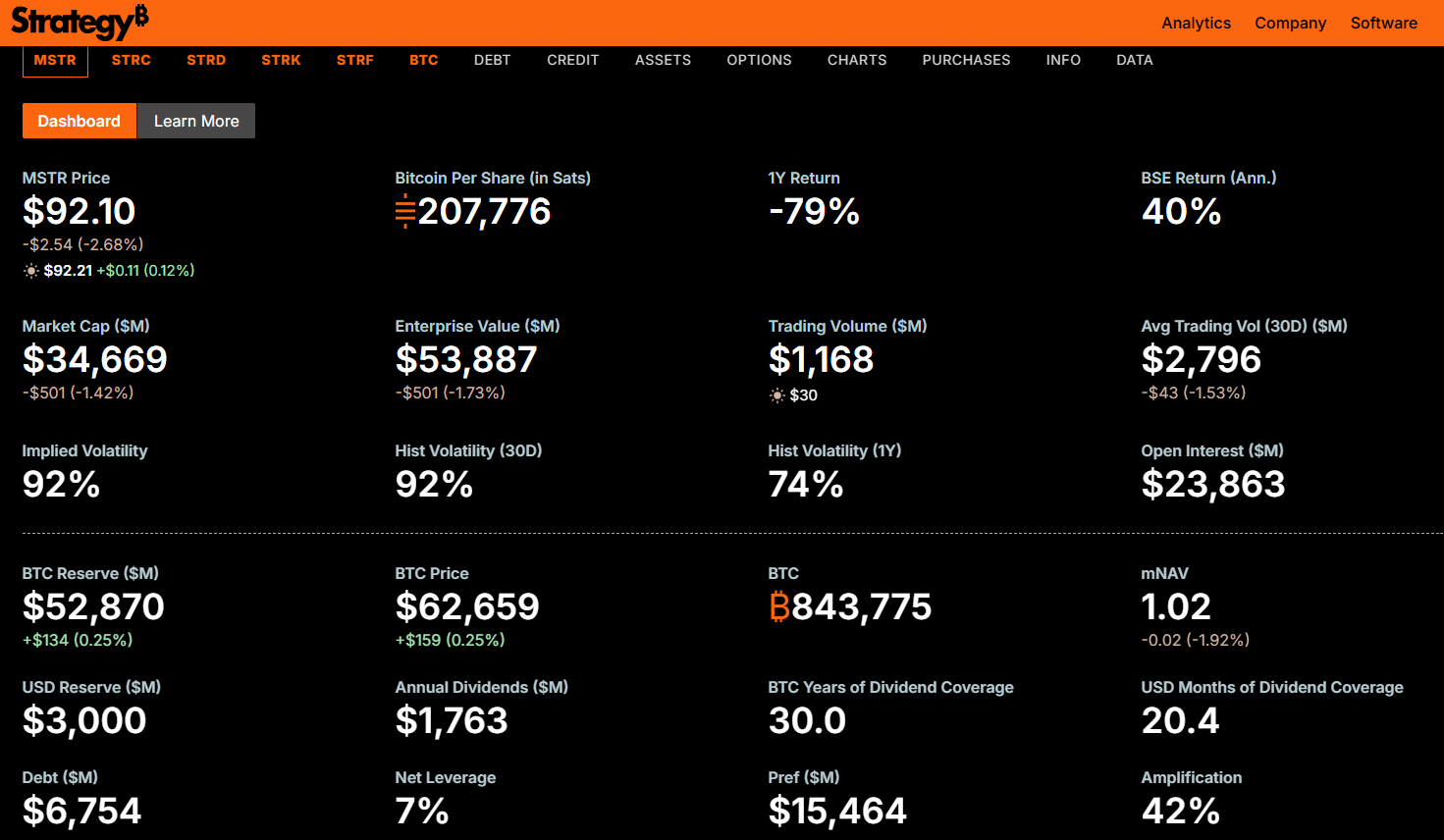
In other developments, Strategy has increased its cash reserve to $3B after a $467M MSTR share sale. This has effectively increased its coverage for its financial obligations to 20 months. 

Bitcoin banks Bitcoin banks
Source: Strategy

It seems that the firm was partly following the recommendations by JPMorgan analysts who urged for a 24-36 months cash reserve by selling more MSTR, not its BTC holdings. 

Overall, Strategy’s “Bitcoin bank” dreams may still be far from reach right now. Even so, there is traction across banks that could determine whether it will be viable in the future. 


Final Summary

  • Bitcoin adoption among banks has surged by 32%, but Spot BTC ETFs may be preferred for margin than physical BTC.
  • Strategy increased its cash reserves to $3B and 20 months of coverage, just shy of 24 months recommended by JPMorgan. 


Source link