Home Blog Page 243

Why Lucid Stock Bounced Back Today

0
Why Lucid Stock Bounced Back Today


Trading in Lucid Group (NASDAQ: LCID) stock was halted several times yesterday due to volatility after a publication that follows electric vehicle (EV) companies reported that the company was considering filing for bankruptcy or going private.

Shares plunged more than 50% before reversing course after the company called the report false. Lucid then took it a step further. After releasing a letter to the editor of EV (electric-vehicles.com), Lucid’s stock popped today. As of 10:13 a.m. ET, Lucid shares were up by 17%.

Missed Nvidia in 2009? This Rare Signal Is Flashing Again. In 2009, a “Double Down” signal flashed for a little-known chipmaker called Nvidia. For the first time in years, that same “Total Conviction” signal is flashing for a company 1/100th the size of Nvidia. Continue »

Image source: The Motley Fool.

Investors still need to watch the balance sheet

Lucid’s letter, signed by its chief legal officer, stated: “Lucid unequivocally denies the central factual assertions” that were reported. It also reiterated that it was not considering Chapter 11 bankruptcy protection nor taking the company private.

It also said that the company was looking into the “circumstances surrounding publication” and “all available legal remedies.”

Investors certainly breathed a sigh of relief from this strong response. Lucid reported having about $4.7 billion in liquidity when it reported Q1 results in early May. It is still losing money, however, and that is what investors need to monitor.

Lucid is hoping its new Gravity SUV will help spur demand, and it has also entered a partnership with Uber Technologies to build and deploy a premium, purpose-built global robotaxi fleet using its EV technology.

Look for updates regarding both when the company reports second-quarter results on Aug. 4. That will likely drive where Lucid stock goes from here.

Should you buy stock in Lucid Group right now?

Before you buy stock in Lucid Group, consider this:

The Motley Fool Stock Advisor analyst team just identified what they believe are the 10 best stocks for investors to buy now… and Lucid Group wasn’t one of them. The 10 stocks that made the cut could produce monster returns in the coming years.

Consider when Netflix made this list on December 17, 2004… if you invested $1,000 at the time of our recommendation, you’d have $396,542!* Or when Nvidia made this list on April 15, 2005… if you invested $1,000 at the time of our recommendation, you’d have $1,299,961!*

Now, it’s worth noting Stock Advisor’s total average return is 931% — a market-crushing outperformance compared to 210% for the S&P 500. Don’t miss the latest top 10 list, available with Stock Advisor, and join an investing community built by individual investors for individual investors.

See the 10 stocks »

*Stock Advisor returns as of July 15, 2026.

Howard Smith has positions in Lucid Group. The Motley Fool has positions in and recommends Uber Technologies. The Motley Fool has a disclosure policy.

Why Lucid Stock Bounced Back Today was originally published by The Motley Fool


Source link

BlackRock’s crypto assets fall 39% despite $15 billion of net inflows

0
BlackRock's crypto assets fall 39% despite $15 billion of net inflows

The figures contrast with BlackRock’s broader business, which posted record assets under management (AUM) of $15.3 trillion after attracting $192 billion in net inflows during the quarter. The company also beat Wall Street expectations with adjusted earnings per share of $13.91 on $7.08 billion in revenue.

BLK shares traded 4.15% higher at £1,068 in pre-market trading Wednesday.

BlackRock’s crypto target

BlackRock is targeting $500 million in annual revenue from the business under its 2030 plan, the firm said in its earnings call.

This would represent an increase of more than tenfold, compared to the $40 million BlackRock currently generates in base fees and securities lending, accounting for less than 1% of the firm’s total fee revenue.

BlackRock has steadily expanded its crypto ETF lineup since listing its spot bitcoin ETF (IBIT) and spot ether ETF (ETHA), in 2024. More recently, the firm introduced the iShares Bitcoin Income ETF (BITY), which seeks to generate income by writing covered call options on bitcoin exposure, offering investors an alternative to simply tracking the cryptocurrency’s price.

The asset manager also manages $60 billion of Circle’s reserves, about one-quarter of the $300 billion stablecoin market, and wants to become the industry’s reserve manager of choice, it added.

BlackRock pointed to 5 billion crypto wallets as a new distribution channel for its traditional investment products during the earnings call.


Source link

US producer prices unexpectedly fall in June

0
US producer prices unexpectedly fall in June


WASHINGTON, July 15 (Reuters) – U.S. producer prices unexpectedly fell in June, another indication that inflation was retreating before the recent escalation in the Middle East ‌conflict.

The Producer Price Index for final demand dropped 0.3% last month after a ‌downwardly revised 0.6% increase in May, the Labor Department’s Bureau of Labor Statistics said on Wednesday. Economists polled ​by Reuters had forecast the PPI unchanged after a previously reported 1.1% advance in May.

In the 12 months through June, the PPI increased 5.5% after rising 6.0% in May.

A 1.4% decline in goods prices, the largest since July 2022, accounted for the decrease in the ‌PPI over the month. Goods ⁠prices were weighed down by a 6.4% drop in the cost of energy products. Wholesale food prices fell 0.6%. Prices for services rose ⁠0.2%.

The ceasefire between the United States and Iran collapsed last week after commercial tankers came under fire in the Strait of Hormuz, triggering military strikes between the United States and Iran. ​Oil prices ​rose to a four-week high after Washington reimposed ​a naval blockade of Iran.

The government ‌reported on Tuesday that the Consumer Price Index dropped 0.4% in June, the largest decline since April 2020, after increasing 0.5% in May. The decrease, which mostly reflected a decline in energy prices, slowed the annual increase in consumer inflation to 3.5% from 4.2% in May.

The Federal Reserve tracks the Personal Consumption Expenditures Price Indexes for its 2% ‌inflation target.

Prior to the PPI data, economists estimated that ​PCE inflation excluding the volatile food and energy ​components rose 0.2% in June after ​climbing 0.3% in May. That would translate into a 3.3% year-on-year increase ‌in the so-called core PCE inflation ​after rising 3.4% in ​May.

Financial markets expected the U.S. central bank to keep its benchmark overnight interest rate unchanged in the 3.50%-3.75% range this month. Traders, however, continued to see a ​rate hike in September. Inflation ‌was last below 2% in early 2021. Fed Chair Kevin Warsh told ​lawmakers on Tuesday that the central bank had “no tolerance for persistently elevated inflation.”

(Reporting ​by Lucia Mutikani; Editing by Chizu Nomiyama)


Source link

Your Biggest AI Cost Isn’t the Technology — It’s the Hidden Debt Quietly Draining Your Budget

0
Your Biggest AI Cost Isn't the Technology — It's the Hidden Debt Quietly Draining Your Budget


Opinions expressed by Entrepreneur contributors are their own.

Key Takeaways

  • AI technical debt is no longer just an IT concern — it has become a business issue that directly reduces ROI and slows enterprise AI adoption.
  • Organizations that audit existing AI investments, strengthen data and infrastructure and eliminate low-value projects are better positioned to realize sustainable returns.

You did everything right. You invested in AI early, ran pilots, got board approval and committed real budget to an AI-first strategy. So why is the ROI still so hard to prove?

In the past few years, one problem has come up in nearly every executive conversation I’ve had: AI technical debt. Not the definition your engineering team uses internally, but the business cost behind it. Shortcuts taken to get AI tools running faster, integrations bolted onto systems never designed for them and pilots that shined in demos but needed constant fixes in production all compound into a cost that’s now eating into every AI dollar you spend.

IBM’s Institute for Business Value puts a number on it: enterprises that ignore technical debt see AI project ROI drop by 18% to 29%. That’s the money spent maintaining, patching and working around problems that shouldn’t have existed in the first place. And 81% of the executives IBM surveyed said technical debt is already constraining their AI success.


Why AI debt compounds faster than any tech debt before it

Technical debt has been around since the first developer took a shortcut to meet a deadline. But AI debt plays by different rules, and I’ve watched it catch leaders off guard in new ways.

Traditional tech debt sits still: old codebases, outdated servers, systems that haven’t been touched in years. AI debt moves. The prediction model that worked well in January starts producing unreliable results by June because real-world conditions shifted and no one scheduled a retraining cycle. The integration your team built between your CRM and your AI analytics tool breaks every time either system updates. Each fix looks minor on its own, but twelve months of minor fixes add up to a budget line nobody planned for.

Then there’s the vendor problem. Gartner predicts more than 40% of agentic AI projects will be canceled by the end of 2027, citing escalating costs and unclear business value. One reason: the market is saturated with what Gartner calls “agent washing,” vendors rebranding chatbots as AI agents. Of the thousands of agentic AI vendors, Gartner estimates only about 130 offer genuine capabilities. If you’ve been buying based on demos and pitch decks, it’s worth asking your team whether what you purchased really qualifies.

Four signs your AI investment has a debt problem

Here are four patterns I see repeatedly when talking to executives who invested early in AI but can’t explain the returns.

1. Your AI tools work in demo but underperform in production. This is the most common complaint I hear. The pilot looked impressive in the boardroom. Six months later, your team is spending more time maintaining the system than using it. If your AI line items are growing but the business outcomes aren’t, that gap is the tax.

2. You’re paying for multiple AI tools that do overlapping things. Marketing bought one platform. Operations bought another. Finance is trialing a third. None of these purchases was coordinated. Now you have five tools that don’t communicate with each other, a monthly bill that keeps climbing and no single person who can map out what they all do. This kind of uncoordinated tool purchasing is one of the fastest-growing hidden costs I see.

3. Your data team spends more time cleaning than analyzing. Every AI system runs on data, and if your data infrastructure wasn’t ready before you layered AI on top, every project is building on a weak base. I’ve seen companies spend six months on an AI initiative only to realize the real problem was the quality of the data feeding it. My advice: ask about data readiness before you sign the AI contract, not after.

4. You can’t explain your AI ROI to your board. This one matters most because no technology team can fix it for you. If the value feels vague, the governance probably doesn’t exist. Deloitte’s 2026 State of AI in the Enterprise report found that only one in five companies has a mature model for governing autonomous AI agents. No governance means no measurement, which leaves you in front of the board with a number you can’t defend.

Three moves worth making before your next AI investment

If any of those signs sound familiar, here’s what I’d recommend.

Audit before you add. Before signing your next AI contract, ask one question: can our current infrastructure support this without creating new debt? If the answer is vague, that tells you everything you need to know. The biggest mistake I see is treating AI as a technology purchase. PwC’s 2026 AI predictions research reinforces that technology delivers only about 20% of an AI initiative’s value. The other 80% comes from redesigning how the work gets done, and CTOs can’t do that alone.

Cut the projects that aren’t delivering. Ask for a list of every AI proof-of-concept currently running, what each one costs per month and what measurable business outcome it produces. If that third column is mostly blank, those are the ones to cut. Shut them down and redirect those resources toward the two or three initiatives with a realistic path to production value.

Modernize before you layer. This is the advice that sounds least exciting but produces the biggest returns. At Accedia, the projects where AI actually delivered on its promise had one thing in common: the client invested time in fixing their infrastructure before introducing AI. In a recent case, we spent eight weeks retiring outdated data components and restructuring their systems. When we introduced AI after that, deployment reached production 30% faster than their previous attempts, because it was built on a foundation that could support it.

Where the real returns are

The next time someone asks you to justify your AI spend, don’t reach for another dashboard or vendor pitch. Look at what’s underneath. The only way to see real AI returns over the next 18 months is to fix what’s broken before investing in what comes next.

Key Takeaways

  • AI technical debt is no longer just an IT concern — it has become a business issue that directly reduces ROI and slows enterprise AI adoption.
  • Organizations that audit existing AI investments, strengthen data and infrastructure and eliminate low-value projects are better positioned to realize sustainable returns.

You did everything right. You invested in AI early, ran pilots, got board approval and committed real budget to an AI-first strategy. So why is the ROI still so hard to prove?

In the past few years, one problem has come up in nearly every executive conversation I’ve had: AI technical debt. Not the definition your engineering team uses internally, but the business cost behind it. Shortcuts taken to get AI tools running faster, integrations bolted onto systems never designed for them and pilots that shined in demos but needed constant fixes in production all compound into a cost that’s now eating into every AI dollar you spend.

IBM’s Institute for Business Value puts a number on it: enterprises that ignore technical debt see AI project ROI drop by 18% to 29%. That’s the money spent maintaining, patching and working around problems that shouldn’t have existed in the first place. And 81% of the executives IBM surveyed said technical debt is already constraining their AI success.




Source link

U.S., U.K. unveil stablecoin roadmap as CLARITY Act stalls: ‘For their own political gain!’

0
U.S., U.K. unveil stablecoin roadmap as CLARITY Act stalls: 'For their own political gain!'


The U.S. and U.K. have reaffirmed their commitment to reducing regulatory friction for digital assets and the modernization of capital markets.

In a joint statement issued on the 14th of July, the two governments shared a 10-point view on stablecoins and tokenized assets, with innovation as the anchor pillar. 

The UK and United States affirm that stablecoins are an important vehicle for innovation in digital money. The UK and United States intend to enable the use of stablecoins in cross-border finance.

Some of the issues addressed include reserves, liquidity, and prudential requirements for stablecoin issuers to operate across the two markets. 

In particular, the countries pledged to avoid ‘imposing burdensome’ reserve requirements for stablecoins. 

Neither government intends to impose burdensome reserve requirements that are disproportionate to risk and that create unwarranted barriers to entry.

The above stance is noteworthy given the recent U.K. softer stance on stablecoin reserves. Initially, it pushed for a strict plan where only 60% of reserves would earn interest, while 40% would be non-yielding at the central bank. The industry pushed against this and called it anti-competitive.

In response, the Bank of England softened the proposal, allowing up to 70% in yield-bearing bonds and reducing cash requirements to 30%. This somewhat mirrored the U.S. GENIUS Act framework, which mandates reserves to be backed by highly liquid assets like U.S. Treasury bonds. 

Additionally, it scrapped its caps on individual stablecoin holdings to match the U.S. open market. Still, the two countries have divergences on some aspects of crypto regulation. 

The U.S.’s CLARITY Act stalls as the U.K. eyes clear rules by 2027

First, the U.K. will defer capital gains tax for crypto lending to avoid burden and double taxation. The rules will be live in 2027, alongside its broader crypto regulatory framework covering stablecoins, exchanges, staking, and market abuse, among others. 

However, a similar U.S. crypto market structure bill, the CLARITY Act, has stalled and risks being deferred to the 2030s. With ethics provisions becoming a sticky issue, odds of CLARITY Act passage dropped to a record yearly low of 32% before briefly hitting 38%. 

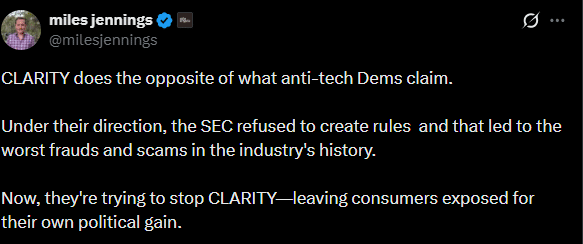
The bill has now become a political issue with increasing anti-tech rhetoric between Republicans and Democrats, according to Miles Jennings, legal chief at a16z VC firm.   

CLARITY Act US UK stablecoins
Source: X

The U.S. and the U.K. are pushing for a frictionless stablecoin and tokenization framework. But the U.S. risks falling behind amid uncertainty around the CLARITY Act. 


Final Summary

  • The U.S. and U.K. vowed to reduce friction for stablecoin usage as part of driving innovation in capital markets. 
  • But the U.S. could fall behind as CLARITY Act passage expectations have fallen to record lows. 


Source link

Bitcoin, ether hold steady after rising on U.S. inflation report: Crypto Markets Today

0
Bitcoin, ether hold steady after rising on U.S. inflation report: Crypto Markets Today

Bitcoin and ether (ETH) consolidated during Asian and European hours after rallying on Tuesday following a weaker-than-forecast U.S. inflation figure.

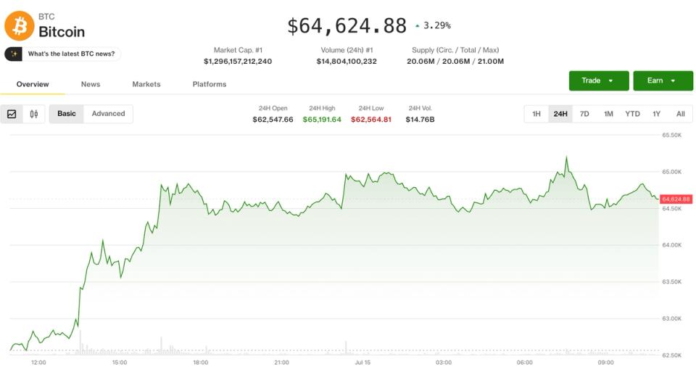
Bitcoin, while more than 3% higher over 24 hours, fell 0.6% since midnight UTC as tensions between Iran and the U.S. over tanker movements in the Strait of Hormuz ramped up. The largest cryptocurrency earlier touched a three-week high of $65,200.

Ether marked a similar trajectory, remaining 5% higher over 24 hours even after dropping 0.8% since midnight. It touched $1,895, the highest level since June 3, on Tuesday.

U.S. equities also rose in the period, with Nasdaq 100 futures and S&P 500 futures posting respective gains of 0.53% and 0.22%.

The altcoin market also showed pockets of strength; PUMP rose by 8.5% since midnight after a team and investor unlock was mopped up by investors, suggesting robust demand.

Derivatives positioning

  • BTC derivatives positioning remains largely unchanged. Open interest ticked up to $17.3 billion, though the move is not meaningful, the three-month annualized basis held at 3.8% and funding rates remained broadly in the 0%-8% annualized range across multiple venues. In essence, the market continues to consolidate
  • Options positioning tilted more bullish as the 24-hour call/put ratio moved to 66/34 following yesterday’s softer 58/42 read and the one-week delta skew held steady at ~15%. The ATM term structure remains in contango, with the front end around 32%–33% and the long end at ~42.5% out to mid-2027 – indicating a calm, non-stressed volatility environment with a renewed lean toward upside positioning.
  • Coinglass data shows $357 million in 24-hour liquidations, with a 19-81 split between longs and shorts. ETH ($132 million) and BTC ($118 million) were the leaders in terms of notional liquidations.
  • The Binance liquidation heatmap indicates $63,500 as a core liquidation level to monitor in the event of a price drop.

Token talk

  • CoinMarketCap’s “Altcoin Season” indicator fell to 46/100 on Wednesday, likely due to the strength shown by the largest cryptocurrencies, bitcoin and ether.
  • The indicator was also dragged down by , which lost around 1% since midnight UTC despite buoyancy in the broader market.
  • Hyperliquid (HYPE) demonstrated its strength, adding 4% since midnight as it looks to extend May’s rally, which has been characterized by a series of higher highs and higher lows. The next target would be a record high above $78.00.
  • HYPE’s rival token, LIT, stalled after a strong month, rising by just 0.5% as it started experiencing profit-taking and supply distribution as it neared its record high of $2.76.
  • There was also a strong gain for zcash (ZEC), which surged by more than 10% over the past 24 hours before consolidating around $557.


Source link

6 Cryptocurrencies I’m Watching Like a Hawk in July

0
6 Cryptocurrencies I'm Watching Like a Hawk in July


The crypto sector has, at least in terms of prices, largely ignored the progress networks have made during the past year or so, thanks to the bear market. But there are now enough signs of life to start thinking about shopping for the coins that will be the leaders in the next bull market.

And, in July specifically, there’s a lot going on. Here are the coins I’m watching closely to see how they fare this month and why.

Missed Nvidia in 2009? This Rare Signal Is Flashing Again. In 2009, a “Double Down” signal flashed for a little-known chipmaker called Nvidia. For the first time in years, that same “Total Conviction” signal is flashing for a company 1/100th the size of Nvidia. Continue »

Image source: Getty Images.

1. Ethereum and Solana

Ethereum (CRYPTO: ETH) currently holds the largest base of tokenized real-world asset (RWA) value (representing ownership of assets like stocks and bonds), with about $15.9 billion on chain, or a little less than half of the market’s total — though that share has been sliding for months. A year ago, it had just $8.5 billion in tokenized assets, so the main reason I’m watching it is to confirm that its growth isn’t being slammed by competitors.

Solana (CRYPTO: SOL) is one of those competitors, and I’m curious to see if its current deluge of capital inflows can continue. Its tokenized asset base reached $3.3 billion in mid-July, and it surpassed Ethereum’s by holder count. A year ago, it had only $570.4 million in tradeable tokenized assets, and, at least in July so far, it appears to be increasing those assets, unlike Ethereum, which is seeing slightly negative capital flows.

There’s another reason I’m watching both of these networks closely: their tokenomics. Neither has a strong mechanism in place to compensate token holders for investing their capital, like a stock buyback or a dividend. That may be changing.

Solana’s proposal SIMD-0553 would lift its daily fee burn, removing coins from circulation, from 648 to 7,500; a sister proposal, SIMD-0550, would double the supply reduction from 15% to 30%. Both proposals, if adopted and implemented, would help to reduce the growth of the coin’s supply over time, which would be modestly better for holders.

For Ethereum, its next upgrade, Glamsterdam, is set for implementation in the second half of 2026. It will include a gas (user) fee repricing scheme that could lead to marginally more token burning activity — but there might be bigger changes on the way, too.

2. Bittensor

Bittensor (CRYPTO: TAO) is an artificial intelligence (AI) infrastructure play thanks to its network’s ecosystem of independent subnets, each providing a specific service to paying users. All use TAO, the chain’s native token, as currency. Its subnets generated about $43 million in Q1 usage revenue, though critics argue much of that reflects recycling of newly created supply rather than external customer payments.

The awkward part is that the largest subnet reportedly receives about $52 million in incentive payments from Bittensor despite generating only $2.4 million in revenue. Thus, the network subsidizes activity more than it monetizes it at this point.

So I’m watching the network and its ecosystem to determine whether the subnet structure can gain traction and become a center of value generation for Bittensor.

3. Hyperliquid, Aster, and Lighter

Perpetual futures, or perps, are leveraged derivatives without an expiration date, and there’s a three-way race among crypto players to be the biggest provider of decentralized perpetual trading. The three cryptos below are also important because they currently run some of crypto’s most direct value-capture systems, in which trading volume on their exchanges drives buybacks of their tokens, potentially making holders richer.

Hyperliquid (CRYPTO: HYPE) holds roughly 70% of the decentralized perp market. About 99% of its platform fees are spent on buybacks of its token, HYPE, thus reducing the circulating supply.

Aster (CRYPTO: ASTER) and Lighter (CRYPTO: LIT) are the smaller challengers looking to unseat Hyperliquid. Aster’s late-2025 incentive surge enabled it to briefly top Hyperliquid’s perpetuals volume before fading, whereas Lighter’s new collaboration with Robinhood Markets could make it a dark horse candidate for the segment’s new champion.

I will be specifically looking at how much trading volume these platforms are gaining and retaining, as well as how much capital is being onboarded to their nascent decentralized finance (DeFi) ecosystems.

Should you buy stock in Ethereum right now?

Before you buy stock in Ethereum, consider this:

The Motley Fool Stock Advisor analyst team just identified what they believe are the 10 best stocks for investors to buy now… and Ethereum wasn’t one of them. The 10 stocks that made the cut could produce monster returns in the coming years.

Consider when Netflix made this list on December 17, 2004… if you invested $1,000 at the time of our recommendation, you’d have $398,160!* Or when Nvidia made this list on April 15, 2005… if you invested $1,000 at the time of our recommendation, you’d have $1,249,202!*

Now, it’s worth noting Stock Advisor’s total average return is 918% — a market-crushing outperformance compared to 209% for the S&P 500. Don’t miss the latest top 10 list, available with Stock Advisor, and join an investing community built by individual investors for individual investors.

See the 10 stocks »

*Stock Advisor returns as of July 15, 2026.

Alex Carchidi has positions in Ethereum and Solana. The Motley Fool has positions in and recommends Bittensor, Ethereum, Hyperliquid, and Solana. The Motley Fool has a disclosure policy.

6 Cryptocurrencies I’m Watching Like a Hawk in July was originally published by The Motley Fool


Source link