Over the past couple of years, the word “AI” has become like a broken record, heard at least once almost every day, often followed by a wave of anxiety.
What has happened amid all the FOMO and paranoia is that users have begun sharing virtually everything deemed “confidential” under the sun in search of answers.
Businesses pay for intelligence, but for that to be useful, you need to present the AI model companies with proprietary data, workflows, and corrections that give them a competitive edge.
The buyer is essentially giving up their knowledge simply to make use of what they have purchased.
Nadella’s concern is that companies ultimately pay twice, once in cash and again with institutional know-how over time.
Satya Nadella says companies may be paying for AI twice
Microsoft CEO Satya Nadella argued that the visible cost of AI might just be the beginning.
“You essentially pay for intelligence twice, once with money, and again with something even more valuable: the proprietary knowledge you must reveal to make that intelligence useful,” Nadella wrote in a recent blog post.
For AI systems to perform better, there needs to be higher-quality internal context, which likely includes employee prompts, operational procedures, agentic activity, and corrections.
More Palantir:
“Models learn ‘from exhaust,’ the prompts people write, the tools agents use, and especially the corrections people make when the model is wrong,” Nadella said. “Every correction is distilled into institutional know-how.”
“I am paying for tokens that create no value,” Karp said in his most recent appearance on CNBC’s “Squawk Box,” describing the frustration he hears from enterprise customers. “These people are stealing the weights and alpha of my business.”
Additionally, Karp also challenged the industry’s basic pricing model: “If I can make you $1 billion tomorrow, wouldn’t I say I’ll make you $1 billion, and I want 30%? Why are they charging for tokens if it’s so valuable?”
Nadella’s version feels a lot less confrontational, but far more coherent, than Karp’s. Still, the underlying warning remains the same.
Businesses are effectively renting models while donating the knowledge that makes them much more capable.
“In consuming intelligence, you are creating intelligence, and what you create should belong to you,” as Nadella puts it.
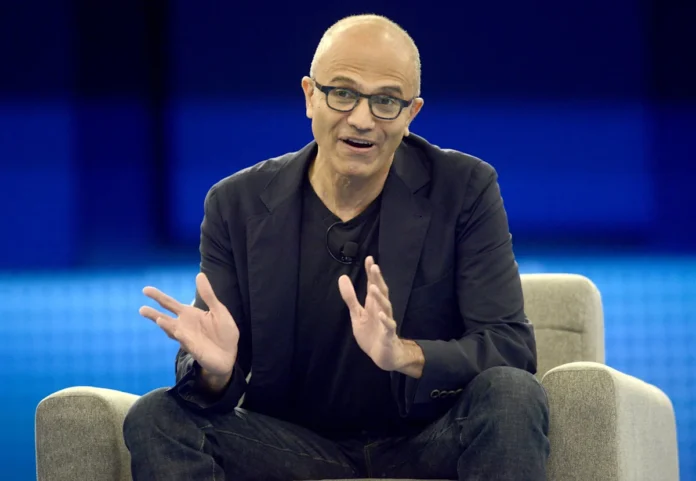
Microsoft CEO Satya Nadella’s enterprise AI warning echoes concerns raised by Palantir CEO Alex Karp. Stephen Brashear/Getty Images
Nadella’s warning strengthens Palantir’s core AI pitch
For Palantir (PLTR) stock investors, Nadella’s warning is important and may have indirectly validated the problem Karp says Palantir was built to solve.
The CEO of the controversial tech firm Karp argued that enterprises should not expose their proprietary data, workflows, and operational knowledge directly to large language models outside their organizations.
Palantir’s answer is Ontology, an application layer that connects models to company operations while controlling what models can access and retain.
Karp said Ontology makes AI “safe and useful and precise,” preventing models from caching customer data, replicating the business, or transferring sensitive intellectual property.
He went a step further in his interview with podcaster Mathias Döpfner, saying businesses need an application layer that “protects your data from being essentially abused by large language model providers.”
If customers become more wary of the data they give up, Palantir could be in line for a massive long-term windfall, but it could also create valuation risks elsewhere in the AI sector.
Palantir needs to prove Ontology can turn that strategic concern into durable contracts, expanding margins, and measurable customer returns.
It’s worth mentioning that the stock is down 27% in the past six months and more than 26% year-to-date, according to Seeking Alpha data. Still, Palantir stock is changing hands at 88 times non-GAAP forward earnings, a steep premium, to say the least, compared to the sector median of around 25 times.
Nadella’s warning raises the stakes for the AI trade
The interesting part is that the broader AI trade is already up against the uncomfortable question that Wall Street hasn’t answered: Who will earn enough money to justify the extraordinary spending?
For perspective, Amazon, Microsoft, Alphabet, and Meta are projected to spend about $630 billion on data centers and AI chips in 2026 alone, according to Reuters, more than 4 times their 2023 guidance.
However, with recent developments, it seems the chickens are finally coming home to roost as the AI trade undergoes a shakeout.
Bank of America’s latest survey found that 45% of fund managers view an AI bubble as the market’s biggest tail risk, Reuters also reported. Yet investors remain heavily committed to the chip stock trade.
Moreover, several of Wall Street’s most popular personalities have sounded alarms.
Ray Dalio says AI is “now in the early stages of a bubble,” while Jeremy Grantham warns that “sooner or later, the bubble will burst.”
“Big Short” investor Michael Burry has long been skeptical of the AI boom, calling semiconductor valuations “a pure form of overvaluation” and warning that the end may be near.
Nadella’s argument adds to those vulnerabilities.
The reverse information paradox may lead customers to redirect spending toward private, model-agnostic systems, weighing on the biggest names in AI and calling their nosebleed valuations into question.
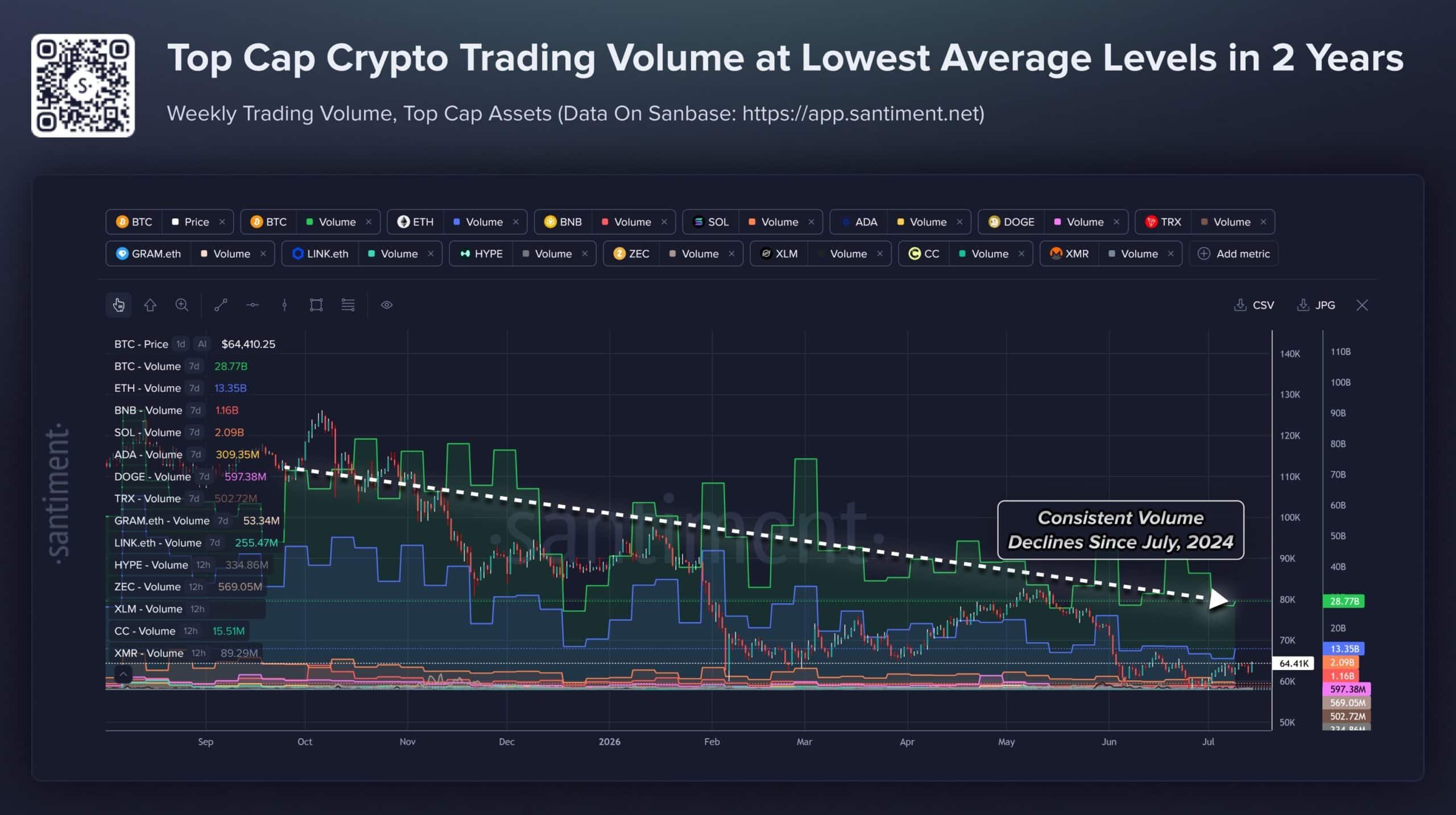
The trading volumes of the top crypto assets have been dwindling since July 2024, wrote the analytics platform Santiment in a post on X.
Source: Santiment on X
The trading activity was at its weakest average level in two years. It reflected weak demand and lower market confidence. Market participants are not rotating capital as aggressively, and each sell-off prompts more capital to flee.
Heavy macro pressure, Bitcoin [BTC] spot ETF outflows, and bearish price action since October 2025 for the leading crypto helped explain the dwindling volumes.
Thin liquidity means that reduced demand would mean rallies can be more easily faded. Yet, if seller exhaustion has reached cyclical extremes, a subsequent recovery could be quick, and even modest buying pressure could move prices quickly.
The Solana buying opportunity
Source: Ali Charts on X
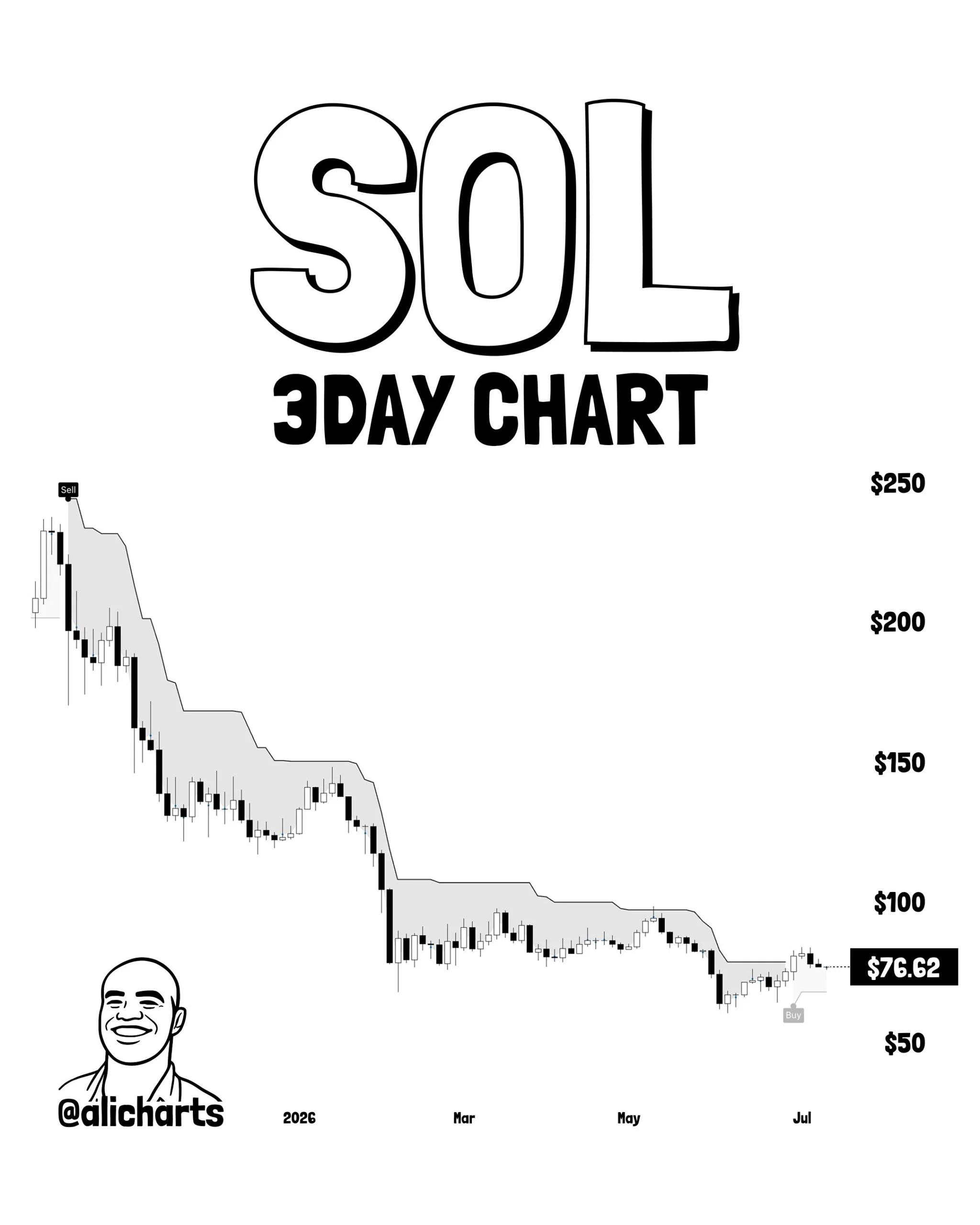
Against this backdrop of reduced volume, Solana [SOL] has turned bullish, according to crypto analyst Ali Martinez. The popular technical analyst used the SuperTrend tool on the 3-day timeframe to show that the ATR trailing stop has flipped bullishly.
This is a buy signal, and the $96 and $121 levels were the next levels to watch out for.
The Hodler Net Position Change metric on Glassnode has been positive throughout 2026. The metric tracks the monthly position change among long-term investors, and positive trends show hodlers were actively adding to their holdings.
SOL still trading within a bearish trend
Source: SOL/USDT on TradingView
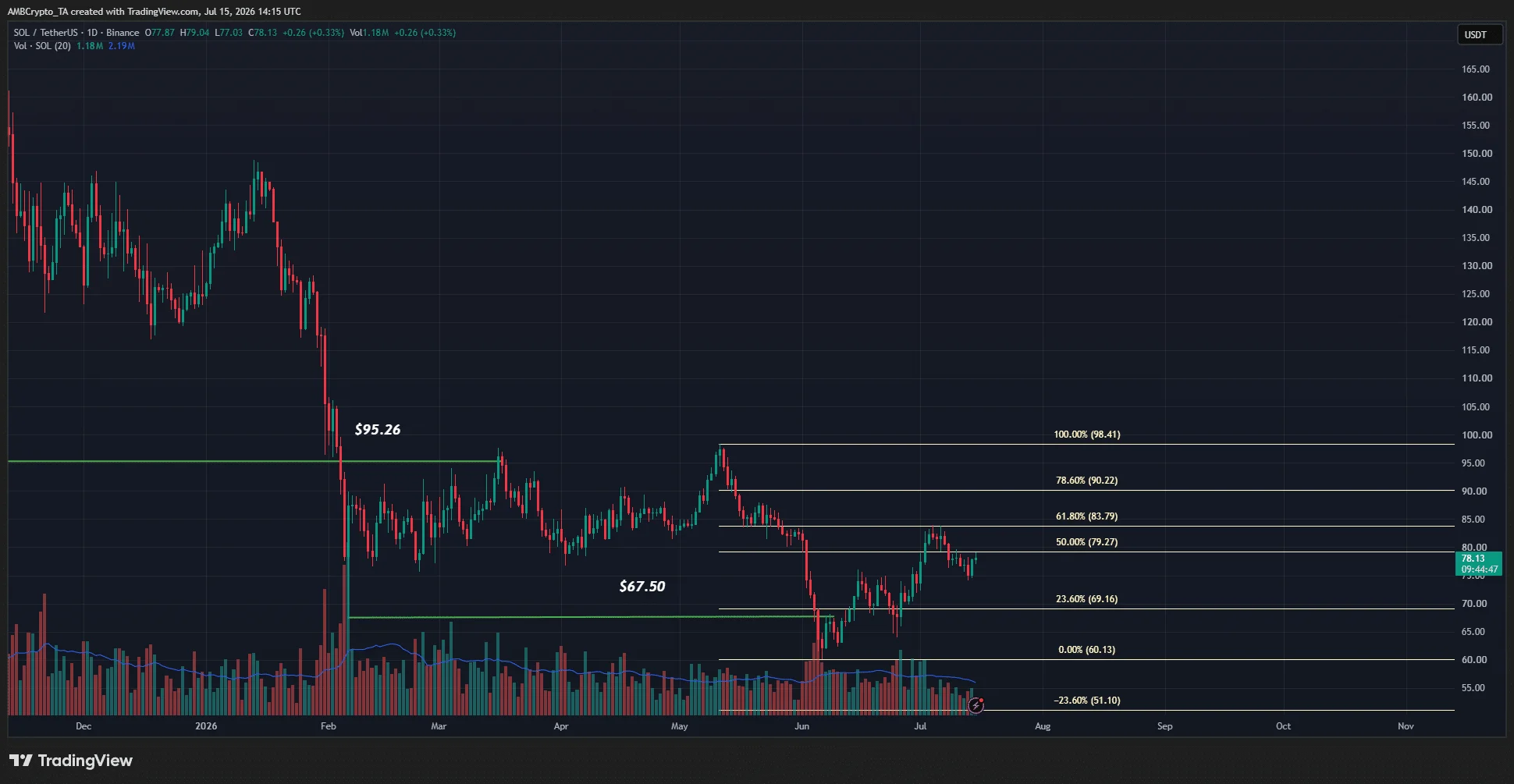
The swing lows at $95.26 and $67.50 were broken earlier this year, keeping the bearish Solana swing structure in place. Based on the drop from $98.41 to $60.13, Fibonacci retracement levels were plotted.
The $83.79 and $90.22 were the key resistance levels to watch out for. Another one was the $116 level, which was the realized price of Solana. Since the market price was well below this level, it showed that the aggregate holder base was facing unrealized losses.
This can prompt a sell-off on subsequent price bounces, making recovery harder until the wider market recovers and attracts greater capital inflows.
Recent selling pressure has also been reinforced by large token movements. A $15.14 million onchain SOL token move from Alameda Research was spotted recently, and the subsequent short-term price move resulted in just over $10 million in long liquidations.
Final Summary
The Solana buy signal in recent days and hodler accumulation trends throughout 2026 gave the altcoin a bullish tint.
Yet, the price charts and overhead supply zones meant a meaningful recovery would be difficult and requires greater capital inflows.
For the first time since at least 1974, new homes are selling for less than existing ones, and the culprit is a mix of builders getting generous and sellers refusing to budge.
In the first quarter of 2026, the median price of a new single-family home was $403,200—$1,400 below the median existing home price of $404,600, according to data sent to Fortune by the National Association of Home Builders, drawing on Census Bureau and NAR figures.
It marks the fourth consecutive quarter in which existing home prices have exceeded new home prices, a streak that began in the second quarter of 2024. Typically, new homes carry a premium over existing ones. That premium, which has averaged 16% going back to 1987, fell to -2% as of April 2026—the first time it has gone negative in data stretching back five decades, according to John Burns Research & Consulting.
But Alex Thomas, research manager on the macro team at John Burns, said it points to old fashioned supply and demand.
“There’s a lot that goes into that data point that is, like, some of it is an artifact of methodology, but there’s some truth to it as well,” he told Fortune.
New home prices are nearly $1,400 cheaper than resales.
Courtesy of John Burns Research and Consulting
A changing home build
Builders have been shrinking what they build. The median size of a new home sold has contracted to around 2,400 square feet, down from roughly 2,500 in 2022 and 2,700 in the mid-2010s. Smaller homes mean lower prices—and that alone accounts for part of the apparent discount relative to the existing home market, which skews larger. NAHB also attributed the pricing shift to builders constructing on smaller lots, shifting production toward the South, and offering incentives to move inventory—all against a backdrop of rising construction costs driven in part by tariffs on building materials that NAHB estimates have added as much as $9,200 to the average new home price.
All included in that price change is where the house is located.
“Home prices are holding much firmer in Northeast and Midwest markets that have not seen as much of an increase in supply,” Thomas said. “There just aren’t that many new homes being built in those regions, and softer pricing conditions across the Sunbelt are dragging down national median new home prices.”
The NAHB data confirms the regional divergence: New homes still carry a $309,200 premium over existing homes in the Northeast and a $66,800 premium in the Midwest. The discount flips in the West, where existing homes run $55,500 above new, and the South, where the gap is just $700.
Still, Thomas says the deals are real, and may even be larger.
“The true discount could be more substantial in certain markets, given that many builders are offering incentives beyond just price cuts, such as design credits, rate buydowns, or covered closing costs, that are not captured in Census data on median new home prices,” he said. John Burns’ survey work puts those incentives at roughly 7 to 8% of new home sale prices, a level Thomas called “pretty abnormal” relative to historical norms.
The affordability crisis has pushed builders further: Nearly 20% of new homes faced outright price cuts in the fourth quarter of 2025, according to Realtor.com. Buyers in markets with dense new construction have taken note, walking into builder offices and negotiating across competing communities.
Sellers holding onto the old for the highest dollar
The reason builders are willing to deal comes down to an asymmetry with resale sellers.
“Existing home prices are sticky on the way down,” Thomas said. “Resellers want the same prices their neighbors got a year or two ago, and are slower to adjust prices when market conditions change. Existing owners can delist and wait out the market, whereas builders have to move inventory given holding costs.”
However, he said, “I wouldn’t blame boomers specifically.”
Data, on the other hand, shows a distinct generational divide. Baby boomers now account for 42% of all buyers and a dominant 55% of all sellers, according to NAR’s 2026 generational trends report—and those who do sell are moving with equity-fueled flexibility that younger buyers simply don’t have. Meanwhile, boomers who hold low-rate mortgages or own their homes outright have little financial pressure to list.
A Redfin analysis of 2024 Census data found that empty-nest baby boomers own 28% of U.S. homes with three or more bedrooms, compared with just 16% for millennial households with children. Many can’t afford to move even if they wanted to. Meredith Whitney, the Wall Street analyst who predicted the 2008 financial crisis, has noted just one in 10 seniors can afford assisted-living facilities, leaving millions effectively trapped in homes they can no longer leave.
There’s also a rate-lock phenomenon that has effectively frozen the resale market. The average first-time homebuyer age hit a record 40 in 2025, and the share of first-time buyers fell to an all-time low of 21%, according to NAR—the lowest since the association began tracking the figure in 1981. Thomas tracks the gap between the average outstanding mortgage rate—currently around 4.3%—and prevailing market rates, now closer to 6.5%. Until those two lines converge, transaction volumes will remain depressed and the pressure on builders to discount will persist, he said.
“The takeaway is that the premium is negative for the first time ever,” Thomas said. “And I think what it’s saying is correct—there are deals right now.”
DTCC safeguards more than $114 trillion in securities, making it one of the most important pieces of financial market infrastructure. Every day, it records ownership and settles transactions involving stocks, bonds and other securities. Rather than creating new digital assets, DTCC’s system converts existing securities into blockchain-based “digital twins” that retain the same legal ownership, dividend and governance rights as the underlying assets.
That distinction separates DTCC’s approach from many tokenized stock offerings available today.
Some crypto platforms issue tokenized “wrappers” that mirror a stock’s price but do not necessarily provide investors with the legal rights associated with owning the underlying shares.
DTCC’s model instead allows institutions to convert existing securities between traditional electronic records and blockchain-based tokens without changing ownership.
“They’re the ones who are flipping from one settlement regime to the next,” Mark Wendland, CEO of Canton Strategic Holdings, said in an interview. “I cannot understate the importance of a firm like DTC piloting and doing these real transactions given the role they play in U.S. financial markets.”
Throughout the day, participants demonstrated several use cases. JPMorgan converted holdings of the Invesco QQQ Trust ETF into tokenized assets before using tokenized collateral to satisfy central counterparty margin requirements with CME Group. DTCC also processed tokenized Treasury transactions, equity trades and collateral pledges, while the SPDR S&P 500 ETF Trust, one of the world’s largest ETFs, was also tokenized during the event.
Dell’s AI server revenue surged 757% YoY to $16B while SMCI badly missed estimates, revealing opposite execution across the same AI buildout.
Dell trades at a P/E of 34 versus SMCI’s 15, with a Taiwan chip smuggling probe and $8.8B in debt pricing in serious governance risk.
Act now: the analyst who called NVIDIA in 2010 just named his top 10 AI stocks — and Dell Technologies didn’t make the cut. Grab the names FREE today.
Dell Technologies (NYSE:DELL) and Super Micro Computer (NASDAQ:SMCI) both reported earnings recently, and their results reveal two very different versions of the AI server story.
24/7 Wall St.
Dell showed disciplined scale. Supermicro showed messy growth. Comparing them right now feels essential, because they sell into the same hyperscale and enterprise buildout but with wildly different execution.
AI Servers Lift Dell. Supermicro Trips Over Its Own Story.
Dell’s Q1 FY27 was the kind of quarter you rarely see from a company this size. Revenue hit $43.84 billion, up 87.54% YoY, with AI-Optimized Servers alone contributing $16.13 billion, a 757% YoY jump. Non-GAAP EPS came in at $4.86 versus a $2.96 estimate.
Storage lagged at 8%, which is worth flagging, but ISG operating margin still expanded to 10.5%. CEO Jeff Clarke described AI deployments where a single GB200 NVL72 rack has 1.2 million parts, framing complexity as Dell’s moat.
DELL Earnings Quotes — 24/7 Wall St.
Supermicro’s Q3 FY26 told a rougher tale. Revenue reached $10.24 billion, up 122.7% YoY, yet missed the $12.45 billion estimate by 17.75%. GAAP gross margin recovered to 9.9% from 6.3%, which is progress, though the numbers remain preliminary and unaudited.
CEO Charles Liang leaned on the transformation narrative: “Supermicro’s transformation into a total datacenter infrastructure provider is accelerating.” Fine words. The $6.6 billion cash used in operations undercuts them.
Act now: the analyst who called NVIDIA in 2010 just named his top 10 AI stocks — and Dell Technologies didn’t make the cut. Grab the names FREE today.
SMCI Earnings Quotes — 24/7 Wall St.
A Full-Stack Giant vs. a Pure-Play Specialist
Lens
Dell
Supermicro
Core Bet
Full-stack integration across ISG and CSG
Fast time-to-market on NVIDIA platforms and DCBBS
FY Revenue Guide
$165B to $169B
$38.9B to $40.4B
Key Vulnerability
Gross margin compressed to 17.8% from 21.1%
Governance review, $8.8B in debt and convertibles
Dell’s AI orders reached $24.4 billion in a single quarter, and the FY27 AI server target sits near $60 billion.
Supermicro cites more than $13 billion in Blackwell Ultra orders, still meaningful, though the June 29 Taiwan raid tied to an Nvidia AI chip smuggling probe reset the risk profile. Reddit sentiment cratered to 22 to 27, deep bearish after that news.
The Next Test Is Whether Supermicro Can Convert Orders Cleanly
I will watch Dell’s storage attach rate closely, because Clarke openly admitted “we are not satisfied with the attach today.” That is where the real margin lift lives.
For Supermicro, the questions are simpler and harder: can the board close the export-control review, can DCBBS margins hold near 10%, and does the new Silicon Valley manufacturing footprint actually accelerate deliveries? Dell trades at a P/E of 34, while Supermicro sits at 15. That gap prices in the governance drag.
Where Execution Looks Cleanest This Cycle
On the data available today, Dell is executing at a different tier. The scale, the $3.118 billion in free cash flow, and Clarke’s willingness to describe operational messiness in detail suggest disciplined execution.
Supermicro’s profile is more suited to investors who accept governance risk and volatile margins, and the valuation reflects real skepticism after the stock fell 43.83% over one year. Key signposts for reassessing Supermicro would be a clean audit and steady 10%-plus gross margins. Dell also carries caveats, with insiders net sellers recently, though business quality this quarter stands out.
Act now: the analyst who called NVIDIA in 2010 just named his top 10 AI stocks — and Dell Technologies didn’t make the cut. Grab the names FREE today.
An attacker drained approximately $18 million in USDC from Ostium’s liquidity vault on Arbitrum in an oracle manipulation exploit detected by blockchain security firm Blockaid, onchain data shows.
According to Blockaid’s alert, the attacker leveraged a registered PriceUpKeep forwarder, a component of Ostium’s automated infrastructure, to submit oracle price reports with future-dated timestamps. The manipulated reports created the appearance of profitable trades, which triggered an $18 million USDC payout from the vault.
Ostium is a decentralized perpetuals exchange on Arbitrum that allows users to trade real-world assets including commodities, forex, and equity indices, with up to 200x leverage, settling in USDC.
Ostium uses a custom price-feed system to track real-world asset prices, with a third-party automation network called Gelato responsible for pushing those prices onchain at the right moments. A smart contract called PriceUpKeep sits at the center of that process, acting as the trigger that writes the latest price data to the blockchain whenever a trade needs to be executed.
A wallet labelled by blockchain analytics platform Arkham as belonging to the U.S. government has transferred approximately 54.9 billion Shiba Inu [SHIB]. The tokens are worth around $235,000. This has renewed attention on crypto assets seized during the FTX and Alameda Research investigations.
The movement was detected on-chain on July 15. While Arkham identified the SHIB as assets seized from FTX and Alameda, no U.S. government agency has publicly explained the purpose of the transfer.
Arkham flags movement from government-labelled wallet
According to Arkham, the government-linked wallet transferred 54.895 billion SHIB. This was alongside smaller token movements from an address it attributes to assets seized in connection with FTX and Alameda.
The transfer was visible on-chain, although the destination does not, in itself, establish why the assets were moved. Government-controlled wallets routinely transfer digital assets for a range of operational reasons. This includes custody management, consolidation, or future disposal.
Arkham suggested the SHIB could ultimately be used in the FTX creditor repayment process. However, no court filing, Department of Justice statement, or update from the FTX Recovery Trust had confirmed the purpose of the transfer at the time of writing.
Since the exchange’s collapse in November 2022, the estate has made multiple distributions to eligible creditor classes. Also, it has been recovering billions of dollars in assets through liquidations, settlements, and asset sales.
Bankruptcy administrators have previously said eligible creditors are expected to receive full principal repayments, with many also receiving statutory interest.
However, there is currently no indication that Wednesday’s SHIB transfer forms part of those ongoing creditor distributions.
Blockchain reveals movements, not motives
Government wallet activity frequently attracts attention because blockchain data makes transfers publicly visible in real time. However, on-chain data alone cannot explain why assets are moved.
Without supporting court documents or official statements, transfers between government-controlled wallets or custodians may reflect administrative actions rather than imminent sales or distributions.
As a result, the latest SHIB movement should be viewed as a confirmed on-chain transfer rather than evidence of a specific government action.
Final Summary
Arkham detected the transfer of approximately 54.9 billion SHIB, worth around $235,000, from a wallet it labels as belonging to the U.S. government.
Although the transfer comes as the FTX estate continues creditor repayments, no official source has connected the movement to the bankruptcy distribution process.