Home Blog Page 246

My Husband and I Decided IVF Was Our First Step, Not Our Last Resort

0
My Husband and I Decided IVF Was Our First Step, Not Our Last Resort


It was just my husband and me at our kitchen table. All of the IVF supplies were out. Somehow, there were too many instructions, but also not enough. How do we know we’re mixing the medicine correctly? What if there’s an air bubble in the needle? What if there’s a really big air bubble?

I stood there half-naked with circles drawn on my belly to mark where to inject and where not to inject. And right as I was about to give myself the shot for the first time, my husband let out a nervous laugh.

I lost it. I was overwhelmed. Not just by the task at hand, but also by what the task would ultimately, hopefully, lead to: a baby.

I never told my husband this (or anyone else for that matter), but that night, I thought: I can’t do this. I’m throwing in the towel. It’s not too late to give up on IVF.

And yet, despite my conflicted emotions, it may surprise many to learn that we chose IVF proactively, not out of necessity, but because this is how we wanted to get pregnant.

Why we chose IVF

My husband and I delayed parenthood. We were both late bloomers. We both started new careers around 30, married five years later, and then a few years after that decided to try to have a baby. But by this time, I was 38 going on 39, so we chose IVF for three reasons:

  • Delivering a healthy baby: At my age, the chances of miscarriage and genetic abnormalities increase. With IVF, PGT-A (preimplantation genetic testing for aneuploidy) can be used to screen embryos for chromosomal abnormalities before transferring to the uterus. Selecting a chromosomally normal embryo may reduce the risk of miscarriage due to chromosomal abnormalities and lower the chance of transferring an embryo with certain chromosomal conditions.
  • Time and flexibility: We may want more than one child. As we age, our eggs only continue to deteriorate in quality, but with IVF, we will always have our embryos ready to go when the time is right for us. My age essentially becomes just a number.
  • Money: Both my husband and I received fertility benefits through our employers, so the financial burden of IVF wouldn’t be as heavy as it might have been; a true privilege that helped us make our decision.


The author gets a kiss from her husband while on a path outside.

The author said she and her husband have no regrets about living life to its fullest in their early and mid 30s. 

Courtesy of Jacki Ochoa.


The right choice for our family

Don’t get me wrong. IVF is hard and expensive, and frankly, it is an emotional roller coaster. But I know in my bones that we made the right choice for our family. While my husband and I don’t have infertility diagnoses, genetic concerns, or really anything else (other than high cholesterol, oops!), because of my age, there are increased risks that keep me up at night.

With IVF, it matters less that I’m now 39 because doctors can carefully select the best, most healthy embryos.

That being said, we don’t know if our IVF journey will result in pregnancy yet. With one round of IVF, my body produced 34 eggs, resulting in 4 euploid embryos that are chromosomally normal. If the first transfer is successful, I’ll still have multiple embryos that could be used for future pregnancies, thus removing my age as a factor because they’ve already been deemed chromosomally normal and viable for pregnancy.

IVF gave us time back

My husband and I took our time starting our family, but we didn’t miss anything. We gained, we lived, we made memories together in our early and mid-thirties, and built a solid foundation for our relationship. And because of IVF, we hope to experience a healthy pregnancy and parenthood on our timeline.

They say time is our greatest, most expensive resource, and that’s exactly what IVF gave us.

This article is not a substitute for professional medical advice, diagnosis, or treatment. Always consult your qualified physician or healthcare provider.




Source link

The Clarity Act isn’t a ticket to sanctions evasion, actually

0
The Clarity Act isn't a ticket to sanctions evasion, actually

Ironically, some critics of the bill have pointed to recent reporting by the Wall Street Journal on the Hong Kong exchange CoinEx as evidence of the risk. CoinEx is actually a story of how to use a public ledger to track, trace, and disrupt nation state activity.

Investigators traced roughly 3.84 billion dollars in transactions tied to Iran, connecting wallets controlled by Iran’s central bank to sanctioned military networks and to funds stolen separately by North Korean hackers. That level of detail is knowable today because it happened on a public blockchain, the same visibility critics are treating as the risk.

What the Clarity Act actually contains

Clarity contains nearly twenty distinct provisions addressing anti-money laundering, sanctions, and law enforcement authority.

As the bill is currently drafted, digital asset service providers get brought fully under the Bank Secrecy Act for the first time, with risk assessments, internal controls, a compliance officer, training, audits, and suspicious activity reporting all required.

Real-time information sharing between exchanges and law enforcement gets written into statute as recognized practice — the Beacon Network model of real time interdiction, seizure and disruption — replacing voluntary industry coordination with a legal standard.

An independent working group gets tasked with developing AI-powered tools to detect and disrupt terrorist financing and money laundering in digital asset markets. Kiosk operators face wallet pinning, hold periods, and daily transaction caps for first-time users, paired with blockchain intelligence requirements to catch scammers before funds leave the platform.


Source link

Simon Property Group’s Quarterly Earnings Preview: What You Need to Know

0
Simon Property Group's Quarterly Earnings Preview: What You Need to Know


Businessman trading stock market on teblet screen by Nespix via iStock

With a market cap of $70.9 billion, Simon Property Group, Inc. (SPG) is a self-managed REIT that owns, develops, and operates large-scale shopping, dining, entertainment, and mixed-use destinations across North America, Asia, and Europe. Through its operating partnership and strategic stakes in companies like Taubman Realty Group and Klépierre, it manages a vast portfolio of retail properties totaling over 183 million square feet globally.

The Indianapolis, Indiana-based company is expected to release its fiscal Q2 2026 results soon. Ahead of this event, analysts project SPG to report a Real Estate FFO of $3.18 per share, a rise of 4.3% from $3.05 per share in the year-ago quarter. It holds a solid track record of consistently surpassing Wall Street’s bottom-line estimates in the last four quarterly reports.

More News from Barchart

For fiscal 2026, analysts forecast Simon Property Group to report Real Estate FFO of $13.21 per share, up 3.8% from $12.73 per share in fiscal 2025.

www.barchart.com

SPG stock has increased 35.5% over the past 52 weeks, outperforming the broader S&P 500 Index’s ($SPX) 20.8% gain and the State Street Real Estate Select Sector SPDR ETF’s (XLRE) 7.7% rise over the same time frame. 

www.barchart.com

Shares of Simon Property Group rose 2.3% following its Q1 2026 results on May 11, with net income increasing to $479.6 million ($1.48 per share) from $413.7 million ($1.27 per share) a year earlier, while Real Estate FFO climbed 7.5% year-over-year to $1.21 billion, or $3.17 per share. Investors were also encouraged by solid operating metrics, including a 6.7% rise in domestic and portfolio NOI, occupancy improving to 96%, base minimum rent per square foot increasing 5.2% to $61.99, and retailer sales per square foot surging 11.8% to $819.

The stock additionally benefited from management raising its full-year 2026 Real Estate FFO guidance to $13.10 per share – $13.25 per share.

Analysts’ consensus view on SPG stock is cautiously optimistic, with an overall “Moderate Buy” rating. Among 21 analysts covering the stock, seven suggest a “Strong Buy” and 14 recommend a “Hold.” The average analyst price target is $222.85, indicating a potential upside of 1.1% from the current levels.

On the date of publication, Sohini Mondal did not have (either directly or indirectly) positions in any of the securities mentioned in this article. All information and data in this article is solely for informational purposes. This article was originally published on Barchart.com


Source link

Analyzing Ether.fi’s slip amid $8.6B market crash: What’s next for ETHFI?

0
Analyzing Ether.fi’s slip amid $8.6B market crash: What’s next for ETHFI?


Ether.fi [ETHFI] has posted a sharp decline as capital outflows across the broader market drive much of the fall.

The asset recorded a double-digit loss in the early hours of Tuesday, extending its price to a low of $0.384 on the chart. Outflows continue to dominate, yet the market is already flashing early signs of a possible recovery and leaves room for a rally to still stretch higher.

Capital exits ETHFI’s on-chain economy

The steepest hurdle facing ETHFI’s price over the past day has been the on-chain capital exit.

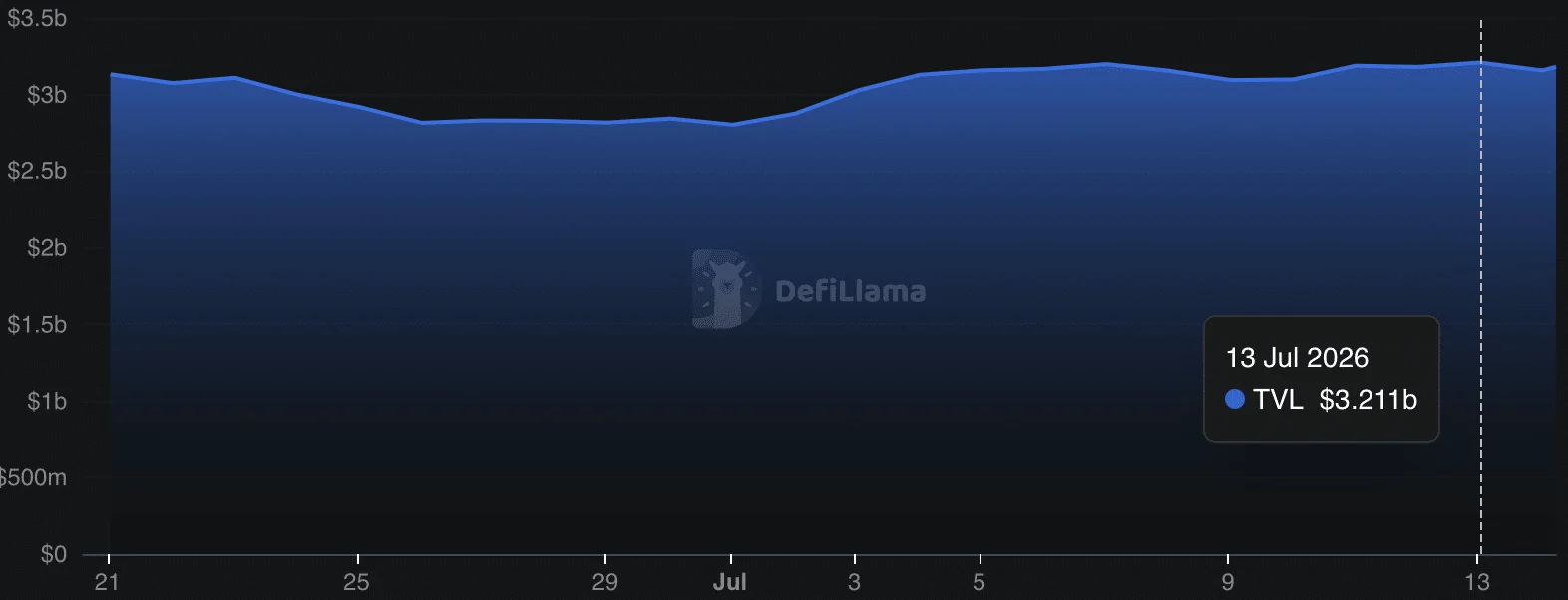
Total value locked (TVL), which gauges the strength of on-chain capital through the deposits and withdrawals moving through the protocol, shows that roughly $54 million has left the market.

The metric slid from $3.212 billion to roughly $3.153 billion, signalling that retail holders are exiting the market, likely on concerns over rising volatility.

Etherfi Total value locked.
Source: DeFiLlama

On a protocol level, the asset has held up decently, with earnings—the profit that remains once incentives are stripped out—reaching $1.34 million and already nearing half of the $2.79 million generated in June.

The pattern suggests the recent sell-off reflects a reaction to market sentiment and not a structural bearish trend. That sentiment traces back to the notable decline the crypto market absorbed over the past day, when it shed around $8.61 billion in total capitalization.

Perpetual contracts keep bears in play

The clearest gap in the market emerges from ETHFI’s perpetual contracts, which show that bears still hold some strength after an 11% decline dragged open interest to $62.26 million.

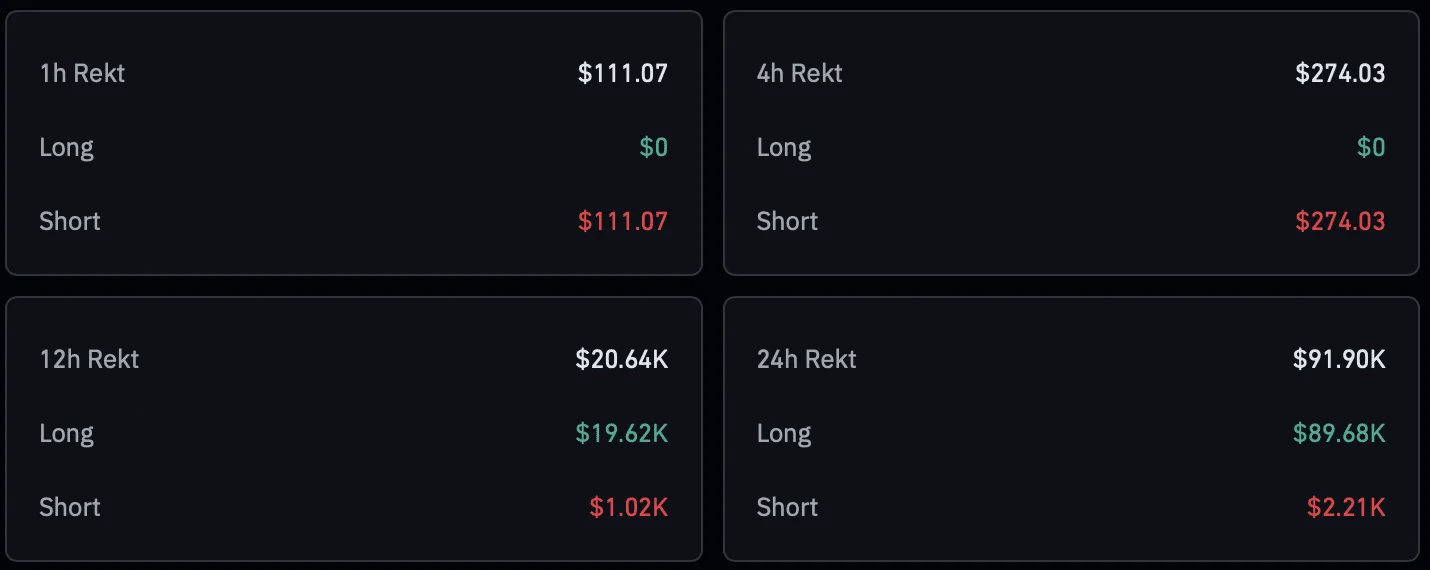
That gap stems from an imbalance in liquidations, with market data revealing a wide disparity between long and short liquidations. Over the past 24 hours, long traders have lost roughly 40 times more than short traders.

The liquidation data shows short traders lost just $2,210 against $89,680 for long traders across the same period, and the uneven spread points to the strength of the bears.

Liquidation chart. Liquidation chart.
Source: CoinGlass

On lower timeframes, the liquidation disparity widens further, though the capital lost this time around remains minimal.

The liquidation heatmap offers no clear directional bias for the asset, instead showing fairly evenly distributed clusters.

These clusters mark areas on the chart where buy or sell orders sit, and clusters resting above the price usually act as sell zones that pull the price toward them and force selling, while clusters below reverse the dynamic and force buys once the price drops into them.

For now, there’s no decisive direction, leaving momentum to dictate the next price move.

Rising long volume hints at ETHFI accumulation

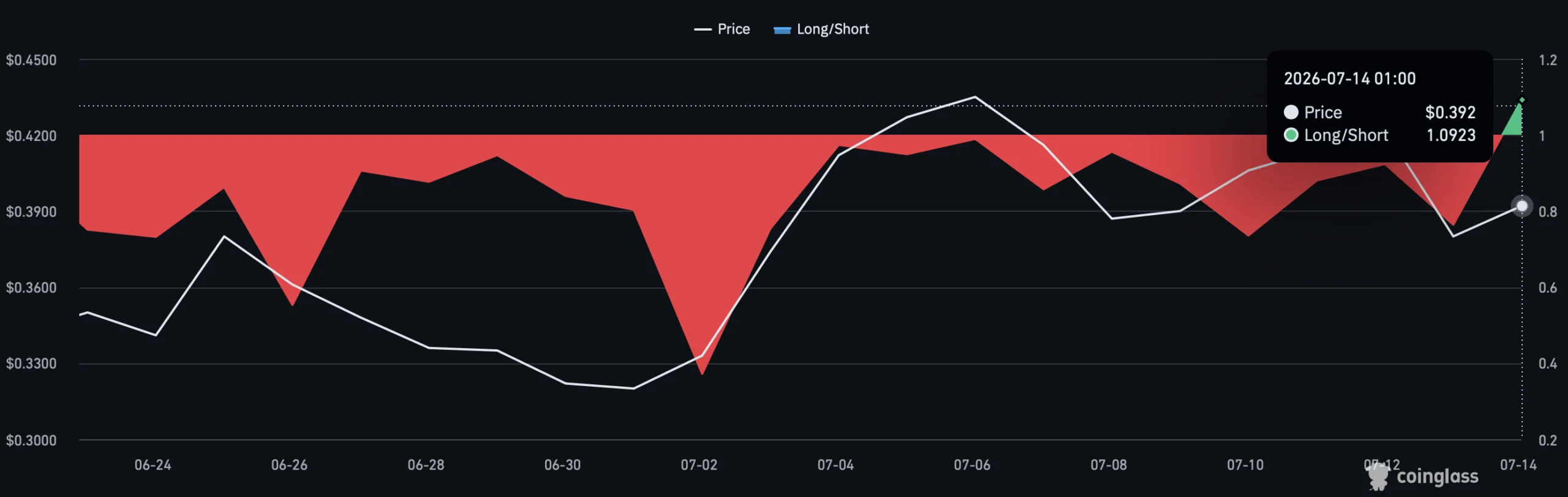
While liquidations remain skewed in favour of the shorts, activity on the long-to-short ratio points to rising accumulation.

At the time of writing, the long-to-short volume ratio on the chart shows more long volume in the market, pushing up to 1.02. A continued climb would imply that buy interest still lingers in the market.

Long to short ratio. Long to short ratio.
Source: CoinGlass

Whether that offers a sufficient basis for a shift in direction remains unclear. The broader crypto market that shaped the sell-off sentiment has begun cooling, and a strong chance remains that ETHFI benefits from the turn and recovers, flipping momentum against the sellers.


 Final Summary

  • Ether.fi’s token fell 10% after roughly $54 million left the protocol, moving in step with a broader crypto market that shed about $8.61 billion in a day.
  • Buying activity is quietly picking up and a calming market could give ETHFI room to bounce back.


Source link

Binance bets on becoming a crypto ‘super app’ as stablecoins reshape growth

0
Binance bets on becoming a crypto 'super app' as stablecoins reshape growth

Binance believes its next phase of growth will come from payments and financial services rather than cryptocurrency trading alone, as stablecoins reshape how people use digital assets, according to Shunyet Jan, the exchange’s head of spot trading and derivatives business.

In an interview with CoinDesk on Binance’s ninth anniversary, Jan outlined the strategy as Binance and shared a glimpse of the platform’s future priorities.

“We’re trying to not just be a crypto exchange, but be a super app that involves payment,” Jan said. “If you think of us as a payment provider, then that number becomes much bigger.”

Jan said Binance’s new strategy reflects how people are increasingly using cryptocurrencies beyond trading. While trading remains at the core of Binance’s business, he said stablecoins are increasingly being used for payments and transfers, creating a larger market than trading alone.

“I don’t think it’s really leveled off,” Jan said. “What’s happened is that a lot of it is driven by stablecoin usage.”


Source link

Axon Enterprise’s Quarterly Earnings Preview: What You Need to Know

0
Axon Enterprise's Quarterly Earnings Preview: What You Need to Know


Person holding cellphone with webpage of US security equipment company Axon Enterprise Inc_ on screen with logo By Timon

With a market cap of $45.6 billion, Axon Enterprise, Inc. (AXON) is a global public safety technology company dedicated to protecting more lives through connected hardware, software, and AI-powered solutions. It serves law enforcement, public safety agencies, enterprises, and governments with an integrated ecosystem designed to improve safety and operational effectiveness.

The Scottsdale, Arizona-based company is expected to release its fiscal Q2 2026 results soon. Ahead of this event, analysts project AXON to report an EPS of $0.30, a 64.7% decline from $0.85 in the year-ago quarter. The company has exceeded Wall Street’s bottom-line estimates in three of the last four quarters while missing on another occasion. 

More News from Barchart

For fiscal 2026, analysts forecast Axon Enterprise to post EPS of $1.63, up 30.4% from $1.25 in fiscal 2025. Moreover, EPS is projected to surge 155.8% year-over-year to $4.17 in fiscal 2027.

www.barchart.com

AXON stock has decreased 22.5% over the past 52 weeks, lagging behind the broader S&P 500 Index’s ($SPX) 20.8% return and the State Street Industrial Select Sector SPDR ETF’s (XLI) 20.9% gain over the same period. 

www.barchart.com

Shares of Axon Enterprise climbed 10.6% following its Q1 2026 results on May 6 as the company reported record quarterly revenue of $807 million, up 34% year-over-year, marking its ninth consecutive quarter of 30%+ growth, driven by strong demand for TASER 10, Axon Body 4, AI products, and counter-drone solutions. Investors were encouraged by Software & Services revenue rising 35% to $355 million, AI-related product revenue surging more than 700% year over year, counter-drone revenue jumping over 300%, and annual recurring revenue reaching $1.5 billion, up 35%, highlighting accelerating adoption across Axon’s ecosystem. 

The rally was further supported by Axon raising its full-year 2026 revenue growth outlook to 30% – 32%, while maintaining a strong 25.5% adjusted EBITDA margin forecast and reporting net income of $169 million with adjusted EBITDA of $202 million.

Analysts’ consensus view on AXON stock is bullish, with an overall “Strong Buy” rating. Among 20 analysts covering the stock, 15 suggest a “Strong Buy,” four give a “Moderate Buy,” and one provides a “Hold” rating. The average analyst price target is $677.63, suggesting a potential upside of 20.3% from current levels. 

On the date of publication, Sohini Mondal did not have (either directly or indirectly) positions in any of the securities mentioned in this article. All information and data in this article is solely for informational purposes. This article was originally published on Barchart.com


Source link

The St. Louis Cardinals Are Now Slugger Jordan Walker’s Team

0
The St. Louis Cardinals Are Now Slugger Jordan Walker’s Team


On the last swing of the night, St. Louis Cardinals outfielder Jordan Walker won the T Mobile Home Run Derby.

In a thrilling finish to the event, Walker blasted his 12th home run, which was one more than Philadelphia Phillies hometown favorite, Kyle Schwarber.

With that last swing of his powerful bat, Walker took home the $1million prize.

But Walker walked away from Citizens Bank Park in Philadelphia with more than a hefty paycheck, and a Home Run Derby Championship.

In sport team circles, it is often common to label a specific player as “this is (fill in the name, such as LeBron James’) team.

The St. Louis Cardinals are now “Jordan Walker’s team.”

Walker has now become the undisputed leader of the St. Louis Cardinals.

Walker is “the man” in St. Louis.

It hasn’t always been smooth sailing for Walker in his St. Louis tenure.

All About St. Louis Cardinals Slugger Jordan Walker:

Jordan Walker is tall and muscular, at 5-5, 250 pounds.

His long arms and legs are focal points of power in his frame.

Walker was a 1st round selection of the St. Louis Cardinals in the 2020 Major League Baseball draft.

Walker was drafted as a third baseman, but the Cardinals converted him to the outfield in 2022.

He was chosen out of Decatur High School, in Decatur Georgia.

As the No. 21 player taken in the draft, the Cardinals gave Walker a hefty $2.9million contract.

The Cardinals kept Walker away from his Duke University commitment.

At the time he was drafted, Baseball America ranked him the No. 6 Cardinals prospect.

At the time he was drafted, Baseball America pointed out that many scouts thought Walker would be a “fringe” type player, hovering on the margins of a big league club.

Scouts felt his swing was too long, and he would never develop the type of power his frame dictated.

Walker spent five season in the Cardinals player development minor league program.

In 1,474 plate appearances, Walker hit .286/.364/.481/.845, with 48 home runs, and 178 RBIs. He struck out 326 times, while earning 144 walks.

His minor league career was pretty successful.

Walker made his major league debut March 30, 2023, when he was just 20-years-old.

His career got off to a fine start, as he hit. 276, with 16 homers and 51 RBIs in 465 plate appearances in his rookie year.

Walker really struggled in his 2nd year on the Cardinals. As sports.yahoo.com indicated, “Walker’s transition to the major leagues was anything but smooth. His offensive production fell sharply in 2024, leading to two separate demotions by the Cardinals.” In fact, he hit .201 in 2024, then .215 in 2025.

As sports.yahoo.com also stated, “Walker had burst onto the scene as a rookie, but then his swing mechanics let him down. He couldn’t stop hitting the ball on the ground.”

Walker has smoothed out some wrinkles and issues with his swing mechanics, resulting in a complete Walker renaissance in his 2026 season.

Now a National League All Star, Walker enters the second half of the season with 22 home runs, and his 74 RBIs lead all of Major League Baseball.

Walker has also stolen 13 bases in 18 attempts for St. Louis.

The St. Louis Cardinals Lineup:

As the second MLB half begins, the Cardinals have a 50-45 record. They sit behind the Brewers and Cubs in the National League Central Division.

The Cardinals have played competitive baseball. And Jordan Walker is the focal point of their lineup.

Just recently, the St. Louis Cardinals were having declining attendance issues. At the All Star break this year, they have drawn 1,435,588 fans.

The Cardinals do feature an exciting rookie second baseman in JJ Wetherholt.

Alec Burleson is a very credible left-handed hitter.

But, Walker is “the man.”

Here is the current Cardinals lineup against left-handed pitchers:

JJ Wetherholt-2B

Ivan Herrera-C

Alex Burleson-1B

Jordan Walker-RF

Lars Nootbaar-LF

Masyn Winn-SS

Bryan Torres-DH

Jose Fermin-3B

Nathan Church-CF

The Cardinals don’t feature Stan Musial, Lou Brock, Albert Pujols Ozzie Smith, or Ken Boyer type team leaders.

But…

Enter St. Louis Cardinals Jordan Walker.

Walker’s performance in the T Mobile Home Run Derby has called attention to both Walker’s capabilities, and the fact that Walker can potentially lead the Cardinals to a playoff berth.

The night of July 14, 2026 may have changed the Cardinals momentum for the season.

The night of July 14, 2026 certainly changed the life and reputation of Jordan Walker.

With Walker’s father, mother, and grandmother cheering him on from the Citizens Bank Park stands in Philadelphia, Jordan Walker became the centerpiece of the 2026 edition of the St. Louis Cardinals.

The St. Louis Cardinals are now Jordan Walker’s team.


Source link