Home Blog Page 247

The St. Louis Cardinals Are Now Slugger Jordan Walker’s Team

0
The St. Louis Cardinals Are Now Slugger Jordan Walker’s Team


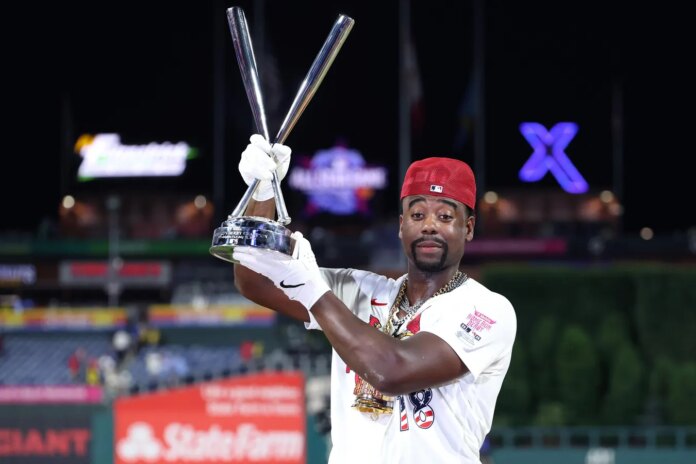
On the last swing of the night, St. Louis Cardinals outfielder Jordan Walker won the T Mobile Home Run Derby.

In a thrilling finish to the event, Walker blasted his 12th home run, which was one more than Philadelphia Phillies hometown favorite, Kyle Schwarber.

With that last swing of his powerful bat, Walker took home the $1million prize.

But Walker walked away from Citizens Bank Park in Philadelphia with more than a hefty paycheck, and a Home Run Derby Championship.

In sport team circles, it is often common to label a specific player as “this is (fill in the name, such as LeBron James’) team.

The St. Louis Cardinals are now “Jordan Walker’s team.”

Walker has now become the undisputed leader of the St. Louis Cardinals.

Walker is “the man” in St. Louis.

It hasn’t always been smooth sailing for Walker in his St. Louis tenure.

All About St. Louis Cardinals Slugger Jordan Walker:

Jordan Walker is tall and muscular, at 5-5, 250 pounds.

His long arms and legs are focal points of power in his frame.

Walker was a 1st round selection of the St. Louis Cardinals in the 2020 Major League Baseball draft.

Walker was drafted as a third baseman, but the Cardinals converted him to the outfield in 2022.

He was chosen out of Decatur High School, in Decatur Georgia.

As the No. 21 player taken in the draft, the Cardinals gave Walker a hefty $2.9million contract.

The Cardinals kept Walker away from his Duke University commitment.

At the time he was drafted, Baseball America ranked him the No. 6 Cardinals prospect.

At the time he was drafted, Baseball America pointed out that many scouts thought Walker would be a “fringe” type player, hovering on the margins of a big league club.

Scouts felt his swing was too long, and he would never develop the type of power his frame dictated.

Walker spent five season in the Cardinals player development minor league program.

In 1,474 plate appearances, Walker hit .286/.364/.481/.845, with 48 home runs, and 178 RBIs. He struck out 326 times, while earning 144 walks.

His minor league career was pretty successful.

Walker made his major league debut March 30, 2023, when he was just 20-years-old.

His career got off to a fine start, as he hit. 276, with 16 homers and 51 RBIs in 465 plate appearances in his rookie year.

Walker really struggled in his 2nd year on the Cardinals. As sports.yahoo.com indicated, “Walker’s transition to the major leagues was anything but smooth. His offensive production fell sharply in 2024, leading to two separate demotions by the Cardinals.” In fact, he hit .201 in 2024, then .215 in 2025.

As sports.yahoo.com also stated, “Walker had burst onto the scene as a rookie, but then his swing mechanics let him down. He couldn’t stop hitting the ball on the ground.”

Walker has smoothed out some wrinkles and issues with his swing mechanics, resulting in a complete Walker renaissance in his 2026 season.

Now a National League All Star, Walker enters the second half of the season with 22 home runs, and his 74 RBIs lead all of Major League Baseball.

Walker has also stolen 13 bases in 18 attempts for St. Louis.

The St. Louis Cardinals Lineup:

As the second MLB half begins, the Cardinals have a 50-45 record. They sit behind the Brewers and Cubs in the National League Central Division.

The Cardinals have played competitive baseball. And Jordan Walker is the focal point of their lineup.

Just recently, the St. Louis Cardinals were having declining attendance issues. At the All Star break this year, they have drawn 1,435,588 fans.

The Cardinals do feature an exciting rookie second baseman in JJ Wetherholt.

Alec Burleson is a very credible left-handed hitter.

But, Walker is “the man.”

Here is the current Cardinals lineup against left-handed pitchers:

JJ Wetherholt-2B

Ivan Herrera-C

Alex Burleson-1B

Jordan Walker-RF

Lars Nootbaar-LF

Masyn Winn-SS

Bryan Torres-DH

Jose Fermin-3B

Nathan Church-CF

The Cardinals don’t feature Stan Musial, Lou Brock, Albert Pujols Ozzie Smith, or Ken Boyer type team leaders.

But…

Enter St. Louis Cardinals Jordan Walker.

Walker’s performance in the T Mobile Home Run Derby has called attention to both Walker’s capabilities, and the fact that Walker can potentially lead the Cardinals to a playoff berth.

The night of July 14, 2026 may have changed the Cardinals momentum for the season.

The night of July 14, 2026 certainly changed the life and reputation of Jordan Walker.

With Walker’s father, mother, and grandmother cheering him on from the Citizens Bank Park stands in Philadelphia, Jordan Walker became the centerpiece of the 2026 edition of the St. Louis Cardinals.

The St. Louis Cardinals are now Jordan Walker’s team.


Source link

U.S. CFTC moves to stop Kalshi from canceling trades as ordered by Michigan court

0
U.S. CFTC moves to stop Kalshi from canceling trades as ordered by Michigan court

The U.S. Commodity Futures Trading Commission threw itself in between Michigan courts and prediction market firm Kalshi on Tuesday, issuing an order to disallow the company from meeting a local court demand that it cancel previous customer transactions.

The CFTC move amplifies its legal fight with state governments and courts over what its chairman argues is its unbreakable and exclusive regulatory authority over trading at Kalshi, which it regulates as a designated contract market (DCM).

“The commission will not allow states or state courts to bully registered entities into violating the Commodity Exchange Act and CFTC regulations,” said CFTC Chairman Mike Selig in a statement alongside his agency’s order. Selig has embraced prediction markets and promised to institute friendly regulations, and he’s also vigorously defended his agency’s authority to regulate them in a way that negates state powers.

The CFTC has sued a number of states that have sought to halt or penalize event contract businesses as illegal gambling. The agency noted Tuesday that Michigan is the first state to attempt to interfere in transaction activity directly.


Source link

Bolivia includes USDT in payment systems – Tether CEO hails ‘cornerstone’

0
Bolivia includes USDT in payment systems - Tether CEO hails 'cornerstone'


The Bolivian government is mulling formally recognizing Tether’s USDT as part of the currencies in its payment network. If it goes ahead with the plan, that would be a massive U-turn from its strict ban against currencies not issued by the Central Bank of Bolivia, including stablecoins. 

In 2020, Bolivia reinforced the ban, only to ease the restriction in mid-2024 to ease remittances and a US dollar shortage. 

Now, the country plans to move from easing the restriction to formally integrating USDT into its payment system. Commenting on the same, José Gabriel Espinoza, the Minister of Economy and Public Finance, said,  

We are working on and technically evaluating the possibility of including USDT in the Bolivian payment system, so that it circulates as just another currency, like the dollar, like the Bolivian boliviano.

USDT adoption in LATAM

The shift follows President Rodrigo Paz Pereira’s inauguration in 2025. Like the President Donald Trump administration, the Paz government vowed to integrate digital assets into the traditional banking system. 

In fact, most businesses around Bolivia already use USDT as a unit of account, and several Bolivian banks are now supporting the stablecoin. Reacting to the update, Tether CEO Paolo Ardoino said, 

USDT is more and more used as a cornerstone within several emerging market economies.

Most of the stablecoin adoption in Latin America is driven by remittance, shortage of foreign exchange, or inflation, according to Rain, one of the payment infrastructure players in the region. 

For the Bolivian case,  stablecoin card spending exploded 6x in 2025 after the ban was lifted in 2024. Most of the transfers are meant for international payments for goods and services due to the shortage of US dollars.

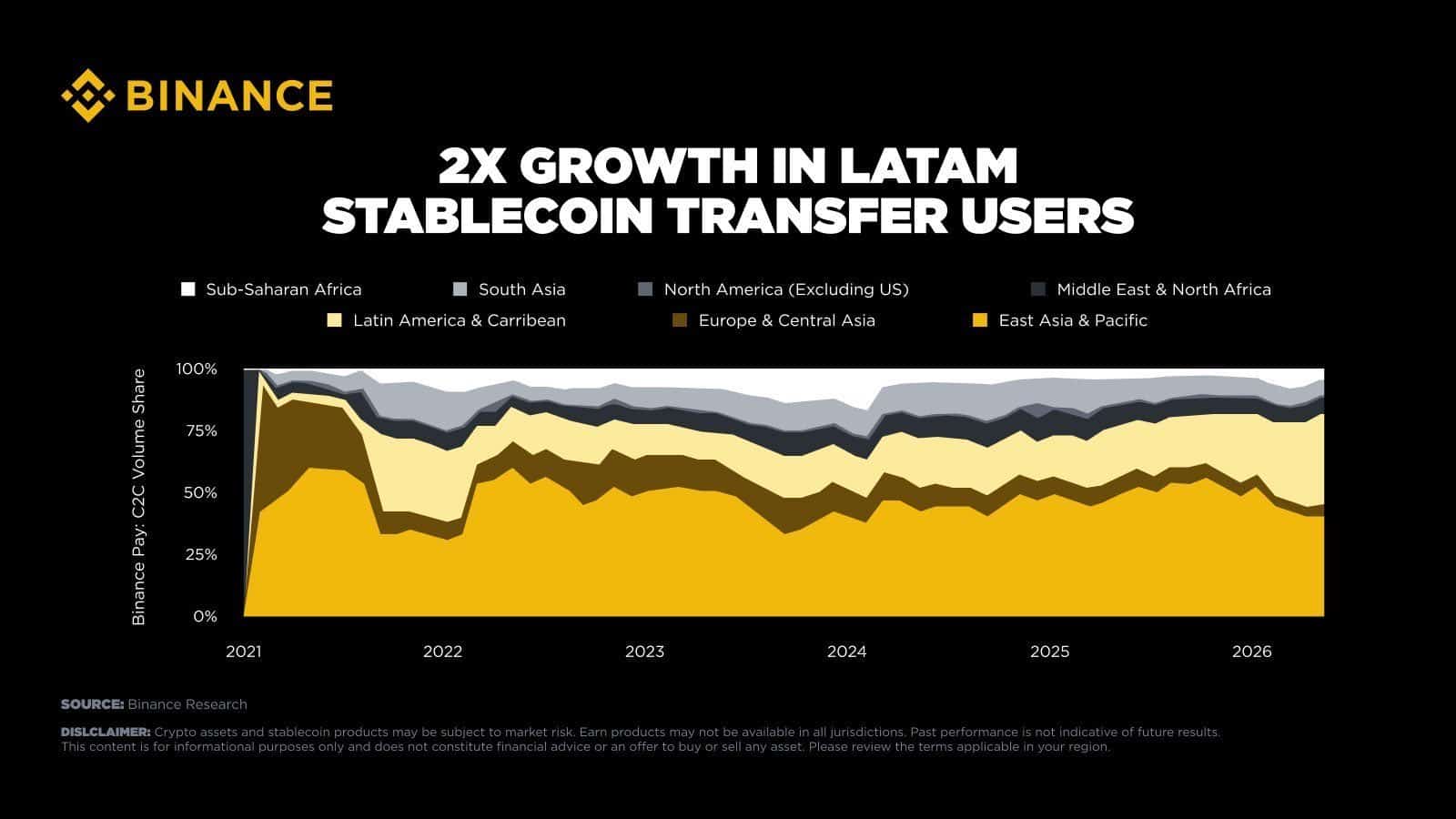
A similar adoption trend was noted by Binance across LATAM. Notably, stablecoin transfer users grew 2x, with Binance co-founder Yi He calling the region the ‘crypto’s strongest utility markets.’

Bolivia USDT
Source: Binance Research 

But the adoption is not only happening at the government level; global businesses like Hyundai are increasingly embracing stablecoins as well. 

This has seen stablecoin transaction volume hit a record $1.78T in June, but USDT only accounted for 36% market share. Circle’s USDC dominated with +60% market share. 

That said, USDT hit a new milestone of $190B in market supply in May. But this has since dropped to $184B, underscoring $6B in capital outflows in the past few weeks. This suggested broader risk-off sentiment in the crypto market, but real-world usage was still strong. 


Final Summary

  • Bolivia is considering formally recognizing USDT in its national payment system. 
  • Despite the growing adoption and usage, the USDT supply has dropped by $6B amid a broader crypto downturn. 


Source link

Target’s problems aren’t what you think they are

0
Target's problems aren't what you think they are


When Target CEO Michael Fiddelke took over the struggling company in February, he faced a daunting task. Not only did he have to reverse a sales slide, but the new boss also had to change how consumers saw the brand.

Conservative shoppers viewed the brand as “woke” because of its DEI policies, bathroom rules, and Pride merchandise. Liberal shoppers watched Target abandon some of those things, leaving the company to anger customers on both ends of the political spectrum.

That wasn’t the chain’s biggest problem, according to GlobalData Managing Director Neil Saunders. He believes Target’s lackluster sales had more to do with failing on execution than being caught up in cultural issues like DEI.

“As important as that matter is, and as much as it does have some impact, it has never been the main issue,” Saunders wrote, according to the Associated Press.

Sujeet Naik, an analyst at Coresight, did an interview with TheStreet looking at the changes Target has made and where the company stands now. 

Target needed to make changes

TheStreet: Was Target really struggling as badly as it was portrayed?

Sujeet Naik: I would say no. Headlines were exaggerated, but Target is not facing any existential crisis. It just lost momentum over the past few years while Walmart and Amazon kept widening their advantages.

Sales slowed, traffic weakened, shoppers questioned its value proposition, and the company became caught up in political debates that distracted from the business. At the same time, execution slipped as many customers increasingly complained about out-of-stocks, messy stores and inconsistent shopping experiences.

The encouraging part is that consumers haven’t abandoned Target. In our Back-to-School survey, it remains the second most popular destination after Walmart, narrowly ahead of Amazon.

That tells me the brand still has meaningful equity. The challenge isn’t getting consumers to know Target, but it is giving them a compelling reason to choose it more often.

TheStreet: Will the chain be able to reset as a non-political brand, and is that even the right choice?

Naik: I am not convinced this is fundamentally a political story anymore. Politics certainly
damaged Target because it upset consumers on multiple sides, but I don’t think
shoppers wake up asking whether Target is political.

They ask whether it offers good prices, whether the shelves are stocked, and whether shopping there feels easy. The bigger issue is that Target lost clarity around what made it different.

Walmart owns value. Amazon owns convenience. For years, Target owned affordable style
and discovery, better known as the “Tarzhay” experience. That positioning became blurred. The retailer now needs to rebuild a clear retail identity rather than simply trying to become less political.

TheStreet: What does the back-to-school season mean for the chain?

Naik: Back-to-school is one of the most important moments of the year for Target because
it combines almost everything the company does well: apparel, school supplies, accessories, home, beauty, and convenience.

This year’s back-to-school season is especially important because consumers are cautious, but they are still spending. Our research estimates U.S. back-to-school spending will reach $36.1 billion in 2026, up 5.9% year over year.

More Target:

However, shoppers are becoming much more deliberate about where they spend. That plays into Target’s strengths. More than four in five BTS shoppers plan to shop in-store, which highlights the importance of physical stores for discovery, immediate needs and seeing products before buying. 

Target also benefits because back-to-school is a category where Amazon is not automatically the winner. Back-to-school is more store-driven. Parents often need to check sizes, match school lists, and make last-minute purchases, things that favor Walmart and Target stores.

TheStreet: Has the new CEO made an impact?

Naik: It’s still early, so I would separate direction from results. Michael Fiddelke has been saying the right things. He’s acknowledged that Target lost shoppers’ trust, and his priorities on better merchandising, cleaner stores, improved execution, and investing in the shopping experience address many of the company’s actual weaknesses.

First quarter 2026 sales and traffic have been strong, but I don’t think we have yet seen enough evidence to say the turnaround has been achieved.

The real test starts now. Back-to-school is the first major opportunity for Target to show that stores are easier to shop, products are consistently available, and the company has rediscovered what made customers choose Target over Walmart or Amazon in the first place.

If those improvements show up consistently during back-to-school and continue into the holiday season, then we will be able to say the new leadership is making a meaningful difference. Right now, I would describe the turnaround as promising, but still very much in the execution stage.

Target has returned to sales growth. Schwemmer/Shutterstock

Target had a strong first quarter

First-quarter financial results were stronger than expected, providing encouraging early signs that our clarified strategy is resonating with our guests and driving broad-based growth across our business,” said Fiddelke in the Q1 earnings release.

  • First-quarter net sales grew 6.7% over last year.

  • Comparable traffic grew 4.4% compared with Q1 2025. 

  • Net sales in all six core merchandising categories were higher than a year ago.

  • Digital comparable sales grew 8.9%, led by more than 27% growth in same-day delivery.

The CEO made it clear during the chain’s Q1 earnings call that he’s happy with the results, but not satisfied.

“… A single good quarter has never been our goal,” Fiddelke said. “Our goal is consistent long-term growth. So while we’re very encouraged by our Q1 results, what you’ll hear from me and the team today is our focus on continuing the work to reach our full potential as a company.”

Target needed a reset

As a frequent Target shopper with more than 30 years experience in covering retail, I never really believed that the woke controversies were the biggest issue facing the brand. Instead, I strongly felt the retailer had let its merchandise go a little stale, while delivering a less-than-friendly in-store experience with long checkout waits.

That’s something I discussed with RTM Nexus CEO Dominick Miserandino.

“You are spot on about the culture wars with Starbucks and Target being similar. In fact, having been running online media companies and social media for 30 years, there are countless places which reflect the fickleness of the public,” he wrote.

Those controversies, he noted, were not what was causing Target’s sales struggles.

“People have a culture wars type moment and that changes quickly. Besides Starbucks, one can think of dozens of examples where we had this social media outrage and then the public gets over it pretty quickly,” he added.

Target, Miserandino shared, has been correcting its core operational problems.

“But more importantly, the 2026 numbers are showing this growth turnaround,” he shared.

Saunders thinks that Target has made progress, but that work remains.

“I do not, for one moment, believe that everything has been fixed at Target. And, to be fair, nor does Target’s management. But there has been a change in tone and focus, and there is a determination to get to grips with the issues,” he wrote on his Linkedin page.

He cited a number of meaningful changes the company has made.

Target is now showing up better, albeit in a patchy way, Saunders noted. But initiatives like a focus on trading cards and collectibles, showcasing food better, injecting more fashion in the shape of edited capsules, and so forth, all helped to drive custom and spend.

Related: 40-year-old furniture chain shutting down for good

This story was originally published by TheStreet on Jul 13, 2026, where it first appeared in the Retail section. Add TheStreet as a Preferred Source by clicking here.


Source link

Some U.S. Senate Democrats come out against Clarity Act, calling it a ‘corrupt’ bill

0
Some U.S. Senate Democrats come out against Clarity Act, calling it a 'corrupt' bill

The Clarity Act will need to be sold to a large number of Democrats in the coming days, if it’s going to advance from the Senate before Congress’ summer break and the focus on this fall’s midterm elections. Though a new and potentially final draft is set to emerge as soon as Tuesday, it’s still absent a resolution on what may be the last and most important sticking point: a section that bans senior government officials — including the president — from personally engaging in the crypto industry.

That ethics provision remains at the forefront of the debate, and many Democrats have said they can’t vote for a Clarity Act that doesn’t have it. Those vows also came from the Democrats who have been at the negotiating table and voted yes on the bill when it was approved by the Senate Banking Committee.

“If this system does not stop Trump’s corruption of the entire industry, this bill is worthless,” said Murphy, who hasn’t been among Democrats at the negotiating table with Republicans. “If it protects Trump’s dominance over an industry that he will have more control to regulate, in fact, the bill is, in and of itself, a fundamental corruption if it gives Trump’s corruption the protection of law.”


Source link

BMW’s U.S. business is delivering when it matters most

0
BMW's U.S. business is delivering when it matters most


BMW solidified its position as the top-selling luxury automaker in the U.S. with strong second-quarter sales, a result that comes as many rivals experienced declines.

The timing of BMW’s impressive quarter is important. One of the brand’s largest markets, China, has gone in the opposite direction in 2026, forcing BMW (BMWYY) to revise its outlook for the year. 

While U.S. demand can’t fully offset the China slowdown, the growth in U.S. sales gives BMW a resilient and profitable market it can rely on. It’s also a source of stability at a time when rivals like Mercedes-Benz, Lexus, and Audi have seen sales slide.

America keeps BMW’s momentum alive

Excluding the smaller Mini brand, BMW sold 102,713 vehicles in the U.S. in Q2, a healthy year-over-year increase of 13%. First-half sales reached 186,944 units, up by 4.7%.

103,257 of those models were larger, more expensive SUVs.

These are some of the brand’s most profitable models, led by the X5, with 41,554 sales in the first half. BMW will launch an all-new X5 soon, giving the company the chance to strengthen one of its core nameplates.

SUVs aside, BMW also saw strong first-half gains for the 3 Series (+32.3%) and Z4 (+47.8%), demonstrating the sustained interest in the manufacturer’s overall lineup.

More Automotive:

BMW didn’t merely grow — it has also pulled further ahead of rivals. Audi’s first-half sales dropped by 17% and Lexus saw a 5.2% drop, reports Automotive News.

“Our second-quarter results reflect the confidence customers continue to place in the BMW brand and validate our long-term strategy for the U.S. market,” said BMW of North America CEO Sebastian Mackensen.

Just as demand wanes elsewhere, BMW’s U.S. performance has maintained its momentum.

BMW saw strong first-half gains for the 3 Series and Z4.BMW

China slowdown magnifies importance of other markets

Combined Mini and BMW sales fell to 117,815 units in the China sales region in Q2 2026, a decline of 30.2%. Year-to-date sales in the region are down by 20.4%, by far the largest decline for the automaker. 

The only other region that declined in the first half was Asia-Pacific, Eastern Europe, Middle East, and Africa, down by 9.6% combined. Every other region experienced growth in 2026.

Related: BMW’s biggest market is becoming its biggest headache

Due in part to the impact of China, historically a key profit driver for the brand, BMW revised its guidance for the 2026 financial year. Its automotive EBIT margin guidance was cut to between 1% and 3%, down from 4% to 6% previously.

BMW also anticipates a significant group profit decline, which the company defines as a figure above 15%, reports Reuters.

The widening gap in BMW’s performance in China and the U.S. will become a focus of its strategy moving forward. Presently, BMW is depending on the U.S. to cushion the slump in China sales and profits.

BMW’s U.S. strength has limits

BMW’s U.S. business is in a healthy position and performing as well as management could hope.

As a whole, its lineup is performing well, with most models increasing their sales in 2026. Its product mix is strong and demand for both newer and older models appears consistent. The carmaker’s high-margin SUVs like the X5 and X6 are performing well in 2026.

However, the U.S. market’s growth can’t fully account for the losses in China. As Autoblog reports, BMW is also about to launch the Neue Klasse generation of vehicles in the U.S., and their success can’t be guaranteed.

Relying too heavily on one or two markets could leave the automaker vulnerable to regional economic slowdowns and unpredictable shifts in demand.

As the China market becomes less reliable, BMW could become increasingly dependent on other markets like the United States. Together with Europe, America may play a growing role in protecting the brand’s earnings.

Related: America’s car affordability crisis is getting worse

This story was originally published by TheStreet on Jul 14, 2026, where it first appeared in the Automotive section. Add TheStreet as a Preferred Source by clicking here.


Source link

Cardano whales tighten supply – Is $0.20 back in sight for ADA?

0
Cardano whales tighten supply - Is $0.20 back in sight for ADA?


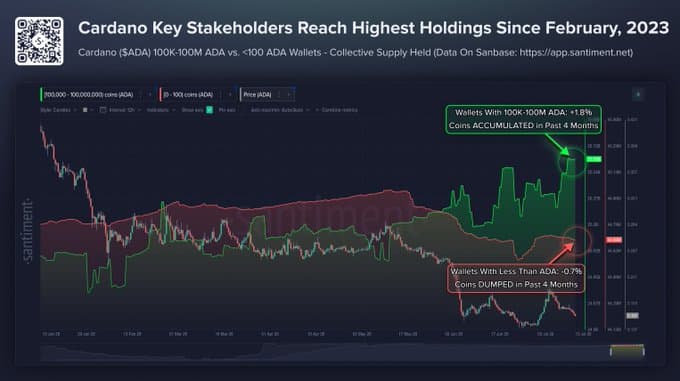
Cardano’s [ADA] largest investors continued accumulating despite weak retail participation, pushing supply concentration to its highest level in years. Wallets holding between 100,000 and 100 million ADA increased their combined balance to more than 25.6 billion ADA, marking the highest level since February 2023. 

Retail participants moved in the opposite direction, with wallets holding fewer than 100 ADA owning 0.7% fewer coins than they had four months earlier. That divergence highlighted growing confidence among large holders while smaller investors reduced exposure. 

The accumulation also developed as ADA traded near multi-year lows, reinforcing the view that whales continued building positions during periods of subdued sentiment. Although the market remained cautious, sustained supply absorption reduced the liquid supply available for immediate selling pressure.

Source: Santiment/X

Whale-sized orders pointed to stronger accumulation

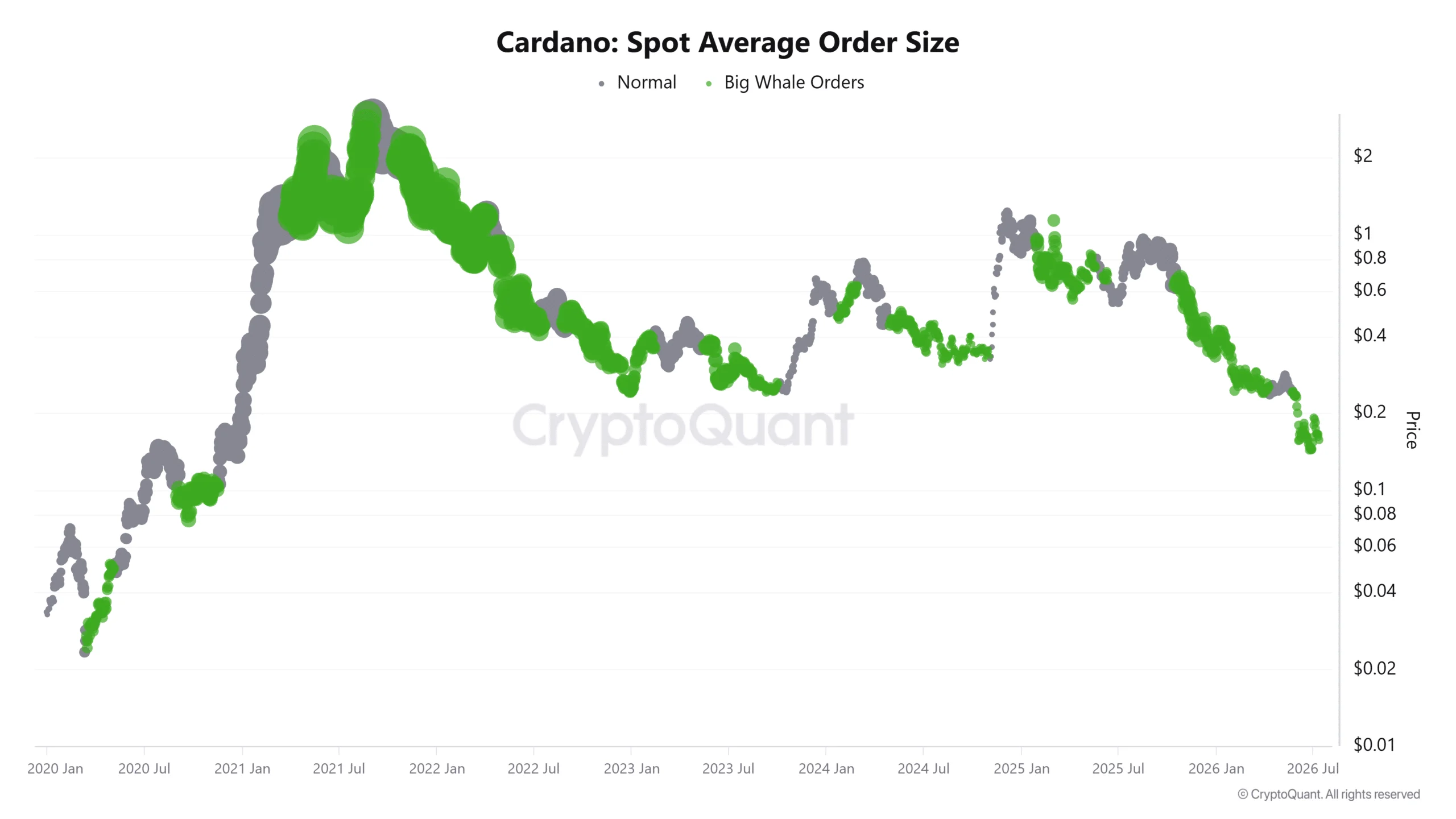
The Spot Average Order Size reflected the growing influence of larger market participants rather than retail traders. 

The indicator consistently flagged Big Whale Orders, showing that sizeable transactions dominated market activity, aligning closely with the expanding holdings among Cardano’s largest wallets. 

Rather than relying on frequent small trades, large participants executed fewer but significantly bigger orders, suggesting deliberate accumulation instead of speculative buying. Retail activity remained comparatively subdued, allowing whales to absorb available liquidity without triggering excessive volatility. 

The order flow also complemented the on-chain supply distribution trend, strengthening the broader accumulation narrative. If this pattern continued, larger investors could keep supporting ADA even while overall market sentiment remained cautious.

Source: CryptoQuant

Binance’s top traders stayed firmly bullish

Binance’s top traders maintained a clear bullish bias despite Cardano’s relatively subdued price performance. 

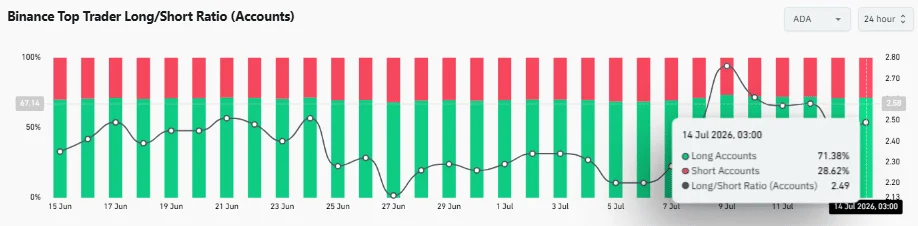
At press time, Long/Short Ratio showed 71.38% of top trader accounts holding long positions, while only 28.62% remained short. That imbalance produced a Long/Short Ratio of 2.49, highlighting continued confidence among experienced market participants. 

Although ADA failed to produce a sustained breakout, professional traders continued positioning for higher prices instead of reducing exposure. Their conviction contrasted sharply with weakening retail participation reflected in the supply distribution data. 

Such positioning did not guarantee an immediate rally, yet it suggested that sophisticated traders continued expecting favorable conditions ahead. If buying activity strengthens further, those long positions could reinforce any developing recovery.

Source: CoinGlass

Cardano defends support as sellers regain control

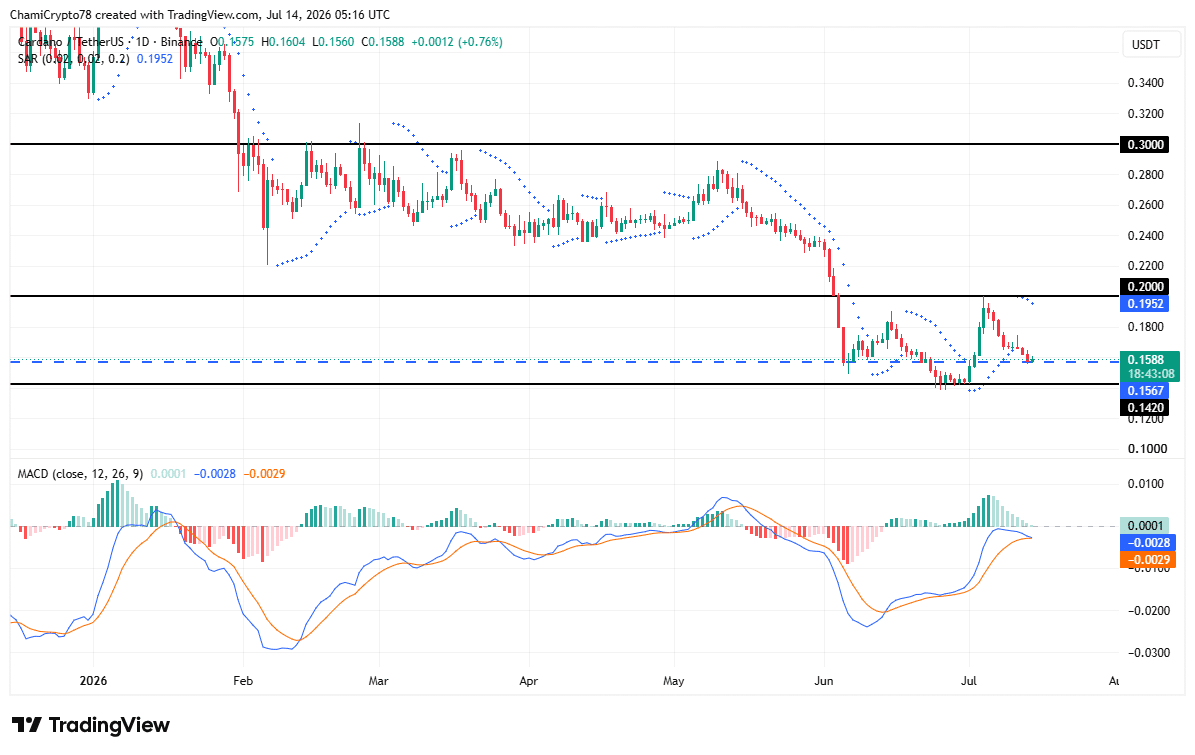
Cardano pulled back after failing to sustain its early July rebound, leaving the $0.20 resistance firmly intact. 

Price returned to the $0.1588 area and continued trading just above the critical $0.1567 support, showing that buyers still defended this level despite fading upside pressure. 

Unlike the previous rebound, the Parabolic SAR flipped above the candles as of writing, indicating that short-term control shifted back toward sellers. The MACD also weakened as the MACD line narrowed toward the signal line without completing a bearish crossover, while the positive histogram continued shrinking. 

That combination showed that buying pressure had eased even though bulls had not completely lost control. 

ADA price action ADA price action
Source: TradingView

If Cardano holds above $0.1567, buyers could mount another challenge toward the $0.20 resistance. 

However, a decisive close below support would likely strengthen bearish pressure and increase the probability of another move lower before a sustained recovery emerged. 


Final Summary

  • Whale accumulation kept rising even as retail participation continued weakening across the Cardano network.
  • ADA remained above support, though sellers still capped the price below the important $0.20 resistance.


Source link