Home Blog Page 248

Cardano whales tighten supply – Is $0.20 back in sight for ADA?

0
Cardano whales tighten supply - Is $0.20 back in sight for ADA?


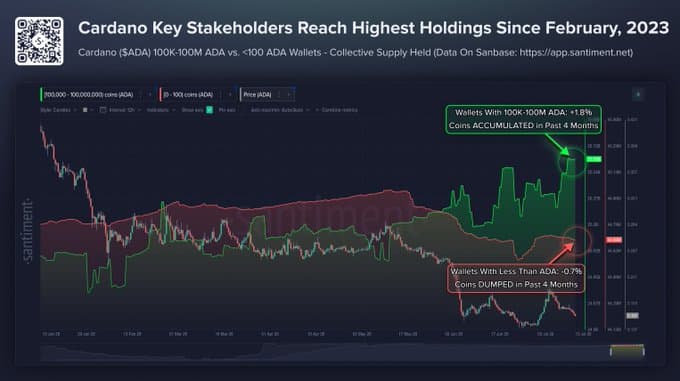
Cardano’s [ADA] largest investors continued accumulating despite weak retail participation, pushing supply concentration to its highest level in years. Wallets holding between 100,000 and 100 million ADA increased their combined balance to more than 25.6 billion ADA, marking the highest level since February 2023. 

Retail participants moved in the opposite direction, with wallets holding fewer than 100 ADA owning 0.7% fewer coins than they had four months earlier. That divergence highlighted growing confidence among large holders while smaller investors reduced exposure. 

The accumulation also developed as ADA traded near multi-year lows, reinforcing the view that whales continued building positions during periods of subdued sentiment. Although the market remained cautious, sustained supply absorption reduced the liquid supply available for immediate selling pressure.
Source: Santiment/X

Whale-sized orders pointed to stronger accumulation

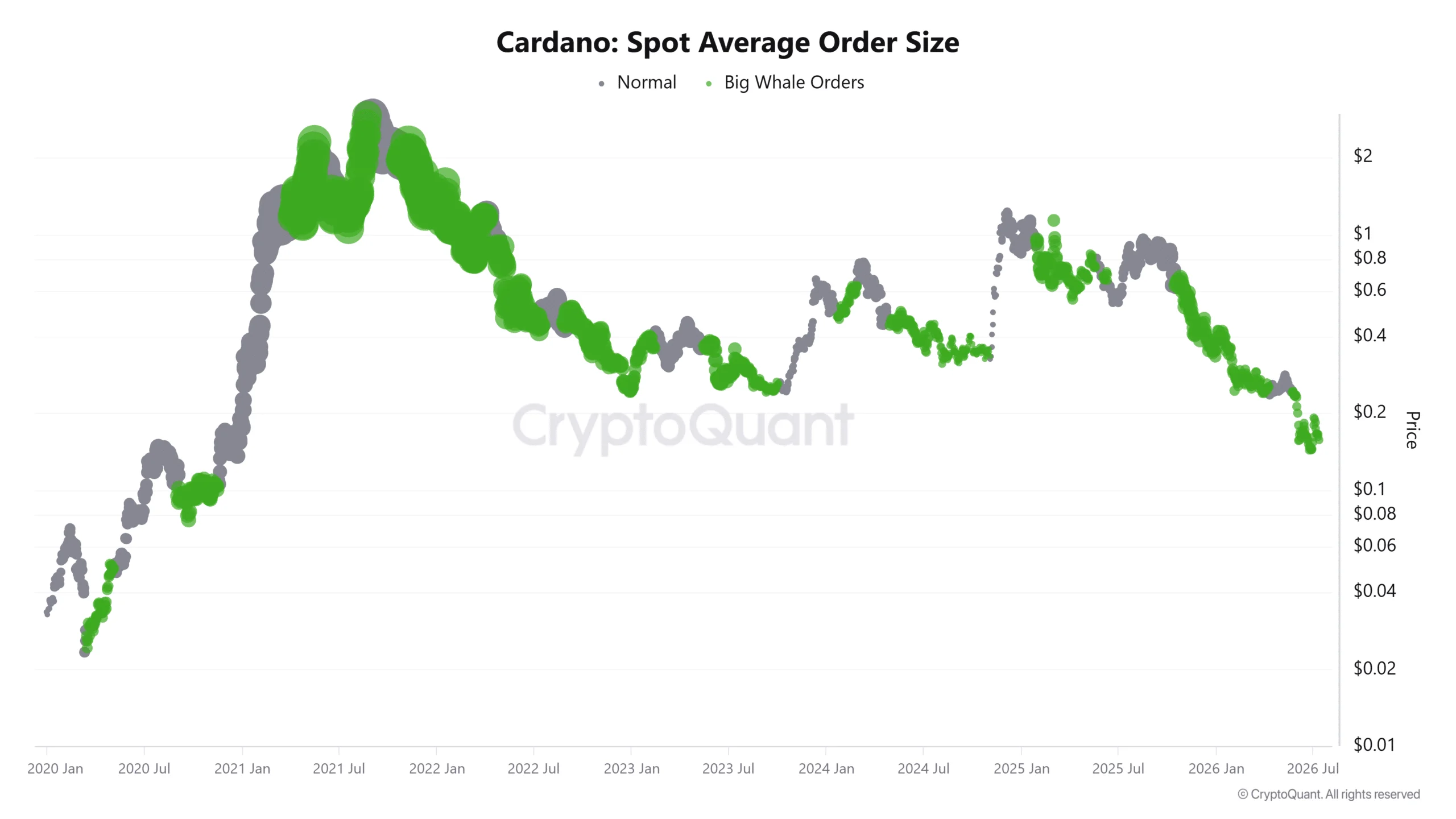
The Spot Average Order Size reflected the growing influence of larger market participants rather than retail traders. 

The indicator consistently flagged Big Whale Orders, showing that sizeable transactions dominated market activity, aligning closely with the expanding holdings among Cardano’s largest wallets. 

Rather than relying on frequent small trades, large participants executed fewer but significantly bigger orders, suggesting deliberate accumulation instead of speculative buying. Retail activity remained comparatively subdued, allowing whales to absorb available liquidity without triggering excessive volatility. 

The order flow also complemented the on-chain supply distribution trend, strengthening the broader accumulation narrative. If this pattern continued, larger investors could keep supporting ADA even while overall market sentiment remained cautious.
Source: CryptoQuant

Binance’s top traders stayed firmly bullish

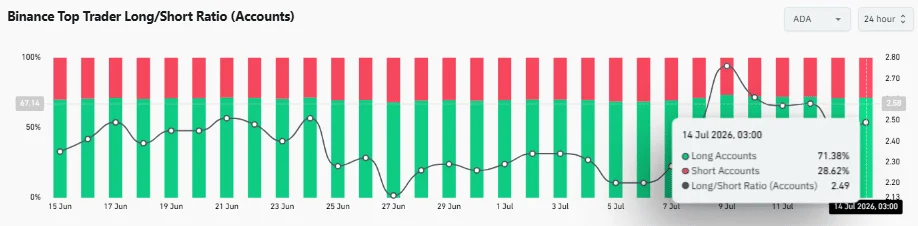
Binance’s top traders maintained a clear bullish bias despite Cardano’s relatively subdued price performance. 

At press time, Long/Short Ratio showed 71.38% of top trader accounts holding long positions, while only 28.62% remained short. That imbalance produced a Long/Short Ratio of 2.49, highlighting continued confidence among experienced market participants. 

Although ADA failed to produce a sustained breakout, professional traders continued positioning for higher prices instead of reducing exposure. Their conviction contrasted sharply with weakening retail participation reflected in the supply distribution data. 

Such positioning did not guarantee an immediate rally, yet it suggested that sophisticated traders continued expecting favorable conditions ahead. If buying activity strengthens further, those long positions could reinforce any developing recovery.
Source: CoinGlass

Cardano defends support as sellers regain control

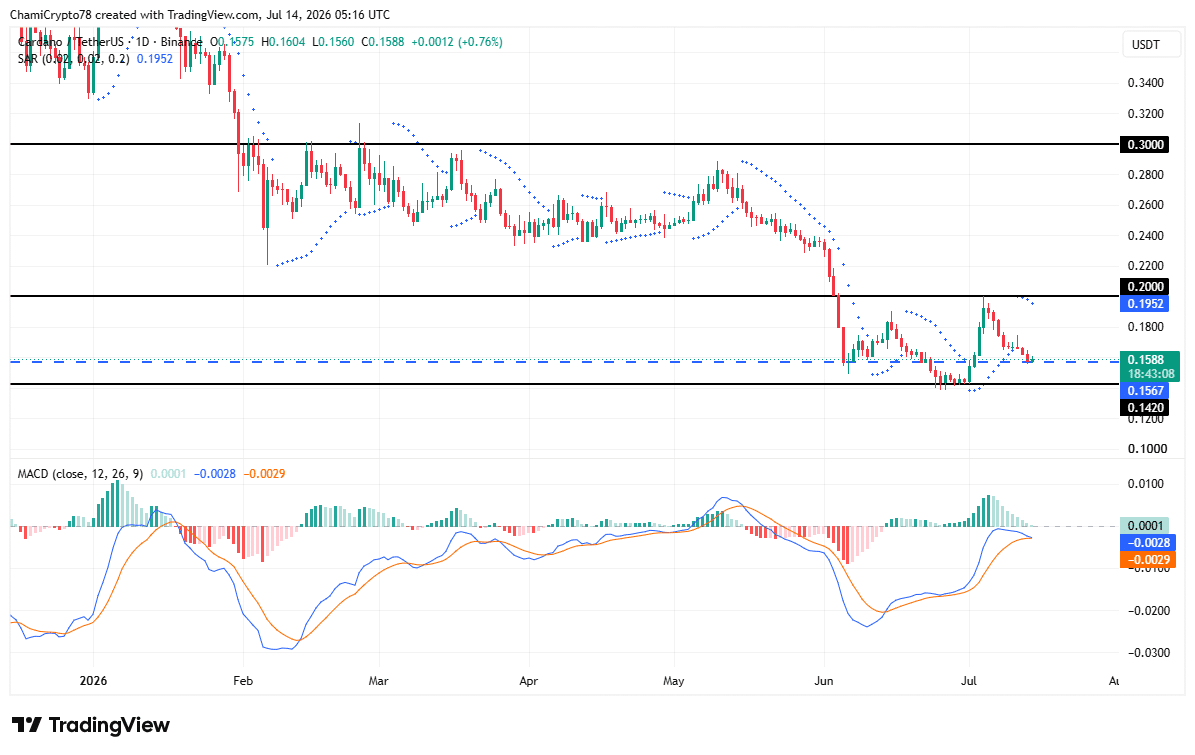
Cardano pulled back after failing to sustain its early July rebound, leaving the $0.20 resistance firmly intact. 

Price returned to the $0.1588 area and continued trading just above the critical $0.1567 support, showing that buyers still defended this level despite fading upside pressure. 

Unlike the previous rebound, the Parabolic SAR flipped above the candles as of writing, indicating that short-term control shifted back toward sellers. The MACD also weakened as the MACD line narrowed toward the signal line without completing a bearish crossover, while the positive histogram continued shrinking. 

That combination showed that buying pressure had eased even though bulls had not completely lost control. 
ADA price action ADA price action
Source: TradingView

If Cardano holds above $0.1567, buyers could mount another challenge toward the $0.20 resistance. 

However, a decisive close below support would likely strengthen bearish pressure and increase the probability of another move lower before a sustained recovery emerged. 


Final Summary

  • Whale accumulation kept rising even as retail participation continued weakening across the Cardano network.
  • ADA remained above support, though sellers still capped the price below the important $0.20 resistance.



Source link

Mizuho turns bearish on stablecoin issuer Circle, citing Open USD competition

0
Circle takes banking step with U.S. trust bank approval

Japanese investment bank Mizuho downgraded Circle (CRCL) to underperform from neutral and slashed its price target to $50 from $85, arguing that OpenUSD’s business model threatens the stablecoin issuer’s long-term economics.

Circle shares were trading 0.6% lower at $62.63 at publication time.

Open USD, a dollar-backed stablecoin unveiled June 30 by the Open Standard consortium, “could fundamentally alter CRCL’s business model, which relies on retaining a large portion of the treasury yield to drive revenues,” analysts led by Dan Dolev said in the Tuesday note to clients.

The consortium counts more than 140 partners, including Mastercard (MA), Stripe, Coinbase (COIN) and BlackRock (BLK).

USDC has also lost momentum in recent months, with its circulating supply falling to about $73 billion from nearly $80 billion in March. The decline comes as the stablecoin market has shrunk by roughly $10 billion since May amid softer crypto trading activity and growing competition from newly regulated issuers.

Unlike Circle’s USDC model, which captures reserve income before sharing a portion with partners such as Coinbase and Binance, Open USD charges a small operating fee and distributes most reserve income to issuers and distributors, the analysts said.


Source link

Customers Are Now Using ‘Friendly Fraud’ to Get Free Stuff

0
Customers Are Now Using 'Friendly Fraud' to Get Free Stuff


Credit card companies are becoming unlikely accomplices in a new kind of shoplifting, as some consumers skip the return line and just dispute the charge instead. Chargebacks, originally designed to protect people from real theft, are increasingly being used to reverse legitimate purchases. Researchers call this trend “friendly fraud.” American consumers filed 158 million transaction disputes in 2025, up 29% from 2021, far outpacing growth in card transactions overall, Bloomberg reports.

Some chargebacks are genuine, since online shopping makes it easy to forget what you bought or doesn’t give you enough time to catch a mistake before the return window closes. But a lot of it is deliberate, as evidenced by TikTok tutorials that coach shoppers on how to use chargebacks to score free merch.

While large retailers can absorb these losses by raising prices across the board, small businesses can’t. Every successful fraudulent dispute costs a merchant the product, the revenue and a penalty fee, on top of the labor spent fighting it.

Credit card companies are becoming unlikely accomplices in a new kind of shoplifting, as some consumers skip the return line and just dispute the charge instead. Chargebacks, originally designed to protect people from real theft, are increasingly being used to reverse legitimate purchases. Researchers call this trend “friendly fraud.” American consumers filed 158 million transaction disputes in 2025, up 29% from 2021, far outpacing growth in card transactions overall, Bloomberg reports.

Some chargebacks are genuine, since online shopping makes it easy to forget what you bought or doesn’t give you enough time to catch a mistake before the return window closes. But a lot of it is deliberate, as evidenced by TikTok tutorials that coach shoppers on how to use chargebacks to score free merch.

While large retailers can absorb these losses by raising prices across the board, small businesses can’t. Every successful fraudulent dispute costs a merchant the product, the revenue and a penalty fee, on top of the labor spent fighting it.


Source link

Goldman bans the very bets JPMorgan wants to sell

0
Goldman bans the very bets JPMorgan wants to sell


Wall Street has always preferred to sell the shovels rather than dig for gold. The house keeps its cut whether the player wins or loses, and the oldest edge in finance is owning the table instead of sitting at it.

That instinct built the trading desks, the exchanges, and the fee machines that keep the biggest banks rich in good markets and bad ones alike.

So when a fast-growing new corner of the market started minting overnight winners, the usual script wrote itself. The banks would study it, bless it, and eventually package it for clients the way they once did with options, futures, and crypto. Some of the biggest names on Wall Street have said out loud that they want in.

One of the loudest players in that chorus just did something far stranger than buy in. Before it sells a single one of these bets to a single client, Goldman Sachs (GS) has told its own people they are no longer allowed to make them.

In a quiet update to its personal trading policy, the bank barred employees from wagering on prediction market contracts tied to companies, elections, financial markets, and the economy, according to Bloomberg. Sports and entertainment bets are still fine.

How a niche betting market became Wall Street’s newest obsession

Prediction markets let people bet real money on real events, from whether the Federal Reserve cuts rates in December to whether a sitting president finishes the year in office. Each contract pays out based on the outcome. That turns a guess about the future into something you can trade like a stock.

I have been tracking this shift since these platforms went mainstream, including JPMorgan’s own warning to staff about them earlier this year. What started as a crypto curiosity is now a line item in Wall Street strategy meetings.

Related: Goldman Sachs issues major prediction for US housing market

Two years ago, almost no one outside the crypto world had heard of Polymarket. Today it and its regulated rival Kalshi clear billions of dollars in bets every week, and traditional finance has noticed.

The scale of the run is easy to miss until you line up the numbers:

  • Sector trading volume jumped from about $16 billion in 2024 to nearly $64 billion in 2025, with Bernstein projecting roughly $240 billion this year, according to CNBC.

  • Kalshi raised $1 billion at a $22 billion valuation, and its weekly volume neared $3 billion, up from about $100 million a year earlier, according to Decrypt.

  • Polymarket drew a roughly $2 billion investment from Intercontinental Exchange (ICE), the parent of the New York Stock Exchange, according to ICE.


Source link

JPMorgan sees Hyperliquid partnership weighing on Circle, Coinbase

0
JPMorgan sees Hyperliquid partnership weighing on Circle, Coinbase

Hyperliquid is one of crypto’s fastest-growing trading venues and the leading decentralized perpetual futures exchange. The platform processed more than $150 billion in trading volume in July alone, while its volume relative to Binance climbed to 11.5%, underscoring its growing share of the derivatives market. USDC balances on Hyperliquid have swelled to roughly $6 billion, making it an increasingly important distribution channel for the stablecoin.

Under the new arrangement, Coinbase will classify USDC on Hyperliquid as “on-platform,” collecting the income generated by reserves and paying 90% of it to Hyperliquid. JPMorgan estimated Coinbase previously split nearly all of the revenue evenly with Circle.

The bank cut earnings estimates for both companies, citing the Hyperliquid agreement and weaker crypto markets, though it expects higher interest rates to provide some support for USDC-related revenue over the longer term.

USDC has also lost momentum in recent months. Its circulating supply has fallen to about $73 billion from nearly $80 billion in March, part of a broader $10 billion contraction in the stablecoin market since May as crypto trading activity cooled and new regulated rivals chipped away at the dominance of USDC and Tether’s USDT.

Japanese investment bank Mizuho said in a report last week that Circle’s final approval from the U.S. Office of the Comptroller of the Currency to establish First National Digital Currency Bank is a positive milestone, but investors may be overestimating its significance.


Source link

Coinfest Asia 2026 Connects Institutions, Builders, and Traders to The World’s Crypto Festival

0
Coinfest Asia 2026 Connects Institutions, Builders, and Traders to The World’s Crypto Festival


Coinfest Asia, The World’s Crypto Festival, organized by Indonesia Crypto Network (ICN), will return to Melasti Beach, Bali, Indonesia, on 20–21 August 2026, bringing together institutions, builders, traders, founders, investors, developers, and global Web3 communities in one of Asia’s most dynamic crypto gatherings.

This year, Coinfest Asia will feature dedicated programs for different parts of the crypto ecosystem, helping attendees access relevant insights, networking opportunities, product showcases, and business connections across Asia’s fast-growing crypto and Web3 markets.

What Attendees Can Do at Coinfest Asia

The 2026 edition departs from traditional conference formats by organizing content into three intent-based tracks. This structure is intended to align attendees with specific functional areas of the industry:

  • Institutional Track
    Focused on digital asset adoption, stablecoin integration, and tokenization. Programs include Stablecoins Readiness Workshop, Asia Go-To-Market Sessions, Closed-Door Stablecoins & Tokenization Roundtable, panel discussions, and keynote sessions.
  • Builders Track
    Geared toward developers and startups across AI, blockchain, and digital infrastructure. Programs include Gemini AI Masterclass, “What the Hack!” Web3 Developer Course, AI Vibe Code Competition, Asia Go-To-Market Sessions, and sessions focused on product development and ecosystem growth.
  • Traders Track
    Created for active traders and market participants looking to understand market narratives, sharpen trading strategies, and connect with trading communities. Programs include Trading Competition by TRIV, Alpha Hunting Masterclass, Yapper Masterclass, Bitcoin Crash Course, Live Degen Experience, trading-focused panels, and keynote sessions.

Through these tracks, Coinfest Asia aims to make the festival easier to navigate while keeping the experience open and connected across the wider crypto industry. 

Opening Access to Asia’s Web3 Markets

A core objective of the 2026 event is providing localized insight into Asian markets. The event introduces “Asia Go-To-Market Sessions,” which provide briefings on regulatory environments, user behaviors, and growth channels in specific jurisdictions.

These sessions are organized in collaboration with regional ecosystem partners:

  • Japan GTM Session with WebX 2026
  • Malaysia GTM Session with MYBW 2026
  • Vietnam GTM Session with Conviction
  • Indonesia GTM Session with Indonesia Crypto Network
  • Taiwan GTM Session with FutureMode
  • India GTM Session with India Blockchain Week 2026

Through these sessions, attendees can better understand local user behavior, regulatory direction, community dynamics, partnership opportunities, and distribution strategies across Asia.

“Asia is not one single market. Each country has its own users, regulations, culture, and growth channels,” said Joditha Winatajaya, Head of Event at Coinfest Asia. “Through Asia Go-To-Market Sessions, we want to connect the audiences with the right local ecosystems, all in one place.”

A Foundation Built on Industry Leadership

Coinfest Asia 2026 will feature speakers from across blockchain infrastructure, exchanges, wallets, stablecoins, payments, data, AI, institutional finance, venture capital, and Web3 communities.

Confirmed speakers include Charles Hoskinson (Founder, Input Output Group), Felix Fan (CEO, Trust Wallet), Alexander Svanevik (CEO, Nansen), Nick See Tong (APAC & Singapore Lead, Base), Iñaki Moreno (Strategic Partnerships Lead, Web3 & AI, Google), William Sutanto (CEO, INDODAX), Ploy Boonyavee (Thailand/Indochina Country Manager, Tether), Gabriel Rey (CEO, TRIV Group), Calvin Kizana (CEO, Tokocrypto), Angela Ang (APAC Managing Director and Singapore President, BitGo), Tianwei Liu (CEO, StraitsX), Thomas Chou (Head of APAC, Canton Foundation), Akshat Vaidya (Co-Founder, Maelstrom) and more.

The event is also supported by leading companies across crypto, fintech, infrastructure, and digital assets, including Binance, Tokocrypto, Indodax, Triv, Duitku, ClickHouse, CockroachDB, BYDFi, Zoomex, FundedXyz, WalletConnect, GOIDR, GudangKripto, and more partners to be announced.

Since its launch, Coinfest Asia has grown into one of the world’s leading crypto gatherings, bringing together global companies, local ecosystems, builders, traders, institutions, and communities in Bali.

The 2026 edition builds on that momentum by combining industry programming with a festival environment designed for more fluid interaction. Beyond the main stages, Coinfest Asia will feature expo areas, curated business matching, networking activations, product showcases, community gatherings, and side events across the festival experience.

Tickets for Coinfest Asia 2026 are now available. Companies looking to expand into Asian crypto markets can also explore partnership and marketing opportunities through the official event channels.

About Coinfest Asia

Coinfest Asia is the world’s largest crypto festival, organized by Coinvestasi, a subsidiary of Indonesia Crypto Network (ICN). Held annually in Bali, Indonesia, the event brings together institutions, builders, and traders to connect, collaborate, and drive the future of digital assets in Asia and beyond.

Learn more about Coinfest Asia.

 Disclaimer: This is an Event Partner post and should not be treated as news/advice.


Source link

Freight Distress Report: Carrier, logistics closures erase over 245 jobs

0
Freight Distress Report: Carrier, logistics closures erase over 245 jobs


Four companies are eliminating nearly 250 jobs at logistics and distribution facilities across New Jersey, North Carolina, Illinois and California, while nine transportation- and logistics-related companies have recently sought bankruptcy protection.

The latest bankruptcy filings and layoff notices highlight continued financial stress across trucking, freight forwarding, warehousing, trailer manufacturing and supply chain services.

The largest announced workforce reduction involves Fusion Transport LLC, a New Jersey logistics provider that plans to lay off 79 employees at its Piscataway facility effective Oct. 1, according to a Worker Adjustment and Retraining Notification filed with the state.

Fusion Transport provides freight management, warehousing, e-commerce fulfillment and retail consolidation services.

It was not immediately clear whether the Piscataway facility will close permanently after the layoffs.

More trucking bankruptcies emerge

Several additional trucking and logistics companies also entered bankruptcy proceedings over the past two weeks, underscoring the breadth of financial pressure facing smaller freight operators.

Jackson and Son Hauling LLC, an FMCSA-registered motor carrier based in Ruther Glen, Virginia, filed for Chapter 7 bankruptcy protection on July 13 in the U.S. Bankruptcy Court for the Eastern District of Virginia. According to the filing, the carrier operated two trucks and employed two drivers at the time of the petition.

Victory Freight Corp., a San Bernardino, California-based trucking company, filed for Chapter 7 bankruptcy on July 2 in the Central District of California. Court records indicate the carrier cited a multimillion-dollar legal claim as one of its primary liabilities as it moves to liquidate its assets.

IPS Express Logistics Inc., a transportation and supply chain company based in San Leandro, California, also filed for Chapter 7 bankruptcy protection in the U.S. Bankruptcy Court for the Central District of California.

Meanwhile, Talon Logistics Inc., a Woodland Hills, California-based drayage and intermodal carrier, filed for Chapter 11 protection on June 29. Bankruptcy records indicate the company operates approximately 40 to 50 power units and has invested heavily in zero-emission equipment, including electric and hydrogen-powered trucks serving the Los Angeles market.

The additional filings suggest that financial challenges continue to affect carriers across multiple segments of the freight economy, from small owner-operated trucking companies to regional intermodal fleets and specialized logistics providers.


Source link