Home Blog Page 252

Entrepreneurs Who Design Their Lives First Build Better Businesses. Here’s How to Do It.

0
Entrepreneurs Who Design Their Lives First Build Better Businesses. Here's How to Do It.


Opinions expressed by Entrepreneur contributors are their own.

Key Takeaways

  • Most entrepreneurs chase freedom — only to build businesses that trap them. Truly free entrepreneurs design the life they want first and then build a business model that is forced to support it.
  • Define the non-negotiable lifestyle milestones that set the trajectory for how you build your business, shift from high-touch to productized delivery, and hire outcome owners instead of task doers.
  • Reevaluate your high-demand clients, monitor your time to value generation ratio, and have an exit strategy in place.

Most entrepreneurs start a business because they want freedom. They envision a Tuesday morning at their child’s school event or a month working from a beachside resort without the constant, low-level anxiety of a standard 9-5. They trade the predictable grind of a corporate job for the promise of autonomy. They convince themselves that being the boss is the ultimate escape.

The challenge is that this reality often ends up being nothing more than a bait-and-switch. Along the way to building the business, the freedom disappears. Instead of creating a business that serves them, they accidentally build a prison filled with huge amounts of responsibility, stress and pressure. Their new “job” ends up demanding more of their time than any corporate boss. Instead of being the captain of the ship, they find themselves in the grimy engine room trying to keep the power on and patch every leak.

Most entrepreneurs assume this chaos is a lack of effort and double down to burn themselves out even further. They believe that once the company reaches success, they will eventually earn the right to be free. Truly free entrepreneurs do the complete opposite. They design the life they want first and then build a business model that is forced to support it.


1. Define your Champagne Moments first

In the startup world, there is an obsession with growth and revenue. While these are critical to the life and health of the business, too much focus on this metric can end up costing you your sanity. What’s the point of achieving $10M in revenue if you haven’t seen your family in six months?

Your Champagne Moments are non-negotiable lifestyle milestones that can set the trajectory for how you build your business. These moments become your North Star to drive your ongoing business decisions.

2. Shift from high-touch to productized delivery

One of the biggest bottlenecks in most companies is the founder’s brain. If your services require your specific expertise to be delivered, you’re operating a high-paid freelance gig instead of a business. This creates a hard growth ceiling and blocks your ability to scale your time.

To reclaim your freedom, you have to productize what you do by turning your expertise into a repeatable system that can be executed autonomously or by anyone else on the team. Freedom starts when you stop being the one doing the work and shift to the one who owns the machine.

3. Hire outcome owners instead of task doers

Entrepreneurs often fall into the trap of “I’ll just do it myself.” This happens because they falsely believe that no one else can meet their standards. If this sounds like you, it could be a sign that you’ve hired doers rather than outcome owners. The last thing you want is to hire people who just wait to be provided a checklist before taking action. This creates an environment where every tiny decision falls on your shoulders.

Instead, true freedom comes from hiring people who are capable of taking responsibility and owning specific results or parts of the delivery process. It’s important to have people on your team who can take expectations and turn them into actions.

4. Reevaluate your high-demand clients

Not all revenue is good revenue. We’ve all had those clients who pay well, but are highly demanding. These types of clients are counterproductive to creating a business that generates true freedom. When clients expect midnight email responses and constant hand-holding, they are a drain on your resources and mental load.

On the other hand, clients who value your standard processes and don’t expect customized solutions require significantly less stress. While firing a high-paying client can be a scary thought for any entrepreneur, it’s sometimes a necessary step toward reclaiming your peace of mind.

5. Monitor your time to value generation ratio

Many entrepreneurs measure their success by the size and value of their company. What they often fail to evaluate is the amount of personal effort required to get there. Making half a million dollars a year looks great on paper, but not so much if the cost is working 100 hours a week.

Instead, focus on tracking and increasing your profit per founder hour. This simple measurement will force you to rethink and remove any low-value tasks that create more strain on your freedom and schedule than they’re worth.

6. Always have an exit strategy

You’ve worked hard to build a successful business. Congrats! The challenge is that you’ve probably been so busy focused on operating the business that you haven’t considered what comes next. Having an exit strategy is important to building a business centered around freedom. This doesn’t mean you intend to actually walk away from the business. However, having a solid exit strategy means that the business no longer needs you. That’s where you find true freedom.

The best way to do this is to make sure that you have a robust set of Standard Operating Procedures (or SOPs). These documented guidelines are a valuable asset to ensure that you can step away from the business at any time and nothing bad will happen.

Moving from an operator to a freedom-focused architect can be a psychologically jarring experience for entrepreneurs. We want to be in control and chase success at every corner. Building a business around your desired lifestyle and freedom will require you to check your ego at the door. It will require trusting a system over your gut instincts or flying by the seat of your pants. But the world doesn’t need more burnt-out founders who sacrifice their lives, family and friends for superficial “success.” Instead of building a business with the hope you’ll eventually gain freedom, start by designing your business around the freedom you want.

Key Takeaways

  • Most entrepreneurs chase freedom — only to build businesses that trap them. Truly free entrepreneurs design the life they want first and then build a business model that is forced to support it.
  • Define the non-negotiable lifestyle milestones that set the trajectory for how you build your business, shift from high-touch to productized delivery, and hire outcome owners instead of task doers.
  • Reevaluate your high-demand clients, monitor your time to value generation ratio, and have an exit strategy in place.

Most entrepreneurs start a business because they want freedom. They envision a Tuesday morning at their child’s school event or a month working from a beachside resort without the constant, low-level anxiety of a standard 9-5. They trade the predictable grind of a corporate job for the promise of autonomy. They convince themselves that being the boss is the ultimate escape.

The challenge is that this reality often ends up being nothing more than a bait-and-switch. Along the way to building the business, the freedom disappears. Instead of creating a business that serves them, they accidentally build a prison filled with huge amounts of responsibility, stress and pressure. Their new “job” ends up demanding more of their time than any corporate boss. Instead of being the captain of the ship, they find themselves in the grimy engine room trying to keep the power on and patch every leak.

Most entrepreneurs assume this chaos is a lack of effort and double down to burn themselves out even further. They believe that once the company reaches success, they will eventually earn the right to be free. Truly free entrepreneurs do the complete opposite. They design the life they want first and then build a business model that is forced to support it.



Source link

TeraWulf CEO: ‘Not All Megawatts Are Created Equally’ in AI Race

0
TeraWulf CEO: 'Not All Megawatts Are Created Equally' in AI Race

The context: Building AI data centers remains a multi-year effort with labor emerging as a key execution challenge.

  • Prager said the Kentucky facility is expected to come online beginning in 2028 and that TeraWulf has hired Fluor to help construct the project.
  • He said securing skilled labor and contractors is a bigger challenge than equipment procurement as hyperscale AI facilities become increasingly specialized.
  • Prager said proximity to reliable power remains the most important requirement for AI customers.

Reading between the lines: TeraWulf says Bitcoin mining is no longer part of its long-term strategy.

  • Prager said the company originally entered Bitcoin mining because it already owned power assets and mining provided a flexible electricity customer.
  • He said Bitcoin’s commodity-driven revenue model did not provide the predictable, long-term cash flows the company prefers.
  • “We’re not involved in Bitcoin,” Prager said, describing AI infrastructure as a more natural fit for TeraWulf’s business.

Worth watching: Prager argued the AI infrastructure boom is constrained by power quality rather than available land.

  • He said the U.S. faces a shortage of electricity and warned investors that “not all megawatts are created equally.”
  • Prager said successful AI campuses require reliable generation, redundant transmission, favorable regulation and strong community relationships.
  • He added that TeraWulf focuses on redeveloping former industrial sites and, where needed, adding new power generation to support both AI facilities and the broader electric grid.


Source link

VELVET crypto rallies 29% – Can 2,500 new holders sustain the rally?

0
VELVET crypto rallies 29% - Can 2,500 new holders sustain the rally?


Velvet [VELVET] has extended its bullish run over the past 24 hours, climbing 29% at press time, as market sentiment continues to build.

The underlying dynamics suggest the asset could strengthen its footing and stretch those gains further across the next couple of trading sessions.

Holder growth underpins Velvet’s bullish structure

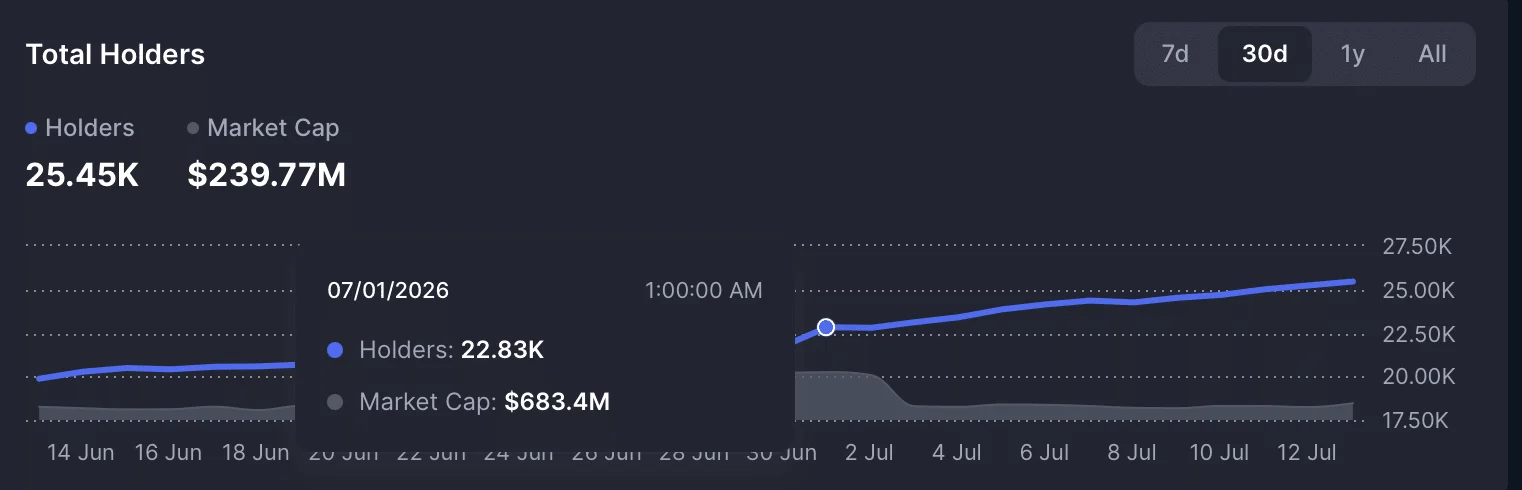
Velvet’s bullish outlook draws its strength from a surge in holders. CoinMarketCap data shows the number of wallets holding VELVET has kept climbing, reaching a new all-time high within the past 24 hours.

Holder numbers have jumped by more than 2,500 in July alone, rising from 22,830 to 25,450 at the time of writing. That accumulation has fed directly into price, with the asset gaining over 80% between July 7 and now.

Velvet token holder chart.
Source: CoinMarketCap

Rising holder counts tell only part of the story, since sentiment has added its weight to the move.

Velvet’s social footprint has expanded alongside it, with the token’s mindshare climbing 38% to 1,820 over the last 24 hours on CoinMarketCap. Mindshare gauges how many mentions and interactions a token attracts within a 24-hour window.

The broader social sentiment score has likewise reached 6.34 out of 10, pointing to a bullish lean among investors that could feed a further leg up in price.

Perpetual traders flip long on Velvet

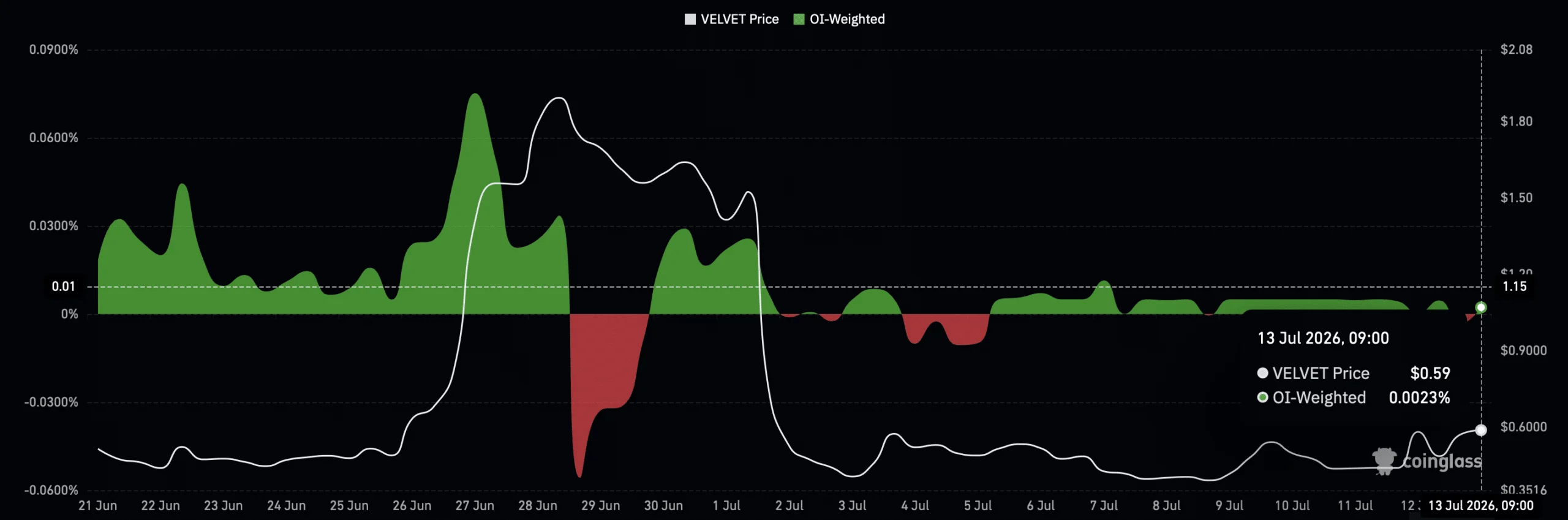
Early in the day, even as the price climbed, most of the market still sat net short on Velvet, with the Funding Rate holding in negative territory. That positioning has since flipped, with the Funding Rate swinging sharply to around 0.0023% as of writing, signaling that long positions now outweigh shorts across the market.

Velvet funding rate chart. Velvet funding rate chart.
Source: CoinGlass

Short sellers are now bearing the brunt, with liquidated short positions totaling roughly $182,000 over the last 12 hours against just $20,260 in liquidated longs across the same stretch. The gap has grown starker over the past four hours, where shorts lost $71,620 while longs gave up just $784.

Fresh capital has also begun flowing in behind the bullish case, with Open Interest, a measure of the total value of outstanding leveraged contracts in an asset’s perpetual market, surging 79% to roughly $42 million.

With that capital underpinning VELVET, the asset looks set to hold its bullish footing over at least the short term.

Liquidation levels point to further upside

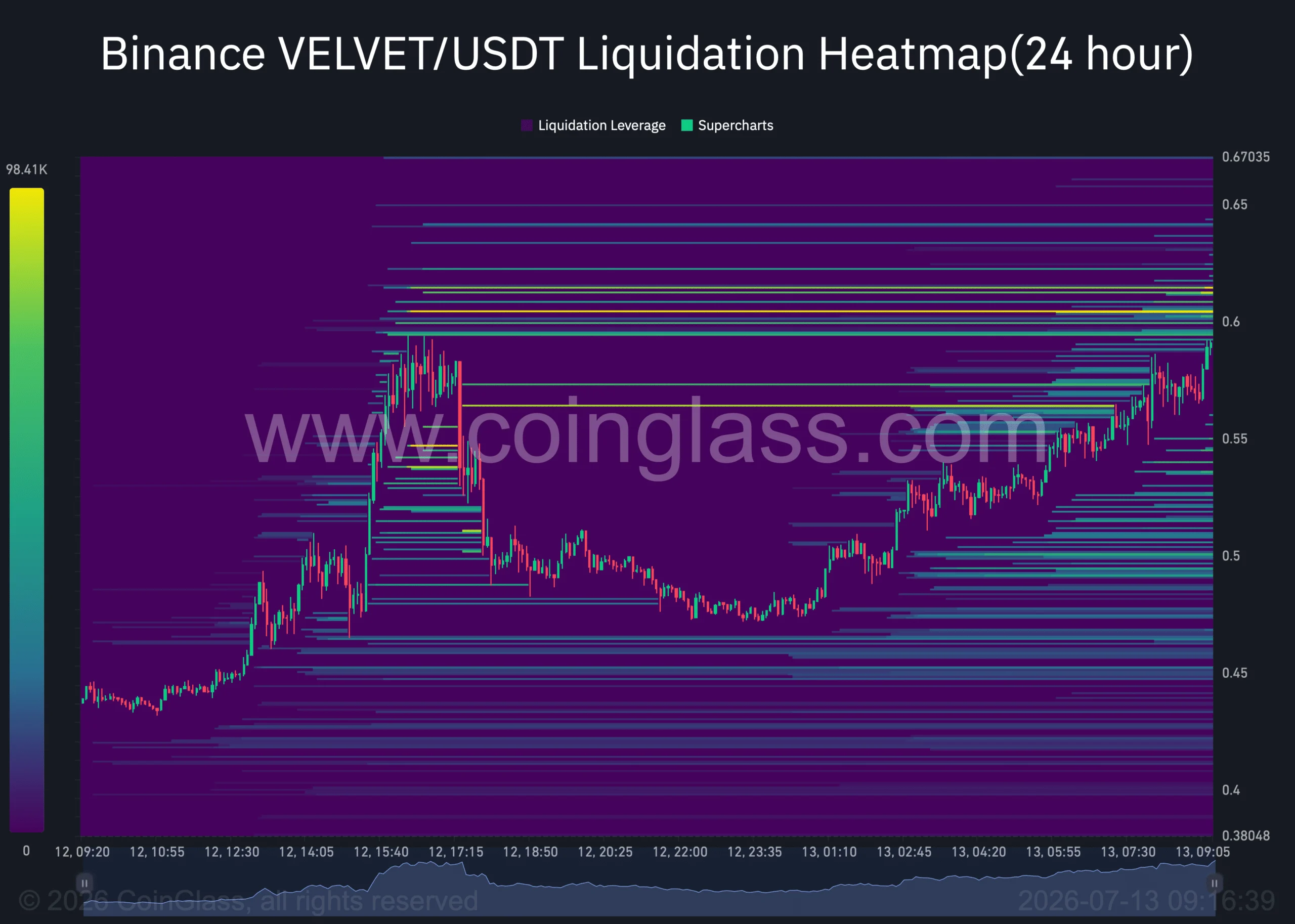
CoinGlass’s liquidation heatmap points to room for Velvet to push higher still. Clusters of liquidation levels remain stacked above the current price, and those pockets tend to act as a magnet that draws price toward them.

Velvet liquidation heatmap chart. Velvet liquidation heatmap chart.
Source: CoinGlass

The downside cannot be dismissed either, though most of the clusters below sit close to the current price, which suggests any pullback would stay shallow.

For now, the prevailing momentum leaves price positioned to trend further above its current level, extending the run it has built since early July.


Final Summary

  • VELVET holders climbed past 25,400 to a new all-time high in July, driving an 80% price gain since the 7th.
  • The funding rate flipped positive as shorts absorbed heavy liquidations, signaling traders have swung behind the rally.


Source link

Franklin Crypto CIO says crypto prices are disconnected from fundamentals

0
Franklin Crypto CIO says crypto prices are disconnected from fundamentals

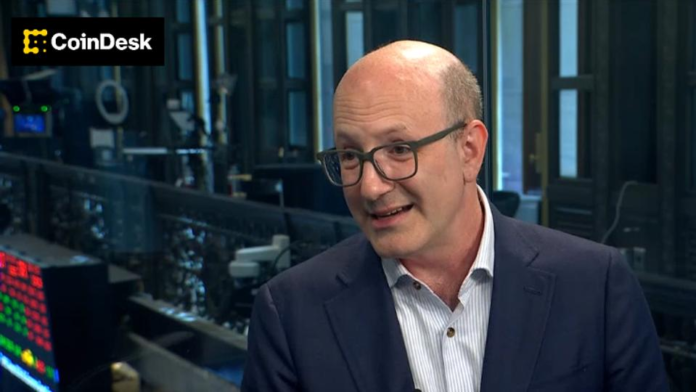
Latest developments: In an interview with Jennifer Sanasie on CoinDesk’s Public Keys Ginns said the convergence between traditional finance and crypto continues to gain momentum despite a prolonged market slump

  • Franklin Crypto aims to build a leading fundamental crypto investment platform following Franklin Templeton’s acquisition of 250 Digital, the firm that emerged from CoinFund’s liquid investment business, Ginns said.
  • While venture capital remains a natural fit for institutional allocators, Ginns said current market conditions also make liquid crypto investments increasingly attractive.
  • “There’s a big disconnect between where prices are and real fundamentals,” Ginns said, pointing to growing institutional engagement across the sector.

What this means: Ginns identified several developments that could bring more institutional capital into crypto markets.

  • He pointed to Robinhood’s blockchain initiative as an example of traditional financial distribution moving onto crypto rails, creating new opportunities for developers and users.
  • Ginns also cited growing interest in tokenized money market funds, which could allow investors to earn yield while maintaining on-chain portability.
  • Tokenized equities, stablecoin adoption and broader financial infrastructure are all contributing to the convergence of traditional finance and blockchain technology, he said.


Source link

HELOC and home equity loan rates today, Monday, July 13, 2026: Just a 2-basis-point differential

0
HELOC and home equity loan rates today, Monday, July 13, 2026: Just a 2-basis-point differential


The difference between the current home equity loan (HEL) rate and the average HELOC rate is just 2 basis points, according to Curinos, a real estate data analytics company. Especially when rates are this close, choosing the right option doesn’t come down to just rates. It’s how you plan to use your funds that will dictate the loan product that is best for you.

The average HELOC adjustable rate is 7.23%, according to real estate data analytics company Curinos. The 2026 HELOC low was 7.19%, last observed in mid-May.

The national average rate on a fixed-rate home equity loan is 7.36%, up from its 2026 low of 7.31% in late June.

Both rates are based on applicants with a minimum credit score of 780 and a maximum combined loan-to-value ratio (CLTV) of less than 70%.

Most HELOCs are variable-rate products, meaning their interest rates are tied to an external interest rate. When that rate rises or falls, the rate on your HELOC generally follows suit.

HELOCs are typically tied to the prime rate, the baseline rate banks currently charge their most creditworthy customers. 

The best HELOC lenders will assess the risk any borrower presents and add a margin to protect themselves. Riskier borrowers will have larger margins, while those considered less risky will receive smaller ones. Factors such as your credit score, debt-to-income ratio (DTI), and loan-to-value ratio (LTV) will all be considered in this assessment.

A home equity loan and its interest rate work like a HELOC in some ways and like a traditional primary mortgage in others.

As with a HELOC, the prime rate usually impacts your home equity loan rates, and lenders incorporate a margin into your rate. Both HELOC and home equity loan rates are loosely influenced by the Federal Reserve’s federal funds rate and broader economic conditions.

However, like many first mortgages, home equity loans are typically fixed-rate products, meaning you’ll have the same interest rate for the entire term. Fixed-rate HELOCs exist, but they’re much less common.

Learn more: HELOC and home equity loan interest rates: How they work and what you can expect to pay

Specific loan requirements vary by lender, but generally, home equity loans and HELOCs require a borrower to:

  • Have a FICO credit score of 680 or higher

  • Show a history of good credit and proof of sufficient monthly income

  • Obtain an appraisal to determine the current market value of the home

  • Have at least 15% to 20% equity in the house

  • Have a debt-to-income ratio of 43% or less

  • Show proof of in-force homeowners insurance.

Lenders may charge origination fees and other closing costs on a HELOC or home equity loan. When shopping for yours, make sure to ask about all possible application fees, annual charges, early account closure fees, and other one-time or ongoing expenses. Shop multiple lenders to find the lowest interest rate and the fewest fees. 

Read more: Home equity line of credit (HELOC) vs. home equity loan: What’s the difference, and which is right for you?

Rates vary significantly from one lender to the next. You may see rates from nearly 6% to as much as 18%. It really depends on your creditworthiness and how diligent you are as a shopper. The national average for a HELOC is 7.23%, and 7.36% for a home equity loan. Those can serve as a guide when shopping rates from second mortgage lenders.

For homeowners with low primary mortgage rates and significant equity in their homes, it’s likely a good idea to consider a HELOC or a home equity loan now. First off, rates are the lowest in years. And you don’t give up that great primary mortgage rate that you earned when you bought your house. You can use cash drawn from your equity for home improvements, repairs, and upgrades. Or virtually anything else. 

If you withdraw the full $50,000 from a home equity line of credit and pay a 7.25% interest rate, for example, your monthly payment during the 10-year HELOC draw period would be about $302. That sounds good, but remember that the rate is usually variable, so it changes periodically, and your payments will increase during the 20-year repayment period. A HELOC essentially becomes a 30-year loan. HELOCs and HELs are best if you borrow and repay the balance within a much shorter period.


Source link

Binance.US CEO says exchange is rebuilding, eyes return to 20% U.S. market share

0
Binance.US CEO says exchange is rebuilding, eyes return to 20% U.S. market share

Latest developments: CEO Stephen Gregory said Binance.US is focused on growth after what he described as a two-year “hibernation” tied to regulatory issues surrounding the broader Binance brand.

  • Gregory said Binance.US is a separate U.S.-only entity with its own governance structure, though it shares a common beneficial owner and brand name with Binance.com.
  • He said the exchange previously held roughly 20% of the U.S. crypto exchange market and is targeting a return to that level.
  • Gregory said Binance.US is now licensed exclusively to serve U.S. customers.

What this means: Binance.US is trying to compete with exchanges such as Coinbase and Kraken by emphasizing lower trading costs and a broader product lineup.

  • Gregory said the exchange has reduced fees to “essentially almost a no-fee exchange,” with 0% maker fees and 2-basis-point taker fees.
  • He said the company has kept costs low by operating with a lean team and expects to generate revenue from services like custody alongside trading.
  • Gregory said the exchange is rebuilding liquidity through incentives and direct outreach to retail customers, including personally contacting some of its top users for feedback.


Source link