Kite [KITE] emerged as an unexpected beneficiary of the crypto rally over the last 24 hours, with its market capitalization climbing by roughly $48.6 million. This, as its value surged by around 23% on the charts.
Now, market bulls may be commanding the headlines. And yet, on a structural level, KITE seemed to be weakening at press time. In fact, a pullback appeared likely as buyers grew briefly exhausted on a short-term basis.
KITE stalls inside a key supply zone
On a structural basis, KITE may be in a vulnerable position right now.
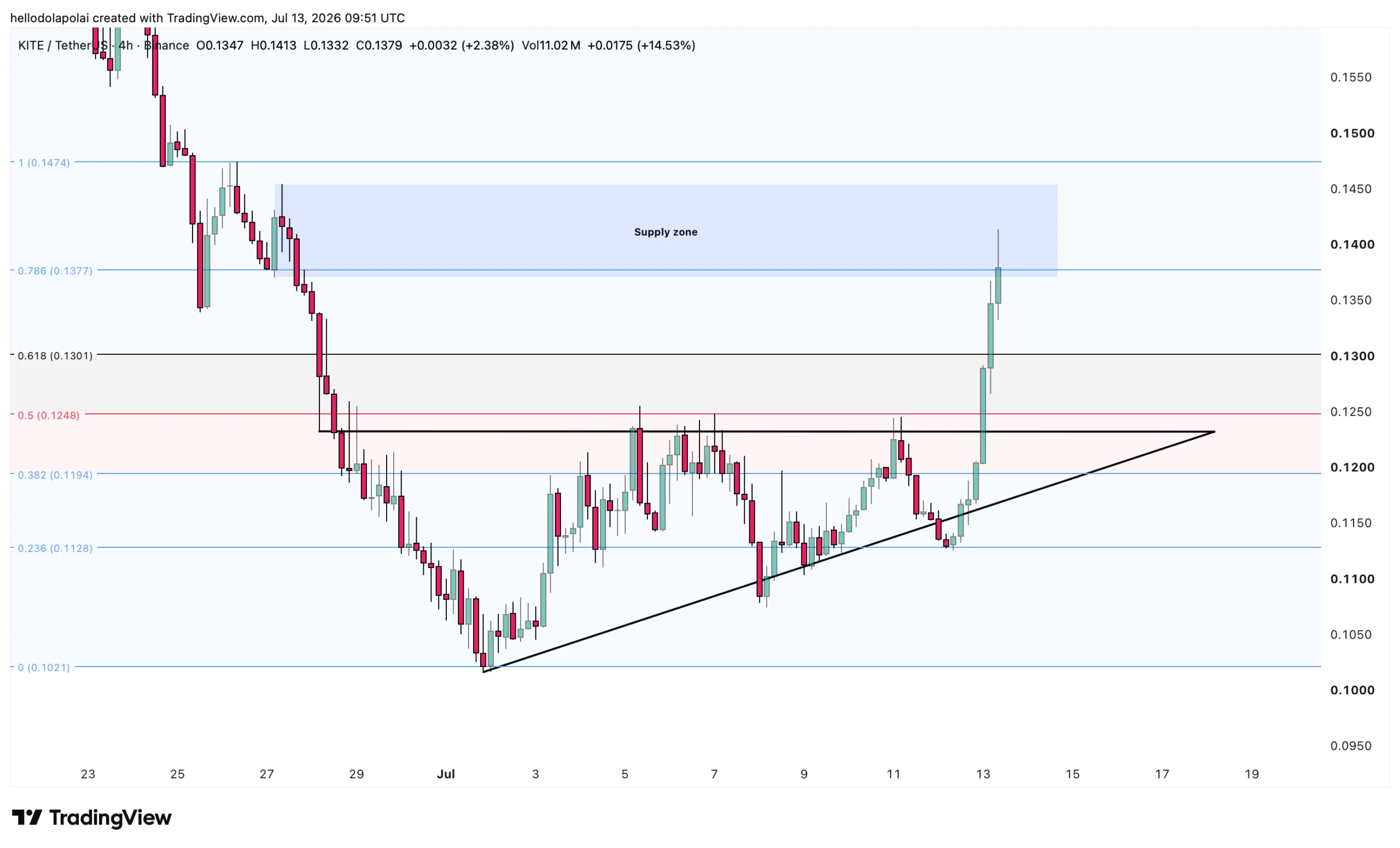
The altcoin’s latest rally pushed the crypto into a key supply zone on the 4-hour chart. Supply zones mark the areas where sell orders accumulate, and the probability of a decline from that level always runs high.
Source: TradingView
That level also seemed to coincide with the 0.786 Fibonacci resistance, signaling firm resistance as the price traded into this territory.
Given the selling pressure at this zone, a potential pullback would drag KITE towards support levels on the chart.
Analysis also pointed to the nearest support zone at the 0.618 Fibonacci level (or $0.13). Should that fail to attract enough buy orders to lift the price, KITE would slide to the 0.5 Fibonacci line (or $0.124).
If the price retraces into the bullish structure that preceded its rally—marked by the black line—that structure will be invalidated. This would mean that bears in effect will set the tone for the price going forward.
Momentum indicators show buyer pressure fading
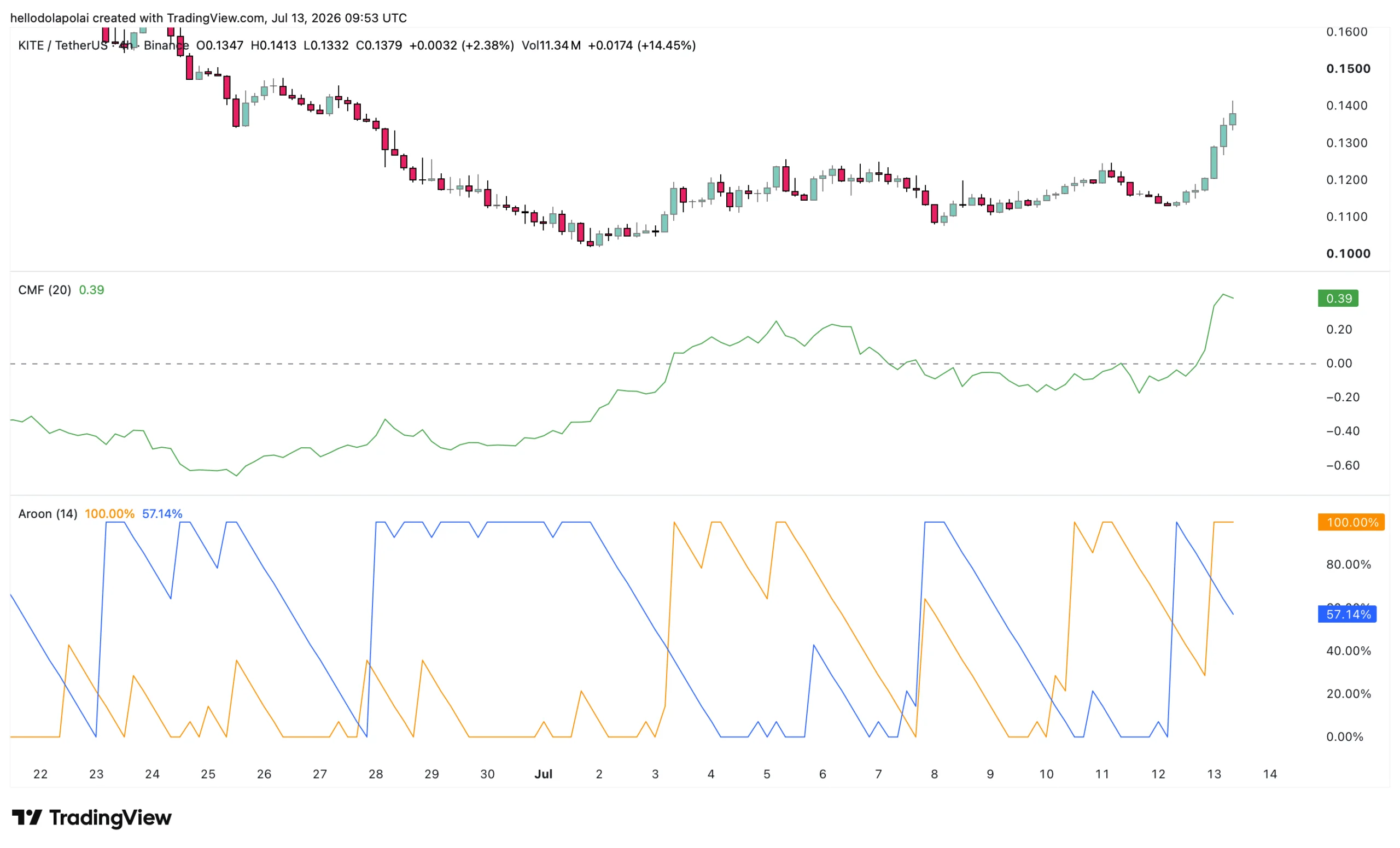
Buyer pressure no longer held the strength it carried earlier either. The Chaikin Money Flow (CMF) stood out as one key indicator reflecting that decline. The overall CMF trend had a reading of 0.39, but a slight downtick alluded to a hike in selling volume too.
Source: TradingView
While the reading did not really confirm a bearish trend, a sustained decline would send the price backwards in the short term. Unless the CMF flips into negative territory on the chart.
The press time placement of the Aroon Indicator added to this outlook. Especially as the Aroon Up sat at its maximum reading of 100% while the Aroon Down held at roughly 57%.
Until that gap widens to 100% on the Aroon Up and 0% on the Aroon Down, the market won’t be committed to a decisive bullish phase. A strengthening bull trend typically sustains those readings.
Spot data shows investors cashing out of KITE
Finally, spot market data seemed to confirm that investors may indeed be cashing out on KITE.
Spot Netflow data from CoinGlass hinted at a net sell, with Netflow reaching roughly $312,000, while total KITE sales over the period amounted to around $5.72 million.
When selling pressure climbs this high, the price tends to scale back, in line with the previous trend that tied these sales to KITE trading into the supply level on the chart.
Final Summary
KITE’s 23% surge drove it straight into the 0.786 Fibonacci resistance, a supply zone where stacked sell orders leave the asset exposed to a slide.
Spot Netflow turned negative at roughly $312,000 against $5.72 million in total sales.
A solo bitcoin miner recently hit the jackpot in a lottery-like stroke of luck, turning a modest investment into an outsized gain.
The miner equipped with a small, hobbyist-grade device called a Bitaxe recently struck Bitcoin block number 957,382 and walked away with 3.1382 BTC, worth roughly $200,000.
The miner was running the rig for just eight hours through the Public Pool service. His average hash rate? A measly 995 GH/s, or about 1 terahash per second.
This marks the second time a single Bitaxe has solo-mined a block on Public Pool.
It’s an open-source, credit-card-sized ASIC miner powered by the same Bitmain BM1370 chip found in massive industrial Antminer S21 machines. The Bitaxe Gamma version pumps out 1 to 1.3 TH/s while using just 15-21 watts of power. You can buy one for $60 to $150.
Think of it as the mining equivalent of winning the lottery with a scratch-off ticket from a gas station.
Solo mining is having a moment
This isn’t the first time a solo miner has made big gains on a small investment.
Silver (SI=F) September futures opened at $59.71 per ounce on Monday, July 13, 2026, 0.8% lower than Friday’s closing price of $60.17. The price of silver fell even further this morning, reaching $58.60 by 8:33 a.m. ET.
The price of silver opened lower this morning and has continued to trend lower amid ongoing exchanges of attacks between the U.S. and Iran. While the U.S. claims the Strait of Hormuz is still open, Iran has stated that the strait is effectively closed.
As a result, oil and gas prices are moving higher yet again, putting tangible strains on American wallets at a time when the Fed has vowed to get inflation back under control. Controlling inflation could involve raising interest rates, or at least keeping them at current levels for longer, a notable headwind for silver prices.
Current price of silver
The opening price of silver futures on Monday was down 0.8% compared to Friday’s close. Here’s how the opening silver price has changed versus last week, month, and year:
One week ago: -4.6%
One month ago: -10.9%
One year ago: +59.4%
For context, silver’s year-over-year growth was 173.3% on May 14.
Want to learn more about the current top-performing companies in the silver industry? Explore a list of the top-performing companies in the silver industry using the Yahoo Finance Screener. You can create your own screeners with over 150 different screening criteria.
How beginners can invest in silver
There are several ways to invest in silver, from buying the metal itself to choosing financial products tied to its price. Here’s how each option works.
Physical silver
The most direct way to invest in silver is to buy it in physical form, either as bullion bars or government-minted coins. This gives you direct ownership of the metal, with no counterparty risk from an exchange or financial institution.
The trade-off is logistics. You’ll need to think about storage, security, and potentially insurance. Dealers also charge a markup above the spot price, which means prices need to rise enough to cover that premium before you’re in profit. Still, for investors who want tangible ownership of their assets, physical silver is a straightforward option.
Silver ETFs
Silver exchange-traded funds (ETFs) trade on stock exchanges the same way individual stocks do. Some ETFs hold physical silver directly, giving shareholders fractional ownership of real metal. Others invest in silver mining companies rather than the commodity itself.
ETFs are generally the most accessible and liquid way to get silver exposure. You can buy and sell them through any standard brokerage account, and there’s no storage or insurance to worry about.
Keep in mind, though, that some silver funds are taxed as collectibles rather than investments, which can mean a higher tax rate. It’s worth confirming the tax treatment with a professional before investing. You’ll also have to keep an eye on expense ratios.
Whether you’re tracking the price of silver since last month or last year, the price-of-silver chart below shows the precious metal’s value journey so far this year.
West Texas Intermediate crude futures have surged to nearly $80 a barrel from $67 at the start of the month, stoking fresh concerns about inflation.
Focus on CPI and Warsh testimony
Investors will receive a fresh read on price pressures Tuesday when the Labor Department releases the June consumer-price index at 8:30 a.m. ET.
Economists surveyed by Bloomberg forecast that headline CPI will fall below a 4% annual rate. The report is expected to show the first declines in both headline and core inflation since January, following May’s readings of 4.2% and 2.9%, respectively.
Even if the figures meet expectations, they risk being viewed as backward-looking in light of the recent oil price surge. Should inflation instead prove more persistent, the data could amplify concerns about the Fed’s path forward.
Attention will then turn to Mr. Warsh’s testimony on Capitol Hill. Given the Fed chair’s preference for limited forward guidance, investors will be watching closely for any signals on rates and inflation.
According to analysts at ING, he could “if he chooses, emphasize the tameness of inflation expectations.”
They added that Mr. Warsh “has enough ammunition here to ride the rate hike risk and instead hold pat. Even if he comes under pressure to hike, the richness attached to the 5yr part of the curve tells us that any hike (if delivered) is likely to be subsequently reversed, with the prospect still for bigger cuts than hikes.”
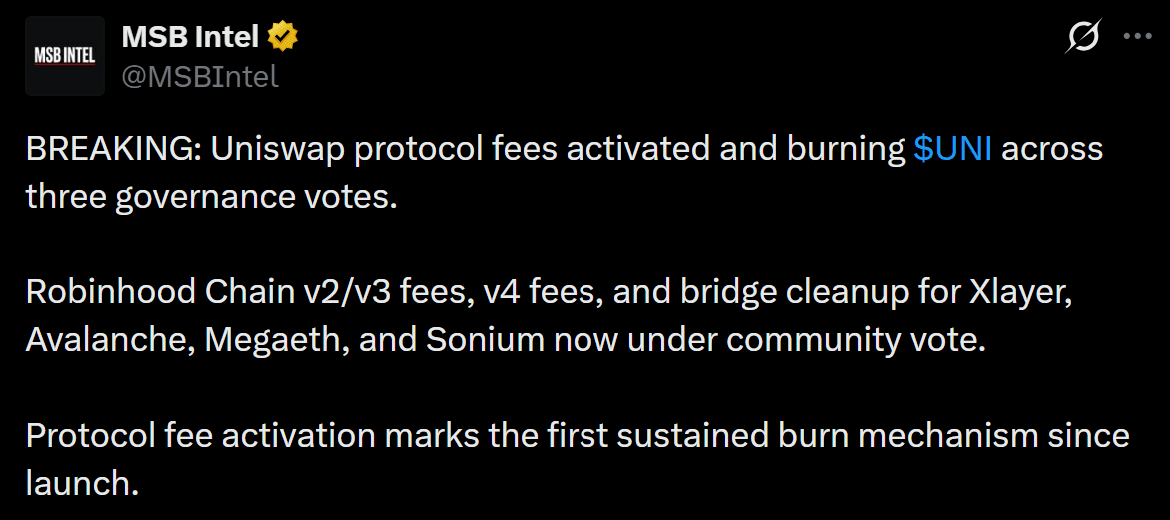
Uniswap [UNI] has opened community voting on a proposal that could introduce the protocol’s first sustained UNI burn mechanism. The initiative spans three governance votes.
They include protocol fee activation on Robinhood Chain, v4 deployment, and bridge infrastructure across all other chains.
If Uniswap members approve the proposals, the protocol will begin depositing fees into TokenJar accounts. At press time, the voting stood at 74% in support of the proposal.
Once there, users can acquire an amount of UNI sufficient to burn it completely and in turn collect their UNI from the TokenJar account.
Source: X
The proposal will link the supply of UNI with the actual use of the protocol rather than just providing incentives through governance.
Protocol revenue strengthens UNI value capture
That potential shift becomes more meaningful when viewed alongside Uniswap’s growing protocol revenue. Every increase in trading activity would generate additional fees, creating more opportunities to remove UNI from circulation through the proposed burn mechanism.
Currently, according to DefiLlama data, Uniswap generates approximately $5 million per day in fees. Moreover, its annual protocol revenue stands near $50 million.
As v4 deployments and Robinhood Chain attract more trading volume, fee generation could continue expanding.
Despite that, the projected burn rate remains modest relative to UNI’s total supply. Still, the mechanism introduces a lasting connection between protocol usage and token scarcity.
If network activity continues growing, UNI’s long-term value could increasingly reflect organic protocol demand rather than governance incentives alone.
Robinhood Chain tests Uniswap’s growth strategy
Whether the burn mechanism delivers meaningful results now depends on user adoption rather than governance alone. Robinhood Chain has quickly become an early test of that thesis after surpassing $1 billion in cumulative swap volume within days of launch.
That momentum suggests Uniswap’s ecosystem is reaching users beyond its traditional base. Rising wallet interactions and swap activity further indicate participation extends beyond speculative interest.
However, sustained success will depend on retaining those users over time. If daily transactions and liquidity continue expanding, Robinhood Chain could become an increasingly important contributor to Uniswap’s long-term protocol growth.
Final Summary
Uniswap could link long-term token value to protocol usage through its proposed fee-funded burn mechanism.
Uniswap adoption on Robinhood Chain will determine whether sustained burns meaningfully strengthen token scarcity.
A quiet transformation is happening inside America’s largest corporations. And actually, most people have no idea it is occurring.
The pension funds and 401(k) plans covering millions of American workers are increasingly being handed over to Wall Street‘s elite firms to manage. Why? It’s like the companies sponsoring those plans no longer believe they can do it themselves.
The trend is now impossible to ignore. Goldman SachsGS) confirmed July 9 that it had won mandates to manage a combined $70 billion in retirement assets for two of America’s most iconic companies: Verizon Communications Inc. (VZ) and Lockheed Martin Corporation (LMT).
The deal includes approximately $30 billion in pension assets for both companies and approximately $40 billion in Verizon’s defined-contribution retirement assets, typically 401(k) plans, according to Goldman.
No, it is not routine portfolio management. It is one of the largest corporate investment outsourcing wins in recent history, and it tells you something important about where the entire asset management industry is heading.
Goldman Sachs GS) confirmed the announcement on July 9. The firm’s outsourced chief investment officer (OCIO) business manages approximately $480 billion in assets as of March 31, according to company disclosures.
Why America’s biggest employers are handing their retirement plans to Goldman
The forces driving corporate America toward outsourced investment management are structural, not cyclical.
Corporate pension portfolios have become genuinely difficult to manage internally. Alternative assets, which include private equity, private credit, and infrastructure, have grown from roughly 5% of institutional portfolios to 30-50% in many cases, according to the April 2026 Praxis Rock report.
A typical corporate benefits team may have just a handful of internal staff. That lean team simply cannot source private equity deal flow, track capital calls, monitor complex distribution waterfalls, or even conduct meaningful due diligence across dozens of alternative managers simultaneously.
The second pressure is what Goldman has described as a “financial vortex” in its own 2025 Retirement Survey and Insights Report. Some worker groups facing competing financial priorities, including housing, debt, and caregiving, are demanding increasingly sophisticated retirement options.
More Goldman Sachs:
Personalized managed accounts, lifetime income solutions, and digital investment strategies are no longer niche products. They are what employees expect.
The third driver is operational speed. Traditional pension consulting works on a “consultant advises, committee decides” model that can slow significant portfolio adjustments by months.
Under the OCIO model that Goldman operates, the firm takes full discretionary control over manager selection, asset reallocation, and risk oversight. Corporate sponsors get a single accountable partner and faster execution.
“Large plan sponsors are consolidating responsibilities with one partner with the investment expertise and depth of platform to manage their bespoke needs,” said Marc Nachmann, Goldman’s global head of asset and wealth management, in the announcement.
The context behind Verizon and Lockheed Martin
Neither of these companies came to Goldman without a history. In a report by RGA, Verizon executed a massive pension risk transfer in 2024, offloading $5.9 billion in plan liabilities for 56,000 retirees to RGA Reinsurance and Prudential.
The Goldman OCIO mandate is the next phase of that multi-year strategy to reduce internal retirement management burden while protecting funded status gains.
Lockheed Martin has been one of the most active corporate pension de-riskers in the country. Back in 2018, we saw an $800 million transfer to Athene covering approximately 9,000 retirees, according to Athene.
Lockheed executed a $4.9 billion transfer in 2021 and an additional $4.3 billion transfer in 2022, collectively shifting tens of thousands of beneficiaries to insurance company annuity coverage, Lockheed reported.
Moving investment management to Goldman represents the logical next step in the same framework: reduce complexity, transfer risk, and focus internal resources elsewhere.
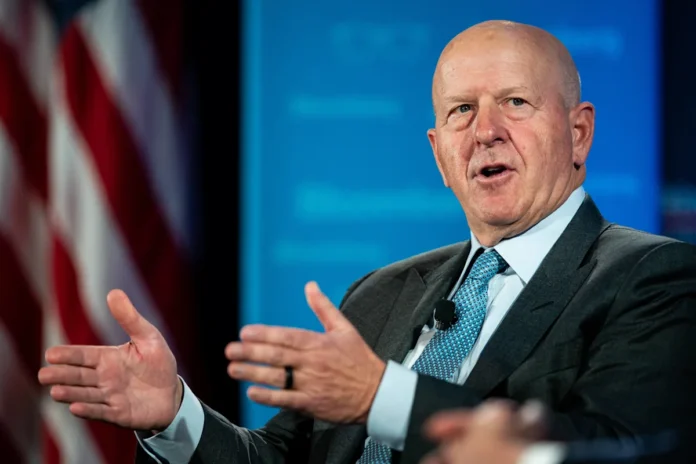
Goldman Sachs’ Asset and Wealth Management division generated $16.68 billion in full-year 2025 net revenues. The division currently oversees approximately $3.7 trillion in total assets.Paul Yeung/Bloomberg via Getty Images
Why Goldman wants this business, the revenue strategy behind the mandate
My read of the Goldman strategy here is this. The firm’s financial disclosures also make it explicit.
Goldman’s Asset and Wealth Management division generated $16.68 billion in full-year 2025 net revenues, including a record $11.54 billion in management and other fees, according to the 2025 Annual Report.
That fee revenue has grown at a 12% compound annual growth rate since 2021. The division oversees approximately $3.7 trillion in total assets, according to Goldman Sachs.
The attraction of OCIO mandates is the revenue profile. Long-term institutional mandates generate steady, recurring fee income that does not fluctuate with trading volumes or deal flow.
Goldman’s trading and investment banking revenues are inherently volatile. Growing the fee-based asset management business creates a structural buffer against those swings.
In Q1 2026 alone, Goldman reported $62 billion in long-term fee-based net inflows, marking the firm’s 33rd consecutive quarter of positive long-term inflows, according to the Q1 earnings presentation.
Net revenues in Asset & Wealth Management were $4.08 billion in Q1, up 10% year over year, with management and other fees reaching $3.08 billion, according to the Q1F26 report.
Now, do I think Goldman Sachs can sustain the momentum of securing massive mandates like the $70 billion Verizon and Lockheed? Of course, yes.
It’s clearly evident that the mandate is layered onto a business already managing $480 billion in OCIO assets.
Opinions expressed by Entrepreneur contributors are their own.
Key Takeaways
Most entrepreneurs chase freedom — only to build businesses that trap them. Truly free entrepreneurs design the life they want first and then build a business model that is forced to support it.
Define the non-negotiable lifestyle milestones that set the trajectory for how you build your business, shift from high-touch to productized delivery, and hire outcome owners instead of task doers.
Reevaluate your high-demand clients, monitor your time to value generation ratio, and have an exit strategy in place.
Most entrepreneurs start a business because they want freedom. They envision a Tuesday morning at their child’s school event or a month working from a beachside resort without the constant, low-level anxiety of a standard 9-5. They trade the predictable grind of a corporate job for the promise of autonomy. They convince themselves that being the boss is the ultimate escape.
The challenge is that this reality often ends up being nothing more than a bait-and-switch. Along the way to building the business, the freedom disappears. Instead of creating a business that serves them, they accidentally build a prison filled with huge amounts of responsibility, stress and pressure. Their new “job” ends up demanding more of their time than any corporate boss. Instead of being the captain of the ship, they find themselves in the grimy engine room trying to keep the power on and patch every leak.
Most entrepreneurs assume this chaos is a lack of effort and double down to burn themselves out even further. They believe that once the company reaches success, they will eventually earn the right to be free. Truly free entrepreneurs do the complete opposite. They design the life they want first and then build a business model that is forced to support it.
1. Define your Champagne Moments first
In the startup world, there is an obsession with growth and revenue. While these are critical to the life and health of the business, too much focus on this metric can end up costing you your sanity. What’s the point of achieving $10M in revenue if you haven’t seen your family in six months?
Your Champagne Moments are non-negotiable lifestyle milestones that can set the trajectory for how you build your business. These moments become your North Star to drive your ongoing business decisions.
2. Shift from high-touch to productized delivery
One of the biggest bottlenecks in most companies is the founder’s brain. If your services require your specific expertise to be delivered, you’re operating a high-paid freelance gig instead of a business. This creates a hard growth ceiling and blocks your ability to scale your time.
To reclaim your freedom, you have to productize what you do by turning your expertise into a repeatable system that can be executed autonomously or by anyone else on the team. Freedom starts when you stop being the one doing the work and shift to the one who owns the machine.
3. Hire outcome owners instead of task doers
Entrepreneurs often fall into the trap of “I’ll just do it myself.” This happens because they falsely believe that no one else can meet their standards. If this sounds like you, it could be a sign that you’ve hired doers rather than outcome owners. The last thing you want is to hire people who just wait to be provided a checklist before taking action. This creates an environment where every tiny decision falls on your shoulders.
Instead, true freedom comes from hiring people who are capable of taking responsibility and owning specific results or parts of the delivery process. It’s important to have people on your team who can take expectations and turn them into actions.
4. Reevaluate your high-demand clients
Not all revenue is good revenue. We’ve all had those clients who pay well, but are highly demanding. These types of clients are counterproductive to creating a business that generates true freedom. When clients expect midnight email responses and constant hand-holding, they are a drain on your resources and mental load.
On the other hand, clients who value your standard processes and don’t expect customized solutions require significantly less stress. While firing a high-paying client can be a scary thought for any entrepreneur, it’s sometimes a necessary step toward reclaiming your peace of mind.
5. Monitor your time to value generation ratio
Many entrepreneurs measure their success by the size and value of their company. What they often fail to evaluate is the amount of personal effort required to get there. Making half a million dollars a year looks great on paper, but not so much if the cost is working 100 hours a week.
Instead, focus on tracking and increasing your profit per founder hour. This simple measurement will force you to rethink and remove any low-value tasks that create more strain on your freedom and schedule than they’re worth.
6. Always have an exit strategy
You’ve worked hard to build a successful business. Congrats! The challenge is that you’ve probably been so busy focused on operating the business that you haven’t considered what comes next. Having an exit strategy is important to building a business centered around freedom. This doesn’t mean you intend to actually walk away from the business. However, having a solid exit strategy means that the business no longer needs you. That’s where you find true freedom.
The best way to do this is to make sure that you have a robust set of Standard Operating Procedures (or SOPs). These documented guidelines are a valuable asset to ensure that you can step away from the business at any time and nothing bad will happen.
Moving from an operator to a freedom-focused architect can be a psychologically jarring experience for entrepreneurs. We want to be in control and chase success at every corner. Building a business around your desired lifestyle and freedom will require you to check your ego at the door. It will require trusting a system over your gut instincts or flying by the seat of your pants. But the world doesn’t need more burnt-out founders who sacrifice their lives, family and friends for superficial “success.” Instead of building a business with the hope you’ll eventually gain freedom, start by designing your business around the freedom you want.
Key Takeaways
Most entrepreneurs chase freedom — only to build businesses that trap them. Truly free entrepreneurs design the life they want first and then build a business model that is forced to support it.
Define the non-negotiable lifestyle milestones that set the trajectory for how you build your business, shift from high-touch to productized delivery, and hire outcome owners instead of task doers.
Reevaluate your high-demand clients, monitor your time to value generation ratio, and have an exit strategy in place.
Most entrepreneurs start a business because they want freedom. They envision a Tuesday morning at their child’s school event or a month working from a beachside resort without the constant, low-level anxiety of a standard 9-5. They trade the predictable grind of a corporate job for the promise of autonomy. They convince themselves that being the boss is the ultimate escape.
The challenge is that this reality often ends up being nothing more than a bait-and-switch. Along the way to building the business, the freedom disappears. Instead of creating a business that serves them, they accidentally build a prison filled with huge amounts of responsibility, stress and pressure. Their new “job” ends up demanding more of their time than any corporate boss. Instead of being the captain of the ship, they find themselves in the grimy engine room trying to keep the power on and patch every leak.
Most entrepreneurs assume this chaos is a lack of effort and double down to burn themselves out even further. They believe that once the company reaches success, they will eventually earn the right to be free. Truly free entrepreneurs do the complete opposite. They design the life they want first and then build a business model that is forced to support it.