Home Blog Page 267

Mortgage and refinance interest rates today, Saturday, July 11: Rates moving lower today

0
Mortgage and refinance interest rates today, Saturday, June 13, 2026: All rates moving lower


According to average rates from the Zillow lender marketplace, the current 30-year fixed rate fell by 3 basis points to 6.44%, the 15-year fixed rate fell by 9 basis points to 5.82%, and the 5/1 ARM fell by 3 basis points to 6.43%.

Read more: Weekly survey of mortgage lenders with the lowest rates: Rates bubble higher

Here are the current mortgage rates today, Saturday, July 11, 2026, according to the latest Zillow data:

  • 30-year fixed: 6.44%

  • 20-year fixed: 6.21%

  • 15-year fixed: 5.82%

  • 5/1 ARM: 6.43%

  • 7/1 ARM: 6.35%

  • 30-year VA: 5.88%

  • 15-year VA: 5.43%

  • 5/1 VA: 5.66%

Remember, these are the national averages and are rounded to the nearest hundredth.

Read more: Discover 8 strategies for getting the lowest mortgage rates

These are today’s mortgage refinance rates, Saturday, July 11, 2026, according to the latest Zillow data:

  • 30-year fixed: 6.52%

  • 20-year fixed: 6.11%

  • 15-year fixed: 5.89%

  • 5/1 ARM: 6.55%

  • 7/1 ARM: 6.58%

  • 30-year VA: 5.88%

  • 15-year VA: 5.42%

  • 5/1 VA: 5.44%

Again, the numbers provided are national averages rounded to the nearest hundredth. Mortgage refinance rates are often higher than rates when you buy a house, although that’s not always the case.

Read more: Want to refinance your mortgage in 2026? Here’s what to do.

Use the mortgage calculator below to see how today’s interest rates would affect your monthly mortgage payments.

Mortgage payment calculator

Mortgage payment breakdown

81% Principal & interest

$2,151


You can bookmark the Yahoo Finance mortgage payment calculator and keep it handy for future use, as you shop for homes and the best mortgage lenders. You also have the option to enter costs for private mortgage insurance (PMI) and homeowners’ association dues, if applicable. These details result in a more accurate monthly payment estimate than if you simply calculated your mortgage principal and interest.

There are two main advantages to a 30-year fixed mortgage: Your payments are lower, and your monthly payments are predictable.

A 30-year fixed-rate mortgage has relatively low monthly payments because you’re spreading your repayment out over a longer period of time than with, say, a 15-year mortgage. Your payments are predictable because, unlike with an adjustable-rate mortgage (ARM), your rate isn’t going to change from year to year. Most years, the only things that might affect your monthly payment are any changes to your homeowners insurance or property taxes.

The main disadvantage of 30-year fixed mortgage rates is the mortgage interest, both in the short and long term.

A 30-year fixed term comes with a higher rate than a shorter fixed term, and it’s higher than the intro rate to a 30-year ARM. The higher your rate, the higher your monthly payment. You’ll also pay much more in interest over the life of your loan due to both the higher rate and the longer term.

The pros and cons of 15-year fixed mortgage rates are basically swapped with those of the 30-year rates. Yes, your monthly payments will still be predictable, but another advantage is that shorter terms come with lower interest rates. Not to mention, you’ll pay off your mortgage 15 years sooner. So you could save hundreds of thousands of dollars in interest over the life of your loan.

However, because you’re paying off the same amount in half the time, your monthly payments will be higher than if you choose a 30-year term.

Learn more: Dig deeper into 15-year vs. 30-year mortgages

Adjustable-rate mortgages lock in your rate for a predetermined period, then adjust it periodically. For example, with a 5/1 ARM, your rate stays the same for the first five years and then goes up or down once per year for the remaining 25 years.

The main advantage is that the introductory rate is usually lower than what you’ll get with a 30-year fixed rate, so your monthly payments will be lower. (Current average rates might not necessarily reflect this, though — in some cases, fixed rates are actually lower. Talk to your lender before deciding between a fixed or adjustable rate.)

With an ARM, you have no idea what mortgage rates will be like once the intro-rate period ends, so you risk your rate increasing later. This could ultimately end up costing more, and your monthly payments are unpredictable from year to year.

But if you plan to move before the intro-rate period is over, you could reap the benefits of a low rate without risking a rate increase down the road.

Read more: Learn whether now is a good time to get an adjustable-rate mortgage

First of all, now is a good time to buy a house compared to a couple of years ago. Home prices aren’t spiking like they were during the height of the COVID-19 pandemic. So, if you want or need to buy a house soon, you should feel pretty good about the current housing market. 

Plus, despite the recent uptick, mortgage rates are lower than they were this time last year.

The best time to buy is typically whenever it makes sense for your stage of life. Trying to time the real estate market can be as futile as timing the stock market — buy when it’s the right time for you.

Learn more: Which is more important, your home price or mortgage rate?

According to Zillow, the national average 30-year mortgage rate is 6.44% right now. Why are Zillow’s rates usually different than those reported by Freddie Mac (which reported 6.49% this week) and elsewhere? Each source compiles rates by different methods, and rates are reported for different time frames. Zillow obtains rates from its lender marketplace and reports them daily, while Freddie Mac pulls information from loan applications submitted to its underwriting system and averages them for the week. However, mortgage rates vary by state and even ZIP code, by lender, loan type, and many other factors. That’s why it’s so important to shop with multiple mortgage lenders.

Are interest rates expected to go down?

According to the latest available forecasts, the MBA expects the 30-year mortgage rate to be between 6.4% and 6.5% through 2026. Fannie Mae predicts a 30-year rate of 6.4% through the end of the year.

Yes, they are, compared to yesterday. According to average rates from the Zillow lender marketplace, the current 30-year fixed rate fell by 3 basis points to 6.44%, the 15-year fixed rate fell by 9 basis points to 5.82%, and the 5/1 ARM fell by 3 basis points to 6.43%.

In many ways, securing a low mortgage refinance rate is similar to the process you used when you bought your home. Try to improve your credit score and lower your debt-to-income ratio (DTI). Refinancing into a shorter term will also land you a lower rate, though your monthly mortgage payments will be higher.


Source link

Hyundai’s ‘real world adoption of USDT’ cut transfers to 7 minutes: Details

0
Hyundai's ‘real world adoption of USDT’ cut transfers to 7 minutes: Details


South Korean automaker Hyundai is doubling down on stablecoins for internal transfers between its subsidiaries. 

During its testing stage, the automaker saw faster transfers between U.S and Mexico subsidiaries. Instead of the typical 4 hours or more for traditional interbank transfer methods, the firm said it took about 7 minutes to transfer Tether’s USDT between its two offices. 

Commenting on the test, Hyundai hailed stablecoin transfers as offering “overwhelming speed and superior stability” to conventional methods. The pilot involved Hyundai Motors Group-owned credit card firm Hyundai Card, Avalanche, Tether and payment integrator Axiym.

Source: Hyundai

For his part, Paolo Ardoino, Tether CEO, billed the move as an impressive “real world adoption of USDT.” Bo Hines, CEO of Tether U.S., scored the Hyundai move as “what the future of finance looks like.”

At the end of July, the automaker will conduct a similar test with Circle’s USDC and Visa for EU transfers. 

For Hyundai, this was a foundation for utilizing and scaling stablecoins for remittances between overseas subsidiaries. But its credit card division plans to go beyond internal transfers. The firm noted, 

Going forward, we will explore and continuously expand various businesses utilizing stablecoins, including international remittance and payment infrastructure.

This signals growing enterprise stablecoin adoption.

Stablecoin adoption wars: USDT vs. USDC

Stablecoins have graduated from a crypto experiment to a tool that addresses real global pain points: US dollar accessibility and cheaper, faster cross-border transfers. 

Although Euro-based stablecoins have also seen significant growth, they still have a smaller market share compared to US Dollar-based alternatives. 

But the USD-based segment has become increasingly competitive. The recent activation of the MiCA regime saw USDC gain significant ground over Tether’s USDT. 

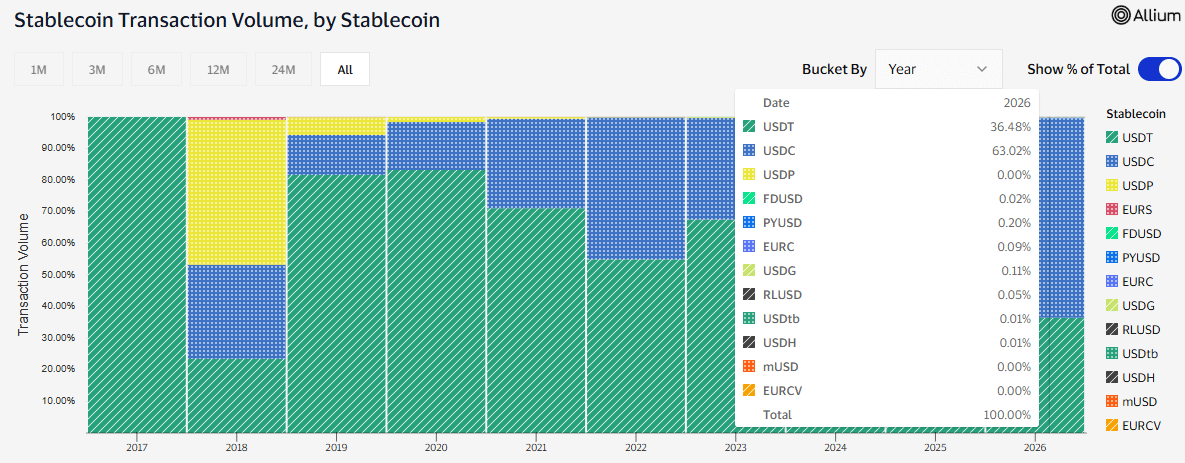
In fact, USDC currently accounts for 63% of annual stablecoin transaction volume (about $6T out of the total $9T). That was more than double Tether’s USDT volume of $3.3T (36%). 

Hyundai stablecoins
Source: Visa 

Worth pointing out that this was the first time USDC has led in annual stablecoin transfer volume. Whether the MiCA will allow USDC to maintain its dominance by the end of the year remains to be seen. 


Final Summary

  • Hyundai plans to scale internal stablecoin transfers using USDC and USDT 
  • USDC dominates 2026 stablecoin transfer volume at 63%, underscoring significant usage


Source link

People Who Don’t Know How to Code Make 6 Figures By Cashing In On the $4.7 Billion ‘Vibe Coding’ Boom

0
People Who Don’t Know How to Code Make 6 Figures By Cashing In On the $4.7 Billion ‘Vibe Coding’ Boom


Opinions expressed by Entrepreneur contributors are their own.

The four moves any non-coder can use to launch a one-person business this week.

Key Takeaways:

  • Discover what “vibe coding” really means — and why 63% of the people using it to build real businesses have never written a line of code.
  • Watch how one solo founder built a $401 million business in year one with $20K and his brother as his only employee.
  • Screenshot the exact Perplexity Computer prompts that reverse-engineer what four solo founders did to build their businesses — without figuring it out from scratch.

You have the idea. You have the laptop. You have every AI tool on the market open in a tab. And you are still not launching anything.

That is the quiet frustration behind the biggest shift in one-person business formation of the last decade. The tools are here. Most solopreneurs are still waiting to feel technical enough to start. The founders in the video above stopped waiting — and the moves they made are not what most solopreneurs expect.

The four moves I break down in the video above are designed to fix that — starting with the one most non-coders skip.

“Vibe coding” is the term Andrej Karpathy, one of the co-founders of OpenAI, coined in early 2025 to describe a new way of building software. You describe what you want in plain English, an AI writes the code, and you refine it by conversation instead of syntax. It sounded like a joke a year ago. According to Startup Fortune, it is now a $4.7 billion market growing at 38% a year, with 63% of active users identifying as non-developers.

This is not a fringe movement. Axios reported in June that Americans are starting one-person businesses 20% faster than they were a year ago, while startups planning to hire employees have stayed flat — a shift Nasdaq’s economists tie to autonomous coding tools. Intuit’s 2026 AI Impact Report, built on more than 34,000 SMB owners, found that 43% of AI-using businesses say AI has increased their revenue, versus just 2% who say it has gone the other way.

That compression is what Rule 5 of my book, The Wolf Is at the Door, is really about. In a world where the software builds itself, adaptability is no longer about learning faster than the market — it is about shortening the loop between what you see and what you launch. The reason a solo founder can now sell a company for $401 million with almost no employees is not that AI made him smart. It is that AI has collapsed the reaction time that used to give bigger competitors the advantage. That opportunity is now in your hands, no seven-figure marketing budget required.

This weeks video breaks down how Matthew Gallagher launched Medvi in two months with $20K and his brother as his only employee, how Billy Howell charges $750 to $2,500 per app with no coding background, how the creator behind BridgeMind made $42,630 in 142 days building live on YouTube, and how KEV hit $100,000+ in revenue and 67,000 users across four apps — plus the four Perplexity Computer prompts to reverse-engineer their moves in your own business this week.

Every founder, every move and every prompt is walked through in the video above — including the four Perplexity Computer prompts that turn what took these founders months of trial and error into a single afternoon of work.

The free AI Success Kit, available to download for a limited time, comes with a free chapter from my new book, The Wolf is at The Door – How to Survive and Thrive in an AI-Driven World.

The four moves any non-coder can use to launch a one-person business this week.

Key Takeaways:

  • Discover what “vibe coding” really means — and why 63% of the people using it to build real businesses have never written a line of code.
  • Watch how one solo founder built a $401 million business in year one with $20K and his brother as his only employee.
  • Screenshot the exact Perplexity Computer prompts that reverse-engineer what four solo founders did to build their businesses — without figuring it out from scratch.

You have the idea. You have the laptop. You have every AI tool on the market open in a tab. And you are still not launching anything.


Source link

XRP price jumps 2% on bitcoin strength as buyers push through $1.10 resistance

0
XRP price jumps 2% on bitcoin strength as buyers push through $1.10 resistance

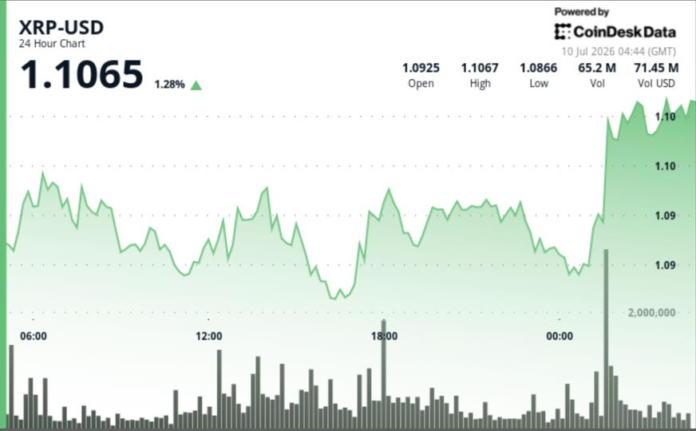
• The main breakout came around 01:00 UTC, when volume jumped to 43.51 million XRP, about 88% above the 24-hour average.

• The move carried XRP to an intraday high of $1.1065 before price stabilized near $1.1020-$1.1040.

• A later 60-minute spike reached 14.17 million in volume, pushing XRP from $1.0958 to $1.1052 before profit-taking slowed the move.

Technical Analysis

• The key development is that XRP cleared the $1.0950-$1.1000 area after several sessions of range-bound trading.

• The breakout was supported by volume, which gives the move more weight than the earlier low-volume attempts above resistance.

• Higher lows through the session show buyers are stepping in earlier, with $1.0880 acting as the main support level during pullbacks.

• The post-breakout hold near $1.1020-$1.1040 is constructive because XRP did not immediately lose the $1.10 area after the spike.

• The next test is whether buyers can keep XRP above $1.10 long enough to challenge $1.1065 and then $1.13.

What traders should watch

• $1.10 is the immediate support level after the breakout.

• $1.0880 is the next level to watch if XRP slips back into its prior range.

• $1.1065 is the first resistance after marking the session high.

• $1.11 is the next psychological level, followed by $1.13 if momentum continues.


Source link

Gold prices today, Friday, July 10, 2026: Gold finally opens higher this morning

0
Gold prices today, Friday, July 10, 2026: Gold finally opens higher this morning


Gold (GC=F) August futures opened at $4,135.40 per troy ounce on Friday, July 10, 2026, up 1.2% from Thursday’s opening price. The gold price moved slightly lower this morning to $4,115.10 at 8:00 a.m. ET.

Gold prices opened higher this morning, reversing a trend of opening lower each day so far this week. Today’s opening price for gold is 1.2% higher than Thursday’s opening price, but still 1.2% lower than where prices began this week.

Gold spent much of the week falling because the U.S. and Iran reengaged in military conflict this week, sending oil prices higher and putting a permanent peace deal with Iran in real jeopardy. Oil prices (BZ=F) are currently up 7.1% over the last five days, putting rising inflation back at the forefront of Fed discussions.

Despite these renewed inflation worries, there is just a 25.1% chance the Fed will raise rates following their two-day meeting at the end of July. That percentage jumps to nearly 50% following their September meeting, according to the latest percentages in the CME Group’s FedWatch tool.

The opening price of August gold futures on Friday was 1.2% higher compared to Thursday’s opening price. Here’s a look at how the gold price has changed versus last week, month, and year:  

  • One week ago: +1.7%

  • One month ago: -1.5%

  • One year ago: +24.4%

On Jan. 29, gold’s one-year gain was 95.6%.

24/7 gold price tracking: Don’t forget you can monitor the current price of gold on Yahoo Finance 24 hours a day, seven days a week. 

Want to learn more about the current top-performing companies in the gold industry? Explore a list of the top-performing companies in the gold industry using the Yahoo Finance Screener. You can create your own screeners with over 150 different screening criteria.

A gold investment can add stability and inflation protection to your portfolio. But it can also dilute your gains when stock prices are rising quickly. Finding the right balance between gold’s diversification benefits and profiting from growth potential in other assets can be challenging. 

Even the experts are divided on how to achieve the correct balance. Below, five experts explain their recommended gold allocations, which range from 0% to 20%. 

Learn more: How to invest in gold in 4 steps

Robert R. Johnson, professor at Creighton University’s Heider College of Business, does not advocate gold investing. In his words, “while having a small position in precious metals may dampen portfolio volatility in the short-run, the tradeoff between slightly dampened volatility and the lost long-term return is certainly not a prudent one, particularly for Gen Z/millennials with long investing time horizons.”

Brett Elliott, director of content and SEO at American Precious Metals Exchange (APMEX), recommends setting an allocation that aligns with your investing goals. 

Growth-oriented investors may be comfortable with an allocation of 10% or 15%, according to Elliott. But income investors will prefer a smaller position, because gold provides no yield. A 2% to 5% gold allocation can provide some resiliency without an excessive drag on income potential. 

Learn more: Who decides what gold is worth? How gold prices are determined.

Blake McLaughlin, executive vice president at Axcap Ventures, said historical data support a gold allocation of 5% to 8%. “Gold may not offer the outsized return potential of private investments, but the metal holds a set of attributes that are increasingly hard to ignore,” according to McLaughlin. Those attributes include the metal’s resilience amid economic uncertainty and geopolitical unrest. 

Thomas Winmill, portfolio manager at Midas Funds, believes most investors will benefit from a long-term gold allocation of 5% to 15%. Winmill specifically advocates investing in gold mining companies through a mutual fund. 

Your risk tolerance and current mix of financial versus hard assets can guide you to an appropriate allocation, according to Winmill. 

  1. Risk tolerance: Keep your allocation percentage low if you tend to panic in volatile cycles.  

  2. Financial vs. hard assets: Financial assets are stocks and bonds. Hard assets include tangible items like real estate, gold, collectibles, classic cars, and equipment. If you have no home equity and your wealth is primarily in financial assets, you can set your gold allocation higher. Or, if your home is paid for and more valuable than your stock portfolio, gold investing may not be necessary.  

Learn more: Thinking of buying gold? Here’s what investors should watch for.

Vince Stanzione, CEO and founder at First Information, recommends a 20% gold allocation, specifically in physical gold or a gold ETF. Stanzione argues for a higher exposure to gold as a wealth protection strategy. As he says, “gold keeps with inflation and gold retains its purchasing power,” while paper currencies are devaluing around the world.   

Learn more: Gold IRA: Benefits, risks, and how it differs from a traditional IRA

Whether you’re tracking the price of gold since last month or last year, the price-of-gold chart below shows the precious metal’s change in value so far this year. 


Source link

Metaplanet announces join study to bring BTC-powered digital credit to Japan

0
Metaplanet announces join study to bring BTC-powered digital credit to Japan

“The four companies will examine issues in product design, the need for proof-of-concept initiatives, and the possibility of future issuance,” Metaplanet said in a statement. “At this time, nothing has been determined regarding issuance timing, terms, yield, product details, distribution methods, or the form of collaboration.”

Japan’s traditional credit market leans in favor of large corporations with public bond offerings. Mid-sized and growth companies often face high costs and operational burdens around issuance, sales, investor management, interest payments and redemptions, according to Metaplanet.

Digital credit could open the debt market to these smaller companies, bridging traditional capital markets with onchain technology, enabling 24/7 global trading and settlement, holder-level rights management, automated pro-rata interest calculations and transparent onchain payments/redemptions.

Key roles

Each company is bringing its own strength to the table. Metaplanet and its securities arm will design and create the new products that combine bitcoin with credit offerings. They’ll also handle selling them to investors, communicating with customers, and managing everything afterward.

JPYC will explore the use of its stablecoin in the process, making sure it can be used smoothly for payments and redemptions.

Progmat will provide a secure, regulated system for turning the products into digital tokens on the blockchain. This includes tracking ownership, handling transfers, and connecting everything to the stablecoin payments system.


Source link

Seller-paid rate buydown: How it works and how to ask for one

0
Seller-paid rate buydown: How it works and how to ask for one


A seller-paid rate buydown may be the mortgage-rate relief that hopeful homebuyers are looking for. Few house hunters might imagine the seller coming to their rescue, but it’s possible, and in some real estate markets, even likely. Here’s how.

When marketing a home-for-sale listing, sellers often need to generate more interest. That’s where open houses, advertising, and price reductions come into play. There are also seller concessions. Those are cash or closing-cost credits issued by the seller and used as incentives for potential buyers.

A rate buydown is a powerful marketing tool where the seller pays to lower the buyer’s mortgage rate.

➡ Read more: Seller concessions vs. credits

Rate buydowns can be either permanent or temporary.

A permanent seller-paid rate buydown is when the seller buys discount points to lower a buyer’s mortgage rate for the life of the loan. 

“If the seller is a builder, developer, or has other properties in the area, they may choose to offer a rate buydown versus a price cut, in order to maintain values and comps for their other properties,” Lindsey Harn, of the Lindsey Harn Group in San Luis Obispo, California, told Yahoo Finance. “Sometimes sellers also want to keep the comps high for their neighbors, or simply be stuck on hitting a certain sales price for their home.”

A temporary seller-paid rate buydown lowers the buyer’s mortgage rate only for a specified time. The seller makes a cash contribution to the mortgage escrow account to fund the temporary rate cut. For example, a 2-1 buydown lowers the rate by 2% in the first year and 1% in the second. For the third year and the remaining term of the loan, the borrower will pay the issued mortgage rate. 

“As a buyer, a temporary rate buydown can be great if you expect your income to increase over the next two to three years,” Harn said. “However, as a buyer, if you think rates are going to drop and you are going to want to refinance in the next two to three years, the funds spent on the rate buydown can be a ‘waste’ of money.”

Read more: Temporary vs. permanent rate buydown

Negotiating the purchase of a home will fall to your buyer’s agent. However, if you’re interested in exploring a seller-paid rate buydown, it’s worth asking your agent if the local real estate market is prone to such seller concessions. It’s also not a bad idea to get a second opinion or two.

If you’re seeing other listings similar to the one you’re pursuing that promote buydowns, press the matter with your agent, politely, of course. Some agents are better than others at negotiating a deal. 

If you’re a hands-on negotiator, make sure you:

  • Have a mortgage preapproval in hand. 

  • Have researched your local real estate market. A buyer’s market is more conducive to seller concessions, such as rate buydowns. 

  • Know the cost of the buydown you’re proposing by talking to your lender.

  • Have your real estate agent put the specific buydown details in your purchase agreement or counteroffer.

  • A lower interest rate can enhance the affordability of a home purchase.

  • A seller-paid rate buydown may be more valuable to a buyer than a price cut on the house. Use a mortgage payment calculator to run various scenarios. 

  • Even a temporary buydown can help new buyers transition to homeownership by providing a budget cushion for moving expenses, furniture, or home improvements.

  • A temporary buydown might put you in a budget squeeze when the higher interest rate kicks in to your monthly payment.

  • A permanent buydown lowers only your interest rate. A price cut of an equal amount may also lower your property taxes.

  • Depending on the type of loan, there are limits to seller concessions, most commonly ranging from 3% to 6%, though up to 9% on conventional loans with more than 25% down.

One discount point generally reduces a mortgage rate by about 0.25%, so for a life-of-the-loan 1% reduction in the interest rate, four discount points would be required. That would equal 4% of a home’s purchase price. For example, on a $400,000 home, four discount points would cost $16,000.

A 2% buydown can be either a permanent or a temporary interest rate reduction. A seller may offer to lower the buyer’s mortgage rate by 2% for the first year, such as in a 2-1 buydown, or for the life of the loan. 

A seller can generate more buyer leads by offering a temporary rate buydown. This is particularly useful in a buyer’s market, where there are more homes for sale than there is demand. 

➡ Read more: Understanding housing inventory

Under the right circumstances, both the buyer and seller can benefit. A buyer can get a lower mortgage rate, and the seller can drive more interest to their listing — and perhaps do it at a lower cost than reducing the asking price. 


Source link