Home Blog Page 266

Got $10,000? Broadcom vs Marvell: Only One Will Match The AI Hype

0
Wall Street Thinks AI Is Slowing. Wall Street Is Wrong


Quick Read

  • AVGO generated $10.8 billion in AI silicon revenue, up 143% year over year, while MRVL converted 76% of its $2.4 billion quarter from data centers.

  • Broadcom’s 46% free cash flow margin funds buybacks and dividends; Marvell’s acquisition spree cut GAAP net income by 81% last quarter.

  • Act now: the analyst who called NVIDIA in 2010 just named his top 10 AI stocks — and Broadcom didn’t make the cut. Grab the names FREE today.

Broadcom (NASDAQ: AVGO) and Marvell Technology (NASDAQ: MRVL) both just delivered AI-fueled quarters, but the businesses behind the tickers look nothing alike.

Quality Stock Arts / Shutterstock.com

Broadcom is a $1.76 trillion platform pairing custom silicon with VMware software. Marvell is a focused data center specialist leaning into optics and interconnects. Both reported AI acceleration. Only one has scale to match the hype.

Custom XPUs Carry Broadcom. Optics Carry Marvell.

Broadcom’s Q2 FY2026 landed with $22.19 billion in revenue, up 47.87% year over year, with non-GAAP EPS of $2.44. The real story sits inside semiconductors.

AI silicon revenue reached $10.8 billion, growing 143%, driven by custom AI accelerators (XPUs) and Ethernet networking silicon sold to a small group of hyperscalers. CEO Hock Tan told investors “the momentum continues and in Q3 we expect semiconductor revenue from AI to grow over 200% year-over-year to $16.0 billion.” That is a bold call for one quarter.

Marvell’s Q1 FY2027 came in at $2.418 billion, up 27.57%, with the data center segment now 76% of revenue at $1.83 billion.

CEO Matt Murphy pointed to “exceptional AI-related bookings” across 800G and 1.6T scale-out optics, 51.2T Ethernet scale-out switches, scale-up optical solutions for NPO and CPO applications, scale-across datacenter interconnect modules, and custom XPU and XPU-attach solutions. Translation: Marvell wants to own the wiring between accelerators.

Act now: the analyst who called NVIDIA in 2010 just named his top 10 AI stocks — and Broadcom didn’t make the cut. Grab the names FREE today.

Scale vs. Specialization

Business Driver

Broadcom

Marvell

Main growth engine

Custom AI XPUs and Ethernet

800G/1.6T optics, DCI, XPU-attach

AI mix of revenue

$10.8B AI semis

$1.83B data center

Software leg

VMware, $7.18B

None

Next quarter guide

$29.4B, +84% YoY

$2.7B, ~35% YoY

Broadcom’s 46% free cash flow margin and 69% adjusted EBITDA margin let it fund a growing dividend and a $10 billion buyback authorization.

Marvell is spending differently: it closed acquisitions of Celestial AI and XConn Technologies in February 2026, and raised $2 billion in convertible preferred. The tradeoff showed up in GAAP net income, which fell 80.61% on a $331.8 million contingent consideration charge. Growth by M&A is not free.

What I’m Watching Next

Broadcom needs to actually hit that $16 billion AI number in Q3. Since the June 3 report, AVGO has fallen 22.5% to $370.78, suggesting investors are pricing in real execution risk.

Marvell, by contrast, is up 16.1% since its May 27 earnings report, helped by S&P 500 inclusion. I want to see whether Murphy can convert 800G optics bookings into sustained gross margin inside the guided 58.25% to 59.25% range.

Why I Lean Broadcom for Quality, Marvell for Torque

If you want durable AI exposure with a software cushion and a real dividend, Broadcom is the cleaner story to me. The cash flow is enormous, and analyst targets sit at $523.73 versus today’s price, with 44 buy ratings. I stay skeptical of the 200%+ AI guide until we see it.

If you want higher variance and can stomach dilution, Marvell fits a turnaround-plus-growth profile better, especially with a P/E near 85 that only works if optics scale as promised. The two stocks suit different risk appetites rather than a combined position.

Act now: the analyst who called NVIDIA in 2010 just named his top 10 AI stocks — and Broadcom didn’t make the cut. Grab the names FREE today.

Contact editorial@247wallst.com for any questions or corrections.


Source link

High rents are forcing non-college-educated men to live at home and fall out of the labor market

0
High rents are forcing non-college-educated men to live at home and fall out of the labor market

There’s a version of American manhood that used to run on a simple script: leave home, get a job, build a life. Now, however—and rather increasingly—men are falling out of the workforce, just as women outnumber them for the third time in history. This, coupled with the lowest labor force participation rate in years, is causing huge concern for economists who are predicting real-world consequences for years to come.

Men are nearly twice as likely as women to be living with their parents, and a new study says it’s particularly harmful for noncollege-educated men, who are less likely to hold jobs compared to their college-educated counterparts.

As rents have surged across the country, more and more men are moving home, and once there, many stop working. In fact, one in six noncollege men (16%) now live with their parents, compared to 8% of college-educated men. A recent working paper from Gabrielle Penrose, a graduate student fellow at the American Institute for Boys and Men, follows six decades of U.S. Census data and draws a direct line between rising housing costs and the decline of male labor force participation.

“There are very real economic forces that are limiting the options for noncollege-educated men in the United States,” Penrose told Fortune. “Some of what we’re seeing is simply rational responses to a system that’s pricing them out.”

Since 1960, real rents in the United States have risen 150%. Over that same period, wages for men without college degrees have barely moved, thanks to automation, globalization, and the collapse of manufacturing. Penrose’s paper details that when rents rise, more Americans are forced back into the parental home. Men move home at nearly twice the rate of women. And noncollege-educated men who end up there, the data shows, are increasingly dropping out of the workforce.

For Scott Winship, a senior fellow and the director of the Center on Opportunity and Social Mobility at the American Enterprise Institute (AEI), the issue is doubly concerning because noncollege-educated men may face more disadvantages today than what they would have experienced in the ’60s when Penrose first started looking.

“Today, there are many fewer noncollege men than there were a generation ago, and so we should absolutely be concerned about noncollege-educated men today,” Winship told Fortune. “They are a more disadvantaged group than they were in previous generations, just because the share of young adults with a bachelor’s degree is up to 40% or so now, versus in the past, when it was much lower. And so that makes me worry.”

How are rent prices driving men to live at home?

A 10% increase in local rents raises the likelihood a non-college-educated man moves in with his parents by 1.1 percentage points. Penrose used geographic constraints like mountains, coastlines, and lakes as a research instrument in her paper and found that in areas where terrain limits construction and squeezes housing supply, costs are higher for reasons entirely unrelated to local wages or job prospects.

“In some areas, housing costs are higher not because people are earning more and driving up prices, but because there are limits to supply, because of geography: lakes, coastlines,” she said. “Housing is just more expensive there simply because it’s harder to build there.

“It would be surprising if cities with higher housing costs didn’t have more men living at home just because, almost by definition, they’re less affordable,” said Winship, who has studied men’s earnings over time at the AEI.

Simultaneously, the environment is almost enabling it, her paper says. Baby boomer parents, sitting on significant housing wealth, are better positioned than ever to absorb adult children.

“Providing for your adult children when they’re priced out of the housing market is kind of a ‘normal good,’ as economists call it, something people spend more on as they get richer,” Penrose said. “Parents are earning more, and their sons are earning less.”

The data backs it up, according to Brandi Snowden, the National Association of Realtors’ director of member and consumer survey research.

“Baby boomers continued to make up the largest share of recent homebuyers,” she told Fortune while referring to NAR’s 2026 Generation Trends report that showed one-quarter of baby boomers purchased a multigenerational home recently. “This allowed them to care for aging parents or relatives and accommodate adult children that may be moving back into their house, or who have never left.”

The share of men between 25 and 45 living with their parents has nearly doubled since the 1960s, from 7% to 12% today. Women’s rate has also risen, but remains flat at 7%. And the reason the effect falls harder on men than women comes down largely to children. When Penrose isolates women without college degrees who don’t have children at home, their patterns begin to mirror men’s almost exactly.

“When I look at women without a college degree who do not have children, their labor force participation and their rates of living with parents start to look much more like these men,” she said. “The difference is young children.”

Why are young men falling out of the labor force?

The most consequential finding in Penrose’s paper is what happens after men move in. Men living with their parents are 20 percentage points less likely to be in the labor force than those living independently. That same 10% rent increase is associated with a 0.5 percentage point decline in labor force participation. Initial estimates suggest housing costs could explain roughly a third of the total employment decline among noncollege men.

“That’s not too surprising to me, just because if you’re looking at adults in their twenties or even thirties who are living at home, you’re looking at sort of the most disadvantaged guys in their cohort,” said Winship of Penrose’s findings. “So it makes sense that they’ve got other barriers to finding work, to keeping work—and that they’d be more likely to permanently drop out of the workforce.”

One in five noncollege men in their early thirties live with their parents, and the rate remains elevated into their forties, with roughly 14% at age 40. Among nonworking men at home, a quarter have never held a job at all, up from one in five in 1980.

“Some of the pushback I was getting is people saying: ‘Maybe men are using it as a launchpad,’” Penrose said. “That doesn’t seem to be the case. These men who are living with their parents are completely detached from the labor market.”

Zoning restrictions and limits on construction don’t just make cities expensive, they inadvertently suppress workforce participation among the men least equipped to absorb the cost. 

“Policies that restrict housing construction inadvertently weaken labor force participation by raising the price of independence,” Penrose wrote in the report.

“When we think about housing policy, maybe we’re just thinking about affordability, but it’s also about getting people in the position where they’re able to access the labor market,” she said. “Policies that would make housing cheaper in cities like New York should increase participation for men, particularly men without college degrees.”

Winship agreed with Penrose’s point, saying high cost of living cities like New York and San Francisco are often where people can find more job opportunities—but it comes with the double-edged sword of higher rents.

“It points to a real villain in the story, which is just these land use regulations and zoning that constrain how much housing can be built,” Winship said. “Unfortunately, it’s often the cities that are most economically dynamic and have a lot of amenities, that are actually better at promoting upward mobility, that have these problems with zoning. So that’s definitely an area where policymakers should take a look.”

What happens to marriage rates?

Women, for the third time ever in history, now outnumber men in the workforce. And as women earn more than their male counterparts, they perform more labor at home. Winship echoed previous reports of a growing distancing from traditional values of marriage as a major reason for this phenomenon.

“I think, sort of the sleeper issue, is the decline in marriage. In the past, a lot of these younger men and working class men would have been married, and therefore they could have tolerated higher housing costs without having to move back home,” Winship said. “But because marriage has declined so much, you have a lot of single men, especially among young adults, and more so among working class adults. And when housing is expensive, they’re much more likely to find that financially burdensome than in the past. I think that is kind of underlying a lot of the findings of the paper.

“If you’re a young man looking at the situation, you don’t see in the future that you’re going to need to be responsible for a family,” he concluded. “And they don’t really know what their role is in this new world where they’re not going to be the primary breadwinner. And so that pushes toward working less and potentially living at home with their parents. I think marriage really is the sleeper issue here.”

More on labor force participation rates:


Source link

Bitcoin treasury company Empery Digital sold about half of BTC stack

0
Bitcoin treasury company Empery Digital sold about half of BTC stack

Empery Digital (EMPD) on Friday announced the sale of 1,400 bitcoin for $62,200 each, generating $87.1 million in proceeds.

Earlier in July, the company said it would need $65 million to close its 25% ownership in a group acquiring a Midwest facility to be converted into an AI data center.

Empery was among the hastily formed SPAC deals during the 2025 digital asset treasury company frenzy. The results for the group haven’t been pretty, with most seeing share prices collapse by 90% or more from the 2025 highs.

In what could be part of the bottoming process for bitcoin and crypto, a growing group of these companies has become sellers of the digital assets they acquired in 2025.

Empery continues to hold 1,514 bitcoin but said it has no plans to accumulate more and may sell additional BTC to fund other opportunities.

“Going forward, we plan to continue to allocate capital to similar hyperscaler-anchored opportunities,” said co-CEO Ryan Lane.


Source link

These 5 Chip Stocks Are Riding the AI Fab Spending Wave

0
These 5 Chip Stocks Are Riding the AI Fab Spending Wave


Quick Read

  • Gary Dickerson raised AMAT’s 2026 semiconductor equipment growth forecast past 30%, while ONTO locked a $240 million HBM purchase agreement running through 2027.

  • Teradyne’s Q1 revenue surged 87% to $1.28 billion with roughly 70% tied directly to AI demand, as net income jumped 303%.

  • This lithium producer surpassed a $1B private valuation, joining some of America’s most powerful startups. Now you can invest in EnergyX alongside global giants like General Motors, but only through July 16. (sponsor)

Applied Materials (NASDAQ:AMAT) just told the Street its semiconductor equipment business will grow more than 30% in calendar 2026, an upward revision from a prior bar of 20%. That is the sound of an AI fab CapEx supercycle shifting from thesis to invoice, and the picks-and-shovel names selling into every foundry, HBM stack and gate-all-around node are the ones cashing the checks. Five stocks sit directly under that spending fire hose. Here is where the money is moving, in order.

Intel

1. Onto Innovation: The Advanced-Packaging Sleeper

Onto Innovation (NYSE:ONTO) is the name most retail investors still cannot spell, but it sits at the exact chokepoint AI needs: inspection and metrology for HBM stacks, 2.5D logic and gate-all-around devices. When TSMC and SK hynix bolt an accelerator together, Onto’s Dragonfly and Atlas tools decide whether the die passes or scraps. That is process control leverage on the fastest-growing corner of the fab, well beyond commoditized deposition.

The Q1 FY26 earnings report did the talking. Revenue hit a record $291.95 million, up 9.5% year over year, with the advanced nodes business tracking roughly 25% full-year growth. Onto also locked a volume purchase agreement worth more than $240 million with a leading HBM manufacturer running through 2027. CEO Mike Plisinski flagged “the accelerating adoption of our Atlas G6 OCD system for next-generation logic and memory devices” as the tell.

July 16 is the Final Day to Tap Into the Lithium Boom (sponsor)
General Motors, POSCO, and 50,000+ everyday investors have already backed lithium producer EnergyX.

Here’s why you should do the same before their July 16 investment deadline: lithium prices are up 75% this year, with demand projected to grow a staggering 5X by 2040.

With tech that can recover up to 3X more lithium than traditional methods, EnergyX is preparing to unlock up to 15M+ tons. Become a private-stage EnergyX investor before the July 16 deadline.

The stock action agrees. ONTO closed at $321.44 on July 10 after ripping nearly 94% higher year to date and more than 212% over the past year. The analyst target sits at $369.60 with seven of seven analysts at a Buy or Strong Buy rating. The bigger surprise is what a $479 billion incumbent is telling investors about 2026.

2. Applied Materials: The Heavyweight Raising Its Own Bar

Applied Materials is the broadest AI-fab exposure in the group. Deposition, ion implant, CMP, epitaxy, advanced packaging: If a wafer moves, Applied touches it. Gate-all-around transistor transitions and HBM DRAM stacking both pull disproportionate dollars per wafer, and Applied’s Precision Selective Nitride PECVD and Trillium ALD tools were built for exactly that geometry.

Q2 FY26 delivered a fourth straight beat: non-GAAP EPS of $2.86 versus $2.66 expected, revenue of $7.91 billion, up 11.4% year over year, and non-GAAP operating margin expanding to 32.1% from 30.7%. CEO Gary Dickerson bluntly raised the ceiling: “we now expect our semiconductor equipment business to grow more than 30% in calendar 2026.”

Shares reflect the move: AMAT closed at $602.50 on July 10, up 124.09% year to date. Forward P/E of 36 is not cheap, but with 28 Buy ratings against a single Strong Sell, the Street is not blinking. The next name goes narrower and hits harder on memory.

3. Lam Research: Etch, Deposition, and the HBM Stack

Lam Research (NASDAQ:LRCX) owns the etch and deposition tools required to build 3D NAND and stack HBM DRAM dies without wrecking yield. Every incremental HBM3E and HBM4 layer means more Lam content per wafer. That is why the memory recovery narrative and the AI CapEx narrative converge on this ticker.

Q3 FY26 was a record quarter across the board: EPS of $1.47 beat by 7.83%, revenue hit $5.84 billion, up 23.76% year over year, and operating margin expanded to 35.0% from 33.9%. Q4 guidance calls for revenue of roughly $6.60 billion. CEO Tim Archer framed it plainly: “Lam delivered record revenue and EPS in the March quarter as AI-driven demand reshapes the semiconductor industry.”

The stock closed at $350.33 on July 10, up 89.31% year to date and 246.66% over the last year. Analyst target is $357.77 with 29 of 35 analysts at a Buy or Strong Buy rating. Etch and deposition are the volume game. The next stock is the quality game, and it has monopoly economics.

4. KLA: The Process-Control Moat Nobody Can Bypass

KLA Corporation (NASDAQ:KLAC) does one thing better than anyone: tell foundries where the defects are before a wafer becomes a $30,000 doorstop. There is no advanced node, no HBM stack and no CoWoS package being built at scale in 2026 without KLA inspection and metrology on the floor. That is the moat, and it prints margins that look like software.

Q3 FY26 revenue was $3.42 billion, up 11.5% year over year, with the Semi Process Control segment doing $3.08 billion. The kicker is profitability: TTM operating margin of 41.2% and return on equity of 95%. Capital return matched the confidence: a 17th consecutive dividend increase to $2.30 per share and a new $7 billion buyback authorization. CEO Rick Wallace called KLA “a key enabler of the AI ecosystem” across foundry/logic, memory, advanced packaging, and services.

KLAC closed at $231.52 on July 10, up nearly 82% year to date. Solid, though the real punchline is a $56 billion test company whose AI exposure just detonated.

5. Teradyne: The AI Test Kingpin

Teradyne (NASDAQ:TER) tests the chips after everyone else builds them. Every accelerator, every HBM die, every networking ASIC gets validated on Teradyne automatic test equipment before it ships to a hyperscaler. Approximately 70% of Q1 revenue is tied to AI-related demand. There is no other name on this list with that level of direct AI concentration.

Q1 FY26 obliterated estimates. Revenue: $1.28 billion, up 87.04% year over year. Non-GAAP EPS: $2.56 versus $2.11 expected, a 21.15% beat. Non-GAAP operating margin expanded to 37.5% from 20.5% a year prior, and net income surged 303.36% to $398.9 million. CEO Greg Smith made the thesis explicit: “our results reflect the strength of our wafer to AI data center strategy.”

Shares closed at $359.60 on July 10, up 73.25% year to date and 264.63% over the past year. Analyst target is $423.41. Retail has noticed too: Reddit engagement spiked in mid-June with 263 upvotes and 73 comments in a single peak window on r/wallstreetbets. Robotics remains free optionality on top of the test franchise.

The Bottom Line

Applied Materials raised its 2026 growth bar past 30%, KLA green-lit a $7 billion buyback, Lam printed a record quarter, Onto locked HBM into 2027, and Teradyne grew revenue 87%. That is a coordinated capex flood, well beyond a simple rotation, and the equipment vendors are the toll booths. China export controls and tariffs remain the tail risk on all five names, but with hyperscaler capex still climbing and every advanced node needing more process control per wafer, the window for reasonable entry is narrowing quarter by quarter.

Meet America’s Newest $1b Unicorn (Sponsor)

A US startup just passed a $1 billion private valuation, joining billion-dollar private companies like OpenAI and ByteDance. Unlike those other unicorns, you can invest in EnergyX right now; but only until July 16.

Over 50,000 people already have, along with global giants like General Motors and POSCO.

Here’s why there’s so much interest: EnergyX’s patented tech can recover up to 3X more lithium than traditional methods. That’s a big deal, as demand for lithium is expected to 5X current production levels by 2040. Become an early-stage EnergyX shareholder before the 7/16 investment deadline.

Contact editorial@247wallst.com for any questions or corrections.


Source link

JPMorgan backs crypto bill as Donald Trump vows to ‘not sign other bills’ – What now?

0
JPMorgan backs crypto bill as Donald Trump vows to ‘not sign other bills’ – What now?


The House passed its version of the Digital Asset Market Clarity Act of 2025 nearly a year ago, but the bill is still in a tight spot. However, Mike Belshe, CEO of BitGo, recently pointed out that JPMorgan has shown full support for the CLARITY Act.

He said, 

Let that sink in. The world’s largest bank — long crypto-skeptical — is now publicly supporting crypto market structure legislation. This is a different ballgame.

What does this mean for the market?

Belshe emphasized that JPMorgan’s backing of the CLARITY Act is important because regulatory uncertainty has long been the largest obstacle. So banks, asset managers, pension funds, and investment advisers are likely to be encouraged to get ready for increased crypto participation.

Should the bill pass, it might make it simpler for institutional investors to confidently join the market, which could lead to a wider uptake of cryptocurrencies.

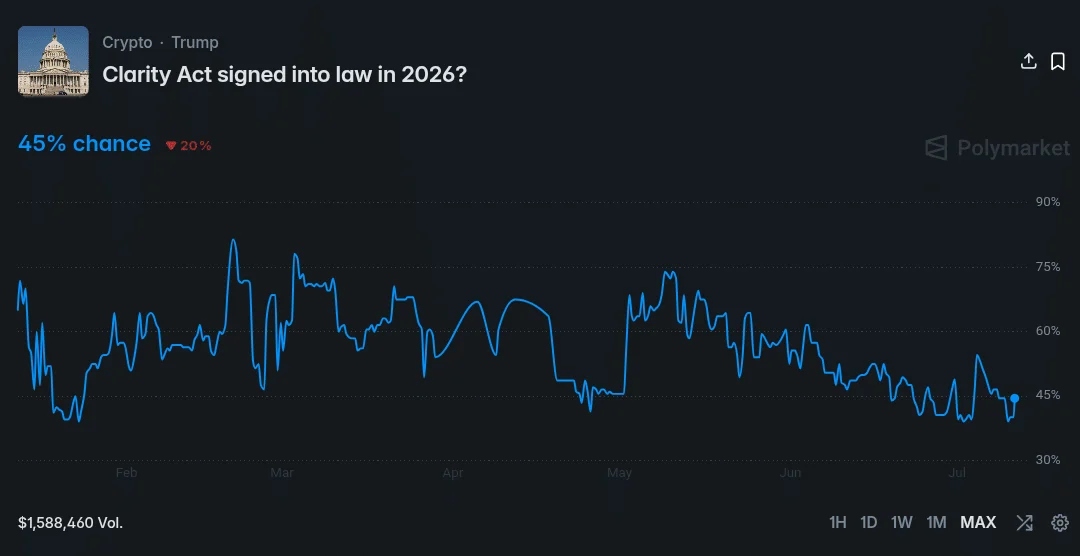
This occurs as the approval odds on Polymarket have dropped to 45%, a 20% decrease from 74% two months ago. 

Polymarket odds 20% drop
Source: Polymarket

Others supporting the passage of the CLARITY Act

However, regarding the approval, the community still appears to be in favor. 

For instance, Rep. French Hill is arguing that the best way to force lawmakers to reach a compromise is to give them a clear deadline to vote on the CLARITY Act before Congress starts its August recess.

Rather than leaving these activities in a regulatory gray area, Hill believes the CLARITY Act would subject them to defined standards and said, 

I’ve encouraged Senate leadership to put it on the floor. I think if you schedule a floor date here in the month of July, that will cause these final meetings, these final discussions to take place. You’ve got to have a deadline in Congress to get people to move and find consensus.

Supporters net increases

Not only this, the bill is also supported by Michael S. Selig, the 16th Chairman of CFTC, who said, 

The Clarity Act, talking to this future proof notion of making sure that crypto is here to stay.

Echoing similar sentiments, Joseph Lubin, Ethereum’s co-founder, added, 

Joseph Lubin on CLARITY ActJoseph Lubin on CLARITY Act
Source: Joseph Lubin/X

In fact, Democratic Senator Elizabeth Warren, who has been a stern supporter of the bill, recently put it best when she said, 

As currently drafted, the CLARITY Act is a ticket to sanctions evasion.

However, Trump has stated that he will “not sign other bills” until Republicans in Congress have passed the SAVE America Act. As a result, the CLARITY Act is now awaiting a new deadline of the 7th of August to advance.


Final Summary

  • JP Morgan, supporting the bill, has ignited fresh optimism for the approval of the CLARITY Act.
  • Though the Polymarket odds have fallen to the 45% Senators, CFTC chairman, Ethereum co-founder, and many others are demanding the bill’s approval. 


Source link

BTC, XRP, ETH price news: Strong in USD, lagging in yen

0
BTC, XRP, ETH price news: Strong in USD, lagging in yen

Early today, traders received Japan’s producer price index for June, which came in at 7.1%, the fastest annual increase since March 2023. The spike in wholesale inflation reinforced expectations for further Bank of Japan rate hikes. A former central bank official said Thursday that the BOJ may hike rates faster, potentially pushing them above 2%.

Note that the Japanese yen and Bitcoin have developed an unusually strong positive correlation, often moving in lockstep against the U.S. dollar. If that correlation holds, yen upswings may ultimately prove positive for bitcoin in general, even as BTC/JPY (and other crypto/JPY) pairs continue to lag in relative terms.

The GPIF Risk

The Government Pension Investment Fund (GPIF) of Japan manages roughly ¥277 trillion ($1.87 trillion) in assets, making it the world’s largest retirement fund. It invests heavily in global stocks and bonds.

Now the Japanese government wants the GPIF and other pension funds to invest more in local assets. Such a rotation could trigger volatility in global financial markets.

“The fund, one of the largest pension pools in the world, held 293.4 trillion yen, or roughly 1.81 trillion dollars, in assets at the end of December, maintaining roughly equal allocations across domestic equities, foreign equities, domestic bonds and foreign bonds,” analysts at InvestingLive said in a market update.


Source link

Mortgage and refinance interest rates today, Saturday, July 11: Rates moving lower today

0
Mortgage and refinance interest rates today, Saturday, June 13, 2026: All rates moving lower


According to average rates from the Zillow lender marketplace, the current 30-year fixed rate fell by 3 basis points to 6.44%, the 15-year fixed rate fell by 9 basis points to 5.82%, and the 5/1 ARM fell by 3 basis points to 6.43%.

Read more: Weekly survey of mortgage lenders with the lowest rates: Rates bubble higher

Here are the current mortgage rates today, Saturday, July 11, 2026, according to the latest Zillow data:

  • 30-year fixed: 6.44%

  • 20-year fixed: 6.21%

  • 15-year fixed: 5.82%

  • 5/1 ARM: 6.43%

  • 7/1 ARM: 6.35%

  • 30-year VA: 5.88%

  • 15-year VA: 5.43%

  • 5/1 VA: 5.66%

Remember, these are the national averages and are rounded to the nearest hundredth.

Read more: Discover 8 strategies for getting the lowest mortgage rates

These are today’s mortgage refinance rates, Saturday, July 11, 2026, according to the latest Zillow data:

  • 30-year fixed: 6.52%

  • 20-year fixed: 6.11%

  • 15-year fixed: 5.89%

  • 5/1 ARM: 6.55%

  • 7/1 ARM: 6.58%

  • 30-year VA: 5.88%

  • 15-year VA: 5.42%

  • 5/1 VA: 5.44%

Again, the numbers provided are national averages rounded to the nearest hundredth. Mortgage refinance rates are often higher than rates when you buy a house, although that’s not always the case.

Read more: Want to refinance your mortgage in 2026? Here’s what to do.

Use the mortgage calculator below to see how today’s interest rates would affect your monthly mortgage payments.

Mortgage payment calculator

Mortgage payment breakdown

81% Principal & interest

$2,151


You can bookmark the Yahoo Finance mortgage payment calculator and keep it handy for future use, as you shop for homes and the best mortgage lenders. You also have the option to enter costs for private mortgage insurance (PMI) and homeowners’ association dues, if applicable. These details result in a more accurate monthly payment estimate than if you simply calculated your mortgage principal and interest.

There are two main advantages to a 30-year fixed mortgage: Your payments are lower, and your monthly payments are predictable.

A 30-year fixed-rate mortgage has relatively low monthly payments because you’re spreading your repayment out over a longer period of time than with, say, a 15-year mortgage. Your payments are predictable because, unlike with an adjustable-rate mortgage (ARM), your rate isn’t going to change from year to year. Most years, the only things that might affect your monthly payment are any changes to your homeowners insurance or property taxes.

The main disadvantage of 30-year fixed mortgage rates is the mortgage interest, both in the short and long term.

A 30-year fixed term comes with a higher rate than a shorter fixed term, and it’s higher than the intro rate to a 30-year ARM. The higher your rate, the higher your monthly payment. You’ll also pay much more in interest over the life of your loan due to both the higher rate and the longer term.

The pros and cons of 15-year fixed mortgage rates are basically swapped with those of the 30-year rates. Yes, your monthly payments will still be predictable, but another advantage is that shorter terms come with lower interest rates. Not to mention, you’ll pay off your mortgage 15 years sooner. So you could save hundreds of thousands of dollars in interest over the life of your loan.

However, because you’re paying off the same amount in half the time, your monthly payments will be higher than if you choose a 30-year term.

Learn more: Dig deeper into 15-year vs. 30-year mortgages

Adjustable-rate mortgages lock in your rate for a predetermined period, then adjust it periodically. For example, with a 5/1 ARM, your rate stays the same for the first five years and then goes up or down once per year for the remaining 25 years.

The main advantage is that the introductory rate is usually lower than what you’ll get with a 30-year fixed rate, so your monthly payments will be lower. (Current average rates might not necessarily reflect this, though — in some cases, fixed rates are actually lower. Talk to your lender before deciding between a fixed or adjustable rate.)

With an ARM, you have no idea what mortgage rates will be like once the intro-rate period ends, so you risk your rate increasing later. This could ultimately end up costing more, and your monthly payments are unpredictable from year to year.

But if you plan to move before the intro-rate period is over, you could reap the benefits of a low rate without risking a rate increase down the road.

Read more: Learn whether now is a good time to get an adjustable-rate mortgage

First of all, now is a good time to buy a house compared to a couple of years ago. Home prices aren’t spiking like they were during the height of the COVID-19 pandemic. So, if you want or need to buy a house soon, you should feel pretty good about the current housing market. 

Plus, despite the recent uptick, mortgage rates are lower than they were this time last year.

The best time to buy is typically whenever it makes sense for your stage of life. Trying to time the real estate market can be as futile as timing the stock market — buy when it’s the right time for you.

Learn more: Which is more important, your home price or mortgage rate?

According to Zillow, the national average 30-year mortgage rate is 6.44% right now. Why are Zillow’s rates usually different than those reported by Freddie Mac (which reported 6.49% this week) and elsewhere? Each source compiles rates by different methods, and rates are reported for different time frames. Zillow obtains rates from its lender marketplace and reports them daily, while Freddie Mac pulls information from loan applications submitted to its underwriting system and averages them for the week. However, mortgage rates vary by state and even ZIP code, by lender, loan type, and many other factors. That’s why it’s so important to shop with multiple mortgage lenders.

Are interest rates expected to go down?

According to the latest available forecasts, the MBA expects the 30-year mortgage rate to be between 6.4% and 6.5% through 2026. Fannie Mae predicts a 30-year rate of 6.4% through the end of the year.

Yes, they are, compared to yesterday. According to average rates from the Zillow lender marketplace, the current 30-year fixed rate fell by 3 basis points to 6.44%, the 15-year fixed rate fell by 9 basis points to 5.82%, and the 5/1 ARM fell by 3 basis points to 6.43%.

In many ways, securing a low mortgage refinance rate is similar to the process you used when you bought your home. Try to improve your credit score and lower your debt-to-income ratio (DTI). Refinancing into a shorter term will also land you a lower rate, though your monthly mortgage payments will be higher.


Source link