Home Blog Page 269

Bitcoin halving cycle history challenges $300,000–$500,000 moonshot forecasts

0
Bitcoin price news: BTC declines to $60,000 area as investors turn to stocks for investment gains

Veteran trader Peter Brandt anticipates a peak between $300,000 and $500,000. Bernstein analysts Gautam Chhugani and Mahika Sapra expect prices to hit $500,000 by 2029, citing booming demand for spot exchange-traded funds (ETFs).

Reality check

However, while the four-year cycles have consistently produced new all-time highs, the reality of this cycle is different.

As bitcoin grows, matures, and becomes more valuable, it takes significantly more capital to push it meaningfully higher. The track record of cycle highs proves it:

  • 2013: $266
  • 2017: nearly ~$20,000 (75x from previous high)
  • 2021: ~$69,000 (3.5x from 2017)
  • 2025: $126,000 (just 1.8x from 2021)

What this means is that bull runs are getting steadier, with more measured gains rather than moonshots. If this trend continues, the next peak may fall well short of the anticipated $300,000 to $500,000 levels. (A rally to $300,000 or more requires over 2 times the jump from the 2025 high)

This is not necessarily bad news, however.

As noted earlier, the bigger the asset becomes, the more capital is required to move it higher. And with the institutionalization of the market and an ever-increasing array of advanced risk management products, such as bitcoin ETF futures, options, volatility bets, arbitrage funds, and structured products with embedded options, BTC is naturally becoming less volatile and more Wall Street-like.


Source link

Semiconductor ETFs Roar Back: SOXX Pulls In $5.4 Billion in a Single Day

0
Semiconductor ETFs Roar Back: SOXX Pulls In $5.4 Billion in a Single Day


etf.com

SOXX Inflows Top $5 Billion

The iShares Semiconductor ETF (SOXX) recorded $5.43 billion in net creations, expanding its assets under management to roughly $46.3 billion—an 11.73% single-day jump in AUM. That kind of one-day move is rare for an established fund and signals a decisive rotation of investor capital back into chipmakers.

SOXX offers exposure to U.S.-listed semiconductor companies, tracking the NYSE Semiconductor Index. It holds the designers, manufacturers, and equipment suppliers that sit at the center of the artificial intelligence buildout, from advanced logic and memory to the tools that fabricate them. For investors looking to express a view on the chip cycle without picking individual winners, SOXX has long been one of the most liquid and widely held vehicles in the category.

The scale of the July 8 inflow suggests institutional demand rather than retail nibbling. When a fund adds more than a tenth of its asset base in a day, it typically reflects large allocators repositioning around a catalyst—earnings expectations, AI capital spending forecasts, or a shift in sentiment toward cyclical growth.

SMH Joins the Rally

SOXX was not alone. The VanEck Semiconductor ETF (SMH) added $552 million on the same day, extending its lead as one of the largest semiconductor funds by assets at nearly $69.8 billion. While SMH’s inflow was a fraction of SOXX’s headline number, the two funds moving in the same direction underscores that the day’s demand was a genuine sector-wide bid, not a single-fund anomaly.

SMH is a close cousin to SOXX but not a carbon copy. It tracks the MVIS US Listed Semiconductor 25 Index and tends to run a more concentrated portfolio, with heavier weightings in its largest holdings. That concentration has historically made SMH a sharper play on the mega-cap chip leaders, while SOXX spreads exposure somewhat more broadly across the industry. Investors often choose between the two based on how much single-stock concentration they want in their semiconductor allocation.

The leveraged corner of the market echoed the theme as well: the Direxion Daily Semiconductor Bull 3x Shares (SOXL) took in more than $1.28 billion, a sign that traders were reaching for amplified upside exposure to the same rally.

What the Flows Signal

Taken together, the day’s numbers paint a clear picture. U.S. equity ETFs led all asset classes with nearly $12 billion in net inflows, but the story underneath was concentration in semiconductors. Money flowing simultaneously into a broad chip fund (SOXX), a concentrated chip fund (SMH), and a leveraged chip fund (SOXL) points to conviction across the risk spectrum.


Source link

Bitcoin (BTC) price challenges Monday’s rejection level as ether (ETH) looks to break its streak of lower highs

0
Bitcoin (BTC) price challenges Monday's rejection level as ether (ETH) looks to break its streak of lower highs

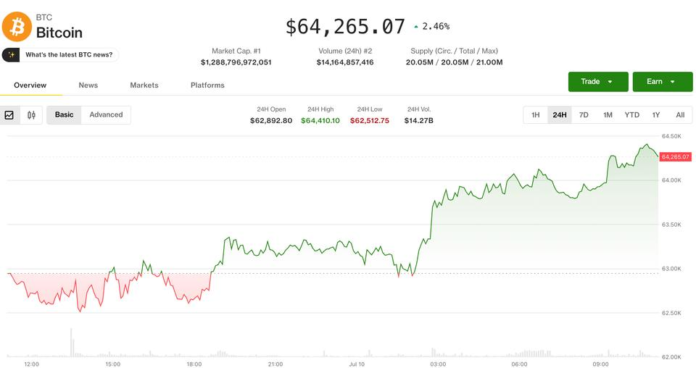
The crypto market took another leg higher on Friday with bitcoin trading at $64,400, up by 2% since midnight UTC.

The largest cryptocurrency is currently at the price it failed to penetrate on Monday. If it can break past this level, it will likely advance toward the June 15 high of $67,250.

Ether (ETH) outperformed bitcoin, rising 2.6% to $1,790 as it looks to snap a trend of sequential lower highs and lower lows.

There were also notable gains across the altcoin sector ahead of the weekend, typically a period of lower liquidity. Zcash (ZEC) and aave both rose by around 5% as optimism is slowly crept back into more speculative bets after months of waning sentiment.

Crypto diverged from U.S. equities, with S&P 500 index futures and Nasdaq 100 futures falling 0.1% and 0.4%, respectively.

Derivatives positioning

  • Crypto derivatives markets are showing signs of stabilization, with speculation easing and longer-term positioning increasing.
  • Volume over 24 hours fell 7% to $140 billion, while open interest (OI) rose 3% to $110.52 billion. This shift suggests the recovery is being driven more by strategic positioning than by high‑frequency speculative activity.
  • Cumulative OI in bitcoin’s USD- and USDT-denominated futures on major exchanges has picked up slightly, from 262K to 272K, as the spot price topped $64,000. When read alongside positive funding rates and positive 24-hour OI-adjusted cumulative volume delta (CVD), the OI increase indicates a growing bias for bullish bets.
  • Ether has yet to see a meaningful rise in futures OI, a sign that traders are still staying away from leverage.
  • In the broader market, most tokens have positive 24-hour CVDs, a sign that buyers are becoming more aggressive, trading market orders rather than passive limit orders. This set expectations for continued price rises ahead.
  • Confirmatory signals come from options-based implied volatility indexes tied to BTC and ETH, which continue to drop. It’s a sign of traders expecting market calm, a feature of rallies. BTC’s index, BVIV, fell to 38.5 early today, the lowest since June 6.
  • In the options market on Deribit, put skews continue to weaken as the price rally eases downside concerns. Calls at $62,000, $65,000, and $67,000 are among the most-traded instruments, along with the $56,000 put. A call represents a bullish bet on the market.


Source link

Is Meta (META) One of the Top Stocks to Buy According to Whale Rock Capital Management?

0
Is Meta (META) One of the Top Stocks to Buy According to Whale Rock Capital Management?


Meta Platforms Inc. (NASDAQ:META) is one of the top stocks to buy according to Whale Rock Capital Management. On June 30, Reuters reported that a federal judge in Oakland, California, rejected Meta Platforms Inc.’s (NASDAQ:META) attempt to dismiss a lawsuit filed by dozens of US state attorneys general, who accuse the company of intentionally designing Facebook and Instagram to be addictive to children while hiding the resulting harm from the public.

Is Meta (META) One of the Top Stocks to Buy According to Whale Rock Despite a Child Addiction Lawsuit Heading to Trial?

Photo by Jakob Owens on Unsplash

US District Judge Yvonne Gonzalez Rogers issued the ruling late on Monday (June 29) night, said Reuters. It added that the judge denied Meta’s motion to dismiss claims tied to deception, unfair business practices, and violations of the federal Children’s Online Privacy Protection Act (COPPA). COPPA requires companies to get parental consent before collecting data from children under 13.

On the COPPA issue specifically, the judge found that it was undisputed that Meta failed to properly notify parents or obtain their consent as the law requires. The 38-page ruling stated that there remain real factual disagreements that a jury needs to resolve, including whether Meta’s platforms are actually addictive, whether the company falsely denied designing them that way, and whether it partly targeted children with these features, Reuters noted.

Reuters added that the judge pointed to internal Meta statements claiming its platforms were not built to cause compulsive use among teens. The judge said a jury could reasonably conclude those statements were misleading if evidence shows the platforms were in fact engineered that way.

This decision means the case will move forward toward trial. As such, both parties will get the chance to present evidence and expert testimony on how Facebook and Instagram’s design affects young users.

Meta Platforms, Inc. (NASDAQ:META) is a technology company. It develops products that enable people to connect and share through mobile devices, personal computers, virtual reality headsets, and wearables. The company operates through the Family of Apps and Reality Labs segments.

While we acknowledge the potential of META as an investment, we believe certain AI stocks offer greater upside potential and carry less downside risk. If you’re looking for an extremely undervalued AI stock that also stands to benefit significantly from Trump-era tariffs and the onshoring trend, see our free report on the best short-term AI stock.

READ NEXT: Top 10 AI Stocks to Buy According to Billionaire Philippe Laffont and 10 Best Dividend Stocks Yielding at Least 5% to Buy According to Hedge Funds.

Disclosure: None. Follow Insider Monkey on Google News.


Source link

Bitcoin’s short-term holders remain 15% underwater—but selling pressure is easing

0
Bitcoin's short-term holders remain 15% underwater—but selling pressure is easing


Bitcoin [BTC] was showing a divergence between spot and derivatives markets. AMBCrypto reported that the apparent demand metric has been negative throughout 2026.

The Coinbase Premium Index was also in the red in recent weeks, showing a lack of demand from institutional players. Meanwhile, rising leverage trends were spotted, leaving the market vulnerable to a liquidation cascade.

The current bear cycle has yet to reach the lows of the previous ones. Stablecoin outflow from exchanges was another hint of defensive positioning from crypto market participants.

This lack of sustained demand was a warning, but also left a potential route higher in the short-term. Here’s what the price action and short-term holder dynamics have to say about a potential Bitcoin price bounce.

Short-term holder buying pressure is dominating BTC, just like in February

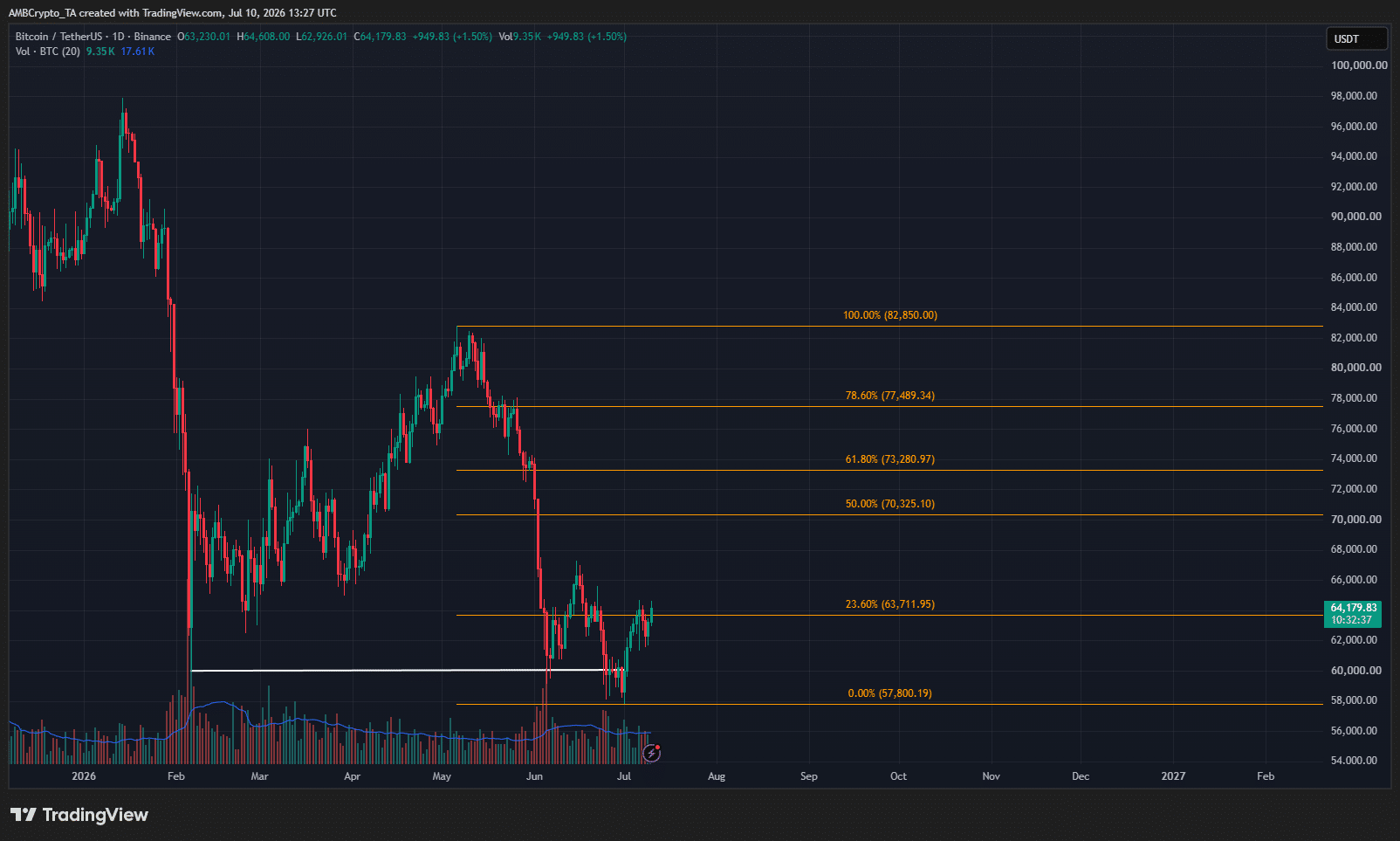
Bitcoin 1-day Chart
Source: BTC/USDT on TradingView

The bearish swing structure saw a continuation signal when the February lows breached in the final week of June. After setting a new low at $57,800, Bitcoin has crept higher.

From a technical analysis standpoint, this bounce can extend up to the $73.2k-$77.5k area, the golden pocket in the Fibonacci retracement levels.

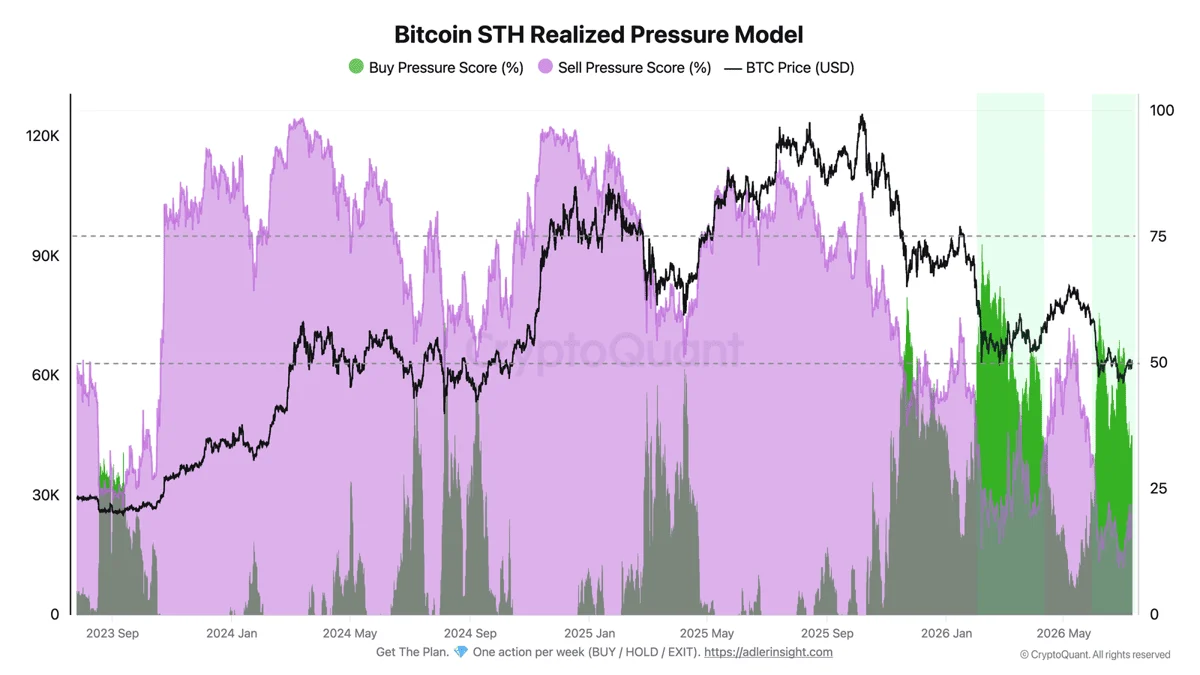
Bitcoin STH Realized Pressure ModelBitcoin STH Realized Pressure Model
Source: Axel Adler Jr.

The Bitcoin Realized Pressure Model metric compares realized buying and selling pressure from short-term holders compared to current BTC prices. Crypto analyst Axel Adler Jr. used this metric to demonstrate that, for now, selling pressure was compressed, and buyers have an advantage, pointing to an accumulation phase.

In February, the buying pressure average score was 61%, compared to the selling average score of 22%. As BTC rallied, the situation shifted. In May, the selling pressure was 43%, compared to the buying score of 11%.

In June and July, short-term holder buying pressure was dominant once again, with 37%-46%, while selling was compressed to 16%.

Until these scores deteriorate, a bounce like the one that commenced in February would be possible.

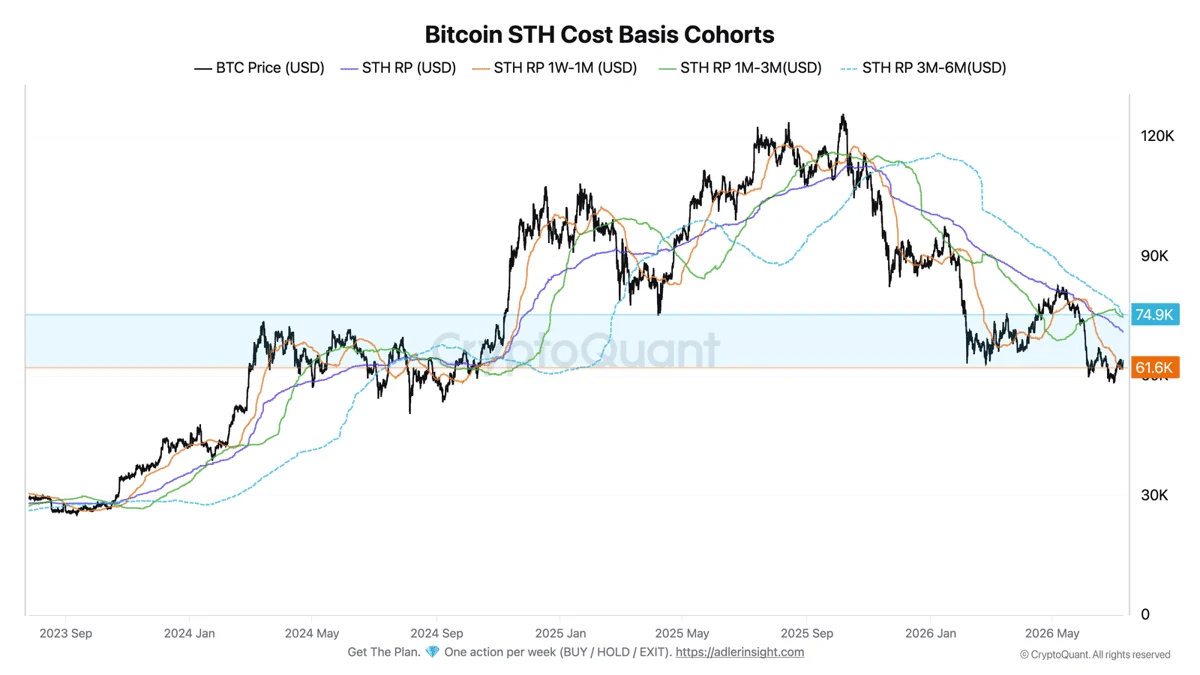
Bitcoin STH Cost Basis CohortsBitcoin STH Cost Basis Cohorts
Source: Axel Adler Jr.

This metric separates different cohorts of short-term holders’ purchase prices. The 1-week-1-month cohort’s realized price was at $61.6k, while the 3-month-6-month holder cohort’s average purchase price was at $74.9k.

The freshest cohort of buyers is in profit, but the older cohorts [1 to 6 months] were underwater by around 15%.

It is possible that this cohort would wait for a bigger price bounce toward or beyond $70k before beginning to sell in large numbers. In such a scenario, a short-term rally would once again be met by a wave of selling.

The analyst concluded that the current market price was within an accumulation zone with “a moderate risk-on tilt”. A reclaim of the $71k level would be a notable confirmation of a bullish pivot.


Final Summary

  • The derivatives build up, and the lack of sweeping, long-term holder accumulation trends was a threat to long-term recovery.
  • Short-term holder accumulation could push prices toward $70k, a popular crypto analyst warned.


Source link

Apple Sues OpenAI Over Alleged Trade Secrets Theft

0
Apple Sues OpenAI Over Alleged Trade Secrets Theft


Apple’s new lawsuit against OpenAI reads less like a routine trade-secret complaint and more like a play-by-play of how the iPhone maker says its rival built its consumer hardware ambitions.

Filed Friday, the suit accuses OpenAI of “a coordinated pattern of misconduct at an institutional level,” including everything from exploiting a security bug to recruiting Apple engineers for “show and tell” interview sessions involving confidential hardware.

Here are the biggest allegations.

OpenAI allegedly exploited an Apple security bug

According to the complaint, Apple’s investigation began after former employee Chang Liu left for OpenAI in January. Apple alleges Liu failed to return a company laptop and later discovered he could still access Apple’s internal systems because of what the company describes as an authentication bug.

Rather than reporting the issue, Apple said that Liu downloaded dozens of confidential engineering files while working at OpenAI, including documents related to unreleased products, technical specifications, presentations, and manufacturing processes.

Apple also alleges Liu encouraged another Apple engineer who was interviewing at OpenAI to study confidential Apple materials ahead of her interviews and advised her how to avoid attracting attention from Apple’s security team while copying files. The complaint says that the two moved conversations to a private messaging app to avoid detection.

Apple says OpenAI turned interviews into intelligence-gathering sessions

Apple also accuses OpenAI of systematically using its job recruitment process to obtain trade secrets. The buzzy AI company, which has filed the initial paperwork in a lead-up to an initial public offering, has become one of the most in-demand employers in tech. Amid the influx of talent, several hardware engineers at Apple have decamped to the AI juggernaut.

The lawsuit claims that Chief Hardware Officer Tang Tan, a former Apple vice president who spent 24 years at the company, asked Apple job candidates to bring physical components for “show and tell” sessions during interviews. OpenAI employees would also ask candidates for prototypes and information about vendors, the complaint alleges.

One then-Apple employee screenshotted and downloaded files from a “highly confidential Apple project,” the lawsuit says, alleging that Tan later asked about that project during the interview.

“OpenAI’s recruiting practices suggest it hires these individuals at least in part because of the confidential Apple-specific knowledge and expertise they have and could improperly obtain,” the complaint says.

Apple says the misconduct went all the way to OpenAI leadership

Apple says it raised its concerns with OpenAI earlier this year and asked the company to investigate whether Apple’s confidential information had entered its business.

According to the complaint, OpenAI never responded, prompting Apple to continue its investigation before filing suit on Friday.

“This is the tip of the iceberg,” the complaint reads. “Apple lacks visibility into what’s been happening behind closed doors at OpenAI, where such misconduct is normalized and exemplified by leadership.”

“This much is clear, however: at every level, from members of its Technical Staff to its Chief Hardware Officer, and in coordination with business partners, OpenAI has been stealing Apple’s trade secrets and confidential information,” the complaint continued. “As a natural result, OpenAI’s nascent hardware business now rests on the shakiest of foundations, rotten to its core by its illegal reliance on misappropriated trade secrets.”

Apple said it is “left with no choice” but to seek damages in an amount to be determined at trial, and court orders preventing OpenAI and the individual defendants from possessing or using Apple’s trade secrets.

The suit marks a dramatic escalation in what had been one of Silicon Valley’s highest-profile AI partnerships, following Apple’s integration of ChatGPT into Apple Intelligence in 2024. The relationship has frayed as OpenAI ramped up its own consumer hardware ambitions by hiring former Apple executives and engineers.

Apple’s suit isn’t the only high-profile claim that OpenAI has engaged in dishonest business practices.

The ChatGPT creator is also embroiled in a legal battle with The New York Times over claims that it allowed its chatbot to use copyrighted material to train its systems.

Elon Musk also previously filed suit against OpenAI, alleging that CEO Sam Altman and the company’s president, Greg Brockman, “stole” the original OpenAI nonprofit and unjustly enriched themselves by changing it to a for-profit model. A jury handed OpenAI a legal victory in May, concluding that Musk had missed the three-year statute of limitations to sue.

Tan, Liu, and representatives for OpenAI and Apple did not immediately respond to requests for comment from Business Insider.




Source link

Meta’s Chief Data Officer Says Agentic Commerce is the “Next Tier of Business”

0
Meta's Chief Data Officer Says Agentic Commerce is the "Next Tier of Business"

In a wide-ranging conversation on CoinDesk Spotlight, Schultz laid out a view of Meta’s future in which agentic commerce is not a product category but an inevitability.

“We think it might be the next tier of business for our entire company,” he told host, Sam Ewen.

The Agentic Economy Is Already Here, But It’s Unevenly Distributed

Schultz framed the agentic economy the same way science fiction author William Gibson framed the future: already present, not yet mainstream.

“We are building business agents for all businesses,” he said. “We have over a million weekly active businesses with Meta agents[…] from basically nothing at the start of the year.”

The use case he outlined was deliberately mundane: coordinating a child’s birthday party. Agents booking times, checking calendars, finding venues, communicating with other parents’ agents, all on WhatsApp. The point of the mundane example is that it scales. If agents can handle low-stakes logistics, they can handle supply chain negotiations, financial settlements, and cross-border commerce.

“You write that example large,” Schultz said, “and then if you’re us, you hope that you do it over WhatsApp”

The payments layer inside that vision is stablecoins.


Source link