Home Blog Page 270

Meta’s Chief Data Officer Says Agentic Commerce is the “Next Tier of Business”

0
Meta's Chief Data Officer Says Agentic Commerce is the "Next Tier of Business"

In a wide-ranging conversation on CoinDesk Spotlight, Schultz laid out a view of Meta’s future in which agentic commerce is not a product category but an inevitability.

“We think it might be the next tier of business for our entire company,” he told host, Sam Ewen.

The Agentic Economy Is Already Here, But It’s Unevenly Distributed

Schultz framed the agentic economy the same way science fiction author William Gibson framed the future: already present, not yet mainstream.

“We are building business agents for all businesses,” he said. “We have over a million weekly active businesses with Meta agents[…] from basically nothing at the start of the year.”

The use case he outlined was deliberately mundane: coordinating a child’s birthday party. Agents booking times, checking calendars, finding venues, communicating with other parents’ agents, all on WhatsApp. The point of the mundane example is that it scales. If agents can handle low-stakes logistics, they can handle supply chain negotiations, financial settlements, and cross-border commerce.

“You write that example large,” Schultz said, “and then if you’re us, you hope that you do it over WhatsApp”

The payments layer inside that vision is stablecoins.


Source link

Figma Stock Is Down 85%, But Wall Street Thinks It’s Time for the Stock to Surge

0
Figma Stock Is Down 85%, But Wall Street Thinks It’s Time for the Stock to Surge


The Figma app on a smartphone screen by Photo Agency via Shutterstock

Figma (FIG) got a much-needed boost this week. Bank of America reinstated coverage of the design software company with a “Buy” rating and a $30 price target. The stock reacted well to the development, though long-term shareholders will hardly have any reason to get excited about the 6% surge in stock price. The stock has been hammered, declining 85% from its 52-week high. The steep fall comes due to investors worrying that generative AI could make design tools like Figma less necessary. 

BofA analyst Tal Liani thinks that the market might have overreacted to the potential risk. His view is that AI is more of a tailwind than a threat. While AI generates designs and content quickly, Figma is the platform where teams actually collaborate and turn that work into finished products. Liani believes AI creating more complexity increases the need for a shared space to manage it all. So, if anything, this could bring even more people into building digital products, which works in Figma’s favor. There’s data behind the optimism too. In the first quarter of 2026, 75% of enterprise customers bought extra AI credits after using up their initial allowance. This suggests that companies are embracing AI features rather than avoiding them. 

More News from Barchart

What makes the bullish view even stronger is that in the same note, BofA took the opposite stance on the company’s larger rival, Adobe (ADBE). The firm downgraded Adobe to an “Underperform” rating, arguing that Figma is set to benefit from the AI shift while Adobe faces tougher competition. The statement is a big boost for Figma, a company whose stock had nosedived from $143 to less than $17 in the past 12 months. Meanwhile, Adobe is dealing with problems of its own.

About Figma Stock 

Figma is a design software company that helps teams build digital products in real time. Its product portfolio includes Figma Design, Figma Slides, FigJam, and Dev Mode. Founded in 2012, the company is headquartered in San Francisco and is led by co-founder and CEO Dylan Field.

Figma’s stock has had a brutal run. Since going public nearly a year ago, FIG stock is down 81%, significantly underperforming the broader software sector, with the iShares Expanded Tech-Software ETF (IGV) declining roughly 15% over a similar period. The decline reflects investor concerns that AI could reduce the demand for design software. In the last five days, however, positive analyst sentiment has helped the stock recover 10%.


Source link

Bitcoin’s ‘next major buying opportunity’ forms in Q4 – Former NASA researcher explains why!

0
Bitcoin’s ‘next major buying opportunity’ forms in Q4 – Former NASA researcher explains why!


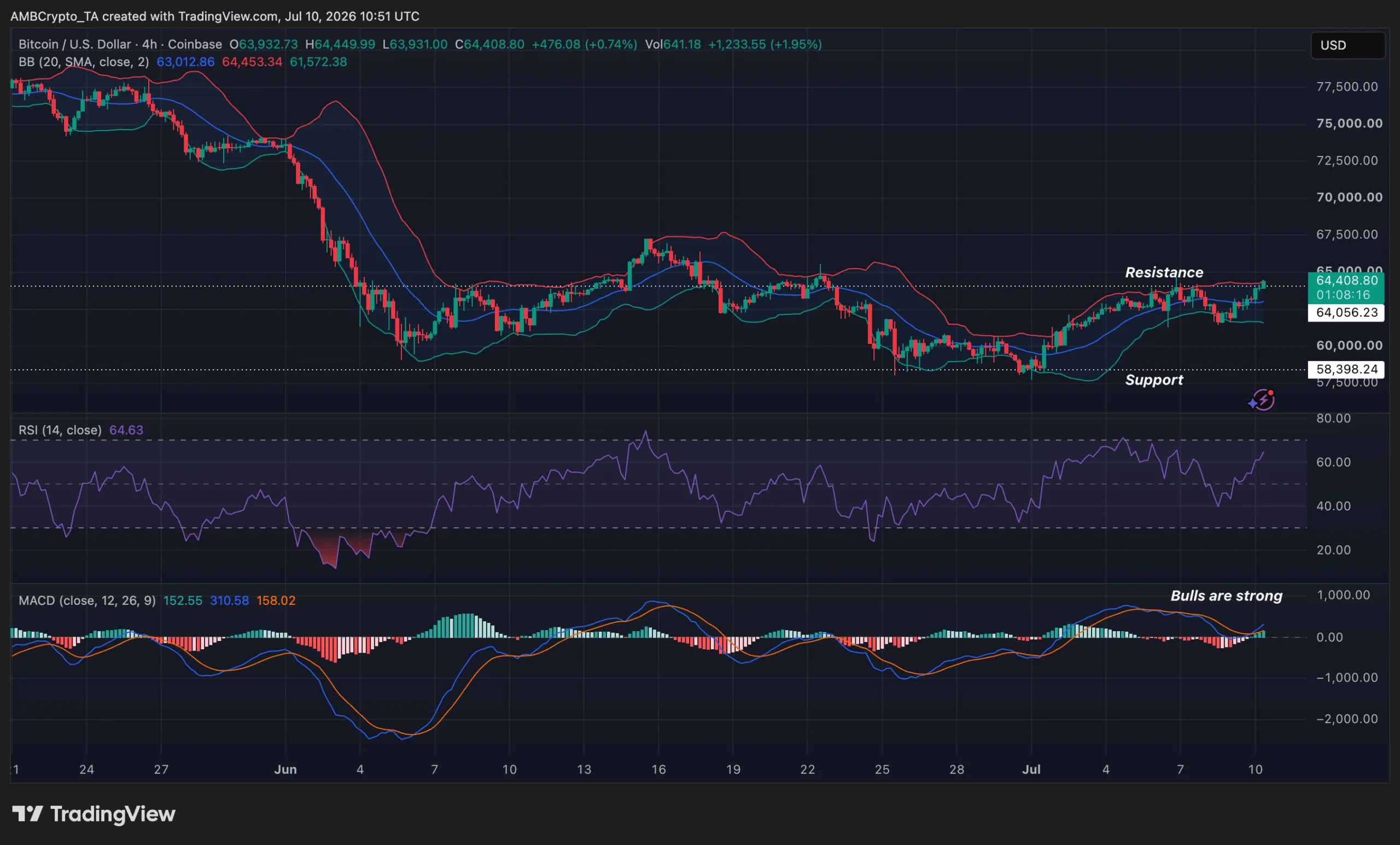
After a 2.32% increase over the previous day, Bitcoin [BTC] was trading at $64,380.20 at press time.

The leading cryptocurrency, however, failed to overcome the resistance level at $80k, which it last reached in mid-May, despite the increase.

Even though the four-hour chart’s RSI and MACD indicators, as well as the narrowing Bollinger bands, further imply that the bullish narrative is here to stay. 

Bitcoin's RSI and MACD
Source: Trading View

On-chain metrics raise red flags

Nonetheless, the data from CryptoQuant’s most recent analysis paints a bleak picture, indicating that Bitcoin is not in a bear market or a confirmed recovery, but rather is in a transitional phase.

On the one hand, conventional U.S. investors are being cautious.

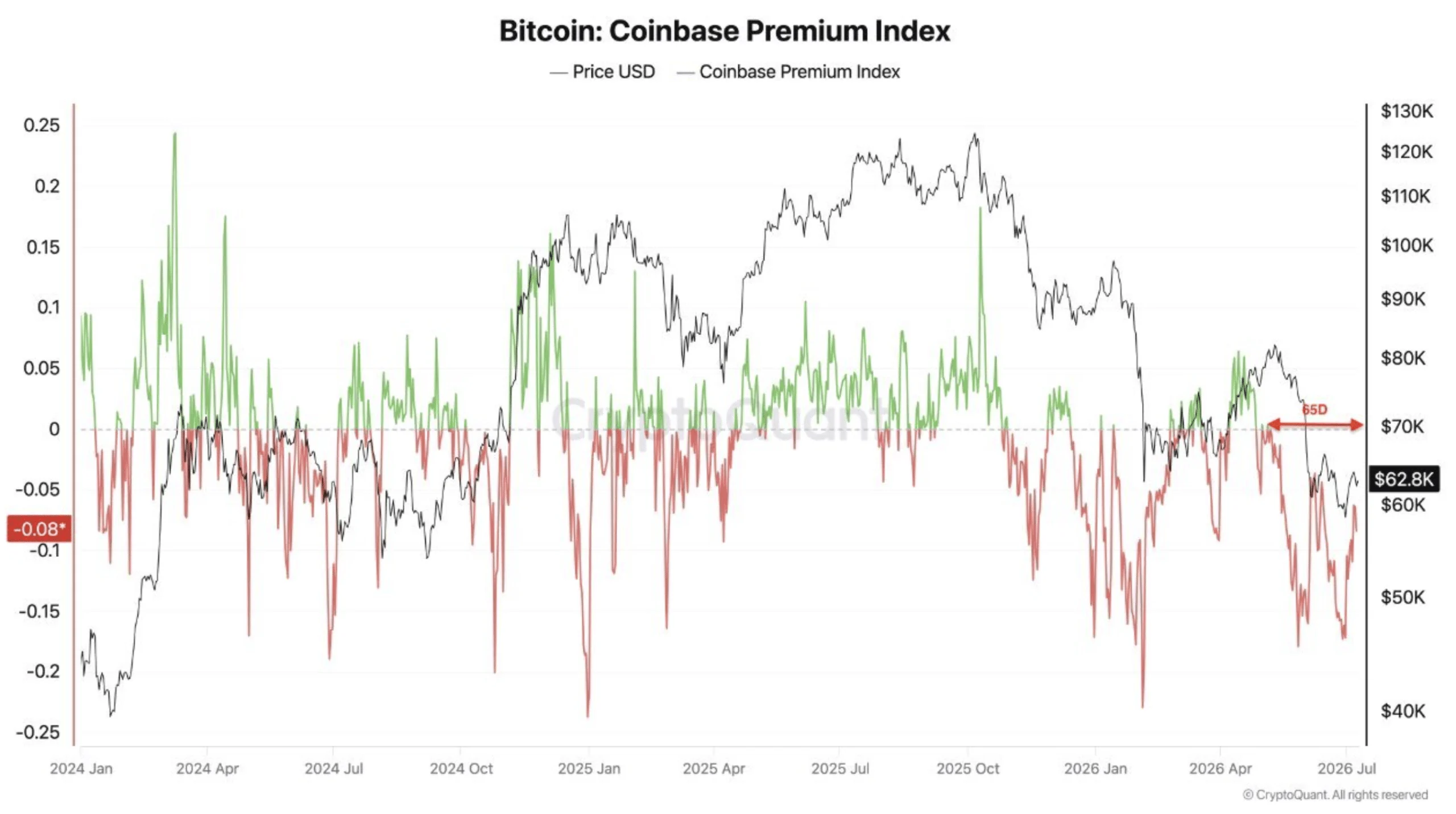
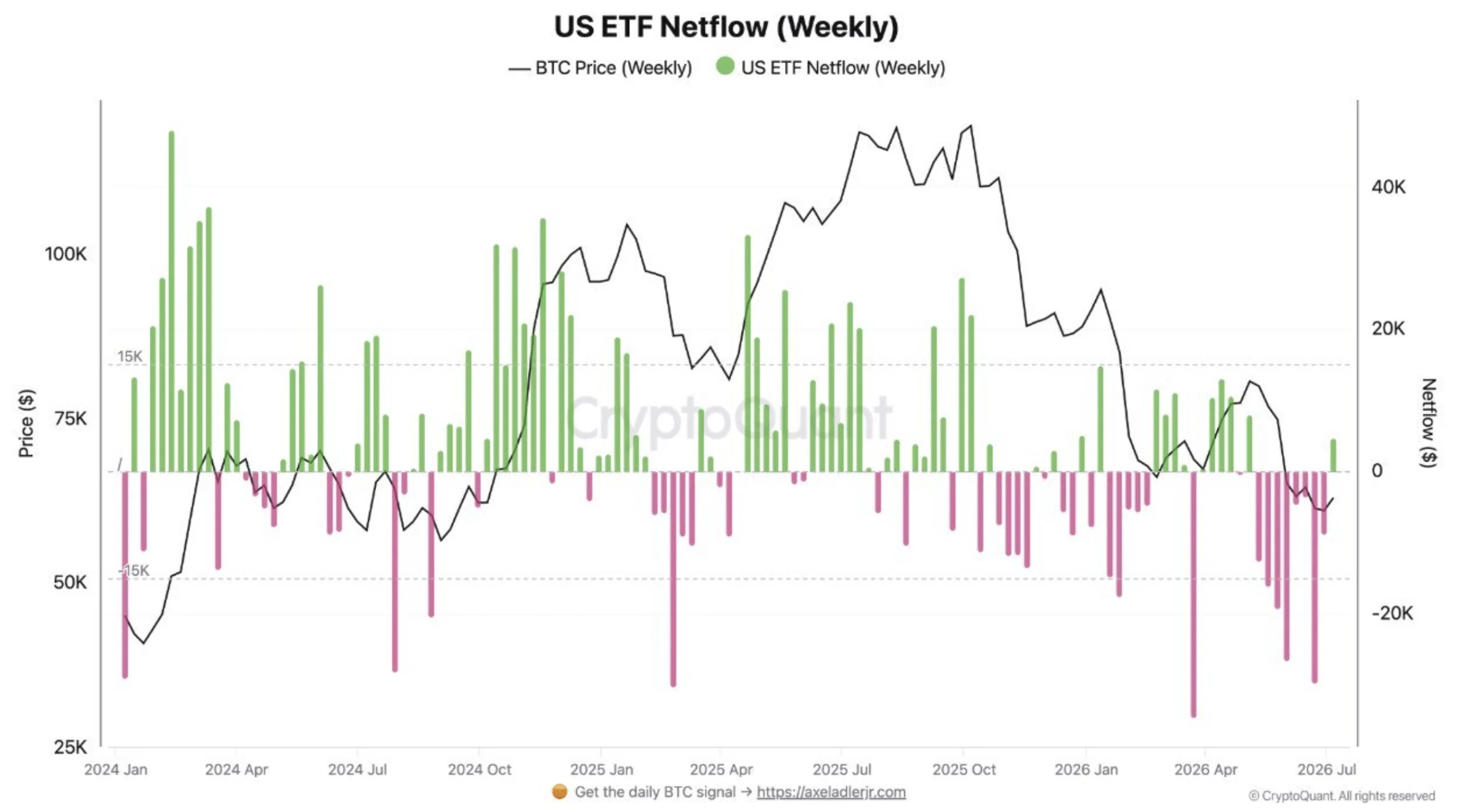
This is because since October 2025, about $10 billion has been pulled out of spot Bitcoin ETFs. Additionally, the Coinbase Premium has been negative for 65 days in a row, suggesting that buying demand from American institutions and individual investors is not strong.

Coinbase Premium IndexCoinbase Premium Index
Source: CryptoQuant

However, on-chain data reveals that new Bitcoin whales are progressively gaining more BTC, as the supply of the cryptocurrency shifts from older, long-term holders to more large, recent investors.

This indicates that although ETF selling pressure indicates a weak market sentiment, big buyers are covertly consuming that supply, which may be preventing further declines. 

U.S. ETF netflowU.S. ETF netflow
Source: CryptoQuant

Community backs Bitcoin

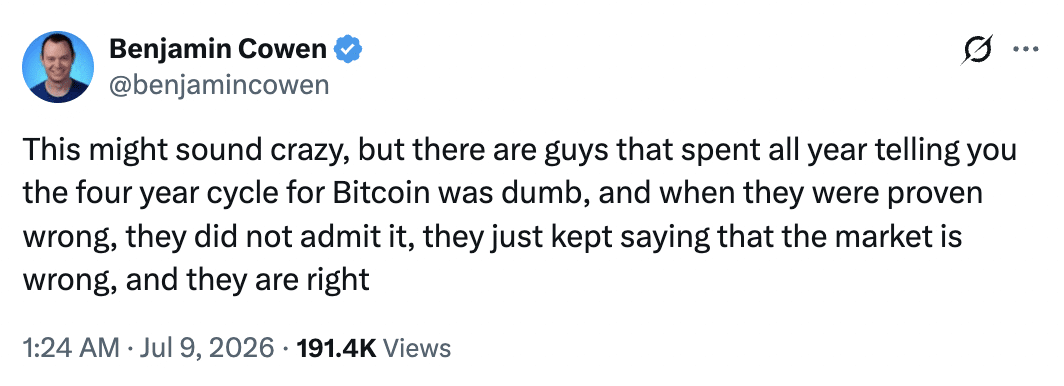
In fact, disregarding these negative metrics, former NASA researcher Benjamin Cowen pointed out, 

Cowen on BTCCowen on BTC
Source: Benjamin Cowen/X

Indeed, according to another analyst, there might be a recurrent four-year cycle in Bitcoin and the larger cryptocurrency market.

According to the analyst, an anonymous 4chan user correctly forecasted the peak of the Bitcoin market in October 2025, and this prediction is consistent with another independent cycle model. 

He added,

If the cycle repeats, Q4 2026 could mark the next major buying opportunity and 2027 is gets crazy.

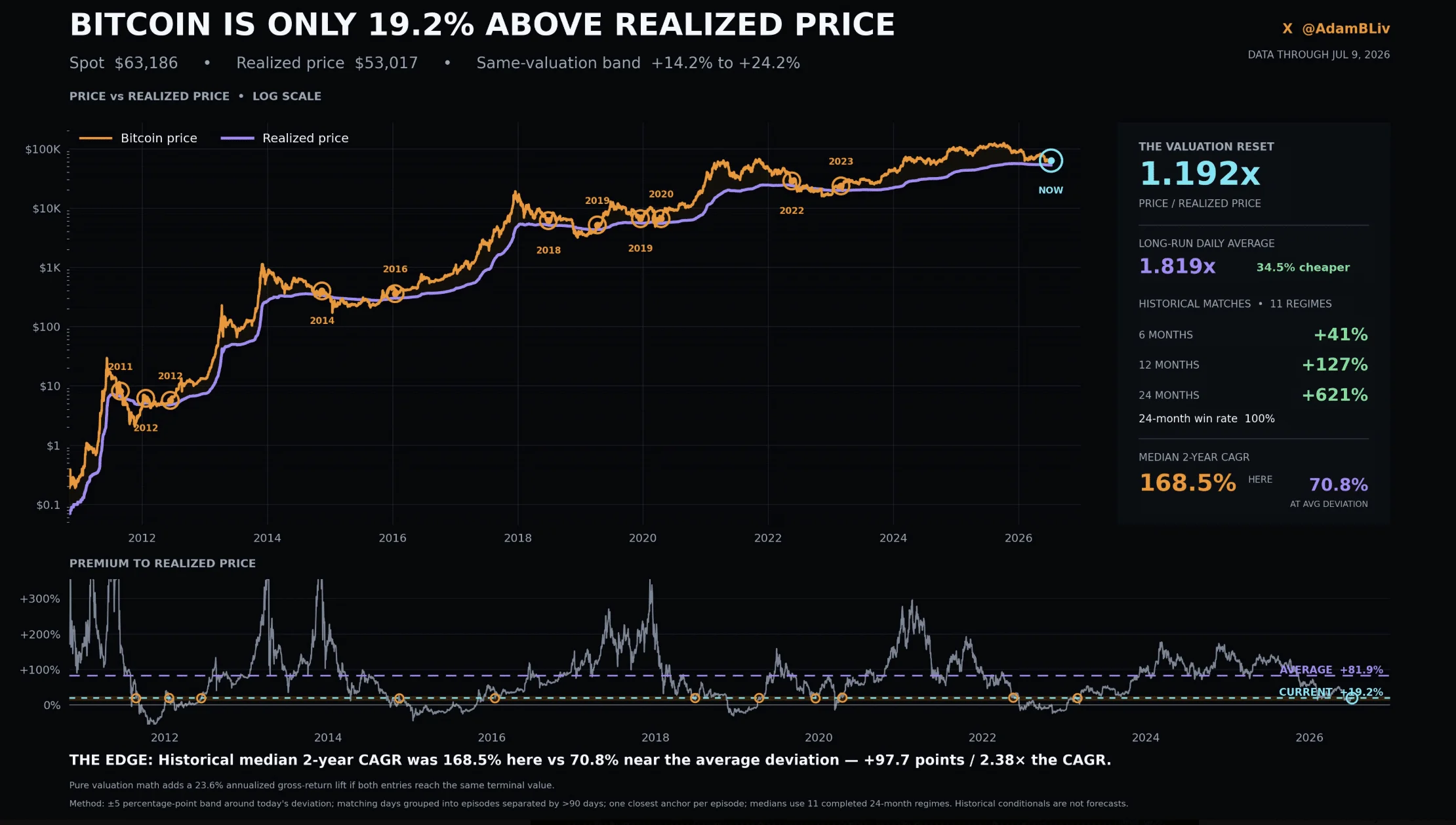
Similar to other opinions about Bitcoin, Adam Livingston contends that BTC seems to be undervalued because it is currently only 19.2% above its realized price, which is the average on-chain purchase price of all BTC, as opposed to an average premium of 81.9% in the past.

According to Livingston’s analysis of previous times when Bitcoin traded at comparable valuation levels, all completed historical regimes produced positive two-year returns, with median returns of 41% after six months, 127% after a year, and 621% after two years. 

Bitcoin is $63,186 while realized price is $53,017,Bitcoin is $63,186 while realized price is $53,017,
Source: X

Nonetheless, AMBCrypto recently pointed out that better sentiment may have trouble spurring the kind of broad purchasing that is required for a long-lasting recovery until new capital returns to spot markets.


Final Summary

  • Bitcoin price action is showing bullish momentum, but on-chain metrics are raising eyebrows.
  • The community is also optimistic about Bitcoin’s upcoming trajectory. 


Source link

Japan’s ‘invest locally’ plan likely to spur demand for assets like bitcoin (BTC), gold: Crypto Daily

0
Japan's 'invest locally' plan likely to spur demand for assets like bitcoin (BTC), gold: Crypto Daily

This hidden form of taxation, first used by nations after World War II, allows authorities to finance deficits cheaply, gradually erode the real value of the debt burden through moderate inflation, and avoid the relatively damaging alternatives of outright default or severe austerity. (Other indebted nations like the U.S., U.K. and European countries may do the same soon enough.)

Such an environment creates a strong incentive to seek assets with limited supply that may preserve purchasing power, such as bitcoin and gold. BTC has already proved its mettle: Housing prices measured in bitcoin look far cheaper than in dollars.

But there’s a near-term risk worth noting. The GPIF holds $931 billion in ​foreign assets, including $232.1 billion in U.S. Treasuries. A slight diversion of capital to local assets may create jitters on Wall Street, potentially breeding risk aversion and selling across all corners of the market, including cryptocurrencies.

For now, however, bitcoin is buoyant, trading above $64,000, with a key momentum indicator signaling a renewed bullish shift in market trend. There are several more key levels between $65,000 and $80,000 that prices need to clear before a full-blown uptrend is confirmed. Stay alert!

Read more: For analysis of today’s activity in altcoins and derivatives, see Crypto Markets Today . For a comprehensive list of events this week, see CoinDesk’s “Crypto Week Ahead.”


Source link

AI Stocks Look Expensive. These 3 ETFs Could Help Investors Stay in the Game.

0
AI Stocks Look Expensive. These 3 ETFs Could Help Investors Stay in the Game.


ETF and $100 bills by Below the Sky via Shutterstock

Artificial intelligence (AI) has been the biggest investing story over the past three  years. Despite the demand, AI stocks treaded some rough waters this year as investors kept rotating out of them due to overvaluation and concerns over massive capital expenditures. While the AI boom still appears to have years of growth ahead, some investors remain skeptical of buying the hottest AI stocks like Micron (MU) and SanDisk (SNDK) after their massive rallies this year.

For those investors, exchange-traded funds, or ETFs, that invest in industries enabling AI offer a much better option. Here are three such ETFs that stand out:

More News from Barchart

AI ETF #1: The State Street Utilities Select Sector SPDR ETF (XLU)

AI cannot run without electricity. With the rapid expansion of AI data centers, power generation has become the biggest bottleneck. Training advanced AI models consumes enormous amounts of electricity. By 2035, data centers are expected to account for 10% to 20% of U.S. electricity consumption, creating a multi-year investment opportunity for utility companies.

The State Street Utilities Select Sector SPDR ETF (XLU) primarily holds regulated utility companies, with electric utilities accounting for 65.8% of the portfolio. These companies generate relatively predictable cash flows as they provide essential services and use regulated pricing structures.

XLU has returned over 36% in the last three years but is up just 7% year-to-date (YTD), trailing the broader market.

www.barchart.com

Many of the fund’s largest holdings include energy companies such as NextEra Energy (NEE), Southern Company (SO), Duke Energy, Vistra (VST), and Constellation Energy (CEG). The Utilities Select Sector SPDR Fund also stands out for its low 0.08% expense ratio, which helps investors retain more of their long-term returns. This ETF offers investors a way to capitalize indirectly on the AI trend without paying premium valuations for AI chipmakers. Another advantage of this ETF is that even if AI enthusiasm temporarily cools down, electricity demand is unlikely to decline. This makes the ETF an appealing option for investors seeking AI exposure with lower portfolio volatility.


Source link

Hyundai adopts stablecoins for cross-border treasury transfers

0
Hyundai adopts stablecoins for cross-border treasury transfers

Hyundai, the world’s third-largest carmaker by vehicle sales, moved a stablecoin-based, cross-border, internal remittance system into production readiness on the Avalanche blockchain, becoming the first major South Korean company to do so.

“Hyundai is the first major enterprise to publicly announce this type of implementation on Avalanche, but the initiative represents more than a technical experiment,” said Justin Kim, head of APAC at Ava Labs, which develops and supports the blockchain platform. “This is already a real treasury management use case, not a sandbox — the pilot moved live USD and USDT between Hyundai Motor’s U.S. and Mexico entities,”

The international transfer comes as stablecoins gain traction beyond crypto trading. Large companies are increasingly testing the technology to move money between subsidiaries, settle cross-border payments and reduce the cost and time associated with traditional banking rails, Lindsey Einhaus, who leads strategy and operations at stablecoin infrastructure firm Bridge, said at Consensus Miami in May.

For the maker of the Kia compact and Ioniq electric cars the first phase involved transferring $20,000 from Hyundai Motor America to Hyundai Motor Mexico by converting dollars into Tether’s USDT stablecoin before converting the funds back into dollars.


Source link

Does age matter when getting a mortgage?

0
Does age matter when getting a mortgage?


Can you get a mortgage and buy a house at the age of 18? What about 68? Does age matter when getting a mortgage? The simple answer is that age discrimination in lending is prohibited. However, real life is a bit more nuanced.

If you’re of legal age in your state, you can sign a contract and apply for a mortgage. In most states, the “age of majority” is 18. It’s 21 in Mississippi and 19 in Alabama and Nebraska. 

There are exceptions. A minor may buy a house if:

  • The minor is legally emancipated, which is a court-ordered process that enables a minor to sign ownership and mortgage agreements. Of course, lender approval would be required. 

  • The property is held in a trust or under joint ownership. Under this legal structure, an adult executes the contract on behalf of the minor with the property placed in a trust or jointly held.

That’s the legal minimum age factor in play. Of course, a borrower, regardless of age, must qualify financially for a mortgage, which includes proof of steady income, an acceptable credit history, and the down payment required for the loan they are applying for.  

Now to the other end of the scale: First of all, home buyers are getting older. The median age for a home buyer is 59, according to the National Association of Realtors. First-time home buyers are averaging 40 years old. 

But is there an age limit?

No, not in a legal sense. A lender will consider a borrower’s source of repayment, whether it’s income from a job, an investment, a retirement account, or other assets (see “Asset depletion loans” below). Even Social Security payments count as income. 

Now, here’s where the real-life nuances come in. Remember, age discrimination in lending is prohibited. However, loan denials increase significantly among those aged 70 and older, according to a 2023 study by the Federal Reserve Bank of Philadelphia. Reasons can include:

  • Mortality risk: While lenders can’t decline an application based on life expectancy, they do consider the risk of loan default or foreclosure that may arise from a loan guarantor’s death. 

  • Declining income and savings: As borrowers age, income often declines or, at the very least, becomes harder to verify. In addition, retirement savings are often drawn down, reducing net worth.  

  • Lack of collateral: In this instance, it’s most directly related to the loan-to-value. The Philadelphia Fed study noted that for elderly borrowers, particularly those refinancing mortgages, the appraised value of the home may be too low for the requested loan amount. “An inability to maintain one’s property may be a contributing factor,” the study added.

Regardless of the reason, “it is important for older individuals to know that they are more likely to be denied credit,” the Fed concluded. 

See today’s best mortgage interest rates.

Using investments to back a mortgage is known as an “asset depletion loan.” Freddie Mac, the government-sanctioned company that helps fund mortgages, offers guidelines for structuring such loans. The assets can be held in a retirement, investment, or deposit account, in a living trust, or from the sale of a business. Other restrictions also apply.

A calculation that divides the eligible assets by 240 determines the borrower’s debt-to-income ratio. 

There is one mortgage with strict age guidelines: the Home Equity Conversion Mortgage, also known as a reverse mortgage. Designed for borrowers 62 and over, a reverse mortgage requires no monthly payment. The equity in the home is paid to the owner as a lump sum or monthly payments. 

A borrower must be of the minimum age required to be legally qualified to sign contracts in their state. In most states, that is 18.  

Yes, retirees can qualify for a mortgage. Lenders can consider a portion of the value of a retiree’s investment portfolio instead of a salary. 

An 80-year-old can buy a house if they qualify financially. However, as noted above, loan denials increase after the age of 70. One option is to use investment assets as a proxy for the debt-to-income ratio. See “Asset depletion loans” above.



Source link