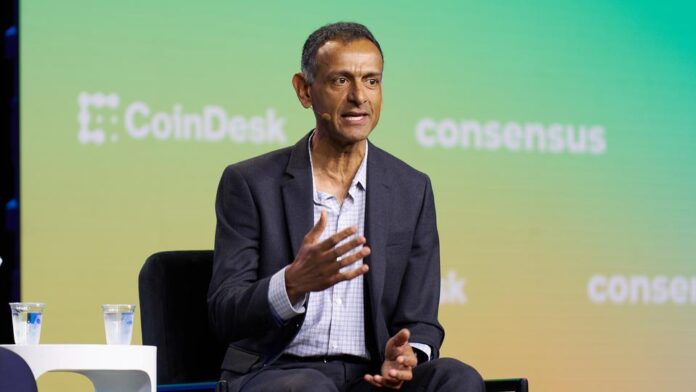
Coinbase Chief Legal Officer Paul Grewal is leaving the company after its high-profile, years-long legal fight with U.S. regulators, and the U.S. exchange also announced further changes to its senior leadership.
Grewal is departing to work at a startup, according to a Thursday announcement from Coinbase. Molly Abraham will now lead the company’s legal team as general counsel, and Ryan Van Grack will become vice chairman, in what’s anticipated to be a broader and more public-facing role.
“Leading Coinbase’s legal team through the biggest fight of our industry has been the single greatest achievement of my six-year tenure,” Grewal said in a statement. “Our legal wins helped ensure crypto not only had a future in this country, but could flourish.”
His statement continued on to say he would continue as an adviser to Coinbase, and would work on Coinbase’s trust charter work through the Office of the Comptroller of the Currency.
Abraham has been at Coinbase since March 2021, running multiple legal teams as the company’s vice president of legal. Prior to that, she was general counsel at an electric flying car startup, according to her LinkedIn.
The Iran War, tariffs and the demand-driven AI-investment boon could add up to create inflationary conditions where Federal Reserve policymakers would need to consider interest-rate hikes later this year.
But not just yet.
According to the minutes of the June Federal Open Market Committee meeting, policymakers at the central bank were concerned about high inflation but needed more data before making a move on the benchmark Federal Funds Rate.
The data could also signal that rates should continue to hold for a while or even go lower sooner than many expected.
The minutes do not name participants so Fed watchers need to closely read the words in the 15-page document released July 8 as well as read between its lines.
LPL Financial Chief Economist Jeffrey Roach said the minutes suggest the FOMC had a “good family fight” over the various scenarios under review — a difficult situation with a wide range of outcomes.
“One thing is certain: future policy is heavily contingent on the political situation in the Middle East. If we can tease out any forward guidance from the minutes, it would be the committee is working through a wide range of scenarios and will not commit to a specific scenario until the incoming data provides necessary clarity,” he said.
Roach added that he didn’t expect the FOMC to make a change in either direction at the July 28-29 meeting.
Fed’s dual mandate requires a tricky dance
The Fed’s dual mandate from Congress requires maximum employment and stable prices.
Lower interest rates support hiring but can fuel inflation. This risks fueling further inflation, potentially leading to an inflationary spiral.
Higher rates cool prices but can weaken the job market. This increases the cost of borrowing and further stifles economic activity.
Fed holds interest rates steady thus far this year
The rate-setting Federal Open Market Committee voted unanimously last month to hold its benchmark Federal Funds Rate target in a range of 3.5% to 3.75%.
Policymakers had cut rates by 25 basis points at its last three meetings of 2025 to shore up the softening labor market.
These “insurance” cuts stopped after the majority of policymakers decided the risk from higher prices was outweighing signs that the jobs market was stabilizing.
The funds rate is the interest rate that the Federal Reserve charges other banks overnight.
A change in the funds rate triggers moves in borrowing costs ranging from credit cards to auto loans and influences long-term mortgage rates.
It is one of several tools the Fed could use to maintain a balanced economy that is neither overheating nor cooling down.
Warsh says inflation risk is dropping
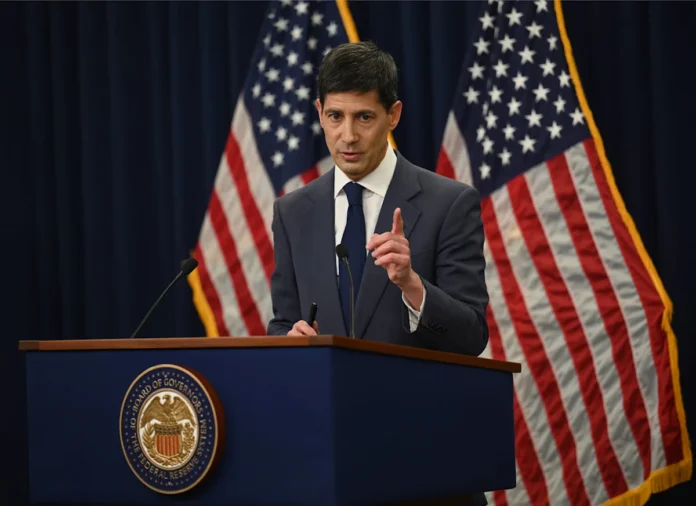
Federal Reserve Chair Kevin Warsh said July 1 that inflation risks have come down in recent weeks although he didn’t offer data or other numbers to support his argument.
Instead, speaking at the European Central Bank’s annual gathering of international policymakers and economists in Sintra, Portugal, the new Fed chair doubled down on his hawkish pledge from the June FOMC meeting that the Fed will focus on delivering “price stability.”
Warsh emphasized the Fed’s commitment to getting inflation back down to its 2% target — a level it has missed for the last five years.
“If there were people in households or the business sector or the financial markets who thought that this central bank was going to be comfortable with an inflation objective above 2%, well, I guess they’d be disappointed,” he said.
“We’re going to deliver price stability in the U.S.,” Warsh said, adding that “the tactics, the strategy and the rest, that’s still to come.”
June FOMC minutes show Fed split on interest-rate outlook
The FOMC debated multiple scenarios June 16-17 on how the U.S. economy could evolve through the end of the year.
In a scenario featuring moderating inflation, “most” participants said they expected the central bank would “maintain or eventually lower the target range for the Federal Funds Rate.”
But “most” participants said that “some policy firming would likely be warranted” if inflation remains elevated.
What’s ahead for interest rates?
Following the July 7 release of the June FOMC meetings, the CME Group FedWatch Tool estimated there will be at least one 25 basis point rate hike this year with more potentially to come in 2027.
New York Fed President John Williams said July 7 that monetary policy was well positioned and that he expected Headline PCE, the Fed’s preferred inflation gauge that’s been hitting close to 4%, will dip over the next several months as energy prices stabilize.
Vinny Amaru, Global Investment Strategist at J.P. Morgan Wealth Management, told TheStreet in an email following the June jobs report on July 2 that the U.S. economy remains resilient overall.
“Slightly weaker payroll gains and mild wage growth reinforce our view that the Fed will remain on hold this year as neither signal the need to hike interest rates to cool an overheating labor market,” Amaru said.
The leadership change follows another executive departure. Last fall, managing director and head of distribution and partnerships John Hoffman left Grayscale, and just joined tokenized asset platform Ondo Finance last month. The company has also added Chief Marketing Officer Ramona Boston and Head of Index Steve Vanourny over the past few months.
The departure comes as Grayscale put its plans to go public on hold. The Stamford, Connecticut-based company confidentially filed for a U.S. initial public offering in November last year. However, a person familiar with the matter previously told CoinDesk that Grayscale has paused its IPO preparations because of market conditions and is unlikely to restart the process before the fourth quarter.
A Grayscale spokesperson previously declined to comment on the IPO timeline, citing the SEC’s quiet period. CoinDesk reached out for comment regarding McGee’s departure.
Founded in 2013 and owned by Digital Currency Group, Grayscale has been a key bridge between traditional finance and digital assets through its regulated crypto investment products, most prominently its Bitcoin Trust (GBTC), which the firm converted into an exchange-traded fund (ETF) in January 2025. The fund once held about $28.5 billion in assets before becoming an ETF. It now manages roughly $8.5 billion as other, lower-fee ETFs have attracted investor money.
Blue Origin Raises $10 Billion at a $130 Billion Valuation – Moby
BREAKING NEWS
Our analysts just identified a stock with the potential to be the next Nvidia. Tell us how you invest and we’ll show you why it’s our #1 pick. Tap here.
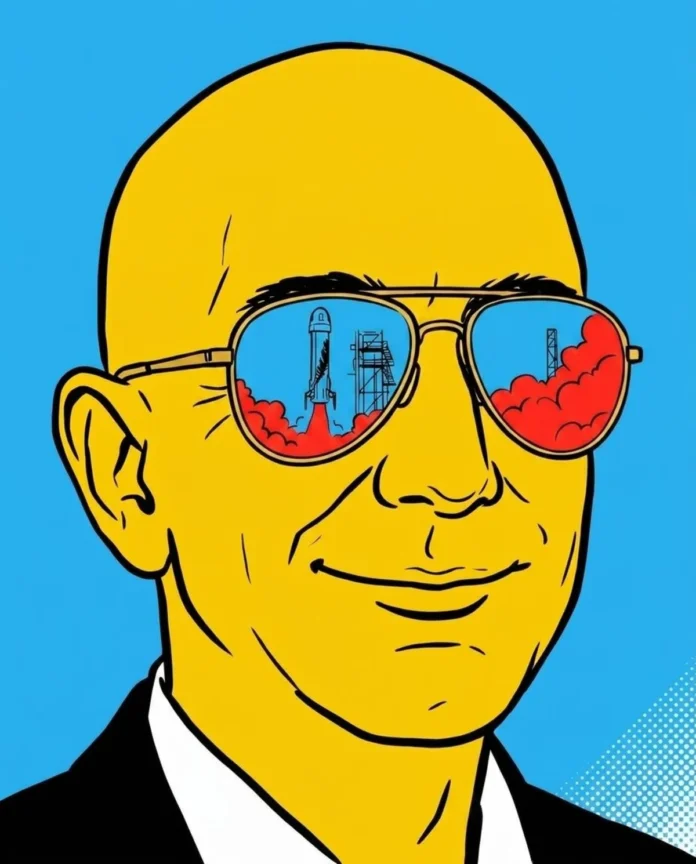
Welcome to the new space race. Except this time, it’s capitalism on both sides, as Jeff Bezos puts Elon Musk in his sights.
Bezos’ rocket company, Blue Origin, is raising $10 billion at a whopping $130 billion valuation, reports CNBC. Bezos will personally plow $2 billion into the deal. Another $4 billion will come from Coatue, and the company is actively seeking investors to fill the rest of the round.
Blue Origin likely needs the money. One of its New Glenn rockets exploded during a test in Florida in May, and the company has an aggressive goal to return to flight by the end of this year.
The deal comes at a hot time for space tech. Musk’s SpaceX went public in June, raising $86 billion in the largest public offering to date. The stock launched up to $225 per share before gravity pulled it back down to $148. Still, the company boasts a near-$2 trillion valuation, larger than South Korea’s GDP.
One stock. Nvidia-level potential. 30M+ investors trust Moby to find it first. Get the pick. Tap here.
Rocket Lab also recently acquired Iridium Communications, a satellite communications provider, in an $8 billion deal. It’s a bet that the newly combined company can chew into some of Starlink’s dominance.
While serious investors are pouring big money into space tech, like any other emerging sector, it’s still an open question how these companies are going to turn those investments into profit.
SpaceX’s wobbly ride since the IPO might be a harbinger: euphoria as shares break the atmosphere and enter orbit, only for gravity, or rather reality, to take over.
Sky [SKY] rallied 11% over the past day, extending a stretch of steady performance for the protocol.
At press time, usage across the protocol ran high, generating $987,000 in fees over the past 24 hours, while volume peaked at $13.49 million within the same window.
Notably, token volume has also trended higher, rising 5.78% to $23.25 million. Together, the price and volume gains point to strengthening performance, and several signals suggest SKY could extend the move.
Can SKY rally toward $0.67?
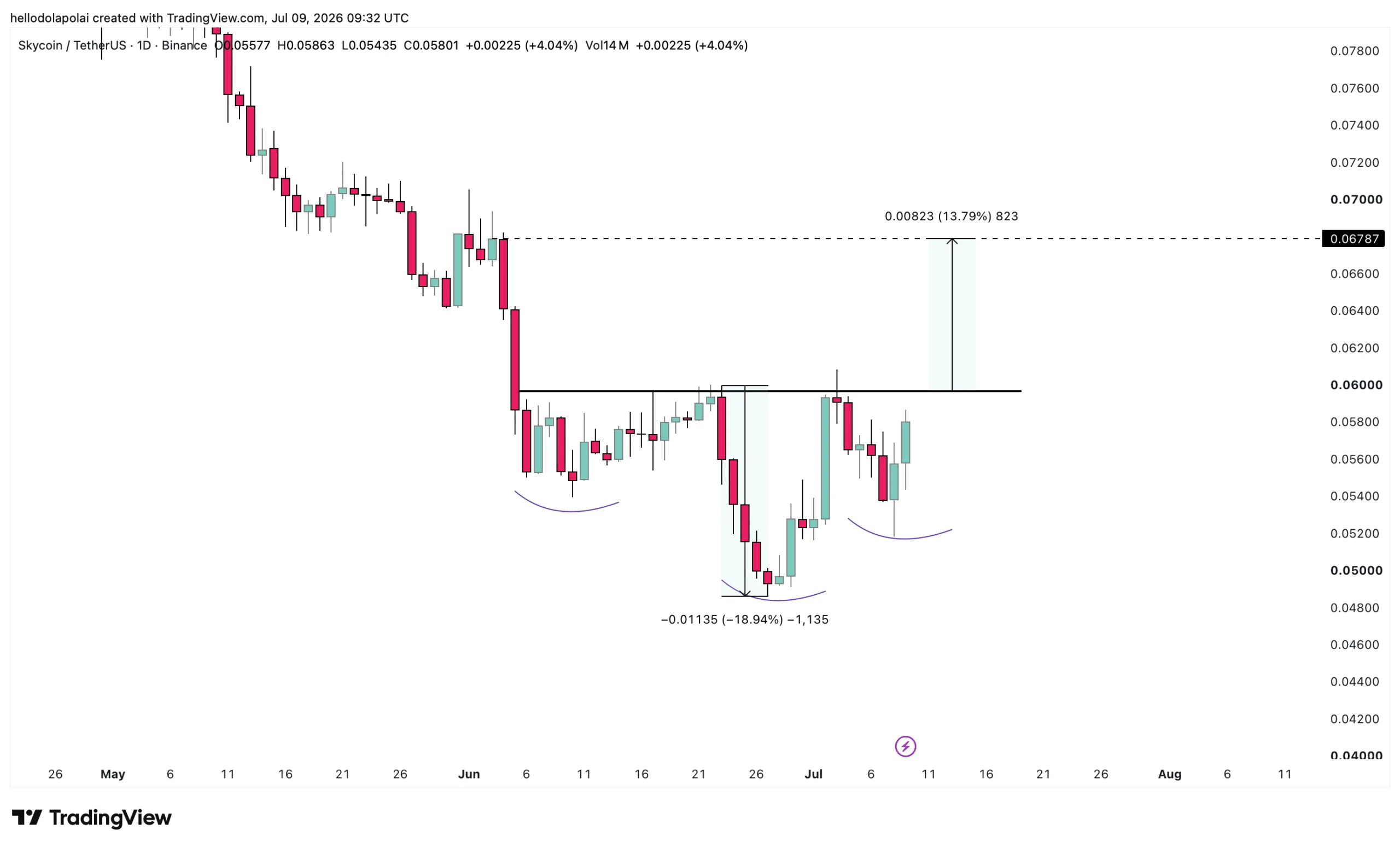
SKY could climb toward roughly $0.067, a level the token last touched in early June. The outlook rests on a recent chart formation, with SKY carving out an inverse head-and-shoulders pattern.
An inverse head-and-shoulders typically forms ahead of a stronger move to the upside. The structure is still developing, but a clean break above the $0.050 neckline would open the door to a much broader rally.
Source: TradingView
Should bullish momentum hold, SKY would post a 13.79% surge to its June target, a move that sits within the near term.
Over the short term, price could consolidate midway before reaching that final target. Getting there would see SKY recover every loss it has accumulated since June.
Momentum indicators strengthen SKY’s case for more upside
Numerous momentum indicators have converged, suggesting SKY could keep extending its gains.
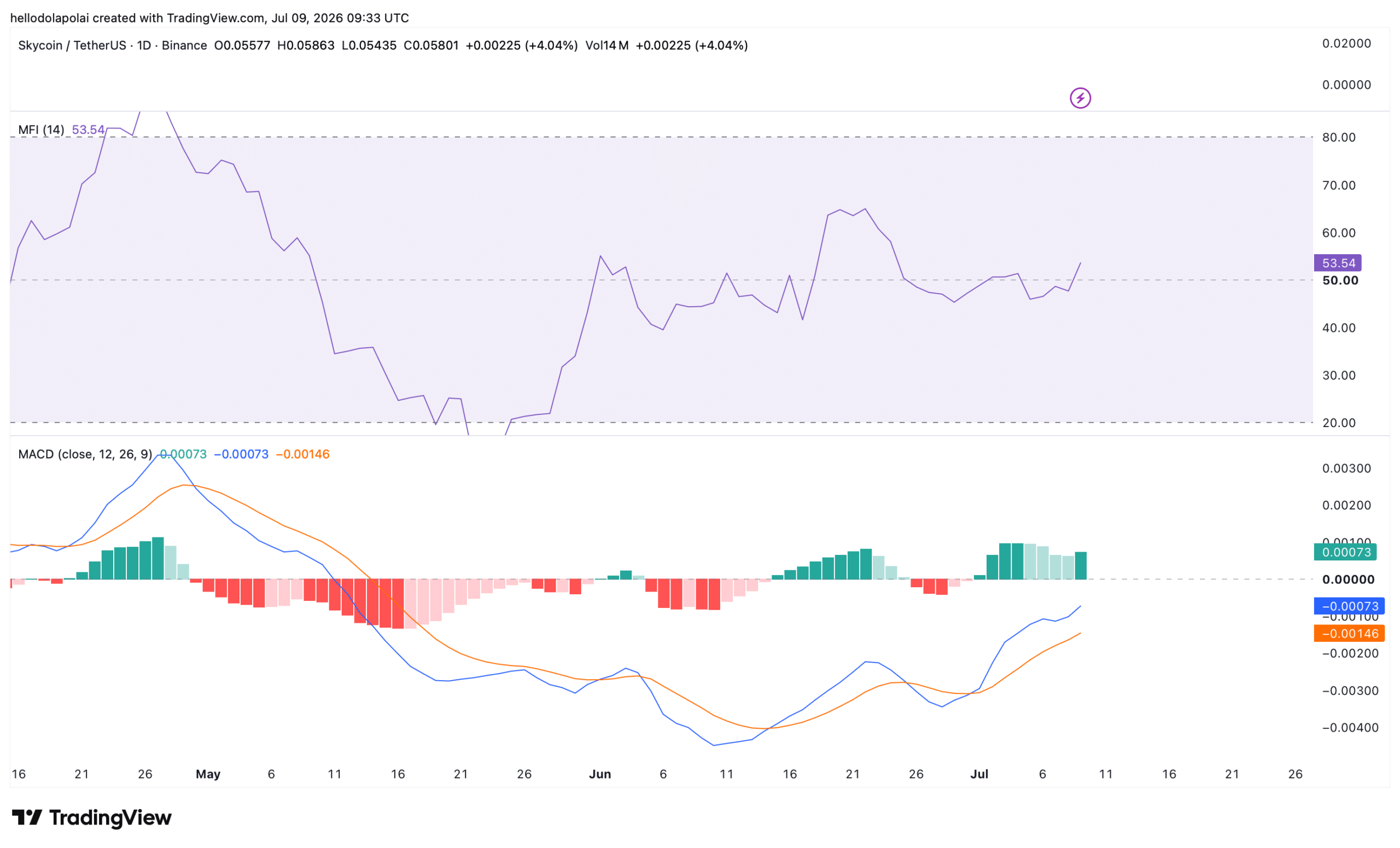
At the time of writing, the Money Flow Index, which tracks capital moving in and out of an asset, showed a growing inflow into the market.
The MFI has ticked upward and crossed the 50 mark. A reading above 50 signals that traders have entered a bullish phase, raising the odds that more capital flows in over the next few sessions.
Source: TradingView
The Moving Average Convergence Divergence (MACD) has regained strength, printing a green histogram bar after several days of fading momentum.
The key test comes as SKY approaches the neckline, where selling pressure typically intensifies. For the bullish case to hold, the MACD would need to cross into positive territory while the MFI stays below 80, a combination that would keep the rally sustainable.
Holder income adds incentive to lock up tokens
Traders now have a stronger incentive to keep their assets locked in the protocol’s TVL, driven by the income flowing to SKY holders. According to DeFiLlama, that income has reached $301,000 since July began, about 30% of the $1.1 million distributed in June.
The dynamic feeds on itself, as a rising SKY price makes holders more likely to lock their tokens, positioning to earn rewards while benefiting from the higher prices.
Final Summary
SKY climbed 11% in a day, with rising fees and trading volume signalling renewed demand for the token.
Growing capital inflows and steady holder rewards give traders reason to expect a further move toward $0.06.
At the last moment, New Hampshire has turned its back on a groundbreaking effort to establish what was expected to be the first rated, bitcoin-backed bond issued under a state’s authority, with a governmental body there canceling the project.
Just a few months after Moody’s Ratings gave the bond a Ba2 rating, the New Hampshire Executive Council, which reviews major state financial actions, slammed the door with a 3-2 decision that sided with those concerned about the state’s financial reputation.
“It was an extremely short-sighted decision,” Keith Ammon, a longtime crypto advocate and the majority floor leader in the New Hampshire House of Representatives, posted on social media site X. “They should gather all relevant facts and information and reconsider their vote at a future meeting.”
Ammon told CoinDesk that it’s an election year for council members, and it only takes one to swing the vote, adding, “We’re not giving up.”
Find out which banks are offering the best CD rates right now. If you’re looking for a secure place to store your savings, a certificate of deposit (CD) may be a great choice. These accounts often provide higher interest rates than traditional checking and savings accounts. However, CD rates can vary widely.
Learn more about where CD rates stand today and how to find the best rates available.
Banks with the best CD rates today
CD rates are relatively high compared to historical averages. That said, CD rates have been on the decline since last year when the Federal Reserve began cutting its target rate. The good news is that several financial institutions offer competitive rates of 4% APY and up, particularly online banks.
Today, Thursday, July 9, 2026, the highest CD rate is 4.10% APY. This rate is offered by Marcus by Goldman Sachs on its 14-month CD.
Here is a look at some of the best CD rates available today from our verified partners:
CD rate predictions for 2026
The Federal Reserve began decreasing the federal funds rate in light of slowing inflation and an overall improved economic outlook. It cut its target rate three times in late 2024 by a total of one percentage point.
Back in December, the Fed announced its third rate cut of 2025. However, it’s now unlikely the Fed will cut rates again in 2026. So far this year, the Fed has left rates unchanged, and a rate increase is growing more likely before the year’s end.
The federal funds rate doesn’t directly impact deposit interest rates, though they are correlated. When the Fed lowers rates, financial institutions typically follow suit (and vice versa). So now that the Fed has lowered rates and kept them low, CD rates are trending lower again. That’s why now may be a good time to put your money in a CD and lock in today’s best rates.
How to open a CD
The process for opening a CD account varies by financial institution. However, there are a few general steps you can expect to follow:
Research CD rates: One of the most important factors to consider when opening a CD is whether the account provides a competitive rate. You can easily compare CD rates online to find the best offers.
Choose an account that meets your needs: While a CD’s interest rate is a key consideration, it shouldn’t be the only one. You should also evaluate the CD’s term length, minimum opening deposit requirements, and fees to ensure a particular account fits your financial needs and goals. For example, you want to avoid choosing a CD term that’s too long, otherwise you’ll be subject to an early withdrawal penalty if you need to pull out your funds before the CD matures.
Get your documents ready: When opening a bank account, you will need to provide a few pieces of information, including your Social Security number, address, and driver’s license or passport number. Having these documents on hand will help streamline the application process.
Complete the application: These days, many financial institutions allow you to apply for an account online, though you might have to visit the branch in some cases. Either way, the application for a new CD should only take a few minutes to complete. And in many cases, you’ll get your approval decision instantly.
Fund the account: Once your CD application is approved, it’s time to fund the account. This can usually be done by transferring money from another account or mailing a check.