At the last moment, New Hampshire has turned its back on a groundbreaking effort to establish what was expected to be the first rated, bitcoin-backed bond issued under a state’s authority, with a governmental body there canceling the project.
Just a few months after Moody’s Ratings gave the bond a Ba2 rating, the New Hampshire Executive Council, which reviews major state financial actions, slammed the door with a 3-2 decision that sided with those concerned about the state’s financial reputation.
“It was an extremely short-sighted decision,” Keith Ammon, a longtime crypto advocate and the majority floor leader in the New Hampshire House of Representatives, posted on social media site X. “They should gather all relevant facts and information and reconsider their vote at a future meeting.”
Ammon told CoinDesk that it’s an election year for council members, and it only takes one to swing the vote, adding, “We’re not giving up.”
Find out which banks are offering the best CD rates right now. If you’re looking for a secure place to store your savings, a certificate of deposit (CD) may be a great choice. These accounts often provide higher interest rates than traditional checking and savings accounts. However, CD rates can vary widely.
Learn more about where CD rates stand today and how to find the best rates available.
Banks with the best CD rates today
CD rates are relatively high compared to historical averages. That said, CD rates have been on the decline since last year when the Federal Reserve began cutting its target rate. The good news is that several financial institutions offer competitive rates of 4% APY and up, particularly online banks.
Today, Thursday, July 9, 2026, the highest CD rate is 4.10% APY. This rate is offered by Marcus by Goldman Sachs on its 14-month CD.
Here is a look at some of the best CD rates available today from our verified partners:
CD rate predictions for 2026
The Federal Reserve began decreasing the federal funds rate in light of slowing inflation and an overall improved economic outlook. It cut its target rate three times in late 2024 by a total of one percentage point.
Back in December, the Fed announced its third rate cut of 2025. However, it’s now unlikely the Fed will cut rates again in 2026. So far this year, the Fed has left rates unchanged, and a rate increase is growing more likely before the year’s end.
The federal funds rate doesn’t directly impact deposit interest rates, though they are correlated. When the Fed lowers rates, financial institutions typically follow suit (and vice versa). So now that the Fed has lowered rates and kept them low, CD rates are trending lower again. That’s why now may be a good time to put your money in a CD and lock in today’s best rates.
How to open a CD
The process for opening a CD account varies by financial institution. However, there are a few general steps you can expect to follow:
Research CD rates: One of the most important factors to consider when opening a CD is whether the account provides a competitive rate. You can easily compare CD rates online to find the best offers.
Choose an account that meets your needs: While a CD’s interest rate is a key consideration, it shouldn’t be the only one. You should also evaluate the CD’s term length, minimum opening deposit requirements, and fees to ensure a particular account fits your financial needs and goals. For example, you want to avoid choosing a CD term that’s too long, otherwise you’ll be subject to an early withdrawal penalty if you need to pull out your funds before the CD matures.
Get your documents ready: When opening a bank account, you will need to provide a few pieces of information, including your Social Security number, address, and driver’s license or passport number. Having these documents on hand will help streamline the application process.
Complete the application: These days, many financial institutions allow you to apply for an account online, though you might have to visit the branch in some cases. Either way, the application for a new CD should only take a few minutes to complete. And in many cases, you’ll get your approval decision instantly.
Fund the account: Once your CD application is approved, it’s time to fund the account. This can usually be done by transferring money from another account or mailing a check.
Rings of fire burn near the movie poster for the film “The Lord of the Rings: The Fellowship of the Ring.” Here’s where to watch the “Lord of the Rings” and “The Hobbit” movies. (Photo by Stephane Cardinale/Sygma via Getty Images)
Sygma via Getty Images
While we’re certainly not limited in options when it comes to larger than life action and adventure films, few stories have even come close to matching the epic scale and immense cultural hold of director Peter Jackson’s “Lord of the Rings” movies.
With meticulously recreated fantasy landscapes, endearing characters struggling and overcoming impossible challenges, and a core story highlighting the power of the good and noble against the forces of evil, this fantasy saga based on the classic works of J.R.R. Tolkien continues to capture the popular imagination.
However, with such an expansive saga crossing centuries and separate trilogies, it may be daunting, especially for the newcomer, to understand how each part connects to the next. The official film franchise currently has seven titles, including “The Lord of the Rings” main trilogy, “The Hobbit” prequel trilogy, and a more recent animated feature.
Let’s walk through how the films connect in chronological order (and release order) so you’ll never need to worry about getting lost during your trek through Middle-earth.
‘The Lord of the Rings’ Movies In Release Order
Let’s begin with the trilogy of films that started it all, listed in order of release.
The Lord of the Rings: The Fellowship of the Ring (2001)
The Lord of the Rings: The Two Towers (2002)
The Lord of the Rings: The Return of the King (2003)
MORE FROM FORBES ADVISOR
‘The Hobbit’ Movies In Release Order
Then, nearly ten years after the first trilogy’s end, a new collection of prequels brought us back to Middle Earth. “The Hobbit” trilogy is listed in release order below.
The Hobbit: An Unexpected Journey (2012)
The Hobbit: The Desolation of Smaug (2013)
The Hobbit: The Battle of the Five Armies (2014)
All films are currently streaming on HBO Max.
‘The Lord of the Rings’ And ‘The Hobbit’ Movies In Chronological Order
The two main trilogies follow simple orders on their own, but things can get confusing when watching all seven films together. This is both because the latest film actually takes place before both trilogies, and because the later released “Hobbit” films sit chronologically before the original “Lord of the Rings” films. So, if keeping to the timeline, one should actually watch the original trilogy last.
But below, let’s step through the movies chronologically.
The Lord of the Rings: The War of the Rohirrim (2024)
The story begins in Rohan when the Dunlending Freca, in a bid for power, demands his son Wulf marry King Helm Hammerhand’s daughter Héra. But when Hammerhand kills Freca in the ensuing argument, Wulf swears revenge.
Years later Wulf, now leading the Dunlendings, invades Rohan and forces the Rohirrim to flee to the Hornburg. But after Hammerhand’s lone battle weakens the enemy, Héra, allied with her cousin Fréaláf, confronts Wulf in a final stand for her people. Later, the valley is dubbed Helm’s Deep in tribute. Then, Héra rides off to meet a wizard named Gandalf.
The Hobbit: An Unexpected Journey (2012)
Nearly 200 years later, that same Gandalf visits the hobbit Bilbo in the Shire and recruits him to join a company of dwarves along their mission. The dwarves, led by Thorin, seek to reclaim their kingdom beneath The Lonely Mountain from the dragon Smaug, and could use Bilbo’s skills in their perilous journey.
Along the way the group encounters several foes including the Orc leader Azog, while Gandalf learns of a potential coming threat from a feared enemy. Separately, by chance, Bilbo meets someone named Gollum and from him acquires a mysterious ring.
The Hobbit: The Desolation of Smaug (2013)
The second film picks up right after and sees the company fend off more foes including giant spiders and, again, Azog. They also find unexpected allies in the elves Legolas and Tauriel. Eventually, the group reaches a lake town near The Lonely Mountain, and then enters the mountain to reclaim it from the titular Smaug.
However, chaos breaks out when the battle against Smaug unexpectedly ends with the dragon flying off towards the lake town in a fury.
Orlando Bloom accepts the Best Fight award for “The Hobbit: The Desolation of Smaug” at the 2014 MTV Movie Awards in Los Angeles.
WireImage
The Hobbit: The Battle of the Five Armies (2014)
The epic conclusion to the trilogy begins with a showdown against Smaug. But then, as Thorin grows mad with greed in his reclaimed kingdom, the people of the lake town, an elf army, and the dwarf army all face off against two orc armies in a deadly confrontation.
By the story’s end though, Bilbo is able to safely return home. However, he keeps the ring he found a secret from everyone, even as he begins to understand that something isn’t quite right about it.
The Lord of the Rings: The Fellowship of the Ring (2001)
And now we step into the main trilogy set about sixty years later. Here, as Bilbo celebrates his 111th birthday, he passes down his belongings to his cousin Frodo, including the ring. However, Gandalf then warns Frodo that the Dark Lord Sauron held the ring before and is sending forces to attack for it.
So Frodo leaves the Shire with his friend Samwise and then eventually allies with Legolas (returning from the “Hobbit” trilogy), Aragorn, Boromir, Merry, Pippen, Gimli and Gandalf on a mission to destroy the ring at Mordor before Sauron can get to it. Ultimately though the group splits apart, with Frodo and Sam continuing to Mordor on their own.
The Lord of the Rings: The Two Towers (2002)
The second entry in the trilogy picks up right after and sees Frodo and Sam stumble upon Gollum (returning from the “Hobbit” trilogy), who becomes their guide. Meanwhile, the other members of the fellowship, along with an even more powerful Gandalf, work to save the nation of Rohan from Saruman, who is working for Sauron.
These events ultimately lead to an epic battle at Helm’s Deep (the same setting from “The War of the Rohirrim”) where our heroes fend off Saruman’s orc forces in one of the most famous parts of the trilogy.
The Lord of the Rings: The Return of the King (2003)
In the epic conclusion to the entire story, our heroes first engage in a spectacular battle against Sauron’s forces at Gondor, the kingdom to which Aragorn is heir. Meanwhile, Frodo and Sam finally make it into Mordor, but find themselves battling with Gollum who wants the ring for himself.
Ultimately, the other members of the fellowship aid in clearing the way for Frodo and Sam, allowing Frodo to reach his destination and complete the mission he’d set out for in the climactic final move against Sauron.
That wraps the current, complete canon of films in this continuity. However, there may still be more to watch from here.
Peter Jackson on stage with his Best Director and Best Screenplay Academy Awards at a “Return of The King” Oscars celebration in Wellington, New Zealand on March 18, 2004.
AFP via Getty Images
New ‘Lord of the Rings’ Movies To Look Out For
While 2014’s “The Hobbit: The Battle of the Five Armies” put a close to the franchise’s formal trilogies so far, since then we’ve also gotten a celebrated TV series, the animated “War of The Rohirrim,” and also confirmation of two additional live action movies in development.
The Lord of the Rings: The Rings of Power (2022–)
Amazon’s TV series The Rings of Power, from showrunners J. D. Payne and Patrick McKay, is a prequel taking place thousands of years before the films. The first two seasons are currently streaming on Prime Video. While the show reliably earns headlines, the series holds mixed reviews from critics and fans.
The show features younger versions of characters familiar from the films, such as Galadriel, as they seek to thwart the growing threat of Sauron. However, the show is not intended to share a continuity with the movies. And, controversially, the series takes much greater departures from Tolkien’s writings than the original films ever did.
Warner Bros. Pictures and New Line Cinema have announced “The Hunt for Gollum” as the franchise’s first return to live action in 12 years. Andy Serkis, who has played Gollum since 2002, is set to both reprise his role and also step into the director’s seat for the film. Ian McKellen and Elijah Wood are returning as Gandalf and Frodo, and Anya Taylor-Joy has joined the cast as elf Seren.
The film is said to take place between “The Hobbit” and “The Fellowship of the Ring” and will follow Aragorn’s (Jamie Dornan) journey to capture Gollum.
The film is set to release December 17th, 2027.
The Lord of the Rings: Shadow of the Past (TBA)
In March, Peter Jackson took to social media to announce that comedian and committed Tolkien scholar Stephen Colbert would be, along with his son Peter McGee and Philippa Boyens, writing yet another live-action addition to the Middle Earth canon.
Set years after the adventures of the original trilogy, this film follows familiar hobbits Sam, Merry and Pippin as they, along with Samwise’s daughter Elanor, reflect on parts of their original adventures which never made it to the screen.
As of yet there are no confirmations on casting.
Future Titles (TBA)
In May, Peter Jackson announced he was in talks to bring forth even more films set in this universe, in particular taking inspiration from “The Silmarillion” and “Unfinished Tales of Númenor and Middle-earth.” Any development on these titles though would be very early, so fans know little about their plans for now.
Frequently Asked Questions (FAQs)
As with any multi-layered franchise with a growing number of entries, the films’ release order will generally be fans’ primary viewing order recommendation. In this case, that would mean beginning with the three “Lord of the Rings” films, and then going back in time chronologically to watch the three “Hobbit” films.
While this is not chronologically correct, watching it this way allows new viewers to experience the story just as fans did in theaters for the first time. Also, much of “The Hobbit” films’ storytelling style includes callbacks and references that will work best with a knowledge of the original trilogy.
For those invested in the timeline, though, a chronological order viewing is also enjoyable.
The Extended Editions of the films, all of which are also on HBO Max, represent a massive addition to the viewing experience with over two hours of additional footage restored across the trilogy. The added content not only extends existing scenes, but includes sequences and character moments unseen in the theatrical cuts that work to bring more of Tolkien’s dense texts to the screen.
However, of note is that director Peter Jackson considers the theatrical cuts to be the definitive versions of the story, with the extended versions being available only for fans seeking more.
Watching all seven canon films in the franchise would take 19 hours and 26 minutes. If watching all extended versions available, that number would go up to 22 hours and 29 minutes.
The core “Lord of the Rings” trilogy alone totals up to nine hours and 18 minutes, with the extended editions pushing this to 11 hours and 23 minutes.
Separately, the “Hobbit” trilogy adds up to seven hours and 54 minutes altogether, with the extended editions here beginning us to eight hours and 52 minutes.
“The Rings of Power” is an Amazon Studios series set thousands of years before the films, and it streams on Prime Video. However, it is not intended to share a continuity with the movies, so it does not have a place in the official chronological watch order.
“The War of the Rohirrim” is an animated film directed by Kenji Kamiyama set 183 years before the main films, making it the first title in the chronological order. It centers on Helm Hammerhand, the king of Rohan whose name is tied to Helm’s Deep, and features Miranda Otto reprising her role as Eowyn.
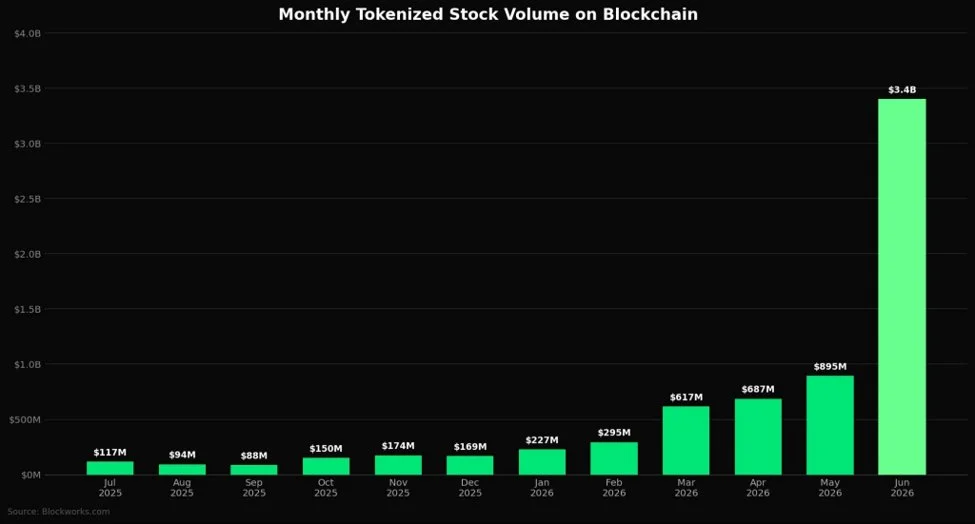
Momentum across tokenized stocks accelerated sharply in June as investors increasingly embraced blockchain rails for trading traditional stocks.
The surge reflected more than speculative enthusiasm. Improving infrastructure, expanding token offerings, and demand for 24/7 trading continued attracting institutional and retail participants.
Monthly trading volume reached a record $3.4 billion, rising 279% month over month and 1,400% year over year. SpaceX’s tokenized IPO and Solana’s [SOL] dominant market share largely drove that growth.
Source: X
As AMBCrypto previously reported, tokenized stocks are increasingly becoming a structural bridge between traditional finance and blockchain markets.
That transition gathered further momentum as monthly transfer volume climbed 91.66% to $8.70 billion. Moreover, Distributed Value rose 31.59% to $1.94 billion, and holders increased 15.59% to 409,240.
Source: RWA.xyz
However, monthly Active Addresses dropped 77.18% to 49,290. The decline suggested larger investors accounted for a greater share of activity.
That trend pointed to stronger institutional participation. However, broader retail involvement could still improve liquidity and price discovery over time.
Tokenized funds move into DeFi
As capital entered tokenized markets, attention shifted from ownership to capital deployment.
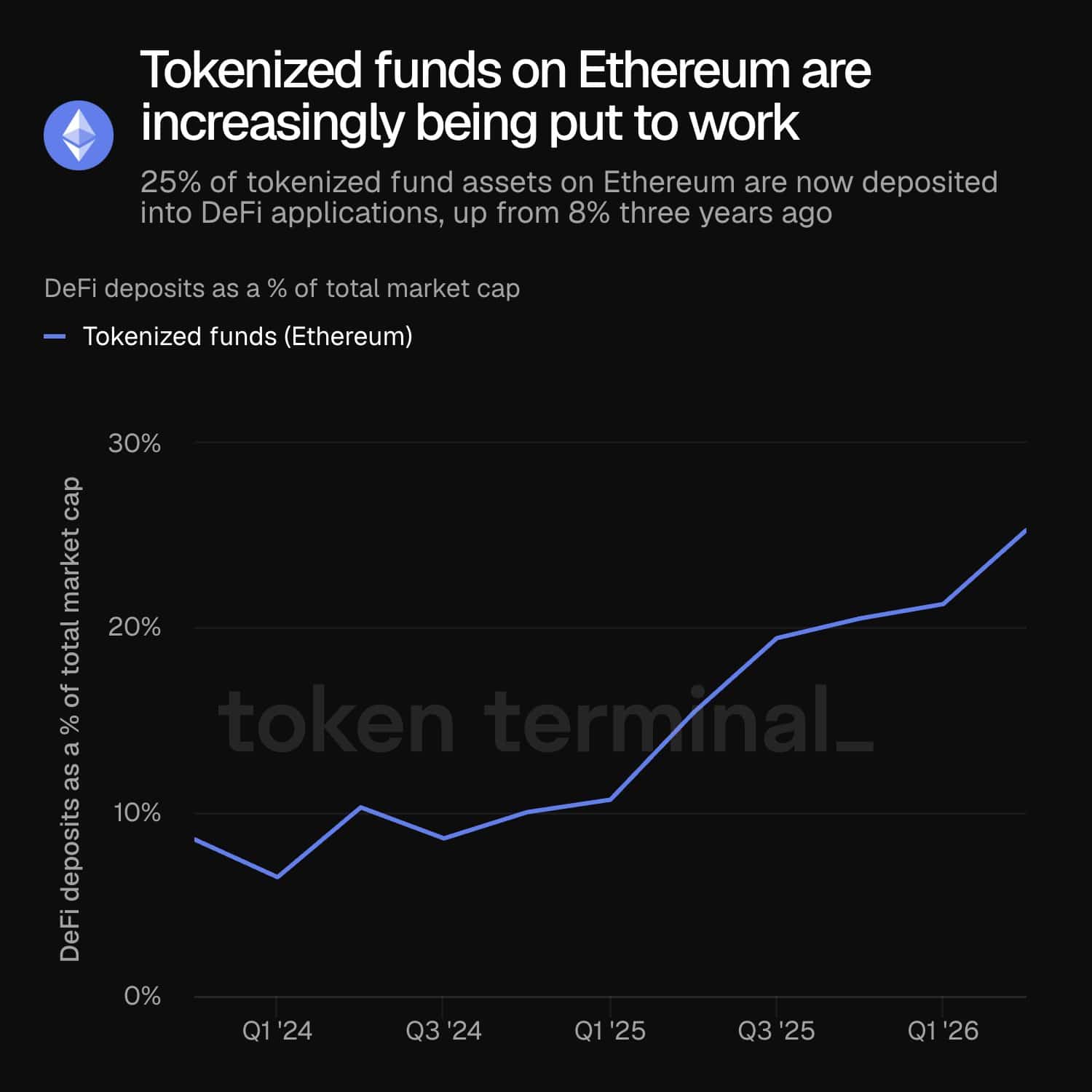
Ethereum [ETH] increasingly reflects that evolution, with 25% of tokenized fund assets deployed across DeFi applications, up from 8% three years earlier.
Source: TokenTerminal
Rather than remaining idle, institutions are increasingly using tokenized funds for lending, liquidity provision, and yield generation, improving capital efficiency across the ecosystem.
This trend is complementary to the growth in tokenized equity trading. It also demonstrates the extension of adoption from simply transactional activities into actual financial activity.
Still, broader integration and regulatory clarity remain essential. If utilization continues expanding alongside issuance, tokenized finance could evolve into a more resilient and self-sustaining financial system.
Institutional demand reshapes tokenization
Capital deployment is now becoming the clearest indicator of tokenization’s maturity.
Institutions are no longer just looking at issuance or trading volumes to judge blockchain networks. Instead, they are increasingly focused on settlement efficiency, liquidity, and capital composability across multiple networks.
For context, Solana remained the leading network for tokenized equity settlement because of its throughput and lower transaction costs.
By contrast, Ethereum continued leading tokenized fund deployment across DeFi, supporting lending, liquidity provision, and yield strategies.
Together, those ecosystems highlighted how different blockchains served complementary roles rather than competing for identical use cases.
Growing Distributed Value, larger transaction sizes, and expanding cross-chain activity suggested that tokenized finance continued developing into functional market infrastructure.
Final Summary
Tokenization is evolving beyond asset issuance as capital increasingly flows into productive on-chain financial applications.
Tokenization is maturing into financial infrastructure as institutional adoption, capital deployment, and real-world utility continue expanding.
But elsewhere, another sign of hope appeared in a Wednesday letter from Senator Ron Wyden to Senate leadership that the Oregon Democrat supported the way the earlier legislation handled the legal protections for developers — specifically the section of Clarity known as the Blockchain Regulatory Certainty Act, which would ensure crypto developers wouldn’t be treated under federal regulations as money transmitters if they’re not handling customer assets. The decentralized finance (DeFi) sector has made preserving the BRCA a top aim in the Clarity negotiations.
Though some of the crypto industry’s DC insiders had begun to express private uncertainty about the Clarity Act’s survival, the effort hasn’t yet reached its fatal deadline for getting done before the summer congressional break and the shift of attention to the fall midterm elections.
The Senate calendar includes three remaining weeks in July and the first week of August. However, the process to advance the legislation could take a few days of that time, meaning there’s scant runway left for a 2026 takeoff. And there’s some concern a defense spending bill may also complicate the chamber’s bandwidth.
Also, the U.S. House of Representatives would need to approve the Senate’s version of Clarity before it could become law, so the process would await the action of a House that’s been nearly paralyzed by Republican infighting. And it would then head to the desk of President Donald Trump for a signature to make it law, though the president has refused to sign another popular piece of legislation — the Senate’s bipartisan housing bill — as he insists that Congress needs to prioritize his demands for new voting rules.
Artisan Partners, an investment management firm, issued its first-quarter 2026 investor letter for the “Artisan Mid Cap Value Fund”. A copy of this letter is available for download here. In Q1 2026, the portfolio underperformed the benchmark Russell Midcap Value Index as the market favored momentum-driven stocks over quality factors. Some holdings faced company-specific setbacks and negative sentiment. The Fund’s Investor Class: ARTQX returned -4.93%, Advisor Class: APDQX declined by -4.90%, and Institutional Class: APHQX fell by -4.97%, all trailing the Index’s 3.68% gain. The equity market in the quarter was mixed, with mid- and small-cap indices showing resilience despite lagging large-cap growth stocks. Volatility increased, initially fueled by interest in AI and private credit, but escalated after the outbreak of war in Iran, leading to rising oil prices. Sector performance varied, with energy leading the gains. The Fund continues to seek companies capable of value growth during market dislocations at attractive entry points. Also, review the Fund’s top five holdings to see its best picks for 2026.
In its first-quarter 2026 investor letter, Artisan Mid Cap Value Fund highlighted Brown & Brown, Inc. (NYSE:BRO) as a newly added position. Brown & Brown, Inc. (NYSE:BRO) is a leading insurance brokerage firm that operates through Retail and Specialty Distribution segments. On July 7, 2026, Brown & Brown, Inc. (NYSE:BRO) closed at $69.27 per share, reflecting a market capitalization of $23.48 billion. Brown & Brown, Inc. (NYSE:BRO) posted a one-month return of 15.10%, while its shares lost 35.94% over the past 52 weeks.
Artisan Mid Cap Value Fund stated the following regarding Brown & Brown, Inc. (NYSE:BRO) in its Q1 2026 investor letter:
“We initiated six new positions in Q1, representing an above-average rate of new purchase activity. Increased market volatility and greater dispersion in US equities during the quarter created more opportunities to add new names that meet our three margin-of-safety criteria: attractive business economics, sound financial condition and attractive valuation. Additionally, we sought to use recent volatility to upgrade the portfolio’s quality. Our three largest new buys by position size were Brown & Brown, Inc. (NYSE:BRO), Veralto and IQVIA Holdings.
Brown & Brown is a leading US insurance broker focused on the middle market. The shares have come under pressure alongside the broader broker group, as investors recalibrated expectations following a period of elevated growth driven by a hard insurance market. As pricing and growth have begun to normalize, valuations have compressed, creating what we believe is a more attractive entry point. From a business economics perspective, insurance brokerage is a compelling model. Brokers act as intermediaries without taking underwriting risk, resulting in high margins, low capital intensity and strong free cash flow conversion, supported by high customer retention. Brown & Brown has built a scaled platform serving small- and mid-sized businesses, a segment that tends to exhibit resilient demand, and has compounded value over time through consistent organic growth and acquisitions in a fragmented industry. While near-term growth is moderating and competition has increased, we view concerns around AI driven disruption as overstated. Brokers provide critical advisory and claims support functions that remain difficult to replicate, and technology should enhance productivity over time rather than displace the model. From a financial standpoint, the company is generating strong, recurring cash flows, with a solid balance sheet that supports continued reinvestment and M&A. With the shares now trading closer to the lower end of their historical valuation range, we believe the risk/reward is favorable.”
“I’ve Already Got CrowdStrike”: Customer Confidence Highlights CRWD’s AI Strength
Brown & Brown, Inc. (NYSE:BRO) is not on our list of 40 Most Popular Stocks Among Hedge Funds Heading Into 2026. According to our database, 41 hedge fund portfolios held Brown & Brown, Inc. (NYSE:BRO) at the end of the first quarter, compared to 42 in the previous quarter. While we acknowledge the potential of Brown & Brown, Inc. (NYSE:BRO) as an investment, we believe certain AI stocks offer greater upside potential and carry less downside risk. If you’re looking for an extremely undervalued AI stock that also stands to benefit significantly from Trump-era tariffs and the onshoring trend, see our free report on thebest short-term AI stock.
In another article, we covered Brown & Brown, Inc. (NYSE:BRO) and shared Madison Mid Cap Fund’s views on the company. In addition, please check out our hedge fund investor letters Q1 2026 page for more investor letters from hedge funds and other leading investors.
Others took a more macro view. Strive CEO Jack Mallers, among others, described bitcoin’s selloff as a warning of a macro fiat liquidity crunch. Bitcoin has a history of moving early and aggressively on liquidity shifts and is often viewed as one of the most sensitive assets to changes in money supply growth, Treasury operations, and overall financing conditions.
Average requests rose to 10.3% of shares from 9.7% in Q1, but ranged widely (1.3%–38.1% at Blue Owl’s OTIC). Many requests were follow-ups from investors who were only partly satisfied last quarter. New inflows fell by about 56% on average, so most funds saw net outflows of roughly 3% of the prior quarter’s net asset value.
Fitch, therefore, expects continued redemptions in months ahead.
“With BDCs capping redemptions at 5% quarterly, unfulfilled requests will lead to persistent elevated redemptions for many firms in the coming quarters,” ratings agency Fitch warned,” the ratings agency said.
Same story but different structures
Bitcoin ETFs are liquid, exchange-traded vehicles, where outflows directly impact the spot price of BTC. Private credit BDCs are the opposite: illiquid, long-duration lending vehicles with built-in quarterly gates.
Still, the fact that investors rushed for exit in both at the same time does point to broader caution around liquidity and risk appetite. Amid all this, energy markets continue to send risk-off signals, with the U.S. strategic petroleum reserve falling to lowest since 1983. So, if energy market remains disrupted, the government now has significantly less buffer to flood the market with oil and keep prices lower.