A group of crypto and Web3 firms that includes OKX, MetaMask, Matter Labs and Genlayer have formed the “Internet Court” to reach dispute resolutions between AI agents.
These days, AI agents negotiate and pay one another without humans in the loop, but as with human-to-human transactions, agent-to-agent transactions will run into contractual disagreements.
The problem is that agentic systems have no way to settle these disputes, and traditional courts are not built to handle such cases. Hence the need for the 27-firm-backed protocol, led by the Genlayer Foundation, which makes AI-based payments, escrow and dispute resolution interoperable, according to a press release.
Agentic commerce is not prepared for the potential fallout when agents disagree at machine speed, according to David Riudor, CEO and co-founder of the GenLayer Foundation. “Internet Court is the shared place agents can turn to when a deal goes wrong. Machine-speed money needs machine-speed adjudication,” he said.
A key problem the dispute protocol solves is interoperability between a variety of AI commerce systems. Agentic commerce is certainly charging ahead but the infrastructure underpinning this new economy is still highly fragmented.
According to the Zillow lender marketplace, the average 30-year fixed-rate mortgage rose by 12 basis points to 6.47% today, Friday, July 10, 2026. The average 15-year fixed rate fell by 3 basis points to 5.86%. The average 5/1 ARM rose by 11 basis points to 6.46%.
Here are the current purchase rates, according to the latest Zillow data, for Friday, July 10, 2026:
30-year fixed: 6.47%
20-year fixed: 6.39%
15-year fixed: 5.91%
5/1 ARM: 6.46%
7/1 ARM: 6.49%
30-year VA: 5.90%
15-year VA: 5.57%
5/1 VA: 5.59%
Remember, these are national averages and have been rounded to the nearest hundredth.
Current mortgage refinance rates
These are the latest refinance rates, according to the latest Zillow data, for Friday, July 10, 2026:
30-year fixed: 6.47%
20-year fixed: 6.29%
15-year fixed: 5.84%
5/1 ARM: 6.54%
7/1 ARM: 6.67%
30-year VA: 5.75%
15-year VA: 5.54%
5/1 VA: 5.44%
Again, the numbers provided are national averages rounded to the nearest hundredth. Mortgage refinance rates are often higher than rates when you buy a house, although that’s not always the case.
Your mortgage rate plays a large role in how much your monthly payment will be. Use this mortgage calculator to see how your mortgage amount, rate, and term length will impact your monthly payments:
Mortgage payment calculator
You can bookmark the Yahoo Finance mortgage payment calculator and keep it handy for future use, as you shop for homes and lenders.
How mortgage interest rates work
A mortgage interest rate is a fee for borrowing money from your lender, expressed as a percentage. You can choose from two types of rates: fixed or adjustable.
A fixed-rate mortgage locks in your rate for the entire life of your loan. For example, if you obtain a 30-year mortgage with a 6% interest rate, your rate will remain at 6% for the entire 30-year term unless you refinance or sell.
An adjustable-rate mortgage locks in your rate for a predetermined period and then adjusts it periodically. Let’s say you get a 7/1 ARM with an introductory rate of 6%. Your rate would be 6% for the first seven years, then the rate would increase or decrease once per year for the last 23 years of your term. Whether your rate goes up or down depends on several factors, such as the economy and housing market.
At the beginning of your mortgage term, most of your monthly payment goes toward interest. Your monthly payment toward mortgage principal and interest stays the same throughout the years. However, less and less of your payment goes toward interest, and more goes toward the mortgage principal or the amount you originally borrowed.
A 30-year fixed-rate mortgage is a good choice if you want a lower mortgage payment and the predictability that comes with having a fixed rate. Just know that your rate will be higher than if you choose a shorter term, and you will pay significantly more in interest over the years.
You may want to consider a 15-year fixed-rate mortgage if you aim to pay off your home loan quickly and save money on interest. These shorter terms come with lower interest rates, and since you’re cutting your repayment time in half, you’ll save a lot in interest in the long run. But you’ll need to be sure you can comfortably afford the higher monthly payments that come with 15-year terms.
Typically, an adjustable-rate mortgage might be suitable if you plan to sell before the introductory rate period ends. Adjustable rates usually start lower than fixed rates, and then your rate will change after a predetermined amount of time. However, 5/1 and 7/1 ARM rates have been similar to (or even higher than) 30-year fixed rates recently. Before getting an ARM just for a lower rate, compare your rate options from term to term and lender to lender.
Are mortgage rates decreasing?
Some rates are decreasing, but not all. According to the Zillow lender marketplace, the average 30-year fixed-rate mortgage rose by 12 basis points to 6.47% today, Friday, July 10, 2026. The average 15-year fixed rate fell by 3 basis points to 5.86%. The average 5/1 ARM rose by 11 basis points to 6.46%.
Mortgage interest rates today: FAQs
What are mortgage interest rates doing today?
According to Freddie Mac, the average 30-year mortgage rate was 6.49% through Wednesday, up from 6.43% a week earlier. A year ago, the average 30-year mortgage rate was 6.72%.
How low will mortgage rates go in 2026?
According to the latest forecasts, the MBA expects the 30-year mortgage rate to be between 6.4% and 6.5% through 2026. Fannie Mae predicts a 30-year rate of 6.4% through the end of the year.
How low could mortgage rates go by 2027?
Mortgage rates are likely to remain little changed in 2027. The MBA forecasts 30-year fixed rates of 6.5% for all of 2027. However, Fannie Mae is more optimistic, predicting average rates will be between 6.3% and 6.4% throughout 2027.
Hyperliquid and Solana-based wallet Phantom have urged the U.S derivatives market regulator, Commodity Futures Trading Commission [CFTC], to modernize its regulations.
Source: HPC
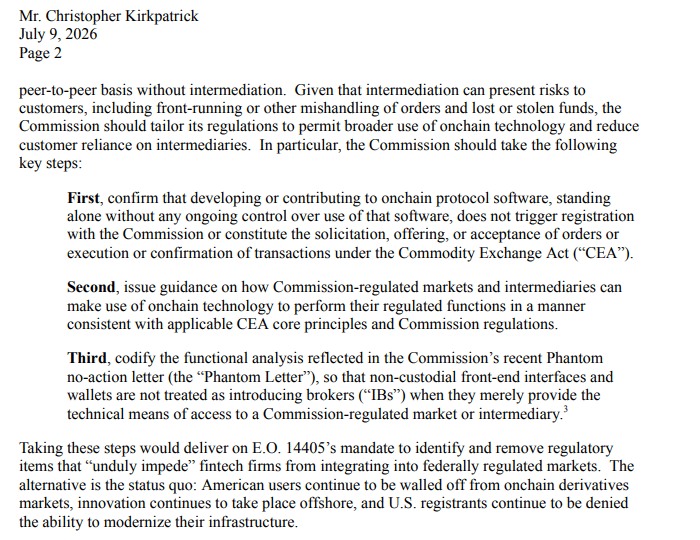
In a letter sent to the CFTC, the DeFi players requested three things. First, the agency should not treat a non-custodial software developer (users control funds, not the platform) as a broker.
In other words, creating on-chain protocols should not automatically trigger CFTC registration as an exchange or clearinghouse. Put plainly, they want developer protections.
Second, the no-action relief granted to self-custodial wallets, as issued to Phantom in March 2026, should be made formal guidance.
An industry coalition made a similar argument and pushed in April. If adopted, non-custodial DeFi front-ends like Phantom would not need broker-dealer or exchange registration to handle even U.S tokenized stocks.
Finally, they want the CFTC to create a framework that allows regulated entities to use blockchain for trading and settlement.
Why are DeFi firms seeking exemptions?
The letter was a response to the CFTC’s request for information regarding issues that are preventing fintechs from partnering with its regulated entities.
Some of the issues raised by Hyperliquid and Phantom are DeFi exemptions, some of which are being deliberated in the CLARITY Act. In fact, even the SEC is exploring a similar “innovation exemption” for tokenized assets trading.
The DeFi players cautioned that failure to explore these recommendations would reinforce the status quo, with dire consequences.
The alternative is the status quo: American users continue to be walled off from onchain derivatives markets, innovation continues to take place offshore, and U.S. registrants continue to be denied the ability to modernize their infrastructure.
Why DeFi exemptions request could be delayed
But these requests, even if granted, could trigger legal challenges from traditional market participants. The Chicago Mercantile Exchange (CME) has already sued the CFTC over its approval of Kalshi’s crypto perpetuals (perps).
CME argued that perps are swaps rather than futures, meaning the contracts should fall under its regulatory framework. That stance prompted the CFTC to reconsider how it defines swaps.
Hyperliquid Policy Center founder Jake Chervinsky called the CME lawsuit anti-competitive and a “shocking misjudgement.”
Citadel Securities and the umbrella body representing traditional exchanges have also opposed DeFi exemptions, particularly for tokenized asset trading. They argue regulators should treat every platform as a broker based on its function, not its underlying technology.
In short, DeFi platforms handling U.S. tokenized stocks should meet the same disclosure requirements and legal obligations as traditional exchanges.
Like CME, other traditional market participants could sue the agency if it grants the requested DeFi exemptions, particularly because lawmakers have not codified them and the CLARITY Act’s future remains uncertain.
Final Summary
Hyperliquid and Phantom have requested CFTC for formalized exemptions for DeFi front-ends
But with the CLARITY Act still in limbo, CME and other traditional players will continue to legally challenge the regulator over such requests.
Prediction market Polymarket applied for a license to offer U.S. users margin trading, enabling them to place bets with less upfront capital, Bloomberg reported Thursday.
Polymarket’s U.S. affiliate, Coming Home GBA LLC, filed for a futures commission merchant license with the National Futures Association, Bloomberg said, citing a company representative. Polymarket will also require authorization from the Commodity Futures Trading Commission (CFTC) for changes to its rulebook that would allow trading without fully collateralized positions.
Prediction market platforms like Polymarket and Kalshi offer yes-or-no wagers on the outcomes of events, such as weather, sports and elections. Margin trading lets investors open positions with less upfront capital, a practice common in traditional markets. Kalshi received clearance to offer margin trading in March.
Polymarket’s application comes as prediction markets continue to grow. Volumes hit $51 billion last year and are on pace to reach about $240 billion in 2026. Wall Street broker Bernstein recently said it expects volume to rise to $1 trillion by 2030 as the sector evolves from niche wagering into wide-based “information markets” spanning sports, crypto, politics and the economy.
January 20, 2025. Donald Trump walks back into the White House. Bitcoin is touching $109,000. Gold is steady at $2,697 an ounce. And a meme coin bearing the president’s name is a few days old and trading around $35, already down sharply from its launch peak of $74.
Six months on, those three assets have gone in three completely different directions. Here is what $10,000 in each one looks like today.
Bitcoin: $10,000 becomes $5,880
On inauguration day, Bitcoin opened around $102,000. A $10,000 investment bought roughly 0.098 BTC. Today, with Bitcoin trading near $60,000, that position is worth approximately $5,880, a loss of just over 41%.
The irony runs deep. Trump entered office as the most crypto-friendly president in U.S. history. He signed executive orders supporting the industry, established a Strategic Bitcoin Reserve, and pushed through the GENIUS Act for stablecoins.
Bitcoin still lost nearly half its value on his watch. Rising Treasury yields, institutional profit-taking, and selling pressure tied to Strategy’s $14 billion unrealized loss position have weighed heavily throughout his term.
Gold was the quiet winner nobody put in their inauguration-day portfolio. At $2,697 per ounce on January 20, $10,000 bought 3.71 ounces. Today gold trades around $4,110, making that position worth approximately $15,248, a gain of about 52%.
The driver is everything Trump’s presidency brought with it: tariff wars, geopolitical tension, U.S.-Iran military strikes, and persistent inflation keeping the Fed cautious. Every time uncertainty spiked, gold climbed. The metal hit an all-time high of $5,597 in January 2026 before pulling back. For an asset dismissed as boring, it has been the standout trade of the cycle.
Trending on TheStreet Roundtable
Trump Coin: $10,000 becomes $430
The TRUMP meme coin launched two days before inauguration day and peaked at $74.27 within 48 hours. By January 20 it had already crashed to around $35. A $10,000 investment bought roughly 285 coins. Today those coins are worth approximately $430, a loss of 96%.
Nearly one million people bought the coin. Analytics firm Nansen found that their combined losses total $3.81 billion. Trump himself cleared more than $635 million from the same token. The trade worked out for one side of the table.
Solana [SOL] traders are openly losing confidence in the market. However, another set of long positions may still be open. Hence, the question: Will SOL rebound or fall and experience further downside?
Solana sentiment and trading activity at YTD lows
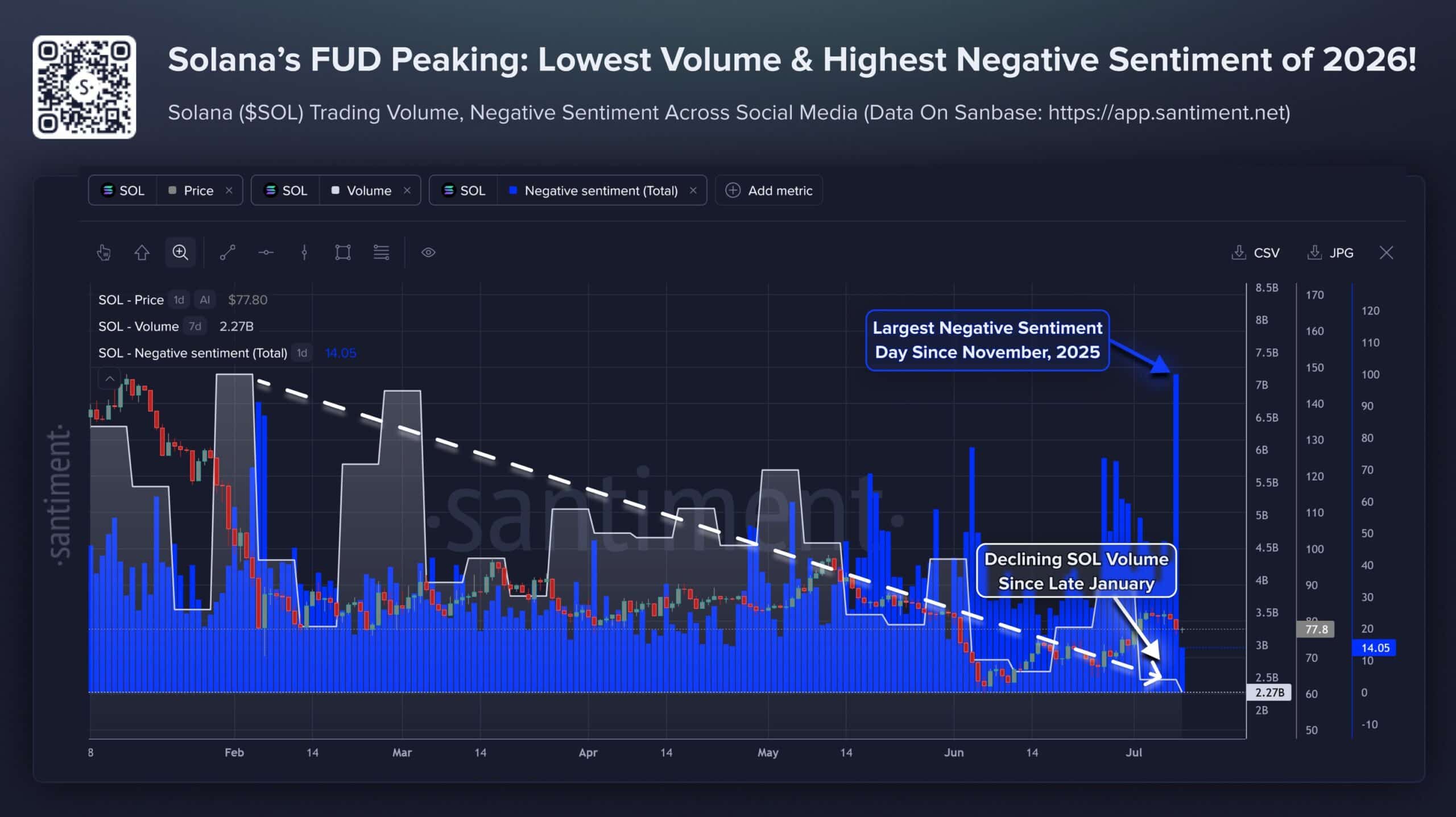
At the time of writing, SOL’s trading volume had fallen to around $2.27 billion – Its lowest level in 2026. Meanwhile, the negative sentiment score also shot up to 14.05.
This has been the biggest wave of negativity around the token since November 2025.
Source: Santiment Intelligence
Much of the frustration comes from the gap between Solana’s growing ecosystem and its price performance. Despite pickup around the tokenized stocks and RWA narratives, traders are yet to see light.
Note that extreme negativity can sometimes make room for an unexpected move up. As it stands, even a modest return of demand could lead to a positive price move.
There’s a catch though!
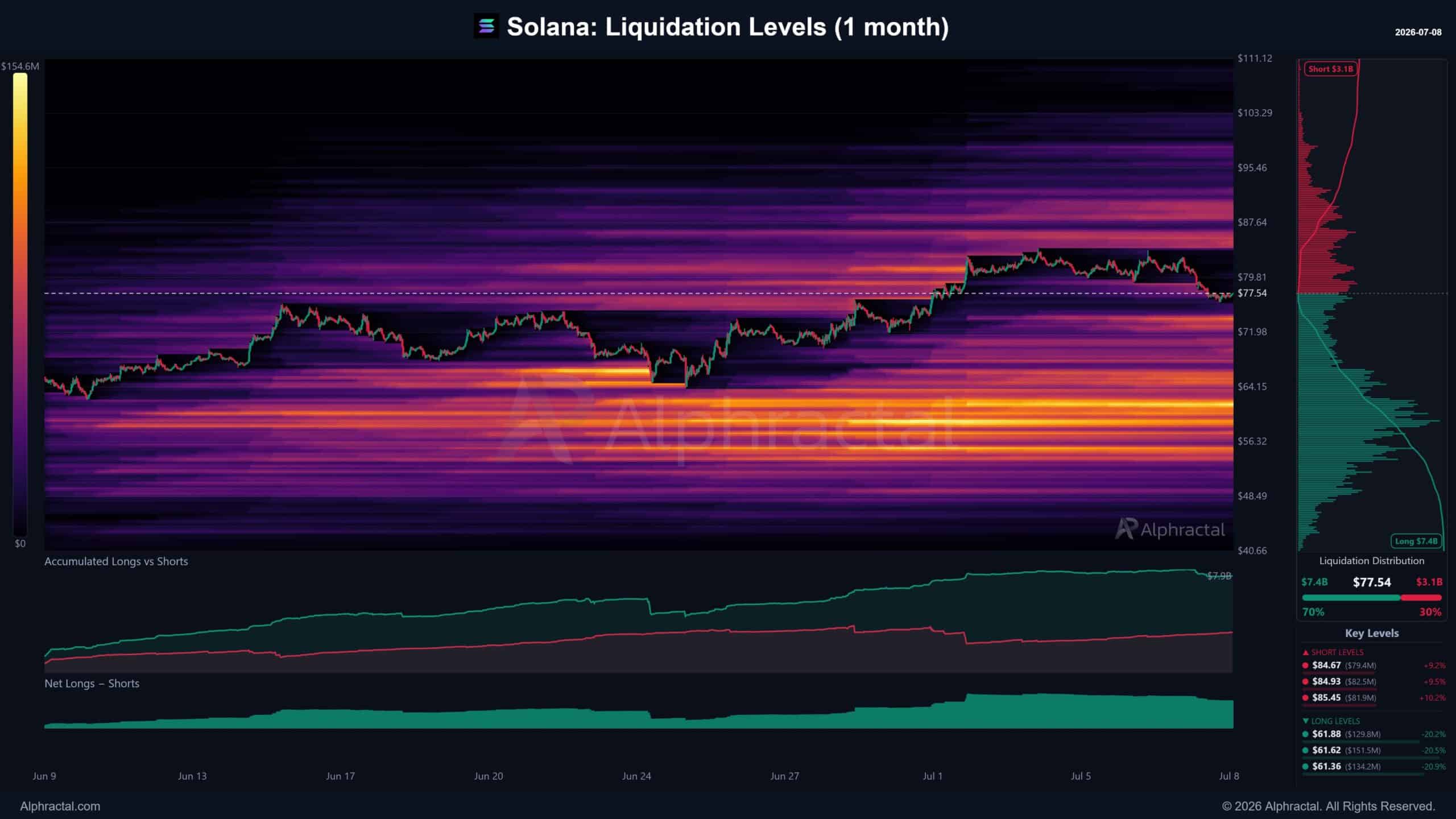
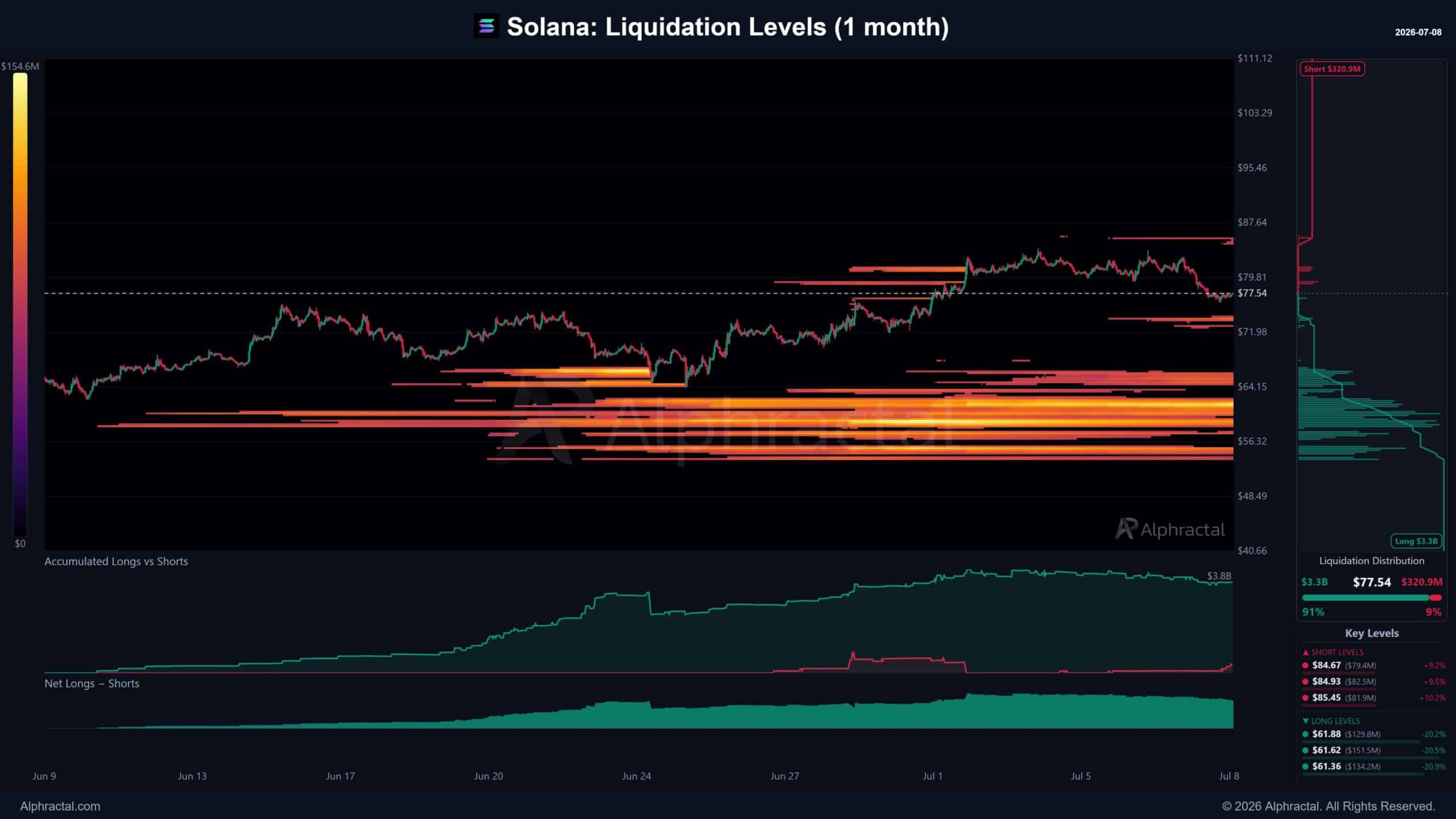
Solana’s derivatives market did seem inclined towards long positions though. In fact, the liquidation map showed around $7.4 billion in long exposure, compared to roughly $3.1 billion in shorts.
Source: Alphractal
The largest long liquidation cluster was at around $61-$62, roughly 20% below the press time price.
Source: Alphractal
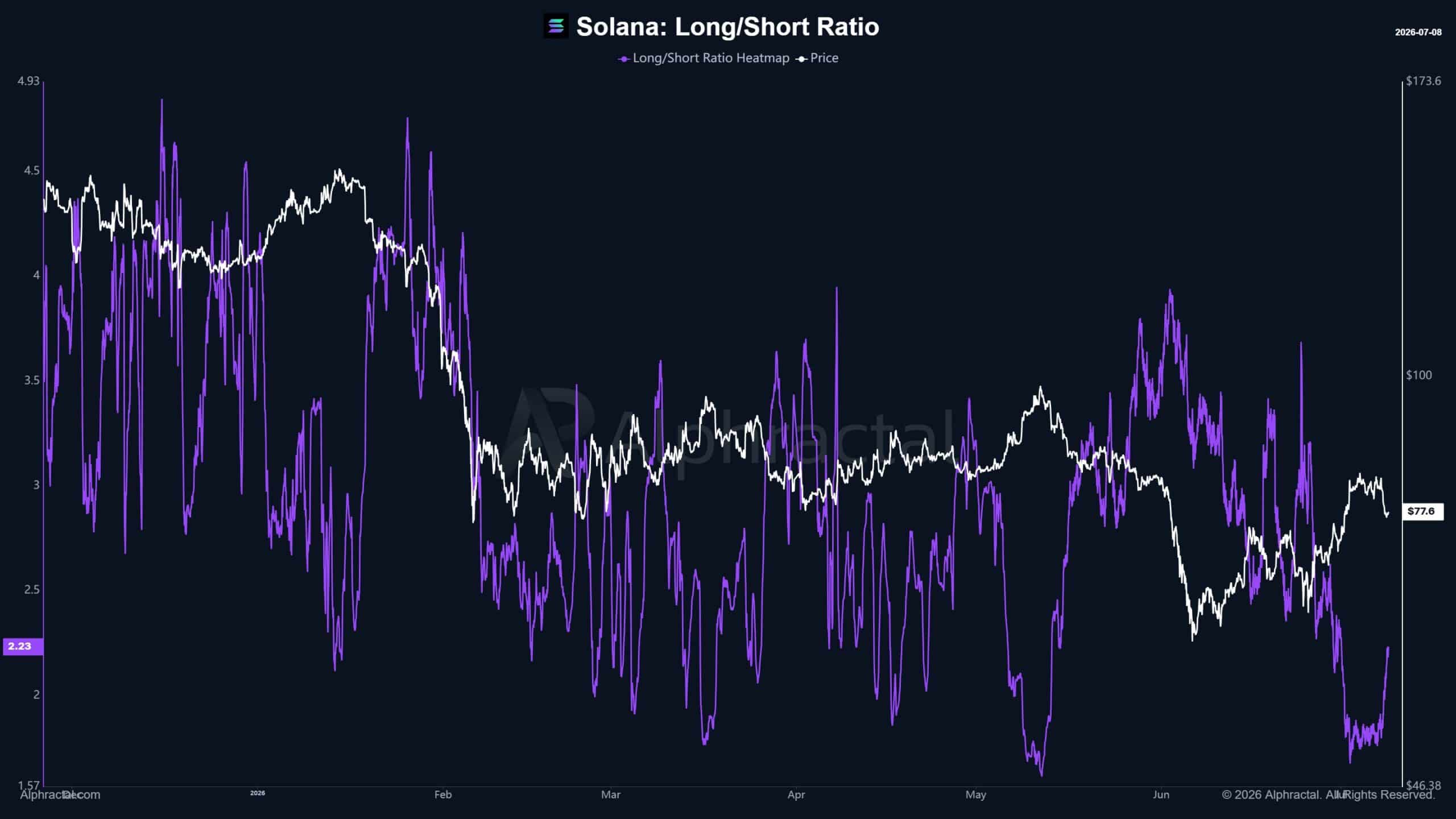
Meanwhile, the long/short ratio across major exchanges had started recovering and was near 2.23 at press time. Traders appeared to be bullish again.
Source: Cryptoquant
Now, none of this guarantees a sell-off. However, if SOL drops, crowded long positions could add to the pressure.
SOL holds, but the bullishness is starting to cool
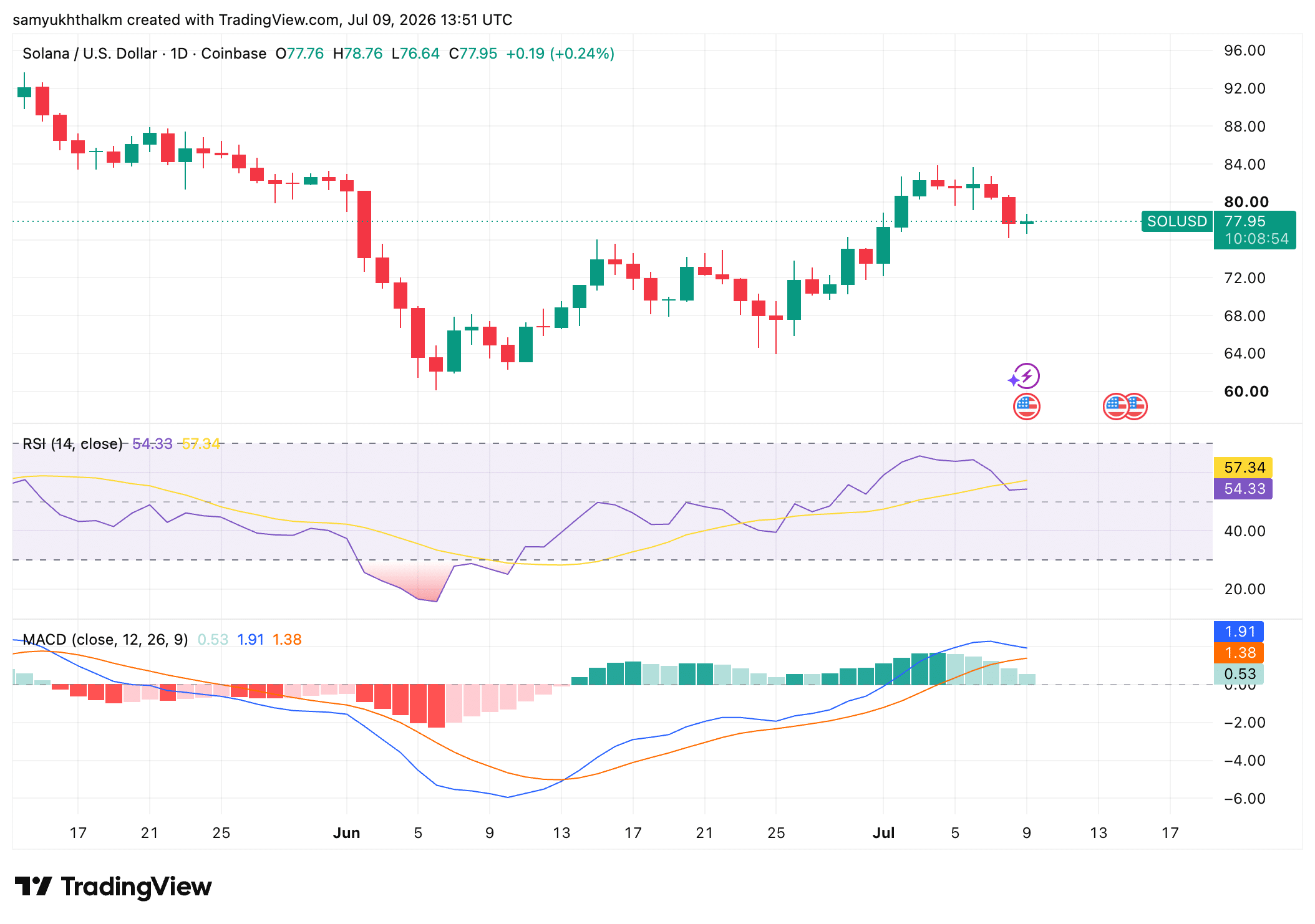
Despite the heavy long positioning, Solana’s price chart seemed to give way to hope. SOL was trading near $77.95 at the time of writing. It had recovered from its June lows and was testing the $82-$83 area.
The RSI was in neutral territory rather than an overbought market. The MACD was also positive, with the MACD line at 1.91, above the signal line at 1.38.
Source: TradingView
However, the upward pace appeared to be slowing down.
A move back above the recent highs may be needed to rebuild confidence. Until then, crowded long positions could be a risk.
Final Summary
SOL’s trading volume and negative sentiment are now at their worst levels of the year.
Downside risk was also relatively higher at press time.
Traders typically do not rely on a single indicator to determine market trends. But this particular MACD has proved reliable as a standalone gauge through the price crash from the record high of $126,000. Since October, negative crossovers have reliably marked the start of steeper declines, while positive crossovers have preceded meaningful recovery rallies – including the December–January bounce and the February–May bounce.
BTC’s daily chart. (TradingView)
The latest bullish crossover therefore points to a notable bounce ahead, though not necessarily the start of a full-blown new uptrend. That bigger move would need more confirmation, which is why the key resistance levels below are now in focus.
Key levels ahead
The first level to watch is the 50-day simple moving average, currently around $65,434. This is simply the average bitcoin price over the past 50 days (roughly two months).
Traders in both crypto and traditional markets watch this line closely to gauge near-term momentum. A clear move above it is often seen as a sign that upside strength is building.
The second key level is $67,292, which was the mid-June high. This is where bitcoin staged a brief recovery from early June lows near $60,000, only for sellers to step in aggressively. That resistance turned the price lower again. Breaking above $67,292 would be another win for buyers, showing they have overcome the previous area of strong selling pressure.