Home Blog Page 285

Metaplanet announces join study to bring BTC-powered digital credit to Japan

0
Metaplanet announces join study to bring BTC-powered digital credit to Japan

“The four companies will examine issues in product design, the need for proof-of-concept initiatives, and the possibility of future issuance,” Metaplanet said in a statement. “At this time, nothing has been determined regarding issuance timing, terms, yield, product details, distribution methods, or the form of collaboration.”

Japan’s traditional credit market leans in favor of large corporations with public bond offerings. Mid-sized and growth companies often face high costs and operational burdens around issuance, sales, investor management, interest payments and redemptions, according to Metaplanet.

Digital credit could open the debt market to these smaller companies, bridging traditional capital markets with onchain technology, enabling 24/7 global trading and settlement, holder-level rights management, automated pro-rata interest calculations and transparent onchain payments/redemptions.

Key roles

Each company is bringing its own strength to the table. Metaplanet and its securities arm will design and create the new products that combine bitcoin with credit offerings. They’ll also handle selling them to investors, communicating with customers, and managing everything afterward.

JPYC will explore the use of its stablecoin in the process, making sure it can be used smoothly for payments and redemptions.

Progmat will provide a secure, regulated system for turning the products into digital tokens on the blockchain. This includes tracking ownership, handling transfers, and connecting everything to the stablecoin payments system.


Source link

Seller-paid rate buydown: How it works and how to ask for one

0
Seller-paid rate buydown: How it works and how to ask for one


A seller-paid rate buydown may be the mortgage-rate relief that hopeful homebuyers are looking for. Few house hunters might imagine the seller coming to their rescue, but it’s possible, and in some real estate markets, even likely. Here’s how.

When marketing a home-for-sale listing, sellers often need to generate more interest. That’s where open houses, advertising, and price reductions come into play. There are also seller concessions. Those are cash or closing-cost credits issued by the seller and used as incentives for potential buyers.

A rate buydown is a powerful marketing tool where the seller pays to lower the buyer’s mortgage rate.

➡ Read more: Seller concessions vs. credits

Rate buydowns can be either permanent or temporary.

A permanent seller-paid rate buydown is when the seller buys discount points to lower a buyer’s mortgage rate for the life of the loan. 

“If the seller is a builder, developer, or has other properties in the area, they may choose to offer a rate buydown versus a price cut, in order to maintain values and comps for their other properties,” Lindsey Harn, of the Lindsey Harn Group in San Luis Obispo, California, told Yahoo Finance. “Sometimes sellers also want to keep the comps high for their neighbors, or simply be stuck on hitting a certain sales price for their home.”

A temporary seller-paid rate buydown lowers the buyer’s mortgage rate only for a specified time. The seller makes a cash contribution to the mortgage escrow account to fund the temporary rate cut. For example, a 2-1 buydown lowers the rate by 2% in the first year and 1% in the second. For the third year and the remaining term of the loan, the borrower will pay the issued mortgage rate. 

“As a buyer, a temporary rate buydown can be great if you expect your income to increase over the next two to three years,” Harn said. “However, as a buyer, if you think rates are going to drop and you are going to want to refinance in the next two to three years, the funds spent on the rate buydown can be a ‘waste’ of money.”

Read more: Temporary vs. permanent rate buydown

Negotiating the purchase of a home will fall to your buyer’s agent. However, if you’re interested in exploring a seller-paid rate buydown, it’s worth asking your agent if the local real estate market is prone to such seller concessions. It’s also not a bad idea to get a second opinion or two.

If you’re seeing other listings similar to the one you’re pursuing that promote buydowns, press the matter with your agent, politely, of course. Some agents are better than others at negotiating a deal. 

If you’re a hands-on negotiator, make sure you:

  • Have a mortgage preapproval in hand. 

  • Have researched your local real estate market. A buyer’s market is more conducive to seller concessions, such as rate buydowns. 

  • Know the cost of the buydown you’re proposing by talking to your lender.

  • Have your real estate agent put the specific buydown details in your purchase agreement or counteroffer.

  • A lower interest rate can enhance the affordability of a home purchase.

  • A seller-paid rate buydown may be more valuable to a buyer than a price cut on the house. Use a mortgage payment calculator to run various scenarios. 

  • Even a temporary buydown can help new buyers transition to homeownership by providing a budget cushion for moving expenses, furniture, or home improvements.

  • A temporary buydown might put you in a budget squeeze when the higher interest rate kicks in to your monthly payment.

  • A permanent buydown lowers only your interest rate. A price cut of an equal amount may also lower your property taxes.

  • Depending on the type of loan, there are limits to seller concessions, most commonly ranging from 3% to 6%, though up to 9% on conventional loans with more than 25% down.

One discount point generally reduces a mortgage rate by about 0.25%, so for a life-of-the-loan 1% reduction in the interest rate, four discount points would be required. That would equal 4% of a home’s purchase price. For example, on a $400,000 home, four discount points would cost $16,000.

A 2% buydown can be either a permanent or a temporary interest rate reduction. A seller may offer to lower the buyer’s mortgage rate by 2% for the first year, such as in a 2-1 buydown, or for the life of the loan. 

A seller can generate more buyer leads by offering a temporary rate buydown. This is particularly useful in a buyer’s market, where there are more homes for sale than there is demand. 

➡ Read more: Understanding housing inventory

Under the right circumstances, both the buyer and seller can benefit. A buyer can get a lower mortgage rate, and the seller can drive more interest to their listing — and perhaps do it at a lower cost than reducing the asking price. 


Source link

‘The stacking continues,’ says unfazed Eric Trump despite $600M Bitcoin venture wipeout

0
'The stacking continues,' says unfazed Eric Trump despite $600M Bitcoin venture wipeout


Eric Trump’s stake in Bitcoin mining and treasury firm American Bitcoin Corp. has been devalued by about $600 million, according to a Bloomberg report. 

He owns about 6% of the firm and doubles as American Bitcoin’s Chief Strategy Officer. His brother, Donald Trump Jr., also owns an undisclosed stake in the firm.

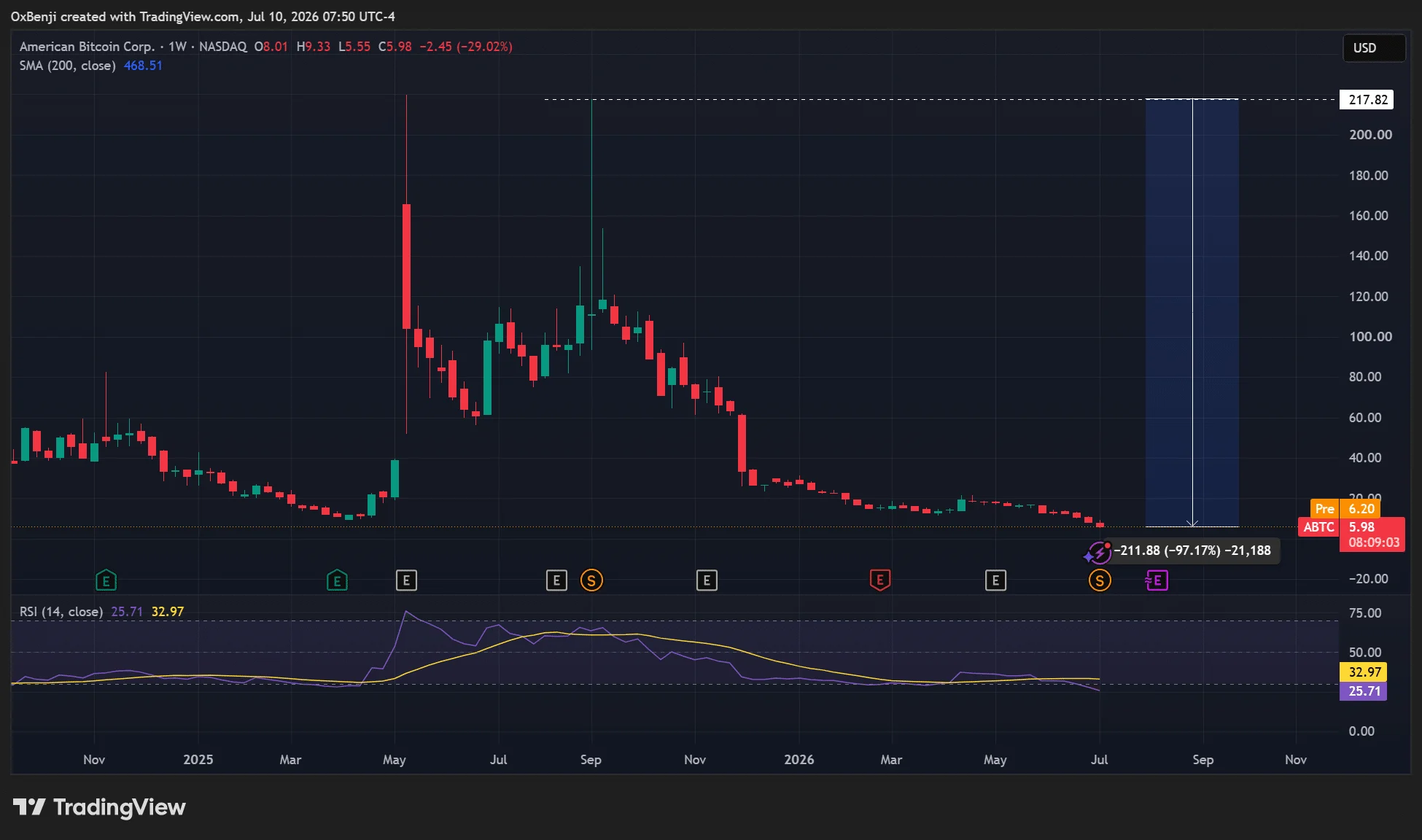
Amid the broader crypto downturn, the firm’s stock, ABTC, has plunged by 97%, crashing from September 2025’s peak of $217 to a record low of $5.98. This week alone, it dumped by over 29%.

Eric Trump American Bitcoin Corp
Source: ABTC, TradingView 

The massive stock dump forced the firm to launch a 1-for-5 reverse stock split on 2nd of July to remain listed on the Nasdaq. 

A company’s stock must maintain a minimum bid price of $1 to remain listed on the exchange. In fact, Nakamoto, another Bitcoin treasury firm, was forced to opt for a stock split to avoid a similar delisting. 

American Bitcoin Corp. scales holdings to 8,000 BTC

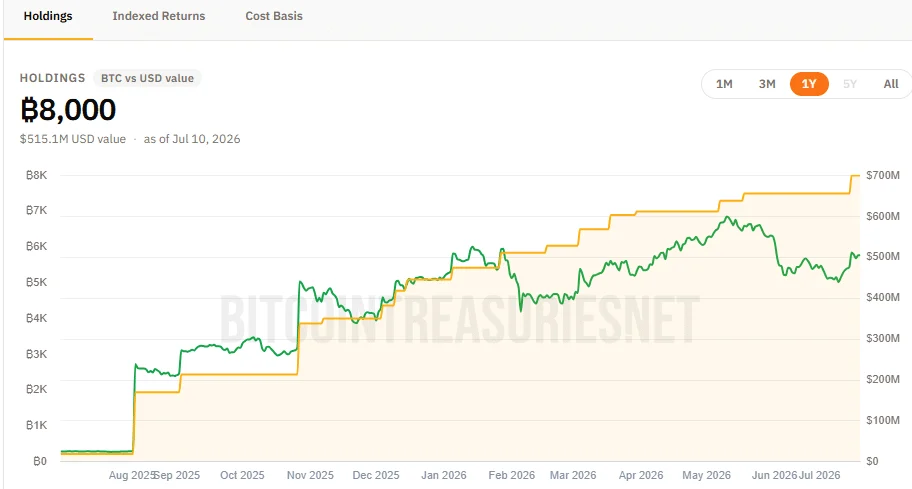
Despite the ongoing stock dump, however, the firm increased its BTC stash to 8,000 coins from 7,500 coins. 

Commenting on the same, Eric Trump downplayed the stock sell-off as just ‘crypto market volatility.’ In fact, he simply reiterated the commitment to ‘stacking’ more BTC at a discount. 

Even with crypto market volatility, I want to reiterate how we continue to differentiate ourselves, mining at a 52% profit margin in Q1 and continually adding to our treasury, all while maintaining one of the lowest SG&A ratios in the industry. The stacking continues.

Eric Trump American Bitcoin CorpEric Trump American Bitcoin Corp
Source: Bitcoin Treasuries 

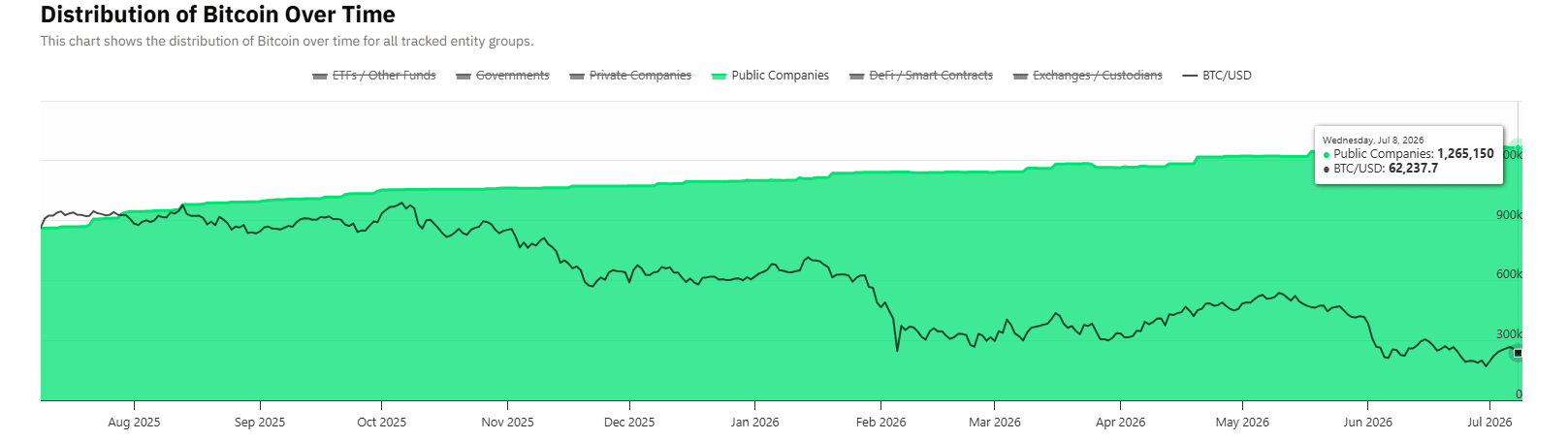
Separately, the broader Bitcoin treasury demand for the crypto asset has eased significantly after its largest buyer, Strategy, became a seller. Strategy recently sold $216M worth of BTC. 

In the last 30 days of trading, the demand from corporate treasuries has been negligible at 0.3%. In fact, after Strategy’s sale, the overall stash held by public companies dropped from 1.267M to 1.265M BTC. 

American Bitcoin Corp Eric trumpAmerican Bitcoin Corp Eric trump
Source: Bitcoin Treasuries 

The market faded the recent Strategy’s sale. However, whether it will help form a ‘durable market bottom’ for BTC and shore broader treasury demand remains to be seen. 


Final Summary

  • American Bitcoin Corp. stock dropped to a record low of $5.9 despite a recent reverse stock split. 
  • It has dropped by 97% from its last year peak of $217, erasing over $600M of Eric Trump’s stake in the firm.


Source link

Bitcoin’s $60,000-$70,000 range becomes third most traded range in history

0
Bitcoin's $60,000-$70,000 range becomes third most traded range in history


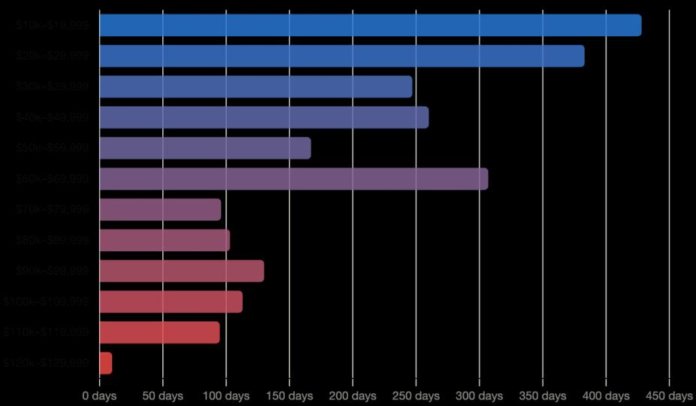
Bitcoin is trading around $64,000, marking 307 days within the $60,000- $70,000 range.

The consolidation range is now the third longest period spent in any $10,000 price band in bitcoin’s history, behind only the $10,000-$20,000 and $20,000-$30,000, according to Glassnode data.

From a technical perspective, bitcoin continues to trade above its 200-week moving average, currently around $62,873. Historically, prolonged moves below this level have been short lived, making it a closely watched gauge of the long term trend.

Despite holding near $64,000, bitcoin remains roughly 50% below its all-time high reached in October.

Onchain data also points to a significant area of support. Glassnode’s Entity Adjusted UTXO Realized Price Distribution, which tracks the price at which bitcoin last changed hands between economic entities, shows that about 6% of the circulating supply sits between $58,000 and $64,000.

Whether this range ultimately resolves higher or lower remains uncertain, but the prolonged sideways trading has established one of bitcoin’s largest cost-basis clusters to date.

UPDATE (July 10, 11:20 UTC): Amends hed from “Bitcoin’s $60,000-$70,000 range becomes third longest consolidation in history”


Source link

Exclusive-Software firm CCC exploring sale, sources say

0
Exclusive-Software firm CCC exploring sale, sources say


By Milana Vinn

NEW YORK, July 9 (Reuters) – CCC Intelligent Solutions, a provider of software and AI-powered workflow tools, is ‌exploring a sale of the company, according to three ‌people familiar with the matter.

The Chicago-based company has hired Morgan Stanley to advise on ​a sale process and has reached out to prospective buyers, including private equity firms, the sources said.

CCC and Morgan Stanley did not immediately respond to requests for comment.

Shares rose 13% to $6.09 in after-hours ‌trading following the Reuters ⁠report on it exploring a sale.

CCC provides software used by auto insurers, collision repair shops, automakers and ⁠parts suppliers to manage accident claims, vehicle repairs and related workflows. The company says its platform connects more than 35,000 businesses across the ​property-and-casualty ​insurance ecosystem.

The company’s market value has ​fallen to roughly $3.3 billion ‌from about $6.4 billion a year ago as investors grew concerned about slowing growth, weaker industry claims volumes and slower-than-expected adoption of some of its newer software products. The company’s shares have declined about 44% over the past 12 months.

CCC has explored a sale previously. ‌Reuters reported in 2023 that the ​company was considering strategic options including ​a potential sale after attracting ​takeover interest, though no transaction materialized.

Advent International, which ‌acquired CCC in 2017 and took ​it public through ​a merger with a special purpose acquisition company in 2021, fully exited its investment in 2025 through a series ​of secondary share offerings, ‌including the sale of its remaining stake in November.

(Reporting ​by Milana Vinn in New York; Editing by Colin ​Barr, Nia Williams and Jamie Freed)


Source link

Apple sues OpenAI, alleging it stole trade secrets

0
Apple sues OpenAI, alleging it stole trade secrets

Apple sued OpenAI on Friday for allegedly stealing its trade secrets, an extraordinary move that pits the $4.6 trillion iPhone maker against the fast-growing AI startup as it prepares to release a new class of hardware products that have been shaped in large part by Apple’s former design boss.

In the lawsuit, filed in the Northern District of California court, Apple accused two former employees now working at OpenAI of systematically stealing confidential data, including information about unreleased hardware products, technical specifications, and details about vendors and contractors in Apple’s supply chain. The complaint also listed OpenAI as a defendant, as well as io Products, a hardware design firm acquired by OpenAI last year that was co-founded by Apple’s former design boss, Jony Ive.

“At every level, from members of its Technical Staff to its Chief Hardware Officer, and in coordination with business partners, OpenAI has been stealing Apple’s trade secrets and confidential information,” Apple said in the 41-page complaint. “OpenAI’s nascent hardware business now rests on the shakiest of foundations, rotten to its core by its illegal reliance on misappropriated trade secrets.”

OpenAI told Fortune in a statement that “we have no interest in other companies’ trade secrets. We remain focused on building innovative technology that empowers people everywhere.”

The lawsuit marks a dramatic escalation between two companies that were once working together to bring OpenAI’s ChatGPT into Apple’s software platforms and Apple’s Siri digital assistant. The partnership between Apple and OpenAI faded over time, and in January Apple announced that it was turning to Google for its Apple Intelligence efforts.

An Apple spokeswoman added in a statement that the company’s teams “are constantly developing breakthrough technologies to create the best products and services in the world, and protecting their work and intellectual property is something we take very seriously.”

Apple accuses Tang Tan, OpenAI’s chief hardware officer and a former vice president at Apple, of systematically stealing secrets, including using confidential Apple codenames during OpenAI’s recruiting process, encouraging interviewers to share secrets from the iPhone maker, and directing them to physically bring Apple hardware parts into interviews. Tan left Apple to join io Products in 2024 after roughly 24 years at the company, where he had risen from product designer to vice president over iPhone and Apple Watch product design.

Chang Liu, a member of OpenAI’s technical staff, is accused of downloading dozens of confidential hardware files, including technical specifications, engineering presentations, and proprietary data for unreleased products. Liu is also accused of instructing an Apple employee on how to bypass security teams when copying files. OpenAI is accused of misappropriating knowledge of Apple’s supplier relationships and proprietary terminology to approach Apple’s supply chain partners. 

Apple’s allegations are all the more striking given the company’s reputation for fiercely safeguarding the secrecy of its products. 

OpenAI has been developing hardware devices to run ChatGPT on, part of a strategy to control its own physical products rather than rely on giants like Apple. OpenAI has recruited from Apple, including hiring some of its top product leaders, and in May 2025 it announced that it was buying Ive’s io Products for $6.4 billion. 

OpenAI CEO Sam Altman has made no secret that he envisions a new class of AI gadgets that replace smartphones as the primary consumer tech device, and Ive’s move to OpenAI turned heads at the time. Ive is not named in the Apple lawsuit.

The lawsuit comes at a period of transition for both companies, with Apple CEO Tim Cook due to hand the reins to John Ternus in September, and OpenAI preparing for an initial public offering as it faces increasing competition from other AI model makers like Anthropic and Google.

Apple is seeking a combination of injunctive relief, monetary damages, and declaratory judgments to stop the alleged theft.

This isn’t the first time OpenAI has faced such accusations. In 2023, the New York Times sued OpenAI and Microsoft, alleging that the companies used its articles and other content to train their AI models without permission. In June, a California judge dismissed a lawsuit from xAI, the company run by Elon Musk, alleging that OpenAI recruited a former xAI engineer to share information about the Grok chatbot.


Source link

Will Maple Finance [SYRUP] extend rally as TVL hits $2.2B? THESE metrics say…

0
Will Maple Finance [SYRUP] extend rally as TVL hits $2.2B? THESE metrics say…


Maple Finance [SYRUP] has climbed over the past day, and much of that move traces back to the protocol’s strengthening fundamentals.

The altcoin rallied 14% as fresh partnerships and capital rotation flowed into the ecosystem, and that underlying performance could sustain the rally across the next several trading sessions.

Capital inflows power SYRUP’s fundamentals

Capital moving into Maple Finance has driven much of the token’s recent performance.

Assets under management reached $4.6 billion in the first half of 2026, up 81% year-on-year, while loans outstanding hit an all-time high of $1.9 billion, a 123% jump over the same period.

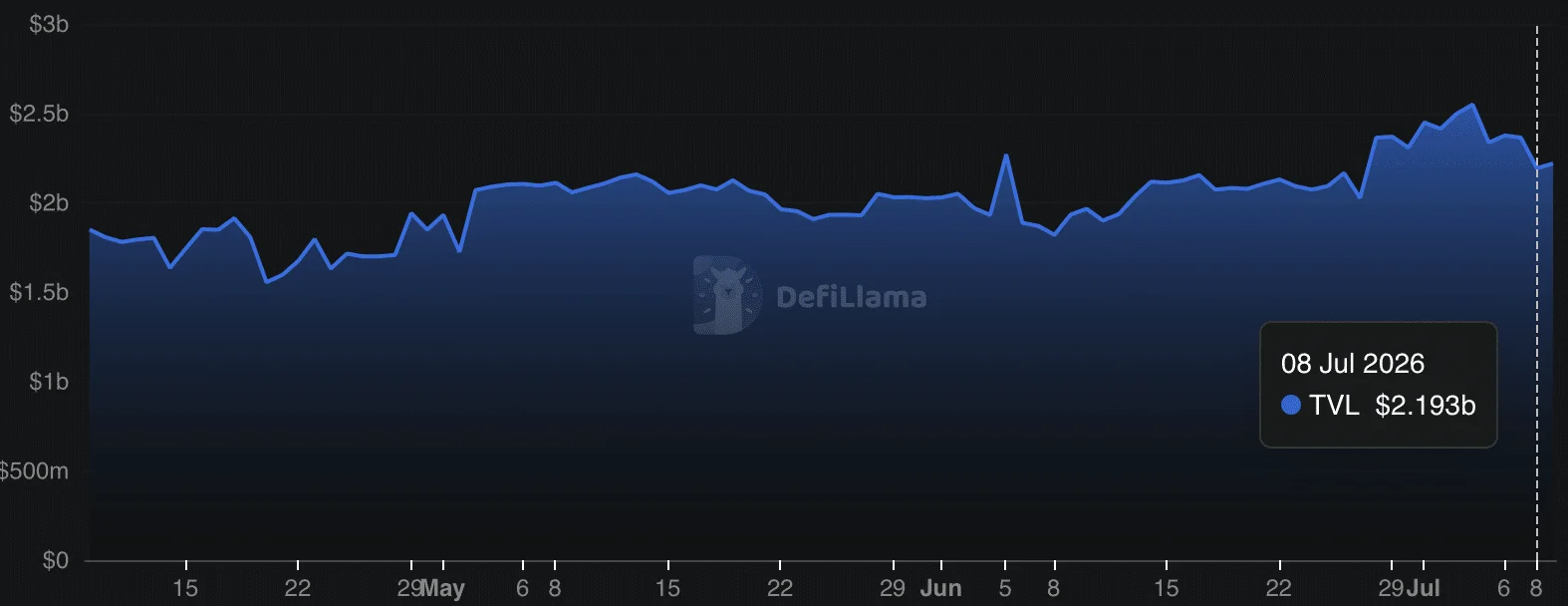
The flow reflects in the protocol’s total value locked (TVL), which measures the assets deposited and locked on the platform mostly by investors holding a long-term outlook, and which surged by more than $220 million over the past day to reach a high of $2.265 billion.

Maple finance total value locked.
Source: TradingView

Much of the inflow points to syrupUSDG, which recently launched on Robinhood and has seen its assets under management climb by more than $200 million according to Maple’s own data.

Sid Powell, co-founder and CEO of Maple Finance, tied much of the growth to demand from fintech and neobank users, noting that the comparable SyrupUSDT product took more than 18 months to reach $100 million in AUM.

How syrupUSDG demand translates to SYRUP growth

SyrupUSDG is an interest-bearing token issued by the decentralized credit protocol Maple Finance, and holders who deposit the Global Dollar (USDG) stablecoin earn returns generated through institutional lending.

Rising adoption of SyrupUSDG feeds activity back into Maple, and that in turn lifts demand for the native token.

The link shows up on-chain, with DeFiLlama data reporting roughly 18% of the token’s market capitalization already staked, worth $36.93 million at the time of reporting, tightening the supply available to the market.

Maple’s yields has played a major role too. The company’s recent report shows the protocol outperformed the industry benchmark by more than 117 basis points at an APY of 4.765% against a benchmark of roughly 3.590%.

SYRUP market outlook and buyback proposal

SYRUP carries a longer-term case beyond the current move, anchored by a proposal to introduce revenue-linked buybacks that scale with earnings.

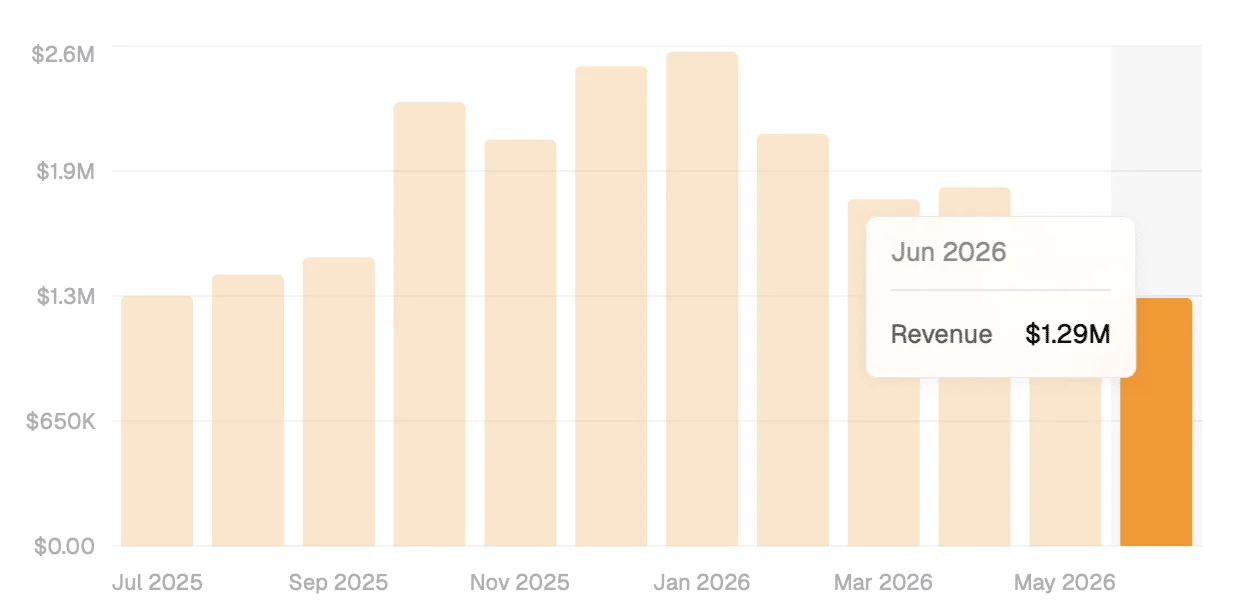
The SYRUP Strategic fund released a plan for a tiered buyback tied to a share of monthly revenue, under which repurchases could rise to as much as 30% once revenue climbs above $2 million.

Maple Finance Revenue. Maple Finance Revenue.
Source: MapleFinance

That threshold is within reach given the protocol’s trajectory. Maple posted $4.4 million in second-quarter revenue, up 47% year-on-year, and now runs at $17.6 million in annualised recurring revenue, which works out to just under $1.5 million a month against June’s $1.29 million.

The framework would run for roughly six months if approved, landing at a point where the protocol’s revenue is closing in on the level that would unlock its steepest buyback tier.


Final Summary

  • Maple Finance’s SYRUP rallied 14% as H1 2026 assets under management reached $4.6 billion, up 81% year-on-year.
  • A proposed revenue-linked buyback could repurchase up to 30% of monthly revenue once it clears $2 million, and could contribute to shortterm outlook.


Source link