Home Blog Page 303

PepsiCo vs. Molson Coors: Which Stock Will Quench Investor Thirst For Profits in 2026?

0
PepsiCo vs. Molson Coors: Which Stock Will Quench Investor Thirst For Profits in 2026?


Choosing between stable dividends and turnaround potential often defines a portfolio strategy. For 2026, comparing snack powerhouse PepsiCo (NASDAQ:PEP) and brewer Molson Coors Beverage (NYSE:TAP) reveals two very different paths for investors.

PepsiCo dominates through its convenient foods and non-alcoholic drinks, leveraging a massive global distribution network. Molson Coors Beverage focuses on the beer market but is aggressively expanding into ready-to-drink cocktails and premium offerings. While both operate in the defensive consumer space, their recent financial trajectories suggest distinct risks and rewards.

The case for PepsiCo

The company sells iconic brands like Lay’s, Doritos, and Gatorade across 200 countries. It relies heavily on retail giant Walmart (NASDAQ:WMT) for approximately 14% of its net revenue. Customer concentration like this adds a layer of risk to the business. As of June 2026, the company no longer has subsidiary ownership of Pizza Hut after Yum! Brands (NYSE:YUM) sold that division. PepsiCo now focuses more on its direct delivery relationships, e-commerce, and the development of snacks that align with changing health trends.

In FY 2025, revenue reached approximately $93.9 billion, representing nearly 2.3% year-over-year growth. Net income for the period was approximately $8.2 billion, lower than the $9.6 billion reported in the previous year. The company carries a debt-to-equity ratio of approximately 2.5x. Free cash flow for the year was close to $7.7 billion, representing the cash generated after capital investments.

The case for Molson Coors Beverage

Molson Coors produces a wide variety of beers and beverages, including Coors Light and Miller Lite. The company is actively diversifying its portfolio into the beverage stock category through acquisitions such as Atomic Brands. It operates through a three-tier distribution system in the United States and has no single customer representing more than 10% of sales. This diversification helps the company reach a broader consumer base as traditional beer volumes face pressure.

During FY 2025, revenue was nearly $11.1 billion, representing a decline of roughly 4% from the prior fiscal year. The company reported a net loss of approximately $2.1 billion for the period. This loss follows a profitable fiscal year 2024 where the company earned more than $1.1 billion, illustrating the volatility of its current transition. These figures highlight the challenges of shifting a legacy business model toward more premium offerings.

As of its December 2025 balance sheet, the debt-to-equity ratio was close to 0.6x. This indicates a lower reliance on borrowed money compared to shareholder equity. Molson Coors Beverage produced nearly $1.1 billion in free cash flow during FY 2025. This cash generation is essential, as it fuels the company’s expansion into non-beer categories such as energy drinks and cocktails.

Risk profile comparison

PepsiCo faces significant risks from shifting consumer behaviors, including the rise of GLP-1 medications and increased price sensitivity. Its scale makes it a target for legal scrutiny, such as recent lawsuits regarding data privacy and product labeling. Furthermore, the business is vulnerable to commodity price fluctuations and geopolitical conflicts that can disrupt global supply chains. If the company fails to use its data analytics effectively to innovate, it could lose volume to lower-priced private-label alternatives.

Molson Coors Beverage must successfully integrate new acquisitions and premiumize its portfolio to offset declining beer consumption. It faces intense competition from Anheuser-Busch InBev (NYSE:BUD) and Constellation Brands (NYSE:STZ) in both traditional and emerging beverage categories. Operational risks such as labor strikes and the ongoing implementation of a global digital infrastructure could disrupt production. Additionally, increasing global scrutiny and mandatory health warning labels on alcohol products pose a long-term threat to demand in key markets.

Valuation comparison

Molson Coors Beverage appears to be the more value-oriented choice for investors as it trades at a significantly lower Forward P/E and P/S ratio than PepsiCo. The Forward P/E compares the stock price to expected earnings over the next year, while the P/S ratio compares the stock price to revenue.

Sector benchmark uses the SPDR XLP sector ETF.
Valuation metrics sourced from Financial Modeling Prep (FMP) and may differ from other data providers.

Which stock would I buy in 2026?

Molson Coors’ primary beer brands, Coors Light and Miller Lite, benefited from the consumer backlash against Bud Light, but that is one of the few bright spots for a company that is struggling to grow beer sales as consumers drink less and increasingly opt for craft beer when they do drink. Wall Street sees 2026 as the third straight year of declining sales, with revenue expected to be a few million dollars lower than in 2025. The move into beverages besides beer is promising, but the business remains less than 10% of Molson Coors’ sales.

PepsiCo is best known for its beverages, including Pepsi, but it is primarily a food company. About 60% of PepsiCo’s revenue comes from snack brands like Lay’s and Tostitos. The rise of GLP-1s is moving consumers toward savory snacks and away from sweets, and PepsiCo is adjusting its product mix and packaging to accommodate this shift. Management says trends indicate savory snacks will outgrow food, benefiting its snack business. Pepsi seems to be more affected by rising U.S. consumer caution about spending, given its snack-food exposure, too.

Both companies are appreciated by investors for their reliable dividend payments. Molson Coors has the higher forward dividend yield at today’s price, at 4.95%, versus PepsiCo’s 4.15%.

Despite Molson Coors’ better dividend and cheaper ratios, investors should want to see a sales turnaround before investing. PepsiCo may be growing slowly, but it is still growing and is the stock to buy.

Should you buy stock in PepsiCo right now?

Before you buy stock in PepsiCo, consider this:

The Motley Fool Stock Advisor analyst team just identified what they believe are the 10 best stocks for investors to buy now… and PepsiCo wasn’t one of them. The 10 stocks that made the cut are built for long-term growth and could produce monster returns in the coming years.

Consider when Netflix made this list on December 17, 2004… if you invested $1,000 at the time of our recommendation, you’d have $407,651!* Or when Nvidia made this list on April 15, 2005… if you invested $1,000 at the time of our recommendation, you’d have $1,252,823!*

That performance is why people listen. With a track record of beating the S&P 500 by 4xStock Advisor offers a distinct advantage. Don’t miss the latest top 10 list, available with Stock Advisor, and join an investing community built for the long haul.

See the 10 stocks »

*Stock Advisor returns as of July 9, 2026.

Brendan Coffey has no position in any of the stocks mentioned. The Motley Fool has positions in and recommends Walmart. The Motley Fool recommends Constellation Brands and Yum! Brands. The Motley Fool has a disclosure policy.

PepsiCo vs. Molson Coors: Which Stock Will Quench Investor Thirst For Profits in 2026? was originally published by The Motley Fool


Source link

Solana under pressure: Pump.fun’s $10M SOL move sparks THIS Q3 debate

0
Solana under pressure: Pump.fun’s $10M SOL move sparks THIS Q3 debate


For Layer 1 networks, price action isn’t just driven by technicals. Solana fits this narrative well.

As a Layer 1 that powers an entire ecosystem, Solana’s growth story isn’t just about price action or creating value for token holders. It’s also tied to how applications and protocols within its ecosystem perform on-chain, driving network demand, revenue, and overall activity.

With that in mind, Pump.fun is back in the spotlight.

The platform recently sold another 122,498 SOL, worth $10.08 million. That brings its total SOL sales to 4,656,826 SOL, valued at $794.8 million, at an average selling price of $170.70.

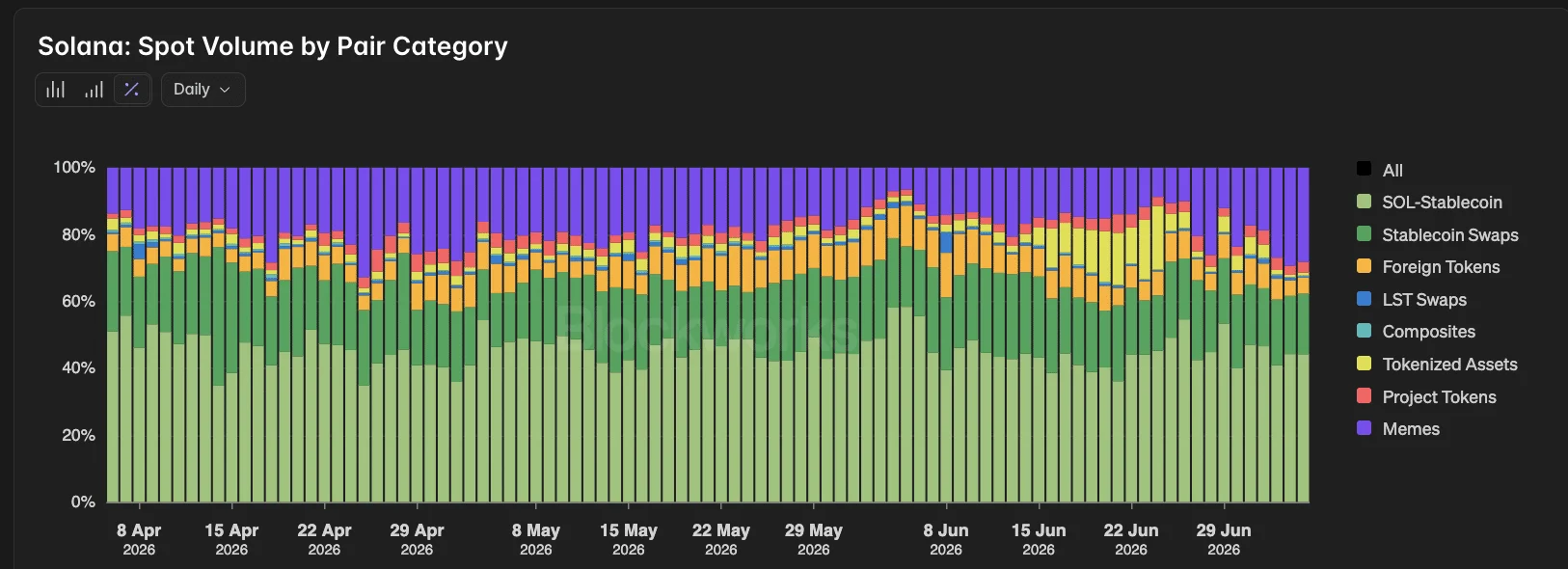
The chart below shows why this latest move has become a key point of discussion. 

Solana
Source: Dune

Evidently, Pump.fun has become one of Solana’s most active trading venues.

Daily Spot Volume has climbed to around $725 million, with more than 517,000 wallets interacting with on-chain DEXs.

Moreover, since the 27th of June, Pump.fun’s revenue has grown 32.2%, while weekly DEX trading volume has increased 57.2% compared with early June.

As one of Solana’s biggest applications, Pump.fun continues to be a major driver of on-chain activity.

Against that backdrop, its latest round of SOL sales quickly grabbed the market’s attention. The move reignited the debate around Pump.fun’s “extraction” narrative, with analysts arguing that the platform is continuously taking value out of the ecosystem rather than recycling it back into Solana.

As a result, some market participants are starting to question Solana’s [SOL] Q3 outlook.

Pump.fun’s selling wave tests Solana’s fundamentals 

On one hand, Pump.fun’s growth reflects the strength of Solana’s network.

The thesis is straightforward. As a leading memecoin launchpad, Pump.fun can only generate this level of trading volume because Solana provides the liquidity, and low-cost infrastructure to support it. From a network perspective, that’s a constructive signal, as higher application activity translates into stronger demand for Solana’s on-chain fundamentals.

The debate, however, begins with how that value is ultimately distributed.

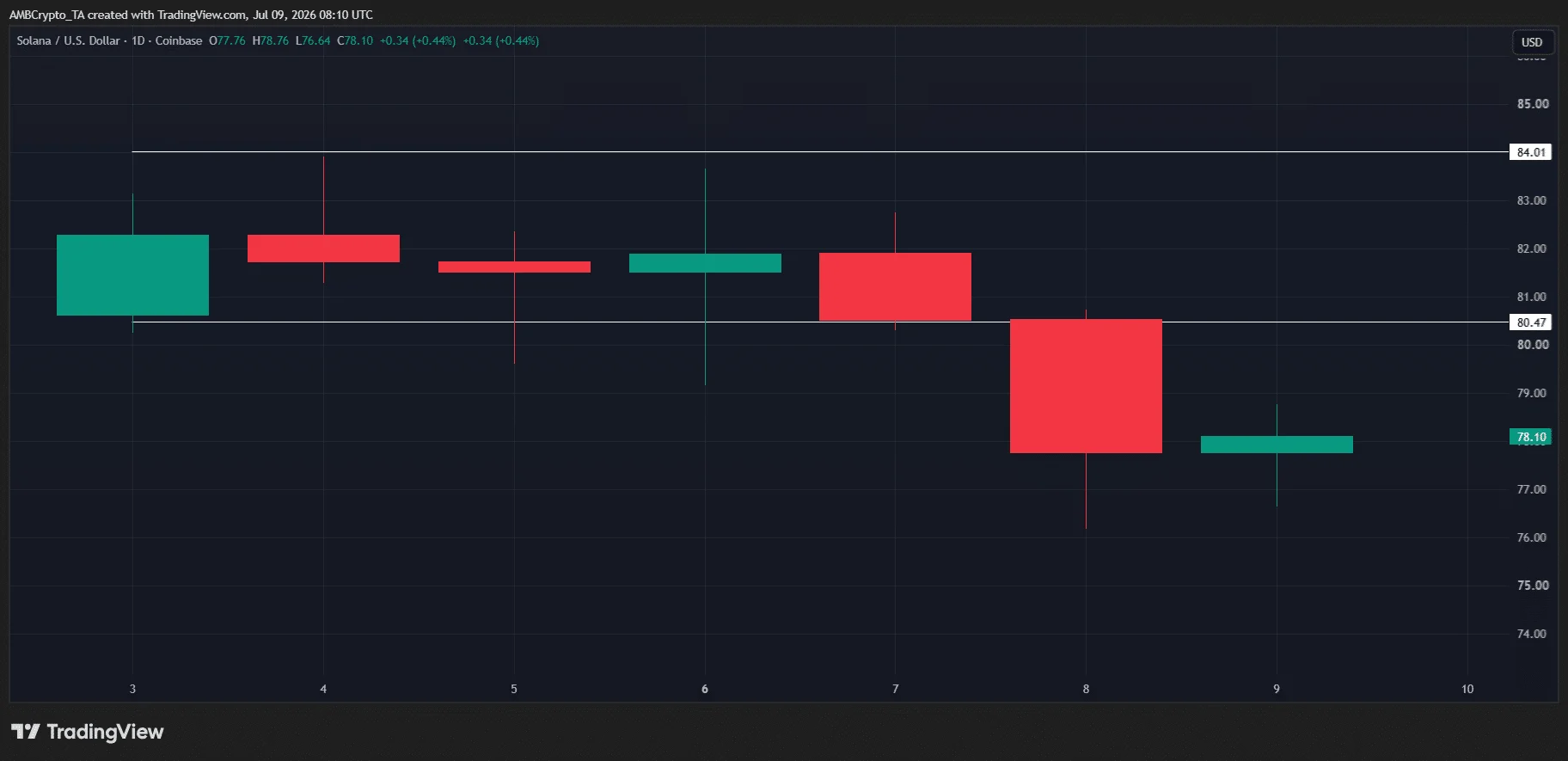
From a technical perspective, this argument is starting to gain attention. Despite strong network activity and rising on-chain metrics, SOL is still struggling to reclaim the $100 level. With the latest $10 million SOL sell-off adding more pressure, the key resistance around $80 remains a major hurdle for bulls.

SOLSOL
Source: TradingView (SOL/USDT)

This puts Solana’s fundamentals under the spotlight.

With Pump.fun’s selling pressure and a broader risk-off market, the big question is whether Solana’s network growth and on-chain activity can translate into enough demand to push SOL above key resistance levels. 

If not, the weakness may extend beyond technicals, creating a more challenging setup for Q3.


Final Summary

  • Pump.fun is driving strong activity on Solana, but its SOL sales have raised concerns about value leaving the ecosystem.
  • SOL remains under pressure despite strong fundamentals, with Q3 depending on whether network growth can overcome selling pressure.


Source link

Why the Silent Rules Nobody Made Are Killing Your Company

0
Why the Silent Rules Nobody Made Are Killing Your Company


Opinions expressed by Entrepreneur contributors are their own.

Key Takeaways

  • If no one can name who authorized a rule or why it exists, it’s probably not a real policy — it’s a habit wearing a costume. Kill it.
  • Each extra approval or check costs a minute. Multiply across every employee, every week, and you’re paying salaries to wait, not produce.
  • Removing friction is cheaper than buying growth. Cut the red tape you never approved before adding another headcount.

Every successful business relies on policies and procedures. Policies and procedures create consistency, improve quality and allow organizations to move in a unified direction.

For this reason, most successful companies have policies and procedures manuals and other written policies. Without them, companies become chaotic and inconsistent as they grow. But there is an important distinction between systems that are intentionally designed and those that simply evolve over time.

The most damaging policies in a business are often the ones that were never actually created.

These can be called made-up rules — unwritten practices that slowly become accepted as official policy, even when no owner, executive, or person with authority ever approved them. They emerge quietly and gradually. An employee assumes something is required in every circumstance. Another employee observes that behavior and repeats it. Before long, an entire department believes a process is a mandatory policy when, in reality, it is not at all.

As organizations grow, these unofficial rules have a way of growing. Each one may seem insignificant on its own, but together they create a layer of legalism that slows decision-making, frustrates employees, delays customer service and quietly limits growth. It can also upset employees by creating an abundance of rigid rules that make the employees feel restricted. Unlike obvious problems such as declining sales or rising expenses, these self-made policies and procedures are rarely visible on a financial statement. Yet, their impact can be enormous.

Good intentions can create bad processes

One of the biggest challenges is that these rules often originate from good intentions. An employee wants to avoid making a mistake, so an extra rigid rule is added to prevent a situation from repeating itself. In other instances, someone encounters an unusual circumstance and begins treating that exception as the standard procedure. Over time, isolated events become permanent rules that harm, not help the company.

The problem is that businesses rarely struggle because of one unique situation. Instead, hundreds of small, unnecessary rules accumulate over months and years. Each additional email, approval, signature, or verification adds only a minute or two. Standing alone, that seems inconsequential. Collectively, however, those minutes become hours, days and eventually weeks of lost productivity, revenue or efficiency across an organization.

Imagine an employee who must wait for an internal confirmation before beginning work, even though all of the information needed to proceed is already available. Perhaps no owner, CEO or senior leader required this waiting period. It simply became “the way we’ve always done it.” If that delay happens dozens of times each week across multiple employees, the organization begins paying people to wait rather than to produce. Customers experience slower service, revenue decreases and management wonders why the business feels less efficient despite hiring more people.

Growth often brings more red tape

This scenario becomes even more pronounced in growing companies. Startups often move quickly because communication is simple and decisions are made by a small group of people. As headcount increases, however, there is a natural temptation for mid or lower level employees to add more approvals, more meetings, more documentation and more checkpoints. While some of these additions are necessary, many are simply reactions to isolated situations rather than thoughtful improvements to the business as a whole.

Over time, employees begin confusing caution with excellence. Instead of asking, “What is the best way to accomplish this?” they begin asking, “What is the safest way to avoid criticism?” Those are fundamentally different questions. The first encourages innovation and efficiency. The second often produces bureaucracy and red tape out of a desire for self-protection.

Perhaps the most dangerous aspect of made-up rules is that no one takes responsibility for them. Ask employees why they follow a particular procedure, and familiar responses usually emerge: “That’s just what we’ve always done,” or “I thought that was company policy.” Continue asking questions, and it frequently becomes clear that no one can identify when the rule started or who authorized it. The process has simply taken on a life of its own.

Challenge every unwritten process

Business owners should periodically examine their organizations with fresh eyes. Rather than asking employees whether they are following procedures, leaders should ask why those procedures exist in the first place and who authorized them. Every recurring process should have a clear purpose. If no one can explain why a particular step is necessary, it deserves careful scrutiny. In many cases, the unwritten rule should be disavowed and eliminated.

One effective exercise is asking managers to identify the biggest obstacles that slow their teams each day. Their answers are often revealing. Employees are rarely frustrated by hard work. They are frustrated by preventable delays — waiting for approvals, tracking down information, duplicating work or complying with procedures that no longer serve a meaningful purpose. These bottlenecks consume time without creating additional value for customers or employees.

It is also important to recognize that removing unnecessary rules does not mean lowering standards. High-performing organizations absolutely need accountability, quality control and thoughtful procedures. The goal is not to eliminate structure. The goal is to eliminate red tape that adds complexity without improving outcomes. Every policy should either reduce risk, improve quality, enhance the customer experience or increase efficiency. If it accomplishes none of those objectives, or it creates more problems than it helps, it is reasonable to question whether it should continue to exist.

Speed is a competitive advantage

Business leaders often focus tremendous energy on generating more revenue. They invest in advertising, marketing, recruiting and technology to accelerate growth. Yet, they sometimes overlook the operational drag occurring inside their own organizations. A company can spend millions of dollars attracting new customers while simultaneously slowing those customers’ experience through unnecessary internal processes. Removing friction is often one of the least expensive — and most profitable — ways to improve performance.

In today’s competitive environment, speed has become a meaningful differentiator. Customers have more choices than ever before, and they increasingly expect prompt responses, efficient service and straightforward interactions. Organizations that eliminate unnecessary delays position themselves to deliver a better experience without spending additional money on customer acquisition.

The best leaders understand that their role is not simply to create new policies. It is also to challenge existing assumptions. They recognize that every process should earn the right to continue existing—and should not be professed as policy without the company specifically authorizing it. As businesses evolve, procedures that once made perfect sense may become outdated. Failing to revisit them allows yesterday’s solutions to become tomorrow’s obstacles.

Eliminate the unnecessary rules

Every organization accumulates unwritten rules over time. Meetings become longer, approvals become more numerous and workflows become increasingly complicated. Left unchecked, these changes gradually reduce the agility that once fueled growth. Successful companies recognize that maintaining operational excellence requires periodic auditing and removal of these unwritten rules. Just as businesses routinely evaluate expenses, marketing efforts and financial performance, they should also evaluate the rules employees create or follow every day.

Sustainable growth is not achieved simply by working harder or hiring more people. It is achieved by creating an organization where talented employees can perform meaningful work without being slowed by unnecessary red tape. The companies that consistently outperform their competitors are often not those with the most elaborate systems. They are the ones disciplined enough to remove the systems that no longer serve a purpose.

Sometimes the greatest improvement a leader can make is not introducing another policy. It is eliminating unwritten rules that were never approved in the first place.


Key Takeaways

  • If no one can name who authorized a rule or why it exists, it’s probably not a real policy — it’s a habit wearing a costume. Kill it.
  • Each extra approval or check costs a minute. Multiply across every employee, every week, and you’re paying salaries to wait, not produce.
  • Removing friction is cheaper than buying growth. Cut the red tape you never approved before adding another headcount.

Every successful business relies on policies and procedures. Policies and procedures create consistency, improve quality and allow organizations to move in a unified direction.

For this reason, most successful companies have policies and procedures manuals and other written policies. Without them, companies become chaotic and inconsistent as they grow. But there is an important distinction between systems that are intentionally designed and those that simply evolve over time.

The most damaging policies in a business are often the ones that were never actually created.


Source link

Cipher, TeraWulf among AI infrastructure stocks trading below contract value, Compass Point argues

0
Cipher, TeraWulf among AI infrastructure stocks trading below contract value, Compass Point argues

Using that approach, the firm said Applied Digital (APLD), TeraWulf (WULF) and Cipher Mining (CIFR) appear to offer the largest disconnect between their contracted business and current valuations. In each case, Compass Point argues the market is assigning little, if any, value to additional AI capacity that has yet to be leased, despite the potential for those projects to generate significant rental income once completed.

Core Scientific (CORZ) and Riot Platforms (RIOT) stand out for different reasons. Compass Point said Core Scientific’s existing contracts are already largely reflected in its valuation, meaning further upside will likely depend on signing new customers. Riot, meanwhile, is valued more on future potential than current lease income, with investors placing a premium on its Corsicana campus and broader AI development pipeline despite its relatively limited contracted capacity today.

The report argues the next two years will be a turning point for the sector as companies shift from announcing AI infrastructure deals to delivering them. As projects are completed, tenants move in and rent payments begin, investors will have a clearer picture of the recurring cash flow these facilities can generate. Companies that execute successfully could be rewarded with valuations more in line with other income-producing infrastructure assets.


Source link

XRP Open Interest on Binance Hits a Three-Month Low: What It Means for Price

0
XRP Open Interest on Binance Hits a Three-Month Low: What It Means for Price


Photo by BeInCrypto

XRP futures open interest on Binance has fallen to roughly 397 million XRP, its lowest level in over three months. The decline arrives as the token trades at $1.09.

Here is what the drop means, how spot data contrasts, and what could come next for the price.

What the XRP Open Interest Decline Actually Means

Open interest measures the total number of outstanding derivative contracts in a market. A decline in this metric, especially alongside price weakness, often reflects deleveraging as traders reduce or close their existing positions.

On Binance, the drop signals lower speculative activity in XRP futures compared to previous periods. Furthermore, the metric is now at its weakest level in over three months, suggesting a cooling appetite for leveraged exposure.

CryptoQuant analyst Arab Chain clearly framed the trend. The analyst wrote that the decline points to “a slowdown in activity within the derivatives market.”

The analyst also noted that falling open interest alongside soft prices often signals weaker risk appetite and an outflow of liquidity from futures.

“Although a decline in open interest is not necessarily a definitive bearish signal, it does point to reduced trader participation in the derivatives market. In many cases, this phase represents a period of repositioning as investors await a clearer market direction,” CryptoQuant analyst Arab Chain said.

Follow us on X to get the latest news as it happens.

XRP Ledger: Open Interest - Binance. Source: CryptoQuant.
XRP Ledger: Open Interest – Binance. Source: CryptoQuant.

The spot side, however, tells a contrasting story. The XRP Binance Scarcity Index has risen to 0.77, its highest reading in over two years. As a result, the available supply for immediate selling on the exchange appears notably reduced.

Exchange reserves reinforce that trend. Binance XRP reserves have dropped roughly 650 million coins, or about 20%, since November 2024. Moreover, they fell from 2.8 billion in May to around 2.6 billion more recently.

Such withdrawals can signal investors moving tokens into self-custody. However, they do not automatically translate into upward price pressure without corresponding demand from fresh buyers entering the market.

What Does This Mean for the XRP Price

Reduced open interest may lead to lower leverage-driven volatility in the short term. As a result, the XRP price action could become more influenced by spot flows than by derivatives positioning across the market.

Technical observations remain mixed, though. Some charts show a hidden bearish divergence on the daily timeframe: price is forming lower highs while the RSI is forming higher highs. Holding above $1.15 is seen as important.

In derivatives, short positions faced pressure near the $1.00 to $1.04 area, contributing to a recent rebound. However, elevated unliquidated long positions across major cryptocurrencies increase the potential for volatility if key levels break.

A failure to hold $1.00 could open the path toward lower supports near $0.87. Meanwhile, XRP’s trajectory will likely continue to correlate with broader market conditions, particularly Bitcoin’s performance and overall risk sentiment.

“While many have been calling bottoms throughout this entire correction on every green candle, I’ve consistently argued that XRP would likely need a test of $1.09 or $0.87 before a true macro pivot could occur… here we are. We’re no longer talking about hypothetical levels. We’re sitting on them,” analyst CasiTrades noted.

XRP Price Analysis. Source: X/@CasiTrades

Trading volume during the latest recovery has stayed relatively modest. Consequently, spot buyer conviction remains unconfirmed at current levels. Resistance sits near $1.19, with further upside toward $1.38 possible on a sustained break.

Subscribe to our YouTube channel to watch leaders and journalists provide expert insights.

https://www.youtube.com/watch?v=750fiQNOXn0

Read the Original story XRP Open Interest on Binance Hits a Three-Month Low: What It Means for Price by Luis Blanco at beincrypto.com


Source link

Zapper shuts down after 7 years despite $13B peak volume – Details

0
Zapper shuts down after 7 years despite $13B peak volume – Details


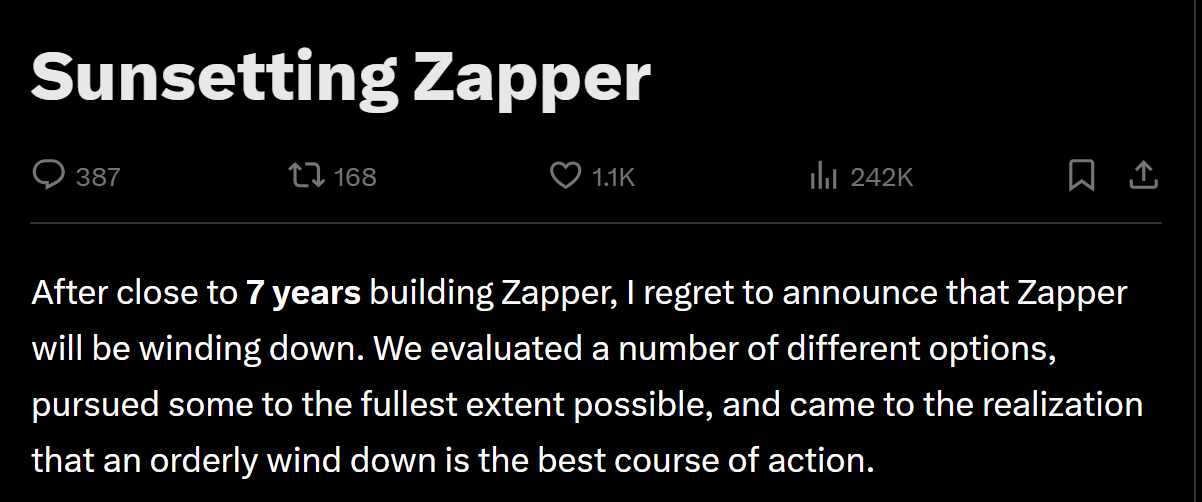
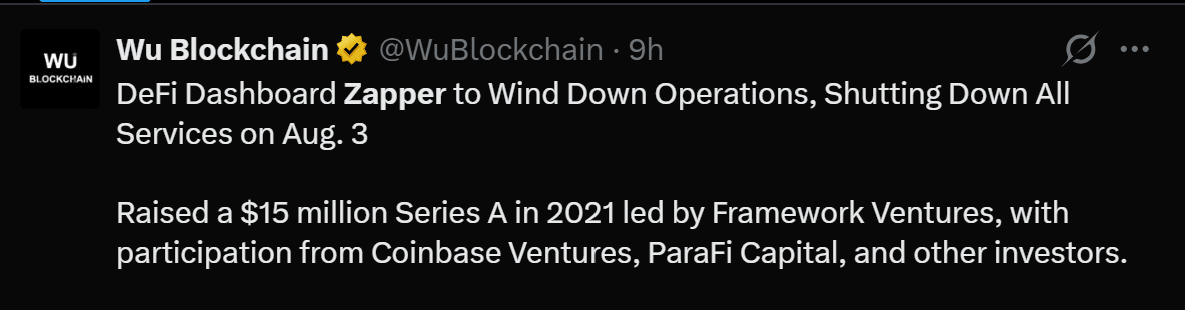
Zapper, a DeFi asset manager, has announced plans to shut down after nearly seven years of operation.

To quantify the scale of its operation, the asset manager had attracted over 2 million active monthly users while it processed over $13 billion at its peak in transaction volume.

Yet, the strong user adoption did not translate into a sustainable business model as revenue declined due to intensified competition. This competition narrowed the asset manager’s profit margin, crippling its operations.

Source: Zapper on X

On the 3rd of August, the asset manager will shut down completely, bringing an end to its operations. The platform will assist its users in transitioning.

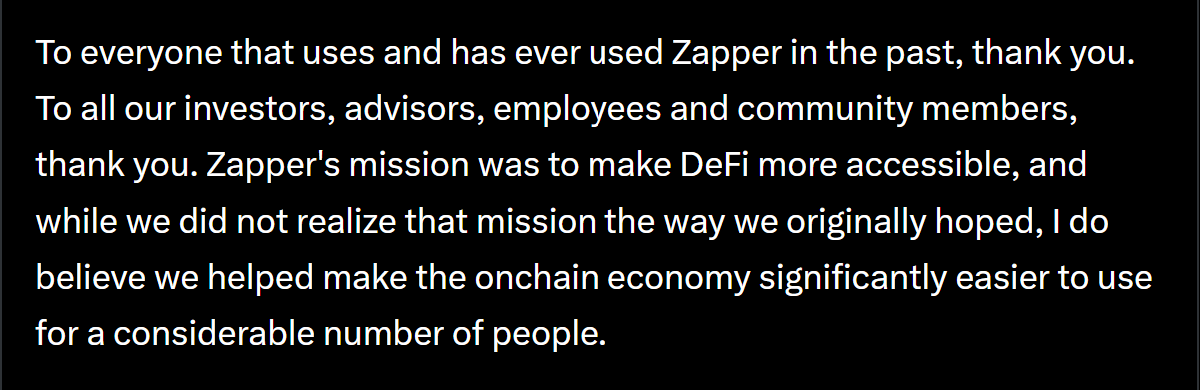
Seb Audet, Co-Founder and CEO of Zapper, acknowledged that Zapper fell short of its mission. On a post on X he stated,

Zapper’s mission was to make DeFi more accessible, and while we did not realize that mission the way we originally hoped…

Source: X

That shift exposed the growing challenge of monetizing DeFi infrastructure beyond attracting traffic. Zapper’s closure suggests the sector is entering a more demanding phase, where long-term survival increasingly depends on sustainable revenue rather than user growth alone.

Growth outpaced sustainable economics

The Zapper shutdown demonstrates some other major limitations of VC funding to ensure the long-term sustainability of DeFi infrastructure.

In fact, Zapper had secured $15 million in funding from Framework Ventures, Coinbase Ventures, and ParaFi Capital. This was to allow it to continue to grow product offerings as well as increase the rate of adoption.

Source: X

Despite the funding, Zapper was unable to counter the decline in profitability. Therefore, fee compression increased while the cost of supporting infrastructure increased, ultimately leading to an unsustainable business model for the company.

More importantly, rather than continuously receiving injections of capital to support their operations, investors expected the projects to be able to generate sustainable revenue.

This trend indicates a larger trend within DeFi where success depends on multiple factors beyond just growth.

All in all, successful infrastructure projects will require stronger monetization, disciplined spending, and clear competitive advantages in order to sustain themselves through future market cycles.


Final Summary

  • Zapper’s shutdown shows that user growth alone cannot sustain DeFi infrastructure businesses.
  • Zapper’s closure highlights the growing importance of sustainable revenue over venture funding.


Source link

Crypto lender giant Aave rolls out vaults for yield-hungry fintech investors

0
Inside the chaotic $300 million emergency bailout that saved a top crypto platform from total collapse

Aave Labs, the organization behind the largest decentralized lending platform Aave , is rolling out vaults to help fintech companies offer yield on stablecoins without requiring users to interact directly with crypto rails.

The new Stable Vaults let wallets, exchanges and payment providers embed stablecoin earning through a single connection. Behind the scenes, the vaults allocate deposits across approved decentralized finance (DeFi) lending strategies while the customer continues using a familiar app interface.

“Stable Vaults make predictable stablecoin earning simple to plug into any fintech application,” Aave founder Stani Kulechov said in a statement.

The move comes as stablecoins has become increasingly part of everyday payments and digital banking. As more fintech firms adopt stablecoins for moving money globally, many are looking for ways to let customers earn a return on idle balances without leaving blockchain rails or navigating crypto-native applications.

Vaults have emerged to fill that role. They are a piece of infrastructure that automatically move users’ deposits between lending and yield strategies based on predefined rules, allowing investors to earn returns without actively managing positions or monitoring markets.


Source link