Home Blog Page 306

Oil spikes, Wall Street drops as US-Iran tensions rebuild

0
Oil spikes, Wall Street drops as US-Iran tensions rebuild


By Pete Schroeder

WASHINGTON, July 7 (Reuters) – Oil prices spiked late on Tuesday on renewed fears that a tenuous peace between the U.S. and Iran was faltering, while U.S. stocks fell, led by technology shares on investors’ concerns about the longevity of the AI-driven ‌rally.

All three major U.S. indices ended the day in negative territory, with the tech-heavy Nasdaq Composite suffering the steepest decline, falling 1.16% ‌to 25,818.69. The Dow Jones Industrial Average lost 0.25% to 52,925.15, and the S&P 500 <.SPX> dropped 0.45%, to 7,503.85.

MSCI’s gauge of stocks across the globe fell 0.64% to 1,121.20.

The selloff began ​following blockbuster results from Samsung Electronics, even though the firm forecast a 19-fold jump in April-June operating profit to 89.4 trillion won ($58.4 billion), the third straight quarter of record operating profit for the world’s largest memory-chipmaker.

Rather than reassuring investors, the results triggered selling in Samsung and rival SK Hynix shares. Investors have increasingly questioned whether profit growth linked to artificial intelligence can be sustained if supply bottlenecks in key components such as memory chips ease. Further weighing on markets was a ‌Reuters report that Chinese startup DeepSeek was developing its ⁠own AI chip, which could reduce its reliance on other major chipmakers to train and run its AI models.

Market pessimism was exacerbated by an apparently worsening situation in the Middle East, after Qatar blamed Iran for an attack on several vessels ⁠in the Strait of Hormuz, with one LNG tanker forced to evacuate its crew due to the risk of explosion, Reuters reported.

The situation escalated as the White House revoked a license it granted Iran to sell oil, part of an effort to ease tensions from the three-month war that had upended global energy supplies. The two ​nations ​are continuing negotiations towards a final agreement to end the conflict.

Oil prices settled 3% higher ​on Tuesday, and then extended gains post-settlement. U.S. crude was ‌last up 5.3% to $72.20 a barrel and Brent rose to $76.09 per barrel, up 5.9%.

“The U.S. reimposing sanctions on Iran is a major escalation,” said Josh Young, chief investment officer at Bison Interests. “Iran may respond with force, further limiting exports through the Strait of Hormuz, and risking $100+ oil prices again in the near term.”

NATO MEETS IN TURKEY

NATO leaders met in Turkey Tuesday, where European leaders unveiled arms deals worth tens of billions of dollars. However, U.S. President Donald Trump expressed frustration at what he said was insufficient support for the U.S.-Israeli war on Iran, and again resurfaced calls for the U.S. to gain control ‌of Greenland from Denmark.

NATO allies were also expected to discuss plans for a multinational ​maritime mission in the Strait of Hormuz along the sidelines of the summit with Gulf ​Arab foreign ministers.

Trump said on Monday the U.S. would either reach a ​deal with Iran or “finish the job,” renewing his threat of military action as Tehran projects defiance following the funeral of ‌Supreme Leader Ayatollah Ali Khamenei.

In currency markets, the dollar index, ​which tracks the U.S. currency against six ​others, was up 0.21% to 101.07, while the euro slid 0.24% against the dollar.

The yen hovered above 40-year lows, and was last at 162.06 per dollar. Traders were alert for intervention given signs of a possible shift in strategy by Japanese authorities.

The yield on benchmark U.S. ​10-year notes was up 7.01 basis points to 4.549% ‌ahead of the Wednesday release of the minutes of the Federal Open Market Committee’s latest meeting. These may give investors more of ​a steer on how new Federal Reserve chair Kevin Warsh is approaching monetary policy.

(Additional reporting by Satoshi Sugiyama in Tokyo and ​Amanda Cooper in London; Editing by Mark Potter, Kevin Liffey and Aurora Ellis)


Source link

Jensen Huang Says His Engineers Prefer Building Agents to Writing Code

0
Jensen Huang Says His Engineers Prefer Building Agents to Writing Code


Jensen Huang says his software engineers love how AI is changing their role.

“These agentic systems are new skills, and now we have a lot of software engineers building agents,” the Nvidia CEO said in an interview published by the company on Wednesday. “If you ask me, every one of my software engineers prefers to be building agents than to be writing Python code.”

Huang said that because of AI, Nvidia’s engineers are doing less coding, which is like typing. Now, they’re working on building agents, benchmarks, and guardrails.

“You’re taking all the mundane work, and you’re trying to get this agent to do it,” he said. “That requires imagination, that requires creativity, a lot of technology.”

Huang, who cofounded the chipmaker in 1993, has been a strong advocate for AI assistants in the workplace. He has repeatedly described a future in which Nvidia will mass-deploy agents across every division to improve productivity.

AI agents break down a task into multiple smaller steps, each tackling a specific task to achieve a bigger goal.

‘Whole bunch of jobs’

In the interview, Huang rejected the idea that AI simply replaces workers, arguing instead that it creates new roles.

“The amount of work that we have to do to bring AI into the world is really quite incredible,” he said. “So it’s creating a whole bunch of jobs. And, my software engineers love this.”

Unlike Anthropic CEO Dario Amodei and Amazon chief Andy Jassy, Huang has dismissed the increasingly popular concern that AI will mass eliminate white-collar jobs.

“This is the part that people don’t realize about AI. The first thing that AI is doing right now is creating an enormous number of jobs,” Huang said in a May TV interview. “AI creates jobs. AI is the United States’s best opportunity to re-industrialize ourselves.”


Source link

XRP price news: Why traders eye this long-term breakout setup in Ripple-linked token

0
XRP price news: Why traders eye this long-term breakout setup in Ripple-linked token

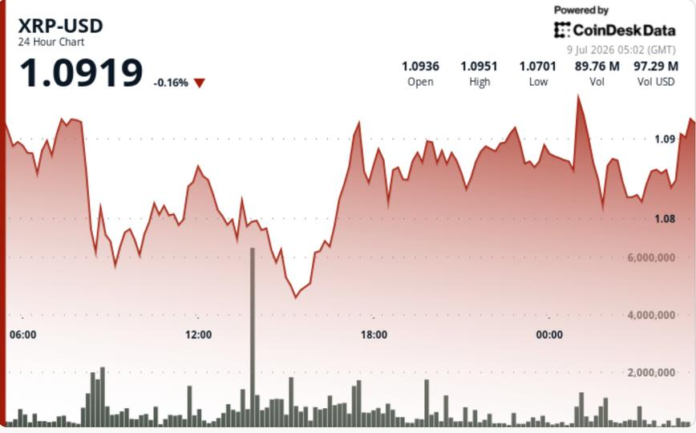
• Volume during that move reached 688,000 XRP, about 120% above the session average, before momentum faded.

• Earlier selling took XRP to a session low near $1.0742 after volume rose to 80.2 million, about 83% above the 24-hour average.

Technical Analysis

• The key development is that XRP continues to defend the $1.00-$1.05 support zone, which analysts say aligns with longer-term moving average and trendline support.

• The near-term chart remains weak despite the small bounce. Lower highs at $1.1133, $1.0993 and $1.0932 show sellers are still capping recovery attempts.

• XRP needs to hold above $1.088-$1.091 to build a cleaner move toward $1.093-$1.095.

• The larger setup remains a compression trade rather than a breakout. Monthly wedge and channel patterns may point to higher targets, but confirmation requires a sustained move above nearer resistance first.

• Relative weakness against bitcoin remains a risk, with the XRPBTC pair testing support near 1,700 sats.

What traders should watch

• $1.00-$1.05 remains the key support zone. Losing it would put $0.90 and then $0.80 back in focus.

• $1.088-$1.091 is the immediate resistance area after capping the latest breakout attempt.

• $1.20-$1.25 is the next major zone, where candle resistance and the 100-day moving average sit.

• A move above $1.40 would be the first stronger sign that XRP is breaking out of its broader compression.


Source link

Shiba Inu drops 5% despite biggest token burn in 6 months – Here’s why!

0
Shiba Inu drops 5% despite biggest token burn in 6 months – Here’s why!


Token burns often act as a mechanism to help a token diverge from broader market FUD.

The logic is simple: Burning tokens permanently removes them from circulation by sending them to dead wallets, reducing the liquid supply available in the market.

If demand stays the same or increases, this lower supply can create scarcity, supporting price and helping the token outperform the broader market.

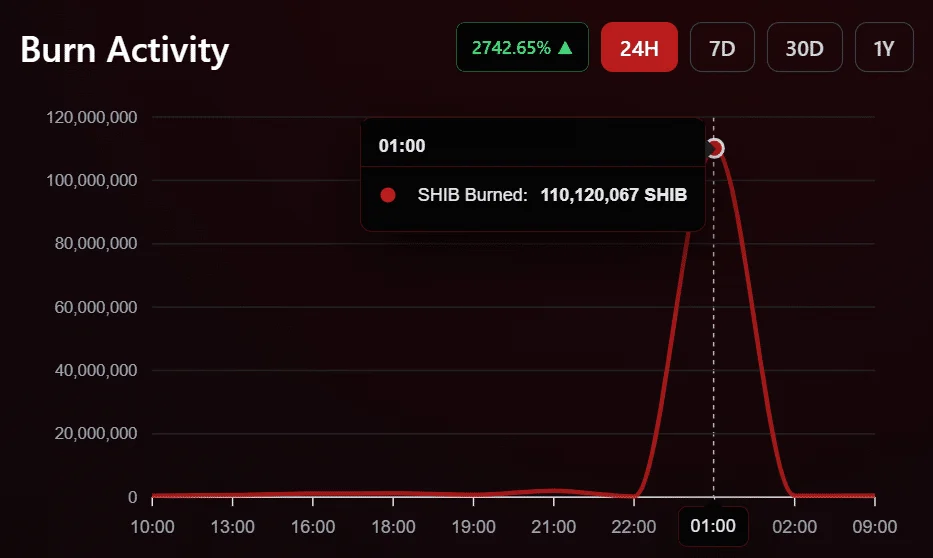
The Shiba Inu community appears to be testing this thesis in real time. As the chart below shows, more than 110 million SHIB were burned on the 8th of July, marking the biggest single-day burn in six months.

More importantly, weekly burns have now climbed to 152 million SHIB, suggesting the burn rate is accelerating despite broader memecoin weakness. 

SHIB
Source: Shiburn

However, the burns have yet to translate into any meaningful technical strength.  SHIB is down around 4.57% on the daily chart, continuing to diverge from the typical scarcity-driven narrative.

The reason becomes clearer when looking at Shiba Inu’s [SHIB] supply dynamics.

Since launch, the SHIB community has burned more than 410 trillion SHIB, yet roughly 585.6 trillion tokens still circulate in the market.

In other words, the recent increase in burn activity removes only a tiny fraction of the total supply, failing to materially tighten the circulating supply. Without a meaningful pickup in demand, reduced supply alone is unlikely to reverse SHIB’s broader downtrend.

From a market perspective, this shifts the focus back to the broader memecoin sector. If sector-wide liquidity continues to weaken, deflationary tokenomics alone may not be enough to trigger a sustained FOMO rally.

Instead, SHIB is likely to remain more sensitive to broader memecoin capital flows than its own burn rate.

SHIB burn activity surges as memecoin weakness deepens 

The recent 110 million SHIB burn wasn’t an isolated event. 

Instead, it capped off a broader pickup in burn activity.

According to Shibburn data, the Shiba Inu community burned 152 million+ SHIB over the past week, lifting the weekly burn rate by 55.77%. Most of that increase came from the 110 million SHIB burned, marking the network’s biggest single-day burn in six months.

Even so, SHIB’s price continues to ignore the spike in burn activity.

The token is down 5%+ over the past week, showing that lower supply alone hasn’t been enough to shift market structure. The memecoin market tells the story.

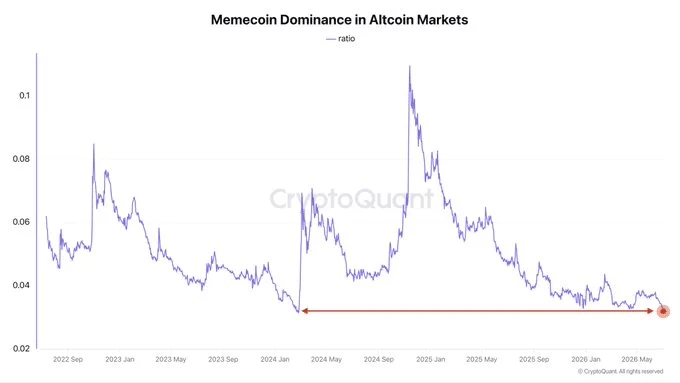
During the Q4 2024 rally, memecoins made up more than 10% of the total altcoin market cap. At press time, that share has dropped to just 3.7%, showing that capital has continued to leave the sector.

MEMECOINSMEMECOINS
Source: CryptoQuant

From a supply-demand perspective, demand clearly remains the limiting factor. 

While token burns continue to reduce supply at the margin, the ongoing outflow of capital from memecoins has more than offset that effect. Until liquidity returns to the sector, demand (not deflationary tokenomics) is likely to remain the primary driver of SHIB’s price.


Final Summary

  • SHIB burned 110 million tokens in its biggest burn in six months, but the price is still falling.
  • Weak memecoin demand continues to outweigh SHIB’s token burns.


Source link

BTC news: Elon Musk’s SpaceX moves bitcoin for the first time in six months

0
BTC news: Elon Musk's SpaceX moves bitcoin for the first time in six months

SpaceX (SPCX) apparently moved bitcoin across its wallets early Wednesday for the first time in about six months in three transfers totaling less than $300 of its $1.16 billion holding that don’t signal any impending sales.

Data from Arkham Intelligence shows the largest transfer across addresses tagged as belonging to the company moved 0.00213 BTC, about $135, between two wallets. A second sent 0.00139 BTC, or about $89.

In the third, Coinbase Prime’s custody service topped up a SpaceX address with 0.000738 BTC, around $47, the kind of small amount an exchange sends to cover network fees before a larger transaction can go through.

SpaceX went public on June 12 in the largest IPO on record, and its filing put the company’s full bitcoin position on a public balance sheet for the first time. Small movements can draw attention after a share listing even though none of the coins reached an exchange deposit address and none left SpaceX’s control.

The company still holds 18,712 BTC. Transfers this size are usually routine maintenance: funding a wallet to pay fees, consolidating coins across addresses or testing a signing setup before moving a real balance.


Source link

Bitcoin and ethereum prices today, Wednesday, July 8, 2026: Crypto prices down following U.S.-Iran strikes

0
Bitcoin and ethereum prices today, Wednesday, July 8, 2026: Crypto prices down following U.S.-Iran strikes


Bitcoin (BTC-USD) opened at $63,318.46 on Wednesday, July 8, 2026, down 1.1% from Tuesday’s open. The price of bitcoin was down to $62,044.96 as of 8:45 a.m. ET this morning.

Ethereum (ETH-USD) opened at $1,769.31 on Wednesday, July 8, 2026, down 1.6% compared to Tuesday’s opening price. Ethereum prices this morning shifted to $1,742.22 as of 8:45 a.m. ET.

Both bitcoin and ethereum prices are trending downward this morning following renewed hostilities in the Middle East.

The U.S. conducted airstrikes against Iranian targets in retaliation for Iran firing on non-military ships in the Strait of Hormuz. Talks between the two countries were already on pause as Iran observes a weeklong funeral for the late Supreme Leader Ali Khamenei, and now the airstrikes and the president’s recent comments put long-term peace into serious jeopardy.

Demand for risk-based assets like crypto tends to decline during uncertain geopolitical situations such as this. Analysts and investors will be monitoring whether this is a temporary or longer-lasting trend in crypto, even as it’s already trying to recover from one of its worst monthly performances in years.

The price of bitcoin this morning was 1.1% lower than the day before. Here’s a look at how the opening bitcoin price has changed versus last week, month, and year:

  • One week ago: +8.1%

  • One month ago: +0.1%

  • One year ago: -41.5%

The all-time high for bitcoin was $126,198.07 on Oct. 6, 2025. The all-time low value for bitcoin was $0.04865 on July 14, 2010. 

The price of ethereum this morning was down 1.6% compared to Tuesday morning. Here’s a look at how the opening ethereum price has changed versus last week, month, and year:

  • One week ago: +12.7%

  • One month ago: +4.9%

  • One year ago: -30.4%

The all-time high for ethereum was $4,953.73 on Aug. 24, 2025. The all-time low value for ethereum was $0.4209 on Oct. 21, 2015. 

Bitcoin, ethereum, and other cryptocurrencies are rapidly evolving. Follow the latest developments from Yahoo Finance and others here.

You generally owe taxes when you sell cryptocurrency for more than you paid for it. This also applies when you exchange one digital asset for another. Converting bitcoin into ethereum, for example, isn’t “just a trade” in the eyes of the IRS. It’s a taxable event if the value changes.

Crypto taxes aren’t paid at the time of the transaction, but instead, they’re reported on your tax return for the year in which the transaction took place. So, if you sold crypto for a profit at any point during 2025, that activity is reported when you file your 2025 return in early 2026.

How much tax you pay depends on two main factors:

  1. How long you held the asset before selling

  2. Your overall taxable income and filing status

Hold it for less than a year, and you’ll usually face higher rates. Hold it longer, and the rates tend to be lower.

This holding-period distinction matters more than most people realize. A few days can make a difference of as much as 17% or more — so timing matters.

Learn more: Yes, crypto is taxed. Here’s when you have to pay.

Whether you’re brand new to tracking the value of bitcoin and ethereum or a more seasoned crypto investor, Yahoo Finance’s price-of-bitcoin and price-of-ethereum charts below show a visual history of how the currencies’ value continues to move and evolve.

More on crypto from the Yahoo Finance team: 


Source link