Sometimes, a business has to get smaller in order to grow, or at least that’s what executives, including Wendy’s CFO Ken Cook, say when they explain why they’re closing locations.
“We’re focused on improving restaurant-level economics, taking a hard look at underperforming restaurants in our system from both the financial and customer experience perspective and working with franchisees to improve those, transfer those to another operator or potentially closing them,” he said during the chain’s third-quarter earnings call.
Closing up to 350 restaurants, he said, will improve the financials of those that remain and leave franchise operators with cash to invest in their remaining locations.
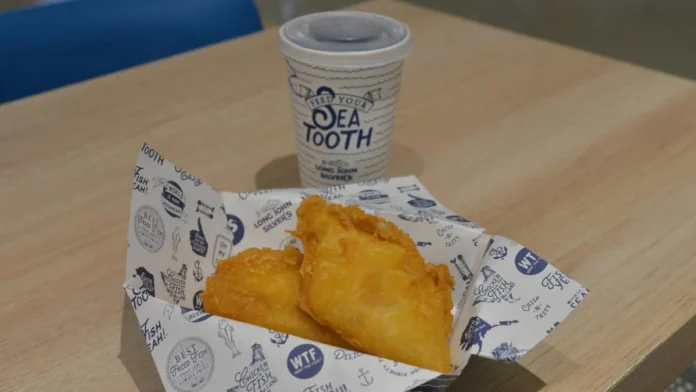
Long John Silver’s, an iconic fast-food chain like Wendy’s, has also been closing locations — dropping from over 1,000 units in 2015 to fewer than 500 currently, based on the Consumer Edge 2026 Restaurant Outlook report.
At its peak, the chain operated more than 1,400 restaurants, according to Food Republic.
The company’s Senior Vice President Tony Ellis, much like Cook, believes that the closures, at least the ones over the past three years, have actually put the seafood chain in a strong position to return to growth.
Long John Silver’s footprint has shrunk
Tony Ellis told SeafoodSource that Long John Silver’s has closed “roughly 110 to 120 locations over the past three years.” He said the company now operates 214 company-owned restaurants and about 262 franchised units, which matches the total on the company’s restaurant locator page.
Long John Silver’s Chief Marketing Officer Laura Ellis said that not all of the closures were due to financial performance.
“We want our in-restaurant experience to be as positive as the taste of our food, so we’ve spent a ton of time remodeling our footprint,” she said. “As you can imagine, our brand has been around since 1969, so some of our restaurants were in dire need of a facelift. This means some of those restaurants are temporary closures, and some are a departure from historical strategy.”
Tony Ellis explained that nearly 70 of the closures came from the chain exiting co-branded locations with Taco Bell, KFC, and A&W, which he said aligns with “broader industry trend of major chains increasingly preferring single-brand locations.”
“The company listed liabilities of $457.3 million and assets of $329.1 million in the Chapter 11 filing late Monday in U.S. Bankruptcy Court in Delaware,” the Tampa Times reported.
That filing was due to its 1989 leveraged buyout, which saddled the company with debt.
Why has Long John Silver’s shrunk?
QSR Pro published an extensive analysis of Long John Silver’s decline in March.
“There’s no single villain in this story. What’s happening to Long John Silver’s is structural, compounding, and instructive for anyone who operates or considers investing in legacy QSR franchises,” the website reported.
Food Costs, QSR Pro noted, created a systemic problem for the chain.
More Restaurants:
“Food costs are the first problem. Commodity beef prices are volatile, but seafood is in another category entirely. Wild-caught fish supplies are subject to fishing quotas, weather events, ocean temperature shifts, and international trade dynamics,” it shared.
Not being able to pivot to chicken or beef during times when fish prices are high also created unique challenges for the chain.
“McDonald’s can quietly shift its beef blend when spot prices spike. There’s no equivalent move available when your entire brand promise is fish,” QSR Pro added.
The seafood brand also has a traffic pattern problem.
“Seafood has historically been a dinner-leaning daypart, with a secondary spike during Lent. That leaves enormous breakfast and lunch capacity sitting idle, a structural waste that commodity chains like McDonald’s or Taco Bell solve by spanning all three dayparts. Long John Silver’s has never cracked breakfast at scale,” the trade publication shared.
Long John Silver’s has refreshed some of its restaurants.Shutterstock
Restaurants are struggling broadly
“The restaurant space has been tough. There’s a lot of competition, so it’s a very saturated market to begin with,” Black Box Chief Insights Officer Victor Fernandez told Restaurant Dive.
It’s a number of negative headwinds impacting businesses at the same time, Ari Felhandler, an equity analyst covering the consumer sector at Morningstar, said to Restaurant Dive.
“In addition to ballooning food and labor costs, operators are dealing with higher insurance premiums, further straining their finances, Felhandler added. “At the same time, the industry has remained stubbornly reliant on value promotions, further squeezing margins.”
Long John Silver’s is in the middle of a comeback
“The good news is that we are not struggling,” Laura Ellis told SeafoodSource.
She explained that the company just celebrated 16 consecutive quarters of comparable sales growth, marking a milestone “we are very proud of as a brand.”
Tony Ellis added that the chain’s sales increased from approximately $400 million at the end of 2022 to nearly $430 million at the end of 2025.
Four Oaks Partners purchased Long John Silver’s in 2022, according to Franchise Times.
“Four Oaks Partners has its sights set on international expansion, with a particular focus on the Southeast Asian market. It has continuously operated multiple locations in Singapore since 1983, and in recent years, has opened new locations in Thailand, Indonesia, and Malaysia,” according to Food Republic.
Laura Ellis, who spent eight years at Yum Brands, thinks the brand has domestic growth potential as well.
“Sometimes you work for a brand that’s nostalgic and people say, ‘I used to love that, but I don’t like it anymore.’ When I tell people I work for Long John Silver’s, that’s not the reaction I get at all. It’s, ‘I love Long John Silver’s. I didn’t know there was one nearby me anymore,'” she told Franchise Times.
“We’re really driving awareness and reminding people that we’re here and opening new locations.”
U.S. stock futures fell and oil prices rose after peace talks between the U.S. and Iran got off to a rocky start on Sunday, with President Donald Trump wasting no time with threats to renew war.
Futures tied to the Dow Jones industrial average fell 191 points, or 0.37%. S&P 500 futures were down 0.52%, and Nasdaq futures lost 0.74%.
U.S. oil futures rose 2.1% to $78.19 a barrel, while Brent crude climbed 1.2% to $81.53. Gold dropped 1.5% to $4,180.40 per ounce.
Earlier in Switzerland, Vice President JD Vance said both sides had already made “great progress” in talks, saying the U.S. side represented an “outstretched hand” toward the people of Iran.
But after Iran said Saturday that it’s closing the Strait of Hormuz again as Israel continues attacking Hezbollah positions in Lebanon, Trump told Fox News on Sunday he spoke with Iranian officials and warned them, “You close it and you won’t have a country. You won’t even make it back to your f–king country.”
He also said the U.S. may take over the strait, adding “I’ll blow the s–t out of them. If they don’t make a deal, we’ll collect tolls.”
Last weekend, Trump and Iranian officials confirmed they agreed on a memorandum of understanding that reopens the strait, ends the U.S. naval blockade, and begins a 60-day period for both sides to negotiate other issues like Tehran’s nuclear program and relief from U.S. sanctions.
But on Sunday, the president claimed that after the 60-day negotiation window ends, “I can do whatever I want.”
While Iran halted talks after Trump’s comments, its delegation remained in Switzerland to continue negotiations. But Lebanon will remain a sticking point. Israeli Prime Minister Benjamin Netanyahu reiterated that he would keep military forces in southern Lebanon “as long as we need to protect our people.”
Until the situation in Lebanon settles down, talks over Iran’s nuclear program will take a back seat. In addition, the tug-of-war over the Strait of Hormuz will drag on.
While the U.S. ended its naval blockade on Iran as part of the MOU, Central Command also said “U.S. forces remain present and vigilant to ensure all aspects of the agreement with Iran are adhered to, obeyed, and in full force and effect.”
For its part, Tehran’s new Persian Gulf Strait Authority warned that ships must follow a regime-established route that passes along the Iranian coast and that alternatives are prohibited.
And despite its deal with the U.S. banning tolls for 60 days, the PGSA is requiring insurance that will eventually come at a cost.
“At present, this insurance is provided free of charge to the vessel owner, with all expenses covered by the Islamic Republic of Iran,” Iran said. “The PGSA reserves the right to introduce insurance fees in the future, which will be determined by the relevant insurer. Owners will then be required to purchase and renew coverage accordingly.”
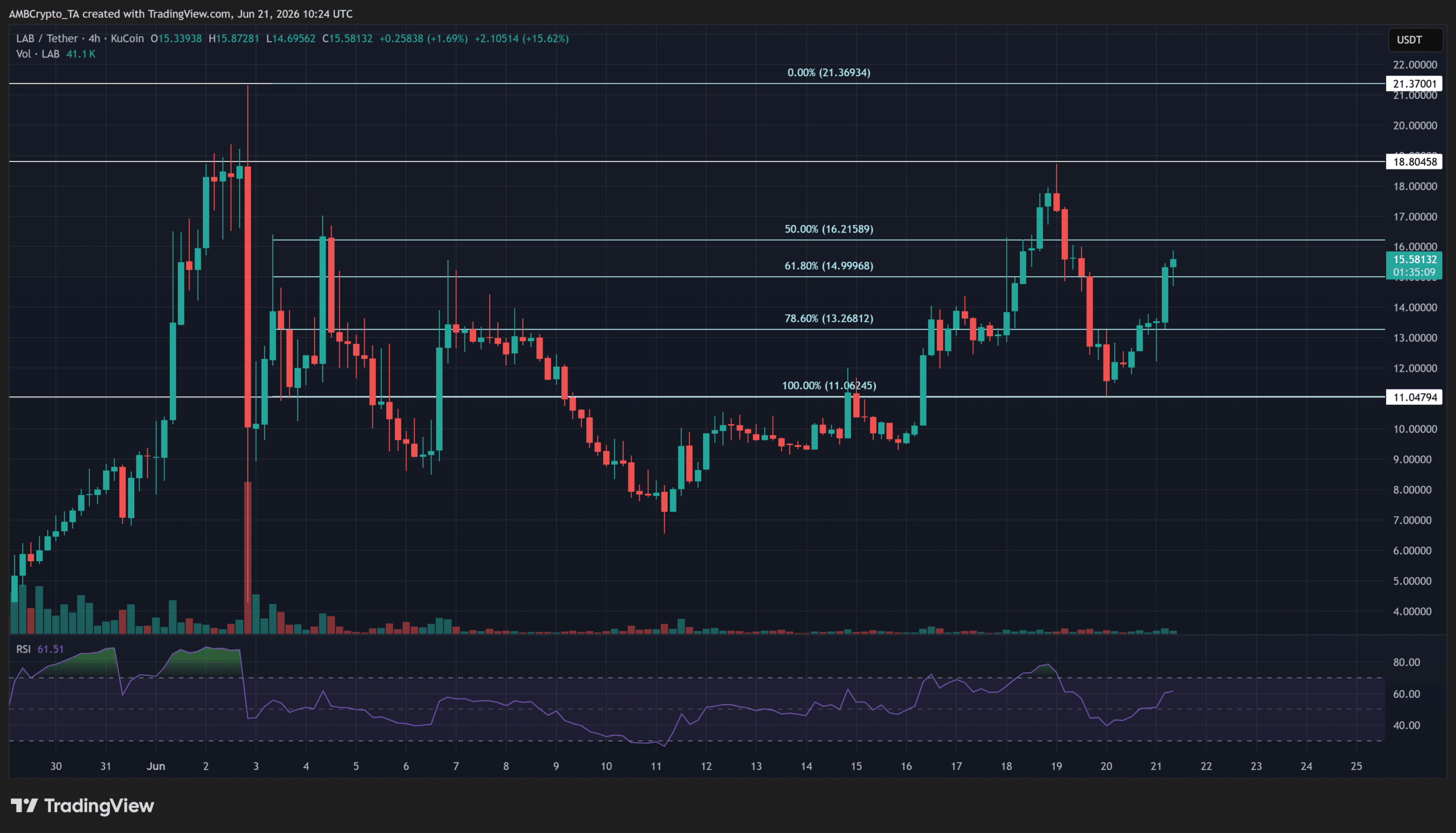
LAB crypto rallied 27.96% to $15.48 in 24 hours, far exceeding Bitcoin’s 0.97% advance, as buyers continued building momentum from the recent defense of the $12 breakout zone. The altcoin had declined by over 21% on the 20th of June, sitting at $12. Buyers were able to defend the June breakout level and, in doing so, prevented a deeper pullback.
As the price continued upward, LAB began moving up toward the 61.8% and 50% Fibonacci retracements. These retracement levels had been influencing price all month long. Traders were determining whether the decline was a short-term correction or the beginning of a longer-term trend change as the price hovered in between them.
Meanwhile, the RSI moved to 61.5 after declining from overbought conditions above 75 near the $18.80 high. This shift indicates improving momentum. As a result, buyers appear to be regaining strength.
Source: LAB/USDT on TradingView
Even so, volume has decreased significantly since buyers drove price to the $21.37 high. This suggests participation remains limited. Therefore, conviction is yet to fully return.
For now, LAB must reclaim the $16.21 level. If buyers achieve that with stronger volume, momentum could strengthen further. Yet, the price could retest the $18.80 high. A successful breakout there could then open the path back toward the previous high of $21.37.
On the other hand, resistance remains a key obstacle. If LAB fails to overcome it, the probability of a move back to $13.27 increases. Should selling pressure persist, the risk of a deeper decline toward the critical $11.07 support zone would also rise.
Short liquidations fuel the rally
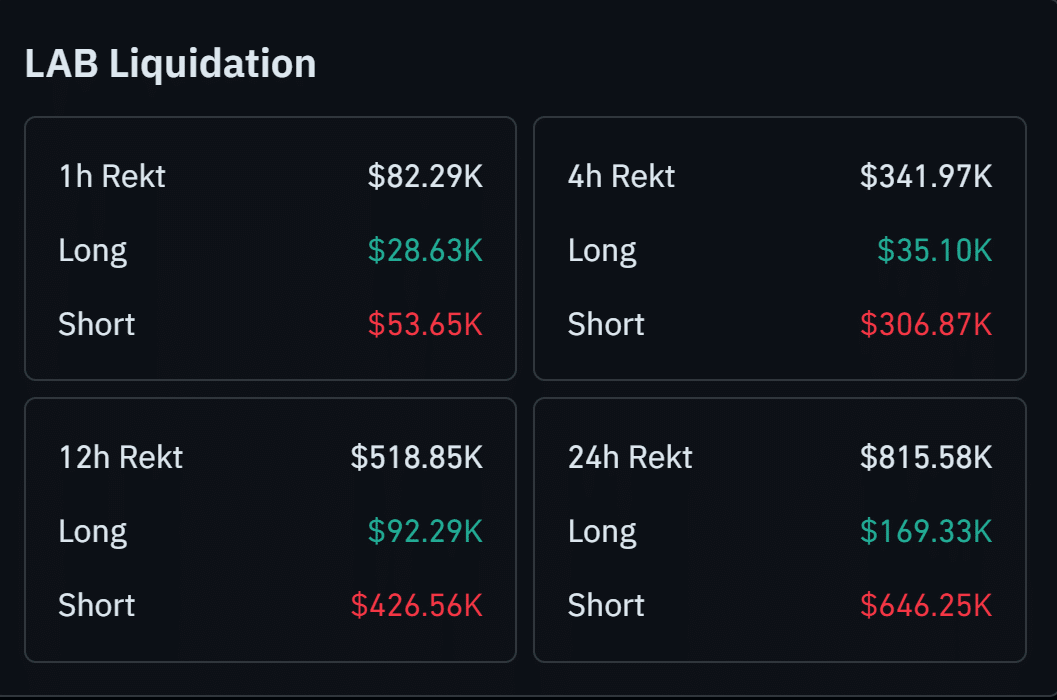
As buyers tried to get back above the resistance level, liquidation activity fueled the upward movement. According to CoinGlass data, the last 24 hours saw an increase in total liquidations to the tune of $815,580. Shorts accounted for over $646,250, and longs accounted for $169,330.
Source: CoinGlass
This imbalance suggests bearish traders absorbed most of the losses as price rebounded from $12 toward $15.48. Therefore, at this point the success of this rally will depend upon whether new demand will replace the current demand driven by selling.
Final Summary
LAB reclaimed key support and recovered sharply, but stronger volume remains essential for a sustained move higher.
LAB benefited from heavy short liquidations, though fresh buyer demand must emerge to maintain momentum.
Find out how much you could earn with today’s money market account rates. The Federal Reserve cut its target rate three times in 2025 and has left rates alone so far in 2026. So deposit rates — including money market account (MMA) rates — have been steadily declining. It’s more important than ever to compare MMA rates and ensure you earn as much as possible on your balance.
Even so, some of the top accounts are currently offering rates as high as 3%-4% APY. Since these rates may not be around much longer, consider opening a money market account now to take advantage of today’s high rates.
Here’s a look at some of the top MMA rates available today, Sunday, June 21, 2026:
How much interest can I earn with a money market account?
The amount of interest you can earn from a money market account depends on the annual percentage rate (APY). This is a measure of your total earnings after one year when considering the base interest rate and how often interest compounds (money market account interest typically compounds daily).
Say you put $1,000 in an MMA at the average interest rate of 0.61% with daily compounding. At the end of one year, your balance would grow to $1,005.72 — your initial $1,000 deposit, plus $5.72 in interest.
Now, let’s say you choose a high-yield money market account that offers 4% APY instead. In this case, your balance would grow to $1,040.81 over the same period, which includes $40.81 in interest.
The more you deposit in a money market account, the more you stand to earn. If we took our same example of a money market account at 4% APY, but deposited $10,000, your total balance after one year would be $10,408.08, meaning you’d earn $408.08 in interest.
We just covered Donald Trump Stock Portfolio: 10 Best AI and Tech Stock Picks in 2026. Extreme Networks (NASDAQ:EXTR) ranks #7 (see Donald Trump Stock Portfolio: 5 Best AI and Tech Stock Picks in 2026). The stocks identified in this article are based on Trump’s financial disclosure filings released by the U.S. Office of Government Ethics. According to a statement from the Trump Organization cited by Reuters, Trump’s investment holdings are maintained through fully discretionary accounts managed by third-party financial institutions, which have sole authority over investment decisions.
Stock Performance Since Trade Date: +91%
Extreme Networks (NASDAQ:EXTR) is a networking infrastructure company. It makes wired and wireless network equipment, including switches, wireless access points, and related hardware. It sells networking products and software solutions to enterprise customers, government agencies, educational institutions, and healthcare providers. Its moat is built on product differentiation through AI-driven networking capabilities and the shift toward a cloud-managed software platform that creates customer stickiness. Its customers are large enterprises, federal government agencies, financial services companies, and educational institutions that require robust networking infrastructure.
Extreme Networks (NASDAQ:EXTR) is making a foray into artificial intelligence with its Extreme Platform ONE, an AI-driven networking platform that automates network management and provides intelligent network analytics. The platform allows customers to manage complex networking tasks at a fraction of the time compared to their previous systems. Approximately 36 percent of total revenues are now recurring, up from lower levels in previous years, with software-as-a-service annual recurring revenue growing 29 percent year-over-year.
SouthernSun Smid Cap Strategy stated the following regarding Extreme Networks, Inc. (NASDAQ:EXTR) in its fourth quarter 2025 investor letter:
During the fourth quarter we initiated new positions in Oshkosh Corporation (OSK), Live Oak Bancshares Inc (LOB) and Extreme Networks, Inc. (NASDAQ:EXTR) Extreme Networks, Inc. (EXTR) Earlier in 2025, we added EXTR to the Small Cap strategy. We have con……… (Click Here to Read the Letter in Detail)” (Click here to read the full text)
Pixabay/Public Domain
While we acknowledge the potential of EXTR as an investment, we believe certain AI stocks offer greater upside potential and carry less downside risk. If you’re looking for an extremely undervalued AI stock that also stands to benefit significantly from Trump-era tariffs and the onshoring trend, see our free report on thebest short-term AI stock.
This week in crypto, the market stayed relatively mixed.
Bitcoin traded in a tight range as investors waited for fresh signals from U.S. interest rate policy, while overall sentiment remained cautious. Altcoins saw the bigger moves, with a handful of tokens posting strong rallies while others suffered sharp corrections.
Overall, it was a week of selective momentum rather than a broad market breakout, with traders continuing to rotate capital into the strongest setups.
Weekly winners
Aerodrome Finance [AERO] – Decentralized exchange broke past key resistance
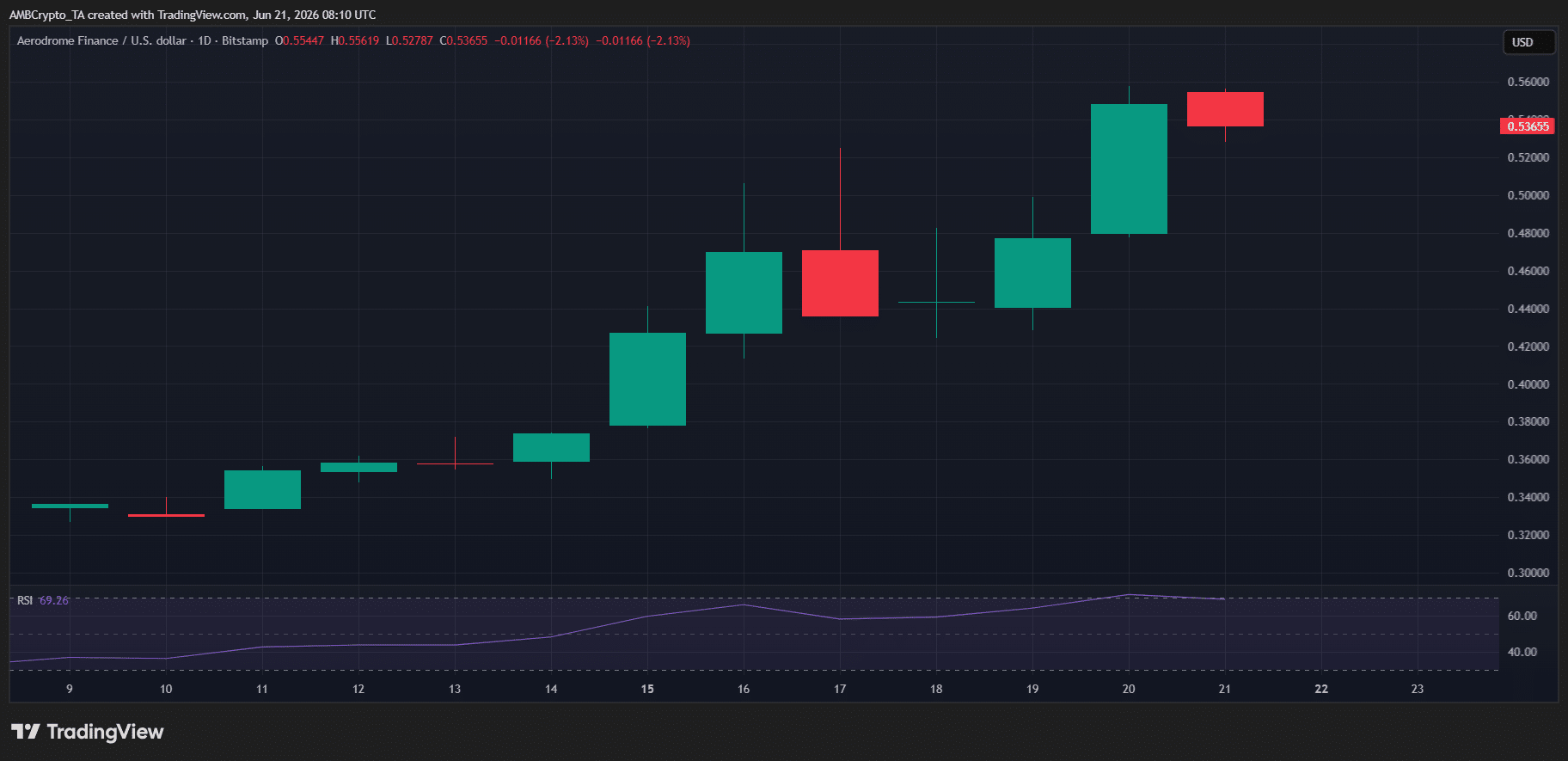
Aerodrome Finance [AERO] was the strongest weekly mover, posting a 44% rally. This extends last week’s 13.7% gain, showing that buyers have been steadily stepping in on dips.
However, the setup is now getting more technical. On the weekly chart, AERO pushed through the $0.50 resistance zone, a level it hadn’t reclaimed since the early May cycle. That breakout is bullish, but it also creates overhead pressure where profit-taking could slow momentum in the short term.
At the same time, the asset is cooling off slightly, with a 2% intraday pullback after RSI pushed above 75. That kind of move, however, usually points to a short-term cooldown rather than a full trend reversal.
Source: TradingView (AERO/USDT)
The key question now is whether this is just a reset or the start of a deeper pullback.
On the daily timeframe, structure still looks constructive. AERO held strong through the prior weekly run and quickly recovered from intraday dips, suggesting buyers are still active underneath price. If that support continues to hold, AERO could stabilize and attempt another push higher toward the $0.55 area.
Jito [JTO] – Liquid staking on Solana reinforced bullish conviction
Jito [JTO] emerged as the second biggest weekly winner this week with a 28% rally. Notably, as a liquid staking protocol on Solana, JTO’s move tracked closely with SOL’s nearly 3% weekly gain.
This is notable because strength in Solana flows into ecosystem-native protocols like Jito. When SOL trends upward, it increases staking demand, within Solana DeFi. Since Jito captures value from SOL staking, rising confidence in SOL directly improves demand for JTO, making it a natural “beta” play on Solana’s momentum.
Looking at the chart, though, JTO is also starting to outperform SOL. While SOL posted a modest weekly gain, JTO has now recorded back-to-back weeks of gains, suggesting buyers are becoming more active. If that momentum continues, JTO could be gearing up for a move toward the $0.90 level in the coming week.
Jupiter [JUP] – Solana DEX aggregator is approaching a key test zone
Jupiter [JUP] took the third spot this week with a strong 19% rally. Notably, this came on top of last week’s 14% gain, bringing its total advance over the past two weeks to nearly 35%. The move pushed JUP back above the $0.20 level, reversing all of the losses it had accumulated earlier in June.
From a technical standpoint, the rally still looks healthy. Momentum has been building steadily, but unlike many sharp breakouts, the RSI has yet to enter overbought territory. That suggests buyers remain in control without the move becoming overly stretched.
Put simply, JUP is showing strong momentum while still leaving room for further upside. If buyers maintain control, the token could continue retracing toward its mid-May levels, with the $0.25 resistance zone likely to be the next major area to watch.
Other notable winners
Outside the majors, altcoin movers also stood out this week.
Cortex [CX] led the action with a +254% move, followed by Biconomy [BICO] surging +233%, while Synapse [SYN] climbed +208%, rounding out the list of biggest movers.
Weekly losers
Audiera [BEAT] – Crypto asset showed bear-dominated control
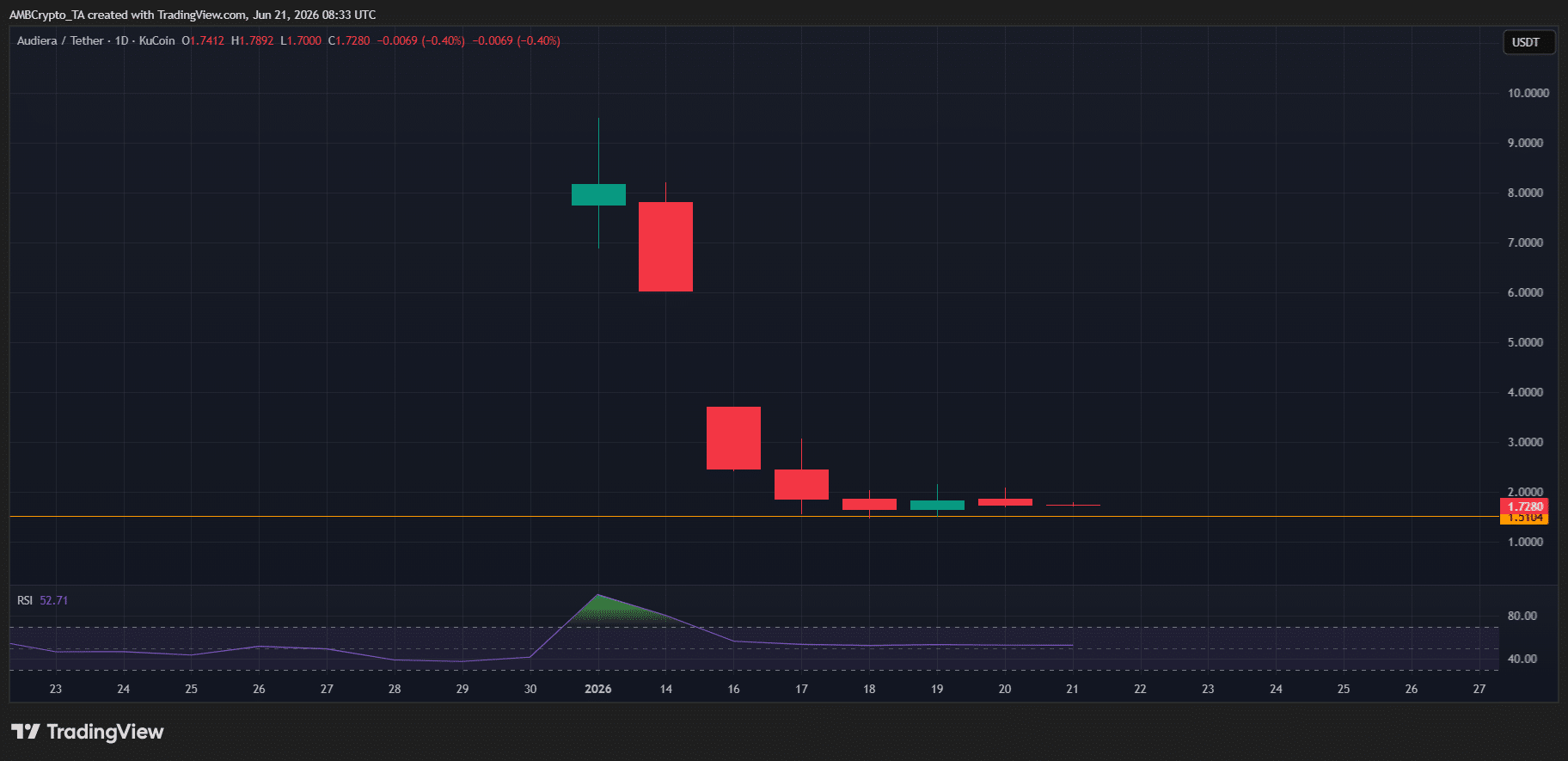
Audiera [BEAT] led this week’s losers chart with a 72% decline. From a technical lens, the move initially looks like a typical cooldown following last week’s explosive rally, which pushed BEAT close to the $10 mark.
However, a broader view suggests buyers have yet to fully step back in. Profit-taking has clearly accelerated with the token now trading around $1.70. From an investor perspective, the scale of the decline cannot be ignored, as it raises the possibility that the move reflects more than just routine profit-taking.
The logic is straightforward: After such a sharp collapse, some investors may panic sell, turning a healthy correction into a deeper retracement. As a result, the focus now shifts to whether bulls can establish support and restore confidence in the market.
Source: TradingView (BEAT/USDT)
That said, there are some early signs that stabilization may be underway.
On the daily chart, BEAT has spent the past six days trading around the $1.70 area, suggesting a potential base is beginning to form. At the same time, the RSI has cooled back toward neutral levels after becoming heavily overextended during last week’s rally.
If buyers continue defending, the token could be setting up for a recovery attempt in the coming sessions.
Humanity [H] – Blockchain project saw bearish pressure on a key support zone
Humanity [H] came in as the second-biggest loser this week with a notable 50.8% pullback. Unlike BEAT, however, H’s decline follows a 43% drop the previous week, showing that sellers have remained firmly in control for two straight weeks.
The main concern is that H has now fallen back to around $0.16, breaking below the $0.19 support level it had been holding since late May. When a support zone gives way after being defended for weeks, it usually signals weakening buyer conviction and opens the door for further downside.
Simply put, the chart still favors the bears. There are few signs of buyers stepping in aggressively, and momentum continues to point lower. If that trend continues, H could end up giving back all of its monthly gains, with the $0.10 area becoming a realistic downside target in the coming weeks.
DeXe [DEXE] – Decentralized asset hit a monthly low
DeXe [DEXE] took the spot as the third-biggest weekly loser, pulling back nearly 18%. Notably, the setup looks similar to Humanity’s, with DEXE extending its decline after last week’s 9.5% correction, suggesting buyers have been losing control for two consecutive weeks.
The bigger concern is the break below the $15 support zone. During the week, DEXE briefly dipped as low as $13, marking its lowest level in over a month. When a key support level gives way like that, it usually signals that sellers are gaining the upper hand and that further downside cannot be ruled out.
Looking at the daily chart, there is little evidence of a strong rebound yet. Buyers have struggled to defend support or, leaving the short-term trend tilted toward the bears. Unless bulls step in soon, DEXE looks vulnerable to further weakness, with a move toward the $10 area becoming increasingly likely.
Constellation [DAG] led the losers with a 37.8% drop, followed by ETHGas [GWEI] falling 37%, and MYX Finance [MYX] slipping 35%, as momentum sharply cooled.
Conclusion
This week was a rollercoaster. Big pumps, sharp dips, and nonstop action. As always, stay sharp, do your own research, and trade smart.
Final Summary
Aerodrome Finance [AERO], Jito [JTU], Jupiter [JUP] led the week in gains.
Audiera [BEAT], Humanity [H], and DeXe [DEXE] saw significant declines.
Tilray Brands‘ (NASDAQ: TLRY) stock rose dramatically after its initial public offering, then plunged, tracking the broader marijuana sector’s rise and fall. The huge growth that Wall Street had hoped for simply didn’t materialize, and investors moved on. But Tilray is still around and, more to the point, is repositioning its business for the long term. Is now a good time to buy it?
What does Tilray Brands do?
Tilray Brands started life as a marijuana company. It is still doing that, but it has branched out. The company now describes itself as “a global lifestyle and consumer packaged goods company,” with operations in cannabis, beverages, and hemp-based foods. In the beverage space, it recently acquired BrewDog, a craft brewer that also operates physical bars/restaurants.
Missed Nvidia in 2009? This Rare Signal Is Flashing Again. In 2009, a “Double Down” signal flashed for a little-known chipmaker called Nvidia. For the first time in years, that same “Total Conviction” signal is flashing for a company 1/100th the size of Nvidia. Continue »
Image source: Getty Images.
Acquisitions have played a big role in the company’s business pivot. Tilray is a relatively small company with a market cap of roughly $500 million. Execution risk is something that investors need to monitor closely, since it is fairly easy for management at a small company to get stretched too thin. For example, the purchase of BrewDog required multiple transactions spread across three countries. And Brew Dog was bought out of administration, which is the U.K. version of bankruptcy, so it wasn’t exactly a strongly performing business. Simply put, Tilray is making bold moves. So far, however, management appears to be executing its plans reasonably well.
At this point, Tilray is looking more and more like a consumer staples company and a brand manager. It is an interesting pivot that could lead to a material long-term opportunity for investors. Indeed, the company now has more diversification, and the new business lines aren’t as politically and legally complex as pot. Notably, the company reported record revenues backed by 11% organic growth in the fiscal third quarter of 2026.
What it didn’t report was positive earnings. In fact, it has never reported positive earnings in its entire existence as a public company. So, from a big picture perspective, Tilray is still a money-losing start-up.
Tilray: Right direction, more time needed
For aggressive growth investors, a deep dive into Tilray’s business might be well worth the effort. There are interesting and positive things happening as the company reworks its business model. However, most investors should probably watch the company from the sidelines. Until it is proven that the revamped business is sustainably profitable, the risk/reward balance will remain tilted toward risk.
Should you buy stock in Tilray Brands right now?
Before you buy stock in Tilray Brands, consider this:
The Motley Fool Stock Advisor analyst team just identified what they believe are the 10 best stocks for investors to buy now… and Tilray Brands wasn’t one of them. The 10 stocks that made the cut could produce monster returns in the coming years.
Consider when Netflix made this list on December 17, 2004… if you invested $1,000 at the time of our recommendation, you’d have $417,305!* Or when Nvidia made this list on April 15, 2005… if you invested $1,000 at the time of our recommendation, you’d have $1,293,148!*
Now, it’s worth noting Stock Advisor’s total average return is 936% — a market-crushing outperformance compared to 209% for the S&P 500. Don’t miss the latest top 10 list, available with Stock Advisor, and join an investing community built by individual investors for individual investors.