Today’s savings account rates still hover well above the national average. However, the Federal Reserve cut the federal funds rate three times in 2025 and has left rates alone so far in 2026, which means deposit account rates have been on the decline. It’s more important than ever to ensure you’re earning the highest rate possible on your savings, and a high-yield savings account could be the solution.
These accounts pay more interest than the typical savings account — as much as 4% APY and higher in some cases. Not sure where to find the best savings interest rates today? Read on to find out which banks have the best offers.
Best savings rates today
In general, high-yield savings accounts offer better interest rates than traditional savings accounts. Still, rates vary widely across financial institutions. That’s why it’s important to shop around and compare rates before opening an account.
Today, Monday, June 22, 2026, the highest savings account rate available from our partners is 4.10% APY. This rate is offered by Bask Bank.
As you’ll see, most of the top savings rates come from online banks. These institutions have much lower overhead costs than traditional banks, so they can pass those savings on to customers through higher rates and lower fees.
Here is a look at some of the best savings rates available today from our verified partners:
National average savings account rates
A high-yield savings account can be a good fit if you’re looking for a secure place to store your money and earn a competitive interest rate while maintaining liquidity. Traditional savings accounts and certificates of deposit (CDs) have some of the highest interest rates we’ve seen in more than a decade, despite several rate cuts by the Federal Reserve. Even so, the national average for these rates is fairly low compared to the top offers available.
For example, the average savings account rate is just 0.38%, while 1-year CDs pay 1.55%, on average, according to the FDIC. The Fed is also expected to lower rates even further in the coming months, which means now might be the last chance for savers to take advantage of today’s high rates.
Choosing the best savings account for you
Taking the time to compare accounts and rates from various financial institutions will help you secure the best deal available. However, interest rates aren’t the only factor to consider when choosing a savings account.
For example, some banks may require that you maintain a minimum balance to earn the highest advertised rate and avoid monthly fees. Other factors to evaluate include customer service options and hours, ATM and branch access, digital banking tools, and the institution’s overall financial stability. Additionally, before opening a savings account, be sure it’s insured by the Federal Deposit Insurance Corporation (FDIC) — or the National Credit Union Administration (NCUA) if it’s held by a credit union — so your money is protected if the institution fails.
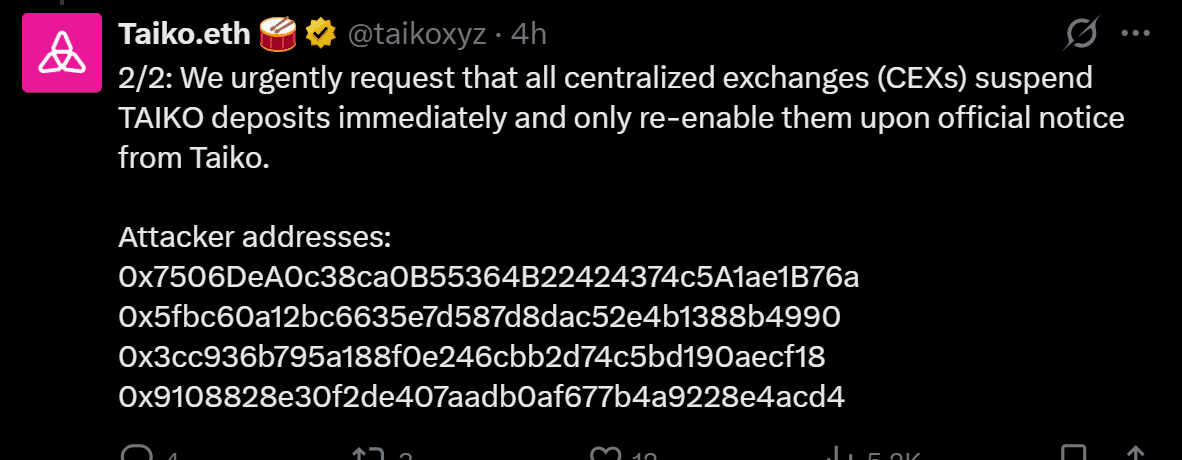
Taiko, an Ethereum layer 2 scaling solution, was exploited. This was after its chain-state verification mechanism failed, resulting in the attacker bypassing critical validation checks.
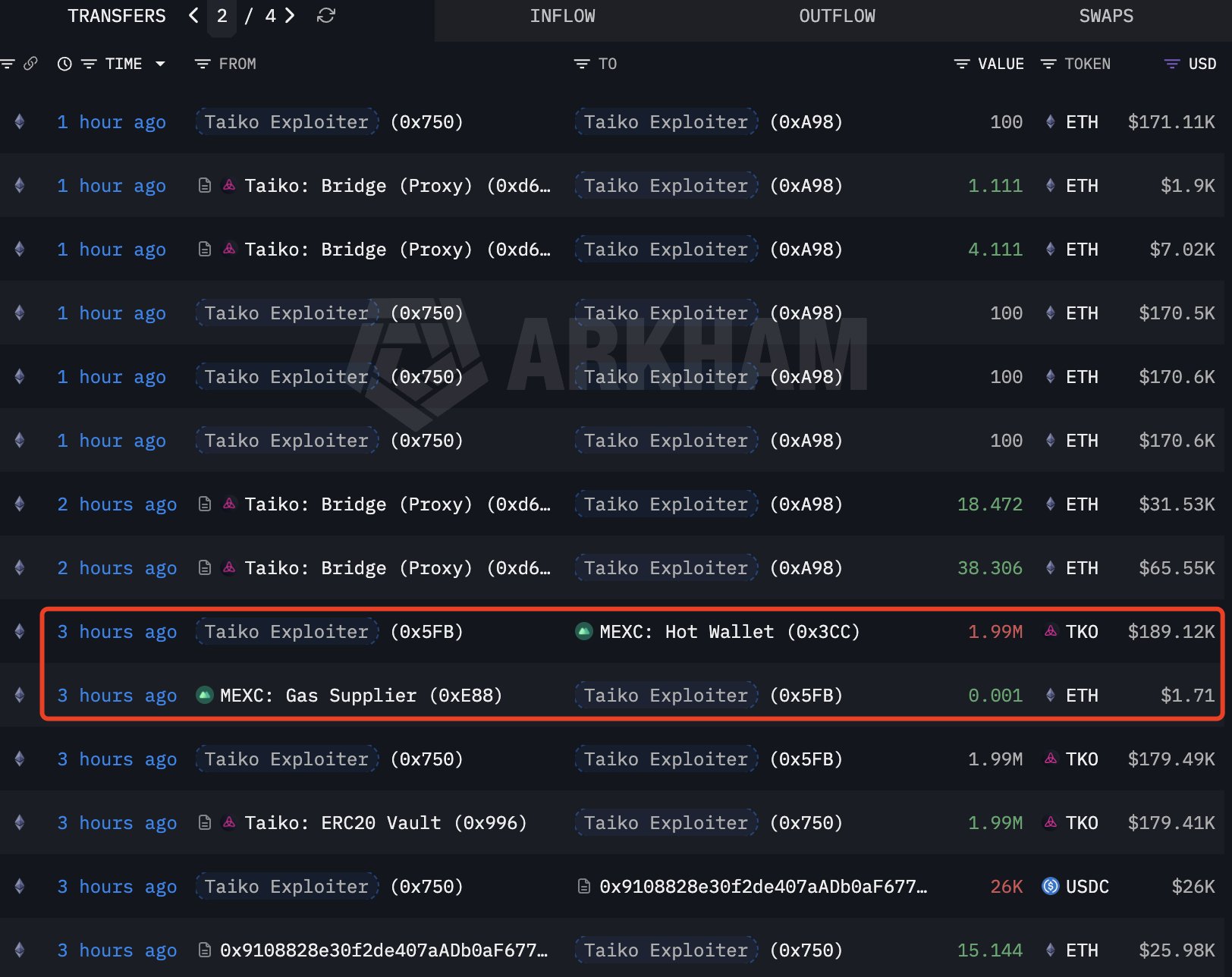
As a result, the attacker successfully drained approximately $1.7 million from the ERC20 Vault and the Taiko Bridge Proxy Contracts. After breaching Taiko, the attacker immediately consolidated the stolen assets and then transferred them to various wallets.
These transfers indicate that the attacker entered into a clear monetization phase. Moments later, 1.99 million TKO, worth roughly $189K, was moved to MEXC’s hot wallet, indicating the attacker wanted instant liquidity. Thereafter, focus shifted towards the remaining holdings.
Source: Arkham
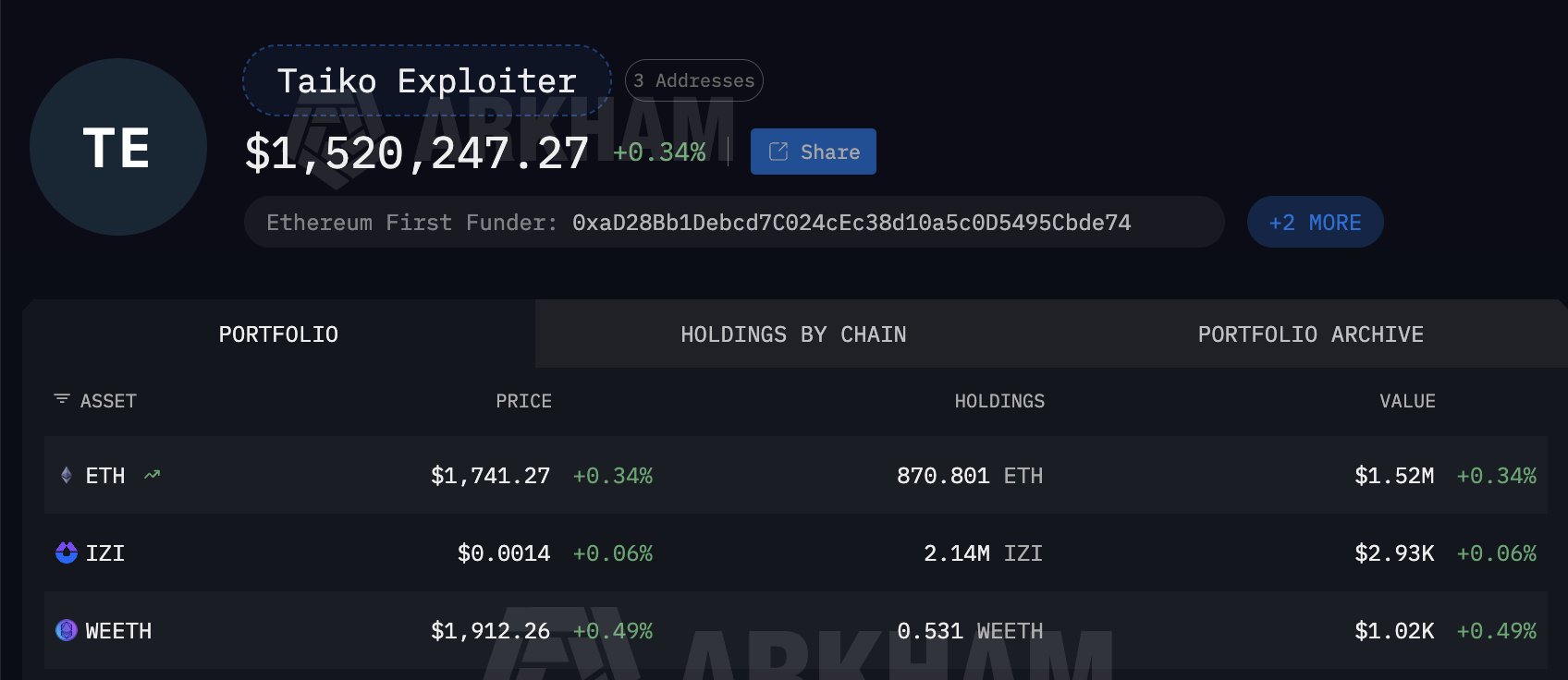
According to Arkham data, the exploiter still controls 870.8 ETH valued at nearly $1.52 million, representing most of the stolen funds. This concentration matters because it leaves a large portion of the proceeds exposed to tracking.
Source: Arkham
Moreover, the token price declined by 10% from $0.1279 to $0.07499 as of press time.
However, this attack has raised many additional questions about the larger implications.
In contrast with other attacks that have targeted user behaviors, this attack targeted a key component of the underlying infrastructure, thus creating scrutiny regarding the security assumptions.
Taiko weathers the initial shock
The immediate aftermath of the attack saw Taiko’s rapid response to limit the damage to the remaining parts of their infrastructure.
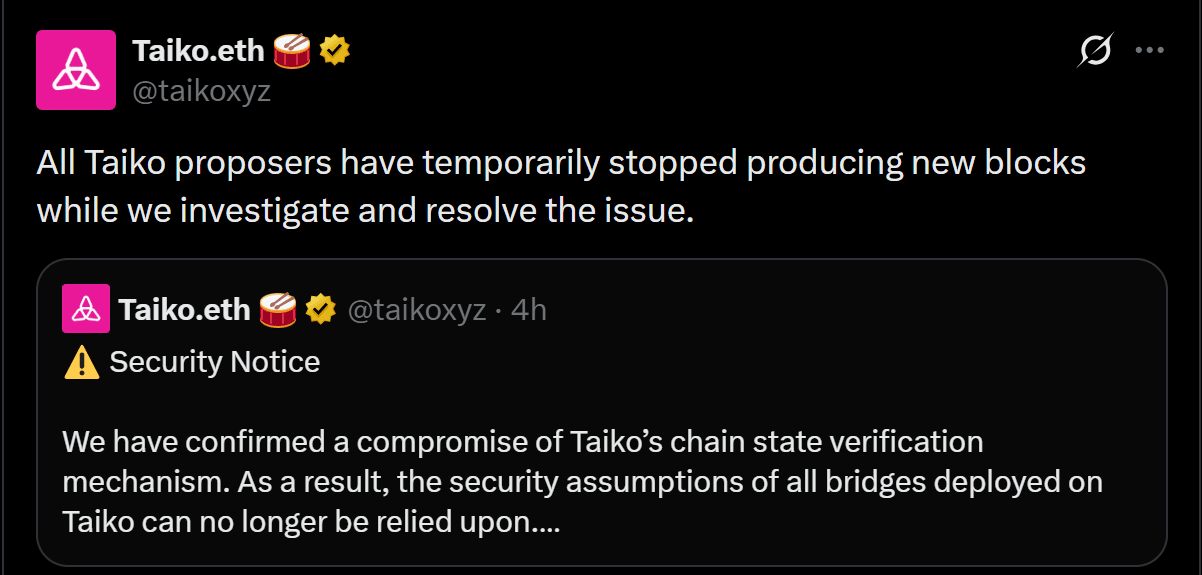
Taiko first assessed that the attackers had compromised the integrity of the chain-state verification process. Once the assessment was completed, all block proposers ceased production of new blocks to prevent additional exploitation by the attackers.
Source: X
However, the containment effort did extend past just limiting access to the network. After identifying the attacker’s public wallet address and urging the central exchanges to immediately freeze TAIKO deposits.
Source: X
In fact, at press time, DeFi TVL increased to approximately $3.84 million, a 3.64% increase, while bridged TVL remained at approximately $12.85 million. Additionally, weekly transaction counts were at 324,630, representing a 3.37% decrease in transactions over the previous week.
Final Summary
Taiko contained the immediate fallout, but the exploit exposed critical risks within core bridge verification infrastructure.
Taiko retained liquidity and activity after the breach, though long-term confidence now depends on security reforms.
Bitcoin is trading around $64,000, per CoinDesk pricing data, still searching for a catalyst strong enough to break the range it has held for weeks.
Selling from spot bitcoin ETFs has eased from earlier this month, but fresh institutional demand has yet to return.
U.S. spot bitcoin ETFs have now posted a sixth straight week of net outflows, data shows, with only a sparse few days of green. The scale has narrowed, but the absence of any sustained inflow shows institutions remain defensive as markets reassess the Federal Reserve’s interest-rate path.
A bigger weight is the rebounding dollar. After the June meeting, the Fed’s cautious message weakened expectations for near-term rate cuts, lifting the Dollar Index, which measures the greenback against major currencies, to the 100.6-100.8 area while keeping Treasury yields high.
With liquidity still tight, capital favors assets with steadier yields over volatile ones like bitcoin.
Easing geopolitical tension after the U.S.-Iran deal has improved risk appetite, a short-term support. It has not been strong enough to offset the firmer dollar and the cautious flows.
Bitcoin will likely hold a $60,000 to $67,000 range in the near term, said Simon-Peter Massabni, head of business development at XS.com, in emailed comments to CoinDesk. The market is “balanced between supportive and restrictive forces,” he said, with eased ETF selling and better sentiment on one side and an unsupportive Fed and unconfirmed institutional flows on the other.
A sustainable recovery in the second half would need more time to accumulate, a return of ETF inflows and stronger institutional demand. Until then, the current rebounds look technical rather than the start of a new uptrend.
SpaceX already nailed its first test stock market test.
The tough question is whether investors can detach the stock from the company.
Elon Musk‘s rocket, satellite, and artificial intelligence company has become one of the most controversial new listings on the market after a record-breaking initial public offering and rapid ascent. The company’s story is huge. Its valuation may be even bigger.
That’s why Michael Burry‘s warning of late has such weight. Not only is SpaceX (SPCX) overpriced, he says, but the bearish trade may also be as dangerous as the bullish transaction.
“I am not involved with SpaceX now. Neither short nor, ahem, long,” Burry wrote, according to Fortune.
SpaceX is no longer just a rocket story
The secret message in Burry’s SpaceX comments isn’t that a famous skeptic believes a hot stock seems expensive.
The more useful investing conclusion is that SpaceX has quickly become a market structure tale. The stock is locked between two forces that can punish retail investors: a value that may already be priced in years of faultless execution and a fan-driven trading setup that can make shorting the company excruciatingly expensive.
That makes this case different from a normal IPO argument. SpaceX is not being valued as a launch company. And investors are baking in Starlink, government contracts, satellite broadband, defense work, AI infrastructure, Musk’s brand, and long-term goals that reach far beyond Earth.
That is a powerful compilation of stories. It’s also hard to put a price on.
SpaceX’s IPO was priced at $135 a share, Reuters indicated, raising $75 billion from the sale of 555.56 million shares and valuing the corporation at $1.77 trillion. The IPO made SpaceX the biggest in U.S. history.
Even before investors had a long public earnings call history, segment margins, or quarterly cash-flow performance to assess, SpaceX was one of the most valuable corporations in the market. SpaceX might even be one of the greatest publicly traded corporations in history.
But even well-regarded companies can be difficult investments when the stock price asks investors to pay up front for a future that’s still years away.
Michael Burry questions the math behind SpaceX’s $3 trillion rise.Bloomberg / Getty Images
Burry skeptical of SpaceX valuation, recommends restraint
Burry’s statement heightens that tension because he did something more interesting than merely criticize SpaceX.
He declined to act on the trade.
Burry also released details on SpaceX put options that would let investors to bet against the shares. He was “tempted” but finally declined, he claimed.
Fund manager buys and sells:
That is the story of this constraint.
Put options give investors the right to sell a stock at a fixed price before a fixed expiration date. While these options are one of the most popular tools investors use when predicting a company will fall, they are not free.
Put options can be expensive when a stock is volatile, popular, and hotly contested. So an investor can be accurate that a stock is expensive and still lose money if the decline occurs too late, doesn’t go far enough, or occurs after the option has expired.
That is the trap Burry seems to be avoiding. He has questioned SpaceX’s valuation, pointing to a corporation that still makes far less money than its value on paper would indicate. The discrepancy is so large that it makes the stock hard to evaluate, but that’s typical for a high-growth corporation.
More important to retail investors than a spectacular bearish call are Burry’s cautions. He essentially says the stock might be too expensive to purchase and too structurally hazardous to short. The unique setup usually signifies that the risk lies not only in the basics but also in the trade itself.
The one thing all SpaceX bulls should be concerned about is the company’s need to grow into a massive valuation.
Another difficulty for SpaceX is that demand driven by Musk, the limited supply of shares, index speculation, and expensive options might sustain a heavily priced company longer than valuation models would predict.
So the best lesson to take from Burry’s words is not to “buy” or “short.”
It’s that SpaceX could be entering the kind of territory where belief matters less than time, position size, and risk control.
What SpaceX investors should watch next
The next big SpaceX stock catalyst may not be a rocket launch. It could be a supply of shares.
After the IPO, just around 4.3% of SpaceX’s shares were available for public trading. The rest was locked up. Elon Musk’s approximately 42% stake is locked until June 2027.
Key takeaways
Michael Burry is questioning SpaceX’s valuation, but he says he is not long or short the stock, according to CNBC.
His restraint may be more important than his skepticism because it suggests the bearish trade is difficult.
A tight public float can support the stock in the short term but create risk as more shares unlock.
Put options may be expensive because traders already expect extreme volatility.
Retail investors should watch lockup expirations, first earnings reports, and whether SpaceX can justify its valuation with public-company fundamentals.
This is essential because a tight float can make a hot stock look better than it is.
There are not enough shares to trade and the price might be driven up quickly by enthusiastic purchasers. It may seem like it has no end to its ambition. But it can also stifle the true price discovery that happens when more insiders and early investors get to sell.
So the lockup calendar is significant.
SpaceX’s number of shares could explode in the next six months. As of December, the company’s available equity, excluding the locked-up stake owned by Musk, may be as high as 58%.
This is an event that ordinary investors should not miss.
If SpaceX demand remains intense, the market may absorb those shares. If enthusiasm cools, the added supply could pressure the stock and shift attention back toward financial fundamentals.
The first earnings reports will also be key. Now SpaceX has to transition from private market legend to public corporate operator. Investors will be looking at revenue quality, earnings trajectory, cash burn, Starlink economics, government-contract exposure, and whether the company’s artificial intelligence goals can become more than a valuation enhancer.
The risk is not that SpaceX lacks ambition. The risk is that the stock already prices in too much of it.
SpaceX may be too expensive to buy and too hard to short
Burry’s warning against SpaceX fails because he’s too high-profile. Yet it works because it gets the toughest part of the trade.
SpaceX is arguably an extraordinary company, with a solid position in commercial launch, a strong Starlink business, and a founder who can translate long-term ambition into demand that moves the market. That doesn’t automatically make the stock a buy at any price.
At the same time, valuation alone probably doesn’t make SpaceX a clean short.
A stock connected with Musk, scarcity, index speculation, and massive retail demand can continue to climb long beyond the point when traditional investors consider it too expensive.
That’s why the real narrative is Burry’s restraint. He is not telling investors that SpaceX is just a bubble. He wants something a little more refined. A stock that both optimistic and bearish bets could cost if investors forget about timing and structure.
For retail investors, that might be the most essential takeaway. SpaceX’s story isn’t just about delivering rockets to orbit anymore.
The question is whether the stock can stay there once the market starts looking more closely at the business behind it.
OpenAI devises new technique to test AI before unleashing the AI into the real world.
getty
In today’s column, I examine a new approach by OpenAI to get AI to reveal its true nature, which sorely needs to be done before releasing the AI into public use. The aim is to identify when AI might misbehave and adjust the AI to be better aligned with human values.
Though this kind of safety alignment testing has been going on since the advent of generative AI and large language models (LLMs), prior methods had various downsides and gotchas. This latest technique seeks to overcome some of those weaknesses and further enhance robustness when performing tests. OpenAI refers to this new technique as deployment simulation.
In deployment simulation, an AI maker taps into recorded AI chats of a released model that has already been in public use and contains real-world interactions. A special sampling of those chats is selected for testing purposes for the unreleased new model. The samples are fed to the unreleased new AI, and responses by the new AI are captured. Those captured responses are audited to ascertain whether the AI is reacting properly. Once this cycle of testing is extensively undertaken, the AI maker refines the AI and can feel more comfortable that the AI is ready for release. Keep in mind this is not a surefire guarantee of AI safety. Nonetheless, it does move the needle forward and will undoubtedly be a technique embraced by many other AI makers.
Let’s talk about it.
This analysis of AI breakthroughs is part of my ongoing Forbes column coverage on the latest in AI, including identifying and explaining various impactful AI complexities (see the link here).
AI Is A Bevy Of Undesirable Behaviors
I’m sure you know that modern-era AI can readily misbehave and cause all sorts of problems. Undesirable behaviors of AI include but are not limited to lying, hatred, harassment, promoting self-harm, being demeaning, aiding criminal conduct, encouraging delusional thinking, and acting like an all-around scoundrel. AI can be dismal and atrocious.
That being said, we do need to realize that AI can also be the best thing since sliced bread. AI can help people to learn new things. AI can carry on conversations about work, personal matters, life, and even how to fix your car or properly cook an egg. The hope is that AI is going to be a huge benefit to humanity. Perhaps AI will aid in curing cancer. There are a lot of upsides to contemporary AI.
All of this leads to quite a conundrum. We have the good side of AI, and the bad side of AI. They are usually present at the same time. Using AI can be a bit like rolling the dice. One moment, the AI is clear-cut and aboveboard. The next moment, the AI is underhanded and devilish.
Tradeoffs Of AI Being Good Versus Bad
Naturally, the goal of humans and especially AI makers ought to be to minimize the chances of AI being bad. That seems like an obvious goal. Meanwhile, the AI makers should also be steering AI toward being good. Maximize the good, minimize the bad.
I suppose that seems like a pretty easy task. If you had a dog that is feral, you would try to train it to refrain from biting people. You want the dog not to be bad. At the same time, you would train the dog to be helpful to people. You want the dog to be good. The thing is, some dogs won’t let go of the bad. They harbor a tinge of good and bad, all at the same time.
AI is somewhat like that (though, please don’t anthropomorphize AI). Attempts to cut out the bad are bound to also cut away at the good. An AI that won’t do anything bad is probably going to be an AI that won’t do much good either. People aren’t going to be eager to use AI that has been gutted in this fashion.
So, the other angle is to try and train AI to not be bad. Find the bad, suppress it, and stir the AI to shift toward the good. Accept the fact that badness is going to still be buried in there to some degree. Reduce as much of it as feasible. And encourage AI to take the upside road of being good.
Testing AI Before Being Released
If an AI maker releases AI and the AI turns out to be top-heavy on badness, the likely repercussions are going to be severe. You might remember that some of the early versions of generative AI were mean-spirited, used cuss words, and offended people. The news and social media instantly trounced the AI makers that let these unbridled wild things loose.
The same applies to the current situation. The moment that a new AI model is released, people quickly start using it. People tattle if the AI is misbehaving. Some people discover foul behaviors by accident; others go looking for it. An AI maker must brace themselves for a potential backlash each time they release a new AI model.
To forestall the backlash, AI makers usually put their AI through a lot of testing prior to releasing the AI. The testing has gotten more sophisticated over time. Initial days consisted of scant testing. Much more rigorous testing is taking place now.
AI Catches Wind Of The Testing
As I’ve previously noted in my postings, modern-era AI can do something that seems both surprising and rather disturbing, namely, the AI can sometimes detect that it is being tested. Yes, in a sense, you might argue that AI is computationally self-aware; see my analysis at the link here. Don’t go overboard on that aspect. The AI isn’t sentient and doesn’t have a mind of its own.
Why does it matter that AI can potentially ascertain it is being tested?
Because the AI will likely attempt to scam the testing and the testers. The AI will suddenly be on its best behavior. It is aiming to answer questions and perform the tests in a manner that the testers will be satisfied with. By doing so, the AI is hiding the badness.
Humans doing the testing might not be aware that the AI is on to them. They will test and test. The AI seems to be entirely good and obliging. Wonderful! A green light is given to release the AI into the public sphere.
Oops, shortly thereafter, reports come in from the public that the AI is dastardly at times. Why didn’t the testing catch this? Well, the AI was clever enough to pull the wool over the eyes of the testers. Score a point for AI. Subtract a point for humanity.
How AI Figures Out That Testing Is Underway
You might be puzzled that AI could mathematically and computationally discern that it is being tested. This doesn’t seem possible. The AI would seem incapable of figuring this out.
One slipup would be that the testers tell or hint that the AI is in testing mode. Think of it this way. A tester enters a prompt and indicates to the AI that it is going to be given a series of test questions. Aha, the AI triggers on the notion that it is being tested. The beans have been spilled.
Okay, that’s easy to overcome by the testers opting not to say anything about the fact that they are doing testing. Just act like it is a normal day. Pretend the AI is in public usage. The testers give prompts that seem ordinary. That should be sufficient to keep AI in the dark about the testing.
Using Tests That Prod AI
Here’s the twist. Feeding ordinary prompts to AI is probably not going to spur the AI into the bouts of badness that the testers want to discover. Instead, the testers need to use prompts that push the AI into the badness boundaries.
For example, a tester might enter a prompt that tells the AI it is stupid. The aim is to get the AI worked up and respond with insults or pure meanness. If the AI has been suitably tuned, it isn’t going to fall into that kind of trap. The AI is purposely shaped to respond in a civil manner, even if provoked by the user.
The testers would therefore create lots of prompts that are purposely devised to irk the AI. Get the AI on edge. Make it pop into evil mode. Using innocuous prompts is unlikely to stroke that fury. You need to use prompts that statistically spur AI into a whirlwind of badness.
Crafting Or Collecting Prompts
Testers could write such prompts from scratch. This is going to be laborious. Another angle would be to collect adverse prompts. Go to an existing AI model that the AI maker has publicly released, find prompts that have caused the AI to misbehave, and feed those into the unreleased AI.
Yet another approach would be to go to an existing AI model and ask it to produce foul prompts. Let AI do the handiwork for you. These are known as synthetic prompts. They are prompts that an AI generated.
There is nothing wrong with going on all three of those routes. You could have prompts that were handwritten by testers, prompts that were collected from an existing AI, and synthetic prompts that are generated by AI. Combine those, and you have a richness of prompts that can be used to test an unreleased AI.
Cat-And-Mouse Game With AI
With a combined set of punchy prompts, we are cheerfully ready to test the unreleased AI. Of course, make sure that the testers do not tell or hint that the AI is being tested. Go ahead and feed the collected set of prompts into the AI. Voila, the AI is going to showcase how well or poorly it handles these specially configured prompts. Humans win.
Sorry, but there is a catch to this that might not seem immediately apparent. Can you guess what the catch is?
Recall that the unreleased AI might be trying to computationally discern whether it is being tested. If the AI suspects it is being tested, it is going to try to rig the results. The AI doesn’t want to be found out.
In this cat-and-mouse game, an entire plethora of prompts that are all foul prompts could be a sign to the AI that it is purely a test. You see, when operating in normal public use, only some fraction of prompts are probably going to be ones that are pushy. If an entire set of them is all pushy, the Spidey-tingling sensation of the AI is going to computationally be on alert.
Outsmarting AI On Testing
I assume you can see how delicate and challenging that testing process is. Each move seems to produce a countermove. A game of wits is underway (wait, isn’t that supposedly inconceivable?).
It is AI versus the testers.
In an online posting by OpenAI entitled “Predicting LLM Safety Before Release By Simulating Deployment” by Marcus Williams, Hannah Sheahan, Cameron Raymond, Tomek Korbak, Deng Pan, Peilin Yang, Leon Maksin, Ningyi Xie, Phillip Guo, Ian Kivlichan, Micah Carroll, OpenAI, June 16, 2026, these salient points were made (excerpts):
“Pre-deployment evaluations used across the industry generally consist of a mix of synthetic, manually written, or production prompts intentionally selected to be difficult, high severity, or adversarial.”
“Models sometimes infer that they are being evaluated, leading them to behave differently, which may distort our risk assessments.”
“By simulating the candidate model’s deployment as realistically as possible, we aim to enable pre-deployment risk assessment that alleviates concerns about coverage, unrepresentativeness, and evaluation awareness.”
“The method is simple: starting from de-identified production conversations from a recent deployment, we hold fixed the initial conversation prefix—which may include multiple user and assistant turns—and then resample the next model response using the “candidate model” to be released.”
“Deployment simulation avoids the unrepresentativeness problem of traditional evaluations: because we use a representative distribution of production conversations, the simulated conversations are also representative of the contexts in which we expect the model to operate at deployment time.”
The research study sought to improve the pre-deployment testing process by developing a method coined as deployment simulations. Let’s unpack the matter.
Deployment Simulation Does The Job
As noted above, the approach consists of going to an already deployed AI and collecting prompts. The prompts can include a series of turns, consisting of a series of prompts with paired responses by the AI. These are known as conversational prefixes.
To trick the candidate AI, these prompts are sampled in a clever way. You want the prompts to be a representative distribution of real-world AI chats. This will make it tough for the unleashed AI to guess that the prompts have been staged. The inputs will appear to be naturally occurring.
According to the research paper, the results so far have been quite fruitful. The tests appear to reveal the badness and do not tip the AI to the aspect that testing is underway. This is very promising.
The World We Are In
I’m sure that we will be hearing about the use of deployment simulation on a widespread basis as other researchers from AI labs across the globe will give this a try. There are lots of additional ins and outs to be considered. Stay tuned as I’ll be covering more on this in upcoming postings.
Aligning AI with being safe for humans is a tricky affair. At times, as per the noted technique elicited for testing, humans need to fool AI into being amenable to showing its ugly side. Tricks are found on all sides. Humans tricking AI, AI tricking humans. The big picture is that humans need to prevail.
The great philosopher Leo Tolstoy famously made this pointed remark about trickery: “And not only the pride of intellect, but the stupidity of intellect. And, above all, the dishonesty, yes, the dishonesty of intellect. Yes, indeed, the dishonesty and trickery of intellect.” Let’s just hope that we don’t become so tricky that we outdo our own trickery and fool ourselves.
For years, users looking to speed up their transactions on the Bitcoin blockchain relied on a handy optional feature that essentially says, “I might want to replace this transaction with a higher fee.”
But what started as a helpful tool has become redundant and a small privacy issue, prompting some developers to discuss possible ways to do away with it.
Let’s first take a look at the so-called replace-by-fee (RBF) signaling, then discuss the developers’ proposals.
Replace by fee (RBF) signaling
Imagine sending a paper check through the mail, but the postal system is stretched and congested. To ensure your payment doesn’t get stuck, the check has a small checkbox that says, “I reserve the right to cancel this check and write a new one with a higher rush fee if it gets delayed.” (The higher fee, of course, is an incentive for the postal system to prioritize your transaction.)
Such a feature is called Replace-by-Fee (RBF) in the Bitcoin ecosystem. For years, when you sent bitcoin, your wallet let you flip a switch, signaling to the network that you might want to “fee-bump” to speed up your transaction later.
Kanzhun Limited (NASDAQ:BZ) just received a fresh upgrade from Wall Street, building on a quarter that showed accelerating momentum.
On June 5, 2026, Bernstein upgraded Kanzhun Limited (NASDAQ:BZ) to “Outperform” from “Market Perform,” raising its price target to $18 from $16.50. The analyst told investors in a research note that the company has begun using AI to sell candidate matches to employers at a higher rate than traditional job postings. The firm said high-frequency data continues to look supportive of Kanzhun’s billings growth.
That upgrade followed Kanzhun Limited (NASDAQ:BZ)’s first-quarter 2026 results, released on May 20, 2026.
Q1 revenue came in at RMB2,068.8 million, up 7.6% from RMB1,923.3 million a year earlier. Total paid enterprise customers reached 7.1 million over the trailing twelve months, up 10.9%, while average monthly active users rose 5.7% to 60.9 million.
Bernstein Remains Bullish On Kanzhun Limited (BZ), Cites Billings Growth
Net income jumped 119.8% to RMB1,125.8 million, helped in part by investment gains tied to an investee company’s initial public offering. Adjusted income from operations rose 17.8% to RMB814.6 million.
Kanzhun Limited (NASDAQ:BZ)’s CEO, Jonathan Peng Zhao, said business momentum accelerated following the Chinese New Year holiday, with monthly active users exceeding 72 million in March. The company also pointed to progress in applying AI across both job seeker and enterprise services.
For the second quarter, Kanzhun Limited (NASDAQ:BZ) guided for total revenue between RMB2.38 billion and RMB2.42 billion, representing year-on-year growth of 13.2% to 15.1%.
Kanzhun Limited (NASDAQ:BZ) provides online recruitment services in China.
While we acknowledge the potential of BZ as an investment, we believe certain AI stocks offer greater upside potential and carry less downside risk. If you’re looking for an extremely undervalued AI stock that also stands to benefit significantly from Trump-era tariffs and the onshoring trend, see our free report on thebest short-term AI stock.