Home Blog Page 323

Jim Cramer: CoreWeave’s Backlog ‘May Be Much Greater’ Than Wall Street Thinks

0
Jim Cramer: CoreWeave’s Backlog ‘May Be Much Greater’ Than Wall Street Thinks


Quick Read

  • Jim Cramer says debt documents suggest CoreWeave (CRWV) already carries more contracted demand than its reported $99 billion backlog implies.

  • CoreWeave reached $5 billion in annual revenue faster than any cloud in history while posting a $740 million net loss last quarter.

  • Backlog rocketed from $30 billion in mid-2025 to nearly $100 billion by March 2026, anchored by long-term commitments from Meta and OpenAI.

  • Act now: the analyst who called NVIDIA in 2010 just named his top 10 AI stocks — and CoreWeave, Inc. Class A Common Stock didn’t make the cut. Grab the names FREE today.

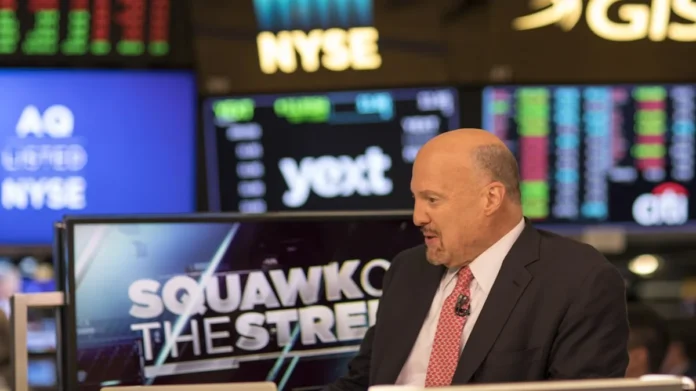
Jim Cramer used his June 16 Mad Money Mad Dash segment to make the case that CoreWeave’s contracted revenue pipeline could be even larger than what the Street currently models.

ojbyrne / Flickr

“It’s got the best handle in the buildout. And this morning, [a research note] comes up with a piece looking at the debt documents showing that the backlog may be much greater when they report,” Cramer said of the AI cloud operator.

He paired that observation with a vivid pitch for the company’s execution: “If you want to put a rocket into space with a data center… you might at least peruse CoreWeave’s work, because that’s the one that knows how to build them fast.”

The bigger-backlog thesis comes from a third-party research note reviewing CoreWeave’s debt documents, not from the company itself, so investors should treat the upside as a possibility rather than confirmed guidance.

Why Cramer’s Backlog Claim Matters

CoreWeave (NASDAQ:CRWV) already disclosed a striking number on its Q1 2026 earnings release: a $99.40 billion revenue backlog as of March 31, 2026, anchored by a $21 billion commitment from Meta signed in March. CEO Michael Intrator called it “the strongest bookings quarter in CoreWeave’s history.”

Act now: the analyst who called NVIDIA in 2010 just named his top 10 AI stocks — and CoreWeave, Inc. Class A Common Stock didn’t make the cut. Grab the names FREE today.

The trajectory is what gives Cramer’s call its punch. Backlog moved from $30.1 billion in Q2 2025 to $55.6 billion in Q3 2025, then $66.8 billion in Q4 2025, before reaching nearly $100 billion last quarter. OpenAI alone accounts for roughly $22.4 billion in total commitments, and NVIDIA added a $2 billion Class A stock investment alongside a $8.5 billion non-recourse delayed draw term loan facility.

If the research note Cramer flagged is right and the debt documents imply additional contracted demand, the next reported backlog figure could move materially higher. The next earnings report is currently estimated for around August 13, 2026, though it has not yet been company-confirmed.



Source link

Axelar disables Secret connection after $4.67M exploit hits IBC-linked assets

0
Axelar disables Secret connection after $4.67M exploit hits IBC-linked assets


Cross-chain interoperability protocol Axelar has disabled its connection to Secret Network following an exploit that resulted in the loss of approximately $4.67 million in bridged assets.

In an update on June 19, Axelar said it had identified an incident affecting assets bridged over the Inter-Blockchain Communication [IBC] protocol from the Axelar chain to Secret Network. The team said the issue appears to be isolated to the Secret-side ICS-20 smart contract used in the Cosmos IBC connection between the two networks.

“Approximately $4.67M worth of tokens” were taken, according to the protocol.

Axelar shuts down affected connections

Axelar said its emergency committee disabled the Secret and Secret-SNIP connections immediately after becoming aware of the incident.

The protocol also said it has contacted relevant exchanges and law enforcement agencies while investigations continue.

According to the initial assessment, the exploit is limited to assets bridged from Axelar to Secret Network through the affected IBC route. Axelar said no other IBC connections appear to be impacted and that no other Secret Network tokens have been affected.

The team further stated that Axelar’s core protocol remains unaffected.

“We’re preparing a detailed post-mortem,” the protocol said.

Investigation focuses on Secret-side contract

The incident highlights the complexity of cross-chain infrastructure, where vulnerabilities can arise within specific integrations rather than the underlying bridge network.

Axelar’s statement suggests the issue originated in the Secret-side ICS-20 contract associated with the Cosmos IBC connection, rather than within Axelar’s validator network or core interoperability infrastructure.

That distinction could become an important focus of the investigation as both ecosystems work to determine the root cause of the exploit.

The latest incident adds to a growing list of bridge-related security events across the crypto sector, where interconnected networks and smart contracts continue to present attractive targets for attackers.

At the time of publication, neither Axelar nor Secret Network had released a detailed technical explanation of how the exploit occurred.


Final Summary

  • Axelar disabled its Secret Network connections after approximately $4.67 million in bridged assets was stolen.
  • The protocol said the issue appears isolated to a Secret-side ICS-20 contract, while Axelar’s core infrastructure remains unaffected.


Source link

Smart-contract and DeFi coins lead losses as BTC price wilts for 4th straight day

0
Bitcoin price news: BTC falls below $60,000 to weakest price since October 2024

The largest cryptocurrencies remained under pressure for a fourth straight day, with bitcoin falling 2.5% in 24 hours to just below $62,400.

It’s not alone. The CoinDesk 20 Index (CD20) has dropped 3.3%, with ether (ETH), XRP (XRP) and solana (SOL) all weaker. The CoinDesk Smart Contract Platform Select Capped Index fell 4%, and the CoinDesk 80 and CoinDesk DeFi Select Index are following close behind.

Concerns about Strategy (MSTR), the Michael Saylor-led bitcoin treasury company, continue to dominate market sentiment, with particular focus on its dividend-paying preferred stock, STRC.

“Strategy, the largest listed BTC holder, has watched its STRC preferred collapse below par, and the market is now openly pricing the tail that it has to sell coins to defend the structure,” analysts at Marex said.

“Add five straight months of BTC trading under its estimated $78k production cost, quietly forcing the weakest miners to capitulate, and you have two real sellers that were not in the frame a week ago,” they added.

Derivatives Positioning

  • Bulls continue to bleed as the market wilts in the wake of Wednesday’s hawkish Fed meeting. In the past 24 hours, more than $450 million in leveraged bets has been liquidated. As has been the case since the meeting, most are longs.
  • Open interest (OI) in bitcoin and ether futures is largely unchanged over the past 24 hours. SOL futures OI increased to over 70 million tokens, just shy of the June 5 record 71.57 million. In other words, demand for leverage remains near all-time highs, pointing to potential for outsized volatility.
  • The same is true of XRP, where futures OI is hovering at its highest since October last year.
  • As for cumulative volume delta, most of the biggest 25 tokens, except TRX and LAB, show negative OI-adjusted CVD for the past 24 hours. That’s a sign sellers are trading at market orders, leading the price action, as opposed to passive limit orders. It’s been the same playbook since at least Wednesday.
  • Funding rates for most tokens remain flat to negative, pointing to bearish sentiment. ADA, XLM, and BCH funding rates are down to between minus 20% and minus 30%.
  • In the bitcoin options market, traders are lifting put options in size, prepping for a potential slide down to $52,000 or lower in the coming weeks.
  • The bearish sentiment is also evident from 25-delta skews, which show one-week puts trading at a volatility premium of 10% or more.

Token Talk

  • Need evidence of how frenzied sentiment about AI is? Check out the LAB token, the cryptocurrency native to the LAB Terminal, which is a browser-based and extension-accessible platform for high-performance trade execution. Its key feature: AI-powered research and trade routing to minimize slippage.
  • LAB has gained 57% in seven days, a staggering rise compared with the malaise in the broader market.
  • The outperformance doesn’t end there: The token has surged 92% this month, following gains of 900% in May, 250% in April and 78% in March. Talk about a bull market.
  • Over the same period, bitcoin has ricocheted from $68,000 to $82,000 and back to $63,000.
  • While LAB’s performance is impressive, their’s not apparent reason for it. And it’s not without controversy.
  • Blockchain investigation expert ZachXBT recently highlighted that insiders supposedly own 95% of the token’s supply. He said they have used four methods concurrently to attract retailer investors. These include high-interest over-the-counter loans with promotional conditions, unilateral vesting period extensions, delayed or withheld market rewards and undisclosed market-making deals.
  • As the old saying goes: All that glitters is not gold.


Source link

How to Calculate Whether You Can Afford to Retire in 2028

0
How to Calculate Whether You Can Afford to Retire in 2028


If you’re thinking of retiring in 2028, you might already be picturing yourself having more free time and less stress. But now’s the time to figure out whether your savings will be enough to support your lifestyle.

If your plans need some tweaking, you’re better off discovering that this year, as opposed to three months before your planned workforce exit. So with that in mind, here’s how to determine whether you can afford to retire in 2028.

Missed Nvidia in 2009? This Rare Signal Is Flashing Again. In 2009, a “Double Down” signal flashed for a little-known chipmaker called Nvidia. For the first time in years, that same “Total Conviction” signal is flashing for a company 1/100th the size of Nvidia. Continue »

Image source: Getty Images.

1. Estimate your monthly expenses

The first step in figuring out whether you’re on track for a 2028 retirement is to understand how much you expect to spend each year. Don’t assume your spending will shrink significantly in retirement, because that may not be the case.

While commuting costs and other work-related expenses might disappear, you could easily find yourself spending more on healthcare, travel, hobbies, and home maintenance as your property ages. So make a list of your anticipated retirement expenses and figure out what you’re looking at spending on a monthly and annual basis.

2. Evaluate your retirement income sources

Once you retire, you may have several income streams available, from Social Security to savings. It’s important to understand how much actual income you can access on an annual basis to make sure you’re able to cover your spending needs.

With Social Security, that’s easy. Just create an account at SSA.gov and access your most recent earnings statement. It should give you an estimate of your monthly Social Security benefit at different filing ages.

With regard to your retirement savings, you’ll need to figure out what withdrawal rate you’re comfortable with. If you have a fairly even split between stocks and bonds and are retiring at a pretty traditional age (for example, sometime in your 60s), you may feel comfortable using a 4% withdrawal rate.

Let’s say you’ve saved $1.2 million. At 4%, your annual income from your IRA or 401(k) is roughly $48,000, not accounting for inflation adjustments.

If you’ll also get $30,000 a year in Social Security, your total annual income is $78,000. If you expect to spend $6,000 a month, you’re in a pretty good place, because your annual income can cover your anticipated spending plus give you a small buffer for unplanned bills.

3. Test your plan against future risks

Even if it seems like your retirement income streams will hold up, it’s important to test those numbers against events like market downturns or periods of prolonged inflation.

If the stock market crashes 20% your first year of retirement, you may not be able to withdraw $48,000. You’ll need to ask yourself if you’re willing to spend less or work part-time temporarily to cope, and/or if you have enough cash to give yourself a period to wait for a market recovery.

If inflation remains elevated, meanwhile, you may need to reduce spending in discretionary categories like leisure to ensure that your basic needs, like food and utilities, are covered. You’ll also want to make sure your IRA or 401(k) is invested to keep up with rising costs.

It’s exciting to find yourself getting close to retirement, but it’s important to go into that stage of life with confidence. That means having a grasp on your spending, an income strategy, and a backup plan in case hiccups arise.

The $23,760 Social Security bonus most retirees completely overlook

If you’re like most Americans, you’re a few years (or more) behind on your retirement savings. But a handful of little-known “Social Security secrets” could help ensure a boost in your retirement income. For example: one easy trick could pay you as much as $23,760 more… each year! Once you learn how to maximize your Social Security benefits, we think you could retire confidently with the peace of mind we’re all after.

Many Americans leave money on the table in retirement. Learn more about these retirement strategies and more, available when you join Stock Advisor.

View the “Social Security secrets” »

The Motley Fool has a disclosure policy.

How to Calculate Whether You Can Afford to Retire in 2028 was originally published by The Motley Fool


Source link

Graphic Novel ‘First Freedom’ Explores The Roots Of Juneteenth

0
Graphic Novel ‘First Freedom’ Explores The Roots Of Juneteenth


Five years ago, when President Biden signed legislation enacting Juneteenth, which honors African American heritage and history on the date that emancipation was (belatedly) proclaimed in Texas in 1865, as a federal holiday, it felt like the arc of history was finally starting to bend just a little bit toward justice and reconciliation. It seemed like a good time to take stock of the centuries of history and decades of struggle leading to that moment, and to recognize the life of Ms Opal “Granddear” Lee, the extraordinary Texas woman whose decades of work resulted in the holiday being federally recognized.

First Freedom: The Story of Opal Lee and Juneteenth, a graphic novel by writer Angélique Roché and the art team of Alvin Epps, Bex Glendining, and Millicent Monroe that came out in February from Oni Press, tells that story with remarkable passion and clarity. It follows Ms Lee’s story from her childhood in the segregated South of the 1930s, through the Civil Rights era, and down to the present day, against the backdrop of American history.

Based on extensive research and conversations with Ms Lee, her family and others in her circle, Roché’s narrative emphasizes how much faith, patience and tireless effort was required of Lee’s generation just to secure the basic dignities of American citizenship. Against that backdrop, the achievement of getting Juneteenth recognized as a federal holiday stands out as the historical accomplishment that it is.

The book was in development in 2024, referring to events ending in 2021, and is full of unintentionally poignant reminders of how much time has passed in just the last two years. In 2021, Ms Lee was welcomed into the White House through the East Wing, which is now a pile of rubble awaiting transformation into a massive new fortified “ballroom.”

She was greeted by a President who marked the occasion with the words “Great nations don’t ignore their most painful moments. They embrace them. Great nations don’t walk away. We come to terms with mistakes we made. And remembering those moments, we begin to heal and grow stronger.”

The book quotes a Supreme Court that unambiguously and unanimously affirmed the principles of equal rights in the 1954 Brown vs. Board of Education decision, which, like emancipation, took a while to actually go into effect.

The contrast between the recent past and the present does not take away any of First Freedom’s power. Rather it amplifies it and makes it more necessary for Americans to hear this story, particularly in a format that is so accessible to readers of all ages and backgrounds.

First Freedom leverages the graphic novel format to transform over a century of biography and the complex journey of emancipation into an immersive experience,” said Roché. “By blending history, narrative and historically accurate imagery, First Freedom aims to bridge generational gaps with the profound emotional depth of Dr. Opal Lee’s story [Lee has received honorary doctorates from many universities]. Combined with a historic timeline, robust citations and recommended resources, First Freedom is designed to not only transport the reader to the past but to provide a deeper understanding of the story’s significance to the present.”

First Freedom bends over backwards to be explanatory and narrative rather than didactic, and it helps that Opal Lee is such an endearing and relatable figure. The story does not flinch from the realities of segregation, including the violence that the family faced moving into white neighborhoods in Fort Worth in the 1950s, but there is more hope than fear, more faith in the power of righteousness to defeat injustice, in its pages.

“We’re honored to bring Opal Lee’s extraordinary story to life for a new generation through the creative vision of Angélique Roché, Alvin Epps, Bex Glendining, and Millicent Monroe,” said David Steward II, CEO of Polarity, the company that owns Oni Press. “First Freedom illustrates how one voice can inspire meaningful change, chronicling Opal’s journey from grassroots activism to national recognition, elevating Juneteenth beyond a historical milestone. The graphic novel serves as a powerful testament to resilience, justice, and freedom—a narrative that embodies the values we aspire to share with our Oni readers.”

Oni is not a publisher that shies away from controversy, though it is doubtful they viewed this book as especially polarizing. But at a moment when just remembering historical fact feels like a political act, First Freedom hits different this Juneteenth.

Below is an exclusive preview of pages from First Freedom by Angélique Roché, Alvin Epps, Bex Glendining, and Millicent Monroe (Oni Press, 2026).


Source link

Hyperliquid whales accumulate over $17M HYPE – Is supply tightening?

0
Hyperliquid whales accumulate over $17M HYPE - Is supply tightening?


Hyperliquid [HYPE] whale accumulation intensified after several large investors increased their exposure through a series of sizable transfers that drew attention across the market. 

Fansara Capital’s wallet 0x644 received 146,853 HYPE worth approximately $10 million from FalconX. 

Shortly afterward, a newly created wallet received another 108,000 HYPE valued at roughly $7.3 million from the same source.

Together, the transfers moved more than 254,000 HYPE into private wallets, highlighting continued interest from large holders despite recent price fluctuations. 

Tokens kept leaving exchanges

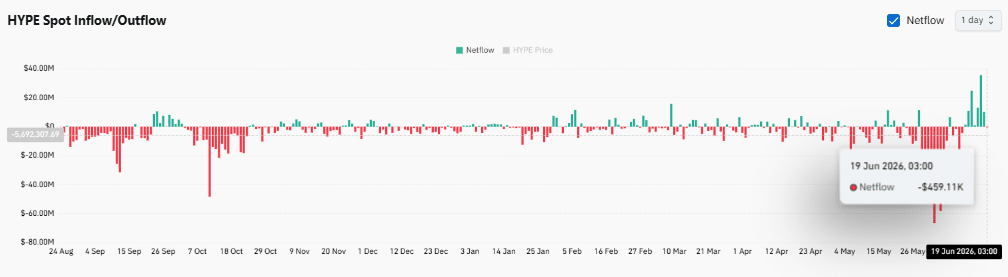
Exchange withdrawal activity remained dominant as spot netflows stayed negative. 

Data from the spot inflow and outflow chart showed a netflow reading of negative $459.11K on the 19th of June, indicating that outflows exceeded inflows during the session. That trend aligned with the whale transactions observed on-chain. 

Rather than moving tokens toward exchanges, market participants removed more HYPE from trading venues. As a result, exchange-held supply declined while private wallet balances increased. 

Recent sessions also recorded several negative netflow readings before a brief recovery, suggesting that the broader withdrawal trend remained intact. 

While netflows alone did not determine future price direction, persistent exchange outflows reflected lower immediate selling pressure because fewer tokens remained available for trading.

Source: CoinGlass

Bulls absorbed the largest losses

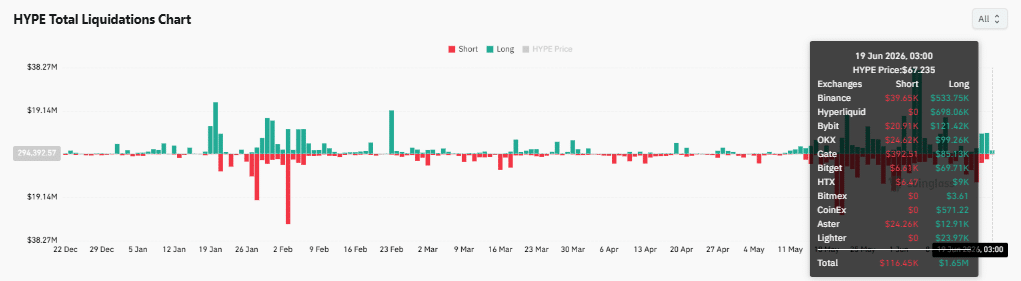
Liquidation data revealed that bullish traders endured the majority of losses during HYPE’s recent retracement. Total long liquidations reached approximately $1.65 million on the 19th of June, while short liquidations stood near $116.45K.

The imbalance suggested that many leveraged traders entered positions during the rally toward resistance and later faced forced closures as the market pulled back. 

Exchange-specific data supported that trend. Hyperliquid recorded roughly $698.06K in long liquidations, while Binance registered about $533.75K. Several other exchanges also reported elevated long-side losses.

Despite the heavy liquidation activity, bearish traders did not gain a decisive advantage because short liquidations remained relatively limited. Instead, the data pointed to a leverage reset that removed aggressive long exposure from the market. 

Such conditions could create a healthier market structure if demand returns after excess leverage leaves the system.

Source: CoinGlass

Can HYPE reclaim $75 next?

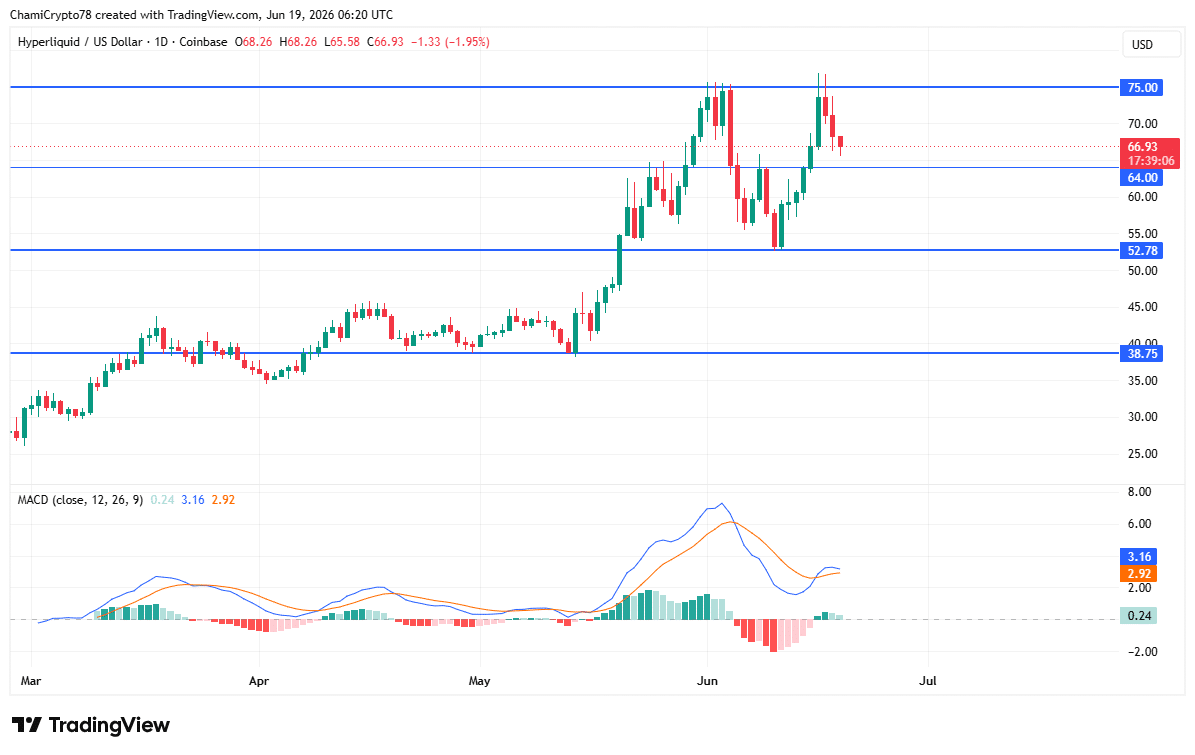
Price action remained constructive despite the decline from resistance near $75. 

HYPE defended the $64 support zone and traded around $66.93 at the time of analysis, preserving a higher-low structure on the daily chart.

The MACD also reflected improving conditions. The MACD line remained above the signal line, posting readings of 3.16 and 2.92, respectively. 

In addition, the histogram stayed in positive territory, indicating that bullish strength had not fully disappeared despite the recent pullback. 

Earlier in June, HYPE rebounded from the $52.78 support area before advancing toward resistance. 

Sellers later emerged around $75 and triggered a correction, yet buyers maintained control of the broader structure by defending key support levels. 

HYPE price actionHYPE price action
Source: TradingView

If buyers continue protecting the $64 zone, HYPE could challenge the $75 resistance area again. 

However, if sellers push the token below support, HYPE could revisit lower demand zones before another recovery attempt develops.


Final Summary

  • Whale purchases and exchange outflows reduced available HYPE trading supply.
  • Long liquidations surged, yet buyers continued defending the $64 support.


Source link

GoMining challenges Jack Dorsey’s Square with a pure BTC payment rail

0
GoMining challenges Jack Dorsey's Square with a pure BTC payment rail

Bitcoin mining company GoMining said it is making it easier for companies to accept bitcoin payments, bringing it into competition with companies including Block’s (XYZ) Square.

Where GoMining says it differs from incumbents is that the entire transaction is completed in bitcoin. Many competitors, including Square, allow customers to pay in bitcoin while delivering fiat currency to the retailer. GoMining retailers who want fiat will need to handle the conversion themselves.

“Our idea isn’t to squeeze bitcoin into the old fiat experience and lose what makes it bitcoin along the way,” CEO Mark Zalan said in an interview over Telegram. “It’s to solve the real problems with BTC payments the high and variable fees, the slow and unpredictable settlement, while preserving non-custody and onchain finality.”

GoMining’s software development kit (SDK) and application programming interfaces (API) for its BTC payment protocol GoBTC Pay, unveiled Friday, enable retailers to access its GoBTC Pay system. The company plans to recruit an initial 10 merchants as part of the rollout, it said.


Source link