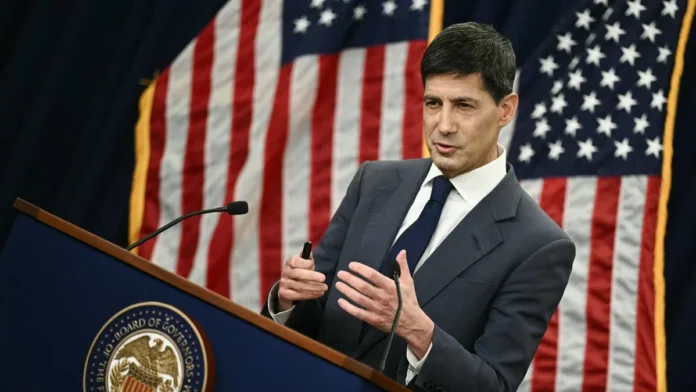
The Federal Reserve under Kevin Warsh‘s one-month leadership as Chair isn’t providing the highly anticipated lower interest rates that consumers, businesses and investors initially expected earlier this year to cut short-term borrowing costs.
It is, however, bringing an intense commitment to a “regime change” that reflects the 56-year-old lawyer’s pledge to reform the world’s largest and most influential central bank with fewer words and more real-time data.
That includes the creation of not one, but five blue-ribbon task forces of “outside consultants” that will study Fed processes in an attempt to create a modern framework for monetary policy that mirrors the best practices of global financial and business leaders.
The task forces will work with Fed officials and staff to consider a full range of topics “worthy of a fresh look” and will provide recommendations by the end of the year, Warsh said.
WEBs Investments CEO Ben Fulton described Warsh’s remarks – made June 17 in a press conference after the Federal Open Market Committee voted to hold rates steady – as “concise, confident, and reflective of strong leadership.”
Rather than focusing primarily on monetary policy, Warsh’s comments emphasized the governance, structure, and future direction of the Fed, Fulton told TheStreet in an email.
“The announcement of five committees tasked with reviewing both the current state and long-term future of the Fed demonstrated an intent to reshape the institution and redefine its role,” Fulton said.
Warsh ushers in new era of change at the Fed
SimCorp Managing Director of Investment Decision Research Melissa Brown said Warsh’s changes show “that the Fed’s operational flexibility is hurt” if it provides strong signals about future interest rates even though markets tend to prefer more certainty.
“A lot could potentially change with how the Fed conducts its business, especially with the introduction of task forces to study most aspects of what it does,” Brown told TheStreet in an email.
“I was also happy to hear him reiterate the Fed’s commitment to fight inflation when there has been some chatter about whether he would be more likely to lower rates to appease the administration,” Brown added.
Fed’s dual mandate requires a tricky balance
The Fed’s dual mandate from Congress requires maximum employment and stable prices.
Lower interest rates support hiring but can fuel inflation. This risks fueling further inflation, potentially leading to an inflationary spiral.
Higher rates cool prices but can weaken the job market. This increases the cost of borrowing and further stifles economic activity.
Historically, the U.S. central bank has favored stable jobs over higher prices.
But not right now.
Warsh repeatedly referred to “price stability” during his comments, and highlighted how the central bank’s policies have missed its 2% inflation target for the last five years.
“We will deliver price stability,” he said.
Fed keeps interest rates steady in 12-0 vote
Driven by sticky inflation fueled by energy shocks from the Iran War, the FOMC voted 12-0 to hold rates steady. It was the first time since June 2025 that the policymaking committee unanimously agreed.
The FOMC last held the benchmark Federal Funds Rate steady at 3.50%-3.75% at its April 30 meeting.
Policymakers had cut rates by 25 basis points at its last three meetings of 2025 to shore up the softening labor market.
These “insurance” cuts stopped after the majority of policymakers decided the risk from higher prices was outweighing signs that the jobs market was stabilizing.
Warsh said the committee thought that jobs data has been moving in a good direction.
‘”What I heard was that strong, productivity-led growth is not something that we fear, but something we embrace,” he said.
Fed cuts forward guidance in FOMC statement
A terse 132-word post-meeting statement was dramatically shorter than the April 29 release and others from previous Chairs.
It also didn’t offer indications of how the committee was looking at the short-term policy moves.
The quarterly Summary of Economic Projections (SEP) and “dot plot” also changed sharply in June. In March, 12 of 19 officials expected to cut interest-rates at least once in 2026. No one expected rate hikes.
The June projections: nine of the 19 expect at least one 25 basis-point rate increase this year, eight expect no change and only one forecast a cut.
Nomura Asset Management International CIO Greg Gizzi said that the June SEP had a definite hawkish tilt, which Warsh tamped down, “characterizing them as merely estimations of where members believe conditions might evolve.”
“He emphasized that no committee member feels bound by their projections, quipping that all submissions ‘were coming in with pencils – those kind with big erasers,”’ Gizzi told TheStreet in an email.
‘Dot plot’ impacts interest-rate bets
The March FOMC ‘dot plot’ hit in the early stages of the Iran War when many Fed watchers expected a short conflict and quick flip in higher crude oil prices. It showed inflation at 2.7% at the year’s end.
The June FOMC projections forecast inflation to be at 3.6% at the end of 2026.
“Despite the recent pullback in oil, half of the members of the FOMC expect rate hikes as soon as this year, reflecting strong labor market and inflation data,” Goldman Sachs Asset Management’s Kay Haigh told Bloomberg.
“Our base case remains that the Fed can just about avoid hikes, but the path is narrow and there will be a high premium on the incoming inflation data,” she added.
Bloomberg Economics’ Anna Wong said the new projections mean Warsh “could play a key role in influencing the direction of rates,” adding “We no longer expect the FOMC to cut rates by 25 basis points later this year.”
The big news coming from Warsh was the creation of five task forces made up of participants “inside and outside economics” to study:
Communication tools including the afore-mentioned post-meeting press conferences and “dot plots.”
The Fed’s $6.7 trillion balance sheet made up of government debt and mortgage-back securities.
Existing data sources.
How the Fed thinks about jobs and productivity, including the use of AI.
The models and other measures that the Fed uses for inflation.
Warsh said the timelines for recommendations will depend on the individual task forces and the urgency of the answers needed. He noted he was “still recruiting” consultants and expected the work to be finalized by the end of the year.
The task forces’ missions all reflect areas of Fed operations that Warsh has been criticizing since resigning from the Fed Board of Governors in 2011.
The Wealth Alliance CEO and Managing Director Robert Conzo said the Fed’s current communications policy is 20 years old and that implementing AI would provide more enhanced and comprehensive data.
“Which means the Fed will improve data-gathering sources and use real-time information, not ‘echoes of history,’ thereby revising old-fashioned survey methods,” Conzo told TheStreet in an email.
How the Federal Funds Rate affects your wallet
The Federal Funds Rate is the interest rate at which depository institutions lend balances at the Federal Reserve to other depository institutions overnight.
Changes in the funds rate trigger a chain of events that affect:
Other short-term interest rates.
Foreign-exchange rates.
Long-term interest rates.
The amount of money and credit in the economy.
And ultimately, a range of economic variables, including employment, output, and prices of goods and services.
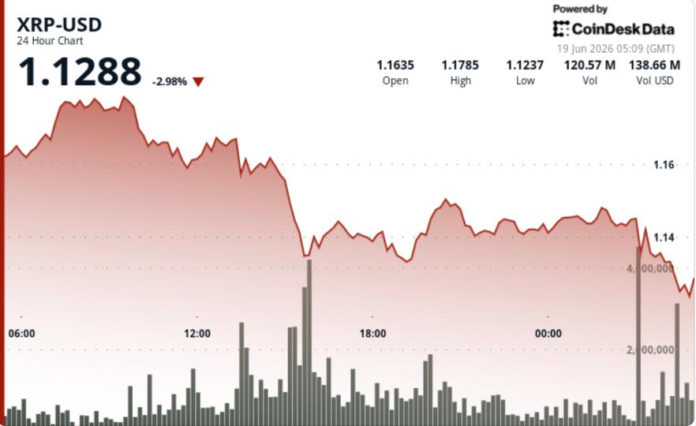
XRP gave back more of last week’s rally on Wednesday after sellers pushed the token through $1.15 support, a level traders had been watching since the recent move above $1.20.
The decline came on some of the session’s heaviest volume and followed another rejection below the descending trendline that has capped every recovery attempt for months.
News Background
• XRP remains caught between growing expectations for U.S. crypto legislation and a market that continues to prioritize technical levels over narrative.
• Traders are also watching the year-long symmetrical triangle that has compressed price action between support near $1.10 and resistance around $1.25.
Price Action Summary
• XRP fell from $1.1873 to $1.1465 during the 24-hour session, losing 3.4%.
• The sharpest selling arrived around 15:00 UTC when volume surged to 134.2 million XRP, roughly 170% above average, breaking support at $1.1550.
• Buyers emerged near $1.13 and helped lift XRP back toward $1.15 into the close, though the rebound failed to reclaim broken support.
Technical Analysis
• The key development was the loss of $1.15. That level had acted as support following last week’s breakout and now risks turning into resistance.
Yum Brands Sheds Pizza Hut for $2.7 Billion – Moby
THE GIST
Our analysts just identified a stock with the potential to be the next Nvidia. Tell us how you invest and we’ll show you why it’s our #1 pick. Tap here.
After 68 years of successes, losses, and a slow long erosion, Pizza Hut is leaving the Yum Brands building. The company is shedding off the chain for $2.7 billion in a split deal, with a private equity firm taking the global business and Yum China absorbing the mainland China operations.
This portends a broader trend: A rude awakening that a mid-century pizza mega-brand cannot operate under the quick-service restaurant (QSR) model anymore.
WHAT HAPPENED
Don’t worry, the Hut isn’t shuttering, at least not yet. But it is being pawned off to the highest bidder: Yum Brands announced a definitive agreement to sell Pizza Hut for $2.7 billion.
The deal splits the chain geographically: private equity firm LongRange Capital will pay roughly $1.5 billion for all Pizza Hut operations outside mainland China, while Yum China Holdings will acquire the China business for approximately $1.2 billion.
There are some financial acrobatics involved in this dealmaking: After taxes, fees and other adjustments, Yum expects net proceeds of approximately $2.3 billion. And that excludes a potential $75 million earn-out from LongRange by 2030. Yum will also absorb one-time separation costs of roughly $85 million during the remainder of 2026. The board simultaneously approved a $4 billion share repurchase authorization, making clear where management sees better returns on capital.
This was a strategic sell-off in the making, as the process began in November of last year. In February, Yum Brands announced it would close 250 Pizza Hut locations in the U.S., and the chain ended last year with 19,974 locations globally. While Yum’s overall global sales grew 5% last year, Pizza Hut’s sales declined 2%.
WHY IT MATTERS
One stock. Nvidia-level potential. 30M+ investors trust Moby to find it first. Get the pick. Tap here.
China is Pizza Hut’s second-largest market, accounting for nearly 20% of sales. Yum China buying that slice is logical: it has operated the China business since spinning off from Yum Brands as an independent company in 2016.
But the sale of Pizza Hut tells a pertinent story. It’s what happens when a legacy brand fails to adapt to platform-era delivery economics and then gets marooned inside a conglomerate with faster-growing alternatives.
Meanwhile, rival Domino’s has been eating Pizza Hut’s lunch for years. Domino’s posted 3.0% U.S. same-store sales growth in fiscal 2025 and gained a full point of market share in the QSR pizza category, while Pizza Hut contracted. Domino’s built its moat through proprietary tech and digital-first ordering: Over 85% of its U.S. retail sales in 2024 came through digital channels. Pizza Hut just couldn’t keep up with the pace.
For Yum shareholders, the news comes as a respite. Freed from a declining asset, the management can redirect capital toward KFC and Taco Bell, both of which are better performing assets. The $4 billion buyback authorization amplifies that signal.
WHAT’S NEXT
Both transactions are expected to close in Q3, pending regulatory approval. Yum management will provide more details in its next earnings call.
But the more interesting question is what LongRange Capital actually does with a 19,000-location pizza chain saddled with legacy costs and a brand that hasn’t meaningfully grown same-store sales in years. It’s either a genuine reinvention of the brand or a simple strip-and-flip.
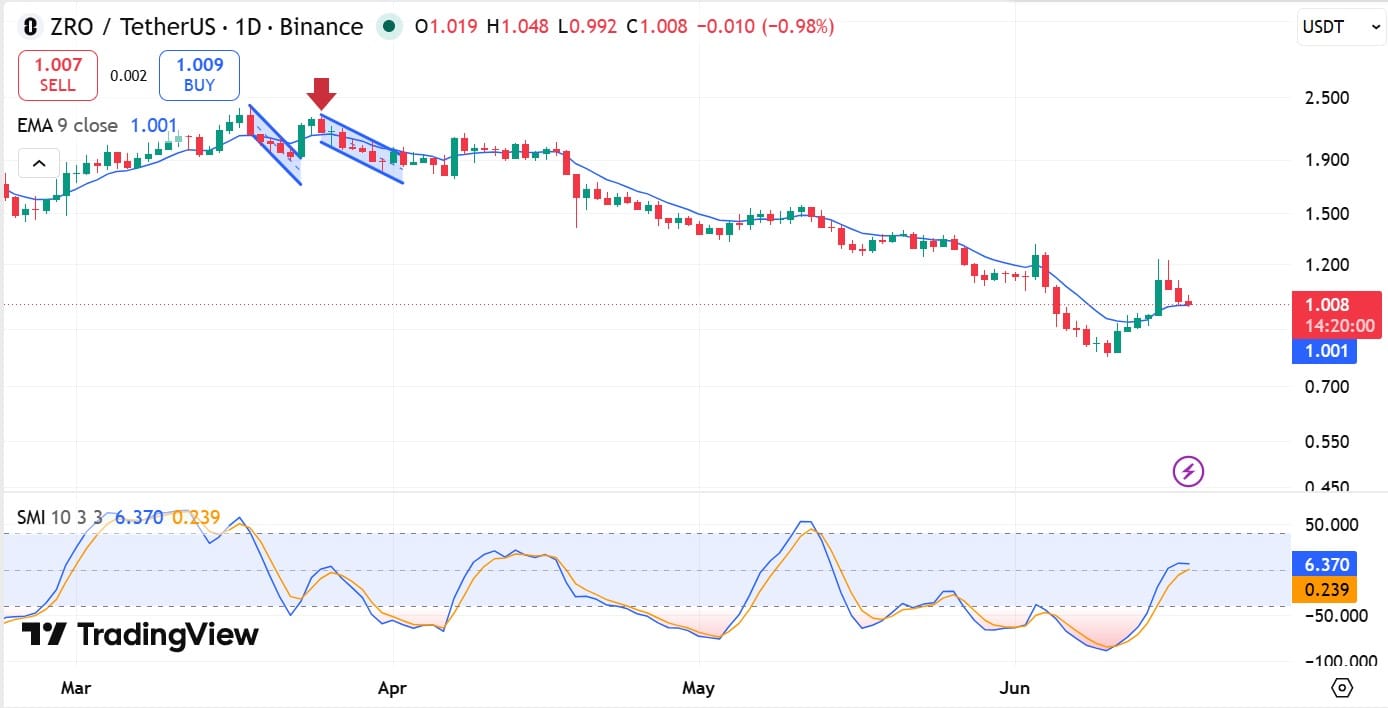
After recovering from the recent hacking crisis, LayerZero [ZRO] reclaimed $1 and jumped to $1.2. However, the altcoin faced rejection at this price level. As a result, ZRO has closed at lower lows for three consecutive days, breaching $1 support to a low of $0.09.
At press time LayerZero traded at $1.007, down 5.7% on the daily charts. Amid this price slip, some investors, especially whales, are choosing to exit positions.
Whale offloads $3.96M in ZRO
With ZRO declining for three consecutive days, a whale has significantly increased spending. Arkam data revealed that the whale has been aggressively selling over the past 24 hours.
In the past day, the wallet transferred 3.51 million ZRO tokens worth $3.96 million to Binance, making the moves in portions. Despite these deposits, the wallet still holds 1.2 million ZRO valued at $1.2 million.
With such a major holder depositing during a period of weakness, it is mostly to lock in gains and also operational expenses. Since the wallet still holds a significant share of holdings, it suggests the holder is yet to fully capitulate.
Source: Santiment
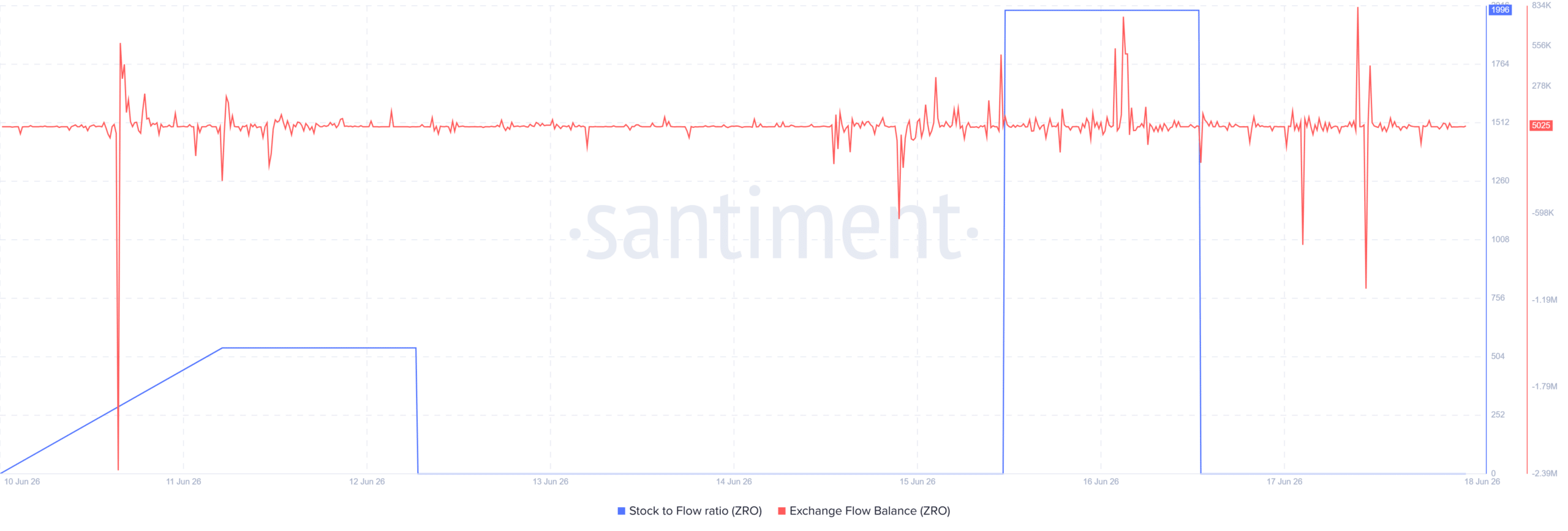
Additionally, other market participants have also been selling as the Exchange Flow Balance remained positive at press time, hovering around 5k. A positive flow balance suggests that more sellers are active than buyers.
With intense sell-side activity, supply has increased significantly, thus reducing scarcity. Often, such market conditions have further weakened the market, leading to a price drop.
Can ZRO bulls hold $1?
The whale selling further exacerbated an already weakened market. In fact, the market lacks strong momentum, with downside risk remaining elevated.
Looking at the Stochastic Momentum Index (SMI), the indicator sat deep within oversold territory at 6 as of writing. The SMI at such low levels suggests that sellers are dominating the market.
Source: TradingView
With bullish pressure remaining minimal, this suggests the prevailing trend is likely to continue. Currently, LayerZero is testing its key support at $1. If the recent selling spree in the market continues, ZRO will lose the $1 support again and drop towards the $0.88 support level.
However, if the $1 support holds, the altcoin will be strong enough for another leg up, rebounding towards $1.3.
Final Summary
An investor wallet transferred 3.51 million ZRO tokens, worth $3.96 million, to Binance.
LayerZero faces intense selling pressure, risking another dip toward $0.88.
For several months each year, smoke from agricultural fires blankets Chiang Mai, a city in northern Thailand. But when Arinjay Jain moved there in 2024, he was too excited about his new life to worry about the haze.
“I landed here in the worst possible time, but I still loved it,” Jain told Business Insider.
A few years ago, he was running a small IT services startup he cofounded in Singapore. At 50, he was done with the grind and retired early to Chiang Mai, where he rents a one-bedroom apartment for about $425 a month.
Over months of reporting, I’ve spoken to retirees who have moved to Chiang Mai. For many of them, the city offered something they felt was increasingly hard to find back home: safety, affordability, and a slower pace of life.
Thailand’s long-stay visa options have long attracted overseas retirees. In 2025, Thai civil registration data recorded just under a million registered foreign residents, though the true number is likely higher.
Exact figures for retirees in Thailand are hard to pin down. However, at least 7,178 Americans in Thailand were receiving Social Security benefits as of December 2024, according to the most recent US government data.
Chiang Mai, which has an international airport, accounts for a sizable share of that population, with about 161,000 registered foreign residents in the province in 2025, out of 1.8 million residents.
Every time Amanda publishes a story, you’ll get an alert straight to your inbox!
Stay connected to Amanda and get more of their work as it publishes.
There, a bowl of noodles from a street food stall or a latte from a café can cost around 75 Thai baht, or about $2.50.
The city also has a robust healthcare system, including English-speaking private hospitals and senior facilities that cater to international residents for much less than they would spend in the West.
Perhaps the biggest draw of living in Chiang Mai is the freedom retirees say they have gained over how they spend their time.
The Thai concept of “sabai sabai” — living in a relaxed, unhurried way — is something many told me they’ve come to embrace.
Below, you’ll find interviews with people who chose to retire in northern Thailand, from a couple who moved into a care home in their 70s to former Disney Imagineers who set out to build a more creative life abroad.
Bitcoin BTC$62,616.73 and the Dollar Index (DXY) are moving in opposite directions, with the latter on the verge of a major move that may embolden crypto bears.
The largest cryptocurrency is under pressure for a third straight day, trading near $63,900 and down nearly 1% since midnight UTC. The broader market is mostly showing similar losses, with the exception of a few tokens such as HASH, XLM and ENA, which gained 7% or more.
The Dollar Index, which tracks the U.S. currency’s value against major fiat currencies, has gained 0.26% to 100.66, extending Wednesday’s 0.8% rise. What’s notable is that the index is now on the verge of firmly breaking out of a 13-month-long trading range.
This type of setup usually leads to more momentum chasing by traders, resulting in further gains. Strength in the greenback typically weighs on dollar-denominated assets such as bitcoin.
BTC has historically tended to move in the opposite direction to the dollar. Its 90-day correlation coefficient with the DXY was recently minus 0.82.
June 17 (Reuters) – A top Huawei executive’s admission that the Chinese telecom company illegally conducted business in Iran can be used in the upcoming U.S. trial against Huawei, according to a judge’s ruling filed in Brooklyn federal court on Tuesday.
Chief Financial Officer Meng Wanzhou made the admission as part of a 2021 deal to dismiss the criminal charges she faced in the case. In a four-page statement of facts, Meng acknowledged lying to a financial institution about Huawei’s compliance with sanctions and export control law.
“Meng was — and is still — Huawei Tech’s CFO,” U.S. District Judge Ann Donnelly wrote in ruling that the statement was admissible at trial. “Huawei Tech should not be able to object that admitting the statement of its senior executive about her conduct in connection with her job — which Huawei Tech adopted — violates Huawei Tech’s rights.”
Donnelly rejected Huawei’s argument that prosecutors could not use Meng’s admission against it because the company was entitled to remain silent despite her statement. The judge also said it was unnecessary for Huawei to question her at trial.
A Huawei spokesperson did not immediately respond to a request for comment.
MENG ARRESTED IN 2018, ANGERING CHINA
Meng, whose father Ren Zhengfei founded Huawei, made worldwide headlines in 2018 when she was arrested on a U.S. warrant after landing in Vancouver, straining both U.S.-China and China-Canada relations.
The warrant was filed after a sealed indictment accused her and the company of bank fraud for misleading HSBC and other banks about Huawei’s business in Iran.
Meng spent nearly three years under house arrest in a six-bedroom, multi-million-dollar Canadian home as she fought extradition to the U.S.
In an unusual resolution during the pandemic, she was allowed to appear in court remotely from Vancouver in September 2021 to enter into a deferred prosecution agreement before flying to China for a hero’s welcome. The agreement called for the charges to later be dropped.
Shortly after Meng was freed, China released two Canadians it had been holding, and two American siblings who had been prevented from leaving the country were allowed to fly home.
The case against Huawei has plodded on. In addition to the original charges for misleading banks, a superseding indictment accused the company of stealing trade secrets and other crimes.
Since 2019, the U.S. has restricted Huawei’s access to U.S. technology, accusing the company of activities contrary to U.S. national security, which Huawei denies.