Home Blog Page 332

US homebuilder sentiment falls in June amid rising costs

0
US homebuilder sentiment falls in June amid rising costs


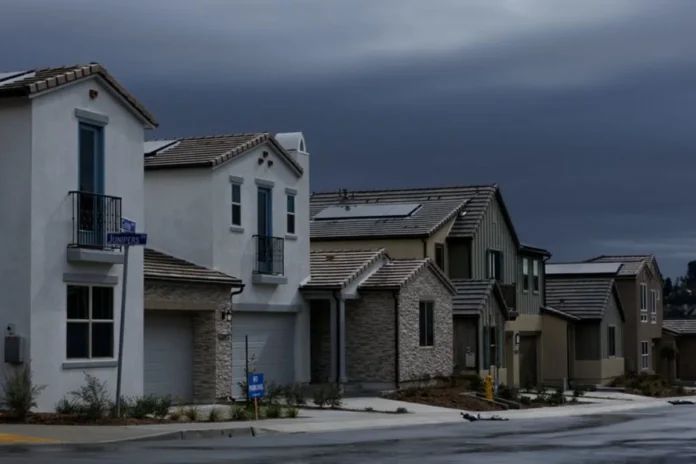
WASHINGTON, June 15 (Reuters) – U.S. homebuilder sentiment fell in June, weighed down by higher mortgage rates and costs for construction materials, a survey showed ‌on Monday.

The National Association of Home Builders/Wells Fargo Housing Market index dropped ‌two points to 35 this month. It was the 14th straight month that the index remained below ​40, the longest such stretch since the 2011-2012 foreclosure crisis.

Economists polled by Reuters had forecast the index staying steady at 37. The NAHB said rising material costs, elevated mortgage rates and ongoing affordability challenges continued to strain the housing market.

Mortgage rates have risen as ‌the U.S.-Israel war on Iran ⁠drove up oil prices, boosting inflation and Treasury yields.

“With the nation short about 1.2 million homes, builder sentiment will remain soft until ⁠barriers are eased and conditions improve for home building,” said NAHB chairman Bill Owens. “Congress can help by passing the major housing package now before the Senate.”

The rate on the popular ​30-year fixed-mortgage ​has risen more than 50 basis points ​since the conflict started at the ‌end of February, data from mortgage finance agency Freddie Mac showed. Washington and Tehran on Sunday said they had agreed terms to end the war and reopen the Strait of Hormuz.

Prior to the war, the housing market was under pressure from import tariffs, which raised prices of building materials as well as appliances. Residential investment, which ‌includes homebuilding, has contracted for five straight quarters.

Weak ​demand is forcing builders to offer incentives, including reducing ​prices to move inventory. The ​share of builders reporting cutting prices increased to 35% from 32% ‌in May. The average price reduction was ​unchanged at 6%.

The use ​of sales incentives rose to 62% from 61% in May, marking the 15th consecutive month this share has reached 60% or higher. The survey’s measure ​of current sales conditions fell ‌two points to 38, while its gauge of future sales was steady ​at 45%. A measure of prospective buyer traffic was unchanged at 25.

(Reporting ​by Lucia Mutikani; Editing by Chizu Nomiyama )


Source link

Strategy’s investors are may be rotating out of its preferred stock for another crypto rival

0
Saylor blamed AI for bitcoin crash. Arca has one word for that: Nonsense


Strategy’s (MSTR) dividend-paying preferred stock, STRC, closed at $91.79 on Tuesday, its third-lowest since trading began in July 2025, amid lower bitcoin prices and debt concerns.

The only lower closes occurred during two sessions later that month, when STRC fell to as low as $88.60. The security was initially priced at approximately $90 in its debut.

STRC was designed to trade as close as possible to its $100 par value. However, it has remained below that level for an extended period and has not traded at $100 since May 15, last month’s ex-dividend date.

Historically, STRC would trade near its $100 par value ahead of the ex-dividend date, the cutoff after which new buyers are no longer entitled to the upcoming dividend. Once the stock went ex-dividend, it often declined by roughly the value of the dividend before gradually recovering toward par, but on June 15, STRC never reached par.

Several factors appear to be contributing to STRC’s persistent weakness.

First, the security has historically traded in tandem with bitcoin, and bitcoin remains under pressure, hovering around $65,000 and roughly 50% below its October all-time high.


Source link

Injective breaks above $5.76 on recovery volume – Can INJ clear $6.06?

0
Injective breaks above $5.76 on recovery volume - Can INJ clear $6.06?


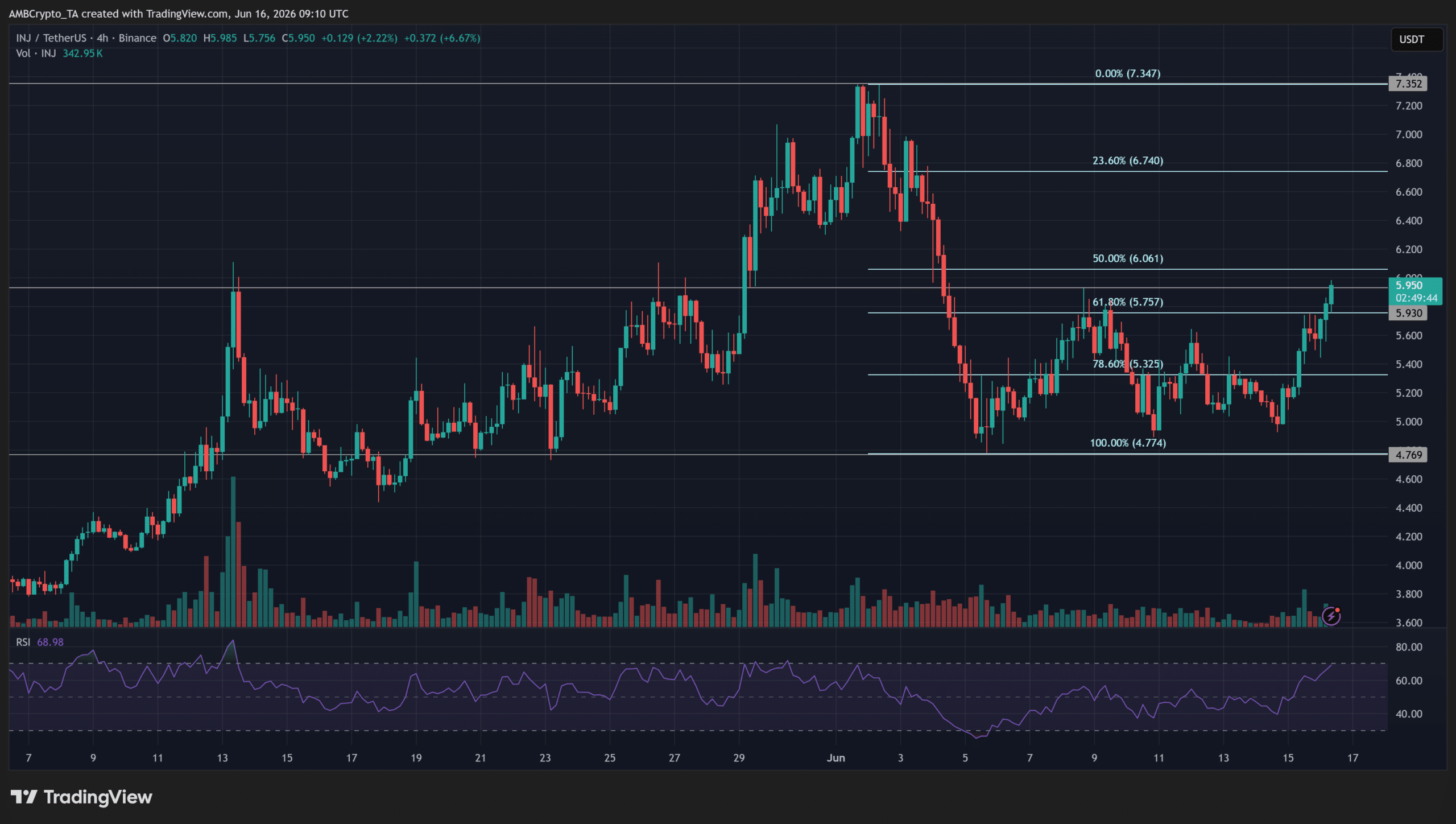
Injective [INJ] surged 12.89% in 24 hours to $5.93, breaking out of a week-long consolidation as momentum and trading activity accelerated sharply.

For most of the past week, INJ remained trapped between the 78.6% Fibonacci support at $5.32 and the 61.8% level at $5.76. That range formed after a sharp correction erased the entire rally from $4.77 to $7.35, producing a near-perfect 100% retracement.

Earlier in the decline, the $5.76 (61.80%) golden pocket failed as support and repeatedly rejected recovery attempts, turning it into the market’s key battleground.

However, that picture has started to change. INJ has now broken above $5.76 and climbed to roughly $5.95, its highest level in ten days.

Source: INJ/USDT on TradingView

This development is notable since AMBCrypto had previously identified the post-Vulcan decline as a “sell the news” correction rather than a structural trend breakdown. More importantly, volume has surged to 342.95K, the strongest reading since the correction began.

That suggests buyers are absorbing supply more aggressively than during previous rebounds. Meanwhile, RSI has climbed to 68.98, its highest level since the June peak.

This signals strengthening momentum, yet it also places INJ near a zone that previously preceded pullbacks. The next test sits at the 50% Fibonacci level near $6.06. A break above that level would strengthen the recovery momentum and expose $6.74.

However, failure to hold above $5.76 would suggest the breakout lacks conviction, shifting attention back toward $5.32 and potentially the $4.77 low.

What’s next for INJ?

Attention is now shifting toward the $6.00-$6.06 zone, where the late-May rally previously paused before accelerating higher. That history suggests trapped holders may reintroduce supply as price approaches resistance.

Meanwhile, RSI has climbed to 68.98, nearing levels that preceded reversals during earlier advances. However, this recovery follows a full retracement to $4.77 and a prolonged consolidation phase, creating a different backdrop.

Volume remains the key signal. Sustained strength above $6.06 would indicate demand is absorbing supply. Otherwise, failure to hold $5.76 could return INJ to consolidation.


Final Summary

  • Injective reclaimed the critical $5.76 level on its strongest recovery volume, shifting focus toward resistance at $6.06.
  • INJ recovery remains constructive, though sustained demand is needed to prevent a return to consolidation.


Source link

Legendary trader says investors are watching the wrong Fed lever: Chart of the Day

0
Legendary trader says investors are watching the wrong Fed lever: Chart of the Day


The AI rally has turned semiconductors and megacap tech into the market’s pressure point — and legendary trader Victor Sperandeo said investors may be watching the wrong Fed lever.

Sperandeo, the Market Wizard and veteran options market trader known as “Trader Vic,” said investors are too focused on whether the Federal Reserve cuts the fed funds rate — the overnight borrowing rate that anchors short-term money — and not focused enough on what happens to the Fed’s balance sheet, the pile of assets the central bank holds.

His point is simple: Lower rates can make money cheaper. They do not necessarily make money easier to get.

That matters most where the market is most crowded. Right now, that is AI — chip stocks, data center plays, and the megacap tech names that have pulled in much of the market’s capital.

“Lowering rates if you reduce the money supply does not produce inflation,” Sperandeo told Yahoo Finance at the June ETP Forum hosted by ETFGlobal. “Now he’s got to convince the other members of this.”

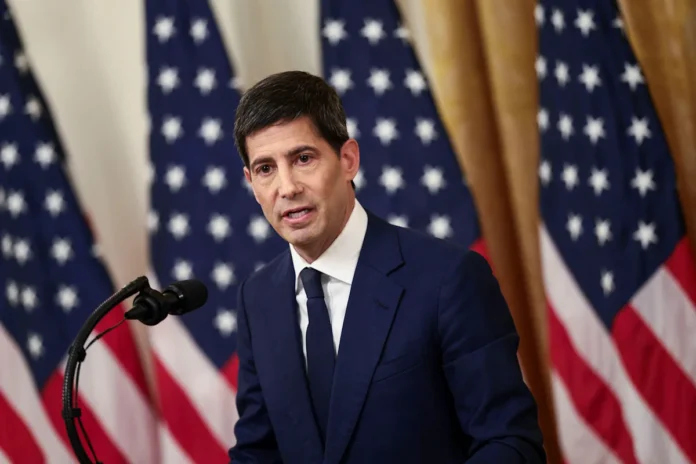
The “he” is incoming Fed Chair Kevin Warsh, who Sperandeo believes would favor lower rates while also shrinking the Fed’s balance sheet. Sperandeo’s timing is conditional. He said the market could top around the Fed’s June meeting if Warsh convinces policymakers to pair “a small cut” with a “reduction of the balance sheet.”

Markets are not pricing in a June cut, but Sperandeo’s broader warning is about what investors count as easing.

Rate cuts are the price lever. The balance sheet is the liquidity lever — and that is the part of monetary policy Sperandeo thinks markets routinely underprice.

One changes what short-term money costs. The other changes how much liquidity the Fed is adding to — or draining from — the financial system · Federal Reserve

If the Fed lowers rates while shrinking its balance sheet, money can be cheaper on the surface while liquidity still tightens underneath.

Sperandeo learned that lesson as an options market maker during the Fed’s Volcker era. As the Fed squeezed money growth, he got a margin call from Chemical Bank.

“Chemical said, look, we want the money back,” Sperandeo said. “So I had to liquidate a bulk of my inventory, about 80% of my inventory, which meant that spreads widened because I had less of stuff to offer at better prices.”

In plain English, when Chemical wanted its money back, Sperandeo had to sell inventory, and the market he traded became less liquid. Scale that across markets, and tighter credit can force investors to cut risk even if rates are falling — or merely holding steady.

That is the underappreciated risk in today’s AI trade: Crowded trades become harder to hold when liquidity thins out.


Source link

Filling up your car won’t feel normal until next summer, S&P says

0
Filling up your car won’t feel normal until next summer, S&P says

The war in the Middle East might be drawing to a close, but one of the largest energy disruptions in history still needs some time to iron out the kinks.

On Sunday, the U.S. and Iran announced a memorandum of understanding to end their conflict that has been waged on and off since February. The tentative deal—scheduled to be formally signed Friday—includes a provision to reopen the Strait of Hormuz, allowing Middle East-produced oil and natural gas to ship around the world again. 

But energy analysts warn that physical energy markets could remain tight well into next year. The strait has been effectively closed to commercial traffic for months, sparking what the International Energy Agency has called the largest oil market disruption in history. Repairing those cracks and resupplying global stocks will likely take more time and effort than signing a deal.

In a research brief published Monday, analysts at S&P Global wrote that while the deal eases long-term oil supply concerns, normalization of flows is likely to take until the summer of 2027, with physical crude markets expected to remain tight throughout this summer. Supply losses are expected to exceed 1.5 billion barrels by the end of June, according to S&P.

When announcing the framework deal, President Donald Trump wrote in a social media post that the strait would reopen “toll-free” and that the U.S. would lift its naval blockade on Iranian ports. But despite the announcement, traffic has remained subdued so far as details of the deal emerge. A BBC analysis, published Tuesday, found only seven vessels had transited the strait since the deal was announced, while nearly 600 tankers and cargo ships remained mostly idle in the Persian Gulf. 

It might take time for ships to feel confident they can safely traverse the strait. “Sailing through the strait will remain riskier and more costly than before the war,” researchers at Oxford Economics wrote in a research note published Monday. “Physical flows are still likely to recover gradually rather than immediately, even if prices respond more quickly to signs that a credible reopening deal is in place.”

The researchers wrote that shipping headaches, high insurance costs, and operational caution are likely to be the main constraints moving forward, even if oil production capacity swiftly returns to pre-war levels.

Obstacles remain on the supply side, too. In a note published May 29, analysts at energy consultancy Wood Mackenzie laid out the reasons why even in a best-case scenario, production will take time to normalize. An immediate reopening of the strait, they wrote, would see oil fields return to 70% of prior production within three months and to 90% within six months. The final tranche—worth roughly 1 million barrels of production per day—will take considerably longer, however, largely due to infrastructural repairs.

Among the primary Gulf exporters, Saudi Arabia and the United Arab Emirates are expected to recover at the faster end of the range, given their high-quality reservoirs and infrastructure, as well as existing export pipeline capacity that can bypass the strait. Countries with more outdated infrastructure, such as Iraq, are expected to recover more slowly.

Other research has come to a similar conclusion: The bulk of operational capacity might recover in the coming months, assuming future flare-ups are avoided, though a full return to pre-war production levels will likely take longer. Capital Economics estimated on Monday that around 80% of energy flows could resume by the third quarter of 2026, but a “return to ‘normal’” won’t happen until 2027.


Source link

Bitcoin miners’ AI pivot faces $50 billion reality check, says VanEck

0
Bitcoin miners' AI pivot faces $50 billion reality check, says VanEck

The report comes amid a dramatic shift in the bitcoin mining industry. Following the collapse in mining profitability after the 2024 halving, many operators began repurposing their power infrastructure to support AI workloads, betting that technology companies would pay significantly more for electricity and data center capacity than bitcoin miners.

Core Scientific (CORZ) signed a multibillion-dollar hosting agreement with AI startup CoreWeave, helping transform the company from a bitcoin miner into an AI infrastructure provider. TeraWulf (WULF), Hut 8 (HUT), Iren (IREN), and Cipher Mining (CIFR) have all announced plans to lease power and data center capacity to AI and high-performance computing customers, while Marathon Digital (MARA), Riot Platforms (RIOT) and CleanSpark (CLSK) are pursuing hybrid strategies that maintain bitcoin mining operations while exploring AI opportunities.

While bitcoin (down about 24% since January), along with other big public crypto names, have lost significant value so far this year as crypto prices continue to slide amid shifting investor focus to AI, bitcoin miners have seen largely green candles across the sector. RIOT is up nearly 94% year-to-date, while CIFR is 62% higher. Others are showing similar gains over the same period.

The fresh narrative has helped drive some of the biggest stock moves in the crypto sector over the past year, and investors have rewarded many of these companies with valuations that increasingly reflect their AI potential rather than their mining businesses.


Source link

Is Vail Resorts (MTN) an Attractively Valued Stock?

0
Is Vail Resorts (MTN) an Attractively Valued Stock?


Baron Capital, an investment management company, released its Q4 2025 letter for its “Baron Real Estate Fund”. A copy of the letter is available to download here. Baron Real Estate Fund was recognized as the Best Real Estate Fund Over Three Years at the 2026 LSEG Lipper Funds Awards, reflecting the three-year performance ending December 31, 2025. The Fund declined 5.39% (Institutional Shares) in Q1, underperforming the MSCI USA IMI Extended Real Estate Index (−0.96%) and the MSCI US REIT Index (+4.52%). Despite the Q1 decline, the long-term performance remains strong. The letter covers current thoughts, portfolio composition, key themes, top contributors and detractors, recent activity, and outlook for real estate and the Fund. The Fund has a positive outlook on the broader equity market and public real estate, and maintains a constructive outlook with compelling reasons to stay the course. Please review the Fund’s top five holdings to gain insights into their key selections for 2026.

In its first-quarter 2026 investor letter, Baron Real Estate Fund Strategy highlighted stocks such as Vail Resorts, Inc. (NYSE:MTN). Headquartered in Broomfield, Colorado, Vail Resorts, Inc. (NYSE:MTN) is a mountain resort and ski area operator. On June 12, 2026, Vail Resorts, Inc. (NYSE:MTN) closed at $133.31 per share. One-month return of Vail Resorts, Inc. (NYSE:MTN) was 7.75%, and its shares lost 14.21% over the past 52 weeks. Vail Resorts, Inc. (NYSE:MTN) has a market capitalization of $4.75 billion.

Baron Real Estate Fund stated the following regarding Vail Resorts, Inc. (NYSE:MTN) in its Q1 2026 investor letter:

“We believe several travel-related real estate companies are well positioned to benefit from a favorable “trifecta” of cyclical, secular, and 2026-specific tailwinds, which should support strong fundamentals and share price performance in the years ahead.

Vail Resorts, Inc. (NYSE:MTN) is an example of several travel-related companies that are attractively valued. It is trading at just 8.4 times 2027 estimated cash flow for best-in-class, irreplaceable assets – an unprecedentedly attractive valuation – while also offering a seemingly secure 7% dividend yield.”

Morgan Stanley Lowers Vail Resorts (MTN) Price Target, Citing Weak Rockies Conditions

Vail Resorts, Inc. (NYSE:MTN) is not on our list of 40 Most Popular Stocks Among Hedge Funds Heading Into 2026. According to our database, 45 hedge fund portfolios held Vail Resorts, Inc. (NYSE:MTN) at the end of the first quarter, up from 43 in the previous quarter. While we acknowledge the potential of Vail Resorts, Inc. (NYSE:MTN) as an investment, we believe certain AI stocks offer greater upside potential and carry less downside risk. If you’re looking for an extremely undervalued AI stock that also stands to benefit significantly from Trump-era tariffs and the onshoring trend, see our free report on the best short-term AI stock.


Source link