EigenCloud [EIGEN] ranked among the market’s top gainers after climbing 14%, as investor interest in the token continued to build.
The rally appeared supported by fresh capital entering the ecosystem. However, derivatives data suggested conviction behind the move remained mixed.
Why is capital flowing into EigenCloud?
On-chain capital flows helped support EIGEN’s recent price performance.
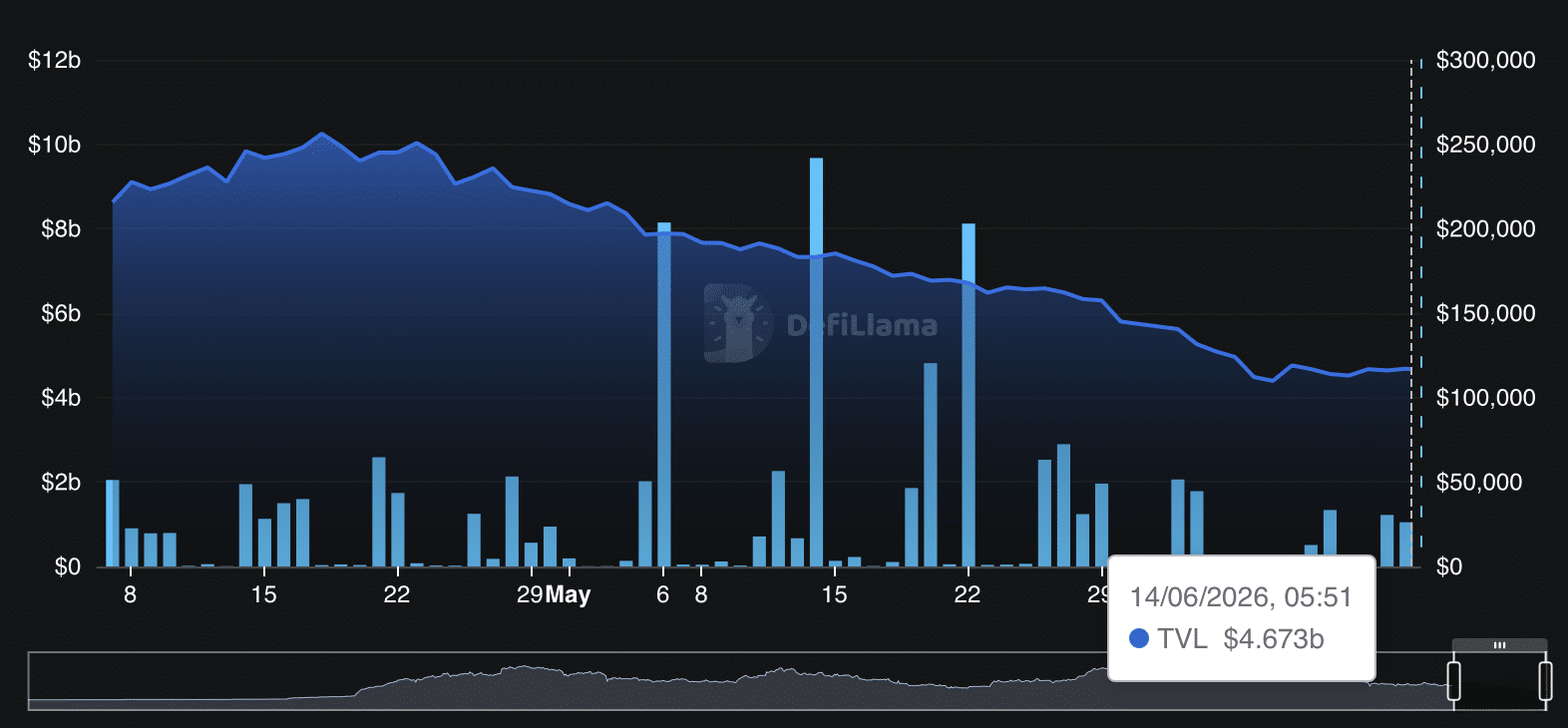
Total Value Locked (TVL), which tracks capital committed to protocols on EigenCloud, increased sharply over the past week.
Source: DeFiLlama
DeFiLlama data showed that TVL rose by $291 million between the 7th of June and the 14th of June, reaching $4.67 billion.
The increase suggested growing investor participation and stronger capital commitment across the network.
Interestingly, the rise came even as the number of EIGEN holders declined over the same period, falling to roughly 223,000 as of press time.
That divergence suggested larger pools of capital entered the ecosystem despite a reduction in holder count.
Are traders still betting on more upside?
Derivatives data also reflected growing interest in EIGEN.
Perpetual market data showed roughly $753,000 in positive Netflow, indicating more capital entered the market than exited it during the observed period. Retail traders on major exchanges appeared increasingly bullish.
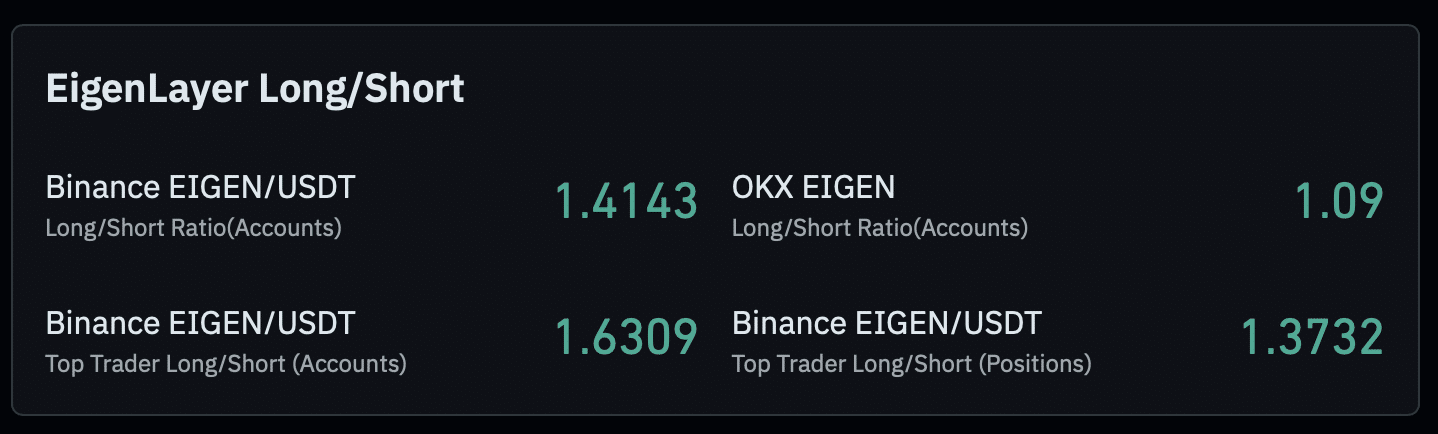
Source: CoinGlass
EIGEN’s Long-to-Short Ratio reached 1.29 on OKX and 1.53 on Binance. Readings above 1 indicated long positions outweighed shorts.
At the same time, total perpetual trading volume climbed to roughly $69 million. That move aligned with growing speculative activity as traders positioned for additional upside.
Sustained buying activity alongside rising price and Open Interest could help support the current trend.
Is the bullish momentum strong enough?
Even so, one metric suggested traders remained cautious.
Funding Rate stayed positive at 0.0024%, indicating long positions continued paying shorts to maintain exposure. The reading showed bullish positioning remained dominant at press time.
However, the margin remained narrow.
Because Funding Rate was only slightly positive, sentiment could shift quickly if buying demand weakened.
That left traders watching whether capital inflows and derivatives demand would remain strong enough to support EIGEN’s latest rally.
Final Summary
EigenCloud’s Total Value Locked rose by $291 million in one week, reaching $4.67 billion.
Positive Netflow suggested fresh capital continued entering the EIGEN market.
The US and Iran said they reached an interim agreement to end hostilities and reopen the Strait of Hormuz, with the deal to be signed in Switzerland on Friday.
The price of bitcoin BTC$65 573,12 has risen to $65,700, up 2% over the past 24 hours, and its highest level since the early June plunge.
The price of WTI crude oil has plunged nearly 5% to just under $81 per barrel, its softest level in about two months.
Nasdaq 100 futures are higher by 1.5% and S&P 500 futures are up 0.9%.
“You’re hitting tank bottom.” That is the phrase one oil industry executive used to describe the state of global petroleum inventories, in a conversation the executive said had already been shared with senior officials in Washington. The same person gave it an unusually specific deadline: mid-to-late June, according to E&E News.
The White House’s response was immediate and direct.
“Politico’s anonymous sources are wrong,” a White House official said, while an Energy Department official added there have been no such discussions about inventory levels, according to E&E News.
Four oil executives told Politico the opposite is true, and at least two of them have now made similar warnings on the record.
Oil inventory data shows the steepest drawdown in decades
The dispute traces back to the Strait of Hormuz, which Iran effectively closed following US and Israeli strikes that began on February 28.
The strait normally carries roughly one-fifth of the world’s oil supply. The inventory drawdown has been underway since the early weeks of the disruption, when the world was already burning through stockpiles at 7.1 million barrels per day.
Worldwide petroleum stocks now hold around 7.5 billion barrels, a decline of approximately 500 million barrels since the conflict began, falling at a rate of roughly 5.8 million barrels per day, according to Jim Burkhard, vice president and global head of crude oil research at S&P Global Energy, cited by E&E News.
Most of that oil already has buyers and is not held in reserve, Burkhard said, and inventories in some regions may be hitting operational minimums.
More Oil and Gas:
On the US side, gasoline inventories fell by 47.5 million barrels between early February and late May, the steepest February-to-May drawdown in EIA weekly data going back to 1990, according to OilPrice.com.
The next-largest February-to-May drawdowns on record were clustered around 30 million barrels, set 15 years ago. US commercial crude stocks separately fell 8 million barrels in the most recent week, the eighth straight weekly decline, leaving stockpiles roughly 3% below their five-year average.
What “tank bottom” means for the strategic reserve
The Strategic Petroleum Reserve has absorbed much of the strain. SPR inventories fell by 9.1 million barrels in a single week and were 36.2 million barrels below year-ago levels, with the recent drawdowns marking the largest weekly SPR withdrawals in history, according to OilPrice.com.
The SPR’s current holdings of roughly 357 million barrels sit well below its maximum capacity of approximately 725 million barrels.
“I’ve never seen inventory numbers fall so much so quickly,” Burkhard said. “It is stunning.” His broader point was that the inventory cushion is the reason prices have not already spiked. “What’s been remarkable is that prices have not moved higher so far, and a big reason for that is the inventory cushion around the world,” Burkhard said. “But that can’t go on forever.”
Exxon and other oil companies are warning about $150 to $160 oil
What separates this warning from typical anonymous-sourcing stories is that the same concern has now been voiced publicly by named executives at major companies.
Exxon Mobil senior vice president Neil Chapman told an investor conference that benchmark Brent crude could reach $150 to $160 per barrel if inventory declines continue, a comment covered when Exxon’s leadership first framed the inventory drawdown not as a forecast but as what the models say happens next once the cushion is exhausted.
“Once you get to that point, then you’ll see prices shoot up,” Chapman said.
“We’re sounding the alarm on these inventories going to record lows,” American Petroleum Institute CEO Mike Sommers said on Fox Business, a program the administration is known to watch closely. “We have to solve this problem in the Strait of Hormuz.”
The warnings extend beyond US oil majors. Frederic Lasserre, head of analysis at commodities trading giant Gunvor Group, said in late April that if the Hormuz closure dragged on for another month, oil markets would effectively run out of stockpiles and hit “tank bottoms,” according to Fortune.
Helima Croft, global head of commodity strategy at RBC Capital Markets, separately described drained storage tanks as an “iceberg under the water” during a Council on Foreign Relations event.
The reason this dispute matters beyond Washington politics is timingMorris/Getty Images
What the national average gas price shows right now
The national average price for a gallon of regular gasoline stood at $4.26 as of Wednesday, $1.28 higher than before the war started, according to AAA data cited by E&E News. That is down from levels closer to $4.50 reached a few weeks earlier, a decline the administration attributes to market optimism around possible negotiations to reopen the strait.
UBS has forecast Brent near triple digits for the rest of 2026, and Citi has warned that Brent could hit $150 per barrel if Hormuz flows remain disrupted into June, a threshold the calendar is now approaching.
The executives’ inventory warning is effectively the mechanism behind those bank forecasts: the price has not yet fully reflected the supply gap because inventories have been absorbing it, and that absorption capacity is what is now running out.
What the public warnings leave out:
The inventory concern is not uniform across fuel types or regions. Some of the private conversations with administration officials have focused specifically on jet fuel shortages on the West Coast, a regional and product-specific squeeze that does not show up in national gasoline averages, according to E&E News.
Total US commercial crude and SPR inventories combined have fallen by around 90 million barrels from their recent peak, including a 16-million-barrel decline in a single week, according to analysis from Saxo Bank cited by Energy News Beat.
This warning lands in the middle of a midterm election cycle in which Democrats have built close to a seven-point lead in voter intentions, meaning gasoline prices are arriving as a political variable on top of an economic one, The Daily Beast reported.
GasBuddy has projected the most expensive summer at the pump in years, forecasting $4.48 around Memorial Day and a $4.80 summer average if the strait closure persists, according to Gas Price Check.
Why summer driving season raises the stakes for oil prices
The reason this dispute matters beyond Washington politics is timing. Peak summer driving season is the period when gasoline demand is highest, and it is arriving at the same moment executives say inventories are at their lowest point of the conflict so far.
If Brent reaches the $150 to $160 range Chapman described, the gap between current pump prices and what the supply math implies would close quickly.
The disagreement between the industry and the White House is not really about whether prices could rise. It is about how much warning the public should be given before they do.
Executives are arguing that the safest message right now is to prepare Americans for higher prices. The administration’s position is that doing so risks becoming a self-fulfilling prophecy.
White House spokesperson Taylor Rogers added a specific prediction in the same statement cited by the Daily Beast, saying gas prices would “drop back to multi-year lows” once the conflict reaches a successful end. Whichever framing proves accurate will likely become clear within the mid-to-late June window both sides are now watching.
The U.S. has reached a peace deal with Iran, both President Donald Trump and Pakistani mediators said Sunday evening, with the president also announcing in a post on Truth Social an end to the U.S. blockade of the Strait of Hormuz, saying “Let the oil flow!”
Trump announced the peace deal in a post on Truth Social.
AFP via Getty Images
Key Facts
Pakistani Prime Minister Shehbaz Sharif, whose country acted as an intermediary between the two sides, announced the deal in a post on social media earlier on Sunday evening, which is set to be signed next Friday in Switzerland.
The deal would declare an immediate end to the conflict on all fronts, Sharif said, including in Lebanon—where Israel struck Hezbollah targets in Beirut just hours earlier.
In Trump’s post on Truth Social, the president promised to remove the naval blockade of Iranian ships in the Strait of Hormuz, before declaring: “Ships of the World, start your engines. Let the oil flow!”
Iranian Deputy Foreign Minister Kazem Gharibabadi confirmed Iran planned to sign the deal next Friday, multipleoutlets reported citing his statements to Iranian state-affiliated media.
Trump and Sharif offered no other immediate details about the contents of the deal, but both Reuters and the New York Times reported the agreement would give both sides another 60 days to address Iran’s nuclear program—something Trump has repeatedly insisted Iran must give up in order for a deal to proceed.
Big Number
$81.30 per barrel. That’s how much U.S. crude oil was trading for in the immediate aftermath of the announcement of the peace deal, with prices falling about 4.2% in the minutes after trading opened.
Contra
Earlier on Sunday, it appeared as if the Israeli strikes on Beirut could upend a possible peace deal. Iran has previously insisted the ceasefire deal with the U.S. must also apply to Israel’s ongoing war with Hezbollah, the Islamist militant group in Lebanon. Continued fighting there has threatened to shatter the fragile truce between the U.S. and Iran multiple times, and Mohammad-Bagher Ghalibaf, Iran’s parliamentary speaker, condemned the most recent attack on Beirut again on Sunday, saying it showed “America either lacks the will or the ability to fulfill its obligations.” In an earlier post on Truth Social, Trump also appeared angry about the Israeli strikes in Lebanon. “This morning’s attack on Beirut should not have happened, particularly on a special day when we are so close to a Peace Deal with Iran,” Trump wrote, calling the Hezbollah attack that prompted the strike “very small and meaningless.”
A significant transformation is currently underway across the established cryptocurrency market. The top crypto exchanges are morphing into multi-asset financial platforms, breaking down the traditional barriers that once kept crypto and Wall Street completely apart.
Crypto exchange OKX rolled out 13 new “X-Perp” markets for European traders on Tuesday, giving retail users direct access to “Magnificent 7” tech stock futures, alongside major commodity indices like gold, silver, and crude oil. The platform also added perpetual markets for major index funds like the SPY and QQQ, enabling users to trade exposure to the largest U.S. equities outside standard market hours.
Exchanges like OKX are deliberately expanding their services to stop cash from leaving their platforms, while catering to everyday traders who now want to bet on more than just crypto.
Centralized exchange trading volumes recently dropped more than 11% to $4.61 trillion, hitting their lowest performance level since late 2024, according to CoinDesk Data’s April 2026 market reviews. “Retail participation across crypto has moderated, but the demand for trading has not disappeared,” said Behrin Naidoo, founder of Neutral DeFi Protocol. Naidoo, an alumnus of London Business School who previously managed global market strategies and fintech investments at J.P. Morgan, PwC, and RMH, told CoinDesk that the problem isn’t a lack of interest, but rather an infrastructure gap.
Bitcoin stabilized around the $60,000–$63,000 range after a sharp selloff earlier this month, while persistent ETF outflows and broader risk-off sentiment continued to weigh on market activity.
However, capital continued rotating toward AI and technology stocks. Despite the weak backdrop, some AI-related tokens outperformed, showing that traders remain willing to chase strong narratives even as the broader market remains cautious.
Weekly winners
Audiera [BEAT] – AI crypto project delivered strong relative performance
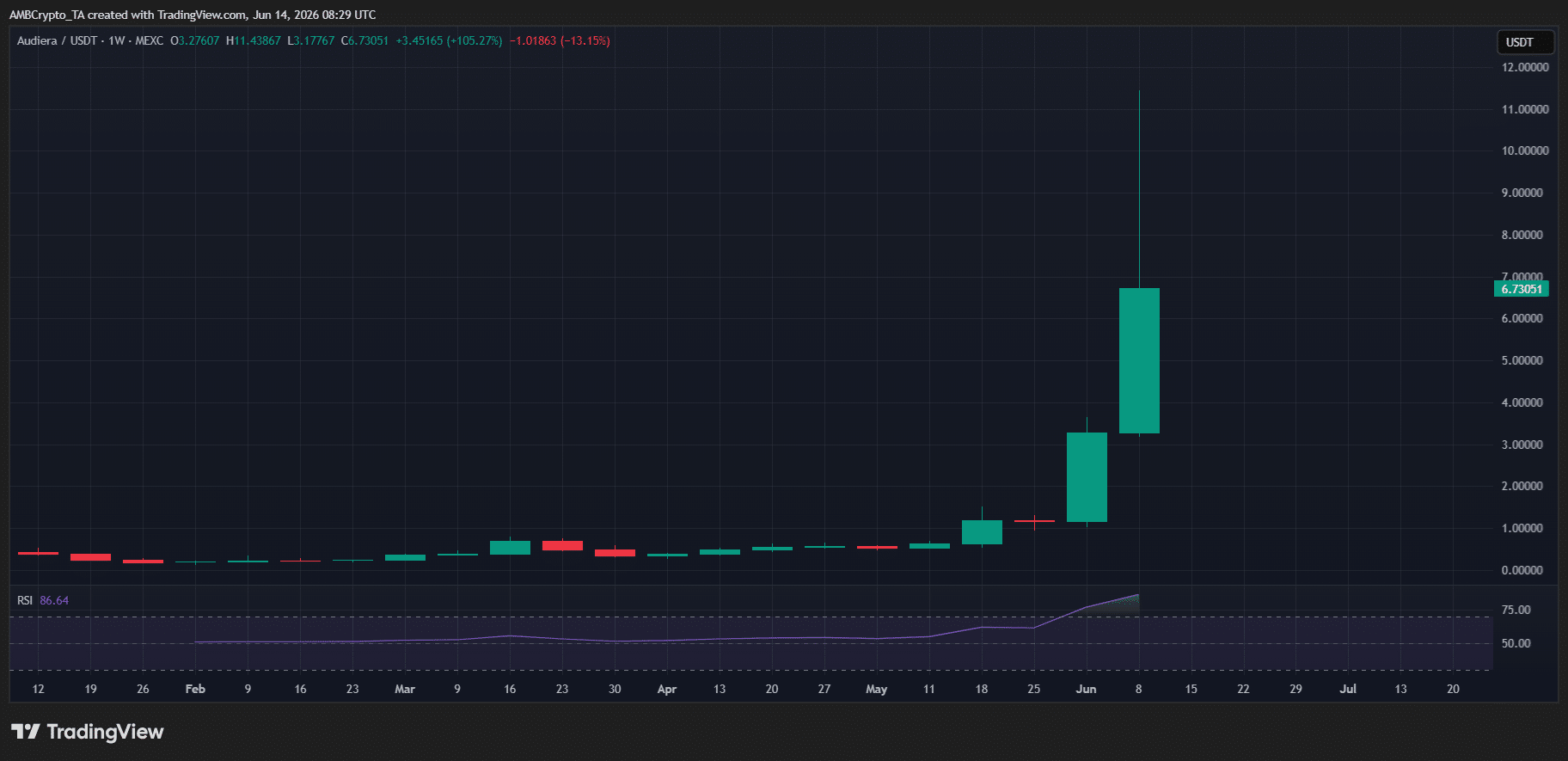
Audiera [BEAT] topped this week with a 106% rally, extending the token’s gains after surging 185% last week. The move was driven by continued buying pressure and strong demand for AI-related tokens.
However, the rally has pushed the RSI above 80, signaling that BEAT is now in overbought territory. While this reflects strong bullish momentum, it also raises the risk of profit-taking in the near term.
Still, as long as BEAT holds above the $6 support level, the broader uptrend remains intact, with the $15 level emerging as the next major target.
Source: TradingView (BEAT/USDT)
From a technical standpoint, BEAT remains in a strong position after breaking into price discovery.
The token continues to hold above key breakout levels, signaling sustained buying pressure despite broader market uncertainty.
As long as bulls defend these levels, the current structure favors further upside. If this momentum persists, BEAT could remain in price discovery mode and extend its rally in the coming week.
Bittensor [TAO] – Decentralized network rose this week but needs to break resistance
Bittensor [TAO] emerged as the second-biggest winner this week, rallying 30%. However, the move appears to be more of a recovery bounce than a confirmed bullish breakout despite TAO reclaiming the $270 level.
Technically, TAO remains below its major resistance zone after trending lower since its March peak near $370.
While buyers have managed to push prices higher this week, the token has yet to break the series of lower highs that has defined the broader downtrend.
As a result, the $290-$350 region remains a key area to watch. A rejection from this zone could see sellers regain control and put lower support levels back under pressure.
Therefore, TAO needs a decisive break above resistance before the recent rally can be viewed as a sustained bullish reversal.
SKYAI [SKYAI] – AI project moved higher this week and is approaching resistance
SKYAI [SKYAI] took the third spot this week with a 25% rally, extending last week’s gains of 30%. The move reflects sustained bid pressure, with bulls continuing to reclaim ground lost during the late-May dip.
Technically, SKYAI remains in a healthy position as momentum indicators are yet to enter overbought territory. This suggests that, despite the recent rally, buyers may still have room to push prices higher before the market becomes overheated.
With the token holding its upward trajectory and momentum remaining constructive, SKYAI appears well-positioned to challenge the next major resistance level. If buying pressure persists, a breakout into the $0.40 zone could be the next step in the ongoing recovery.
Other notable winners
Outside the majors, altcoin movers also stood out this week.
MCOIN (MCOIN) led the action with a 173% surge, followed by SHOW (SHOW), which climbed 149%, while Velvet (VELVET) gained 138%, rounding out the week’s strongest movers.
Weekly losers
Humanity Protocol [H] – Digital identity project staged more than a cooldown rally
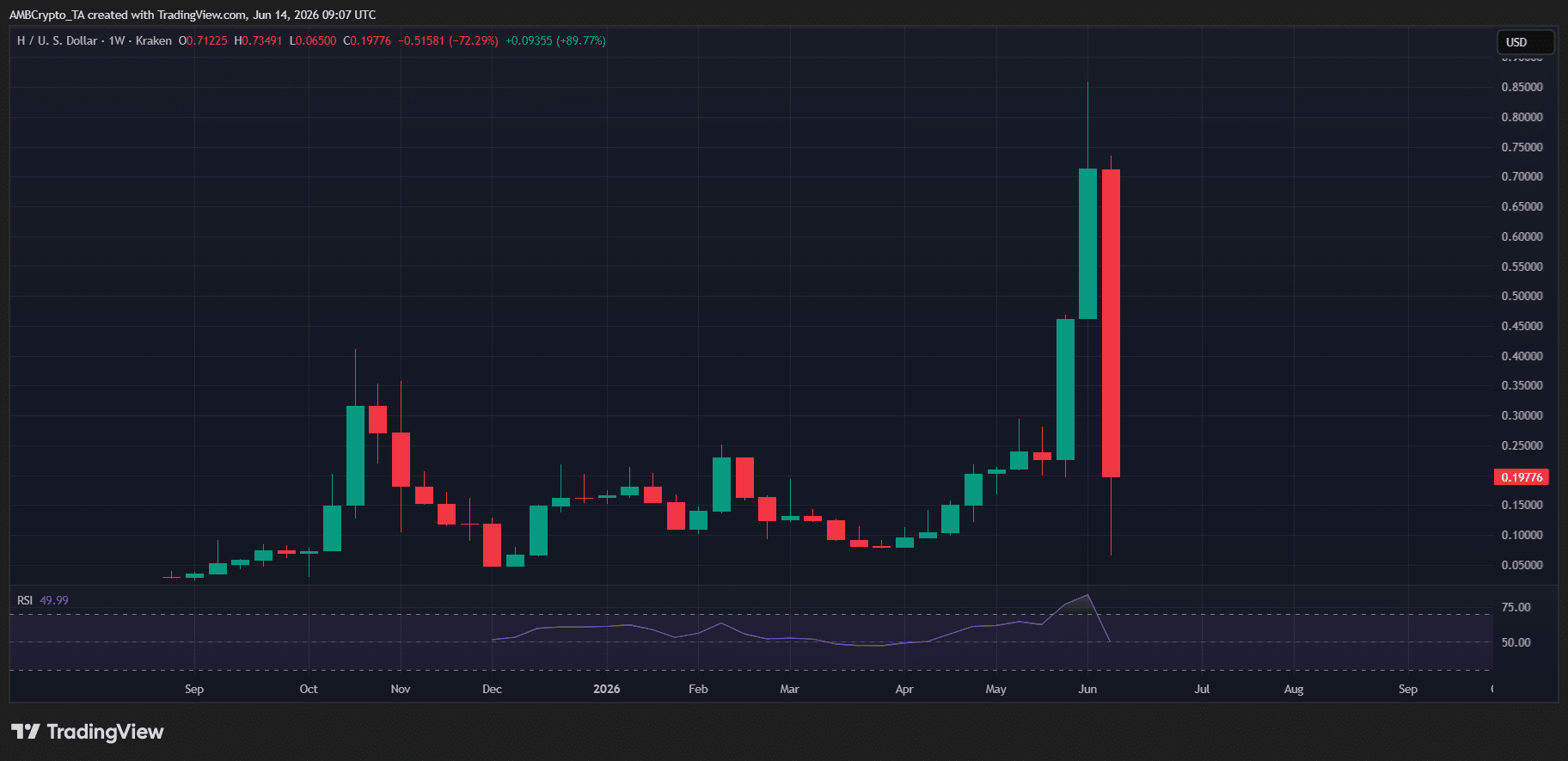
Humanity Protocol [H] led this week’s losers with a 72% decline. Technically, the sharp pullback came after a massive 150% rally over the previous two weeks, which pushed the token to a record high near $0.85. Such steep corrections are often seen after parabolic rallies as traders rush to lock in profits.
However, the scale of the decline suggests more than just a routine cooldown. The selloff pushed H back toward its early-April support zone around $0.19, effectively erasing much of the recent breakout and signaling that sellers have regained control of the market.
As a result, H has lost its bullish structure in the near term. Unless buyers can reclaim key resistance levels and stabilize price action, the token could remain under pressure in the sessions ahead.
Source: TradingView (H/USDT)
This makes H’s decline look like more than a typical post-rally cooldown.
The breakdown back to the $0.19 support zone suggests sellers have taken control, weakening the recovery that had driven the token to new highs just weeks ago.
If buyers fail to defend this level, the current downtrend could trigger a deeper correction. With broader market sentiment still leaning risk-off, H remains vulnerable to further downside in the coming week.
Steller [XLM] – Payments network saw weakening conviction and extended its losses
Stellar [XLM] came in second among this week’s losers with a 10% pullback, extending last week’s 20% decline. The continued losses suggest buyers are gradually losing control, with the token now drifting closer to the $0.14 support zone.
From a technical standpoint, the recent weakness stands out because XLM never showed particularly strong buying momentum during its earlier rally.
While the token surged in May, momentum indicators failed to reach overbought levels, signaling that demand was not strong enough to support a sustained breakout.
As a result, the current pullback appears to be a continuation of fading momentum rather than a temporary correction. If sellers remain active, XLM could continue lower and retest $0.14 in the near term.
DeXe [DEXE] – Governance protocol is repeating a strong rebound rally this week
DeXe [DEXE] took the third spot among this week’s losers with a 9.8% pullback. However, unlike H and XLM, DEXE’s decline looks more like a healthy correction than a bearish reversal.
Technically, the token has seen a similar setup before.
After a sharp pullback in April, buyers returned and pushed DEXE to fresh highs. The current decline appears to be following the same pattern, with profit-taking cooling the rally rather than reversing it.
If buyers continue to hold key support levels, DEXE could use this pullback to build momentum for another move higher. In that case, a rebound toward the $25 level could be the next target.
Siren [SIREN] led the losers with an 84% decline, followed by Sahara AI [SAHARA], which fell 53.4%, while Octra [OCT] dropped 44% as market momentum cooled.
Conclusion
This week was a rollercoaster. Big pumps, sharp dips, and nonstop action. As always, stay sharp, do your own research, and trade smart.
Final Summary
Audiera [BEAT], Bittensor [TAO], SKYAI [SKYAI] led the week in gains.
Elon Musk says SpaceX revenue could reach roughly $1 trillion a year by 2030, and likely more in 2031. That projection sits far above the forecasts of the bankers who just took his company public.
Musk made the claim on X (Twitter) over the weekend, days after SpaceX completed the largest stock market debut in history. His own underwriters model only a fraction of that number.
SpaceX Revenue Math Faces a Steep Climb
SpaceX reported $18.7 billion in revenue for 2025, according to its IPO filing. Revenue climbed from $14 billion in 2024, growth of about 33%.
Revenue stood near $10 billion in 2023, so the trajectory is steep but not vertical.
Even so, hitting $1 trillion by 2030 would demand a 53-fold jump in five years. No company near this size has ever grown that fast.
Musk framed the goal directly on the platform he owns.
I think SpaceX might be able to reach approximately $1T revenue in 2030,” he said in a post.
Follow us on X to get the latest news as it happens
He added that he would be surprised if revenue fell below $1 trillion in 2031.
Wall Street Forecasts Sit Far Below
Morgan Stanley, a lead underwriter, estimates SpaceX revenue near $330 billion in 2030. The bank models $160 billion as early as 2028.
Goldman Sachs leans harder on artificial intelligence yet still lands well short of Musk. Both banks assume years of flawless execution.
The optimism arrived alongside the company’s historic IPO debut, which pushed its valuation past $2 trillion. That session produced a string of surprising IPO facts, including Musk keeping 82.4% of voting power.
The AI Bet Carries the Forecast
Both forecasts rest on AI infrastructure rather than rockets. Morgan Stanley sees AI delivering roughly $190 billion of its 2030 total.
However, that unit earned just $3.2 billion in 2025 while losing $6.4 billion. It would need to outgrow the world’s leading AI labs to deliver.
For now, the Starlink satellite network carries the business, generating $11.4 billion last year. Subscribers reached 10.3 million by March 2026, up from 8.9 million a year earlier.