Home Blog Page 342

Iran proved it can close the Strait of Hormuz, but the U.S. is showing it can punch open a hole

0
Iran proved it can close the Strait of Hormuz, but the U.S. is showing it can punch open a hole


Regardless of a ceasefire deal that reopens the Strait of Hormuz, Iran’s demonstrated ability to shut it down will continue to hang over the global economy, rendering the narrow waterway a contested space.

But while the U.S. has failed to restore freedom of navigation in the strait, a steady drumbeat of messaging recently suggests an effort to dilute Tehran’s new leverage.

Starting late last month, U.S. officials began revealing that more ships had been quietly crossing the strait with U.S. assistance through a route along the Omani coast. Subsequent reports pointed to a more robust U.S. role as “naval overwatch” offered protection from Iranian attacks.

The traffic uptick still represented just a fraction of pre-war levels, but it gave oil markets more breathing room before inventories reach critical levels while providing the U.S. additional leeway in negotiations with Iran.

On Tuesday, Energy Secretary Chris Wright admitted in congressional testimony that traffic in the strait was rising “very meaningfully” in a military operation that wasn’t being disclosed openly.

Then on Wednesday, President Donald Trump described a “secret mission” that he claimed had put more than 100 million barrels of oil on the market, or about five day’s worth of shipments before the war started. 

“I can say it now. Something you didn’t know,” he said. “Do you know we’ve been taking out millions of barrels of oil? Nobody knows it. You know who doesn’t know about it? Iran — until right now.”

On Thursday, U.S. Central Command posted a message saying the Strait of Hormuz is open for transit, touting routes for safe passage, the hundreds of ships that have already crossed, and forces in place to defend against attacks.

“Iran does not control the Strait of Hormuz,” it added.

Interior Secretary Doug Burgum added to the chorus on Friday, when he said more than 20 ships exit the Persian Gulf on some nights under the cover of darkness with help from U.S. forces.

And for good measure, Defense Secretary Pete Hegseth told CBS News on Sunday that the U.S. naval blockage in Iran is “impenetrable” and 125 million barrels of oil have now exited the Gulf, “showing that we control the strait.”

An MH-60R Sea Hawk, assigned to Helicopter Maritime Strike Squadron (HSM) 50, takes off of the flight deck of Arleigh Burke-class guided-missile destroyer USS Thomas Hudner (DDG 116) during flight deck operations, May 19, 2026.

U.S. Navy

Meanwhile, Iran established a separate channel through the strait that runs along its coast, demanding tolls from ships that want to cross and attacking any that try to skirt it.

As a result, U.S. forces and Iran’s Islamic Revolutionary Guard Corps continue to exchange fire on a regular basis as both sides maintain competing lanes.

U.S. aircraft have bombed Iranian missile sites and destroyed fast-attack boats, while the IRGC launches drones at commercial ships and even downed an Apache attack helicopter, forcing the crew to be rescued from the water.

With protection from the U.S. military, tankers are crossing the strait from the Persian Gulf into the Gulf of Oman, where they offload their oil via ship-to-ship transfers—borrowing a tactic that the Iranian and Russian “shadow fleet” have used for years to avoid Western sanctions.

After the transfers, the newly loaded ships take their oil to customers around the world, while the empty tankers cross back into the Persian Gulf to full up on more crude supplies.

This has allowed Kuwait, which has no meaningful routes to export oil other than the Strait of Hormuz, to finally draw down its inventories that had built up during the closure.

In fact, Kuwait began offering to sell its crude to refiners in Asia on Tuesday, marking the first time since the Iran war started.

The United Arab Emirates, which has used a pipeline to get some supplies around the strait, has also been selling oil from inside the Persian Gulf to customers in Asia. 

But Kuwait’s shipments are especially notable as they originate from deep inside the Gulf, meaning tankers must first travel while exposed to much of Iran’s coast before even reaching the strait.

A sailor signals an F/A-18F Super Hornet, attached to Strike Fighter Squadron (VFA) 103, aboard Nimitz-class aircraft carrier USS George H.W. Bush (CVN 77), May 20, 2026.

U.S. Navy


Source link

Summer of crypto (regs): State of Crypto

0
Summer of crypto (regs): State of Crypto

Last Tuesday’s House Ways and Means Committee hearing on digital asset tax bills was pretty straightforward. The members of the committee asked largely substantive questions, seemingly aimed at better understanding both how crypto taxes might work as well as what holes exist in current tax policy. There was no sniping at each other, no real pot shots at President Donald Trump and his family and no major arguments. At most, we had a few lawmakers question whether crypto is really an urgent issue amid current economic conditions.

In agency news, the CFTC published a proposal for better regulating prediction markets, giving the general public some time to weigh in, even as the various legal cases continue.

Why it matters

Crypto taxes are the next big issue after the market structure bill happens (if it happens, anyway). And while the hearing wasn’t exactly spicy, it did suggest that there is a lot of work to be done before crypto tax legislation can proceed through a markup and to the House floor.

The CFTC’s proposal to more closely regulate prediction markets is a first step in this process, and the public comments will be revealing.

Breaking it down

Tuesday’s hearing from the Ways and Means Committee saw lawmakers ask questions about the various discussion draft bills presented for the hearing, addressing the different aspects of the crypto tax debate. It was a remarkably conciliatory hearing, when contrasted with some of the other hearings the crypto industry has watched.


Source link

34-year-old pizza company files for bankruptcy

0
34-year-old pizza company files for bankruptcy


While the global pizza market is projected to grow from $282 billion in 2025 to more than $340 billion by 2034, the success or failure of any individual company depends on a wide range of not always predictable factors.

The rising cost food and operations, changing customer tastes, new competition in a particularly saturated location and, above all, a changing market can sink a company that otherwise had everything it needed.

Pizza giants Papa John’s and Yum! Brands-owned Pizza have both recently confirmed plans to close dozens of underperforming locations to narrow profit margins amid flagging sales in 2025.

Pizza dough supplier Millennium Dough Company enters administration

In May 2026, Washington-based Smoking Monkey Pizza ended up filing for Chapter 11 protection two months after California competitor North County Pizza Inc. did the same. In each case, the company named rising debts as flagging sales could no longer justify the number of operating locations opened during more profitable times.

The latest pizza company to enter administration, or the United Kingdom equivalent closest to Chapter 11 bankruptcy, is West London-based Millennium Dough Company. The company was established in 1992 in the Greenford suburb and created industrial pizza dough for use in various restaurants, including several major pizza chains in the United Kingdom, hotels and commercial suppliers.

Related: New York City is seeing a new kind of Italian restaurant

The dough company advertised itself as specializing in long fermentation and craft-flavor dough. It was also initially known as Millennium Food Services Limited before rebranding to the current name in 2022.

In 2023, the company was acquired by holdings company Aquilla Food Group for an unspecified amount.

As first reported by local press, Nicholas Charles Simmonds and Chris Newell of advisory firm Quantuma Advisory Limited were appointed as joint administrators overseeing the process while the procedure became inevitable after the Millennium’s debt more than doubled from £751,052 ($1 million USD) in 2023 to £1.5 million ($2 million USD) at the start of 2026.

Millennium Dough Company sells artisanal pizza dough to several major UK restaurant and hotel chains.Shutterstock

Why is Millennium Dough Company, a successful pizza dough producer, in administration

The company reported bringing in £1.7 million profit in the year ending on October 2024 but quickly started running up heavy debts amid tightening profit margins driven by rising operating costs and the wider market pressures on the food and hospitality industries over the last year.

In a press statement, the team at Quantuma said that rising costs and cash flow problems pushed Millennium into administration. The company itself has not released a statement on its financial situation so it is not immediately clear whether and how it intends to restructure.

More Travel News:

Unlike with a Chapter 11 filing in the U.S., administration in the UK automatically requires a company to hand over business operations to independent administrators.

“When a company goes into administration, they have entered a legal process with the aim of achieving one of the statutory objectives of an administration,” Companies House, the British government agency that incorporates and dissolves companies, states of the process on its website. “This may be to rescue a viable business that is insolvent due to cashflow problems.”

Related: Another airline files for bankruptcy protection, cancels flights

This story was originally published by TheStreet on Jun 14, 2026, where it first appeared in the Restaurants section. Add TheStreet as a Preferred Source by clicking here.


Source link

Aerodrome is turning liquidity into a prediction market with its biggest upgrade yet

0
Aerodrome is turning liquidity into a prediction market with its biggest upgrade yet

Since debuting on Base in 2023, Aerodrome has become one of the most widely known DEXs on the network by using a system that rewards token holders for directing liquidity incentives toward trading pools. The model helped solve one of DeFi’s longstanding problems: how to bootstrap liquidity for new assets and keep it from disappearing when incentives dry up.

Prediction market similarities

But the model has an inherent limitation, according to Cutler. Decisions are largely based on past performance.

Predictive Allocation seeks to flip that dynamic. Instead of rewarding participants for directing incentives toward pools that have already generated fees, the system encourages them to anticipate where liquidity will be needed next. Those who correctly identify future demand receive a greater share of the revenue generated by those markets.

“The liquidity is now moving in an anticipatory way ahead of where the market is,” Cutler said.

The concept borrows heavily from prediction markets, which use financial incentives to aggregate forecasts about future events. But unlike traditional prediction markets, participants aren’t merely speculating on an outcome.

“It takes that asymmetric upside and truth discovery and brings it into market creation and spot markets for the first time,” Cutler said.

The distinction is important. In a traditional prediction market, traders bet on events they cannot influence. Under Predictive Allocation, directing incentives toward a pool helps create the liquidity needed for that market to succeed. The prediction and the investment become the same action.


Source link

Why is FET’s price up today? OpenAI buzz, trader demand & more…

0
Why is FET’s price up today? OpenAI buzz, trader demand & more…


Artificial Superintelligence Alliance [FET] surged 15.49% over the last 24 hours as trading volume climbed 31.37%, while renewed AI-sector optimism appeared to fuel speculative demand. 

The rally lifted FET’s market capitalization to $480.78 million and pushed the token back into focus among AI-related assets. 

Growing discussion around OpenAI’s reported IPO ambitions added fresh attention to artificial intelligence investments. 

Furthermore, decentralized AI infrastructure narratives continued attracting interest across the crypto market. 

FET also remained closely tied to the Decentralized AI Edge initiative, which strengthened its relevance within the sector. 

As a result, traders appeared to rotate capital into AI-focused tokens in search of stronger returns beyond large-cap cryptocurrencies.

Why are exchange balances climbing?

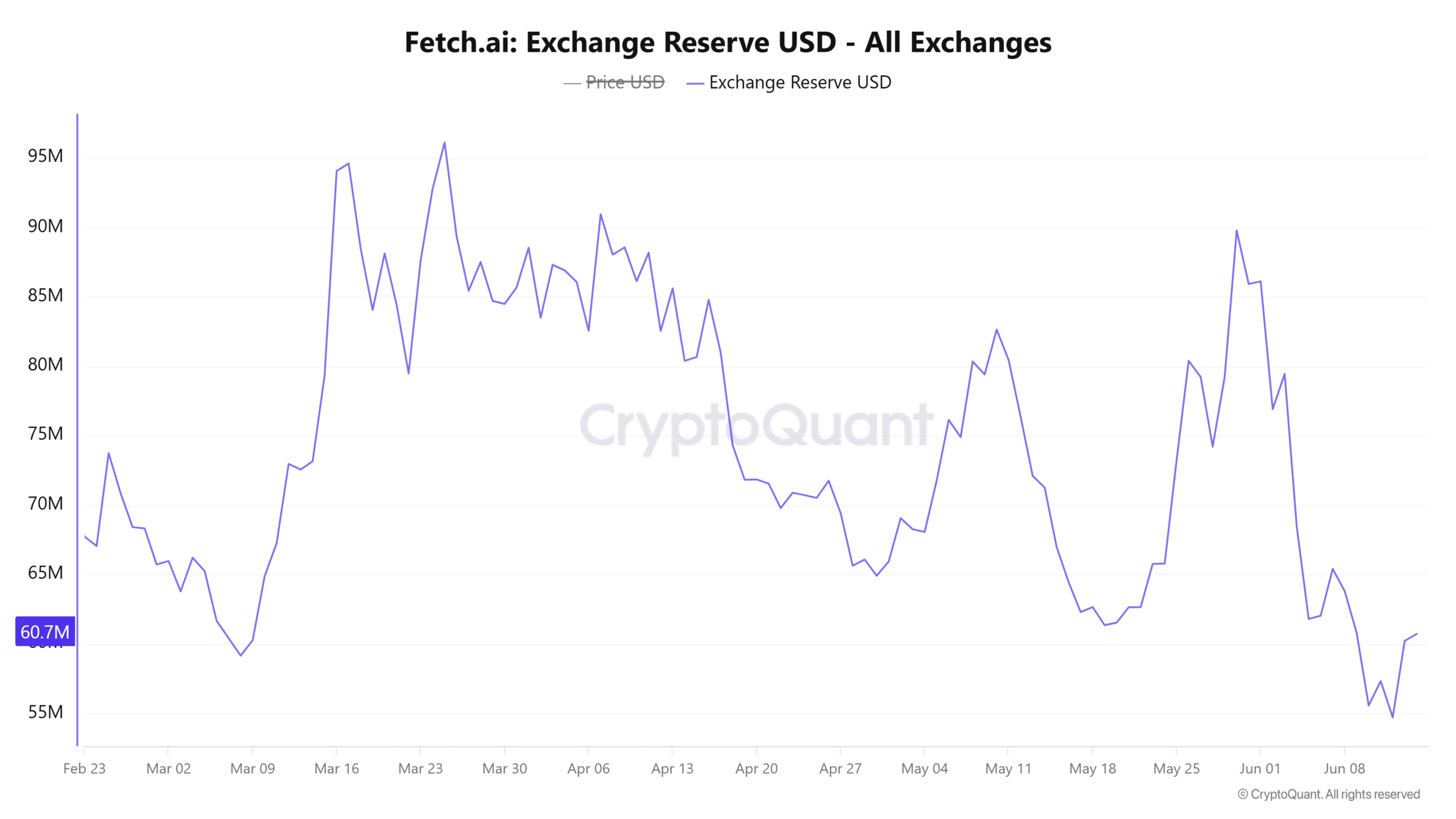
Exchange Reserve increased 11.47% to $60.72 million despite FET’s strong price recovery, creating a notable divergence beneath the surface. 

Rising exchange-held supply often signals that more tokens have become available for trading activity, which can increase liquidity during periods of heightened demand. 

However, the metric also suggested that some holders may have positioned themselves to realize profits after the recent advance. 

While buyers absorbed available supply and maintained control throughout the session, the increase in exchange reserves showed that selling pressure had not completely disappeared. 

Market participants appeared willing to engage on both sides of the market rather than committing exclusively to accumulation. 

Source: CryptoQuant

Can FET reclaim its next resistance zone?

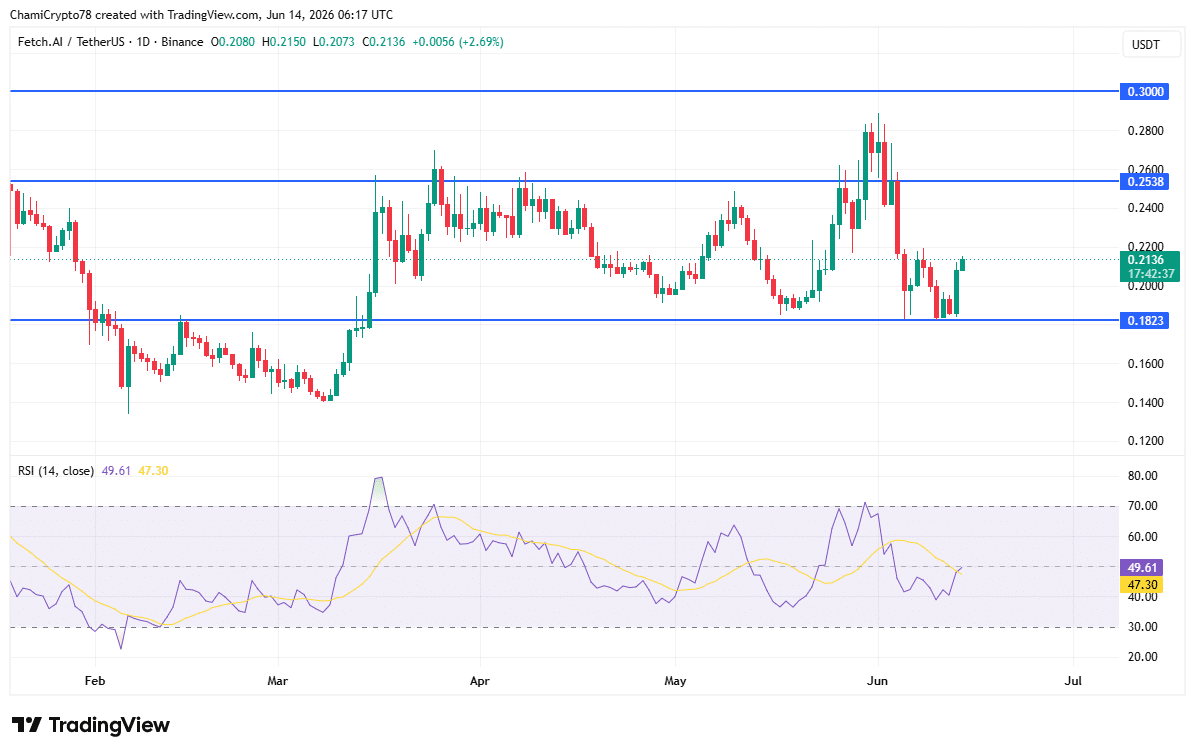
FET rebounded sharply from the $0.1823 support level and recovered toward $0.2136 after defending a critical demand area. 

Price remained above recent lows, which suggested that buyers regained control following the early June decline. 

RSI climbed to 49.61 from weaker readings and approached the neutral 50 threshold, indicating strengthening market conditions without entering overheated territory. The indicator’s recovery reflected improving buying interest rather than excessive speculation. 

Meanwhile, the chart showed that $0.2538 remained the most important resistance level ahead of any attempt toward $0.3000. 

Buyers repeatedly defended support during recent sessions, which strengthened the structure around current levels. 

If FET clears $0.2538, the recovery could extend toward higher resistance zones. 

Should sellers reject another breakout attempt, price could revisit support near $0.1823 before establishing a clearer directional trend.

FET price actionFET price action
Source: TradingView

Bullish traders return to the derivatives market

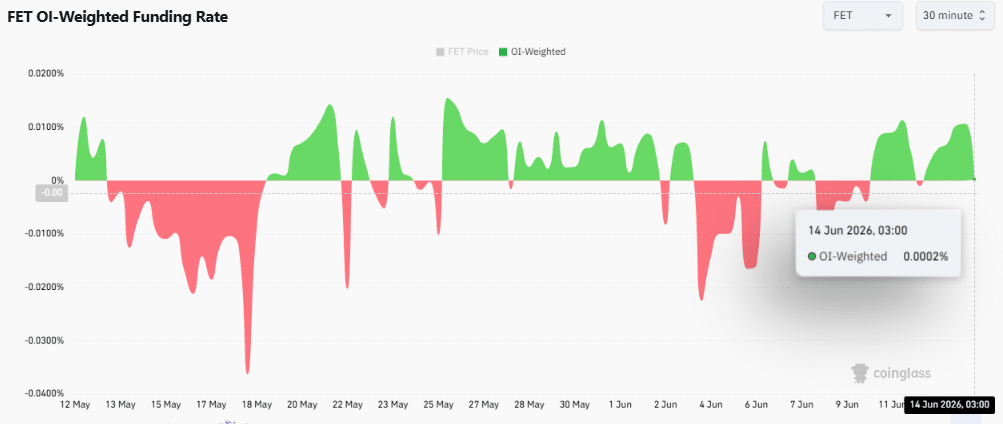
Derivatives sentiment strengthened as the OI-Weighted Funding Rate turned positive and reached 0.0002%. 

The shift indicated that long-position holders had regained confidence and accepted additional costs to maintain exposure. 

Funding remained positive through the most recent sessions, which highlighted growing bullish conviction among leveraged participants. 

Unlike previous periods that featured deeper negative readings, current positioning suggested traders increasingly expected further upside. 

Positive funding also aligned with the recovery in spot prices, creating a more supportive backdrop for continuation. 

However, the reading remained relatively moderate rather than extreme, which reduced the immediate risk of an overcrowded long trade. 

The balance allowed bullish sentiment to improve without showing signs of excessive leverage across the derivatives market.

Source: CoinGlass

FET’s recovery gained support from renewed AI-sector enthusiasm, rising trading activity, and improving derivatives sentiment.

Although exchange reserves increased and introduced potential profit-taking risks, buyers continued defending key support levels while RSI recovered toward neutral territory.

The overall structure favors further upside, and a break above $0.2538 would likely strengthen the case for an advance toward $0.3000.

However, failure to overcome that barrier could keep FET trapped within its current recovery range.


Final Summary

  • FET reclaimed key support as buyers returned and sentiment improved.
  • Rising exchange reserves introduced supply risks despite the ongoing recovery.


Source link

Google Is Paying $920 Million Per Month to SpaceX. Here’s Why Nvidia Is the Quiet Winner Nobody’s Talking About.

0
Google Is Paying $920 Million Per Month to SpaceX. Here's Why Nvidia Is the Quiet Winner Nobody's Talking About.


In the weeks ahead of its June 12 initial public offering, SpaceX racked up a couple of big deals to rent out parts of its data center capacity; one with artificial intelligence (AI) start-up Anthropic and one with Alphabet-owned Google. Both agreements will help SpaceX offset its AI infrastructure costs with recurring revenue streams.

In the background, however, these deals highlighted the AI industry dominance of another company: Nvidia (NASDAQ: NVDA).

Missed Nvidia in 2009? This Rare Signal Is Flashing Again. In 2009, a “Double Down” signal flashed for a little-known chipmaker called Nvidia. For the first time in years, that same “Total Conviction” signal is flashing for a company 1/100th the size of Nvidia. Continue »

Image source: Getty Images.

Nvidia’s dominance on display

On May 6, AI start-up Anthropic agreed to rent compute capacity from SpaceX for more than $1.2 billion per month. The deal is set to run through May 2029, though each party is able to cancel the contract at any point with 90 days’ notice, according to SpaceX’s S-1 filing.

Then, on June 5, a regulatory filing showed SpaceX had inked a deal with Google. After an initial ramp-up period, that agreement will be worth $920 million per month and will run from October 2026 through June 2029. Starting in 2027, either company can end the contract with 90 days’ notice.

For Anthropic’s deal, it will lease the full capacity of SpaceX’s Colossus data center, which features over 220,000 Nvidia graphics processing units (GPUs). Google’s deal will give it access to around 110,000 Nvidia GPUs in SpaceX’s data centers. So even as megacap tech companies like Alphabet are designing and deploying their own AI chips in a bid to become more self-reliant, this deal highlights that most AI roads still run through Nvidia.

Beyond ground-based data centers

Part of SpaceX’s long-term plan is to launch a host of satellites housing data center servers into orbit, where they can avoid some of the constraints currently faced by terrestrial data centers. Nvidia is also a part of that plan.

“Specifically, we believe SpaceX’s reusable rockets, scaled satellite manufacturing, and operational expertise can enable the cost-effective and rapid deployment of massive AI compute satellite constellations — with potentially millions of satellites — for orbital data centers,” SpaceX said in its S-1 filing.

The first version of those future satellites, the AI1, is being designed to use Nvidia chips.That’s not surprising, as in March, Nvidia unveiled the Space-1 Vera Rubin Module, an architecture designed to run large-scale AI models that is suitable to be deployed in space.

SpaceX is designing its own chips and plans to build a massive foundry in collaboration with Tesla and Intel, so it may eventually have less of a need to work with Nvidia. But in the meantime, whether on the ground or in space, Nvidia will be a beneficiary of SpaceX’s ambitions.

Should you buy stock in Nvidia right now?

Before you buy stock in Nvidia, consider this:

The Motley Fool Stock Advisor analyst team just identified what they believe are the 10 best stocks for investors to buy now… and Nvidia wasn’t one of them. The 10 stocks that made the cut could produce monster returns in the coming years.

Consider when Netflix made this list on December 17, 2004… if you invested $1,000 at the time of our recommendation, you’d have $433,268!* Or when Nvidia made this list on April 15, 2005… if you invested $1,000 at the time of our recommendation, you’d have $1,259,391!*

Now, it’s worth noting Stock Advisor’s total average return is 935% — a market-crushing outperformance compared to 207% for the S&P 500. Don’t miss the latest top 10 list, available with Stock Advisor, and join an investing community built by individual investors for individual investors.

See the 10 stocks »

*Stock Advisor returns as of June 14, 2026.

Jack Delaney has no position in any of the stocks mentioned. The Motley Fool has positions in and recommends Alphabet, Intel, Nvidia, and Tesla. The Motley Fool has a disclosure policy.

Google Is Paying $920 Million Per Month to SpaceX. Here’s Why Nvidia Is the Quiet Winner Nobody’s Talking About. was originally published by The Motley Fool


Source link

SEC’s big swing to clear tokenization path isn’t likely to get resilience of full rule

0
SEC's big swing to clear tokenization path isn't likely to get resilience of full rule

“It doesn’t have to be done as a rulemaking,” said SEC Commissioner Hester Peirce, who has led much of the agency’s crypto work since the start of last year. In response to a question from CoinDesk, she said the SEC has exemptive authority that it routinely uses. “We can do it as a rule, but we don’t have to do it as a rule.”

In March, SEC Chairman Paul Atkins described the incoming policy as “an innovation exemption to facilitate limited trading of certain tokenized securities with an eye toward developing a long-term regulatory framework.” He said it would be “limited in time and scope, but long enough so that we can craft more durable rules that harness the full potential of these new technologies.”

More recently in May, he added: “I also think we should consider what a future-proofed framework may look like, which would take the form of notice-and-comment rulemaking and would address the ‘exchange’ definition as applied to onchain trading systems.”

CoinDesk canvassed the views of several lawyers who are former officials at the SEC, asking questions about the choice to put off formal rulemaking, and whether the interim work on this will hold up. Most agreed that the approach may not carry the highest force of SEC authority, but it’d still be difficult to put the toothpaste back into the tube if the next administration sees things differently.


Source link