Moneywise and Yahoo Finance LLC may earn commission or revenue through links in the content below.
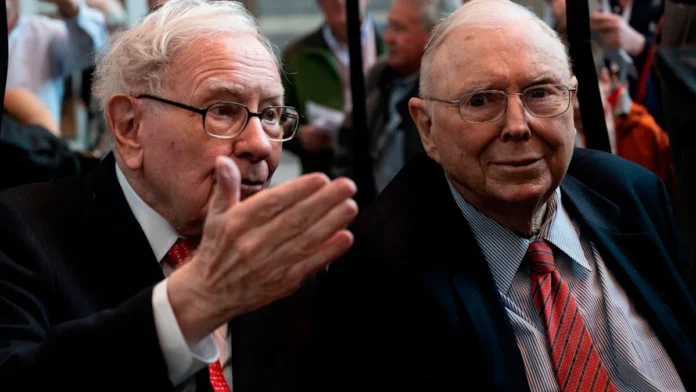
Warren Buffett’s longtime business partner, the late Charlie Munger, had a reputation for being blunt when speaking with shareholders.
Whether he was talking about building wealth or expressing skepticism about cryptocurrency, Munger would often speak candidly.
During a 2019 shareholder meeting for his company, Daily Journal, Munger shared some choice words about day-trading influencers (1). In short, he wasn’t a fan of social media gurus teaching inexperienced investors how to trade stocks.
Top Picks
The ultra-rich use these 5 real estate strategies to build wealth while they sleep — you can start with just $100
The IRS usually taxes gold as a collectible — but this little-known strategy lets you hold physical bullion tax-free. Get your free guide from Priority Gold
Dave Ramsey warns nearly 50% of Americans are making 1 big Social Security mistake — here’s how to fix it ASAP
“If you take the modern world where people are trying to teach you how to come in and trade actively in stocks, well, I regard that as roughly equivalent to trying to induce a bunch of young people to start off on heroin,” he said. “It is really stupid.”
Here’s why the legendary investor was “tired” of get-rich-quick gurus.
Financial misinformation
Financial literacy remains a problem nationwide. According to a 2025 Gallup poll, 42% of Americans aged 18 to 29 seek financial advice on social media (2).
And survey results from the 2025 TIAA Institute-GFLEC Personal Finance Index found that only 48% of adults could correctly answer more than half the Index’s financial questions (3).
Munger thought it was silly for those who are already rich to make more money from “encouraging people to get rich by trading.”
“There are [also] people on TV, and they say ‘I have this book that will teach you how to make 300% a year, and all you have to do is pay for shipping,” he told shareholders. “They mislead you on purpose, and I get tired of it. I don’t think it’s right that we deliberately mislead people as much as we do.”
Listening to bad financial advice can have very real consequences for those who don’t understand the risk.
Rather than trust random advice from a day trader with a large Instagram following, it’s better to find an advisor you can build a direct relationship with. But finding the right finance professional to work with can feel overwhelming — and it should — trusting anyone with your money is a big deal.
Advisor.com exists to bridge this gap, helping you find the best advisor for your specific needs.
Their free service will match you with a curated list of the best options available to you from their database of thousands, ensuring you find a financial advisor you can trust.
There’s no shortage of financial advice being shared online. But while social media personalities hype up risky investing trends like cryptocurrency and meme stocks, both Buffett and Munger have long championed simple, passive investing.
They’ve consistently argued that most investors would struggle to beat the market, making index funds a compelling choice for the average person. In fact, the S&P 500 has delivered an average annual return of more than 14% over the past 10 years (4).
This low-risk, passive investment strategy only requires patience and time.
Contrast this with the fact that, from 2003 to 2023, 98.6% of actively managed domestic equity funds underperformed the S&P 500 Equal Weight Index (5). That’s likely one reason why Buffett is a huge proponent of the index.
“I recommend the S&P 500 index fund, and have for a long, long time to people — and I’ve never recommended Berkshire to anybody,” Buffett said at the 2021 Berkshire Hathaway Annual Meeting. “I think a person who doesn’t know anything about stocks at all, I think they ought to buy the S&P 500 index (6).”
By consistently investing small amounts in index funds, you can harness the wisdom of Munger and Buffett’s advice.
Platforms like Acorns make it easy to begin investing in the kind of index funds they recommend.
Acorns is an automated investing app that rounds up your purchases to the nearest dollar and automatically invests the difference, helping build your investing muscle.
Acorns offers a range of ETFs, including the Vanguard S&P 500 ETF (VOO), the iShares Core S&P Mid-Cap ETF (IJH) and iShares Core S&P Small-Cap ETF (IJR).
“Investing is where you find a few great companies and then sit on your ass,” Munger once told shareholders at a Berkshire Hathaway meeting in 2000 (7).
Of course, finding those few great companies is easier said than done — but it’s important to avoid relying on questionable stock picks finance bros share on TikTok.
This is where Moby can help. Moby offers expert research and recommendations to help you identify strong, long-term investments.
In four years, and across almost 400 stock picks, their recommendations have beaten the S&P 500 by almost 12% on average. They also offer a 30-day money-back guarantee.
Moby’s team spends hundreds of hours sifting through financial news and data to provide you with stock and crypto reports delivered straight to you. Their research keeps you up-to-the-minute on market shifts and can help reduce the guesswork behind choosing stocks and ETFs.
Real estate might be another investment worth adding to your portfolio. Although Munger was notoriously skeptical of certain property investments, Berkshire Hathaway has made several large real estate investments over the years.
For example, Berkshire Hathaway invested nearly $1 billion in two homebuilding companies, Lennar and D.R. Horton, according to a 2025 report from Realtor (8). Munger and Buffett’s firm seemed to be banking on growing demand for U.S. housing.
If you want to take advantage of the real estate market without buying a house, there are some solid options available.
Platforms like Arrived let you invest in shares of rental homes and vacation rentals without taking on the responsibilities of homeownership. Arrived handles property management, tenant turnover and repairs.
Backed by world-class investors like Jeff Bezos, Arrived makes it easy to fit rental properties into your investment portfolio regardless of your current income.
Another way to leverage real estate is by investing in multifamily rentals. One benefit of this market is that it provides protection thanks to multiple rent payments — so if any one tenant is late or chooses to move out, you’re still earning income from the others.
Accredited investors can now tap into this opportunity through platforms such as Lightstone DIRECT, which gives accredited investors access to single-asset multifamily and industrial deals.
Lightstone DIRECT’s direct-to-investor model ensures a high degree of alignment between individual investors and a vertically-integrated, institutional owner-operator — a sophisticated and streamlined option for individual investors looking to diversify into private-market real estate.
Artificial Intelligence AI on Financial Markets. 3D Render
getty
Global power is no longer defined only by oil, trade routes, or military reach. A quieter shift is underway—one driven by pools of capital that sit between governments and markets. Sovereign wealth funds, once built to manage excess oil revenue, are thinking like long-range architects of the global economy.
At the center of this shift is a simple yet far-reaching idea: the fate of artificial intelligence and the future of energy are converging into a single infrastructure story, which is reshaping how countries think about economic expansion. The same systems required to support AI—data centers, high-voltage grids, advanced semiconductors, and uninterrupted electricity—are also the systems required to decarbonize economies and strengthen energy security. Two policy debates that once ran in separate lanes are merging into a single investment challenge.
At the center of that approach is Khaldoon Khalifa Al Mubarak, the fund’s long-serving chief executive, who has overseen Mubadala since its formation in 2002. In our conversation, Al Mubarak framed the fund’s mission in terms that go beyond traditional portfolio management. In his view, sovereign wealth funds are no longer just stewards of surplus capital. They are becoming builders of systems—platforms that will determine how modern economies function over decades, not quarters.
Sovereign wealth funds were originally designed to do something relatively simple: take revenue from natural resources and invest it globally to preserve value for future generations. For decades, that meant stakes in real estate, infrastructure, public equities, and private equity funds.
But the world these funds now operate in is fundamentally different.
Energy systems are being rebuilt while digital systems expand at an extraordinary pace. Electricity demand is rising not just from population growth and industrialization, but also from AI-driven computing. At the same time, renewable energy has become cheaper and faster to deploy than most new fossil fuel infrastructure in many markets.
Capital is seeking more than returns. It now pursues the hardest constraints in the system, where demand is outpacing supply. Whoever controls those constraints—chips, electricity, grid capacity, and digital infrastructure—will have disproportionate influence over global growth.
That is where sovereign wealth funds are increasingly moving.
From Barrels To Bandwidth
Signage of an AI data center is displayed during the MWC (Mobile World Congress), the world’s biggest mobile fair, in Barcelona on March 3, 2025. Surrounded by investment and innovation projects, the Mobile World Congress (MWC) kicks off today in Barcelona amid a context of euphoria but also tensions over artificial intelligence (AI), whose rapid advancement is shaking up the tech sector. (Photo by Josep LAGO / AFP) (Photo by JOSEP LAGO/AFP via Getty Images)
AFP via Getty Images
In the Gulf, this shift is especially visible. Countries that built wealth on hydrocarbons are now positioning themselves for a post-hydrocarbon world without abandoning the energy systems that created their advantage. Instead, they are layering new systems on top of old ones.
Mubadala has expanded far beyond traditional energy investments into semiconductor supply chains, advanced manufacturing, aerospace, life sciences, and digital infrastructure. Ditto for Saudi Arabia’s Public Investment Fund and the Kuwait Investment Authority. These funds are not making isolated bets. They are investing in the very foundations that make both artificial intelligence and modern industrial economies possible—benefits that flow globally.
The logic is straightforward: AI cannot scale without abundant electricity. Energy systems cannot modernize without digital tools that improve efficiency. And both depend on long-term capital that can invest across decades rather than business cycles. Private markets can fund pieces of this transformation. Sovereign wealth funds can fund the system itself.
The rise of AI is often described as a software revolution. But beneath the software layer is something far more physical. Training advanced AI systems requires vast amounts of specialized computing power running continuously—and in many regions, the limiting factor is no longer chips. It is power infrastructure.
This is where energy transition and AI expansion begin to merge.
Francesco La Camera, director-general of the International Renewable Energy Agency, argues that renewable energy can increasingly meet this demand at scale. In a recent conversation, he pointed to the rapid decline in costs for solar-plus-storage systems and the growing evidence that renewables are becoming central pillars of new power systems, not marginal additions. In many parts of the world, the question is no longer whether clean energy is viable—but whether anything else can be built fast enough.
Data centers do not respond to ideology. They respond to cost, reliability, and speed of delivery. Increasingly, the most competitive systems are hybrid—combining solar, wind, and storage rather than relying solely on traditional baseload fossil fuels.
The Geopolitical Layer
A display of networking infrastructure products at the Ericsson AB pavilion at MWC Barcelona 2026 in Barcelona, Spain. Photographer: Angel Garcia/Bloomberg
Unlike most institutional investors, sovereign funds can align national energy policy, industrial strategy, and long-term capital deployment in a coordinated way. In Abu Dhabi’s case, that means connecting energy transition goals with AI ambitions and broader industrial diversification.
That integrated approach spans three overlapping domains: energy systems capable of meeting rising electricity demand; digital infrastructures that can process enormous volumes of data; and industrial ecosystems that connect raw materials, manufacturing, and logistics into globally competitive supply chains. Each reinforces the other. Cheaper clean energy lowers the cost of AI. Better AI improves energy efficiency. Industrial scale reduces the cost of both.
This is more than an economic transformation. It is a geopolitical sea change. Countries that can finance and deploy these systems at scale will not only attract investment—they will shape the conditions under which global growth occurs. The United States and China remain dominant in technology innovation. But the Gulf, through sovereign capital, is enabling infrastructure expansion in both the East and the West.
Still, the system is under strain. Global electricity demand is rising faster than many forecasts anticipated. La Camera has warned that the world is adding record levels of renewable capacity—hundreds of gigawatts annually—yet demand growth continues to outpace expectations. The result is not failure, but tension between what is being built and what is required.
For sovereign wealth funds, that gap is not a warning sign—it is a map. Where demand outpaces supply, infrastructure becomes more valuable. Where systems are strained, capital finds opportunity. And where energy systems and digital infrastructure intersect, long-term influence is possible.
Mubadala’s strategy reflects that logic. It is not betting on a single sector or technology. It is positioning itself across the full stack of modern economic expansion—from energy systems to industrial production to digital infrastructure.
The global economy has always been shaped by infrastructure: railroads, shipping lanes, oil pipelines, fiber-optic cables. What is different now is the speed at which infrastructure cycles are turning—and the scale of capital required to keep up. Sovereign wealth funds are uniquely positioned for this moment. They are large enough to matter, patient enough to wait, and strategic enough to shape outcomes rather than simply respond to them.
The next phase of global growth will not be defined by who builds the best models or extracts the most energy. It will be defined by who constructs the systems that allow both to scale together—and who had the capital, the patience, and the mandate to start building before anyone else.
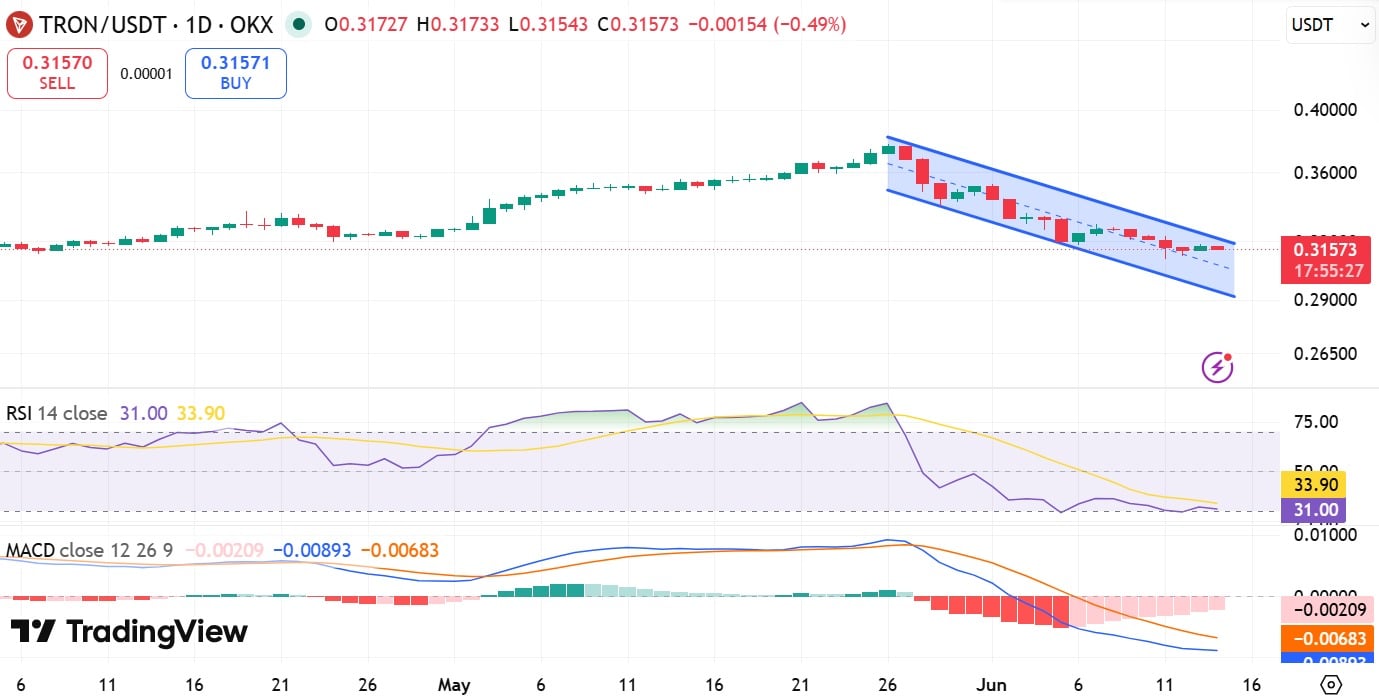
Since facing rejection at $0.37 in late May, TRON [TRX] has traded within a descending channel, reflecting sustained bearish pressure.
As of press time, TRX traded around $0.31, down 3% over the past week. As the altcoin remained under pressure, Tron Inc. continued buying TRX in an apparent effort to support its treasury position.
Why is Tron Inc buying more TRX?
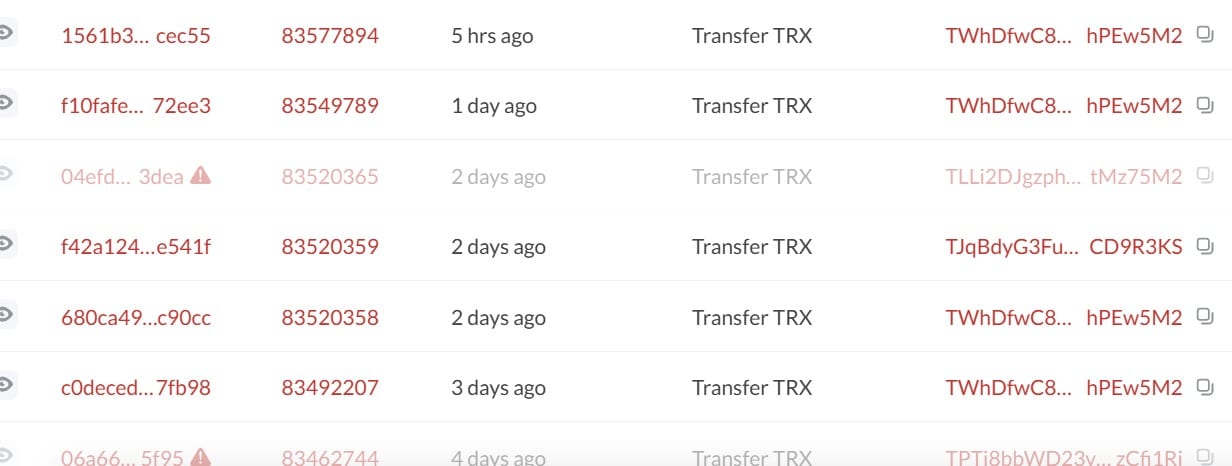
Tron Inc. continued with the aggressive accumulation of TRX as part of its treasury. The Treasury company reported purchasing 157,392 TRX tokens at an average price of $0.3177 for $50k.
The purchase was an addition to another 159,118 TRX acquisition reported the previous day. In fact, so far in June, Tron Inc has accumulated 1.2 million TRX, with total holdings surpassing 700.4 million TRX.
Source: Tronscan
The accumulation came during an extended period of market weakness. Continued buying suggested Tron Inc was absorbing some of the selling pressure as demand softened.
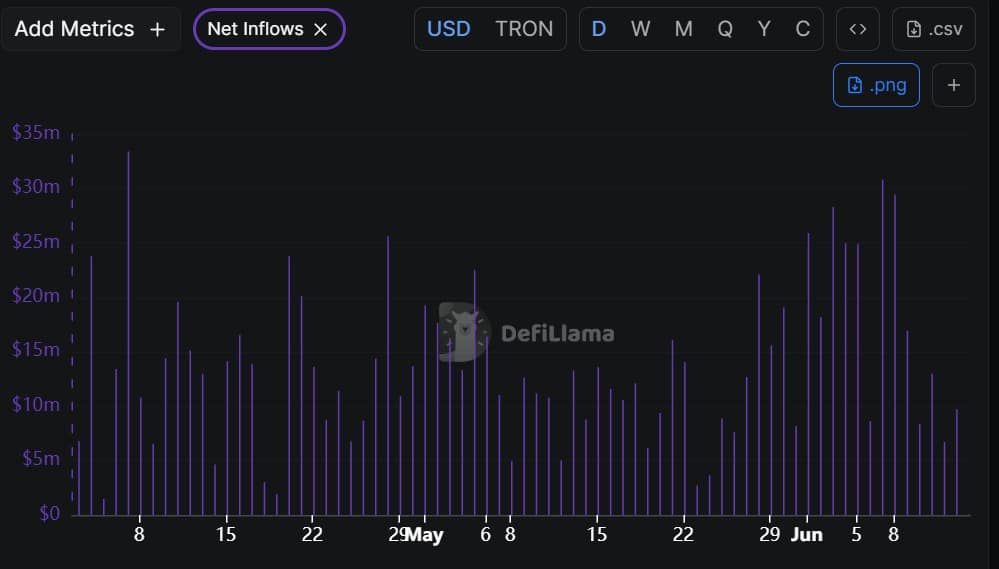
On top of that, the ecosystem continued attracting fresh capital. DefiLlama data showed the network recorded largely positive Daily Net Inflows across the observed period.
Source: DeFilLama
As of press time, Daily Net Inflows stood at around $6.9 million. Positive Net Inflows indicated more capital entered the network than exited it, reflecting continued interest in the ecosystem.
Historically, sustained accumulation by large market participants has helped absorb selling pressure and stabilize prices. If Tron Inc. maintains its pace, the buying activity could help support a broader recovery.
Can buyers stop the decline?
Even so, Tron Inc’s purchases have yet to meaningfully improve market structure.
As a result, downside risk remained elevated. For starters, TRX’s Relative Strength Index (RSI) sat near oversold territory, highlighting persistent selling pressure.
Source: TradingView
With RSI near 30, sellers appeared to retain firm control of the market.
At the same time, MACD remained negative at around -0.0003, while the Signal Line stayed above it. That setup reinforced the prevailing bearish trend and suggested momentum remained weak.
Together, these indicators suggested the downtrend could continue. Holding external factors constant, TRX could lose support at $0.31 and decline toward $0.30.
However, if Tron Inc’s continued accumulation begins to strengthen demand, TRX could reclaim $0.32 and target $0.35.
Final Summary
Tron Inc accumulated 1.2 million TRX in June, raising total holdings above 700.4 million.
The network continued recording positive Daily Net Inflows despite weak price action.
Find out how much you could earn by locking in a high CD rate today. A certificate of deposit (CD) allows you to lock in a competitive rate on your savings and helps your balance grow. However, rates vary widely across financial institutions, so it’s important to ensure you’re getting the best rate possible when shopping around for a CD. The following is a breakdown of CD rates today and where to find the best offers.
Overview of CD rates today
Historically, longer-term CDs offered higher interest rates than shorter-term CDs. Generally, this is because banks would pay better rates to encourage savers to keep their money on deposit longer. However, in today’s economic climate, the opposite is true.
Today, Sunday, June 14, 2026, the highest CD rate is 4% APY. This rate is offered by Marcus by Goldman Sachs on its 14-month CD.
How much interest can I earn with a CD?
The amount of interest you can earn from a CD depends on the annual percentage rate (APY). This is a measure of your total earnings after one year, taking into account the base interest rate and how often interest compounds (CD interest typically compounds daily or monthly).
Say you invest $1,000 in a one-year CD with 1.52% APY, and interest compounds monthly. At the end of that year, your balance would grow to $1,015.20 — your initial $1,000 deposit, plus $15.20 in interest.
Now let’s say you choose a one-year CD that offers 4% APY instead. In this case, your balance would grow to $1,040.74 over the same period, which includes $40.74 in interest.
The more you deposit in a CD, the more you stand to earn. If we used the same example of a one-year CD at 4% APY but deposited $10,000, your total balance when the CD matures would be $10,407.42, meaning you’d earn $407.42 in interest.
When choosing a CD, the interest rate is usually top of mind. However, the rate isn’t the only factor you should consider. There are several types of CDs that offer different benefits, though you may need to accept a slightly lower interest rate in exchange for more flexibility. Here’s a look at some of the common types of CDs you can consider beyond traditional CDs:
Bump-up CD: This type of CD allows you to request a higher interest rate if your bank’s rates go up during the account’s term. However, you’re usually allowed to “bump up” your rate just once.
No-penalty CD: Also known as a liquid CD, this type of CD allows you to withdraw funds before maturity without penalty.
Jumbo CD: These CDs require a higher minimum deposit (usually $100,000 or more), and often offer a higher interest rate in return. In today’s CD rate environment, however, the difference between traditional and jumbo CD rates may not be much.
Brokered CD: As the name suggests, these CDs are purchased through a brokerage rather than directly from a bank. Brokered CDs can sometimes offer higher rates or more flexible terms, but they also carry more risk and might not be FDIC-insured.
The rest was scattered. ZachXBT traced more than $12 million to deposit addresses at the KuCoin exchange and about $8 million to instant swap services, which convert one coin into another quickly and often without identity checks.
Another $8 million was moved off Tron onto the Bitcoin and Ethereum networks through Near Intents, a cross-chain swap tool. Spreading funds across coins, exchanges and blockchains is a common way to break the trail.
Then Tether stepped in. The company can freeze USDT held at a specific address, and ZachXBT said it blacklisted an address tied to the entity holding 72 million USDT. Once frozen, those tokens cannot be moved or cashed out.
It is unclear where the $120 million originally came from. But the pattern, fast movement into a privacy coin, instant swaps and cross-chain hops, is the kind used to launder illicit funds, and Tether’s freeze suggests it reached the same conclusion.
UPDATE (June 12, 12:40 UTC): Amends headline and body to include percentage figure for XMR’s gains.
The next 48 hours could be one of the most volatile periods for risk assets this year, starting Monday.
Between the 15th and 16th of June, the Bank of Japan (BOJ) will release its much-anticipated interest rate outlook. This will be followed by the FOMC meeting on the 16th and 17th of June, where the Federal Reserve will announce its policy decision.
In essence, two of the world’s most influential banks will take center stage.
Market expectations are fairly one-sided.
Why could this week move crypto?
According to CME FedWatch, over 97% of participants are pricing in no change in interest rates at the upcoming Fed meeting. On the BOJ side, however, rate hike expectations are much more active, something that has historically lined up with short-term corrections in crypto.
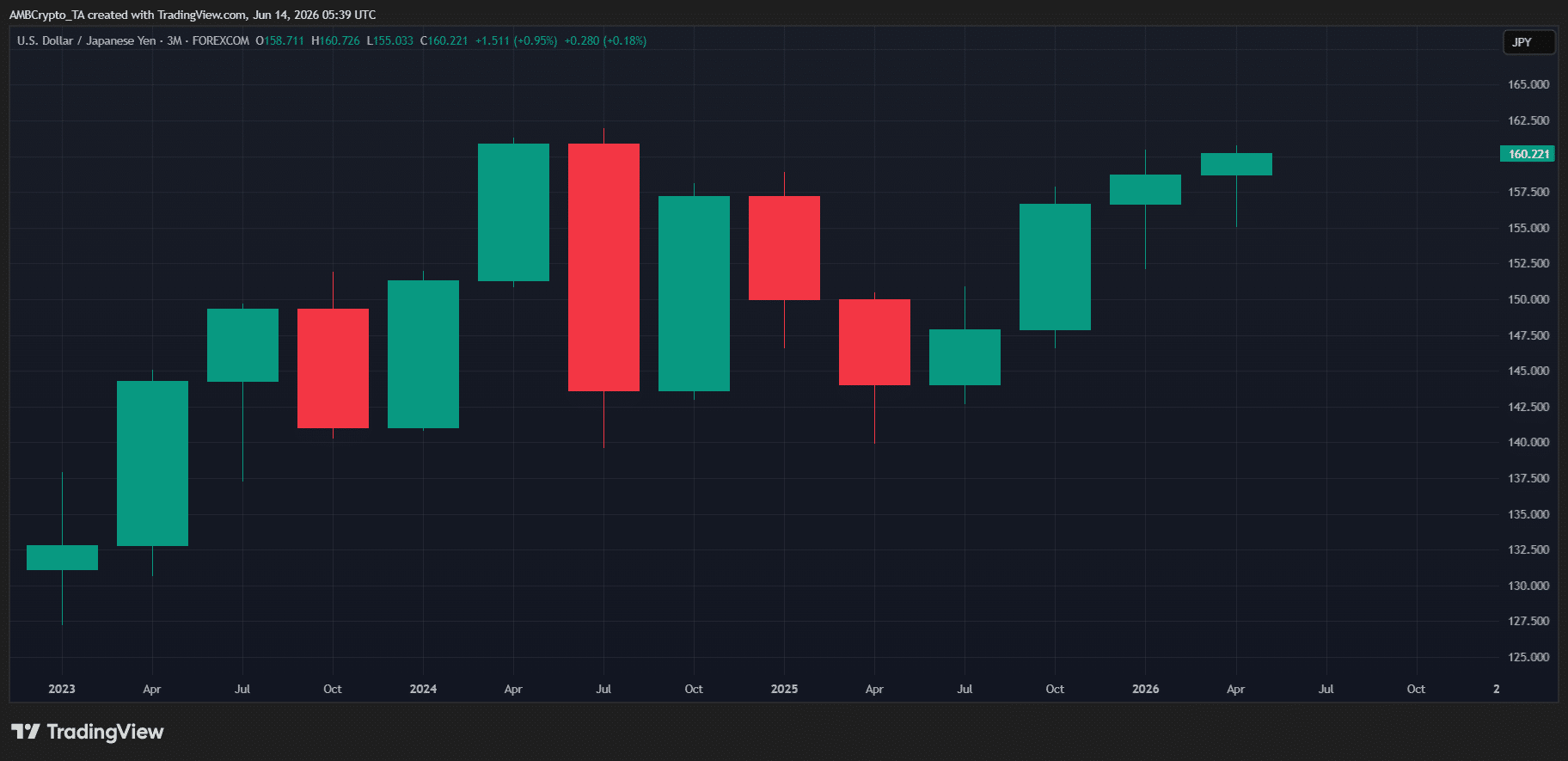
Source: TradingView (USD/YEN)
From a technical view, the Japanese yen keeps weakening against the U.S. dollar. USD/JPY is up around 2.5% year-to-date, pushing back toward the 160 level last seen in early Q3 2024.
In other words, we’re seeing continued dollar strength and yen weakness heading into a pretty key macro event window.
From an economic perspective, a weaker yen puts pressure on the BOJ’s interest rate path.
As the currency depreciates, import costs rise, which can feed into higher inflation in Japan. That, in turn, increases the likelihood that the BOJ considers tightening policy or signaling a more hawkish stance.
More importantly, the timing of this volatility window couldn’t really be worse. The simple idea is this: Even a slightly “cautious” tone from the Fed could be enough to shake markets, and given the current setup in crypto, the market’s ability to absorb that kind of pressure looks pretty limited.
Crypto enters a decision zone, not a trend phase
The upcoming macro week is shaping up alongside a highly volatile crypto market.
On the technical side, high-cap assets still trade over 20% below their earlier 2026 peaks. The recent sell-off lines up with stronger-than-expected labor data, which pushed Bitcoin [BTC] below $60k.
BTC has since bounced nearly 7%, but the market is still split on whether a bottom is in, with bearish signals keeping the risk of another correction on the table.
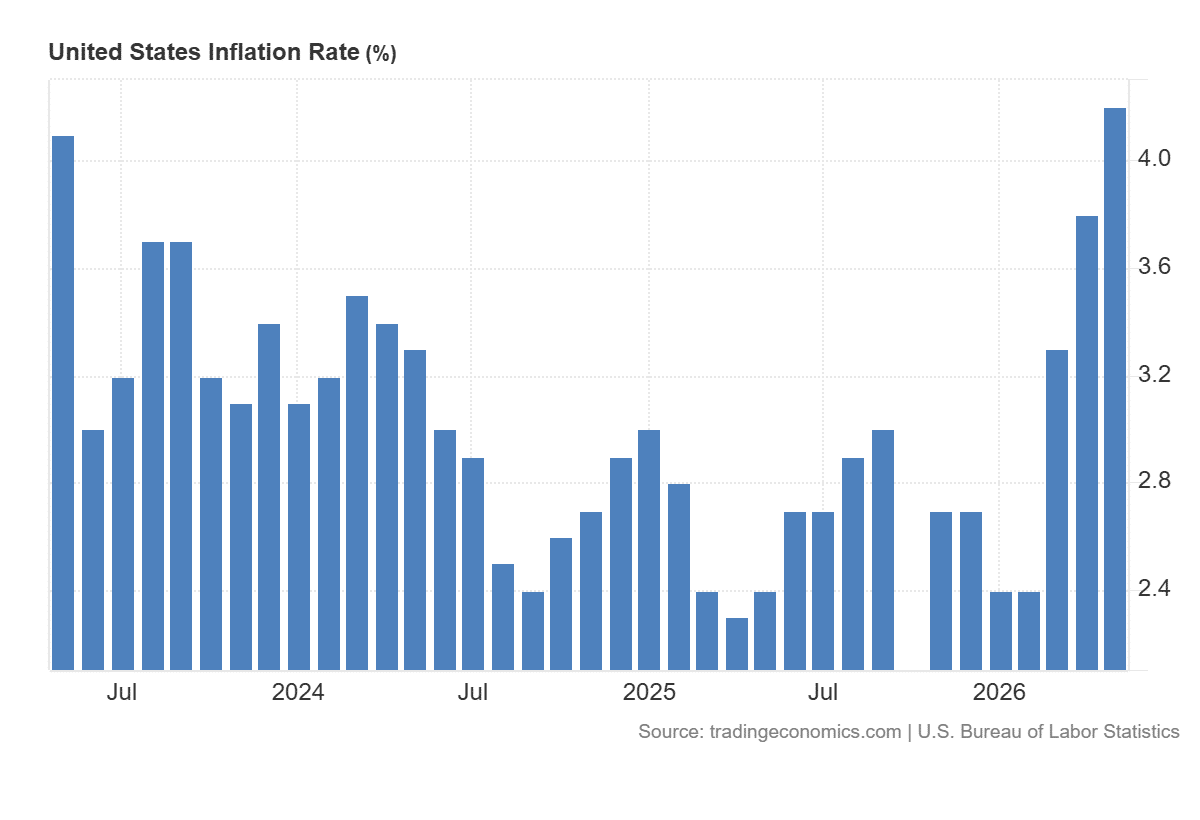
On the macro side, inflation data suggest the Federal Reserve may stay cautious.
As shown in the chart below, U.S. monthly inflation came in at 4.2%, the strongest reading since the Q2 2023 cycle. In simple terms, sticky inflation keeps the Fed tilted toward a no-rate-cut stance heading into the upcoming FOMC.
Source: TradingEconomics
Against this backdrop, the recent Bitcoin rally starts to look like a textbook bull trap.
The logic is simple: BOJ pricing in a potential rate hike, the Fed staying cautious, weak technicals, and an already volatile crypto market all point to a setup that doesn’t look strong enough to carry through the upcoming macro week.
That kind of pressure puts longer-term positioning under stress and keeps overexposed longs at risk of liquidation.
In this setup, a breakdown below $60k for BTC stays firmly in focus.
Final Summary
BOJ and Fed meetings this week could trigger sharp moves as markets stay highly sensitive to interest rate signals.
Weak crypto momentum and sticky inflation keep BTC at risk of a drop below $60K if selling pressure picks up.
Moneywise and Yahoo Finance LLC may earn commission or revenue through links in the content below.
High net worth individuals — typically those with $1 million or more in investable assets — held large portions of their total portfolio in cash in 2024. According to a survey conducted by Goldman Sachs, wealthy individuals park roughly 20% of their net worth in cash and cash equivalent holdings (1).
Higher market volatility and fears regarding persistently high inflation levels are a few major contributors to the shift away from equities and bonds.
Top Picks
The ultra-rich use these 5 real estate strategies to build wealth while they sleep — you can start with just $100
The IRS usually taxes gold as a collectible — but this little-known strategy lets you hold physical bullion tax-free. Get your free guide from Priority Gold
Dave Ramsey warns nearly 50% of Americans are making 1 big Social Security mistake — here’s how to fix it ASAP
And at least some ultra-high-net-worth individuals seem to agree. Before retiring on Dec. 31, 2025, Warren Buffett — the former Berkshire Hathaway CEO and the world’s ninth-richest person according to Forbes real-time net worth tracker (2) — had built the company’s cash balance to a staggering $381.7 billion by the end of the third quarter of 2025 (3).
The strategy paid off — Buffett’s net worth grew by roughly $21 billion last year, despite a tumultuous market backdrop.
Buffett isn’t the only one quietly ditching stocks. Billionaire investor and co-founder of PayPal, Peter Thiel, sold roughly $100 million worth of Nvidia shares through his hedge fund, Thiel Macro, in the third quarter of 2025 (4).
While Nvidia’s stock price surged by nearly 35% in 2025, such moves by the ultra-wealthy spark concerns about a potential AI bubble (5).
As U.S. equities grapple with uncertainties amid the ongoing tariff concerns and potential market overvaluation, cash and cash equivalents might help you hold onto your wealth in stormy weather.
Better investment alternatives
The richer investors get, the more likely they are to look beyond traditional investments. The Goldman Sachs survey revealed that nearly 4 in 10 people with $1 million to $5 million in investable assets have exposure to alternative investments. For those with more than $10 million, alternatives are even more common, with 80% holding them in some form.
For those who don’t want to deal with stock market volatility, there are accessible ways to invest in alternative assets and shield yourself from a potential crash.
One alternative option that can provide returns amidst economic turmoil is real estate.
Rental properties have long been a proven source of steady, passive income for investors. But managing properties costs time, effort and serious cash that many investors simply don’t have.
With that said, that doesn’t mean that there aren’t options for those looking to tap into real estate as an investment vehicle without the hassle of property management.
Turn your cash into rental income
One way to get into this market is by investing in shares of vacation homes or rental properties through Arrived.
Backed by world-class investors, including Jeff Bezos, Arrived allows you to invest in shares of vacation and rental properties, earning a passive income stream without the extra work that comes with being a landlord.
To get started, simply browse through their selection of vetted properties, each picked for their appreciation and income-generating potential. Once you choose a property, you can start investing with as little as $100, reaping any quarterly dividends.
Become a corporate landlord
Residential real estate isn’t the only option if you’re keen to diversify.
If diversifying into multifamily rentals appeals to you, you could consider investing with Lightstone DIRECT, a new investing platform from the Lightstone Group, one of the largest private real estate companies in the country with over 25,000 multifamily units in its portfolio.
Since they eliminate intermediaries — brokers and crowdfunding middlemen — accredited investors with a minimum investment of $100,000 can gain direct access to institutional-quality multifamily opportunities. This streamlined model can help reduce fees while enhancing transparency and control.
And with Lightstone DIRECT, you invest in single-asset multifamily deals alongside Lightstone — a true partner — as Lightstone puts at least 20% of its own capital into every offering. All of Lightstone’s investment opportunities undergo a rigorous, multi-stage review before being approved by Lightstone’s Principals, including Founder David Lichtenstein.
How it works is simple: Just sign up with your email, and you can schedule a call with a capital formation expert to assess your investment opportunities. From here, all you have to do is verify your details to begin investing.
Founded in 1986, Lightstone has a proven track record of delivering strong risk-adjusted returns across market cycles with a 27.6% historical net IRR and 2.54x historical net equity multiple on realized investments since 2004. All told, Lightstone has $12 billion in assets under management — including in industrial and commercial real estate.
As such, even if multifamily rentals don’t appeal to you, Lightstone could still serve you well as an investment vehicle for other real estate verticals.
Fine art tends to maintain its value during turbulent markets. According to a 2025 survey conducted by UBS, high-net-worth collectors are still maintaining their confidence in art — allocating roughly 20% of their wealth in the asset on average in 2025 (6).
Until recently, this world was off-limits to many investors. Not everyone has the time — or cash — to secure a beloved piece of contemporary art. Besides, much of the art world is locked behind a network of brokers, gallery owners and appraisers.
Now, with Masterworks, you can buy fractional shares in multimillion-dollar works by icons like Banksy, Picasso and Basquiat. While art can be illiquid and typically requires a long-term hold, it offers unique portfolio diversification.
Masterworks has sold 25 artworks so far, yielding net annualized returns like 14.6%, 17.6%, and 17.8%.
Even better, if you’re interested in art you can skip the waitlist and go straight to investing.
Note that past performance is not indicative of future returns. Investing involves risk. See important Regulation A disclosures at Masterworks.com/cd
You May Also Like
Join 250,000+ readers and get Moneywise’s best stories and exclusive interviews first — clear insights curated and delivered weekly. Subscribe now.