Home Blog Page 344

Perpetual futures could become crypto’s next ETF moment

0
Perpetual futures could become crypto's next ETF moment

The comparison may indicate how much the U.S. crypto derivatives market could change over the next several years. While spot bitcoin ETFs opened the door for traditional investors to gain exposure to bitcoin through brokerage accounts, regulated perpetual futures could give both retail and institutional traders access to one of crypto’s most popular trading instruments without needing to use offshore venues.

Prediction market platform Kalshi, which launched U.S. perpetual futures last week, said on Wednesday that it already crossed $1 billion in trading volume.

Palmer argued that one reason perpetual futures became so successful outside the U.S. is their simplicity. Unlike dated futures, which require traders to manage expirations and contract rolls, perps allow positions to remain open indefinitely.

“I think it’s a simple derivative structure compared to some of the nuances of dealing with dated futures,” he said. “If I buy a June [future], then it expires, and if I want to keep my position on, I have to roll it.”

Kraken believes removing those complexities — and eventually allowing crypto assets to be used as collateral — could help bring U.S. traders closer to the experience available in international markets, he said.

For now, the company sees the launch of regulated perps as just the beginning. Despite crypto derivatives generating trillions of dollars in annual volume globally, Palmer said the U.S. market remains in its early stages.


Source link

Jim Cramer Is Surprised Starbucks (SBUX) Has Fallen Even Though Coffee Prices Have Eased

0
Jim Cramer Is Surprised Starbucks (SBUX) Has Fallen Even Though Coffee Prices Have Eased


We recently published Jim Cramer Didn’t Hold Back On SpaceX’s IPO & Discussed These 12 Stocks. Starbucks Corporation (NASDAQ:SBUX) is one of the stocks discussed by Jim Cramer.

Coffee chain Starbucks Corporation (NASDAQ:SBUX) is a frequent feature on Jim Cramer’s radar. For a year, the CNBC TV host has discussed the firm’s turnaround effort being led by CEO Brian Niccol. Even though market sentiment has often fluctuated for Starbucks Corporation (NASDAQ:SBUX), Cramer has kept the faith in the firm. Stifel discussed the firm on May 7th, as it raised the share price target to $117 from $115 and kept a Buy rating on the stock. Earlier in the year, on March 9th, Wolfe Research cut the rating to Peer Perform from Outperform and pointed towards the need for sustained execution. This time, in a tweet, Cramer wondered why Starbucks Corporation (NASDAQ:SBUX) wasn’t performing well even though coffee prices had started to ease:

“With the collapse of coffee and a real good game plan, surprised SBUX has fallen this hard–club name”

Jim Cramer Is Surprised Starbucks (SBUX) Has Fallen Even Though Coffee Prices Have Eased

darya-tryfanava-DmpdY8wYNps-unsplash

In his appearance on Squawk on the Street on April 30th, the CNBC TV host made a big prediction for Starbucks Corporation (NASDAQ:SBUX):

“SBUX could be a multi-year rocket ship here”

While we acknowledge the potential of SBUX as an investment, we believe certain AI stocks offer greater upside potential and carry less downside risk. If you’re looking for an extremely undervalued AI stock that also stands to benefit significantly from Trump-era tariffs and the onshoring trend, see our free report on the best short-term AI stock.

READ NEXT: 33 Stocks That Should Double in 3 Years and Cathie Wood 2026 Portfolio: 10 Best Stocks to Buy

Disclosure: None. Follow Insider Monkey on Google News.


Source link

SIREN crashes 67% after losing key support – Can bulls stop the bleeding?

0
SIREN crashes 67% after losing key support – Can bulls stop the bleeding?


SIREN extended its decline dramatically over the past 24 hours as panic selling swept across the market. 

The token plunged 67.09% to $0.1620 while its trading activity accelerated aggressively during the sell-off, with 24-hour volume surging 248.46% to $171 million. 

Such a sharp increase in volume reflected intense market participation rather than renewed buying interest. Instead, traders appeared to have rushed to exit positions as bearish sentiment strengthened throughout the session. 

As a result, Siren [SIREN] erased a substantial portion of its recent recovery and fell to levels not seen since its earlier consolidation phase. 

Why is Open Interest still rising?

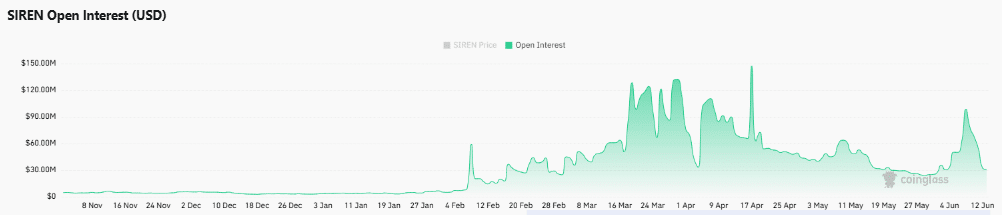
Despite the severe decline, derivatives traders continued increasing exposure. Open Interest climbed 25.34% to $37.72 million even as SIREN suffered one of its sharpest daily corrections. 

This divergence suggested fresh positions entered the market while the price moved lower. 

Rather than signaling confidence, the increase in leverage likely reflected growing speculative activity as traders positioned for further volatility. 

In many cases, rising Open Interest during a steep decline indicates new short positions entering the market instead of aggressive accumulation. 

The combination of falling prices and rising Open Interest reinforced the view that sellers maintained control of the market structure.

Source: CoinGlass

Long traders absorb the bulk of losses

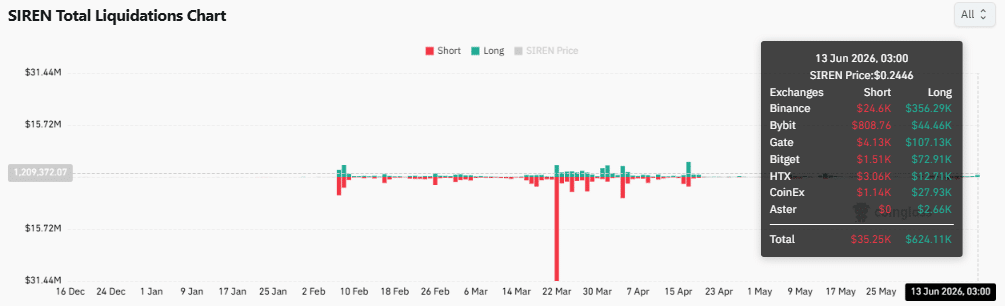
Liquidation data revealed a heavily one-sided event that punished bullish traders. Long liquidations reached approximately $624,000 while short liquidations totaled only about $35,000. 

This imbalance showed that buyers absorbed the overwhelming majority of forced closures during the decline. As long positions unwound, additional sell orders entered the market and intensified downward pressure. 

The liquidation cascade likely accelerated the speed of the breakdown and contributed to the dramatic daily loss. Unlike balanced liquidation events, this distribution reflected a market where bullish conviction deteriorated rapidly. 

Source: CoinGlass

Support breaks as sellers tighten control on SIREN

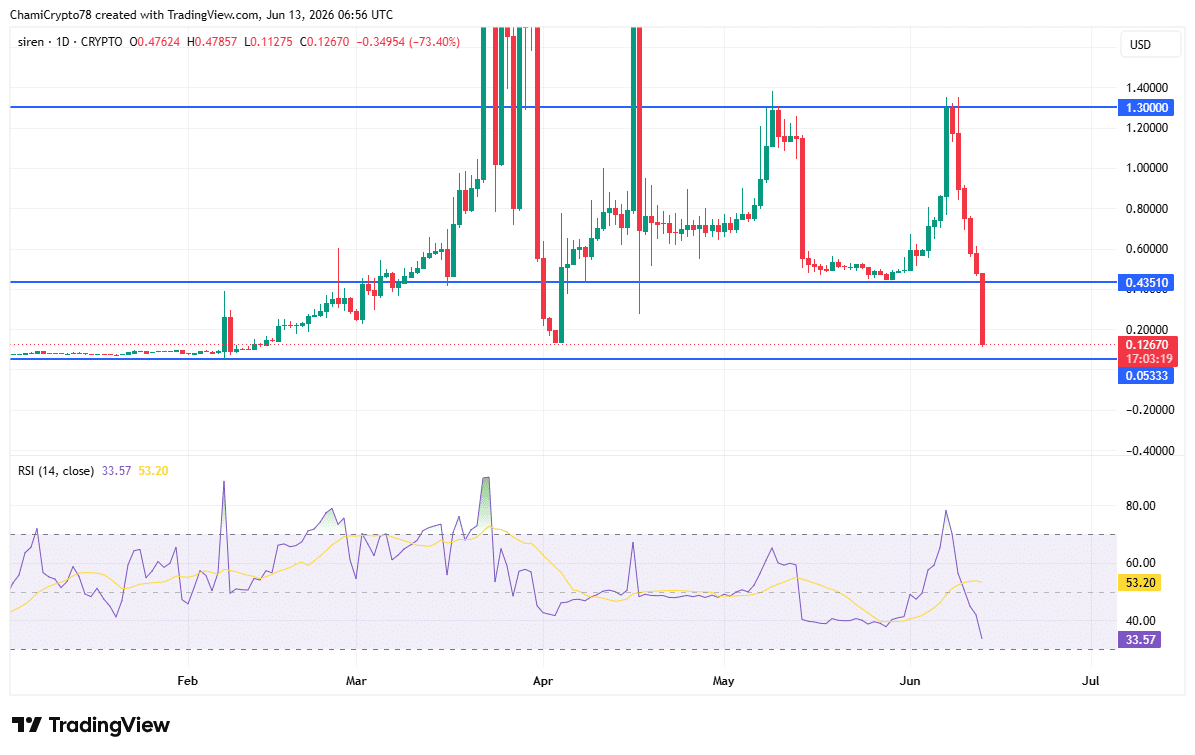
Technical conditions deteriorated significantly after SIREN lost the crucial $0.435 support level that had previously acted as a foundation for consolidation. 

The daily chart showed strong selling pressure from the recent $1.30 rejection zone, pushing the token toward its next major support at $0.053.

With the former support now lost, sellers maintained control of the broader trend and left buyers with little room to regain ground. RSI also weakened significantly, falling to 33.57 and approaching oversold territory.

While such readings can sometimes trigger short-term relief bounces, the indicator had not yet signaled a clear reversal.

Unless SIREN stabilizes above current levels and attracts fresh demand, traders will likely continue monitoring the $0.053 support zone as the next critical downside target.

SIREN price actionSIREN price action
Source: TradingView

Final Summary

  • SIREN lost a major support level as panic selling accelerated sharply.
  • Rising Open Interest suggests traders still expect significant volatility ahead.


Source link

My Husband and I Moved to Lisbon and Then Started a Business Together

0
My Husband and I Moved to Lisbon and Then Started a Business Together


“Do you think we should get a work divorce?” I asked Cody, furiously scribbling in my notebook about a client meeting.

“What do you mean?” he said as he flushed and looked up at me. “Honey, we literally just got the LLC paperwork filed with the IRS. We can’t quit now.”

It was April 2025, and Cody and I were still living out of suitcases after moving to Lisbon.

Both of us had recently been let go from our previous jobs within days of each other. In a fit of sweat and panic, we decided to really make a go of being entrepreneurs of our own micro-marketing agency. I’d bring nearly 15 years of experience in content and brand development and strategy, and he’d bring his project management skills, as well as manage the business’s finances. We’d be an unstoppable CMO/COO team.

It didn’t take long for the cracks to show.

I wondered if we would work well together

I had my doubts about working together from the outset; Cody knew this.

When we had full-time corporate jobs in the US, we’d run to each other to complain about things that would happen at work, as partners do. Something awkward happened in a meeting? I’d spill the tea to Cody at dinner. Weird conversation with a boss? We’d chuckle about it on the weekend.

At the end of the day, we were each other’s safe space. We would delight in what was happening in each other’s professional worlds without the pressure of needing to be part of it.

I loved that balance. We kept work at work, and when work was over, it was all about us.

When we decided to move to Lisbon and start fresh, it was as partners who had built a decade-long marriage on a foundation of sharing everything but work.

We started building our business anyway

When we found ourselves jobless mere weeks after moving our entire lives across an ocean, we decided to bet on ourselves.

Most companies in the US wouldn’t hire us in another country, so we set up our LLC and website. We then started letting close folks know we were available for hire.

We looked like a real business to the public, but inside, we were operating like fish flapping about on the forest floor.

This man, who before could read my every thought and finish my sentences, now didn’t know how to handle all the requests we were getting. I hadn’t a clue how to do taxes in two countries, and looked at him blankly whenever he asked me anything to do with numbers.

After 10 years, we knew our way around conflict as a couple. But owning our own business had us biting our tongues. Honestly, we hadn’t a clue how to work together.

But we eventually found that the tools we’d used in our marriage actually work for building a business together. Primarily: communication — about what we needed, about the tasks we hated doing that the other person was better at, about the burdens we didn’t want to name that we needed help with.

Once we figured out how to leverage each other’s strengths in the business, as we did in our relationship, things really began to click.

Not giving up gave us a new spark

My husband and I were comfortable American DINKS: a dual-income, no-kid couple who’d worked for nearly a decade to climb into tech, allocating nearly 3k a month to pay off six-figure student-loan debt for our degrees. We’d take those salaries, invest as our financial planner advised, allocate a hefty percentage to local orgs, and, of course, travel.

But we’d still close our laptops at the end of the day and immediately grab our smaller screens, for two to three hours spent passively glancing at a larger screen after dinner.

Today, we’re aware we’ll never see those salaries again. I’m not a “director” of anything. He’s not a “manager” of anyone. Instead, we’re entrepreneurs. We’re making less than half of what we made before, and even if we wanted to re-enter the search for full-time jobs in our fields, the job security we thought we had is no more. Layoffs have seemingly decimated the industries we previously worked in.

But what we get instead of those salaries is peace of mind in a new country as we create a deeper quality of life, plus the pleasure of seeing one another blossom into entirely new professional people, together.

Today, Cody and I have had 10 consecutive months of record revenue. Today, I serve as a fractional CMO for (two!) brands, and we both support four more on retainer and build brands for solopreneurs, too. We take every Friday off. We work from pubs in London and cafés in Paris.

Most importantly, we’ve learned to never let the pressures of work dull the shine of a hard-fought, beautiful marriage that we’ve been investing in from the very beginning. He’s the only coworker I’ve ever loved, and I’m so proud of us.




Source link

Ripple wants AI agents to pay in XRP and RLUSD. The market is still mostly USDC

0
Ripple wants AI agents to pay in XRP and RLUSD. The market is still mostly USDC

Ripple is trying to put XRP and RLUSD into the market for AI-agent payments in an environment that is still mostly paying in the dollar-pegged USDC stablecoin.

The company introduced the XRPL AI Starter Kit earlier this week, a set of developer tools for building AI agents that can send payments on the XRP Ledger, per a release shared with CoinDesk.

This kit includes XRPL documentation access through an MCP server (which connects a service’s AI tools to external data sources), Claude skills for wallet creation, balance checks and payments, and support for x402 payments using XRP and Ripple USD, Ripple’s dollar-backed stablecoin.

The pitch is that if AI agents are going to buy API access, pay for model inference, settle invoices or move value between services, they need payment rails that are cheap, fast and easy to trigger without a human clicking approve each time.

Ripple says XRPL can do that with three-to-five-second settlement, predictable fees, native payments, escrow, multisig and a built-in decentralized exchange.

But turning that into actual usage is where challenges lie, with the novel x402 system in focus.


Source link

You can ignore AI giants like SpaceX, but your 401(k) won’t

0
You can ignore AI giants like SpaceX, but your 401(k) won't


NEW YORK (AP) — While you might want to ignore all the hubbub around SpaceX, Elon Musk and IPOs, your 401(k) likely can’t.

SpaceX is now worth $2.1 trillion after its stock launched 19.2% higher in its debut on Wall Street. Whether or not you believe it deserves to be worth more than Exxon Mobil, Bank of America and Coca-Cola combined, the collective market does. And if SpaceX maintains that big a value, it will join some high-profile stock indexes.

Many of these indexes don’t care about how realistic a company’s growth plans are or who its CEO is. They’re simply trying to show how slices of the market, or the whole thing, are performing. And if SpaceX is big enough to meet the qualifications to join those indexes, whether it’s in a few weeks or a year, it will gain entry.

That matters for investors and their 401(k) accounts because they’re depending more than ever on funds that simply mimic these indexes. It’s a lower-cost way to invest, allowing savers to keep more of their investments. Partly because of that, such index funds have usually proven to be better performers than funds that try to pick and choose individual stocks.

Just one in five actively managed U.S. stock funds survived and beat their average index peer over the last decade, at 21%, according to Morningstar’s data through 2025. Such disparities in performance meant investors had more money invested in U.S. index funds than actively managed ones beginning in 2024, and the gap has only grown since then.

Here’s a look at what’s going on:

What indexes are

They’re things the investment industry has created to answer the question: What is the market doing? It’s otherwise tough to answer quickly when the U.S. market has thousands of stocks moving in different directions at any moment.

The S&P 500 is perhaps the most famous and influential index. It tracks 500 of the biggest U.S. stocks, and trillions of dollars in investments are either directly mimicking it or at least benchmarking themselves against it.

The Dow Jones Industrial Average is well known because it’s been around since the 19th century, but it tracks only 30 big stocks so Wall Street pays it little attention.

Companies want to be in indexes

Because index funds are the way so many investors put money into the stock market, companies want to be part of indexes. Stocks can see a big jump in their prices after S&P Dow Jones Indices, Nasdaq, FTSE Russell or other companies announce they’ll be joining their indexes.

The investment industry has created funds, including both traditional mutual funds and exchange-traded funds, to track almost every kind of index. More than 1,000 index funds were available at the end of last year, according to the Investment Company Institute. Of them, 185 tracked the S&P 500.


Source link

BTC, ETH, SOL price news: Bitcoin’s worst week in months got a late macro rescue

0
Bitcoin price live: BTC, ETH, XRP pull back, oil jumps 3% on Iran-Israel strikes

Strategy also sold about 800,000 shares for $128 million through its at-the-market program in the same week. If the bitcoin sale did not matter, traders were left asking why it needed to happen at all.

One possible answer is the S&P 500.

Strategy met the technical requirements for index inclusion in September 2025 but was passed over. Some market commentators have argued that the company’s refusal to sell bitcoin could make it look more like an investment vehicle than a treasury company, which would hurt its chances. Selling a small amount of bitcoin may help Strategy show it can use BTC as a corporate treasury asset, not just hold it forever.

The market reaction was real, however, as bitcoin was already trading into weak risk appetite. Iran tensions had pushed oil higher and revived higher-for-longer rate worries. Tech stocks were under pressure. Bitcoin traded more like a high-beta Nasdaq proxy than an independent store-of-value trade.

But the rebound came from the same macro channel.

President Donald Trump said the U.S. had effectively ended the war with Iran, while officials pointed to progress toward a signed accord. Brent crude fell toward $85. Stocks rallied. SpaceX listed on Nasdaq on Friday and closed at $161, up 19% from its $135 offer price, giving risk traders another reason to step back in.


Source link