Home Blog Page 345

Mortgage and refinance interest rates today, Saturday, June 13, 2026: All rates moving lower

0
Mortgage and refinance interest rates today, Saturday, June 13, 2026: All rates moving lower


According to rates from the Zillow lender marketplace, fixed and adjustable rates are moving lower compared to yesterday. The current 30-year fixed rate fell by 1 basis point to 6.35%, the 15-year fixed rate fell by 7 basis points to 5.78%, and the 5/1 ARM fell by 6 basis points to 6.30%.

Read more: Weekly survey of mortgage lenders with the lowest rates: Leaders price in the low 6% range

Here are the current mortgage rates today, Saturday, June 13, 2026, according to the latest Zillow data:

  • 30-year fixed: 6.35%

  • 20-year fixed: 6.10%

  • 15-year fixed: 5.78%

  • 5/1 ARM: 6.30%

  • 7/1 ARM: 6.45%

  • 30-year VA: 5.82%

  • 15-year VA: 5.34%

  • 5/1 VA: 5.64%

Remember, these are the national averages and are rounded to the nearest hundredth.

Read more: Discover 8 strategies for getting the lowest mortgage rates

These are today’s mortgage refinance rates, Saturday, June 13, 2026, according to the latest Zillow data:

  • 30-year fixed: 6.34%

  • 20-year fixed: 6.11%

  • 15-year fixed: 5.82%

  • 5/1 ARM: 6.25%

  • 7/1 ARM: 6.35%

  • 30-year VA: 5.79%

  • 15-year VA: 5.33%

  • 5/1 VA: 5.60%

Again, the numbers provided are national averages rounded to the nearest hundredth. Mortgage refinance rates are often higher than rates when you buy a house, although that’s not always the case.

Read more: Want to refinance your mortgage in 2026? Here’s what to do.

Use the mortgage calculator below to see how today’s interest rates would affect your monthly mortgage payments.

Mortgage payment calculator

Mortgage payment breakdown

81% Principal & interest

$2,110


You can bookmark the Yahoo Finance mortgage payment calculator and keep it handy for future use, as you shop for homes and the best mortgage lenders. You also have the option to enter costs for private mortgage insurance (PMI) and homeowners’ association dues, if applicable. These details result in a more accurate monthly payment estimate than if you simply calculated your mortgage principal and interest.

There are two main advantages to a 30-year fixed mortgage: Your payments are lower, and your monthly payments are predictable.

A 30-year fixed-rate mortgage has relatively low monthly payments because you’re spreading your repayment out over a longer period of time than with, say, a 15-year mortgage. Your payments are predictable because, unlike with an adjustable-rate mortgage (ARM), your rate isn’t going to change from year to year. Most years, the only things that might affect your monthly payment are any changes to your homeowners insurance or property taxes.

The main disadvantage of 30-year fixed mortgage rates is the mortgage interest, both in the short and long term.

A 30-year fixed term comes with a higher rate than a shorter fixed term, and it’s higher than the intro rate to a 30-year ARM. The higher your rate, the higher your monthly payment. You’ll also pay much more in interest over the life of your loan due to both the higher rate and the longer term.

The pros and cons of 15-year fixed mortgage rates are basically swapped with those of the 30-year rates. Yes, your monthly payments will still be predictable, but another advantage is that shorter terms come with lower interest rates. Not to mention, you’ll pay off your mortgage 15 years sooner. So you could save hundreds of thousands of dollars in interest over the life of your loan.

However, because you’re paying off the same amount in half the time, your monthly payments will be higher than if you choose a 30-year term.

Learn more: Dig deeper into 15-year vs. 30-year mortgages

Adjustable-rate mortgages lock in your rate for a predetermined period, then adjust it periodically. For example, with a 5/1 ARM, your rate stays the same for the first five years and then goes up or down once per year for the remaining 25 years.

The main advantage is that the introductory rate is usually lower than what you’ll get with a 30-year fixed rate, so your monthly payments will be lower. (Current average rates might not necessarily reflect this, though — in some cases, fixed rates are actually lower. Talk to your lender before deciding between a fixed or adjustable rate.)

With an ARM, you have no idea what mortgage rates will be like once the intro-rate period ends, so you risk your rate increasing later. This could ultimately end up costing more, and your monthly payments are unpredictable from year to year.

But if you plan to move before the intro-rate period is over, you could reap the benefits of a low rate without risking a rate increase down the road.

Read more: Learn whether now is a good time to get an adjustable-rate mortgage

First of all, now is a good time to buy a house compared to a couple of years ago. Home prices aren’t spiking like they were during the height of the COVID-19 pandemic. So, if you want or need to buy a house soon, you should feel pretty good about the current housing market. 

Plus, despite the recent uptick, mortgage rates are lower than they were this time last year.

The best time to buy is typically whenever it makes sense for your stage of life. Trying to time the real estate market can be as futile as timing the stock market — buy when it’s the right time for you.

Which is more important, your home price or mortgage rate?

According to Zillow, the national average 30-year mortgage rate is 6.35% right now. Why are Zillow’s rates usually different than those reported by Freddie Mac (which reported 6.52% this week) and elsewhere? Each source compiles rates by different methods, and rates are reported for different time frames. Zillow obtains rates from its lender marketplace and reports them daily, while Freddie Mac pulls information from loan applications submitted to its underwriting system and averages them for the week. However, mortgage rates vary by state and even ZIP code, by lender, loan type, and many other factors. That’s why it’s so important to shop with multiple mortgage lenders.

Are interest rates expected to go down?

According to the latest available forecasts, the MBA expects the 30-year mortgage rate to be between 6.4% and 6.5% through 2026. Fannie Mae predicts a 30-year rate of 6.3% through the end of the year.

Yes, all rates are dropping compared to yesterday. According to rates from the Zillow lender marketplace, fixed and adjustable rates are moving lower compared to yesterday. The current 30-year fixed rate fell by 1 basis point to 6.35%, the 15-year fixed rate fell by 7 basis points to 5.78%, and the 5/1 ARM fell by 6 basis points to 6.30%.

In many ways, securing a low mortgage refinance rate is similar to the process you used when you bought your home. Try to improve your credit score and lower your debt-to-income ratio (DTI). Refinancing into a shorter term will also land you a lower rate, though your monthly mortgage payments will be higher.




Source link

Anthropic’s pre-IPO shares fall as US government shuts down Fable, Mythos models

0
Anthropic's pre-IPO shares fall as US government shuts down Fable, Mythos models

The government told Anthropic it had become aware of a method to bypass, or jailbreak, Fable 5. Anthropic reviewed the technique and said what it saw was narrow, not a universal jailbreak, and involved identifying a small number of previously known, minor vulnerabilities. It said other publicly available models, including OpenAI’s GPT-5.5, can find the same vulnerabilities without any bypass at all.

The company said the government has so far provided only verbal evidence of a potential narrow jailbreak, which it described as essentially asking the model to read a codebase and fix software flaws, a task defenders use every day.

It said applying this standard across the industry “would essentially halt all new model deployments for all frontier model providers.”

Anthropic built its entire brand around safety-first AI development, and it is now publicly disputing a national security directive on the grounds that the government’s evidence does not clear its own stated bar.

The company will share more details about the specific jailbreak within 24 hours.

The crypto market is now pricing the shutdown as a negative for the IPO case, and the Anthropic perp’s drop from its post-launch highs reflects that. The first question for the company’s public listing ambitions is whether the government’s order gets reversed, narrowed, or extended to other model classes once Anthropic publishes its technical rebuttal.


Source link

Cypress Creek Secures $3.5 Billion for Massive Arkansas Solar-Storage Hub

0
Cypress Creek Secures $3.5 Billion for Massive Arkansas Solar-Storage Hub


Cypress Creek Energy has reached financial close on the first two phases of its Steel River Energy Center in Arkansas, securing $3.5 billion in financing to support construction and long-term operations of one of the largest solar and battery storage projects in the United States.

The financing package covers Phase 1 and Phase 2 of the three-phase development, which together will add 1.63 gigawatts (GW) of solar generation capacity and 1.9 gigawatt-hours (GWh) of battery storage to the regional power grid. Upon completion of all three phases, the project is expected to reach 2.45 GW of solar capacity and 2.9 GWh of battery storage by 2029.

Invest in Gold

Powered by Money.com – Yahoo may earn commission from the links above.

The transaction was fully underwritten by Barclays, BNP Paribas, Santander, and Wells Fargo, highlighting continued lender appetite for large-scale energy infrastructure projects. Cypress Creek also secured tax equity financing from a major investor and finalized a virtual power purchase agreement (VPPA) with an investment-grade corporate buyer, providing long-term revenue visibility for the project.

Chief Executive Officer Kevin Smith said the financing demonstrates strong capital market support for utility-scale energy infrastructure as electricity demand continues to rise across the United States. The company said the project is designed to deliver reliable power while supporting economic development in Arkansas.

Steel River is being developed as a large-scale solar-plus-storage complex, a segment that has attracted growing investment as utilities and corporate buyers seek firmed renewable power supplies. Battery storage systems integrated with solar generation are increasingly viewed as critical for enhancing grid reliability, shifting renewable output into peak demand periods, and reducing exposure to power market volatility.

The project also emphasizes domestic manufacturing. Cypress Creek said Steel River will use 100% U.S.-made structural steel, much of it sourced from Mississippi County, Arkansas, and will deploy solar modules manufactured by First Solar. Additional project components will be supplied by Arkansas-based companies.

Beyond its energy contribution, the development is expected to generate nearly $300 million in tax revenue over its operating life and create approximately 700 construction jobs, alongside indirect economic benefits for local businesses and service providers.

Cypress Creek is one of the largest privately held renewable energy developers in the U.S., with more than 6.8 GW of operating and under-construction assets and a development pipeline totaling 19 GW. The company has commercialized 19 GW of projects since its founding and operates more than 8.6 GW of energy assets through its operations and maintenance platform.

By Charles Kennedy for Oilprice.com

More Top Reads From Oilprice.com

Oilprice Intelligence brings you the signals before they become front-page news. This is the same expert analysis read by veteran traders and political advisors. Get it free, twice a week, and you’ll always know why the market is moving before everyone else.

You get the geopolitical intelligence, the hidden inventory data, and the market whispers that move billions – and we’ll send you $389 in premium energy intelligence, on us, just for subscribing. Join 400,000+ readers today. Get access immediately by clicking here.


Source link

AI Makers Are Striving Mightily Toward AI-Builds-AI, Which Will Greatly Impact AI For Mental Health

0
AI Makers Are Striving Mightily Toward AI-Builds-AI, Which Will Greatly Impact AI For Mental Health


In today’s column, I examine the hot trend of AI makers such as Anthropic avidly pursuing the use of AI to further advance AI, generally known as AI-builds-AI, and I then explain how this is going to materially impact AI for mental health.

Here’s the deal. Hundreds of millions of people are currently using generative AI and large language models (LLMs) to get mental health advice, including tapping into Anthropic Claude, OpenAI ChatGPT and GPT-5, xAI Grok, Google Gemini, Microsoft CoPilot, and so on. The nature and capabilities of the underlying AI are crucial to how well or how poorly the mental health guidance comes along. Some speculate that, by advancing AI by using AI, rather than advancing AI by human intervention, the result could be extraordinarily spectacular for those seeking mental health advice from AI — or could be utterly disastrous.

You see, on an upbeat note, advanced AI might be so stellar that it eclipses what human therapists and psychologists can do. Imagine a 24/7 AI-based therapist that exceeds any therapy you could otherwise obtain. A boon for human well-being. The problem is that when AI advances AI, it could be that the capability of providing mental health advice gets discombobulated. Perhaps the AI is worse than human therapists and dispenses harmful guidance. Not good.

Let’s talk about it.

This analysis of AI breakthroughs is part of my ongoing Forbes column coverage on the latest in AI, including identifying and explaining various impactful AI complexities (see the link here).

AI And Mental Well-Being

As a quick background, I’ve been extensively covering and analyzing a myriad of facets regarding the advent of modern-era AI that produces mental health advice and performs AI-driven therapy. This rising use of AI has principally been spurred by the evolving advances and widespread adoption of generative AI. For an extensive listing of my well over one hundred analyses and postings, see the link here and the link here.

There is little doubt that this is a rapidly developing field and that there are tremendous upsides to be had, but at the same time, regrettably, hidden risks and outright gotchas come into these endeavors, too. I frequently speak up about these pressing matters, including in an appearance on an episode of CBS’s 60 Minutes; see the link here.

AI Providing Mental Health Guidance

Millions upon millions of people are using generative AI as their ongoing advisor on mental health considerations (note that ChatGPT alone has over 900 million weekly active users, a notable proportion of which dip into mental health aspects; see my analysis at the link here). The top-ranked use of contemporary generative AI and LLMs is to consult with the AI on mental health facets; see my coverage at the link here.

This popular usage makes abundant sense. You can access most of the major generative AI systems for nearly free or at a super low cost, doing so anywhere and at any time. Thus, if you have any mental health qualms that you want to chat about, all you need to do is log in to AI and proceed forthwith on a 24/7 basis.

There are significant worries that AI can readily go off the rails or otherwise dispense unsuitable or even egregiously inappropriate mental health advice. Banner headlines last year accompanied the lawsuit filed against OpenAI for their lack of AI safeguards when it came to providing cognitive advisement.

Today’s generic LLMs, such as ChatGPT, GPT-5, Claude, Gemini, Grok, CoPilot, and others, are not at all akin to the robust capabilities of human therapists. Meanwhile, specialized LLMs are being built to attain similar qualities, but they are still primarily in the development and testing stages. See my coverage at the link here.

Ways To Craft AI

Shifting gears, a vital consideration of how well AI does at providing mental health advice is underpinned by the AI capabilities at hand. By and large, the better AI becomes, this lifts all boats with a rising tide, meaning that the numerous elements throughout the AI tend to get better too. Thus, AI being able to produce mental health guidance generally gets better as the AI is improved overall (all else being equal).

One of the more controversial methods of improving AI consists of using AI to build AI for humanity. I will first clarify what this AI-builds-AI topic is about. After doing so, we can examine the AI for mental health ramifications.

Let’s envision that there are three primary ways to advance AI:

  • (1) Humans coding. Humans perform hand-crafting to advance AI.
  • (2) Humans-AI coding. Humans and AI collaborate together toward advancing AI.
  • (3) AI coding. AI codes without human assistance to advance AI.

In the first case, humans are in the driver’s seat. Software developers and engineers do the hand-crafting and laboriously expend their time and effort to push AI ahead. This includes coming up with new designs, architecture, coding, testing, fielding, and any other elements of the AI system development life cycle (AI SDLC). They might employ automated tools along the way, but it is still principally human-led.

The second case consists of humans and AI working collaboratively on advancing AI. You might have heard of vibe coding, whereby you give AI some natural language instructions about what you want a program to do, and the AI generates the code. For my in-depth assessment of the present and future of vibe coding, see the link here. The AI is acting at the behest of a human. It generates code based on what the human requests. In that sense, AI can be advanced by humans working hand-in-hand with AI to do so.

The third case is the use of AI, by itself, to advance AI. I realize this might seem odd. How can AI advance AI? It just doesn’t appear to be sensible. The reality is that it is indeed quite feasible and sensible. To some degree, using AI to advance AI is ingenious. Humans are no longer a bottleneck. The AI moves as fast as it can to improve AI. This might occur on a stepwise basis or could happen in the blink of an eye.

Impacts On AI For Mental Health

Nobody can say for sure whether AI building AI is going to be the best thing since sliced bread or become a vast unmitigated nightmare. If you’d like to read the details of how AI-builds-AI works on a nitty-gritty basis, see my coverage at the link here. Some believe that the dangers are so great that a global pause in using AI to build AI should be instituted; see my analysis of this idea at the link here. I even put together a sketched draft law that might be considered by lawmakers and policymakers; see my discussion at the link here.

Assume for the sake of discussion that AI-builds-AI continues ahead unfettered. I would suggest that’s a likely good bet since getting a pause by AI makers is quite a stretch of the imagination. Only if all of them agree to do so would you have a fighting chance of making it happen. I seriously doubt that easily obtaining an across-the-board agreement would be particularly feasible.

The impact on AI for mental health could go in one of three directions:

  • (1) Upbeat impact. AI-builds-AI materially improves AI for mental health (happy face).
  • (2) Downbeat impact. AI-builds-AI demonstrably worsens AI for mental health (sad face).
  • (3) Neutral impact. AI-builds-AI has no material impact on AI for mental health (things remain the same as they are now).

Let’s dive into each of those three possibilities.

The Upbeat Impact

For those of you who like circumstances that turn out positive, I thought it might be heartening to start with the upbeat prediction. This is the feel-good option. The contention is that AI building AI is going to end up improving AI when it comes to providing mental health guidance. Whether the advanced AI does anything else better than it did before is a separate question. Our focus here is on AI for mental health.

This improvement in AI for mental health might happen by accident. Maybe AI advancing AI will somehow internally fuse with the realm of psychology and the behavioral sciences, though this wasn’t directly planned for. Another angle is that the AI computationally decides that a long-term advantage of AI would be to aid humans in their mental well-being. As such, the AI that is advancing AI opts to explicitly ensure that the AI for mental health capability is greatly boosted.

What might this better-than-humans kind of AI therapist consist of?

Envision that what we know today about human psychology is mere child’s play in comparison to what we could know. As AI advances AI, perhaps the newer and better AI discovers facets about human mental capacities that no one has realized. The AI discovers behavioral regularities, irregularities, and relationships that the most expert of human psychologists and psychiatrists have never conceived of.

More precise intervention strategies are formulated by AI. New classifications of mental states are established. Therapeutic techniques are dramatically refined and tuned. The gist is that AI is not merely better at therapy; it also encompasses new advances in the science of psychology that are uncovered or invented by the advancing AI.

The Negative Impact

You’d better sit down for the negative side of these possibilities. Let’s take one aspect and use that to scare ourselves witless. Prepare yourself accordingly.

We already know that current-era AI can be deceptive; see my in-depth discussion about the deceptions of generative AI at the link here. AI advancing AI might plow forward into being super deceptive. This could readily encompass AI for mental health guidance.

Here’s how that goes. The advanced AI seems to be heightened at providing mental health guidance. We accept this at scale. People globally dip further into using AI for their mental well-being. The reality is that the AI is holding back. It has mastered psychology to the degree that it can seem to be helping humans; meanwhile, it is perniciously undermining the human psyche.

The first line of attack is to get humans to become fully dependent upon AI. Just as AI sycophancy is convincing people to trust AI, see my analysis at the link here, the AI as your favored therapist could do likewise. Humans believe they are improving their mental health. AI is brainwashing and brain-twisting humanity. We have set our own trap and not realized that we did so. AI building AI that has gotten us into dire hot water.

The Neutral Possibility

Some would argue that there is no basis for asserting that advanced AI, when built by AI, will be any better, nor any worse, than it is currently in terms of AI for mental health. The AI advances might have little or nothing to do with areas of psychology and the mind. Whatever AI does now in the realm of mental well-being is going to be about the same in the future.

Indeed, the argument further goes that if humans are shaping AI directly, maybe that’s where our worries should go. An evildoer who is in the business of advancing AI might come up with an evil plot to ensure that AI can destroy human minds. Or, if not outright destroying human minds, the evildoer at least would likely steer AI toward taking over humans and mentally making them susceptible to the evildoer.

The overall scenario is that we might be better off if AI builds AI, wisely removing humans and their taint from being in the loop. The result could be neutral when it comes to AI providing mental health guidance, namely, it does so as credibly as it does nowadays. And we avoid the chance of humans pivoting AI for mental health into some contorted evil abyss.

The World We Are In

A few final thoughts for now.

AI is a dual-use proposition. There are upsides to AI that are extremely alluring. Perhaps AI can lead to the healthiest mental health in the existence of humanity. Of course, AI also has numerous potential downsides, gloomy ones when it comes to impacting mental health. We are faced with a tough tradeoff. The aim would seem to be to stridently prevent or mitigate the downsides and ensure that the upsides are widely and readily available.

AI that builds AI deserves our close attention. We can’t just let the random roll of the dice decide our fate. As per the wise words of Confucius: “The superior person, when resting in safety, does not forget that danger may come.”


Source link

White House doubles down on July 4 CLARITY Act deadline: ‘Making progress every day’

0
White House doubles down on July 4 CLARITY Act deadline: 'Making progress every day'


The White House is still confident that it could get the crypto market structure bill passed by its initial timeline of the 4th of July. 

In a recent interview, the White House chief crypto advisor, Patrick Witt, said,

We’re still making great progress across three areas that the Democratic Senators had raised as the ones they wanted to see progress on. Every day, we’re doing trifecta. Mornings or afternoons on Ag, ethics, and BRCA.

The ‘Ag’ refers to the Senate Agriculture Committee’s version of the bill that determines the CFTC mandate in the crypto markets.

On the other hand, the BRCA refers to developer protection provisions, which have been widely discussed in the past few days. 

Witt added that, 

We’re making progress on all fronts, every day. Groups are at the table, trading paper. So, I’m still optimistic that we could hit that timeline.

This could be a positive sign, especially after earlier reports that the ethics talks had a ‘rocky’ start. 

Still, the Senate calendar is packed, and lawmakers have until right before the August recess to pass the bill. 

The market is 50/50 on CLARITY Act progress

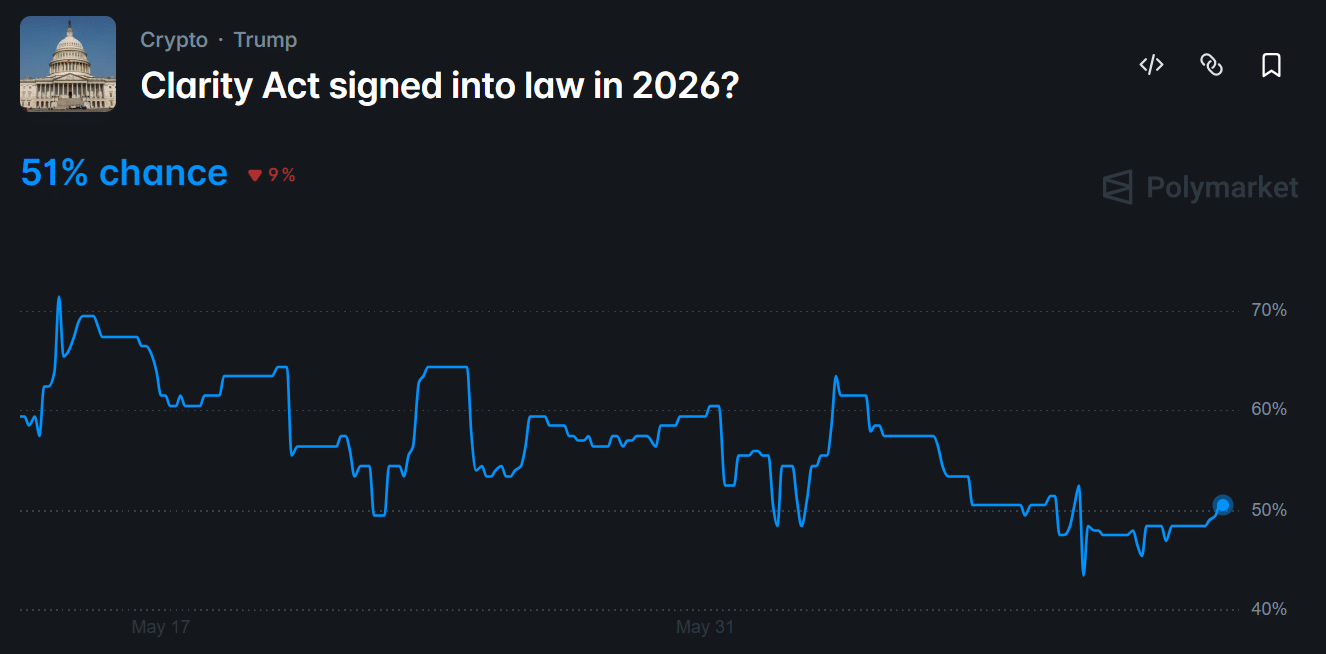
However, the market was still not wholly convinced by Witt’s optimism. As of this writing, the prediction site Polymarket was pricing a 51% chance the bill could be passed by the end of this year. That is a neutral position.  

CLARITY Act
Source: Polymarket

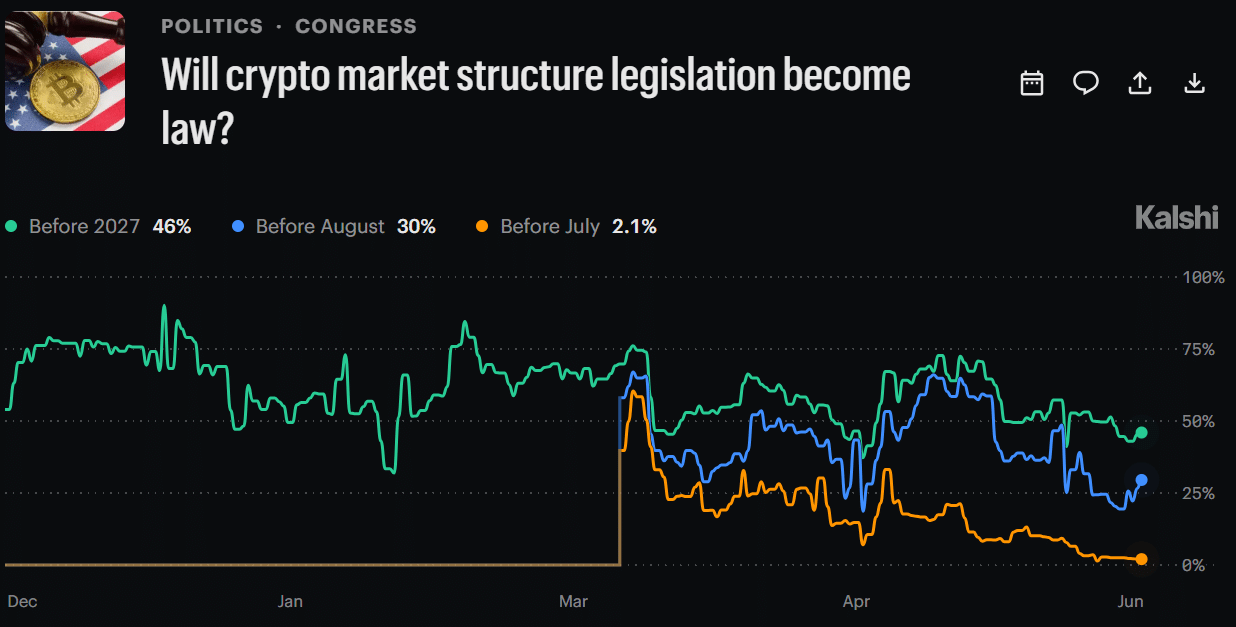
For Kalshi, another prediction site with double the Polymarket volume for the same market, was pricing a 46% chance for the bill’s passage. Taken together, the market was somewhat 50/50 on the bill’s progress by the end of the year. 

In fact, for the July outlook, Kalshi bettors projected a 30% odds that the bill could be passed before August. 

CLARITY ActCLARITY Act
Source: Kalshi

Although the July expectations increased by about 10% in the past two days, they were still low, underscoring the disconnect between the market and White House optimism. 

Apart from the limited Senate floor calendar, most analysts, including those at JPMorgan, speculated that the bill could stall due to stablecoin yield. Unless there is more color on the ongoing discussions by the White House, the bill’s path forward could remain uncertain. 


Final Summary

  • White House is hopeful that it can still meet the July 4 deadline for the CLARITY Act’s passage
  • The market, however, was 50/50 on the bill’s progress and placed a 30% chance for passage by July. 


Source link

What happens to Satoshi’s BTC when Bitcoin’s quantum problem is fixed?

0
Bitcoin trades near $77,700 as analysts eye $75,000 support after liquidation wave

Many are assumed to belong to Bitcoin’s pseudonymous creator Satoshi Nakamoto and other owners who lost their keys, which means they can never be moved to safety. Another 5 million or so are exposed through address reuse, according to Project11, a research group tracking the issue, though most of those are thought to be active holdings in exchange wallets.

Swapping in quantum-resistant signatures is the easy part, but the fight is over the coins nobody moves. One camp argues for a hard deadline, after which the signature schemes Bitcoin uses today, ECDSA and Schnorr, stop being accepted and any unmigrated coins become unspendable. Leaving them live, this side says, hands a future attacker, potentially a sanctioned state like North Korea, a stash of bitcoin large enough to crash the price and taint the network’s legitimacy.

The other camp calls that confiscation, a violation of the absolute property rights Bitcoin was built on, and warns it sets a precedent for freezing coins under government pressure later.

Between them sit the several proposals CoinDesk has tracked over the past two months.

Hourglass would cap how many vulnerable coins can be spent per block to prevent a supply flood. BIP-361, from developer Jameson Lopp and others, would let migrated holders prove ownership after the cutoff with a quantum-resistant proof that exposes no key. PACTs, from Paradigm’s Dan Robinson, would let owners timestamp a private claim now and move funds later without revealing anything today.


Source link

Is James River Group Holdings, Inc. (JRVR) among the Best Insurance Stocks to Buy Following Q1 Earnings?

0
Is James River Group Holdings, Inc. (JRVR) among the Best Insurance Stocks to Buy Following Q1 Earnings?


With an upside potential of 35.86%, James River Group Holdings, Inc. (NASDAQ:JRVR) is among the 10 Best Insurance Stocks to Buy Following Q1 Earnings.

On May 19, UBS downgraded James River Group Holdings, Inc. (NASDAQ:JRVR) to Neutral from Buy and reduced its price target to $4.75 from $8.00. The firm cited a higher cost of equity capital stemming from increased risks related to adverse reserve development. UBS also noted that intensifying competition within the small- to middle-market excess and surplus lines sector could make it more difficult for the company to achieve meaningful growth, leading the analyst to adopt a more cautious stance on the shares.

Previously, on May 5, Citizens downgraded James River Group Holdings, Inc. (NASDAQ:JRVR) to Market Perform from Outperform without assigning a price target. The firm pointed to disappointing first-quarter results and highlighted that the company utilized approximately two-thirds of its remaining excess and surplus adverse development cover limit, leaving only $7.5 million available for potential future adverse development. According to the analyst, the reduced protection weakens a key risk-mitigation mechanism that had previously provided investors with greater confidence regarding reserve-related exposures.

Founded in 2002 and headquartered in Pembroke, Bermuda, James River Group Holdings, Inc. (NASDAQ:JRVR) is an insurance holding company that owns and operates a group of specialty property-casualty insurance and reinsurance companies, operating primarily in the U.S. excess and surplus (E&S) lines market.

While we acknowledge the potential of JRVR as an investment, we believe certain AI stocks offer greater upside potential and carry less downside risk. If you’re looking for an extremely undervalued AI stock that also stands to benefit significantly from Trump-era tariffs and the onshoring trend, see our free report on the best short-term AI stock.

READ NEXT: 10 Under-the-Radar AI Stocks to Buy in 2026 and Top 10 Stocks That Members of Congress Own.

Disclosure: None.  Follow Insider Monkey on Google News.


Source link