Home Blog Page 346

Maelstrom backs Bitcoin privacy – Days after dumping its entire Zcash bag

0
Maelstrom backs Bitcoin privacy - Days after dumping its entire Zcash bag


Maelstrom, the family office of BitMEX co-founder Arthur Hayes, is pushing further into crypto privacy, with two of the four developers it funds through its Bitcoin Grant Program now working full-time on tools that make transactions harder to trace.

The fund disclosed the split in its first annual report on the program, which has paid open-source developers in monthly Bitcoin installments under 12-month contracts since October 2024 and caps grant stacking at $400,000 a year.

Benalleng and Macgyver handle the privacy work, while Rkrux and Stratospher contribute to Bitcoin Core, the network’s main software. Maelstrom framed the grants as long-term backing for Bitcoin’s technical development.

The report said,

The program is aiming to provide its grantees with relatively stable and long term funding. The developers are working on open source technology to improve Bitcoin, with respect to scalability, robustness and privacy.

The two privacy projects attack traceability from different angles. One lets the sender and receiver jointly add inputs to a single transaction so it no longer resembles a standard payment, breaking common surveillance heuristics.

The other lets recipients accept funds without reusing or publishing addresses.

Bitcoin wallets and Solana race to close the same privacy gap

Vikrant Sharma, founder of Cake Wallet, told AMBCrypto that the wallet’s Bitcoin Silent Payments and Payjoin v2 integration fills a gap Bitcoin left open.

“People want to use Bitcoin on the go and they don’t want to reveal their history and balances and all that. Bitcoin is open and permissionless but without privacy, it’s a surveillance tool.”

The same push is reshaping other chains. Helius’s acquisition of Light Protocol aims to build a programmable, fully on-chain privacy layer for Solana, covering encrypted balances and payments for both retail and institutional users.

Maelstrom exits Zcash even as it funds Bitcoin privacy

The grants land as Hayes confirms Maelstrom has sold its entire position in Zcash [ZEC], one of the largest privacy tokens.

He tied the exit to a vulnerability in Zcash’s Orchard pool that could have allowed counterfeit ZEC to be minted undetected. Hayes said he viewed actual minting as unlikely but could not cryptographically rule it out, and he left the door open to re-entry.

He said,

We [Maelstrom] will consistently re-evaluate our thinking and if my assumptions are proven incorrect, will rebuy, hopefully at lower prices.

Privacy tokens remain a fraction of the broader market, with a combined capitalization near $51 billion led by Zcash [ZEC], Monero [XMR], and Dash [DASH], and press-time trading volume of $3.3 billion.


Final Summary

  • Arthur Hayes’ family office Maelstrom is funding Bitcoin privacy work, with half its grant recipients now focused on making transactions harder to trace.
  • The move comes just after Maelstrom sold its entire ZEC holding over a security scare.


Source link

Musk’s SpaceX raises $75 billion in largest IPO ever

0
Musk's SpaceX raises $75 billion in largest IPO ever


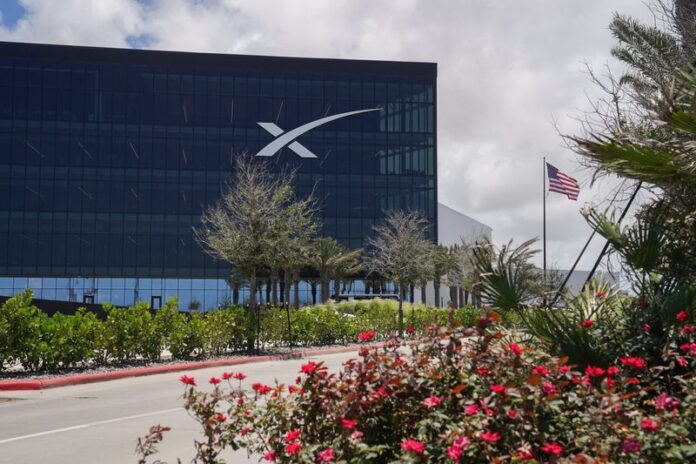
June 11 (Reuters) – Elon Musk’s SpaceX raised the $75 billion it targeted in a hotly awaited IPO on Thursday, selling shares at a fixed price of $135 that valued the space, satellite and AI company at $1.77 trillion.

The largest ‌ever IPO cements SpaceX’s status as one of the world’s most valuable companies. Its shares will begin trading ‌on the Nasdaq on Friday.

Here are some comments on the IPO:

MARK KLEIN, CEO AND PRESIDENT OF SURO CAPITAL:

“The IPO parade, which now looks like it’s turning ​into a stampede, has been coming for a while. You could argue there were flickers of it as early as last year, but it never fully materialized into a broad wave of companies. SpaceX is going to be the bellwether.”

NANCY TENGLER, CEO AND CHIEF INVESTMENT OFFICER OF LAFFER TENGLER INVESTMENTS:

“From our perspective, it is definitely an AI company, but we’re focused on the benefits, scale, and cost ‌reductions that could come from building data centers ⁠in space and from making Starship fully reusable. They’re not there yet. They’re saying the second half of 2026, but that would be a game changer in our view.

“And then they’ve got the ⁠profit generator in Starlink. The TAM on that business is pretty compelling, and I think they’re only scratching the surface.”

JOHN BELTON, PORTFOLIO MANAGER OF GABGX AT GABELLI FUNDS:

“SpaceX is the ultimate growth stock. I think this is a company with significant growth potential ahead of it. ​It’s definitely ​going to be a long-term story, and I think it will ​take time for the stock to find its footing ‌in the public markets. But there are a lot of exciting opportunities ahead.”

JAY WOODS, CHIEF MARKET STRATEGIST AT FREEDOM CAPITAL MARKETS:

“What we’ve seen with many high-profile IPOs is an initial surge in price followed by a period where investors give some of those gains back. I think that’s the most likely scenario here as well.”

“My concern is that retail investors who receive allocations may not take profits soon enough and could get hurt if the stock pulls back. More importantly, investors who missed the IPO ‌may chase the stock in the secondary market after a significant run-up, ​and historically those investors tend to be the most vulnerable if momentum reverses.”

MATT ​KENNEDY, SENIOR STRATEGIST AT RENAISSANCE CAPITAL, A PROVIDER OF ​IPO-FOCUSED RESEARCH AND ETFS:

“Normally I’d say that pricing at the expected terms doesn’t indicate a ton of ‌enthusiasm, but this may be the exception. Here we ​just don’t know. Sure, an ​upsizing or downsizing would have given us a signal. But the company set a single proposed price, and stuck with it.”


Source link

AI shopping agents are coming. No one is ready for them

0
AI shopping agents are coming. No one is ready for them

AI shopping agents are coming. But no one is ready.

While plenty of people are using AI models to help discover products they might want to buy, a customer cannot easily get an AI agent to complete a purchase on their behalf due to security protocols, a lack of agentic commerce standards, and retailer policies that have sought to block third-party shopping agents, said Matt Maher, the founder and CEO of M7 Innovations, an indepedent tech research and development firm.

Melissa Bridgeford, the cofounder and CEO of Wizard Commerce, which makes AI shopping agents, said that even for product discovery, existing AI models, such as OpenAI’s ChatGPT often fall short. She noted that even when a user asks ChatGPT about a product type it might want to purchase, such as ski gloves, it responds with specific product recommendations only 9% of the time.

She said she thought OpenAI had fumbled its initial efforts to build its chatbot into a commerce platform, pivoting away from its Instant Checkout feature that allowed a user to complete a purchase directly from the chat interface. That decision also caused OpenAI’s initial retailers, such as Walmart, to pull out of the relationship.

She also said that she thought the industry was coalescing around allowing agentic commerce to proceed, but allowed that there was still no agreement over how to handle fraud, refunds, and returns—all major issues that could hold back the rollout of shopping agents.

Courtney Robinson, the head of policy and communications at open finance platform Akoya, said that liability in the case of fraud or if an AI agent undertakes a purchase that a customer claims they didn’t intend to make remains one of the biggest unsolved challenges holding back agentic commerce. “Regulation always follows innovation,” she said. “Liability is wide open right now and being negotiated company to company, but there are no standards around where liability sits when an agent buys something that maybe the user didn’t intend or ask for.”

Maher said that while many large companies will seek to protect themselves from legal liability for these kinds of AI agent errors through the terms and conditions of using their websites or agentic commerce gateways, he believed that using terms and conditions would not exempt the merchants from what he called “perceptual liability.” If his AI agent inadvertently bought a blazer from the Gap that he didn’t want the agent to buy, he said by way of example, he was likely still to complain to the Gap and expect a refund, especially if he is a loyal Gap customer.

Security is also a huge challenge. “We have a huge online fraud problem, ecommerce problem without agents and agents are only going to magnify the problem exponentially,” Norman Menz, CEO of cybersecurity company Flare, said. “The attack surface keeps expanding.” He said there were likely to be problems both with bad actors hijacking people’s legitimate agents and using them to make fraudulent purchases and bad actors spinning up their own agents using stolen identities and credit card information.

Adam Winnick, the cofounder and CEO of Finality, a company that uses blockchain technology to enable business, said he thought there would need to be new open source standards and systems around the monitoring and identity verification of AI agents and around ensuring that those agents had been empowered by their legitimate owners to conduct specific transactions on behalf of users. He said blockchain could play a role in such a solution, although he said there might be other ways to create such a system too.

The problem, many panelists said, was that the creation of such standards historically take years, while consumers are pushing to use AI agents for shopping now. “I think there is going to be a demand in the market to adopt and allow for the continued use of [AI shopping agents] before we have a solution to solve for fraud,” Menz said.

Ben Leventhal, the founder and CEO of Blackbird Labs, a blockchain-based dining rewards program for restaurants, said his company was close to being able to enable AI agents to search for restaurants and make reservations on a user’s behalf. He said in the restaurant space, he was less worried about payment fraud, because diners usually paid at the restaurant using a credit card, but that identity verification was still a key unsolved issue for AI agents.

Like Winnick, Leventhal said he thought blockchain technology could help solve this identity issue, but that other solutions might be possible and that existing identity management firms were likely to figure it out. “There is going to be an identity payload that people or their agent will carry with them,” he said.

Leventhal said that in the meantime it was likely that merchants would simply bear the risk of fraud, as they do currently in most “card not present” transactions, such as most ecommerce purchases, where no physical credit card is handed over and the customer is not physically there either.

He was also optimistic about the future of agentic commerce. “Innovators and entrepreneurs are going to find killer use cases and they are going to be impossible to resist,” he said. A lot of the current clunkiness of shopping through chatbots and using AI agents “will get abstracted away and this stuff will just become magical and any time you have magical software,” he said. “It just gets adopted.”


Source link

The U.S. government is betting $2 Billion on quantum computing, and the defense side can’t keep up

0
The U.S. government is betting $2 Billion on quantum computing, and the defense side can't keep up

This is why the most exposed institutional holders have been waiting. They are waiting for the coordination work to happen, which a research grant does not accomplish. The work needs an actor with the standing to convene the protocol communities, the custodians, and the regulators who must move together. No funded entity has taken on that role at the scale Bitcoin requires.

The geopolitical race

Government funding accelerated the offense. Every dollar that compounds into quantum hardware compresses the defense’s runway.

The day after the U.S. announcement, Emmanuel Macron committed €1 billion to France’s quantum strategy and called for Europe to “change the scale” of investment, naming the U.S. and China as its competitors.

China had already routed roughly $17.5 billion through three regional venture funds before the U.S. announcement landed; the U.S. move now gives Beijing the political cover to authorize another round. This is what a three-way industrial-policy race looks like, and it just compressed everyone’s planning horizon, whether they were ready or not.

What has to happen now

A serious response begins with coordinated migration work, started before the offense capability matures, because the migration has a long tail, and the runway just got shorter.

What is different about the post-quantum case is the scale of the coordination challenge. Bitcoin is uniquely exposed: any address that has ever spent funds has its public key sitting onchain in the clear, forgeable the moment elliptic curve cryptography breaks, with no way to recall it.


Source link

Is COMPASS Pathways plc (CMPS) A Good Stock To Buy Now?

0
Is COMPASS Pathways plc (CMPS) A Good Stock To Buy Now?


Is CMPS a good stock to buy? We came across a bullish thesis on COMPASS Pathways plc on BioEquity Watch’s Substack. In this article, we will summarize the bulls’ thesis on CMPS. COMPASS Pathways plc’s share was trading at $11.26 as of June 9th.

Gilead (GILD), Tempus AI (TEM) Expand Multi-Year Oncology R&D Collaboration

Copyright: dolgachov / 123RF Stock Photo

COMPASS Pathways plc operates as a biotechnology company that focuses on mental health in the United Kingdom and the United States. CMPS is transitioning from a clinical-stage research company into a commercial-scale pharmaceutical platform, a shift the market continues to undervalue despite significant de-risking of its lead asset COMP360.

Read More: 15 AI Stocks That Are Quietly Making Investors Rich

Read More: Undervalued AI Stock Poised For Massive Gains: 10000% Upside Potential

Its core investment thesis is anchored in the successful Phase 3 clinical program, where COMP360 demonstrated statistically significant reductions in depressive symptoms, supported by a rolling FDA New Drug Application that has materially reduced regulatory risk.

With crystalline psilocybin patents extending to 2040 and integration into established interventional psychiatry infrastructure, the company has built a defensible moat that positions it ahead of broader psychedelic peers. The treatment is designed to disrupt rigid neural circuitry through 5-HT2A receptor activation, enabling durable neuroplasticity and creating a differentiated episodic model versus chronic antidepressant therapies.

Phase 3 results across COMP005 and COMP006 showed clinically meaningful MADRS improvements with durable response signals and a strong safety profile, including low serious adverse event rates. These data support a high probability of regulatory approval and underpin a base-case valuation framework that suggests significant upside relative to the current share price.

The addressable market for treatment-resistant depression is expanding into a multi-billion-dollar opportunity, with Compass positioned to compete directly against existing therapies such as Spravato while offering potentially longer-lasting effects.

Strategically, the company is viewed as an attractive acquisition target for large pharmaceutical players seeking CNS exposure, with potential interest from AbbVie, AstraZeneca, and Johnson & Johnson. Overall, Compass Pathways represents a high-conviction opportunity with $19 to $22 price targets and substantial upside as commercialization approaches into 2027 period.

Previously, we covered a bullish thesis on CRISPR Therapeutics AG (CRSP) by MADD-Scientis in March 2025, which highlighted Casgevy commercialization, strong cash backing, and multi-platform gene-editing upside across oncology and cardiovascular programs. CRSP’s stock price has appreciated by approximately 25.65% since our coverage. BioEquity Watch shares a similar bullish view but emphasizes Compass Pathways’ (CMPS) late-stage regulatory de-risking and psychiatry-focused pipeline rather than gene-editing expansion.


Source link

TRUMP’s 15% gain masks underlying bearishness – Next key level at $2

0
TRUMP’s 15% gain masks underlying bearishness - Next key level at $2


Official Trump [TRUMP] attracted renewed market attention after posting a 15.79% daily gain that lifted the token to $1.98. 

Trading activity strengthened alongside the advance, with 24-hour volume rising 24.45% to approximately $256 million. 

The combination of rising prices and expanding volume suggested that market participants had returned after an extended period of weakness. 

Interest surrounding the token increased as the rally developed, while the broader recovery attempt stood out after months of declining price action. 

Why does seller dominance persist beneath the rally?

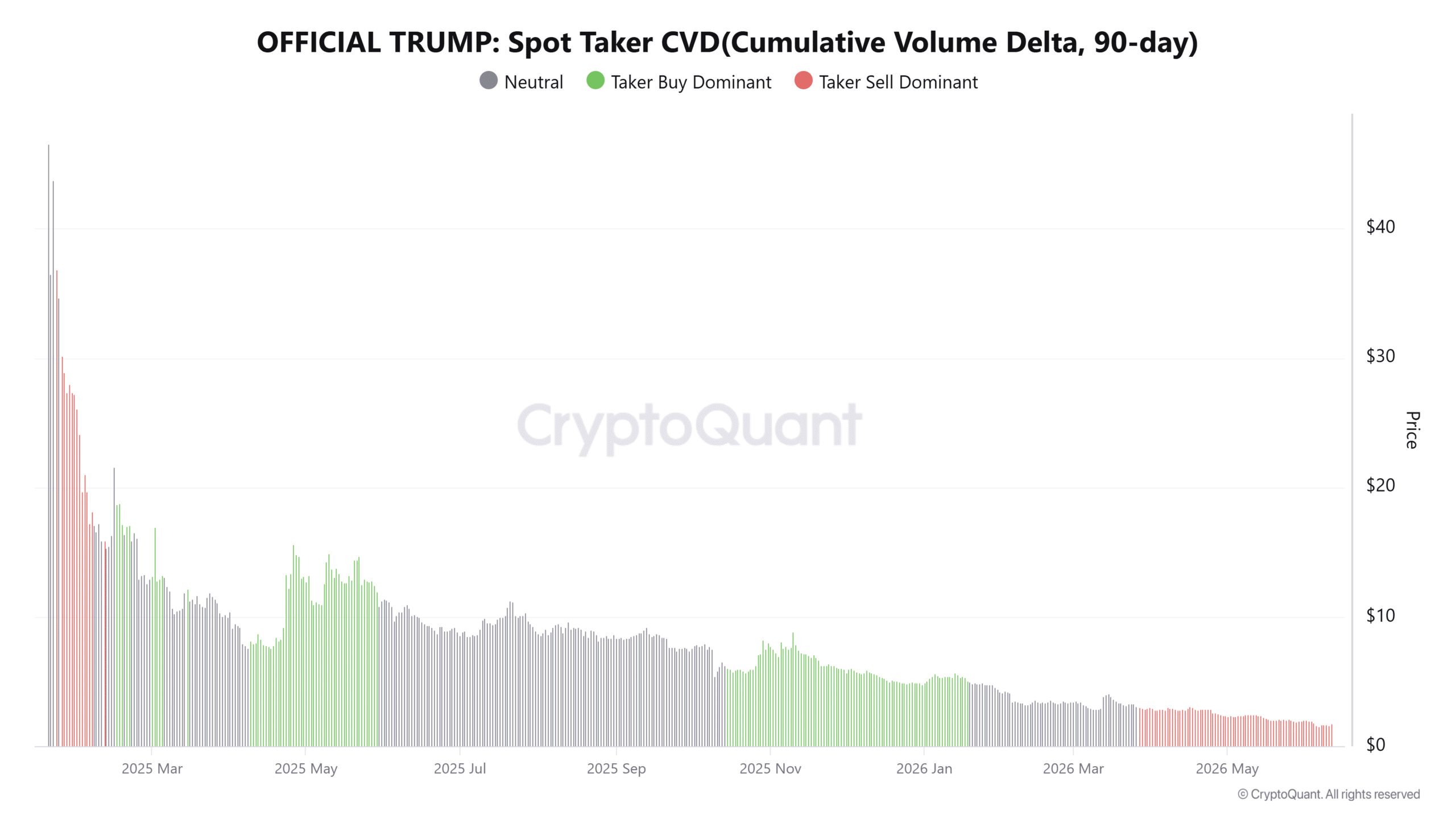
Despite the strong upward move, Spot Taker CVD continued signaling seller dominance. So, aggressive sell orders still outweighed aggressive buy orders over the measured period. 

The divergence created an interesting market structure because price advanced while underlying order flow remained tilted toward sellers. Such behavior often reflects traders taking profits into strength rather than fully embracing a bullish continuation. 

However, buyers absorbed much of that selling pressure and prevented a meaningful pullback from developing during the rally. The persistence of seller-dominant order flow suggested that market conviction remained mixed beneath the surface. 

TRUMP Spot Taker CVD
Source: CryptoQuant

TRUMP breaks from channel pressure

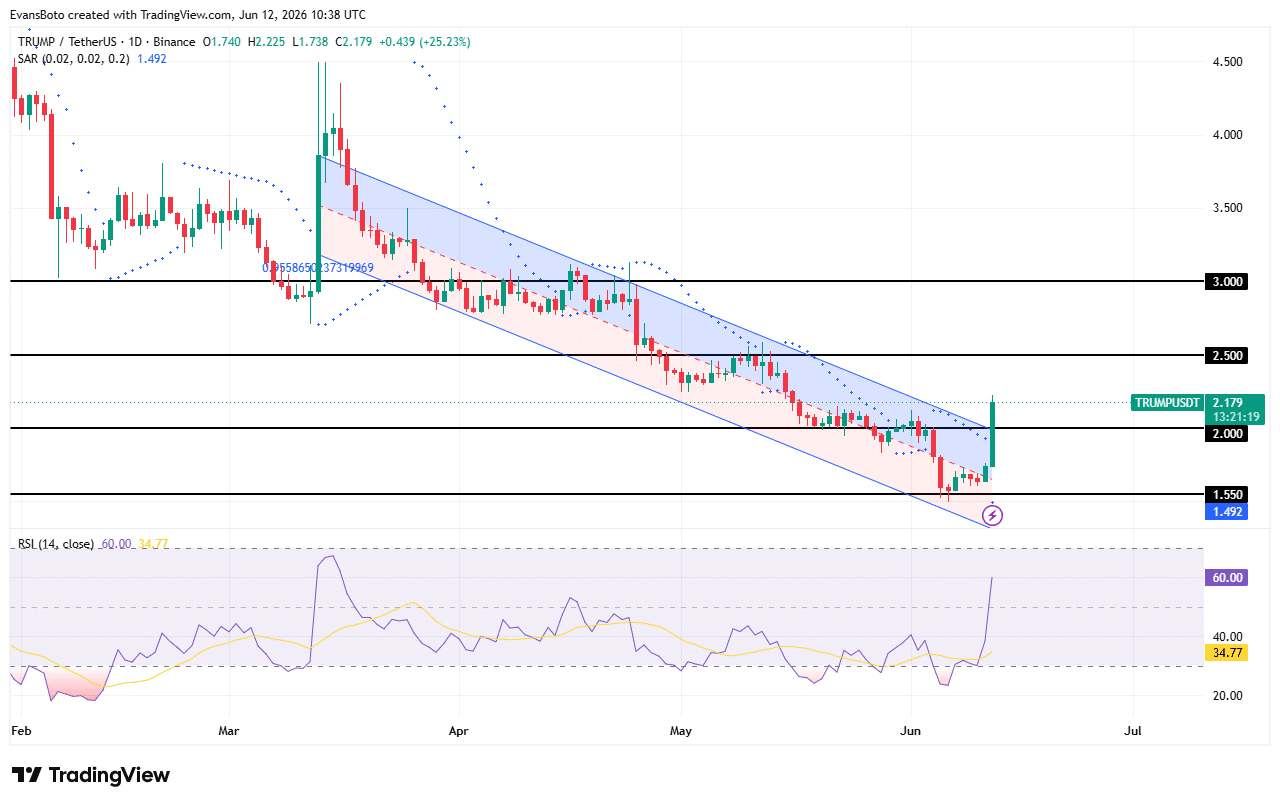
After rebounding from the lower boundary of its multi-month descending channel, TRUMP accelerated sharply and broke above the channel’s upper resistance near $2.00, signaling a potential trend reversal.

The rally pushed the token to around $2.18, marking a gain of more than 25% on the day and confirming strong buyer participation following weeks of sustained weakness.

RSI climbed to 60, its highest reading in several weeks, indicating strengthening bullish conditions without yet entering overbought territory. Parabolic SAR remained below price at $1.49, reinforcing the newly established upward trend.

The breakout has shifted attention toward the next resistance zone around $2.50, which previously acted as a major support level before the broader decline.

If buyers maintain control and defend the $2.00 breakout level, TRUMP could extend its recovery toward $2.50 and potentially challenge $3.00 thereafter.

However, failure to hold above $2.00 would likely invite profit-taking and trigger a retest of support near $1.75. Based on the current structure, the bullish scenario remains favored.

TRUMP price action TRUMP price action
Source: TradingView

Are liquidation clusters pulling TRUMP higher?

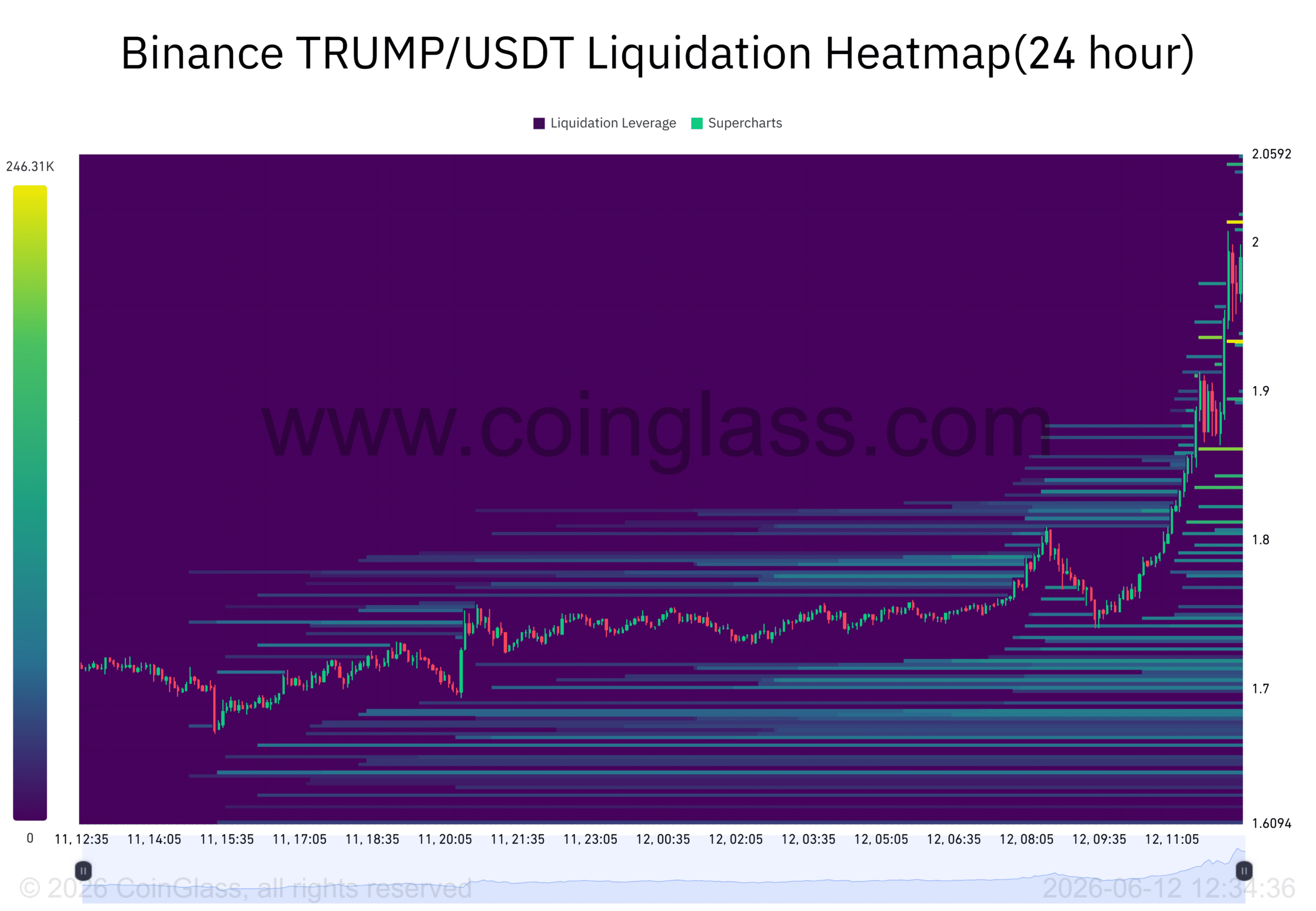
Liquidation data highlighted a concentration of leverage above the current market price, particularly around and beyond the $2.00 region. 

The Binance TRUMP/USDT liquidation heatmap showed several dense clusters extending toward roughly $2.05, where leveraged short positions appeared vulnerable.

Price approached these areas rapidly during the latest rally, increasing the possibility of additional short liquidations if buyers maintained control. 

Traders often view such clusters as liquidity magnets because price frequently gravitates toward heavily leveraged zones.  

If the token continued attracting demand, those liquidation pockets could become the next target area. A successful sweep of nearby leverage would likely strengthen bullish sentiment and encourage traders to pursue higher resistance levels.

Source: CoinGlass

Final Summary

  • TRUMP reclaimed key technical levels as volume growth reinforced buyer participation.
  • Overhead liquidation clusters may attract price if current recovery strength persists.


Source link

Kalshi’s crypto perpetuals spark debate over whether they’re futures or swaps

0
Kalshi’s crypto perpetuals spark debate over whether they’re futures or swaps

Latest developments: Kalshi’s launch of CFTC-regulated crypto perpetuals has reignited a long-running debate over financial market definitions.

  • John Lothian and Kalshi’s Udesh Jha joined The Policy Protocol to debate this topic.
  • John Lothian, publisher of John Lothian News, argued that perpetual contracts resemble swaps because they involve recurring bilateral cash-flow payments through funding-rate mechanisms.
  • Udesh Jha, Kalshi’s head of exchange analytics, countered that perpetuals function like futures because they are exchange-traded, centrally cleared and designed to track underlying spot markets.
  • The debate follows the recent approval and launch of crypto perpetuals on Kalshi under CFTC oversight.

The disagreement: Both sides view the same product through different regulatory lenses.

  • Lothian said perpetuals differ from traditional futures because funding-rate payments create ongoing cash flows between market participants, a feature he associates with swaps.
  • Jha argued that funding rates merely make financing costs explicit rather than embedding them in futures prices, making perpetuals a more efficient version of existing futures markets.
  • According to Jha, perpetuals also eliminate the need for traders to roll positions into new contract months, reducing friction and costs.

Why it matters: The classification could determine who can access the products and under what rules.


Source link