Home Blog Page 361

Jim Cramer Says TJX “Can Offer Great Value for Much Less Than Expected”

0
Jim Cramer Says TJX “Can Offer Great Value for Much Less Than Expected”


The TJX Companies, Inc. (NYSE:TJX) was among the stocks Jim Cramer highlighted on Mad Money as he noted that the market has an appetite for stocks. Cramer mentioned the stock during the episode and commented:

When the economy is doing badly, these are the companies that normally do well as consumers trade down. Even they’re getting hurt, you know, people are really feeling the squeeze. It’s just not happening anymore. Now, you might be saying, “Wait a second. How about TJX? That’s been a winner. That’s a discounter, right?” Well, you need to know TJX is not a play on price as much as it is about selection. When there are a lot of full-priced outlets trying to offload inventory, TJX is the winner. That chain can offer great value for much less than expected. You’re getting quality goods on the cheap, very different from the dollar stores. That’s why its stock hangs in while these others just don’t seem to have the traction anymore.

Stock market data. Photo by Burak The Weekender on Pexels

The TJX Companies, Inc. (NYSE:TJX) sells off-price apparel, footwear, accessories, and home goods. The company offers a wide range of merchandise, including clothing, beauty items, furniture, decor, kitchenware, and seasonal products.

While we acknowledge the potential of TJX as an investment, we believe certain AI stocks offer greater upside potential and carry less downside risk. If you’re looking for an extremely undervalued AI stock that also stands to benefit significantly from Trump-era tariffs and the onshoring trend, see our free report on the best short-term AI stock.

READ NEXT: 33 Stocks That Should Double in 3 Years and 15 Stocks That Will Make You Rich in 10 Years 

Disclosure: None. Follow Insider Monkey on Google News.


Source link

Bitcoin demand hits rare extreme – Is BTC nearing bottom or…

0
Bitcoin demand hits rare extreme – Is BTC nearing bottom or...


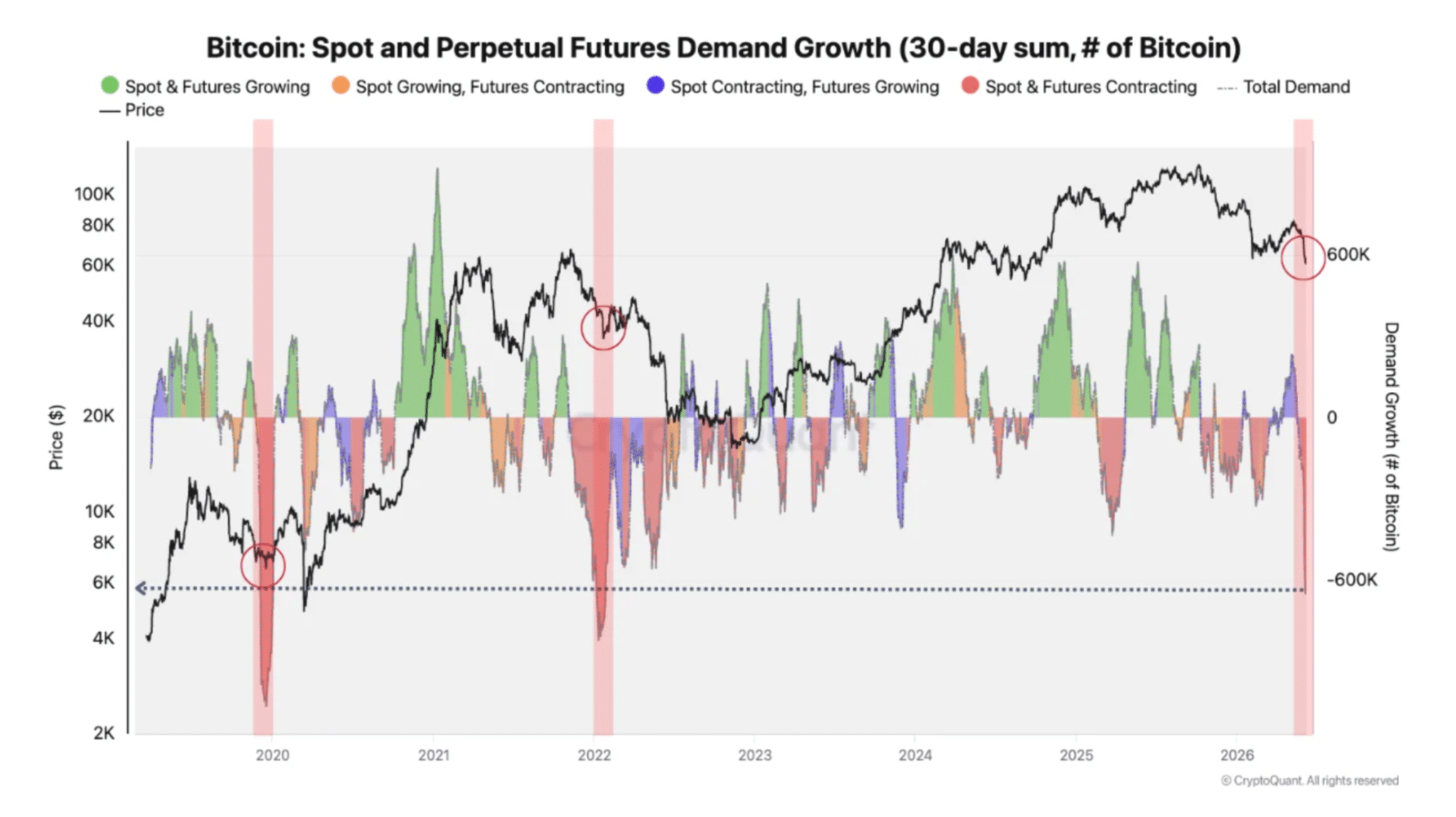
Bitcoin’s demand structure has deteriorated sharply into late 2026. The combined growth of spot and perpetual futures demand has fallen toward -650,000 BTC, a level reached only three times since 2019.

This matters because weakness now extends beyond leveraged traders and into organic market demand.

Historically, similar contractions appeared before major periods of instability.

First, demand collapsed ahead of the March 2020 crash. Later, a comparable deterioration emerged during the 2022 bear market. In both cases, extreme readings signaled structural exhaustion rather than immediate recovery.

Source: CryptoQuant

Now, Bitcoin faces a similar test. Fewer spot buyers are entering, while derivatives exposure continues shrinking. As a result, the market has less capacity to absorb fresh selling pressure.

Yet this does not automatically imply another sharp decline. Instead, history suggests volatility may expand first. Thereafter, Bitcoin could enter a prolonged phase of weak momentum and subdued participation.

Until demand begins recovering from these extreme levels, price action may remain fragile despite approaching long-term value zones.

CVDD Ratio climbs toward cycle-bottom thresholds

Bitcoin’s weakening demand profile continues weighing on sentiment.

However, valuation metrics are beginning to offer a different perspective.

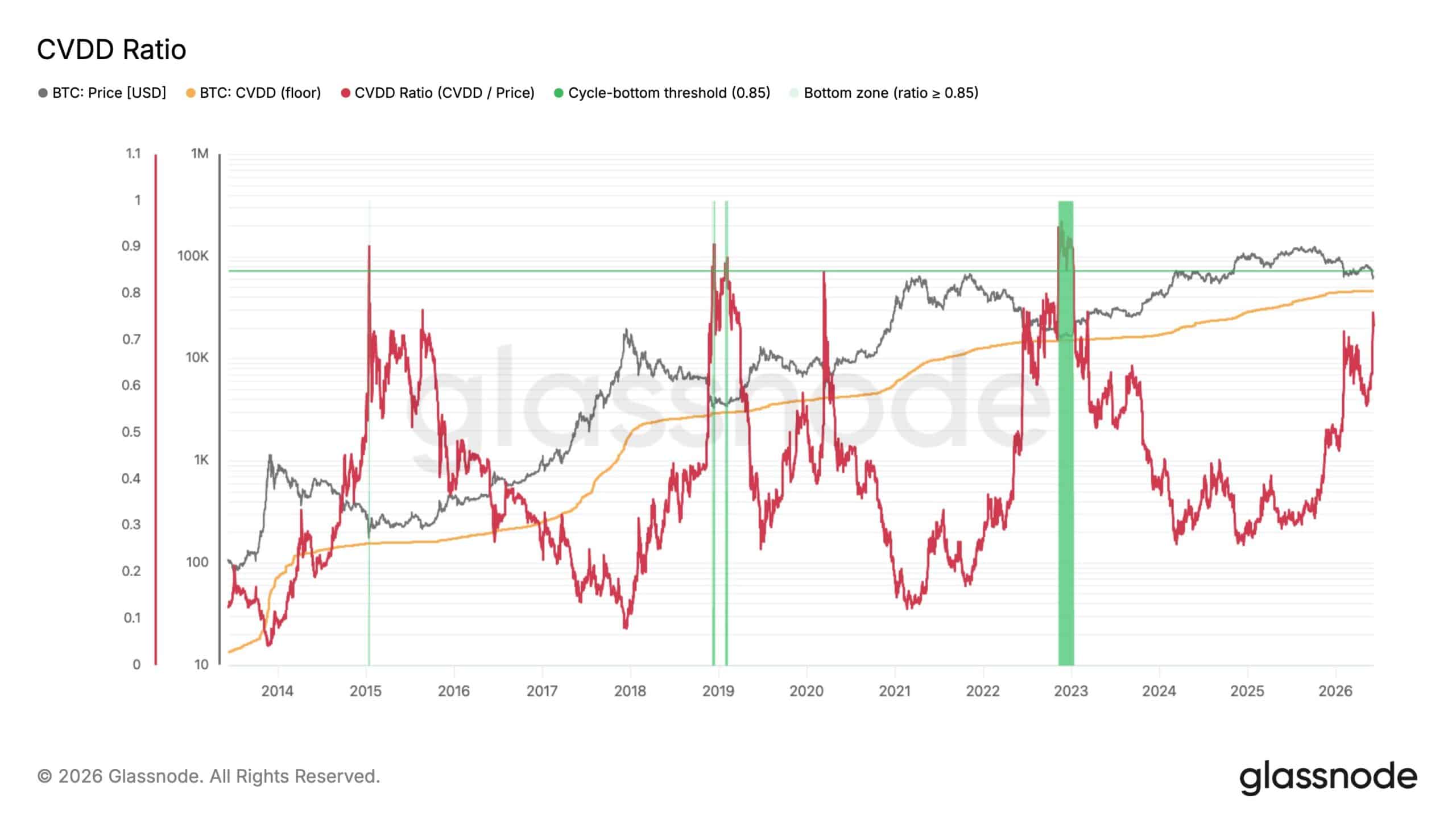
The (Cumulative Value-Days Destroyed) CVDD to price ratio has climbed to 0.73, moving closer to the historical cycle-bottom threshold near 0.85.

Source: Glassnode


Source link

Crypto tax bills a work-in-progress as U.S. House lawmakers pose concerns

0
Crypto tax bills a work-in-progress as U.S. House lawmakers pose concerns

A package of several crypto tax bills may not be ready yet for prime time, as a U.S. House Ways and Means Committee hearing revealed potentially significant questions from lawmakers that suggested the panel hasn’t achieved a bipartisan embrace of the bills that would tailor a clearer tax code for digital asset gains.

The latest legislative drafts are meant to address tax-filing burdens from crypto users and investors, though House lawmakers — especially Democrats — raised pointed questions about the proposed tax treatments during a Tuesday hearing to discuss the bills, and some key members reportedly objected in advance of the session. This preliminary hearing is an opening step of a process that would typically proceed through revisions and markup before the bills could be considered by the wider House of Representatives, and committee Chairman Jason Smith indicated an intent for bipartisan progress.

“I’m aligned with that goal — eventually,” said Richard Neal, the committee’s ranking Democrat, during the hearing. “There’s healthy skepticism on both sides.”

Though the Digital Asset Market Clarity Act that’s slowly winding its way through the U.S. Senate represents the crypto industry’s top policy effort in Washington, a set of new crypto tax laws would rank second on the priority list. As the U.S. rules stand, the taxes on digital asset gains are difficult for investors to manage — especially those who benefit from mining, staking or who make a high number of transactions.

“The committee’s legislation addresses key gaps in the tax code, including parity in tax treatment with comparable traditional financial asset transactions, clarity for tax situations unique to digital assets, and reduction in paperwork burdens for digital asset owners and brokers,” the chairman, Smith, summarized in a statement before the hearing.

One of the bills would address the longtime industry request that small transactions with very minimal gains should be exempted from tax reporting, which could ease the accounting burdens on users as well as freeing up digital assets to be used for routine payments. Another bill would eliminate the double-taxed scenario for mining and staking proceeds, which are taxed upon receipt and when they’re sold.

“If Americans want to pay with a stablecoin instead of a credit card or cash, they should be able to without a pile of tax paperwork,” Smith said during the hearing.

Mining deferrals

But one of the hearing’s witnesses, Mike Kaercher, deputy director of the Tax Law Center at NYU Law, said the bills still contain pitfalls, including his own objection to the mining-and-staking provision that could be abused.

“The problem is that the bill then provides an election for stakers and miners to defer income paid in the form of newly minted coins until disposition,” he said, suggesting it could create a new tax subsidy. He argued that it “violates parity with traditional finance and the principle that income is taxed on receipt.”

“Despite some thoughtful guardrails in the bill, it may be possible for taxpayers to permanently escape tax by earning rewards through certain business structures,” he said.

That concept drew significant attention from the committee’s Democrats, concerned about abuse of such deferral.

It’s unclear whether there will be a viable window for major crypto tax legislation before the current session of Congress ends at the close of 2026. It’s late in that session, and the agenda is already crowded, including with the remaining work on the crypto Clarity Act.

“Regulatory clarity and tax clarity go hand in hand,” said Kevin Wysocki, Anchorage Digital’s head of policy, in a post on social media site X. “If we want innovation, investment, and jobs to stay in America, policymakers need rules that are clear, workable, and built for modern technology.

For its part, the U.S. Senate hasn’t made significant progress on crypto tax bills, though Senator Cynthia Lummis has sought to move similar legislation through Congress’ upper chamber — so far unsuccessfully. Both chambers would ultimately need to approve legislation before it could become law that governs U.S. crypto activity.

A potential reduction of burden on taxpayers in the newly unveiled bills would also be shared by the Internal Revenue Services, which has already been inundated this year with a new tax-reporting regime. The U.S. tax agency has cut a significant portion of its staff under the administration of President Donald Trump at the same time as getting a rapidly increasing influx of crypto filings.

“Millions of Americans own or use digital assets, yet much of the tax code still treats this technology as though it were a niche experiment rather than a growing part of the financial system,” said Coinbase’s vice president of tax, Lawrence Zlatkin. “The result has been confusion for taxpayers, compliance challenges for businesses and unnecessary burdens for the IRS.”

Read More: U.S. House tax committee weighs crypto bills, including relief for small transactions



Source link

How Is Fortinet’s Stock Performance Compared to Other Cybersecurity Stocks?

0
How Is Fortinet's Stock Performance Compared to Other Cybersecurity Stocks?


3d illustration inflation and deflation graph by Deepadesigns via Shutterstock

Fortinet, Inc. (FTNT), headquartered in Sunnyvale, California, provides cybersecurity and convergence of networking and security solutions. Valued at $106 billion by market cap, the company offers network security appliances, software, and subscription services. Fortinet systems integrate the industry’s broadest suite of security technologies, including firewall, VPN, antivirus, intrusion prevention (IPS), web filtering, antispam, and traffic shaping.

Companies worth $10 billion or more are generally described as “large-cap stocks,” and FTNT perfectly fits that description, with its market cap exceeding this mark, underscoring its size, influence, and dominance within the software – infrastructure industry. Fortinet’s competitive strengths include its unified Security Fabric Platform, broad portfolio of security solutions, strong performance and reliability, AI-driven security operations, global reach and support, competitive pricing, and strong R&D investments. Its partner ecosystem and partnerships with major cloud providers further enhance its position.

More News from Barchart

Despite its notable strength, FTNT slipped 3.6% from its 52-week high of $150.07, achieved on Jun. 4. Over the past three months, FTNT stock has gained 71.4%, outperforming the Xtrackers Cybersecurity Select Equity ETF’s (PSWD) 24.4% gains during the same time frame.

www.barchart.com

Shares of FTNT rose 82.2% on a YTD basis and climbed 39.8% over the past 52 weeks, notably outperforming PSWD’s YTD gains of 17.3% and 8.5% returns over the last year.

To confirm the bullish trend, FTNT has been trading above its 50-day moving average since late January, with some fluctuations. The stock is trading above its 200-day moving average since late April, with slight fluctuations.

www.barchart.com

Fortinet’s outperformance was fueled by the FortiOS 8.0 launch, bringing AI-driven security, next-gen SASE, and quantum-safe protection. Automation via FortiAI is cutting response times, while demand is rising for sovereign SASE amid AI and geopolitical risks. Bundled SD-WAN and SASE offerings are driving upsells, and expanded inventory is supporting the positive outlook.

On May 6, FTNT reported its Q1 results, and its shares skyrocketed 20% in the following trading session. Its adjusted EPS of $0.82 topped Wall Street expectations of $0.61. The company’s revenue was $1.9 billion, topping Wall Street forecasts of $1.7 billion. Fortinet expects full-year adjusted EPS in the range of $3.10 to $3.16, and revenue ranging from $7.7 billion to $7.9 billion.

In the competitive arena of software – infrastructure, Palo Alto Networks, Inc. (PANW) has lagged behind FTNT, showing resilience with a 47.7% uptick on a YTD basis and 38% gains over the past 52 weeks.

Wall Street analysts are cautious on FTNT’s prospects. The stock has a consensus “Hold” rating from the 43 analysts covering it. While FTNT currently trades above its mean price target of $108.11, the Street-high price target of $150 suggests a 3.7% upside potential.

On the date of publication, Neha Panjwani did not have (either directly or indirectly) positions in any of the securities mentioned in this article. All information and data in this article is solely for informational purposes. This article was originally published on Barchart.com


Source link

Securitize CEO says tokenized stocks could unlock a $5 trillion crypto market

0
Securitize CEO says tokenized stocks could unlock a $5 trillion crypto market

Securitize CEO Carlos Domingo said he believes tokenized equities and ETFs, not private credit or Treasury products, will be the asset class that ultimately drives the real-world asset (RWA) market into the trillions.

Speaking at a ETHConf panel in New York on Tuesday, Domingo argued that bringing stocks and exchange-traded funds onchain could unlock a market far larger than today’s roughly $30 billion tokenized asset sector.

“The entire equities and ETF market worldwide is probably like $150 trillion,” Domingo said. “Only if a small percentage of that, like 2% or 3%, moves onchain, it gets you very close to that $5 trillion.”

The comments come as Securitize prepares to go public and seeks to expand its role as one of the largest tokenization providers for institutions, including BlackRock.

While tokenized U.S. Treasuries have emerged as the dominant RWA category over the past two years, Domingo argued that tokenized stocks could become the industry’s next major growth engine. Securitize has announced partnerships with the New York Stock Exchange and transfer agent Computershare aimed at enabling on-chain trading and settlement of equities.

Domingo also drew a distinction between what he considers “real” tokenized equities and the growing number of blockchain-based stock products offered outside the U.S.

“A lot of people that today say that they tokenize equities, they’re not tokenizing equity,” he said, arguing that many offerings rely on derivatives or synthetic structures rather than direct ownership of the underlying shares.

According to Domingo, the long-term goal is for blockchain-based securities to offer the same investor rights as traditional shares while benefiting from instant settlement, 24/7 transferability and deeper integration with decentralized finance.

Domingo maintained that public blockchains, particularly Ethereum, remain the preferred infrastructure for institutional tokenization despite concerns around transparency and compliance. Securitize uses smart contracts to restrict ownership to approved investors while allowing assets to move on permissionless networks.

Looking ahead, Domingo said he expects blockchain-based markets to develop alongside existing financial infrastructure before gradually absorbing a larger share of activity.

“The traditional markets are going to stay,” he said. “We’re going to see a new market emerge in parallel that will run on blockchain rails and be much more efficient.”

Read more: BlackRock-backed tokenization firm Securitize clears key hurdle to go public on NYSE


Source link

56-year-old beloved fast-food chain closes over 700 locations

0
56-year-old beloved fast-food chain closes over 700 locations


The chain restaurant sector has battled an array of economic issues over the last five years that have led to location closings and bankruptcy filings.

Certain fast-food chains, such as Long John Silver’s, have downsized their businesses dating back to the Great Recession in 2008.

More recently, as inflation drove up the costs of labor and food since the Covid-19 pandemic in 2020, menu prices also rose significantly, discouraging diners from eating out.

Rising costs lead to closings

Labor and food costs increased by 35% from 2019 to 2025, according to the Bureau of Labor Statistics, and restaurants often passed the extra costs on to their customers with menu prices rising by an average of 31% from February 2020 to April 2025, the National Restaurant Association reported.

Rising restaurant costs contributed to slower sales, which reached their lowest growth rate since the Great Recession of 2008, not counting the Covid pandemic, according to the 2026 Technomic Top 500 Chain Restaurant Report.

“It was a very, very weak year for the Top 500 overall from a sales perspective,” Joe Pawlak, managing principal at Technomic said, according to Restaurant Business.

Long John Silver’s restaurant chain has closed over 700 locations since the Great Recession.Image Source: Shutterstock

Long John Silver’s closes 100s of locations

The challenging restaurant environment has led 57-year-old fast-food dining chain Long John Silver’s to close about 706 restaurant locations nationwide since the Great Recession in 2008.

The seafood fast-food restaurant chain, which launched in Lexington, Ky., in 1969, had 1,081 locations at its peak in 2007, but began its decline the following year, closing 59 locations as the financial crisis began to impact the restaurant sector.

Restaurants filed for Chapter 7 bankruptcy

Some of the restaurant chain victims in the first year of the financial crisis included Starbucks, which closed over 600 locations, according to CBS News, and the owners of the Bennigan’s and Steak & Ale chains, S&A Restaurant Corp., which filed for Chapter 7 bankruptcy liquidation in 2008, Reuters reported at the time.

The Bennigan’s and Steak & Ale chains’ franchisees didn’t file for bankruptcy at the time.

Long John Silver’s continued closing more restaurants in subsequent years, shuttering 33 in 2009, 25 in 2010, 32 in 2011, 21 each year in 2012 and 2013, and then a much larger closing of 75 locations in 2014, ending the year with 815 units, according to QSR Magazine.

Chain has 375 locations after closings

Over the next 10 years, Long John Silver’s closed 330 locations, ending 2024 with 485 restaurants. The fast-food restaurant chain closed another 110 units in the last year and a half, and its website locator lists 375 total stores at last check.

One of the Long John Silver’s franchisees, Uplifted Foods LLC, faced severe financial consequences and was forced to filed for Chapter 7 bankruptcy liquidation about a month after closing its restaurant at the Mall of America in Minneapolis on April 30, according to the Minneapolis/St. Paul Business Journal.

The Eagan, Minn.-based franchisee filed its bankruptcy petition in the U.S. Bankruptcy Court for the District of Minnesota in St. Paul on May 29, listing up to $100,000 in assets and $100,000 to $1 million in liabilities, Bankruptcy Observer confirmed.

Other chains close locations

Other restaurant chains facing economic distress and future closings include Yum Brands’ Pizza Hut chain, which said it would shutter 250 underperforming locations as part of its Hut Forward plan in the first half of 2026.

Papa John’s unveiled in its fourth-quarter earnings call that it will close 300 underperforming restaurants, including 200 by the end of 2026. The company did not reveal a deadline for closing the remaining 100.

Related: Popular seafood chain franchisee files Chapter 7 bankruptcy

This story was originally published by TheStreet on Jun 8, 2026, where it first appeared in the Restaurants section. Add TheStreet as a Preferred Source by clicking here.


Source link

SKYAI loses its recovery gains: Is a deeper correction now underway?

0
SKYAI loses its recovery gains: Is a deeper correction now underway?


SKYAI’s recovery attempt from its rebound on the 6th of June lost strength as sellers regained control across the market. 

Earlier, the token had climbed 15% from the $0.147 support zone and approached $0.205 after weeks of sustained weakness.  

However, that narrative weakened considerably over the last 24 hours. SKYAI fell 27.5% to $0.1928, while its market capitalization dropped to $192.87 million. 

Trading activity also cooled sharply, with volume declining 25.72% to roughly $53 million. As a result, the recovery structure that emerged last week lost credibility, and market participants shifted their focus back toward downside risk.

Traders rush for the exit

Derivatives data showed a broad reduction in speculative exposure as traders rapidly stepped away from leveraged positions. 

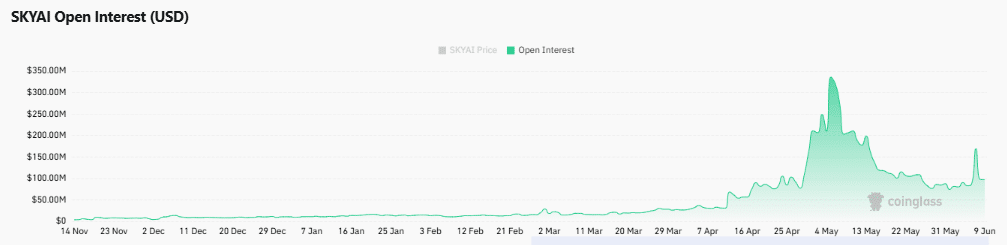
Open Interest dropped 20.38% to $83.7 million, highlighting a significant decline in participation across the futures market. 

Such a sharp contraction usually reflects position closures rather than fresh capital entering the market. 

The decline also aligned with SKYAI’s steep price correction, suggesting that many traders abandoned bullish bets after the recent recovery failed to extend higher. 

In addition, the derivatives market reflected caution as participants reassessed risk following the token’s breakdown. Unless new demand returns, futures activity would likely remain subdued in the sessions ahead.

Source: CoinGlass

Has SKYAI lost its bullish footing?

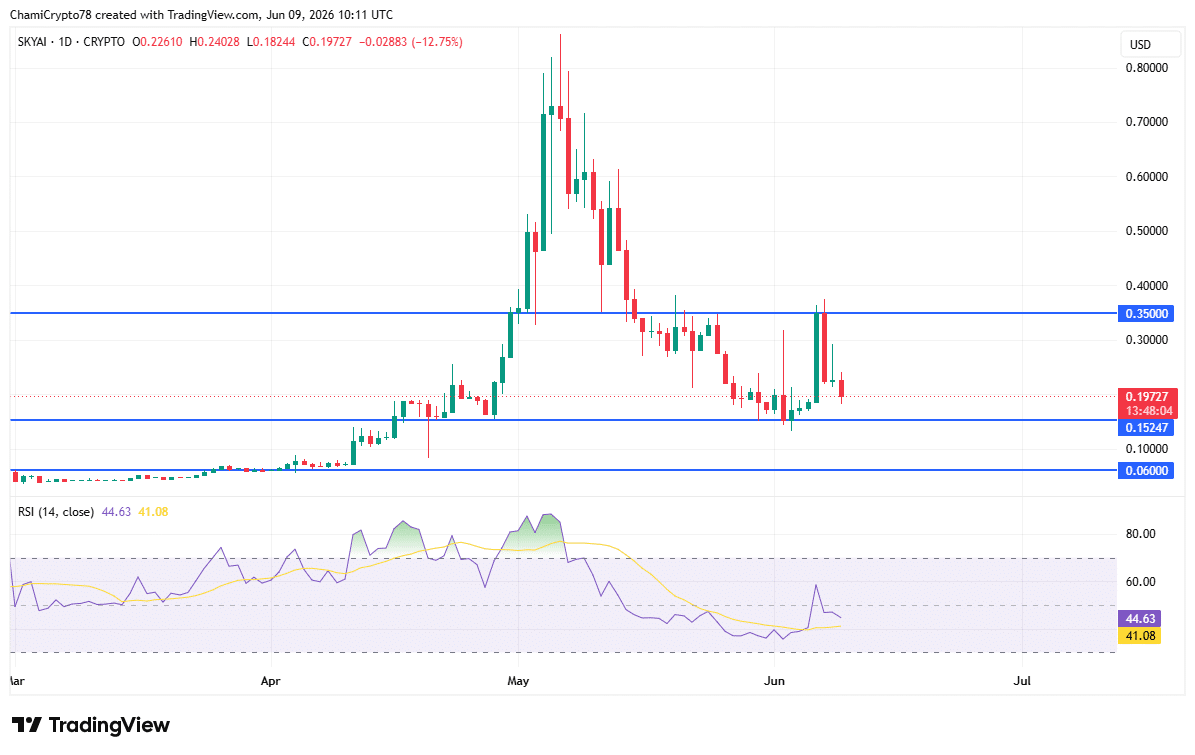
The technical structure weakened considerably after SKYAI failed to reclaim the major $0.35 resistance zone highlighted on the daily chart. 

The rejection near that level preserved the broader downtrend and pushed the token back toward the $0.152 support area. Although price continued trading above that support at press time, buyers no longer controlled the structure that emerged during the June rebound.

RSI also reflected deteriorating conditions. The indicator fell to 44.63 after previously approaching neutral territory during the recovery phase. 

The reading showed that buying strength had faded without entering deeply oversold conditions. Therefore, sellers still retained room to apply additional pressure. 

If SKYAI loses the $0.152 support zone, the next major area of interest would sit closer to the $0.06 historical support level.

SKYAI price actionSKYAI price action
Source: TradingView

Liquidity pockets hint at rebound targets

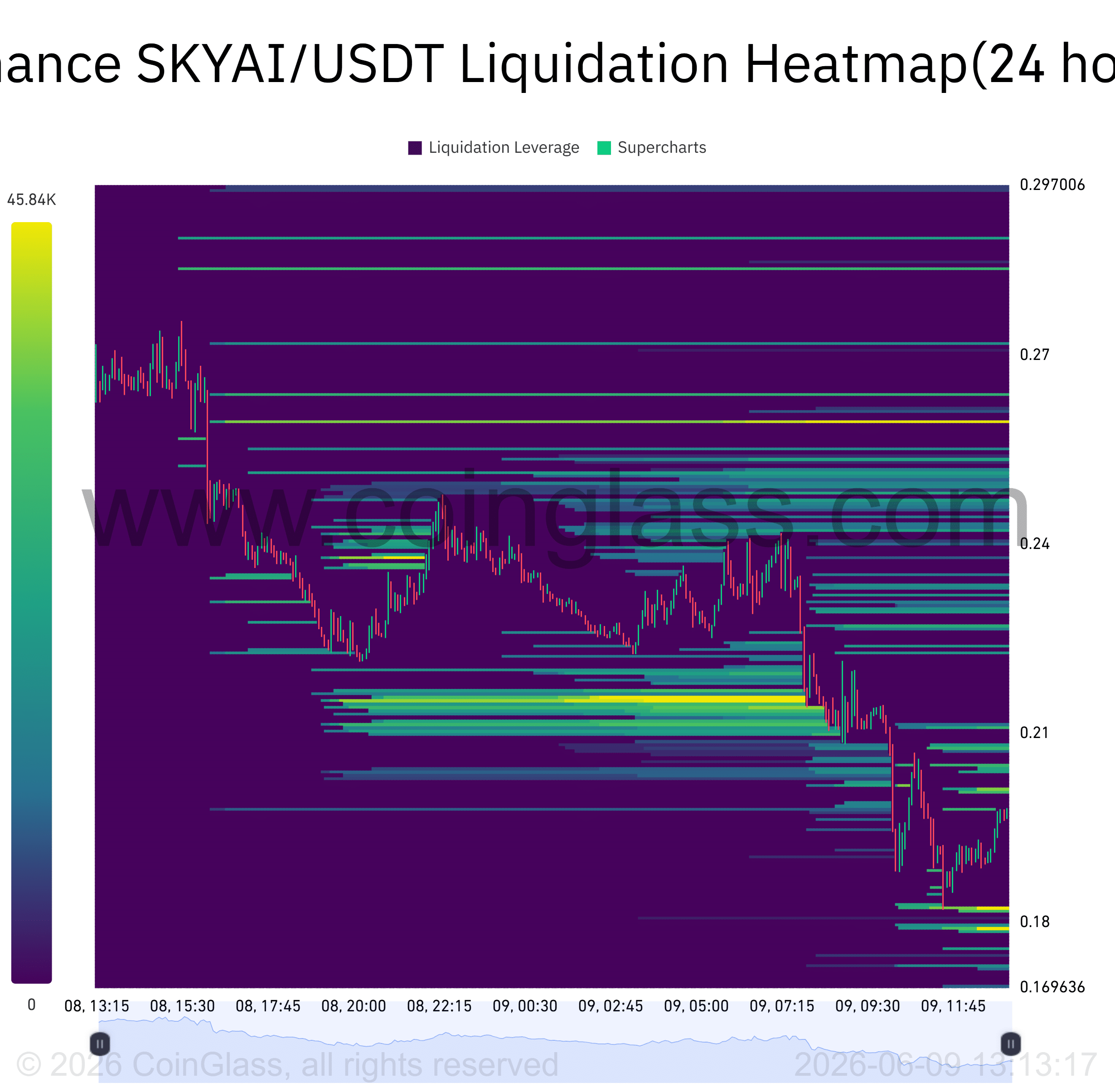
The liquidation heatmap revealed several notable liquidity concentrations above the current market price. 

The most significant cluster appeared between $0.21 and $0.23, where large amounts of leveraged positions remained vulnerable. 

Price often gravitates toward such areas because market makers and liquidations can attract short-term volatility. 

Additional liquidity zones also existed around $0.24 and extended toward $0.27, creating multiple upside targets if buyers regain control. 

However, the heatmap did not guarantee a reversal. Instead, it highlighted where price could move if a relief rally develops. 

Source: CoinGlass

Final Summary

  • SKYAI lost its recovery structure as sellers reclaimed control across the market.
  • Falling Open Interest showed traders reduced exposure during the sharp correction.


Source link