The growing presence of financial institutions in cryptocurrency brings with it increasing demand for Wall-Street style systems in digital asset markets, such as servers that offer split-second advantages when executing trades.
Kalshi is looking to meet that demand by adding Solana-based DoubleZero’s low-latency market data feed to its prediction market order book.
The DoubleZero Foundation said this will provide trading firms with a machine-readable view of a prediction market for pricing, hedging and signal generation on Solana, one of the major layer-1 blockchains.
The foundation described DoubleZeroEdge as a transport layer, sending live exchange and onchain data over dedicated fiber, publishing the data and distributing it simultaneously to all connected traders.
In traditional finance (TradFi), institutions use specialized networks to access data at high speed, whereas in crypto, traders still largely rely on the internet. DoubleZero attempts to address that through a bespoke onchain system.
“This is the same distribution model that has underpinned traditional financial exchanges, from NYSE to Nasdaq to the CME, for decades,” the foundation said in an emailed announcement on Wednesday.
Every few quarters, the debate around Nvidia moves. For a while, it was about whether AI demand was real. Then it was about whether margins could hold. Now, heading into its August 26 earnings report, the question is whether the next product cycle can keep a company already running at this pace from slowing down.
Bank of America thinks it can. And the note behind that view is worth reading before the earnings date arrives.
Bank of America Nvidia earnings preview and $350 price target
In a note shared with TheStreet on August 7, Bank of America analyst Vivek Arya called Nvidia (NVDA) his top sector pick ahead of the company’s fiscal Q2 FY2027 results. He expects revenue of $94 billion to $95 billion, roughly $3 billion to $4 billion above Nvidia’s own $91 billion guidance. That guidance excludes any China data center compute revenue, meaning actual results could come in higher if modest shipments to that market resume. Third-quarter guidance, he says, should come in at $107 billion to $108 billion, well above the approximately $104 billion Wall Street is currently modeling.
For context, Nvidia reported Q1 FY2027 revenue of $81.6 billion in May, up 85% year over year, with data center revenue of $75.2 billion. The Q2 guidance of $91 billion implied continued sequential growth. BofA’s $94 billion to $95 billion estimate would extend that momentum further.
But Arya isn’t really writing about the next quarter. “The commencement of Vera Rubin next-generation chip deliveries marks the beginning of an extended upgrade cycle spanning multiple quarters,” he wrote. That’s the argument. Not just a beat. A new cycle.
Arya has a $350 price target on Nvidia, representing roughly 56% upside from $223.96 at the time of the note. He points out that the stock is trading at about 16 times forward earnings, its lowest valuation in roughly a decade, even as the earnings trajectory continues to rise, as TheStreet reported.
Why Nvidia Vera Rubin could trigger a multi-quarter upgrade cycle
Nvidia confirmed at GTC Taipei in June that Vera Rubin has entered full production. The platform pairs Rubin GPUs with the new Vera CPU and is expected to be available from cloud partners in the second half of 2026. AWS, Google Cloud, Microsoft and Oracle are already preparing deployments, with OpenAI, Anthropic and SpaceX among the first customers. Nvidia is targeting enough capacity to require 2 gigawatts of power for the buildout, as TheStreet reported.
GPU spot rental prices are near all-time highs, Arya notes in the note. The B200 is running at about $5.66 per hour, the H100 at $2.80 per hour, the A100 at $1.64. That data point matters because it addresses one of the persistent doubts about the AI trade. If customers can still rent compute at those prices and make money from it, they have every reason to keep buying the next generation of hardware. The concern about return on investment fades when the rental market is this strong.
More Nvidia:
The Vera CPU is the part of Rubin that Bank of America finds most interesting beyond the GPU story. An earlier note from the bank called it “the single greatest new addition since the GPU.” Arya’s current note projects Vera CPU sales in the second half of fiscal 2027 at roughly $20 billion, with an annual run rate of $50 billion or more by fiscal 2028. That trajectory, if it holds, would make Nvidia the largest server CPU vendor.
Nvidia gross margin and memory cost inflation outlook for 2027
Memory cost inflation has become one of the louder concerns about Nvidia’s margins. DRAM now makes up 40% to 50% of total production costs, up from 15% to 20% historically. The worry is that as Nvidia moves to more memory-intensive architectures, those rising costs eat into its famously high gross margins faster than the company can price around them.
Arya’s note pushes back on that directly. For Vera Rubin compute racks specifically, the memory cost increase amounts to about 60 basis points of gross margin pressure versus Blackwell Ultra. Gross margins are expected to settle at 73% to 74% over time, down modestly from about 75% now. That is not the kind of structural margin erosion that would break the investment case.
The bigger number is at the pod level. Complete AI pods, which bundle in more memory and storage, could see up to 500 basis points of margin impact. But Arya expects that mix to stay small initially. Nvidia’s long-term supply agreements with SK Hynix and its pricing power, given GPU rental rates near all-time highs, give the company room to pass through costs rather than absorb them.
Nvidia confirmed at GTC Taipei in June that Vera Rubin has entered full productionOta/Getty Images
Nvidia OpenAI circular financing and free cash flow explained
Nvidia has committed roughly $70 billion in direct equity stakes to ecosystem partners. That includes $30 billion to OpenAI, up to $10 billion to Anthropic, and $5 billion to Ilya Sutskever’s Safe Superintelligence. Some investors have questioned whether these arrangements are circular, essentially Nvidia financing the customers who buy Nvidia chips.
Arya’s note addresses this directly. Against the $70 billion in direct investments, Nvidia is expected to generate roughly $470 billion in free cash flow across 2026 and 2027. The $70 billion represents about 15% of that. There is room to keep returning approximately 50% of free cash flow to shareholders while making these investments, according to Benzinga.
The $250 billion backstop tied to an OpenAI and SB Energy campus in Ohio is a different kind of commitment. It is not upfront cash. It is a contingent guarantee that only triggers if OpenAI defaults on the lease, with exposure back-loaded to 2028 and beyond. When Nvidia is expected to be generating $300 billion to $500 billion per year in free cash flow by then, the risk profile looks different than the headline number suggests.
NVDA stock valuation at decade low and the BofA bull case
At 16 times forward earnings, Nvidia is at its cheapest in about a decade. The bank’s EPS projections put Nvidia at more than $13 per share by 2027 and more than $25 by 2030, assuming the AI data center market develops along Arya’s model. That model assumes Nvidia holds more than 70% share of a market the bank sees growing past $1.7 trillion in AI data center systems.
The risks are real. AMD is gaining ground in AI accelerators. The major cloud companies are building more of their own custom chips. China export restrictions remain an overhang. Hyperscaler capital spending could get more uneven if the returns on AI infrastructure disappoint. None of those go away.
But the setup Bank of America is describing is a company with this level of earnings power sitting at a valuation that doesn’t reflect it. Whether August 26 confirms that or not almost misses the point. The bigger question is whether Rubin delivers what Arya’s note says it will. If it does, one earnings report is the start of something, not the thing itself.
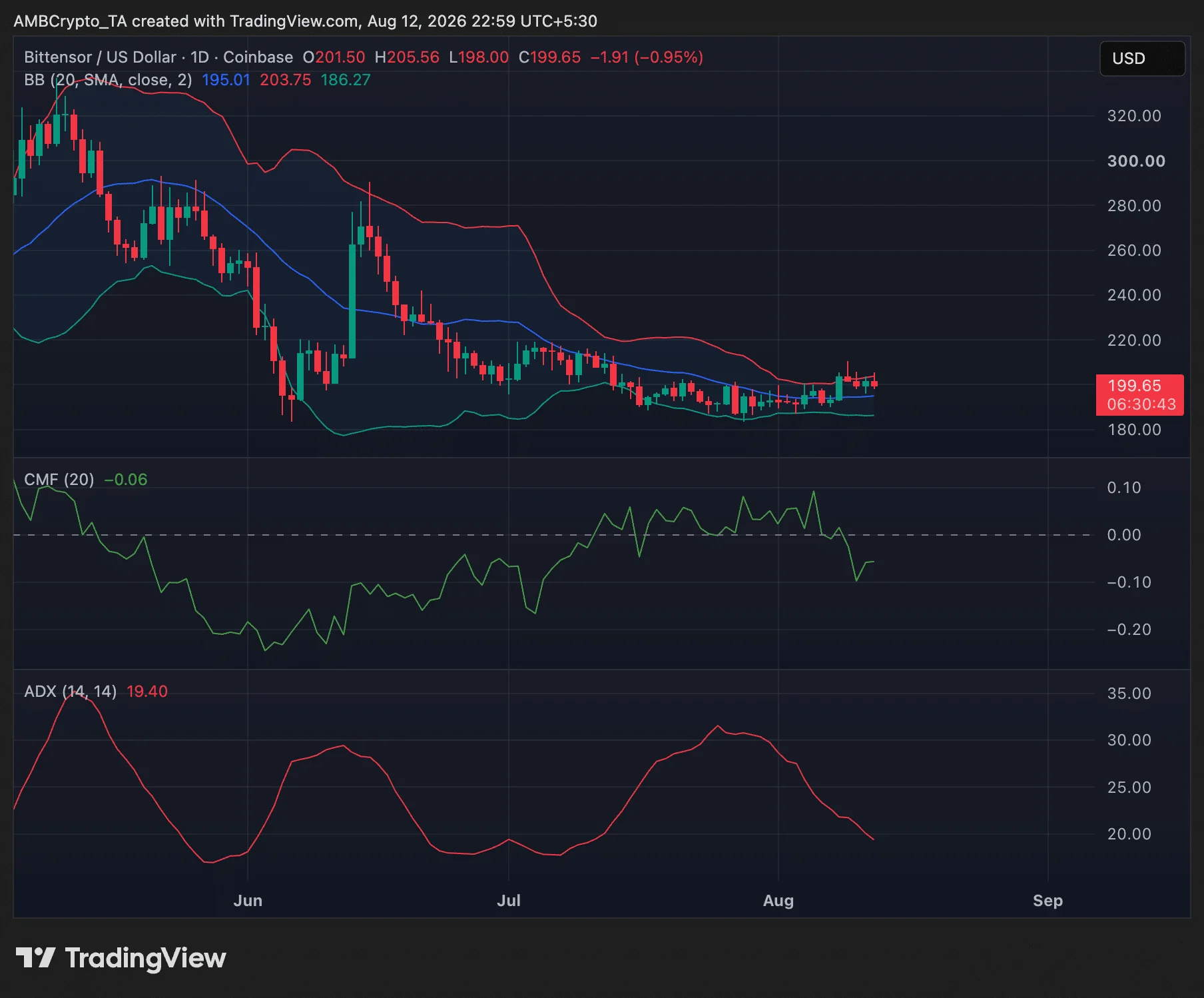
Bittensor [TAO] briefly crossed $205 on August 12 before retreating towards $200, extending its recovery from the August lows without confirming a breakout.
Futures open interest approaching $300m implies traders are already building positions, but capital flowing out and a weak trend mean the move has not attained conviction levels and is yet to broaden.
TAO crypto struggles above $200
TAO was trading at around $199.65, down 0.95% after reaching $205.56 earlier today.
The daily rally briefly carried the price above $203.75, but it could not stay there. Even after the price fell, however, TAO remained above $195.01, leaving the recovery intact for now.
But buyers still need a daily close above the $204–$206 area, and if they get it, $220 would become the next level on the chart.
Below the current price, $195 is doing most of the work. Losing that level would put TAO back under the middle Bollinger Band, with the lower band at $186.27 offering the next reference.
Source: TradingView
Other indicators also did not paint a positive picture, with the Chaikin Money Flow [CMF] at -0.06, showing that capital flows remained slightly negative.
The strength of the trend was also limited, with the Average Directional Index [ADX] at 19.40, with readings in the 20s and 30s normally associated with a more established trend.
Bittensor Open Interest approaches $300M
Data from CoinGlass showed TAO futures open interest was approaching $300 million as at August 12.
Rising open interest shows that traders are adding positions but does not say whether those positions are predominantly bullish or bearish.
Funding shows something more interesting about this setup. TAO’s open-interest-weighted funding rate was near 0.006%, indicating that long-position holders were paying shorts.
That could make the next move sharper. Above the range, attention would turn to $220; below it, $186 remains the main downside level.
Final Summary
TAO briefly cleared $205, but weak CMF and an ADX reading below 20 left the breakout unconfirmed.
Open interest is nearing $300 million, increasing the chance of a larger move once TAO leaves the $195–$205 area.
“Nowww I get why GS never launched the BTC covered call product they filed months ago,” Balchunas wrote. “Better to leapfrog BlackRock’s $BITA vs me too?”
One senior ETF analyst, who asked not to be named, said the deal reflects Goldman’s push to build out its ETF business broadly, noting that BTCI is one of almost 20 funds in the NEOS lineup. “If anything, it shows that bitcoin is just part of the financial world, alongside stocks, bonds, etc.” As of June 30, 2026, Goldman Sachs Asset Management, Innovator from Goldman Sachs Asset Management and NEOS manage more than $130 billion in ETF assets under supervision (AUS), according to the Wall Street bank’s statement.
BlackRock released its own bitcoin income ETF, BITA, on Nasdaq on June 16, about two months ahead of Goldmine’s filing. BITA targets a 15-25% annual yield and sells covered calls on 25-35% of its IBIT holdings. Its expense ratio is 0.65%.
BTCI charges 0.99% and is down 42.55% over the past year, with shares falling from a 52-week high of $65.87 to around $28.40, according to Bloomberg terminal data shared by Balchunas on X. According to the fund’s SEC prospectus, BTCI’s distributions may in part represent a return of capital rather than net investment income, a distinction income investors should weigh.
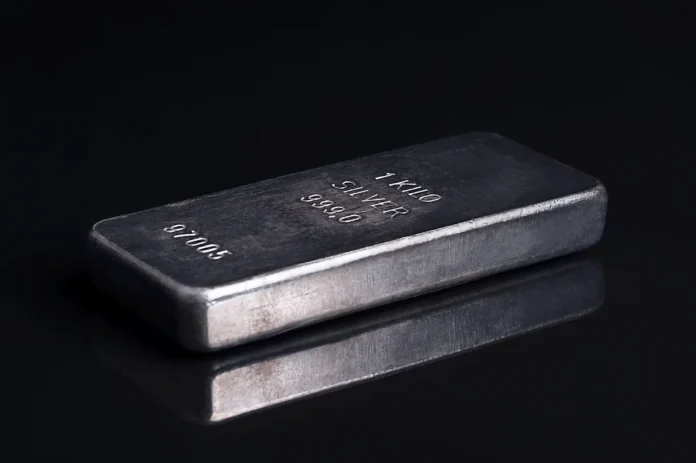
Silver (SI=F) September futures opened at $64.87 per ounce on Wednesday, August 12, 2026, down 0.1% from Tuesday’s closing price. Yet, silver continues to rise this morning, reaching $66.49 as of 7:45 a.m. ET.
Given the Fed’s two mandates of stable employment and controlling inflation, a modest CPI report this morning, especially one that shows “core” CPI remains under control, will reduce the chances of a Fed rate increase in September, fueling further growth in silver prices over the short term.
Current price of silver
The opening price of silver futures on Wednesday, August 12, 2026, 0.1% lower than Tuesday’s closing price. Here’s how today’s opening silver price has changed versus last week, month, and year:
One week ago: +3.9%
One month ago: +8.2%
One year ago: +72.8%
For context, silver’s year-over-year growth was 173.3% on May 14.
Want to learn more about the current top-performing companies in the silver industry? Explore a list of the top-performing companies in the silver industry using the Yahoo Finance Screener. You can create your own screeners with over 150 different screening criteria.
Silver vs. gold: Which made investors more money over the years?
Over the past 50 years, gold outperformed silver, delivering higher long-term returns. Since the 1970s, silver and gold prices have dramatically increased, but their roles in the economy and their long-term performance are very different.
Governments and investors view gold as a store of value, and central banks hold large gold reserves to protect their economies against global inflation or geopolitical crises. It’s also widely used to produce jewelry.
Silver is much more abundant in supply than gold, but it also has more uses. Silver plays a significant role in manufacturing and industrial production; companies use silver to make solar panels, electronics, and medical devices. The industrial demand can affect silver’s prices, causing more drastic changes.
Whether you’re tracking the price of silver since last month or last year, the price-of-silver chart below shows the precious metal’s value journey so far this year.
Delaware was once the go-to state to incorporate. That might be changing.
A number of high-profile corporations have picked up and left the state in the last year, citing legal uncertainty and “subjectivity” introduced by the Delaware Court of Chancery, which handles corporate cases and business disputes.
Elon Musk helped spark the trend when he urged companies to avoid incorporating in Delaware last year after a judge voided his $55 billion pay package. Some prominent companies, like Tripadvisor, left even before Musk’s high-profile case.
Although Delaware has a reputation as a business-friendly state, a series of recent court rulings has left executives wondering if they’ll find better legal protections elsewhere. Musk, for example, reincorporated SpaceX and Tesla from Delaware to Texas.
“If the verdict in my case in Delaware is not overturned, it will be used as precedent in every fake shareholder case for every company incorporated in Delaware for the rest of time!” Musk wrote on X in 2024.
Delaware Gov. Matt Meyer told Business Insider in February that the state is reaching out to companies and working to address concerns. Meyers approved several changes to the state’s General Corporation Law in March.
Companies incorporated in Delaware account for a substantial portion of the state’s revenue. The Delaware Department of State says that close to 2 million companies, including two-thirds of Fortune 500 companies, have made the state their legal home.
“Any company thinking about leaving, we’re actively reaching out, we’re talking to them, we’re understanding what the issues are and understanding what ways we can do better,” Meyer said. “And for those entities that have already made the decision to leave, we’re going to continue to work hard to earn their trust and hopefully to have them come back.”
Here are the biggest companies leaving Delaware.
DoorDash
DoorDash shareholders voted to incorporate in Nevada. Bloomberg/Bloomberg via Getty Images
DoorDash shareholders agreed to end its Delaware incorporation and relocate to Nevada, according to an SEC filing in August.
The company said its concerns around Delaware’s legal system triggered the decision.
“DoorDash’s management and Board believe that the Company will be best positioned to pursue its corporate strategy within the more predictable, statute-based legal environment that Nevada provides,” the company wrote. “However, in recent years, a discussion has emerged in the market over the legal landscape in Delaware, including as a result of cases that reached what many viewed as surprising results, an increasingly litigious environment and high-profile litigation outcomes that involved companies with controlling stockholders.”
Andreessen Horowitz
Andreessen Horowitz announced it was moving its corporation to Nevada in July. Pavlo Gonchar/SOPA Images/LightRocket via Getty Images
VC firm Andreessen Horowitz said in July it would reincorporate its primary business — AH Capital Management — to Nevada.
The firm said “legal uncertainty” has created concern among investors and entrepreneurs on company boards.
“As a result, many of the companies we fund and the entrepreneurs that we talk to are taking a second look at whether they should incorporate in other jurisdictions, prompted by the departure from Delaware of significant technology companies like Dropbox, Tripadvisor, and Tesla,” the firm said in a blog post.
Andreessen Horowitz said it could have relocated “quietly,” but it felt it was important to be transparent.
“For founders considering a similar move, there is often a reluctance to leave Delaware, based in part on concerns for how investors will react,” the firm said. “As the largest VC firm in the country, we hope that our decision signals to our portfolio companies, as well as to prospective portfolio companies, that such concerns may be overblown.”
Roblox
Roblox moved its corporation from Delaware to Nevada in May. Rafael Henrique/SOPA Images/LightRocket
Roblox, the online gaming platform, said its stockholders voted to move the company’s corporate home to Nevada, according to a May SEC filing.
In an April SEC filing, CEO David Baszucki wrote a letter to shareholders urging them to support management’s proposals, which included leaving Delaware.
“We believe that Nevada’s corporate law framework and statutory regime aligns with Roblox’s culture of innovation, values, and mission to connect the world with civility and optimism,” Baszucki said. “It also allows us to continue to build shareholder value, by providing a supportive, predictable environment.
Dropbox
Dropbox, the file-sharing and storage company, told its stockholders in January that it would reincorporate in Nevada. Reuters
The file-sharing and storage company told its stockholders in a January SEC filing that it would reincorporate in Nevada.
Under a section titled “Reasons for the Nevada Reincorporation,” Dropbox said it was in the midst of a “transformational period.”
“The evaluation committee and our board of directors determined that it is important for the Company to be able to operate with agility during this period of business transformation and that it would be competitively advantageous for the Company to have a predictable, statute-focused legal environment during a time of rapid business change,” the company said.
Dropbox added that Nevada might provide a more “predictable legal environment.”
Pershing Square Capital Management
Bill Ackman, the CEO and founder of Pershing Square Capital Management, said he intended to move his corporation from Delaware to Nevada. Reuters
In February, Bill Ackman, the CEO and founder of Pershing Square Capital Management, said he would move the legal home of its investment holdings company to Nevada.
Ackman shared the development in a February X post referencing Dropbox, which also said it would leave Delaware.
“We are reincorporating our management company in Nevada for the same reason. Top law firms are recommending Nevada and Texas over Delaware,” Ackman wrote.
The CEO and founder said he was still considering Texas in a separate post.
Trump Media & Technology Group
The Trump Media & Technology Group, led by CEO Devin Nunes, announced in May that it had reincorporated in Florida. Octavio Jones/Reuters
The Trump Media & Technology Group announced it moved to Florida after shareholders approved a proposal in May. The company operates the Truth Social platform, TV streaming platform Truth+, and Truth.Fi, a financial services company.
President Donald Trump’s political ascent has shifted attention toward Florida, where his private Mar-a-Lago club is located. In 2024, Business Insider spoke to lobbyists who said Florida had become “the power nexus for the country” and “the epicenter of Trumplandia.”
“We’re thrilled to reincorporate our Company in Florida,” CEO Devin Nunes said in a press release. “We’re thrilled to reincorporate our Company in Florida. With its pro-business orientation and respect for the rule of law, Florida is a great place for Trump Media to officially call home.”
The Trade Desk
The Trade Desk, an ad tech company, proposed reincorporating in Nevada in 2024. Photo Illustration by Pavlo Gonchar/SOPA Images/LightRocket via Getty Images
Ad tech company The Trade Desk included a proposal to reincorporate in Nevada in a late 2024 SEC filing.
The company said its board of directors and management “thoroughly discussed” the proposal.
“These discussions were in response to a number of factors, including developments in the competitive and regulatory landscape in which we compete and views regarding the legal landscape in Delaware,” the company said.
The Trade Desk filed another SEC filing that November, saying its stockholders approved the proposal.
Simon Property Group
Simon Property Group, a real estate investment company, proposed reincorporating in Indiana in May. Reuters
Shareholders for Simon Property Group, a real estate investment trust focused on the retail sector, approved a proposal to move its legal home to Indiana, according to a May SEC filing.
Indiana Secretary of State Diego Morales called the decision a “significant milestone” in fostering a “business-friendly environment.”
“We are proud to welcome Simon Property Group home. This move is a big win for Indiana — and it sends a strong message that our state is open for business. We look forward to continuing to support Simon Property Group and all companies who choose Indiana as their home,” Morales said in a press release.
Coinbase
Coinbase said it would leave Delaware to reincorporate in Texas. Sopa Images/Getty Images
The cryptocurrency exchange has filed paperwork with the Securities and Exchange Commission to leave Delaware and reincorporate in Texas, its chief legal officer, Paul Grewal, wrote in a column in The Wall Street Journal.
Texas has become “an increasingly attractive hub for innovative companies like ours,” Grewal wrote. “It’s a shame that it has come to this, but Delaware has left us with little choice.”
He added that recent legislation in Texas has made the state more attractive for the company.
“Senate Bill 29 modernized the Texas Business Organizations Code to codify the business-judgment rule, which rightly empowers directors and officers to make the business decisions they need to innovate,” Grewal wrote, referring to new legislation that gives companies more predictability in corporate governance disputes. “This bill, together with the establishment of the Texas Business Court system, gives companies a business-friendly legal ecosystem with strong protections and efficient dispute resolution.”
Crypto market maker Wintermute plans to invest about $1 billion in high-frequency trading and artificial intelligence data-center infrastructure over five years as it expands into stocks, commodities and foreign exchange.
The London-based firm wants non-crypto markets to generate more than 50% of revenue by the end of 2027, up from 10% now, according to a Bloomberg report citing founder and CEO Evgeny Gaevoy. Wintermute expects to fund the spending with retained earnings.
The push follows a drop in crypto activity. Wintermute’s average daily trading volume fell to about $10 billion this year from $15 billion in 2025 as bitcoin declined to roughly half its October peak above $126,000.
Gaevoy said the privately held company was profitable in 2025 and expects to remain profitable this year, without providing figures. Wintermute recorded $582 million in profit during the 2021 crypto bull market, according to Forbes.