Home Blog Page 370

Akash Network volume doubles – Can AKT’s 14% rally continue?

0
Akash Network volume doubles – Can AKT’s 14% rally continue?


Akash Network [AKT] gained more than 14% in the past 24 hours as altcoins attempted to recover from the week’s selling pressure.

The move came as Bitcoin [BTC] rose over 2.5%, lifting several higher-beta assets, including Ethereum [ETH], Ripple [XRP], Solana [SOL], and AKT.

Even so, several on-chain metrics remained mixed despite rising volume, development activity, and a technical breakout.

Can Akash Network build on this rebound?

Akash Network [AKT] rebounded from a former resistance zone that had acted as a support area after May’s breakout.

AKT traded between $0.436 and $0.526 for more than a month before breaking higher and rallying toward $0.960. The $0.526 level later flipped into support and emerged as a key buying area.

The Cumulative Volume Delta (CVD) improved from negative 1.74 million to a daily peak of 337,000 AKT. That shift suggested buyers regained control after a period of sustained selling pressure.

On top of that, momentum indicators showed early signs of improvement.

AKT
Source: AKT/USD on TradingView

The MACD turned positive for the first time in June on the 4-hour chart. Its signal line also crossed higher, pointing to strengthening momentum.

However, AKT still needed to reclaim the $0.70-$0.75 zone to strengthen the bullish case.

Until then, the broader short-term structure remained weak, leaving the latest move vulnerable to a pullback.

Is network activity improving again?

On-chain activity painted a mixed picture, though several key metrics showed renewed growth.

Token trading volume doubled over the past two days, rising from $8.38 million to $16.25 million. Monthly trading volume also climbed 54% to $414 million.

AKTAkash NetworkAKTAkash Network
Source: Token Terminal

Development activity improved as well.

Code commits increased 20% over the past month, reaching roughly 269. That move aligned with stronger network usage.

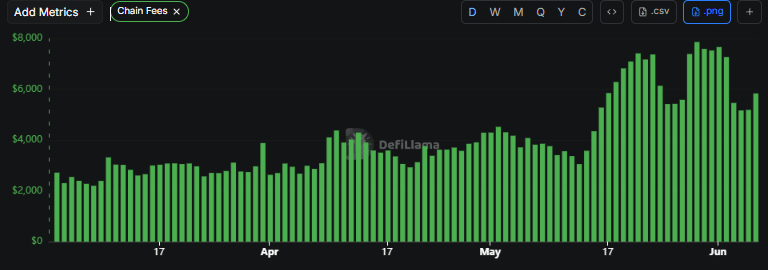
According to DeFiLlama, fee revenue continued rising through mid-May. Peak fees reached $7,858, while daily revenue climbed to $5,186.

AKTAKT
Source: DeFiLlama

Higher fees typically reflect greater network activity, suggesting usage remained healthy during the rebound. Taken together, these metrics pointed to improving engagement across the network. Even so, sustained growth may be needed before a broader bullish trend can take shape.


Final Summary

  • AKT recovered 14% after rebounding from a former resistance zone that has now turned into support.
  • The $0.70-$0.75 zone remains the key area AKT must reclaim before a broader trend recovery can be considered.


Source link

Why bitcoin (BTC) is falling: AI, tech IPOs, quantum, Strategy sale fears all converge, NYDIG says

0
Why bitcoin (BTC) is falling: AI, tech IPOs, quantum, Strategy sale fears all converge, NYDIG says


Bitcoin dropping below $60,000 to a fresh cycle low has left investors searching for a culprit. According to Greg Cipolaro, global head of research at NYDIG, there probably isn’t only one.

In a report last week, he argued that bitcoin and the broader crypto market is facing several overlapping headwinds that have been weighing on prices.

The AI trade sits near the top of his list as bitcoin is increasingly competing for capital with a sector that has become the market’s dominant growth story.

The overlap between AI and crypto investors is larger than many assume, he argued. Both attract investors seeking exposure to emerging technologies and outsized returns. As AI-related stocks continue to outperform, capital followed and rotated from crypto, he wrote.

Investors are also preparing for what could be the largest tech IPO cycle in years. Companies such as SpaceX, OpenAI, Anthropic are widely expected to eventually go public, with SpaceX already deep into the process of making its debut. Large IPOs often prompt institutions to raise cash and reduce existing positions ahead of new offerings, creating a potential headwind for crypto demand, he wrote.

Crypto has also been grappling with a series of industry-specific concerns.

Treasury Secretary Scott Bessent’s claim that U.S. authorities seized roughly $1 billion of Iranian-linked crypto assets raised questions about government reach into digital asset markets. Details remain limited, but the episode challenged one of crypto’s core narratives for some investors, Cipolaro said.

Threat of quantum computing also returned to the conversation after researchers published new work showing that the computational resources required to attack widely used cryptographic systems may be falling faster than previously thought.

Then there is Strategy (MSTR) selling bitcoin.

The sale of 32 BTC, worth $2.5 million at the time, was insignificant from a supply perspective but carried more weight psychologically. Strategy has spent years acting as one of the market’s most consistent buyers, Cipolaro said. Any suggestion that it could become a source of supply, he argued, forces investors to rethink an important pillar of the bull case.

Taken together, those developments could explain why bitcoin has struggled despite no obvious deterioration in underlying network activity or adoption trends.

“Viewed independently, none of these developments appears sufficient to drive a major correction in bitcoin,” Cipolaro wrote. “Viewed collectively, they help explain why price action has weakened despite the absence of a clear deterioration in underlying adoption metrics.”

Has bitcoin found a bottom?

Cipolaro’s onchain analysis offers a mixed answer.

Several indicators are approaching levels that have historically coincided with major bottoms, he noted. Bitcoin’s MVRV ratio has fallen to 1.2, close to the level where market value converges with investors’ aggregate cost basis. The percentage of supply held in profit recently slipped below 50%, another metric often associated with capitulation.

Yet the drawdown itself remains relatively modest by historical standards.

Bitcoin fell down roughly 53% from its peak ($126,000 in October), a much shallower decline than the 75%-90% drawdowns seen in prior cycles, he pointed out.

There’s also a time element: the previous three bitcoin bear markets lasted more or less a year from peak to trough, with the exception of its first-ever bear market ending in 163 days in 2011.

Friday’s sub-$60,000 plunge came only 242 days after the peak.

That means either institutional adoption has fundamentally changed bitcoin’s cycle behavior — or that the market simply hasn’t reached a true capitulation phase yet.

“The onchain data suggests the market has undergone a meaningful reset,” Cipolaro wrote.

But whether the low is already in place “likely depends on whether institutional demand has structurally altered the cycle or merely delayed a deeper reset,” he added.


Source link

Why Wall Street Sees Danaher (DHR) Benefiting From Improving Industry Conditions

0
Why Wall Street Sees Danaher (DHR) Benefiting From Improving Industry Conditions


With 110 hedge fund holders as of Q1 2026, Danaher Corporation (NYSE:DHR) is among the Top 10 Stocks That Members of Congress Own.

On May 26, Citi resumed coverage of Danaher Corporation (NYSE:DHR) with a Buy rating and a $230 price target following a prior suspension of coverage. The firm pointed to Danaher’s reaffirmation of its fiscal 2026 core growth guidance during its first-quarter earnings report and expressed continued confidence in the outlook for the bioprocessing market. Citi noted that the company remains well-positioned to benefit from improving industry conditions and sustained demand across its life sciences portfolio.

On May 14, RBC Capital resumed coverage of Danaher Corporation (NYSE:DHR) with an Outperform rating and a $200 price target. The firm expects the company’s growth trajectory to strengthen as conditions in the bioprocessing market continue to recover. According to RBC, a sustained rebound in bioprocessing activity, the easing of company-specific headwinds, and improving end-market demand could enable Danaher to achieve its targeted 6% revenue growth rate by 2027, reinforcing confidence in its medium-term growth outlook.

Founded in 1984, Danaher Corporation (NYSE:DHR) is headquartered in Washington, D.C. It is a global executive search and talent advisory firm that specializes in recruiting C-suite executives, senior leaders, and emerging talent across more than 20 industries, offering services that include leadership consulting, succession planning, and management assessment.

While we acknowledge the potential of DHR as an investment, we believe certain AI stocks offer greater upside potential and carry less downside risk. If you’re looking for an extremely undervalued AI stock that also stands to benefit significantly from Trump-era tariffs and the onshoring trend, see our free report on the best short-term AI stock.

READ NEXT: 7 Best Water Infrastructure Stocks to Buy for Scarcity Trends and 7 Best 3D Printing Stocks to Buy for Aerospace Components.

Disclosure: None.  Follow Insider Monkey on Google News.


Source link

Here’s why Canton bulls are eyeing $0.20 after CC’s 10% rally

0
Here's why Canton bulls are eyeing $0.20 after CC's 10% rally


Canton [CC] climbed to $0.1652 after posting a 10.61% daily gain at press time, while trading volume rose 22.28% to $35 million as market participation accelerated. The rally coincided with growing attention around Canton Network’s institutional adoption story and the upcoming DTCC soft launch scheduled for July. 

Notably, interest around Visa’s stablecoin integration also strengthened the broader narrative. As a result, buyers pushed CC back toward a major resistance area that has capped price advances for months. The latest move reflected improving sentiment across the market. 

However, traders remained focused on whether Canton could convert this surge into a sustained breakout rather than another rejection near overhead resistance.

Why are spot outflows still dominating?

Despite the strong rally, exchange flow data showed that more tokens continued leaving exchanges than entering them. 

On the 7th of June, Canton recorded approximately $1.97 million in inflows against $2.05 million in outflows, resulting in a net outflow of nearly $80,000. This trend suggested that some holders preferred moving assets away from trading venues instead of preparing for immediate sales. 

Such behavior often aligns with accumulation rather than distribution. Furthermore, the persistence of outflows during a price rally highlighted confidence among participants. 

While the imbalance remained relatively small, it still reinforced the idea that buyers continued absorbing available supply as institutional interest around the ecosystem expanded.

Source: CoinGlass

Bulls keep their conviction intact

Derivatives data showed that traders maintained a constructive outlook despite Canton approaching a key resistance level. 

At the time of writing, the OI-Weighted Funding Rate remained positive at 0.0072%, indicating that long-position holders continued paying a premium to maintain exposure. Positive funding typically reflects stronger demand from bullish traders than bearish participants. 

In addition, the indicator recovered after several negative readings earlier in the month, signaling an improvement in sentiment. Although funding levels remained moderate, they still pointed toward growing confidence in the current trend. 

However, traders would likely monitor future increases carefully because excessively elevated funding rates could eventually introduce overheating risks and encourage short-term profit-taking activity.

Source: CoinGlass

Resistance battle intensifies near $0.1668

Price action showed Canton challenging the important $0.1668 resistance zone after rebounding sharply from support near $0.1470. The daily chart revealed that buyers regained control following several weeks of consolidation within a broad range. 

At press time, the RSI also climbed to 60.13, reflecting strengthening buying interest without entering overbought territory. This positioning suggested that room for additional upside still existed if demand continued increasing. 

In addition, the latest breakout attempt occurred after multiple failed tests of the same resistance area, making the current move particularly significant. Should buyers establish support above $0.1668, the chart structure indicated that a move toward $0.20 could become increasingly likely over the coming sessions.

Canton price actionCanton price action
Source: TradingView

Is $0.20 the next destination  for Canton?

Canton remained positioned near a critical breakout point as institutional catalysts continued attracting attention. Spot outflows supported the accumulation narrative, while positive funding rates reflected sustained bullish conviction. 

If buyers successfully flipped $0.1668 into support, the path toward $0.20 would become considerably clearer. However, another rejection at resistance could keep CC trapped inside its broader trading range before the next major move develops.


Final Summary

  • Canton approached major resistance as volume and institutional interest increased.
  • Spot outflows and positive funding reflected continued confidence among traders.


Source link

Iran fires missiles at Israel as Trump says ‘I’m not happy about’ Israeli strikes on Lebanon

0
Iran fires missiles at Israel as Trump says 'I'm not happy about' Israeli strikes on Lebanon

Israel said Sunday that Iran launched missiles at it in the first such bombardment since a fragile ceasefire took effect in early April, complicating mediation efforts for a deal to end the war.

Iran’s state broadcaster confirmed the launches. Tehran had warned of retaliation after Israel struck Beirut’s southern suburbs without warning earlier Sunday in defiance of Washington’s request days ago to stand down. Israel called it retaliation for the Iranian-backed Hezbollah firing at northern Israel earlier in the day.

“Should these acts of aggression be repeated, the responses will be broader in scope and will encompass all American and Zionist targets throughout the region,” Iran’s Revolutionary Guard said in a statement that also referenced attacks on Iran’s coast and vessels around the Strait of Hormuz.

Israel’s military said it intercepted the missiles, and less than an hour later it said people could leave shelters but stay near them. Sirens sounded in several areas of the country. Multiple explosions were heard in northern Israel.

“Iran has made a grave mistake,” Israel military spokesman Brig. Gen. Effie Defrin said.

Iran had warned that an attack on Beirut would renew full-scale war across the Mideast, even as Pakistan tries to restart talks between Tehran and Washington.

“U.S. forces across the Middle East remain vigilant and ready,” the U.S. Central Command posted on X shortly before the missile launches.

Israel’s attack on Beirut came a few days after the Lebanese and Israeli governments agreed to a ceasefire in U.S.-hosted talks, though Hezbollah rejected the deal. The strike on a residential building killed two people and wounded 20, Lebanon’s health ministry said.

Israel’s strikes and ground invasion in Lebanon in pursuit of Hezbollah, and the militant group’s resistance to disarming, have complicated an overall deal to end the war in the Middle East. Iran says any deal must include an end to fighting in Lebanon.

After Iran’s launches, U.S. President Donald Trump told a Fox News Channel reporter that he wanted the Iranians to stop firing missiles and return to the negotiating table. He also said that Israel’s strikes earlier Sunday were not coordinated with the U.S. and “I’m not happy about it.”

Israel on Monday had announced it would strike the southern suburbs of Lebanon’s capital, but urgent talks via Washington halted that on the condition that Hezbollah stop targeting Israeli border towns.

Hezbollah, which claimed responsibility for firing at Israel earlier Sunday, wants the direct talks between Lebanon and Israel to end. Instead, it supports Iran’s stance that an overall ceasefire deal between Tehran and Washington include the situation in Lebanon.

Israeli Prime Minister Benjamin Netanyahu, who faces elections later this year, wants to press ahead with Israel’s offensive until he believes Hezbollah no longer poses a threat.

Trump in an interview with NBC’s “Meet the Press” that aired earlier Sunday said he would like to see a “more surgical attack on Hezbollah.” He also said he was “not demanding” that Lebanon be part of an overall ceasefire deal in the Iran war.

Mediation efforts on that larger deal continued Sunday as Pakistan’s interior minister visited Iran to talk with officials and Egypt said its foreign minister and his Qatari counterpart discussed “proposed elements” of a potential agreement, with no details.

Meanwhile, Iran continued to assert its grip on the Strait of Hormuz and the U.S. continued its blockade of Iranian ports, with shipments of oil, natural gas and fertilizer affected and the global economy in pain.

Iran since the ceasefire took effect has launched missiles and drones at Gulf nations and said it was targeting the U.S. military presence. After its launches against Israel, Iraq’s Civil Aviation Authority announced that the country’s airspace would close for 72 hours and Syria’s aviation authority announced a 12-hour airspace closure.

Pakistan’s interior minister visits Iran

Pakistan’s interior minister was in Tehran on Sunday. Mohsin Naqvi was delivering a message to Iranian Supreme Leader Ayatollah Mojtaba Khamenei from Pakistan’s army chief Field Marshal Asim Munir, according to Iran’s state-run IRNA news agency. There were no details on the message’s contents.

Khamenei has not been seen in public since he was named the Islamic Republic’s ruler after his father was killed on Feb. 28, the first day of the war.

Pakistani authorities have said Islamabad, with support from regional countries including Qatar, Turkey and Egypt, is working to help bridge differences between the United States and Iran.

In Cairo, Egyptian Foreign Minister Bader Abdelatty and Qatari counterpart Sheikh Mohammed bin Abdulrahman Al Thani discussed “proposed elements” of a potential agreement between the U.S. and Iran, the Egyptian foreign ministry said, without details.


Source link

A quick review of the Ways and Means tax bills: State of Crypto

0
A quick review of the Ways and Means tax bills: State of Crypto

The House Ways and Means Committee circulated seven draft bills ahead of this week’s hearing on crypto tax policy, signaling what the industry can expect.

You’re reading State of Crypto, a CoinDesk newsletter looking at the intersection of cryptocurrency and government. Click here to sign up for future editions.

The narrative

The House Ways and Means Committee is the group of lawmakers tasked with writing laws governing taxes. While we’ve seen draft bills addressing taxes already, it’s this committee that’s really going to handle a hefty part of the work of drafting crypto tax legislation and shepherding it through the legislative process.

Why it matters

The fact that the committee is at the point of discussing draft legislation in a hearing shows progress on this front, and it’s likely the provisions will eventually become law in the coming years, whether as part of a tax-specific legislative package or as part of some other, broader bill.

Breaking it down

Staking and mining, de minimis and stablecoin transactions are all covered in the draft bills circulated late Thursday by the House Ways and Means Committee, among various other issues.

It’s unclear how much progress will be made in terms of actually turning these bills into law in the 2026 calendar year. The House — and Senate, for that matter — has a number of other priorities that are more advanced and require floor time, as CoinDesk has covered before. Still, the existence of the draft bills and a hearing are important steps.

Alison Mangiero, the head of industry affairs and U.S. policy at the Crypto Council for Innovation, an industry trade group, said in a statement that the group of bills was an “important first step.”

“The Ways & Means Committee’s decision to release seven bills and follow with a full committee legislative hearing on June 9 is significant on procedural grounds alone,” she said. “This format, where members work through specific legislation with expert witnesses before any markup, is one the Committee has not used in years. That kind of deliberate, structured engagement represents the unique focus from the Committee on this important work.”

Mangiero called the bills the third leg in the metaphorical three-legged stool of crypto legislation, with the other legs including the stablecoin-focused GENIUS Act and the market structure-focused Clarity Act (the latter of which, as we all know, is still elbow-deep in the legislative process).

“Several provisions in this package reflect priorities we have long advanced: sensible tax treatment for GENIUS-compliant stablecoins that allows them to function as the payments instruments they are; a de minimis exception for routine network transaction fees, a relief we have long advocated for, and believe should be further broadened as the process continues; parity provisions extending securities lending, mark-to-market, and charitable deduction treatment to widely traded digital assets; and clear rules for the taxation of mining and staking rewards,” she said.

In semi-related news, the Financial Accounting Standards Board’s Investor Advisory Committee also met late last month to discuss, among other issues, whether stablecoins qualify to be treated as cash equivalents.

The committee believes there needs to be a “high threshold” to establish something as a cash equivalent, according to a summary of the meeting shared with CoinDesk. The members of the committee did not come to a consensus about what kind of information would be useful for investors.

Possible disclosure information includes how reserves are structured, the type of stablecoin, who the issuer is, where funds are held, disaggregated information about cash equivalents and currency risk and even whether disclosed information was made on an interim basis.

The committee will meet again in November.

Tuesday

  • 18:00 UTC (2:00 p.m. ET): The House Ways and Means Committee will hold a hearing to discuss crypto tax policy.

If you’ve got thoughts or questions on what I should discuss next week or any other feedback you’d like to share, feel free to email me at nik@coindesk.com or find me on Bluesky @nikhileshde.bsky.social.

You can also join the group conversation on Telegram.

See ya’ll next week!


Source link

Micron’s Stock Is Up Over 270% This Year. Here’s How It Can Still Double in 2026.

0
Micron's Stock Is Up Over 270% This Year. Here's How It Can Still Double in 2026.


Micron (NASDAQ: MU) investors have had a banner year, with the stock rising over 270% so far. If you invested in a broad market index fund, a return like that can take well over a decade to achieve. This skyrocketing surge speaks to the results investors can obtain by picking individual stocks, but what’s in the past is in the past. What really matters is what’s coming.

Despite Micron’s strong rise already in 2026, there is a scenario where the stock doubles by the end of the year. That would clearly make it a buy now, but how is a return like that possible to achieve?

Missed Nvidia in 2009? This Rare Signal Is Flashing Again. In 2009, a “Double Down” signal flashed for a little-known chipmaker called Nvidia. For the first time in years, that same “Total Conviction” signal is flashing for a company 1/100th the size of Nvidia. Continue »

Image source: Getty Images.

A memory shortage is driving Micron’s stock higher

Data centers need a large amount of memory to function. There are two primary types of memory, and each gets used differently. DRAM memory is mostly deployed in computing chips, which are seeing a spike in demand as more and more computing power is deployed for artificial intelligence (AI) use. Micron also makes NAND memory, which primarily gets used in data storage like solid-state drives (SSDs). Both of these products are in short supply, which is causing prices to soar. Micron is cashing in on this shortage, but also working to alleviate it at the same time.

By mid-2027, Micron’s new Idaho facility will be up and running, and several other production sites are under construction now. At the same time, investors are getting estimates for 2027 capital expenditures even greater than 2026’s levels. In fact, Nvidia believes its global data center capital expenditures could reach $3 trillion to $4 trillion annually by 2030.

Compared to the estimated $650 billion that AI hyperscalers are expected to spend this year, that growth presents some major supply challenges and could extend the memory chip shortage for several years, allowing Micron’s stock to be an excellent long-term investment.

How Micron could double from here

But in 2026, Micron’s stock isn’t all that expensive at 18 times forward earnings. Its peer, Sandisk (NASDAQ: SNDK), has already risen to about 28 times forward earnings. That could easily unlock another 50% growth just based on valuation alone. However, if investors start to get excited about 2027 data center demand and Micron’s revenue growth exceeds expectations (right now, the analyst consensus projects 263% growth for its next quarter and 250% after that), Micron’s stock could easily rise the other 50% based on beating estimates.

Wall Street only forecasts 60% growth for fiscal year 2027 (ending August 2027), and if that number moves to over 100% (which is entirely possible based on major 2027 demand), I wouldn’t be surprised to see the market bid up the stock as a result.

While Micron could still double this year, I think there’s a compelling case for the stock even if it falls short of that goal.

Should you buy stock in Micron Technology right now?

Before you buy stock in Micron Technology, consider this:

The Motley Fool Stock Advisor analyst team just identified what they believe are the 10 best stocks for investors to buy now… and Micron Technology wasn’t one of them. The 10 stocks that made the cut are built for long-term growth and could produce monster returns in the coming years.

Consider when Netflix made this list on December 17, 2004… if you invested $1,000 at the time of our recommendation, you’d have $443,191!* Or when Nvidia made this list on April 15, 2005… if you invested $1,000 at the time of our recommendation, you’d have $1,258,838!*

That performance is why people listen. With a track record of beating the S&P 500 by nearly 5x, Stock Advisor offers a distinct advantage. Don’t miss the latest top 10 list, available with Stock Advisor, and join an investing community built for the long haul.

See the 10 stocks »

*Stock Advisor returns as of June 7, 2026.

Keithen Drury has no position in any of the stocks mentioned. The Motley Fool has positions in and recommends Micron Technology. The Motley Fool has a disclosure policy.

Micron’s Stock Is Up Over 270% This Year. Here’s How It Can Still Double in 2026. was originally published by The Motley Fool


Source link