Home Blog Page 375

STABLE crashes 18% as support breaks: Is a drop to $0.025 next?

0
STABLE crashes 18% as support breaks: Is a drop to $0.025 next?


Stable [STABLE] faced intense selling pressure over the past 24 hours, with the token dropping 18.5% to $0.0307. Trading activity moved in the opposite direction, as volume increased 18.9% to $24.09 million. 

This combination suggested that market participants actively sold into weakness rather than stepping away from the market. 

Earlier attempts to stabilize above higher levels failed, and sellers gradually strengthened their control. Rising volume during a sharp decline often reflects conviction behind the prevailing trend. 

In this case, the surge in activity accompanied persistent downside pressure, indicating that bearish sentiment had strengthened across the broader market structure.

Leveraged traders rushed for the exit

Derivatives traders also reduced exposure aggressively as conditions deteriorated. Open Interest fell 20.54% to $21.76 million, marking a significant contraction in speculative participation. 

The decline occurred alongside falling prices, suggesting that traders closed positions rather than opening fresh directional bets. 

Such behavior often appears when confidence weakens and participants seek to reduce risk. 

Furthermore, the sharp reduction in Open Interest indicated that leverage had left the market rapidly. While this development removed some liquidation risk, it also reflected fading conviction among short-term traders. 

Until new positions begin entering the market again, STABLE could struggle to generate sustained recovery attempts because speculative demand has weakened considerably.

Source: CoinGlass

Exchange flows hinted at cautious accumulation

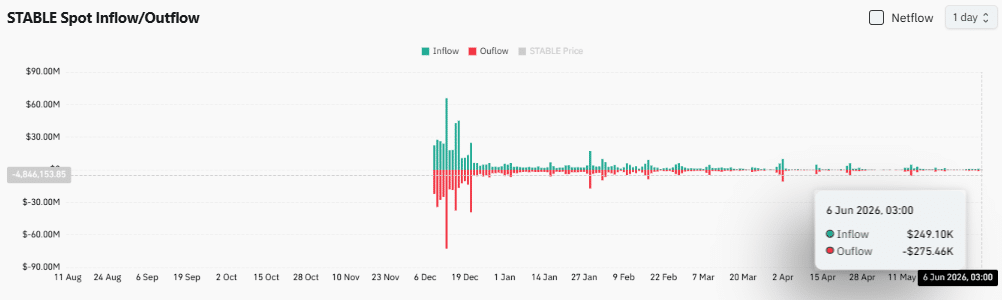
Spot flow data revealed a slightly different picture beneath the surface. 

On the 6th of June, inflows reached approximately $249.10K while outflows totaled about $275.46K. This resulted in net outflows from exchanges despite the ongoing correction. 

Although the difference remained relatively small, it suggested that some holders continued withdrawing tokens instead of preparing them for sale. 

Such behavior often reduces immediate exchange supply and can soften downside pressure. However, the scale of these outflows remained modest compared to the broader sell-off. 

For that reason, exchange activity alone did not appear strong enough to reverse prevailing market conditions. Buyers still needed stronger demand to offset the broader weakness visible across price and derivatives markets.
Source: CoinGlass

STABLE breakdown below support shifts focus lower

Price action deteriorated after STABLE lost the critical $0.0322 support level that had previously contained several pullbacks.

Before the breakdown, the token repeatedly struggled near the $0.0400 resistance zone and failed to establish a higher high. This weakness eventually translated into a decisive move lower. Technical indicators reinforced the bearish picture. 

The MACD line crossed below the signal line, while the histogram expanded further into negative territory. These developments reflected strengthening downside pressure as sellers maintained control of the trend. 

Since the price now trades beneath former support, attention has shifted toward the next major level near $0.0250. Unless buyers reclaim $0.0322 quickly, bearish conditions would likely remain dominant.

STABLE price actionSTABLE price action
Source: TradingView

Final Summary

  • STABLE lost $0.0322 support as sellers strengthened control across the market.
  • Falling Open Interest showed traders exited positions during the sharp correction.



Source link

Crypto’s brutal week: Bitcoin (BTC), Ether (ETH) suffer worst weekly drop since FTX crash

0
Crypto's brutal week: Bitcoin (BTC), Ether (ETH) suffer worst weekly drop since FTX crash


Crypto investors endured one of their toughest week in years as a wave of selling wiped out hundreds of billions of dollars from digital asset markets.

Bitcoin fell 17.3% this week while ether (ETH) dropped 22%, putting both assets on track for their largest weekly declines since November 2022, when the collapse of Sam Bankman-Fried’s FTX exchange triggered a market-wide panic.

Despite a modest stabilization on Saturday, both assets remained near their lows, with BTC trading just above $60,000 and ETH changing hands around $1,550.

The damage extended far beyond the two largest cryptocurrencies. The digital asset market shed roughly $390 billion in value during the week, leaving total market capitalization hovering just above $2 trillion, according to TradingView data. That’s less than half of the nearly $4.2 trillion peak reached in October.

It wasn’t just prices that got hit. Crypto derivatives traders suffered one of the largest wipeouts of this year.

Roughly $7 billion in leveraged positions were liquidated across digital assets during the week, according to CoinGlass data, with Monday and Friday delivering the most severe flushes.

About $5.7 billion of those were long positions, or bullish bets on higher prices.

Why crypto crashed this week

The selloff came as several bearish forces converged at once.

Starting the week, Strategy (MSTR), the largest corporate holder of bitcoin, disclosed it sold BTC for the first time in nearly four years. The transaction was negligible — just 32 BTC worth roughly $2.5 million — but the sale rattled investors who had long viewed Michael Saylor’s company as a perpetual source of demand.

Investors also began questioning whether Strategy may need to sell additional bitcoin to help cover obligations tied to its growing stack of preferred equities.

At the same time, bitcoin ETFs continued to bleed assets. K33 Research head Vetle Lunde argued earlier this week that some of those outflows reflected a broader rotation of capital away from crypto and into artificial intelligence (AI) investments.

With AI-related stocks pushing to record highs and investors anticipating potential IPOs from companies such as OpenAI, Anthropic and SpaceX, “the opportunity cost of holding BTC” has become increasingly difficult for some investors to ignore, Lunde said.

Concerns about AI’s ability to expose flaws in crypto protocols also added to the pressure. Zcash (ZEC), one of the best-performing cryptos earlier this year, tumbled more than 40% after researchers used Anthropic’s latest AI model to uncover a critical vulnerability in the network’s privacy system.

The final blow came with Friday’s stronger-than-expected U.S. jobs report, forcing investors to rethink the Federal Reserve’s next move. Markets that earlier this year anticipated rate cuts are now increasingly expect that the central bank could hike if inflation remains stubbornly high.

U.S. Treasury bond yields surged, while the Nasdaq 100 suffered its worst day since the tariff-driven selloff in April 2025, snapping a record-setting rally that had fueled much of Wall Street’s enthusiasm this year.

For now, the selling appeared to have paused with traditional markets closed for the weekend and crypto prices stabilizing on Saturday.

Whether this week’s rout marked the capitulation that often comes at market bottoms or was merely the latest episode in the downtrend may come down to the broader macro picture. Higher bond yields, rate-hike fears and continued competition from AI investments and IPOs remain key hurdles for the recovery.


Source link

Bitcoin’s Biggest Buyer Just Sold Some. Should Other Investors Follow Suit?

0
Bitcoin's Biggest Buyer Just Sold Some. Should Other Investors Follow Suit?


On June 1, Strategy (NASDAQ: MSTR), the company that built its entire identity around accumulating Bitcoin (CRYPTO: BTC), sold some of the coin for the first time in nearly four years, and the market isn’t pleased despite the piddlingly small quantities involved. It offloaded just 32 Bitcoins for a total of $2.5 million in proceeds. Since the filing was disclosed, Strategy’s shares have fallen 9.3% on June 2 alone, and Bitcoin has lost 6.1%.

Selling 32 out of 843,706 Bitcoins is the financial equivalent of taking a few pennies from a vault of piled treasure. But the psychological significance of this particular sale is what makes it worth talking about. So, let’s examine what’s going on here a bit more closely, then evaluate whether it might be worth thinking about selling the coin.

Will AI create the world’s first trillionaire? Our team just released a report on the one little-known company, called an “Indispensable Monopoly” providing the critical technology Nvidia and Intel both need. Continue »

Image source: Getty Images.

This sell was a pre-planned “inoculation,” not a fire sale

The point of Strategy selling Bitcoin is that the proceeds of the sale funded the company’s dividend payments on Strategy Incorporated Variable Rate Series A Perpetual Stretch Preferred Stock (Stretch), a class of its perpetual preferred stock. Stretch pays a variable annualized yield of 11.5% in monthly cash installments and has grown to a market cap of $10.5 billion since its 2025 debut, so it imposes a substantial financial obligation on the issuer. Servicing the dividend runs at roughly $100 million per month.

But this sale was too small to cover even one month of that required outlay because, quite interestingly, it was designed to fulfill a psychological purpose rather than a financial one.

During Strategy’s first-quarter earnings call on May 5, chairman Michael Saylor told investors that the company would “probably sell some Bitcoin to fund a dividend just to inoculate the market — just to send the message that we did it.” The idea was to expose the market to a tiny, planned sale now, so that a future, larger sale would look routine rather than a cause for panic. Notably, any Bitcoin sale goes back on Strategy’s long-held claims that it’d never touch its coins.

Strategy also raised $128 million through common stock sales the same week. Between equity issuance and the ecosystem of Bitcoin exchange-traded funds (ETFs) channeling institutional capital, the company can likely keep using financing to accumulate the asset while also selling small quantities of it from time to time as needed. Its CEO has said the business expects to still be a net buyer of Bitcoin.

There’s nothing worse about this asset compared to before

Bitcoin’s broader decline, while temporarily exacerbated by Strategy’s sale, has its own causes.

The coin has fallen more than 45% from its October 2025 all-time high near $126,000 due to a combination of a flash crash, macroeconomic instability, and low enthusiasm about crypto as an asset class. But Bitcoin itself hasn’t changed, so its fundamentals remain sound.

So, you probably shouldn’t be racing to sell Bitcoin just because Strategy did. The market’s ongoing reaction will probably prove to be an overreaction in retrospect, even if the coin’s recovery to new highs will take a good while.

Should you buy stock in Strategy right now?

Before you buy stock in Strategy, consider this:

The Motley Fool Stock Advisor analyst team just identified what they believe are the 10 best stocks for investors to buy now… and Strategy wasn’t one of them. The 10 stocks that made the cut could produce monster returns in the coming years.

Consider when Netflix made this list on December 17, 2004… if you invested $1,000 at the time of our recommendation, you’d have $443,191!* Or when Nvidia made this list on April 15, 2005… if you invested $1,000 at the time of our recommendation, you’d have $1,258,838!*

Now, it’s worth noting Stock Advisor’s total average return is 941% — a market-crushing outperformance compared to 211% for the S&P 500. Don’t miss the latest top 10 list, available with Stock Advisor, and join an investing community built by individual investors for individual investors.

See the 10 stocks »

*Stock Advisor returns as of June 6, 2026.

Alex Carchidi has positions in Bitcoin. The Motley Fool has positions in and recommends Bitcoin. The Motley Fool has a disclosure policy.

Bitcoin’s Biggest Buyer Just Sold Some. Should Other Investors Follow Suit? was originally published by The Motley Fool


Source link

I Gave My Daughter a “Yes Day” for Her Birthday

0
I Gave My Daughter a "Yes Day" for Her Birthday


Parenting young kids often feels like saying no on repeat.

No, not today. No, that’s enough. No, maybe later.

So for my daughter’s 7th birthday, I decided to try something different. I decided to give her a “Yes day” and say yes to whatever request and desire she had, within resonable boundaries.

I first heard about it years ago, before I became a mom. A good friend told me about an annual tradition in their home called “Kids in charge day,” where her children picked the meals, the outings, and the flow of the day.

At the time, I had questions. What if they ask for something unrealistic? What if it gets out of hand?

She told me something I didn’t fully appreciate then, but that has stayed with me ever since: kids aren’t as impressed with extravagance. What they want is attention, time, and a sense that their voice matters.

We introduced the idea when our daughter was 4, and it quickly became one of her favorite traditions. So this year, we made it her birthday gift, something she already loved, arriving right on time.

I set boundaries, but kept them simple

“Yes” doesn’t mean anything goes. For us, it meant choices that were safe, local, and doable within the day. My daughter didn’t need endles options. She needed the opportuity to make her own choices.


mom and daughter manicures

The author set the boundaries for her daughter’s “yes day.” 

Courtesy of the author


I let her lead, even when it was uncomforable

Her first request was breakfast: a cream cheese bagel. Easy.

Then came her outfit: red heart socks, faded floral print pants, and an old pink shirt. Something I would’ve picked out for play or painting, not a birthday outing.

I almost redirected her, but stopped short. “Is that what you want to wear?” I asked.

“Yes,” she said, beaming. Confidence is built in moments when kids get to trust their own thinking without being corrected.

The small things seemed to matter most

We headed to National Harbor, just outside of D.C., where she planned to build a bear using gift cards she’d been saving.

When we pulled up, I asked if I could grab a coffee before we got started. “Yes!” she shouted, delighted. That moment surprised me. She wasn’t just receiving the yes. She was learning how to give it.

We wandered into a Black-owned bookstore, hand in hand. She picked out a chapter book. Then, just as excitedly, she grabbed a “Gracie’s Corner” book, a series she used to love as a toddler and one I was almost certain she’d outgrown.

I almost said no again. Then I remembered the assignment. “Yes. And yes.”

I enjoyed watching what she did with the freedom

At Build-A-Bear, she made thoughtful choices. She picked the birthday bear that cost as much as her age so she could spend more on accessories, instead of choosing a more expensive plush that would eat into her budget. I’m not surprised though, my girl loves to save a coin.

By midday, it was “yes, yes, yes.” A candy shop stop. A few treats. There was an ice cream counter inside, and after trying a few flavors, she decided on her own to wait until after lunch.

No prompting. No correction. Just her own good judgment. She felt trusted in the moment and rose to the occasion.

I needed to stretch my comfort too

Later, she asked to ride the Capital Wheel. She was ready. I was not.

Her dad had joined us by then, and they walked hand in hand toward the oversized Ferris wheel while I followed a few steps behind, snapping photos. At the ticket booth, my husband asked for three tickets.


Dad holding daughter's hand

The author joined her daughter and spouse on a ferris wheel even though she’s afraid of heights. 

Courtesy of the author


“Wait, Mom, you’re doing this?!” she asked. I took a breath. “Yes.” She squealed.

Sometimes a “Yes Day” isn’t just about your child. It’s about saying yes to yourself, too. To your own confidence and courage. I know my fear of heights is irrational, but in that moment it felt very real. I was, and still am, proud of myself for pushing through.

She reminded me I deserve yeses too

At the nail salon I typically visit solo, she was treated like royalty. Apple juice in a bejeweled glass. Chocolates at checkout. A cascade of bubbles as we left. We stopped next door at a craft store and picked up stickers and bookmarks.

And then, near the end of the day, she surprised me. She asked if we could go to the makeup store to get something for me. I reminded her it was her day, not mine.

“Yes, but I want to share it with you, Mama.”

That night, we ordered cheeseburgers and fries and sat around the table, her legs swinging as she recapped her favorite parts of the day. Proud. Confident. Already just a little bit bigger.

In that moment, my friend’s words came back to me. A “Yes Day” isn’t about indulgence. It’s about intention. It gives your child space to make decisions, feel heard, and trust their voice.

The goal isn’t just to say yes for a day. It’s to raise kids who know how to use their voice for a lifetime.


Source link

The battle for digital dollars is moving onchain

0
The battle for digital dollars is moving onchain

America’s largest banks are preparing a direct response to one of crypto’s fastest-growing products: stablecoins.

JPMorgan Chase, Bank of America, Citigroup and other major lenders said Friday that they plan to launch a shared tokenized deposit network through The Clearing House by the first half of 2027. The project would allow bank deposits to move across blockchain infrastructure with round-the-clock settlement, giving traditional bank money some of the same capabilities that have helped stablecoins gain traction.

The move highlights the growing competition to become the preferred form of cash on blockchain networks.

“Following the GENIUS Act, a competition seems to be emerging between stablecoins, tokenized deposits and tokenized money market funds to become the preferred onchain cash instrument,” said Reid Noch, vice president of U.S. equity market structure at TD Securities.

Stablecoins, specifically Circle’s (CRCL) USDC and Tether’s USDT, currently dominate that market. The dollar-pegged tokens are widely used for crypto trading, cross-border payments and increasingly for savings products. But banks are concerned that if stablecoins become mainstream, deposits could migrate from traditional accounts into crypto wallets.

Tokenized deposits allow banks to bring customers onchain without losing control of their deposits. A customer’s bank deposit would be represented as a digital token that can move across blockchain rails. Unlike stablecoins, the funds would remain inside the banking system.

Noch said tokenized deposits address long-standing inefficiencies in global payments.

“Anyone who has ever wired money, especially internationally, knows the process can be expensive and often takes one or two business days to complete,” said Noch. By using blockchain infrastructure, tokenized deposits could allow near-instant transfers around the clock while reducing costs and settlement frictions, he said.

The initiative also signals how far blockchain technology has moved into the financial mainstream.

“The biggest banks in America are voluntarily coming onchain,” said Digital Chamber CEO Cody Carbone. “When the country’s largest institutions decide the future of finance runs on blockchain, they’re proving exactly what our industry has been building toward all along.”

Significant competition

Still, the banking industry’s approach differs sharply from crypto’s vision of open networks.

Noelle Acheson, author of “Crypto is Macro Now,” noted that banks have spent years experimenting with private blockchain systems that move money internally while maintaining strict control over users and transactions. The planned Clearing House network expands that model across multiple banks but remains far removed from public blockchain ecosystems where stablecoins circulate freely.

Acheson argued that the project demonstrates that banks are taking stablecoins seriously despite public comments from some executives, including JPM CEO Jamie Dimon, who downplayed the threat. While stablecoins offer greater liquidity and flexibility, she said many corporate customers may prefer a bank-backed system that fits within existing compliance frameworks.

In a report in March, Jeffries said it estimates that stablecoins could drive a 3% to 5% runoff in core deposits over the next five years and shrink average bank earnings by about 3%.

The outcome could reshape how money moves on blockchain networks.

If successful, the Clearing House initiative could emerge as a significant competitor to stablecoins for corporate payments and treasury operations. At the same time, it underscores a broader trend: traditional finance is increasingly adopting blockchain technology, even as it competes with crypto-native alternatives built on the same infrastructure.


Source link

Should Investors Sell Tesla Stock to Buy SpaceX?

0
Should Investors Sell Tesla Stock to Buy SpaceX?


For years, Tesla (NASDAQ: TSLA) offered investors something unique: a public market way to invest alongside CEO Elon Musk’s technological ambitions.

As the company has evolved far beyond an electric vehicle (EV) maker, investors have gradually viewed Tesla as a bet on artificial intelligence (AI), self-driving cars, robotics, automation, and Musk’s ability to build industry-defining businesses. That perception helped Tesla command a premium valuation in the market.

Will AI create the world’s first trillionaire? Our team just released a report on the one little-known company, called an “Indispensable Monopoly” providing the critical technology Nvidia and Intel both need. Continue »

But a potential SpaceX initial public offering (IPO) could quietly change how investors view Tesla stock. For the first time, investors may have another large-scale Musk company to compare directly against Tesla.

And that comparison could matter more than many investors realize.

Image source: Getty Images.

Tesla’s valuation was never just about cars

Tesla delivered roughly 1.6 million vehicles in 2025, making it one of the world’s largest EV manufacturers. But traditional automakers also sell millions of vehicles. None trade at a valuation anywhere close to Tesla’s. For perspective, Tesla’s stock has a price-to-sales (P/S) ratio of 15.6, far ahead of General Motors‘ P/S ratio of 0.4.

That’s because investors never valued Tesla like a normal car company.

They gave Tesla credit for businesses that remain largely ahead of it, including robotaxis, autonomous driving, humanoid robots, AI-driven software, and energy infrastructure. Investors effectively treated Tesla as a technology platform with multiple long-term growth opportunities.

For years, Tesla also benefited from a powerful advantage: scarcity. Investors who believed in Musk’s ability to build transformative businesses had limited public market ways to invest alongside him. SpaceX, xAI, and Neuralink all remained private. So, Tesla became the default option.

But a SpaceX IPO could begin changing that dynamic.

SpaceX could reshape Tesla’s valuation framework

At first glance, some investors may assume a SpaceX IPO matters simply because money could rotate out of Tesla stock. That may happen around the margins. But the bigger shift could involve investor psychology.

A public SpaceX listing would give investors another major Musk-led company to evaluate directly. And unlike Tesla, SpaceX could enter public markets with what many investors may view as a fresher growth story.


Source link

LUNC sheds 37% in 6 days, remains bearish – Wait for THIS before buying!

0
LUNC sheds 37% in 6 days, remains bearish - Wait for THIS before buying!


Terra Classic [LUNC] witnessed five straight days of red on the price charts. Since the 1st of June, it has receded by 30.82%.

CoinMarketCap data showed a 20% increase in daily trading volume, but it was not enough to send the trading volume above the 20-day moving average.

Despite the recent slump, LUNC retained a bullish bias on the higher timeframes. Here’s why there is a good chance that buying the altcoin now could yield decent returns in the coming weeks.

LUNC has not lost its higher timeframe trend yet

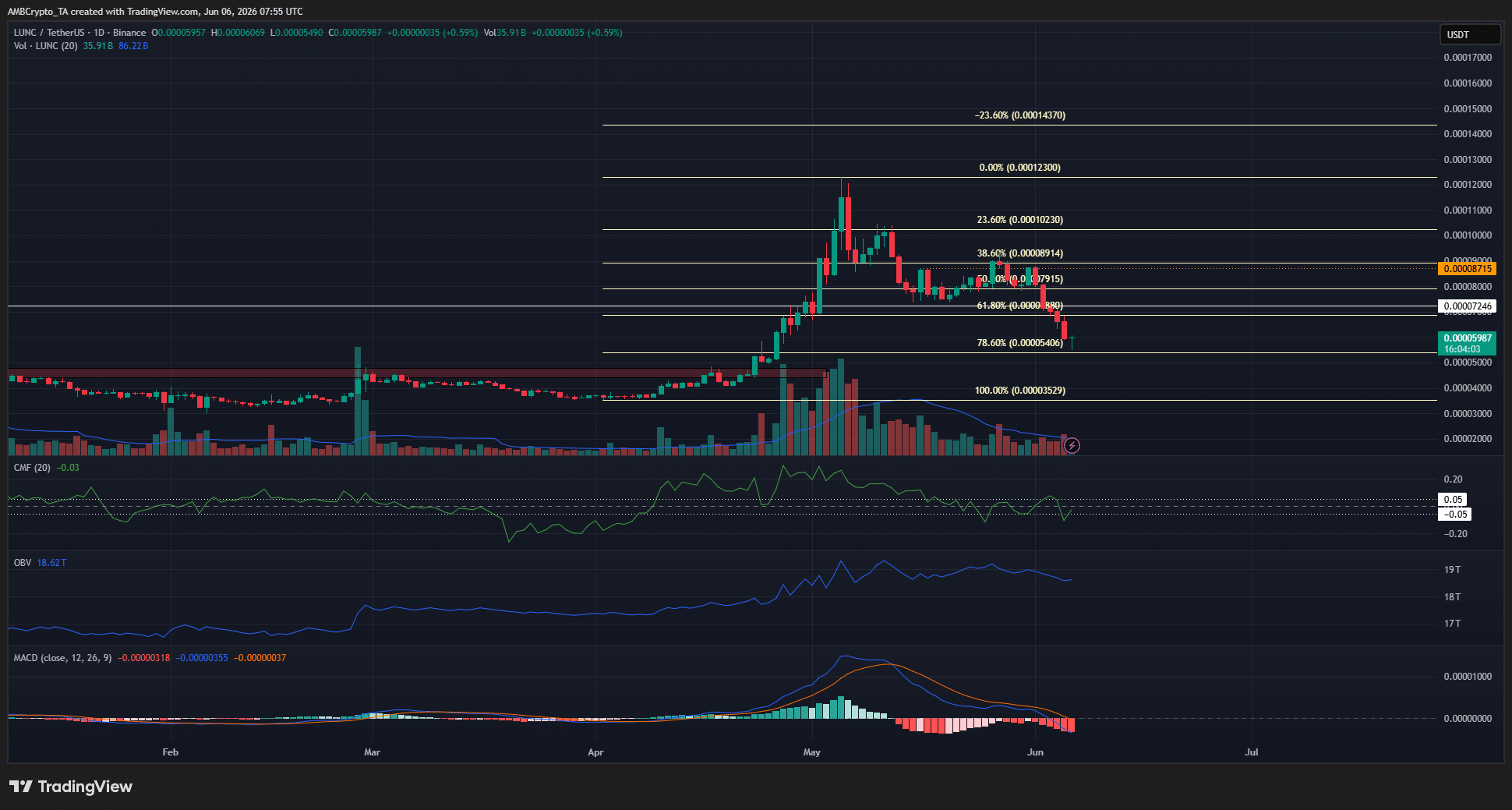
Towards the end of May, AMBCrypto reported that the higher timeframe structure was bullish. It was expected that the $0.000087 resistance zone would be breached.

Instead, around that time, Bitcoin began to sink below $75k, shifting its 4-hour trend bearishly. LUNC bulls faced rejection at the aforementioned resistance and subsequently lost control of the $0.000072 support as well.

LUNC 1-day Chart
Source: LUNC/USDT on TradingView

Yet, the higher timeframe picture remains bullish for LUNC. The swing structure hinges on the $0.000035 and $0.000123 levels. At the time of writing, the 78.6% retracement level at $0.000054 has served as a demand zone.

The CMF remained in neutral territory, indicating that the selling pressure was not running out of hand. The OBV agreed with this finding and has only seen a modest dip over the past month.

The momentum was more bearish, as shown by the MACD, which has sunk below the zero line.

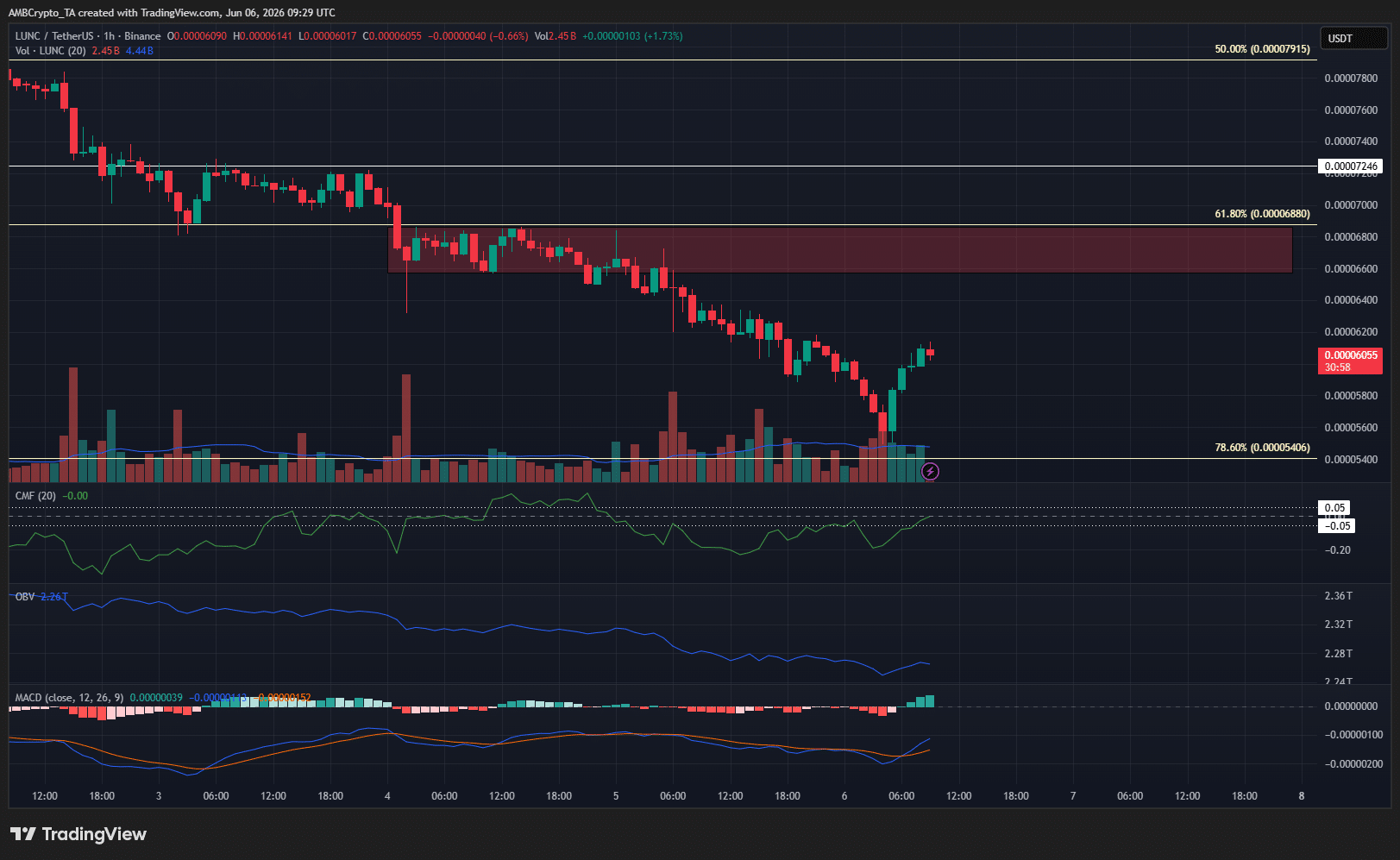
The defense of the golden pocket in recent hours of trading was encouraging, but not an automatic buy signal. Bullish traders need to wait for a clear reversal before buying.

Traders’ call to action – Wait

LUNC 1-hour ChartLUNC 1-hour Chart
Source: LUNC/USDT on TradingView

The 1-hour chart has not yet shifted its structure bullishly. As things stand, a move back above $0.0000686 is needed to show that bulls are back in control. This area marked the local highs that need to be breached to bring a structural shift.

Such an H1 shift will also make it easier for swing traders, giving them added clarity on buyer strength and where the invalidation of the bullish setup lies.


Final Summary

  • LUNC’s breakdown below the $0.000072 support came alongside five consecutive red days on the price charts.
  • Despite the recent losses, LUNC remained bullish on the higher timeframes, and swing traders can await a lower timeframe trend shift before buying.


Source link