Home Blog Page 376

Pfizer’s 6.7% Yield Looks Scary — but the Dividend Story Is Stronger Than It Seems

0
Pfizer's 6.7% Yield Looks Scary -- but the Dividend Story Is Stronger Than It Seems


The S&P 500 index (SNPINDEX: ^GSPC) has a tiny yield of 1.1%. The average pharmaceutical company’s yield is 1.7%. Those comparison points make Pfizer‘s (NYSE: PFE) 6.7% dividend yield look shockingly large. If you are a dividend investor, is it worth buying Pfizer, or is the risk of a dividend cut too great? The dividend is probably on stronger ground than you think.

Who sets Pfizer’s dividend policy?

When you boil it all down, the board of directors decides on a company’s dividend policy. It is entirely up to this group. Obviously, they don’t work in a vacuum. The board consults with a company’s CEO and other top executives before making a dividend decision. So, what management says is often a good indication of what the board is thinking.

Will AI create the world’s first trillionaire? Our team just released a report on the one little-known company, called an “Indispensable Monopoly” providing the critical technology Nvidia and Intel both need. Continue »

Image source: Getty Images.

In Pfizer’s case, management is making a clear statement that its goal is to maintain the dividend. In fact, it stated exactly that on a first-quarter earnings slide titled “Invest to Maximize Post-2028 Growth.” The dividend was right there with investing in research and development, launching new products, and making bolt-on acquisitions.

That’s not a guarantee that the healthcare giant’s dividend won’t be cut. But it is a strong indication that the company understands that dividends are important to its shareholders. And that the goal is to support the current payment through what is very clearly a difficult period.

Pfizer has a normal business mismatch

The big issue the company faces is fairly normal for a pharmaceutical company. It has patent expirations coming up that will lead to a revenue reduction, and it doesn’t have any new drugs on the horizon to offset the impact. Patent expirations happen on a set schedule, but research and development does not. So timing mismatches like this are fairly commonplace in the drug sector.

Pfizer isn’t sitting around hoping for the best. For example, after its own GLP-1 weight-loss drug had to be dropped, it quickly pivoted and bought a company with a more promising GLP-1 candidate. That shows the company is still laser-focused on discovering new drugs in key areas. But it also shows that Pfizer has the capacity to move quickly and strategically when needed.

For example, it has also been creating partnerships. The two most recent agreements are with Chinese companies, one on the GLP-1 side and the other for oncology drugs. All in, Pfizer is doing what it needs to do to deal with upcoming patent expirations.


Source link

Luke Combs Joins Justin Bieber With Multiple Returning Smashes

0
Luke Combs Joins Justin Bieber With Multiple Returning Smashes


Drake is the most successful musician on streaming platforms like Spotify and Apple Music in many regards. He proves his continued popularity every time he releases a new album and it racks up hundreds of millions of plays in only its first week. That was certainly the case recently with his latest blockbuster, Iceman, which generated more than 462 million streams of its 18 tunes – and that was only one of his three full-lengths.

As Iceman arrived, so too did Habibti and Maid of Honour, and fans rushed to listen to everything the Canadian Grammy winner delivered. Unsurprisingly, Drake absolutely dominated the Billboard charts last week, thanks to his trio of projects and dozens of songs. His presence was perhaps felt most dramatically on streaming rosters, where very few popular songs were able to withstand the rapper’s onslaught.

A week later, a number of his recently shared compositions have fallen off of the Streaming Songs chart, making way for a handful of smashes and popular acts to return. Only two stars manage to bring multiple singles to the roster once more, one of whom ranks among the biggest country acts at the moment.

Luke Combs Returns With Two Hits

A pair of recent singles by Luke Combs reenter the Streaming Songs chart this week, and they happen to land side-by-side. “Be by You” is back at No. 48, while “Sleepless in a Hotel Room” reappears at No. 49.

Luke Combs’s Hits Have Both Reached the Top 10

Both “Sleepless in a Hotel Room” and “Be by You” launched on the Streaming Songs chart earlier this year, and the two rank among Combs’s biggest hits. “Be by You” topped out at No. 5, a position it climbed to after launching in a slightly lower spot. “Be by You” is tied with “Love You Anyway” as Combs’s third-highest-rising smash, trailing only a pair of runners-up: “Fast Car” and “Forever After All.”

“Sleepless in a Hotel Room” is another one of Combs’s top 10s – he has six overall. The single, taken from his recent album The Way I Am, topped out at No. 10, narrowly making it into the uppermost tier.

Luke Combs Joins Justin Bieber With Multiple Comebacks

11 tracks return to the Streaming Songs chart this time around, with 13 artists credited on those cuts. Combs is one of only two names that reappear in multiple spaces. He joins Justin Bieber in the feat.

The Canadian pop singer’s “Daisies,” which fronted his surprise 2025 album Swag, is back at No. 41. Meanwhile, Bieber also closes out the Streaming Songs chart with “Beauty and a Beat,” his collaboration with Nicki Minaj. That single debuted on the roster more than a decade ago, but surged to a new peak position in the wake of his closely-watched Coachella headlining performances.

Olivia Dean Scores the Highest Return

The highest-ranking returning favorite on this week’s Streaming Songs chart comes from Olivia Dean. Her single “So Easy (To Fall in Love),” which has already landed inside the top 10, is back at No. 36.

Not far behind come Michael Jackson’s “Don’t Stop ‘Til You Get Enough” and Morgan Wallen’s “I’m the Problem,” which reenter at Nos. 39 and 40, respectively. Joining Combs, Bieber and the aforementioned surging singles are hits from Bruno Mars, Don Toliver, Dexter and the Moonrocks and the Grammy- and Oscar-winning “Golden” from KPop Demon Hunters, which all bound back onto the Streaming Songs list as well.

ForbesLuke Combs Reaches A Career Milestone With The Album That Started It All


Source link

MemeCore loses momentum after 14% crash – Can buyers regain control?

0
MemeCore loses momentum after 14% crash – Can buyers regain control?


MemeCore [M] suffered a sharp setback after declining 14.16% over the last 24 hours, signaling that sellers had regained control following weeks of volatile price action. 

Trading activity remained elevated despite the decline, with volume rising 11.72% to $10.63 million. This combination suggested traders actively repositioned rather than simply abandoning the asset. 

Earlier buying interest had pushed MemeCore toward the upper end of its recent trading range. However, that strength faded as fresh selling pressure emerged near resistance. 

Open Interest collapses as leveraged traders rapidly exit

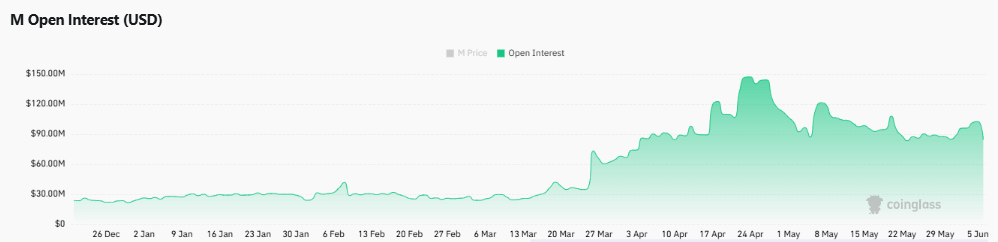
Derivatives data reflected a notable reduction in speculative activity across the market. Open Interest dropped 18.06% to $83.22 million, showing that leveraged traders rapidly exited positions during the correction. 

Such a decline often accompanied by long liquidations and risk reduction rather than aggressive new short positioning. Unlike periods when falling prices coincide with rising Open Interest, the latest move suggested capital left the market instead of betting on further volatility. 

This behavior highlighted weakening conviction among leveraged participants after the recent rejection from higher levels. 

Until Open Interest stabilizes, speculative demand would likely remain subdued.

Source: CoinGlass

Is the descending triangle nearing resolution?

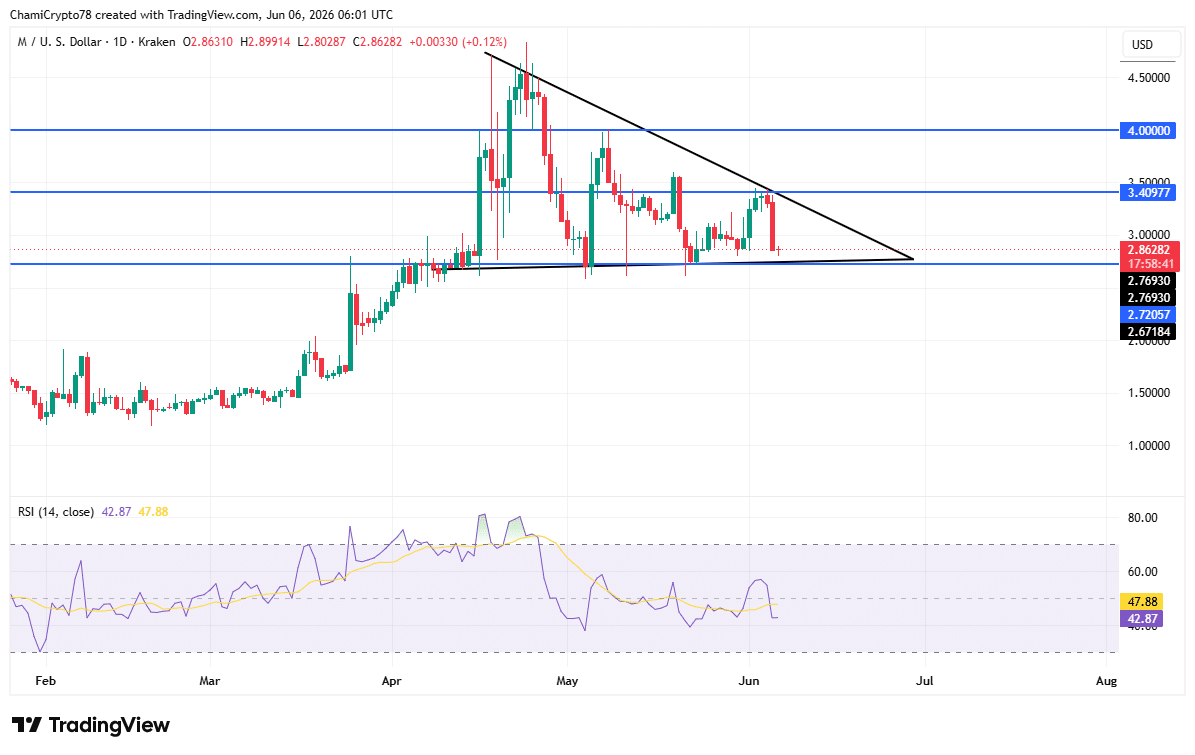
Price action continued respecting a descending resistance trendline that originated from the April peak near $4.70. Several recovery attempts emerged during recent weeks, yet sellers repeatedly defended lower highs and prevented a sustained breakout. 

MemeCore subsequently retested the critical support zone around $2.72, creating a narrowing descending triangle structure. 

This pattern generally reflected increasing pressure on support as resistance gradually declined. 

Resistance remained established around $3.40, while a stronger barrier sat near $4.00. Technical indicators also weakened. The RSI fell to 42.87 and remained below the neutral 50 threshold, indicating buyers had lost strength after the latest rejection. 

MemeCore technical analysisMemeCore technical analysis
Source: TradingView

MemeCore liquidation clusters reveal the next battleground

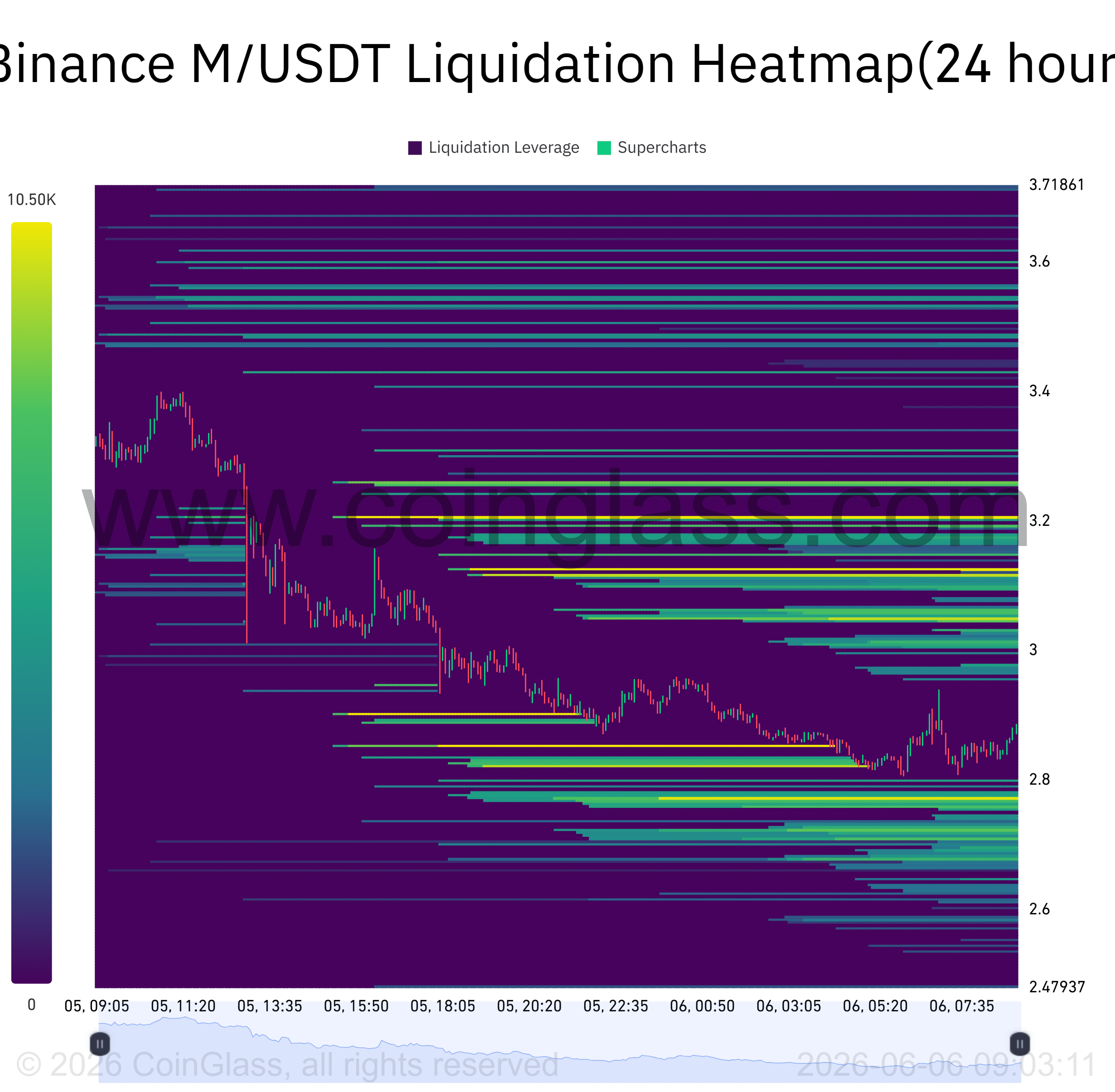
Liquidation data highlighted several areas where price could experience heightened activity in the coming sessions. The largest concentration of liquidity appeared between $3.10 and $3.25, creating a notable upside magnet if buyers regained control. 

Beneath the market, additional liquidity remained concentrated near the $2.75 to $2.80 region, directly around current support. 

This positioning suggested volatility could increase if price revisited the area. While the downside clusters offered short-term support, the larger liquidity pockets remained overhead. 

Therefore, any recovery attempt would likely encounter strong reactions near the $3.10 region before traders could challenge higher resistance levels.

Source: CoinGlass

Final Summary

  • MemeCore lost key bullish strength as price and Open Interest declined together.
  • Support near $2.72 remains critical despite rising selling pressure across markets.


Source link

Billion-dollar crypto investor doubles down on bitcoin, questions Ethereum’s upside

0
Billion-dollar crypto investor doubles down on bitcoin, questions Ethereum's upside

James Wo, the founder and chief executive of crypto investment firm DFG, says bitcoin remains the dominant institutional asset in crypto — and ether is unlikely to reach the same status anytime soon.

Speaking to CoinDesk at the Proof of Talk conference in Paris, Wo rejected Bitmine Immersion Technologies Chairman Tom Lee’s big prediction that ether would hit $250,000, arguing that Ethereum lacks the same consensus and institutional recognition that have formed around bitcoin.

“I totally disagree with him,” Wo said.

“Bitcoin has a very strong consensus. If you talk to everyone who is an early backer… they believe in bitcoin. Now, beyond the early backing of bitcoin, all the people in crypto, and also traditional finance people, are trying to recognize bitcoin as a safe haven or asset class. I don’t think Ethereum is there yet.”

Ether was trading around $1,775 as of time of writing, while bitcoin was near $63,000.

Wo argued that ether’s fundamental valuation remains heavily dependent on the localized application layer running directly on top of the network to capture fee value. With modern Layer-2 networks now diverting transactional volume and capturing fee utility independently, Wo explains that the network’s value accrual has been structurally different.

“The value of ether has been more diversified or decentralized,” Wo noted.

“The Ethereum token as a whole is not going to capture a lot of value. Onchain activity is not as big as people expected… I don’t think Ethereum will even hit an all-time high. I think bitcoin will perform well, but not Ethereum,” he claimed.

Not everyone agrees that Ethereum’s value accrual problem is permanent, however.

In February, Ethereum co-founder Vitalik Buterin reignited debate within the community after suggesting that Layer-2 networks, which have long been seen as the primary scaling solution, may “no longer make sense” as Ethereum becomes faster and cheaper. The discussion reflects broader questions about whether future upgrades could allow more economic activity to accrue directly to the Ethereum base layer.

‘What is bitcoin?’

Wo’s view, however, reflects the perspective of an investor who has spent more than a decade deploying capital across digital assets, that started with bitcoin.

After studying mathematics at university, Wo began watching classmates trade bitcoin during the 2014 bear market. He later entered the sector with $20 million in initial capital from his mother, who, at the time, managed an established enterprise and private equity firm in China.

“At the beginning, I don’t think she trusted me,” Wo recalled. “What is bitcoin? She has no idea.” But she gave him the money regardless and said, “Okay, so I’m going to support you anyway.”

He deployed that initial capital into bitcoin during the market lows of late 2014 and 2015. As the 2016 bull market developed, he diversified DFG’s balance sheet into alternative layer-1 protocols, becoming an early venture participant in ecosystems including Solana, Polkadot and Near.

He also directed early-stage corporate investments into consumer applications and Web3 infrastructure, including an early $10 million allocation into Circle’s USDC stablecoin project in January 2018.

Those investments helped transform DFG from a bitcoin-focused investment vehicle into one of crypto’s larger venture investors. Today, the firm manages more than 100 portfolio entities with over $1 billion in total assets under management.

Bitcoin’s new all-time high

While Wo remains cautious on ether, his multi-year outlook for bitcoin is constructive. He frames the asset as a superior liquid investment compared with regional real estate and traditional equity markets.

“I firmly believe this is going to outperform the Chinese stock market and also the U.S. stock market,” Wo stated. “Bitcoin in any aspect you can think of from the investment angle—liquidity is the best in the world.”

Wo expects bitcoin could undergo a near-term correction before reaching new highs later in the cycle.

“If it goes down 50% as a correction… the bottom should be around $60,000 to $62,000,” Wo calculated, adding that only an extreme geopolitical black swan event would push the asset lower.

Looking further out, he expects bitcoin to reach new records in the coming years.

“At the peak, we have somehow like $125,000… I believe we will see an all-time high in 2027 or 2028.”


Source link

‘The fastest way to get rich quick is don’t’: Dave Ramsey’s truth bomb for investors. His 3 wealth-building rules

0
'The fastest way to get rich quick is don't': Dave Ramsey's truth bomb for investors. His 3 wealth-building rules


Moneywise and Yahoo Finance LLC may earn commission or revenue through links in the content below.

When a caller told Dave (1)Ramsey (1) he had managed to save roughly $40,000 in just six months after moving into a higher-paying sales role, he expected to discuss investments. Instead, Ramsey spent much of the conversation explaining what not to do.

“The fastest way to get rich quick is don’t get rich quick,” Ramsey told the caller.

Top Picks

In other words, when you come into money quickly, the pressure to use it can feel immense. But rushing financial decisions can zero a once-in-a-lifetime change of fortune. Making money is just the first step. Keeping it growing while protecting yourself is the next one.

The caller said his household income had climbed above $200,000 a year and admitted he felt overwhelmed by the amount of investing advice available online. Aside from contributing to a workplace 401(k), most of his growing savings remained parked in the bank while he tried to figure out his next move.

Rather than recommending a hot stock, cryptocurrency or real estate strategy, Ramsey laid out three investing principles he believes can help investors avoid costly mistakes and build wealth over time.

Here are the three investing principles Ramsey says every investor should follow.

Principle 1: Know your investments

Ramsey’s first principle was simple.

“Don’t ever put money in something you don’t understand,” he said.

The advice came after the caller admitted he had largely avoided investing because he didn’t feel confident enough to make informed decisions.

Rather than criticizing the hesitation, Ramsey praised it.

To make his point, he shared the story of an NFL player who had accumulated $10 million and kept it entirely in certificates of deposit (CDs). The player called it “horrible.”

“That’s not horrible,” Ramsey argued. “That’s so much smarter than all the other people you play football with because they’ve all blown theirs or put it in their brother-in-law’s pizza company that went broke, you know?”

CDs are low-risk savings accounts where you agree to lock your money away for a fixed term of your choosing — from six months all the way to five years. In exchange, the bank pays you a fixed interest rate that is generally higher than you would have earned from a typical savings account.

Some investors like CDs; others think they’re too conservative. Ramsey argued it was far smarter to avoid chasing risky opportunities that the NFL player didn’t fully understand.

According to Ramsey, investors should be skeptical of flashy social media trends, complicated financial products and investment opportunities that seem too good to be true. Before investing a dollar, he believes people should understand how an investment works, how it makes money and what risks they’re taking on.

Chasing flashy, complex day-trading or short-term trends rarely ends well for retail investors. According to Quantified Strategies (2), a massive 72% of day traders end the calendar year with net financial losses.

Even worse, long-term tracking indicates that only 1% of day traders remain consistently profitable over a five-year period. In short, fast trades don’t always equal fast money.

Read More: Here’s the average income of Americans by age in 2026. Are you falling behind?

Get reliable growth

For those seeking predictable, reliable growth, a platform like CD Valet can help you find higher-yield options that work for you — regardless of your status in the NFL. They can be used for both medium-term savings and building a cushion for the long haul.

CD Valet tracks over 40,000 verified rates from FDIC-insured banks and NCUA-insured credit unions nationwide. Unlike other websites, they show every publicly available rate, ensuring you have a comprehensive view of the market.

To help you save smarter, CD Valet provides free, specialized tools:

  • Earnings calculator: See exactly how much interest you’ll accrue by the end of your term. Adjust different rates and terms to see how much you can earn with a 12-month vs. a 24-month CD.

  • CD rates map by state: See real-time offers of the best CD rates across the country. Many institutions allow you to open an online account, so you can take advantage of a great CD rate without being located in that state.

Plus, their CD rates are updated continuously, so you can shop, compare and open CDs with ease.

Learning can be an investment, too

Ramsey’s advice wasn’t to avoid investing indefinitely. His point was that investors should understand what they’re buying before they buy it.

For those looking to improve their investing knowledge, Moby provides research, market analysis and stock recommendations designed to help investors make more informed decisions.

In four years, and across almost 400 stock picks, their recommendations have beaten the S&P 500 by almost 12% on average. They also offer a 30-day money-back guarantee. That way, you can make sure Moby’s advice aligns with your investment philosophy.

Plus, their reports are easy to understand for beginners, so you can become a smarter investor in just five minutes.

Instead of relying on social media influencers or market hype, investors can use research to better understand companies, sectors and long-term investing opportunities.

Principle 2: Take it slow

Ramsey’s second principle challenged one of the most common investing temptations.

He compared investing to the classic story of the tortoise and the hare, arguing that slow, consistent investors often outperform those who constantly chase the next big opportunity. To tie it back to an old adage: time in the market beats timing the market.

Later in the conversation, Ramsey and co-host Rachel Cruze emphasized that building wealth doesn’t usually involve day trading, meme stocks, crypto speculation or other fast strategies.

Instead, they pointed to retirement accounts, mutual funds and index funds as the types of investments that have historically helped ordinary Americans build wealth over decades.

The slow-and-steady approach isn’t just Ramseyian theory. According to the long-running Quantitative Analysis of Investor Behavior (QAIB) (3) study by DALBAR, the average equity fund investor consistently trails the market due to emotional buying and selling.

Using 2024 as an example — the S&P 500 surged by 25.02% (4), yet the average retail equity investor took home just 16.54%. This massive 8.48% “behavior gap” often occurs because investors abandon slow, diversified strategies to chase the next big thing. Then they lock in losses by timing the market poorly.

Now, the slow approach may not generate exciting headlines, but the Aesopian fable of investing is that consistency beats excitement in the long run.

Automate your investing habit

One of the easiest ways to embrace a slow-and-steady investing approach is to automate the process. This also taps into dollar cost averaging, which aims to smooth out the peaks and valleys of investing by making regular contributions regardless of market performance.

Acorns helps investors do exactly that by rounding up everyday purchases and automatically investing the spare change into diversified portfolios of ETFs managed by leading firms such as Vanguard and BlackRock.

For example, a $3.25 purchase can be rounded up to $4, with the extra 75 cents invested automatically. While each individual investment may seem small, the habit of investing consistently can compound over time.

You can start by investing in a dividend ETF with as little as $5 — and, if you sign up today, Acorns will add a $20 bonus to help you begin your investment journey. All you need to do is set up a small monthly contribution to boost your investing.

Principle 3: Work with teachers, not just experts

Ramsey’s final principle had less to do with investments and more to do with who investors trust for advice.

He warned against working with financial professionals who leave clients confused.

“Financial people are the world’s worst because a lot of us are nerds and we like being impressive with our nerd knowledge more than we are concerned that you learn,” Ramsey told the caller.

He added, “If they can’t speak to you in such a way that they can teach you, they don’t have the heart of a teacher.”

According to Ramsey, investors should never feel intimidated by financial jargon or leave a meeting feeling more confused than when they arrived. A good advisor should be able to explain recommendations clearly and help clients understand why certain strategies make sense for their situation.

Finding an advisor who can actually teach isn’t always easy.

As Ramsey pointed out, some financial professionals seem more interested in showing off their expertise than helping clients understand how their money works. But when it comes to your retirement, investments and long-term financial goals, working with the wrong advisor can be a costly mistake.

That’s where Advisor.com comes in.

Advisor.com helps connect you with a qualified expert based on your unique goals and circumstances. Instead of spending hours researching advisors on your own, the platform does much of the legwork for you, evaluating advisors based on factors such as experience, client ratios and regulatory history.

Even better, Advisor.com’s network is made up of fiduciaries — professionals who are legally required to put their clients’ interests ahead of their own. Plus, Vanguard research (5) found that working with a financial advisor added 3% to net portfolio returns over time.

Getting started is simple. Just answer a few questions about your finances, investing goals and retirement plans, and Advisor.com’s matching tool will connect you with advisors who may be a good fit for your needs.

You can also schedule a free initial consultation with no obligation to hire.

After all, Ramsey’s advice wasn’t just to find an advisor — it was to find someone who leaves you feeling more confident, informed and in control of your money. And that level of comfort can lead to a long-term financial commitment.

You May Also Like

Join 250,000+ readers and get Moneywise’s best stories and exclusive interviews first — clear insights curated and delivered weekly. Subscribe now.

Article Sources

We rely only on vetted sources and credible third-party reporting. For details, see our editorial ethics and guidelines.

The Ramsey Show Highlights/ YouTube (1); Quantified Strategies (2); Dalbar (3); Slickcharts (4); Vanguard Canada (5)

This article provides information only and should not be construed as advice. It is provided without warranty of any kind.




Source link

Michael Saylor unveils Bitcoin’s four tribes as the market tumbles

0
STRC slips below par as Strategy's (MSTR) cash reserves face growing scrutiny

Following bitcoin’s worst week in two years, Strategy(MSTR) Executive Chairman Michael Saylor published a framework on X, arguing that the Bitcoin community is evolving into four distinct ideological camps.
Rather than viewing these groups as competitors, he presents them as complementary forces that will collectively shape bitcoin’s future.

The first group, Bitcoin Maximalists, sees Bitcoin as the ultimate monetary breakthrough. They believe bitcoin has already solved the problem of digital scarcity and offers superior property rights, protection from inflation, and economic empowerment. Their focus is conviction: bitcoin is not one crypto asset among many, but the dominant digital monetary network.

The second group, Bitcoin Capitalists, views Bitcoin as a form of digital capital that should be integrated into the global economy. They support corporate treasury adoption, institutional custody, bitcoin-backed securities, lending markets, and broader financial infrastructure. Their goal is to expand bitcoin’s reach by embedding it into existing economic systems rather than replacing them.

The third group, Bitcoin Technologists, focuses on improving the protocol. They argue that Bitcoin must continue to evolve to address challenges in scalability, privacy, usability, security, and future threats such as quantum computing. While they support innovation, Saylor notes that changes to bitcoin’s base layer must be approached cautiously to avoid unintended consequences.

The fourth group, Bitcoin Fundamentalists, prioritize protecting bitcoin’s original principles: decentralization, self-custody, immutability, censorship resistance, and individual sovereignty. They are wary of excessive institutional influence, financialization, and protocol changes that could compromise Bitcoin’s core characteristics.

Saylor’s central argument is that Bitcoin needs all four perspectives. Maximalists provide conviction, Capitalists drive adoption, Technologists ensure long-term resilience, and Fundamentalists safeguard the protocol’s integrity. Saylor argues that Bitcoin’s most successful path lies in a balance among these four forces.


Source link

U.S. Crude Oil Storage Levels Are Falling Toward This Critical Level. Here’s What Investors Need to Know

0
U.S. Crude Oil Storage Levels Are Falling Toward This Critical Level. Here’s What Investors Need to Know


The CEOs of Chevron (NYSE:CVX) and ExxonMobil (NYSE:XOM) have both warned that oil prices aren’t fully reflecting the on-the-ground situation in the oil market. The latest update on that comes from the United States, where U.S. oil reserves are getting dangerously low, with a warning from refiner Phillips 66 (NYSE:PSX) about the issue. What’s going on and what should investors do now?

Oil is a global commodity

Oil is global, so events in the Middle East affect the rest of the world. Oil exports from the U.S. market rose as flows from the Middle East were constrained, with oil users seeking supplies from wherever they were available. U.S. oil production isn’t directly affected by the war, and the country is one of the world’s largest oil producers, so it was a logical place to look. Companies like Devon Energy (NYSE:DVN) and Diamondback Energy (NASDAQ:FANG) are likely to be net beneficiaries from high oil prices and increasing demand for U.S. oil.

Missed Nvidia in 2009? This Rare Signal Is Flashing Again. In 2009, a “Double Down” signal flashed for a little-known chipmaker called Nvidia. For the first time in years, that same “Total Conviction” signal is flashing for a company 1/100th the size of Nvidia. Continue »

A hand drawing two lines, one twisted, complex, and confusing and the other straight and easy to understand.

Image source: Getty Images.

However, the real risk in the drawdown on U.S. stockpiles is that it can only go on for so long before the high level of exports will likely need to be curtailed. At the end of May, inventory in Cushing, a key U.S. energy hub, stood at 22.4 million barrels, down four million barrels from February. Industry watchers warn that hitting 20 million barrels could pose operational challenges for energy companies.

So U.S. oil is just a temporary solution to the much bigger problem posed by the Middle East conflict. There simply isn’t enough oil to go around right now, which is basically what Chevron and Exxon have been saying. Oil is a commodity, so prices rise when supply is constrained and demand is high.

Emotions are driving the oil market

The problem is that Wall Street is usually driven by emotions over short periods of time. Chevron and Exxon are looking at the bigger picture, with time frames that look out a decade or more. Investors, given the dramatic, rapid swings in oil prices, are watching news from the Middle East conflict and reacting immediately.

Energy industry executives are pretty clear that there is no quick solution to the current oil shortfall. It could take months to resolve the bottleneck in the Middle East, and the healing process won’t actually start until the conflict ends. There’s no end in sight at this point.


Source link