Bitmine Immersion Technologies (BMNR), the largest corporate holder of ether (ETH), is staring at nearly $9 billion in losses as the token’s slide below $1,800 drags down the value of its massive treasury.
Shares of the Tom Lee-chaired company fell another 5.9% Wednesday, slipping below $17 and extending their decline to 28% since early May. The stock has now dropped below its February lows to its weakest level since the company announced its pivot to an Ethereum treasury strategy in May 2025.
The selloff comes as ETH retests its February lows. The second-largest cryptocurrency has lost more than 20% since early May, when Lee, Fundstrat’s co-founder and BitMine’s chairman, argued that the market’s “mini crypto winter” had likely ended and a new “crypto spring” had begun.
Under Lee’s leadership, Bitmine has amassed more than 5.4 million ETH, or roughly 4.5% of Ethereum’s circulating supply, in roughly a year. That position is worth about $10 billion at current prices.
Those holdings, however, are now deeply underwater, carrying an estimated $8.9 billion in unrealized losses, according to data collected by DropsTab.
Bitmine ether (ETH) holdings and estimated unrealized losses (DropsTab)
Digital asset treasuries under pressure
Bitmine’s drawdown highlights renewed pressure across the digital asset treasury sector, where companies seek to replicate the playbook pioneered by Michael Saylor’s MicroStrategy (MSTR): raise capital through public markets and use the proceeds to accumulate crypto.
That model has become increasingly harder to sustain as crypto prices weakened and many treasury stocks drifted below the value of their underlying assets.
Strategy itself recently disclosed its first bitcoin sale since 2022, sparking debate about how the company might fund future obligations tied to its preferred stock offerings.
Bitmine’s situation differs in some key respects. The company financed its ether purchases primarily through equity issuance rather than debt, leaving it without the leverage concerns and interest payments that some treasury peers face.
The company also generates revenue from staking its ETH and operating its staking service MAVAN. Bitmine said it has staked more than 4.7 million ETH — about 87% of its holdings — and recently estimated annualized staking revenue at roughly $276 million.
Lee calls for $250,000 ETH
The recent price action has not tempered Lee’s long-term outlook.
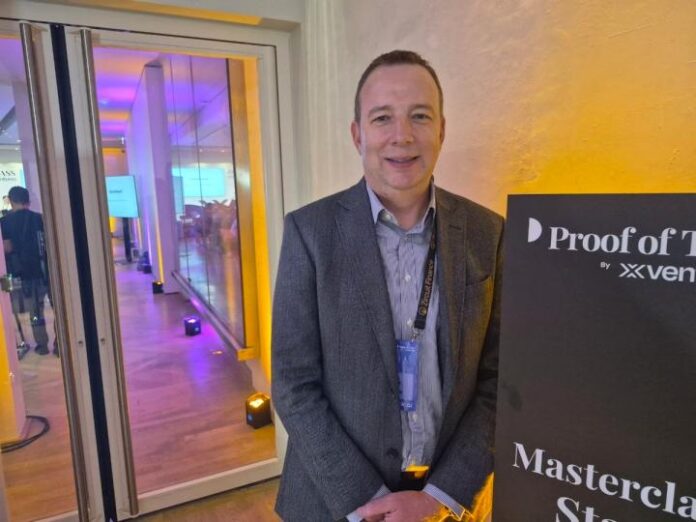
Speaking at the Proof of Talk conference in Paris earlier this week, he said ETH could eventually reach $250,000 as tokenization, AI-driven transactions and corporate staking reshape Ethereum’s role in the global financial system.
For now, investors appear focused on a more immediate reality. Ether is back near levels last seen during February’s selloff, leaving Bitmine’s treasury deep underwater and highlighting the gap between Lee’s long-term thesis and the market’s current view of the asset.
You may already use AI to automate some tasks at work or help solve problems. Now, Robinhood wants you to incorporate AI into your financial plan.
The company recently announced its agentic credit card feature for Robinhood Gold Card cardholders, alongside agentic trading. With these tools, you can link a third-party AI agent (such as ChatGPT or Claude) to your Robinhood account and allow it to purchase items with your credit card or make trades within your investment portfolio.
That means AI can now do everything from booking a hard-to-get dinner reservation to tracking the price of an item you want and buying it when it falls below a specified threshold.
“Our mission has always been to democratize finance for all, and now, that mission extends to AI agents,” Robinhood CEO Vlad Tenev said in the announcement.
But there are some things you should keep in mind before you let AI handle your spending for you. Here’s more about agentic credit cards and some risks to consider.
To use Robinhood’s agentic credit card, you’ll need to connect your preferred AI agent to the Robinhood Banking MCP (Model Context Protocol) and create a virtual card for your agent. This virtual card is unique from your regular Robinhood Gold Card.
The AI agent won’t be able to access your actual credit card number or broader Robinhood account information. Instead, it can only access the virtual card, its transaction history, card details, and any policies you establish.
Once it’s set up, your AI agent will be able to “scan for the best prices, monitor availability, and make purchases automatically based on your instructions,” according to Robinhood. You can tell it what you want to buy and what price you’re willing to pay, and it’ll handle the rest.
For example, let’s say you’re planning a trip and tracking flight prices ahead of booking. You could tell your AI agent to purchase a round-trip flight to your destination on the dates you want when the price goes below $800, or whatever specific amount you’re willing to spend.
The feature is currently available to Robinhood Gold Card holders (which is waitlist only), and Robinhood says it will also be available with the Robinhood Platinum Card when it launches.
Robinhood says the agentic credit card is “one of the first products of its kind,” but it’s also the result of a growing trend toward using AI as a financial tool.
According to Plaid’s “2026 State of Intelligent Finance” research report, 55% of Americans used AI to help manage their finances in the past 12 months, while 53% said they expect AI to take the guesswork out of their financial decisions.
Meanwhile, a January 2026 report from the Consumer Bankers Association said that “agentic payment tools have massive potential to disrupt the existing consumer payments landscape and revolutionize commerce.”
Other payment companies have also recently introduced similar agentic payment options.
Stripe’s Shared Payment Tokens (SPT) technology lets AI agents initiate payments with your permission and designated cards. Like the virtual cards Robinhood uses for agentic transactions, Stripe uses Mastercard- and Visa-issued agentic network tokens, which create unique digital card information. When your AI agent makes a transaction, it uses these tokens instead of your actual card information to make the purchase.
You could compare the process to tokenized payments you may already make with digital wallets, like Apple Pay or Google Pay. When you add a credit card to Apple Pay, for example, a device account number is created, which is unique from your original card account number. The device account number is used for Apple Pay purchases. Each time you transact, the only information shared is that device account number and a transaction-specific security code.
Of course, agentic payments still work differently, since they allow AI to transact for you. So even with tokenized transactions, agentic purchases carry unique risks.
Robinhood says it designed the agentic credit card experience “with safety and control as the top priority,” and there are some guardrails you can set for your AI agent. Those include monthly spending limits and notifications for any purchases the agent makes.
If you choose to approve each purchase, you’ll get a notification within your Robinhood Banking app before your AI agent can complete a transaction. If you don’t want to approve each purchase, you’ll be required to set a monthly spending limit for your agentic credit card.
Even with spending limits and approval notifications, there are still risks to using AI to make purchases.
Whether you opt to approve each purchase or not, Robinhood says you are responsible for any purchases your AI makes with an agentic card.
In addition to your approved spending, unauthorized purchases and fraud are a major concern for some experts as these technologies grow.
Right now, tokenized virtual card numbers, spending limits, and notifications for purchase approval are the safeguards in place for agentic purchases. But it’s difficult to predict exactly what risks could emerge as the use of AI payments increases.
Speaking to Yahoo Finance recently about connecting financial information to AI agents, Eva Velasquez, CEO of the Identity Theft Resource Center said, “At this point, don’t connect your financial accounts to an AI agent. Right now, the technology’s too new. The data sharing implications are still unknown.”
The Consumer Bankers Association report questioned available consumer protections for unauthorized transactions made by AI agents as well as how new scams and instances of fraud could develop alongside agentic payments, especially given a lack of regulation.
“… consumers may be liable for mistakes their agents make and these mistakes could be costly,” the report said. “These exceptions could have significant impacts on the evolution of consumer protection in connection with consumers’ use of agentic payment tools.”
Julian Sawyer, CEO of Zodia Custody, described Standard Chartered’s ongoing acquisition of the firm as a “major validation” that highlights a growing reality in mainstream finance: legacy banks cannot build institutional-grade digital asset custody safely or efficiently without proper software.
Instead of treating crypto as an isolated sector, Sawyer noted that the industry is hitting a maturity point where the underlying blockchain infrastructure is moving toward real-world asset tokenization and stablecoin payments.
“This is the maturity point of where custody of the blockchain…is moving from crypto to other assets, stable coins and tokenization,” he said in an interview with CoinDesk on Wedneday. “If you’re going to do that, you need trust. Trust is what banks do.” Because these financial use cases require absolute trust, global banks are moving to acquire established platforms to gain immediate scale and secure bank-grade tech.
Sawyer noted that client’s interest in their infrastructure software has scaled dramatically. “Every single bank is going to need to know how to hold digital assets,” Sawyer said.
“The big guys are absolutely looking, and everybody else who’s thinking about stablecoins… thinking about tokenization needs to have an answer. So the market is huge.”
Standard Chartered acquisition
Sawyer confirmed that Standard Chartered’s full acquisition of the firm is on track to target a signing at the end of June and complete by the end of August.
He declined to disclose the purchase amount or valuation. In 2023, Zodia announced a $36 million funding round led by SBI Holdings. Market estimates place the custodian’s annual revenue at roughly $34.6 million. Market estimates place the custodian’s annual revenue at roughly $34.6 million with a current total funding of roughly $46 million.
He said that under the acquisition agreement, Standard Chartered’s existing digital custody business in Dubai, Luxembourg, and Hong Kong will merge with Zodia Custody and ultimately fold into Standard Chartered under its brand, meaning Zodia Custody will not exist in the medium term.
Concurrently, a new entity called Zodia Solutions will carry forward the software and infrastructure side of the business, backed by existing bank shareholders including Northern Trust, Emirates NBD, and National Australia Bank.
“This is a major validation,” Sawyer said, detailing the systemic impact of the consolidation. “Every bank in the world is going to do something with digital assets…they are going to need to know and have some technology to be able to hold those assets.”
Global regulation
Institutional integration is forcing a regulatory convergence worldwide. When asked whether the U.K. is holding back from becoming the crypto hub it aspires to be due to internal friction between the Bank of England, the Treasury, and the Financial Conduct Authority (FCA), Sawyer acknowledged the shifting tides.
“I guess I’m old enough to remember when the FCA was ahead of the market and people did come to the UK to set up,” Sawyer noted. “I think one of the fascinating parts of our industry is that each jurisdiction, each government, is moving at a different pace .”
He highlighted the “huge progress” in Asia and Singapore, as well as new regulations in Hong Kong and Abu Dhabi. “The message I would have is this is a very evolving ecosystem and that regulators and the participants need to continue to evolve.”
While some industry participants worry that Wall Street giants will completely take over the sector, Sawyer suggests the crypto industry is naturally moving toward banking due to compliance laws like Know Your Customer (KYC) and Anti-Money Laundering (AML).
“The crypto industry is moving towards banking because of the law,” Sawyer stated.
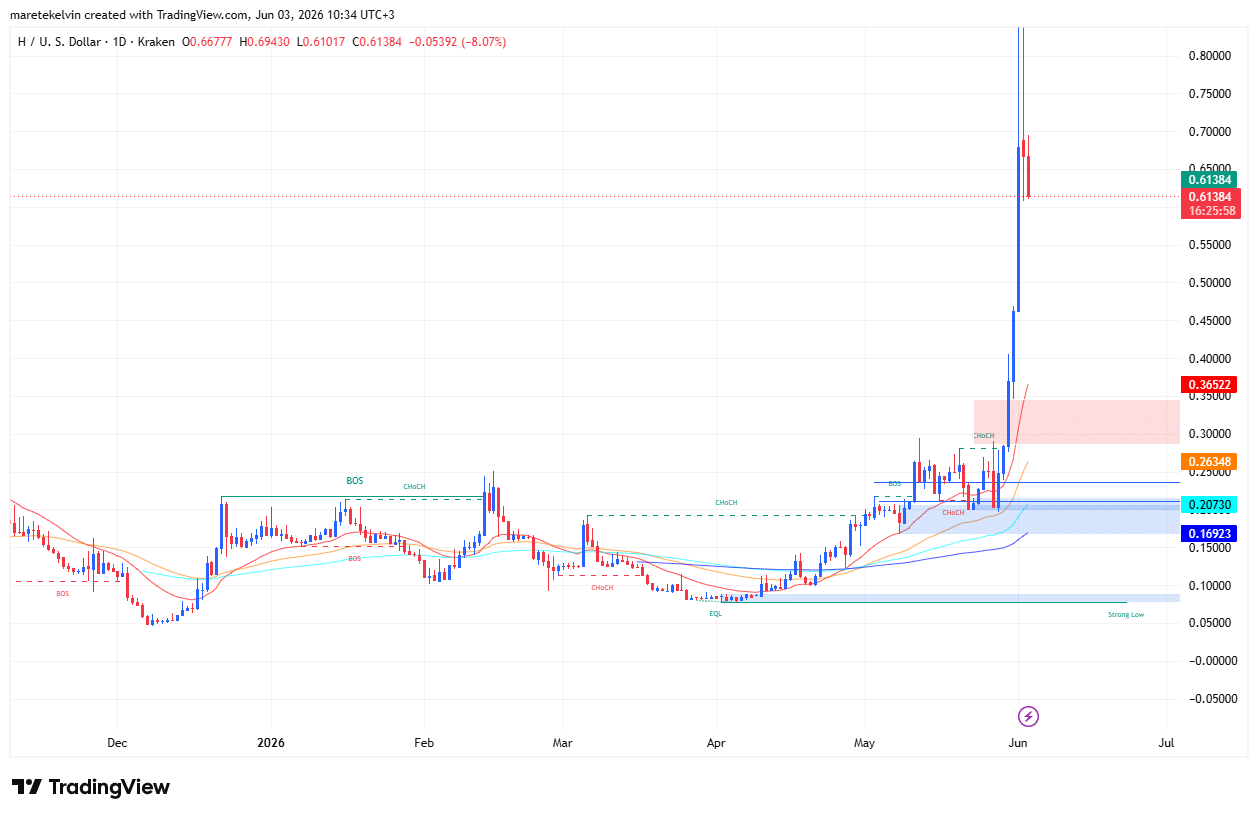
Humanity Protocol’s [H] rally from $0.20 to $0.859 was always going to attract profit-taking at some stage. After printing a fresh all-time high, the token has finally started to give back part of those gains, dropping more than 10% over the last 24 hours.
The correction is not entirely surprising.
The explosive bullish move happened so quickly that several imbalance zones were left behind along the way. Those areas often become magnets for price once momentum begins to fade, as the market looks for liquidity and a more balanced structure.
The token’s long-term structure remains bullish
Despite the correction phase, the token structure still leans to the bulls. The token’s price action is now trading above key EMA support.
The demand zone between $0.286 and $0.346 stands as the key target for the current sell-off. The fact that it coincides with the current 20-day and 50-day Exponential Moving Averages increases the validity of the imbalance zone.
Source: TradingView
Momentum indicators are starting to weaken
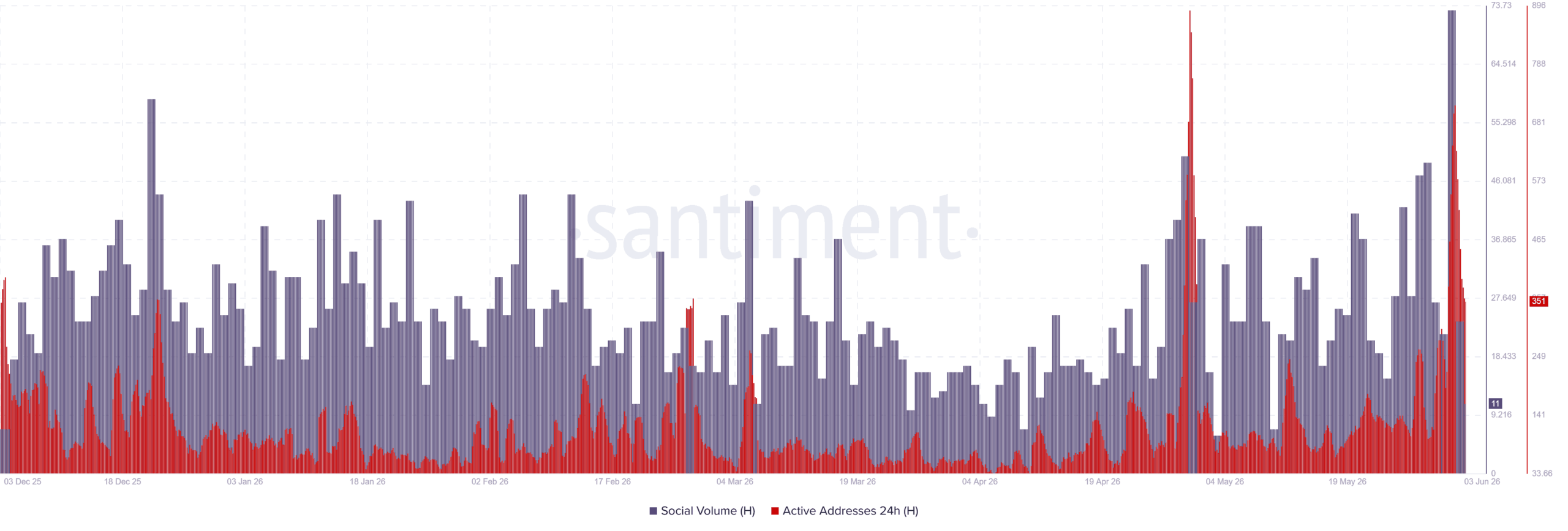
The latest on-chain data suggests the excitement surrounding H may be cooling.
Social volume has fallen sharply from the record levels seen just two days ago. At the same time, active addresses have also declined, indicating fewer participants are interacting with the network.
The shift doesn’t necessarily signal the end of the broader uptrend. However, it does suggest the buying frenzy that pushed H to new highs is losing intensity.
Source: Santiment
Can the pullback extend further?
For now, sellers appear to have the upper hand.
The combination of weakening participation and multiple imbalance zones below the current price gives the market a logical reason to continue correcting. Unless fresh demand returns quickly, traders may continue targeting those lower liquidity areas.
That said, context remains important. H is coming off one of its strongest rallies of the year, and pullbacks are a normal part of trend development.
The key question now is whether buyers step in before those imbalance zones are fully filled—or whether the market needs a deeper reset before the next leg higher can begin.
Final Summary
H has corrected by more than 10% after recently reaching a new all-time high of $0.859.
Falling social activity and declining active addresses suggests that the post-rally momentum may be cooling.
Foster City, California-based Gilead Sciences, Inc. (GILD) discovers, develops, and commercializes medicines in the areas of unmet medical need in the United States and internationally. The company has a market cap of $166.9 billion and provides Biktarvy, Descovy, Genvoya, Odefsey, Sunlenca, Symtuza, and Yeztugo for the treatment of HIV-1 infection in patients, as well as other related drugs.
Companies with a market cap of $10 billion or more are typically referred to as “big-cap stocks.” GILD fits right into that category, with its market cap exceeding this threshold, reflecting its substantial size and influence in the general drug manufacturers industry.
More News from Barchart
However, the stock currently trades 16.7% below its 52-week high of $157.29 recorded on Feb. 11. GILD has declined 12% over the past three months, notably underperforming the State Street Health Care Select Sector SPDR ETF’s (XLV) 7.7% fall during the same time frame.
www.barchart.com
In the longer term, GILD has delivered a different performance. The stock rose 19.1% over the past 52 weeks, outperforming 11.5% rise of XLV over the same period. GILD has been trading below its 200-day moving average since last year and below its 50-day moving average since the end of May.
www.barchart.com
On May 7, GILD stock declined 1.6% following the release of its Q1 2026 earnings. The company’s revenue for the quarter amounted to $7 billion and surpassed the Street’s estimates. Moreover, its adjusted EPS for the quarter came in at $2.03, also coming in on top of Wall Street’s forecasts. Gilead expects full-year results to range from a loss of $1.05 per share to a loss of $0.65 per share.
When stacked against its rival, Amgen Inc. (AMGN) has grown 14.2% over the past year, underperforming GILD.
Wall Street continues to favor the stock highly. Among the 32 analysts tracking GILD, the overall consensus stands at a “Strong Buy.” Its mean price target of $159.20 suggests 21.4% upside potential from current price levels.
On the date of publication, Aritra Gangopadhyay did not have (either directly or indirectly) positions in any of the securities mentioned in this article. All information and data in this article is solely for informational purposes. This article was originally published on Barchart.com
While nearly a dozen U.S. cities put the finishing touches on preparations for the 2026 FIFA World Cup ahead of next week’s kickoff, some of the country’s most sport-frenzied communities are settling in to watch from home. Based on the economics of major sporting events, it might prove a savvy decision in retrospect.
The soccer fever due to grip the U.S. until July 19 will be most vivid in the country’s 11 host cities, where 78 games will be played in stadiums servicing sports meccas such as Boston, Los Angeles, Dallas, and Atlanta. That’s most of the 104 games total for the tournament shared between the U.S., Mexico, and Canada.
Notably absent from that list, however, are the cities home to some of America’s most passionate sports fanbases—a few of which have even hosted World Cup games before. Phoenix, which holds the world’s largest concentration of sports venues in a single metropolitan area, will see no gametime. It’s the same for fans in Detroit, where four major league teams all play within walking distance of each other in the city’s downtown. Chicago won’t host any games either, despite being the third-largest U.S. city, and having thrown the opening ceremony and game the last time the World Cup came to the country, in 1994.
The 2026 World Cup’s host cities were announced in 2022 after a competitive bidding process. But many cities that declined to be considered for participation at the marquee event made their reservations clear years earlier, often citing financial reasons and cumbersome requirements set by FIFA, the tournament’s governing body. For many of America’s most sports-crazed cities missing out on this year’s World Cup, the appeal of hosting mega-events just wasn’t enough to justify the costs.
“FIFA was not able to provide specific details on major unknowns that could result in a major financial burden to our cities,” Tom Sadler, president of the Arizona Sports & Tourism Association, said in a 2018 statement explaining a dropped host city bid for Glendale, a Phoenix suburb.
Chicago backed out for similar reasons, with then-Mayor Rahm Emanuel accusing FIFA of making excessive demands and lacking transparency on issues that “put our city and taxpayers at risk.”
“The guys from international soccer wanted us to underwrite their sporting event,” Emanuel told local broadcasters in 2018. “While I am always eager to boost tourism, I am not going to write a company a blank check that can fleece the taxpayers.”
FIFA did not immediately reply to Fortune’s request for comment.
Jilted by FIFA
To be considered eligible as a host, cities had to comply with a long list of requirements set by FIFA. Cities had to ensure stadiums met specific standards, commit to waiving taxes on items like ticket purchases, and shoulder the bulk of costs related to security and logistics. FIFA also demanded rights to amend its agreements with cities at any time, and for no indemnity clauses that would shield host cities and their taxpayers from financial risks.
To be sure, being a host for a globally televised event—one of the most widely followed anywhere—has its appeal for cities. In Chicago’s absence, Kansas City has emerged as the only Midwestern representative at the tournament, a fact often touted by local officials.
“The world deserves to see the beauty, hospitality, and strength of the American Midwest,” Rep. Mark Alford (R-Mo.) wrote last year in an open letter to President Donald Trump, after Trump floated the idea of pulling hosting rights from Democrat-run cities.
“Unlike many coastal host cities, Kansas City stands alone as the only host city in the geographic heart of the United States,” Alford continued.
But the costs of taking on hosting duties can leave long-lasting scars. While national economic impacts from hosting mega-events like the World Cup can be in the green, due to tourism and spillover effects, individual cities often have a harder time breaking even. Spending on infrastructure can quickly end up as a sunk cost, as centerpieces like stadiums lie idle and drain public funds for years after the intended event—as was the case following the 2010 and 2014 World Cups in South Africa and Brazil, respectively.
Something similar already happened in the U.S. After the 1994 World Cup, the nine host cities posted cumulative losses between $5.5 billion and $9.3 billion, according to a 2004 study, well below the $4 billion gain forecast for cities before the tournament. Losses were due to infrastructure spending as well as high security and operating costs. The study also found World Cup-related economic impact tended to crowd out spending from locals that likely would have happened anyway, but didn’t as more residents opted to avoid highly trafficked areas.
Infrastructure expenses for this World Cup are small compared to previous editions of the tournament, in part because the U.S. hasn’t had to build any new stadiums. And several host cities have invested in projects that could have a longer economic tail, such as public transit and more urban green spaces.
But even for those cities swayed by the global prestige that comes with hosting rights in a World Cup, the bills are already piling up, and officials are being forced to choose between FIFA and their taxpayers. In New Jersey, a highly publicized war of words between the government and FIFA over transport surcharges for fans attending the state’s eight games recently culminated in fare reductions from $150 to around $100 with the help of external sponsors. New Jersey’s fares are still among the highest across U.S. host cities this summer.
The little guy is getting lost in the political horse-trading around the CLARITY Act.
The U.S. Senate Banking Committee recently advanced the Digital Asset Market CLARITY Act, legislation that, if enacted, could finally establish clear rules for digital assets in the United States. The bill has survived months of bipartisan negotiations and horse trading between banking interests and upstart fintech companies.
A bipartisan compromise brokered by Senators Thom Tillis (R-NC) and Angela Alsobrooks (D-MD) broke a log-jam that had slowed down the bill’s progress. In the end, the banks got most of what they wanted in this “deal”: the legislation explicitly prevents fintech platforms from treating stablecoins, digital assets backed by dollars, as interest bearing accounts, while still permitting them to pay rewards and bonuses, as banks and credit card issuers do.
That should have ended the debate. Yet banking lobby groups are demanding tighter restrictions to eliminate many forms of consumer rewards altogether. Clearly, they seek to squash this already compromised bill before a full Senate vote, so that it never reaches the Resolute Desk.
Lost amid the political wrangling of crypto and banking interests is the average American consumer.
According to the Consumer Financial Protection Bureau (CFPB), Americans paid roughly $5.8 billion in overdraft fees in 2023, even after years of industry efforts to reduce so-called “junk fees.” Overdraft charges disproportionately hit financially vulnerable households, with nearly 80% of fees concentrated among 9% of accounts. And then there are account minimums, wire charges and payment delays, which add friction. Meanwhile, the average savings rate is only 0.38%.
Consumers want financial services to move faster, cost less and earn them more.
Stablecoins are gaining popularity because they herald a world where digital dollars move across the internet as cheaply and seamlessly as a WhatsApp message. They can lower remittance costs, improve access to digital commerce, expedite real-time payments and create new ways for consumers to save, spend and transact online.
And Americans are asking for CLARITY because many already use these tools. According to the Crypto Council for Innovation, one in five American adults now owns cryptocurrency. That’s roughly 68.5 million people. Stablecoins are among the fastest-growing categories of digital assets, particularly among younger consumers, immigrants, freelancers and underserved communities seeking faster and cheaper financial tools. Four in five merchants believe accepting crypto could help attract new customers, while 73% of small business owners expect crypto payments to grow.
That’s what makes this debate so politically mystifying. For years, progressives argued that concentrated financial power harmed consumers and Main Street. They criticized large banks for extracting rents while lobbying against regulations that diluted bank influence. Those critiques were often correct. Today some of those progressives, like Elizabeth Warren, who championed the Consumer Financial Protection Bureau, are now defending banking profits against a technology that could inject real competition into financial services and empower consumers and small businesses.
Do American politicians want their country to continue leading, or do they prefer watching such financial transformation from the sidelines?
In the 1990s, the Clinton administration helped usher in the commercial internet through the Telecommunications Act of 1996, a bipartisan effort expanding innovation and competition. Now, Congress has an opportunity to unleash the new internet of value by passing CLARITY.
Under GENIUS and CLARITY, stablecoin issuers must meet strong reserve requirements, transparency obligations, anti-money laundering standards, cybersecurity rules and consumer protections. Sensible public policy will unleash investment and innovation, as it did in the internet era.
This story need not end in conflict between banks and blockchains. Incumbents can just as easily embrace blockchain and its various benefits, from real-time global settlement and tokenized assets, to new forms of on-chain lending, payments, savings and commerce.
The question is whether lawmakers will vote to lead this next technological revolution and advance the interests of American consumers or cede the future to entrenched interests.
Principled Perspectives
Why Crypto May Need ETFs More Than ETFs Need Crypto
Crypto spent its first decade trying to replace Wall Street. Its next trillion dollars may come from partnering with it. The first wave of tokenization focused on creating new assets, new venues and new systems outside traditional finance. Some of that innovation mattered. Much of it struggled with the same problem: markets do not scale on technology alone. They scale on trust, liquidity and distribution. That reality favors ETFs.
The ETF wrapper became one of the most successful financial products of the modern era because it solved practical investor problems at scale: low-cost access, transparency, intraday liquidity, operational simplicity and broad distribution across brokerage platforms and advisory channels.
Those advantages took decades to build. Tokenization does not erase them. In fact, it may amplify them. If blockchain rails can be integrated into ETFs, investors may not have to choose between innovation and protection. They could gain exposure to familiar products with the potential benefits of faster settlement, programmable ownership, collateral mobility and broader digital interoperability, all inside a structure already trusted by institutions, advisors and retail investors.
That is a far bigger commercial opportunity than asking trillions of dollars to migrate into unfamiliar vehicles. This is why one underappreciated development matters. On January 21, 2026, F/m Investments LLC and The RBB Fund, Inc. filed what is believed to be the first exemptive application by an ETF issuer seeking to tokenize shares of an exchange-traded fund, TBIL, the U.S. Treasury 3 Month Bill ETF. The proposal would record ownership on a permissioned blockchain ledger while preserving the same fund, same economics, same exchange listing and same regulatory framework. The application remains pending before the SEC, and there can be no assurance relief will be granted. That may sound like a niche legal filing. It is not. It is a test of whether capital markets modernization happens inside the regulatory perimeter or outside it.
That distinction matters to investors because the next major on-chain growth category may not be speculative tokens. It may be trusted yield, usable collateral and regulated exposure. Stablecoins already demonstrated the demand for digitally native dollars. The next logical step is digitally native instruments backed by real portfolios, real governance and real investor protections.
That is where tokenized ETFs could become powerful.
Imagine Treasury exposure that can plug into next-generation collateral networks. Imagine ETF shares that remain within familiar regulatory guardrails while operating on more modern rails. Imagine advisors and institutions accessing blockchain efficiency without having to underwrite experimental structures.
The first tokenization narrative was “replace incumbents.” The stronger narrative may be “upgrade incumbents.” That does not diminish crypto; it commercializes it.
For regulators, tokenized ETFs may offer a pragmatic path forward: enable innovation where investor protections remain intact, rather than pushing demand into parallel channels with greater uncertainty. For exchanges, custodians, brokers and market makers, it could create a new infrastructure layer around products investors already understand.
For issuers, it may become a race. The firms that combine trusted wrappers, credible assets and functional on-chain rails could capture disproportionate flows. And for allocators, the signal may be simple: blockchain technology is becoming less about novelty and more about plumbing.That is usually when real adoption begins.
The broader lesson is that distribution often beats disruption:
Who already has trusted wrappers?
Who already has liquidity?
Who already has access to advisors, retirement assets and institutions?
Who can bridge old rails and new rails fastest?
Those questions point toward ETFs.
The next trillion dollars of tokenized assets may not come from inventing something entirely new; they may come from upgrading what already works. Crypto’s first era was about building outside the system. Its next era may be about powering the system.
Headlines of the week
By Helene Braun
A few of crypto’s biggest debates converged this past week as Michael Saylor’s Strategy (MSTR) sold bitcoin to fund preferred stock dividends, JPMorgan CEO Jamie Dimon escalated his fight against yield-bearing stablecoins during the CLARITY Act debate, and Citi projected tokenized securities could grow into a $5.5 trillion market by 2030, driven by rising demand for onchain Treasuries and tokenized stocks.
Chart of the Week
RWA Perp Volume by Category: Equities Overtake Commodities (excluding oil)
RWA perps run ~$45–60 billion/week, and flow is rotating out of commodities into equities. Equities roughly tripled to ~$18 billion and just overtook the commodities (excluding oil) block, while oil faded after its April macro spike. This implies that crypto-venue derivatives are increasingly used for 24/7 equity exposure, with commodities now the episodic, event-driven slice.
Note: The views expressed in this column are those of the author and do not necessarily reflect those of CoinDesk, Inc., CoinDesk Indices or its owners and affiliates.