Home Blog Page 396

AT&T (T) Maintains Long-term Outlook and Capital Allocation Plans

0
AT&T (T) Maintains Long-term Outlook and Capital Allocation Plans


AT&T Inc. (NYSE:T) is one of the Best Undervalued Stocks to Buy According to the Financial Media. On May 27, the company highlighted that it maintains its long-term outlook and capital allocation plans, including its outlook for improvement in growth in adjusted EBITDA and adjusted EPS, and increased FCF through 2028.

AT&T (T) Maintains Long-term Outlook and Capital Allocation Plans

This also includes AT&T Inc. (NYSE:T)’s plans to return more than $45 billion to shareholders during 2026-2028 in the form of dividends and share repurchases, and the anticipation that its net debt-to-adjusted EBITDA ratio would come back to the level that is consistent with its target in the 2.5x range in ~3 years after the closing of the transaction with EchoStar.

For Q2 2026, AT&T Inc. (NYSE:T) expects improved YoY growth in wireless service revenue and in consolidated adjusted EBITDA relative to the YoY growth rates that were reported in Q1 2026. Furthermore, it expects Q2 2026 FCF of between $4.0 billion – $4.5 billion.

AT&T Inc. (NYSE:T) is engaged in offering telecommunications and technology services.

While we acknowledge the potential of T as an investment, we believe certain AI stocks offer greater upside potential and carry less downside risk. If you’re looking for an extremely undervalued AI stock that also stands to benefit significantly from Trump-era tariffs and the onshoring trend, see our free report on the best short-term AI stock.

READ NEXT: 10 Best FMCG Stocks to Invest In According to Analysts and 11 Best Long-Term Tech Stocks to Buy According to Analysts.

Disclosure: None. Follow Insider Monkey on Google News.


Source link

FIFA’s dynamic pricing risks keeping actual fans from the World Cup and may be backfiring

0
FIFA's dynamic pricing risks keeping actual fans from the World Cup and may be backfiring

Last week, the New York and New Jersey attorneys general announced an investigation into FIFA’s ticketing practices ahead of the 2026 World Cup.

New York’s Letitia James and New Jersey’s Jennifer Davenport said in a Wednesday news release that the probe will look into “a range of issues that have arisen with FIFA’s ticketing process,” citing reports that allege exorbitant ticket costs, fans being misled about the location of their seats, and staggered ticket sales to create inflated demand that allowed FIFA to hike prices.

“New Yorkers have been waiting years for the World Cup to come to their backyard, and they deserve a fair shot at affordable tickets,” James said in a statement.

A chance to view the final match on July 19 at MetLife Stadium in New Jersey may set fans back nearly $33,000, with seats on the resale market touching $2 million.

How did the World Cup get so expensive?

The 2026 World Cup isn’t just unique because it’s the first to be spread out across 16 cities in three countries. The U.S.—with its 11 cities playing host to 78 of the event’s 104 matches—also has a loose regulatory framework that has allowed FIFA to use dynamic pricing on its ticket sales for the first time.

This pricing model uses an automated system to algorithmically adjust ticket prices based on demand, a common practice across sporting and entertainment events in the U.S. While it may allow some fans to purchase cheap last-minute tickets if there are still empty seats available, dynamic pricing often means more expensive tickets.

Dynamic pricing exploded in sports when the San Francisco Giants pioneered the practice in 2009, leading rest of MLB, the NHL, and NBA to follow a few years later. The Giants used an algorithm created by the company qcue that used 20 variables to determine the cost of some tickets, with a starting range of $7 to $30 that moved in 50 cent-increments depending on demand. 

Prices for NFL and MLB tickets rose an average of about 300% between 1991 and 2023, according to the Fan Cost Index. Sports ticket costs rose more than twice as fast as consumer inflation between 2000 and 2019, per Bureau of Labor Statistics data. Meanwhile, presale tickets for this year’s NBA finals cost $2,000 to $6,000, with resale tickets selling for as much as $85,000.

Now add dynamic pricing to the world’s biggest sports bonanza.

According to an analysis from the Athletic, FIFA’s three primary ticket categories saw an average price increase of 34% from October to April, with the sporting body hiking costs in October, December, and April, each by about 10% to 20%. Those translated to eye-watering average ticket prices ranging from $380 to $4,105 for the event’s early group games and topping $13,000 for the final, leading President Donald Trump to admit, “I wouldn’t pay it either, to be honest.”

To be sure, the World Cup has always been an expensive affair, though previous tickets pale in comparison to this year’s prices. In 2022, when the games were hosted in Qatar, the most expensive general sale tickets for the final match were 5,850 Qatari riyals, or $1,607, a 46% increase from the $1,100 price for the equivalent match in 2018. Qatari residents were able to buy tickets for as low as 40 Qatari riyals, or $11, for group stage matches. 

But the outcry over 2026 ticket costs isn’t just about sticker shock, according to economists and tourism experts. Five-figure seats—on top of lofty travel costs—risk alienating fans by paving the way for the wealthy to snap up tickets. It’s not just an unfortunate truth for fans being priced out of watching their favorite teams, experts said; it risks making the whole business of the World Cup unsustainable.

“It’s a real concern that you might have a world where stadiums—instead of being full of vibrant and excited fans—are instead full of rich people on their phones taking selfies for their influencer accounts,” Victor Matheson, a professor of economics at the College of the Holy Cross, told Fortune.

FIFA President Gianni Infantino has defended steep ticket costs, suggesting the high prices were a result of “market rates” in the U.S., which has a developed entertainment economy, and that Americans are used to shelling out for events.

Still, FIFA made some $60 tickets available for every match of the tournament, after New York Mayor Zohran Mamdani secured 1,000 tickets costing $50 each for the city’s residents.

Like Matheson, Florida State University sports management professor Mark DiDonato believes the high cost to attend live sports will lead to a transformation in the industry more broadly, or a “corporatization of the sporting space.”

“You’re getting a lot more of the upper management people who can afford those tickets who are going to be going to the games,” he told Fortune. “And I think we’re going to see a difference in terms of the fans or the environment based upon that.”

FIFA did not respond to Fortune’s request for comment.

The sustainability of sky-high costs

While sky-high ticket prices may exclude fans from attending the World Cup, the free market can work in the other direction too. As of last month, resale ticket costs were already falling. TicketData founder Keith Pagello told NBC News the dropping prices were a result of not enough purchasing activity at the high price point.

In fact, early indications show FIFA may have overestimated the World Cup’s projected $30.5 billion economic windfall. A recent report from the American Hotel and Lodging Association found that of more than 200 hotels across the 11 U.S. host cities, nearly 80% reported bookings tracking below initial forecasts. U.S. hotels have begun to slash room rates to match softer demand. 

FIFA has already sold 5 million tickets for the World Cup and will see a return on investment, Matheson predicted, but the success of its pricing model remains to be seen and could present a “long-term concern.”

“Can you really become a beloved sport if the kids aren’t able to get there because their parents can’t afford to take them to a bunch of games? [When] people don’t get a chance to casually go to games and you essentially price out your clientele, eventually that means you don’t have fans at all.”

Then again, he added, that’s what dynamic pricing is for. Prices skyrocket when there’s high demand, but when interest in the games diminishes, prices should drop. 

“It wouldn’t be dynamic pricing if FIFA wasn’t taking into account what ultimately happens to ticket sales in the United States the next time they host this event in Spain, Portugal, and Morocco,” Matheson said.


Source link

What next for BTC prices as Bitcoin slides to $70,000 on Strategy’s sale

0
What next for BTC prices as Bitcoin slides to $70,000 on Strategy's sale

Bitcoin extended its slide below $71,000 in early Asian hours Tuesday, down 3.4% in the past 24 hours and 7.5% on the week, as the aftermath of Strategy’s first disclosed bitcoin sale weighed on the market while stocks paused at record highs and oil pushed further on the stalled U.S.-Iran ceasefire negotiations.

BTC traded near $70,830 by Tuesday morning, with the 24-hour range stretching from a low of $70,120 to a high of $73,458, per CoinDesk data. Ether (ETH) hovered just below $2,000 at $1,996, sat flat at $0.10, XRP fell 3% to $1.28 and Solana’s SOL slipped 1.7% to $80.47.

Monday’s 8-K filing from Strategy (MSTR), the largest corporate holder of bitcoin, disclosed the company’s first publicized sale of bitcoin in the five years since it began accumulating, with 32 coins sold for $2.5 million at an average price of $77,135 and proceeds earmarked to fund preferred stock distributions.

CoinDesk covered the sale extensively on Monday, including the broader funding-stack context behind it and the resulting Polymarket resolution around a $14 million market that debates whether the sale occured in May or June.

Stocks eased from all-time highs as investors locked in gains on the AI rally that has dominated markets this year, Bloomberg reported.

MSCI’s Asia-Pacific equity index fell 0.5%, with South Korea’s Kospi sliding 1.8% after its 105% year-to-date run. Nasdaq 100 futures slipped 0.7%, while Chinese tech bucked the trend with Tencent (0700) jumping 7.5%.

Brent crude pared some of Monday’s advance but held around $94.40 a barrel as the U.S.-Iran impasse persisted, with Treasuries holding their losses from the prior session on concerns that higher energy costs would force the Federal Reserve to keep interest rates higher for longer. Iran said it would halt message exchanges with Washington, Tasnim news agency reported.

Hyperliquid’s HYPE remained the outlier in the top 10 by market value, gaining 24.3% over the past seven days to $73.76 even as bitcoin and ether bled.

BTC is now at its lowest level in weeks. With ETF demand still flowing the wrong way and Strategy disclosed as a seller, there is no obvious near-term catalyst for a reversal.


Source link

Bitcoin’s June recovery on hold? ETF outflows, stablecoin drain say…

0
Bitcoin’s June recovery on hold? ETF outflows, stablecoin drain say…


June has started with markets moving deeper into risk-off territory.

Looking at the historical data, the seasonal backdrop is hardly supportive.

According to CoinGlass, Bitcoin has averaged a return of -0.8% in June, making it the second-weakest month of the year. May has already broken BTC’s streak of consecutive monthly gains. This suggests the market may face further downside pressure.

Institutional flows are also reinforcing the cautious outlook.

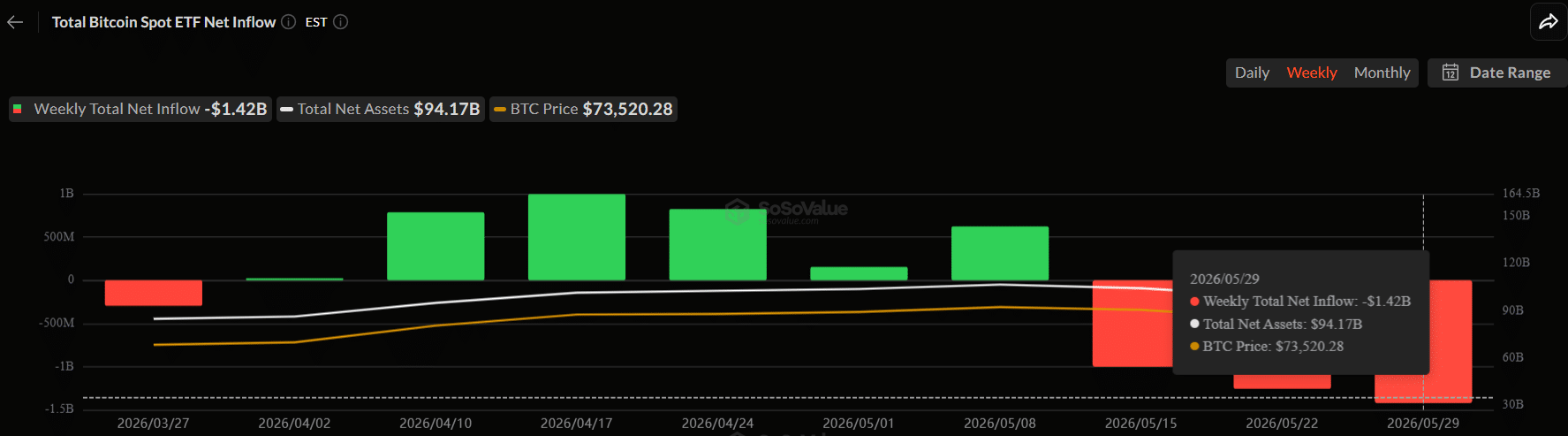
As the chart below illustrates, spot Bitcoin ETFs ended May with more than $2.43 billion in cumulative net outflows. The selling pressure accelerated toward month-end, with investors pulling approximately $1.42 billion from spot BTC ETFs over the past week alone, the third-largest weekly outflow on record.

btc etf
Source: SoSoValue

Taken together, weakening seasonality and ETF outflows continue to paint a challenging picture for Bitcoin. 

According to AMBCrypto, unless a fresh source of liquidity enters the market, the risk-off mood currently dominating investor sentiment could remain a key headwind throughout June. However, with liquidity continuing to dry up, stablecoin metrics may now be the key variable to watch.

Stablecoin liquidity emerges as Bitcoin’s key demand signal for June

Historically, expansions in stablecoin supply have preceded stronger buying activity across crypto markets.

The logic is simple: Stablecoins act as the primary source of deployable capital.

When their supply expands, it signals fresh liquidity entering the market, increasing the pool of capital available to flow into risk assets such as Bitcoin [BTC]. Conversely, when stablecoin growth stalls or contracts, market liquidity tends to tighten, reducing buying power and making sustained rallies more difficult to achieve. 

So far, June appears to be starting with the latter.

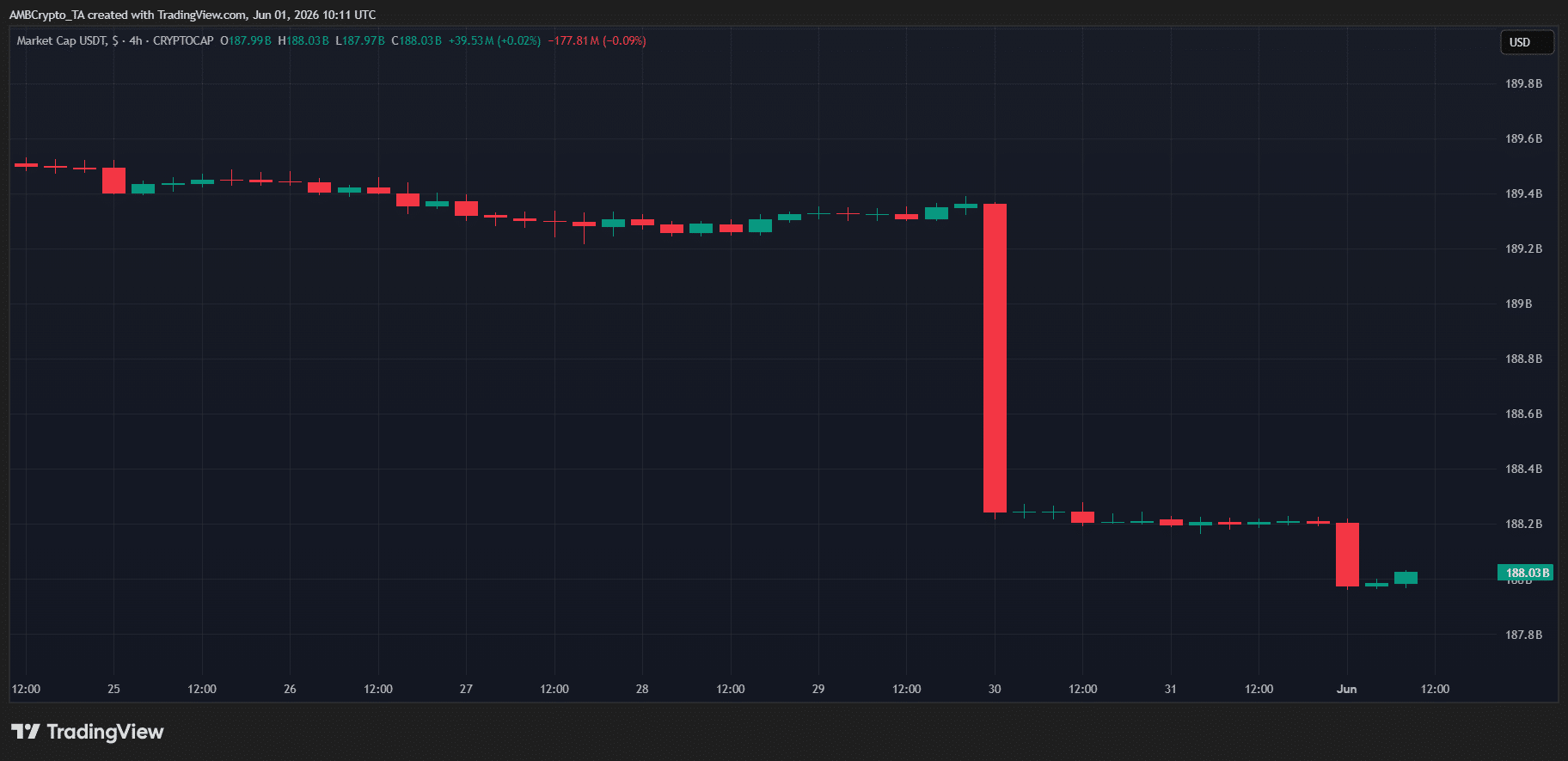
As the chart below shows, total stablecoin market capitalization finished May about $3 billion lower, suggesting liquidity is being pulled from the market rather than added to it. The trend is also visible in Tether’s USDT supply.

Over a recent four-hour period, more than $1 billion was erased from circulation, highlighting the ongoing liquidity drain.

BitcoinBitcoin
Source: TradingView (USDT)

With ETF outflows already weighing on sentiment, the contraction in stablecoin supply adds another headwind for Bitcoin, potentially limiting the market’s ability to stage a strong recovery in the near term. 

This naturally puts Bitcoin’s June outlook on a bearish footing. 

If the current liquidity drain persists, the odds of June extending May’s losses look increasingly likely. More importantly, it highlights why Bitcoin’s Q2 gains remain at risk.

Without a turnaround in liquidity conditions, BTC could struggle to find the demand needed to defend recent gains, leaving the door open for a deeper retracement as June unfolds.


Final Summary

  • Bitcoin starts June under pressure as ETF outflows and weak seasonality continue to weigh on the market.
  • Falling stablecoin liquidity could limit buying demand, making a BTC recovery harder to sustain.


Source link

Strategy news: Strategy’s bitcoin sale triggers fierce debate over Michael Saylor’s true commitment

0
Strategy news: Strategy’s bitcoin sale triggers fierce debate over Michael Saylor’s true commitment

For years, Strategy (MSTR) Executive Chairman Michael Saylor insisted he would never sell bitcoin .

Yet on Monday, the largest company disclosed that it sold 32 bitcoin last week, its first sale in four years. The announcement prompted questions about whether one of bitcoin’s most prominent corporate advocates was changing course.

Most analysts don’t think so. While the transaction sparked debate among investors, they largely agree that the sale was too small to alter Strategy’s long-term bitcoin accumulation strategy.

The company on Monday said that it sold 32 bitcoin between May 26 and May 31 at an average price of $77,135, generating roughly $2.5 million to help fund dividend payments on STRC, its high-yielding perpetual preferred stock known as Stretch. Strategy still held more than 843,700 BTC at the end of May, meaning the sale represented about 0.004% of its total holdings.

While the announcement initially fueled concerns that Executive Chairman Michael Saylor was backing away from his long-held commitment to accumulating bitcoin, several analysts argued that the interpretation misses the bigger picture.

‘Economically immaterial’

TD Cowen analyst Lance Vitanza said reports suggesting Strategy had become a meaningful seller of bitcoin were overblown.

“Headlines suggesting that Strategy has meaningfully reduced its bitcoin position are, in our view, misleading,” Vitanza wrote in a research note. “The transaction was economically immaterial and does not alter the core accumulation thesis.”

Vitanza noted that management has discussed the possibility of limited bitcoin sales on several recent occasions as part of a broader financing strategy. He added that TD Cowen’s model already anticipated small tactical sales and therefore made no changes to its bitcoin accumulation assumptions or its $400 price target on the stock.

The analyst also pointed to signs that Strategy is rebuilding its cash position. The company also sold 801,944 shares of common stock and used part of the proceeds to replenish cash reserves after repurchasing $1.5 billion of convertible debt at a discount.

‘Viable backstop’

Benchmark analyst Mark Palmer reached a similar conclusion about the significance of the sale itself, saying he does not expect bitcoin disposals to become a primary source of funding for dividends.

“We do not expect Strategy to use bitcoin sales as a primary means of funding dividends on STRC and its other perpetual preferred stock issues,” Palmer said. “It is far more likely that the company will continue to replenish its cash reserve through equity issuance and then use reserve funds to pay dividends.”

Palmer, however, argued that the sale could change how investors view Strategy’s bitcoin holdings. “Now, investors should view Strategy’s bitcoin holdings as providing a viable backstop for the funding of preferred dividends,” he said.

Supporting shareholders

Others viewed the transaction as a more meaningful signal.

Risk Dimensions CIO Mark Connors said the move demonstrates that Strategy is willing to prioritize the health of its capital structure over maintaining a strict no-sale stance on bitcoin.

“By selling bitcoin, Saylor has stated two things,” Connors said. “First, we will support our shareholders and creditors in every way… including by selling bitcoin.” “Second, Saylor and Strategy have prioritized the health and perception of health of the MSTR capital structure over being a diamond-handed OG.”

The differing interpretations highlight the key question now facing investors.

Analysts broadly agree that the 32-BTC sale was immaterial. What remains up for debate is whether it was simply a routine treasury decision or an early signal that Strategy’s approach to managing its vast bitcoin reserves is becoming more flexible.

Strategy is lower by 5% on Monday, while bitcoin has fallen back to a near two-month low of $71,000.


Source link

What is flood insurance? Your guide to coverage, costs, and how to buy.

0
What is flood insurance? Your guide to coverage, costs, and how to buy.


Flood insurance is typically a separate policy from your homeowners insurance that specifically protects your property from flood-related events. It’s not always necessary, but it’s worth considering if you live in an area where it could flood.

What is flood insurance?

Flood insurance is a type of property coverage that can protect your home and belongings from flood-related water damage. Potential flooding situations could include:

Keep in mind that coverage can vary by policy, so be sure to read over your terms, conditions, and exclusions to see what your plan covers.

Does homeowners insurance cover floods?

Standard homeowners insurance policies don’t typically cover flood damage, so you would have to purchase a separate plan if you want this coverage. Depending on your provider, you may be able to purchase a special endorsement as an add-on to your homeowners insurance, but it’s more common to have to purchase a separate policy.

What does flood insurance cover?

Flood insurance is often separated into two categories: dwelling coverage and personal property coverage. The former usually covers your home’s structure and built-in appliances, while the latter covers your belongings.

Here’s a look at some of the items you might find under each type of coverage:

Dwelling coverage

  • Your home’s structure, including the foundation

  • Air conditioning units and furnaces

  • Built-in appliances, such as refrigerators and dishwashers

  • Garage and other detached structures

  • Permanently installed carpeting

  • Permanently installed paneling, bookcases, and cabinets

  • Plumbing and electrical systems

Personal property coverage

  • Your personal belongings, such as clothing, electronics, and furniture

  • Carpeting not already included in your dwelling coverage

  • Certain high-value items, such as jewelry and art (often up to a certain amount)

  • Clothes washers and dryers

  • Curtains

  • Food freezers and the food inside

  • Portable and window air conditioners

  • Portable microwaves and dishwashers

Read more: What does homeowners insurance cover?

What does flood insurance not cover?

Flood insurance generally won’t cover:

  • Avoidable damage, such as damage caused by moisture, mildew, or mold

  • Currency, precious metals, and stock certificates

  • Expenses for everyday living and temporary housing

  • Financial losses caused by business interruption

  • High-value items beyond certain limits

  • Landscaping

  • Most motor vehicles and their parts

  • Mudslides or another type of earth movement, even if caused by a flood

  • Outdoor property, including hot tubs, pools, septic systems, patios, decks, and fences

Do you need flood insurance?

In general, flood insurance isn’t required except for specific situations. For example, it may be required if you have a house or business in a Special Flood Hazard Area (SFHA) and have a government-backed mortgage. You may also need flood insurance if it’s a requirement in your mortgage terms, even if you don’t live in a high-risk area for floods.

How much flood insurance coverage do you need?

Your mortgage terms may require you to have sufficient protection to cover the outstanding balance of your loan, but you typically want enough coverage to completely rebuild your home if necessary. This is different from covering your home’s resale value, which could be much lower than the rebuilding cost.

You can estimate your necessary coverage by adding up the costs of rebuilding your home and replacing damaged or destroyed belongings.

Note that National Flood Insurance Program (NFIP) coverage maxes out at $250,000 of building coverage and $100,000 of contents coverage. If you need more than that, you may have to purchase an additional private policy to bridge the gap or have a separate private policy that provides sufficient coverage on its own.

How much does flood insurance cost?

According to FEMA, 37% of NFIP policies nationwide cost between $0 to $1,000 per year, while 32% cost between $1,000 to $2,000 per year for a single-family home. However, your policy’s final cost could vary, depending on these factors:

  • Coverage: Your total coverage amount and the type of coverage you choose can affect your cost. For example, increasing your personal property limits is likely to increase your rates, while increasing your deductible should lower them.

  • Location: You may have to pay higher premiums in high-risk flood areas than in lower-risk areas.

  • Home age: An older home may be more expensive to insure because of older materials and systems, which may pose a greater risk to your provider.

Read more: How much does flood insurance cost in every state?

How to buy flood insurance

You typically have two options for buying flood insurance:

  1. Purchase an NFIP, government-backed plan

  2. Purchase a plan from a private insurer

If you already have a homeowners insurance policy, you should be able to contact your insurer about adding flood insurance. Many providers can write flood insurance through the National Flood Insurance Program. If yours doesn’t have that option, you can search for an eligible provider through the NFIP directory.

You can also compare options from private insurers for policies that aren’t backed by the government. Depending on your needs, you may be able to find higher coverage limits and additional plan options through a private insurance company.

How to lower flood insurance costs

Lower your coverage

While this isn’t an ideal solution, lowering your coverage is a quick and easy way to lower your insurance premium if you need to put some money back in your pocket. However, we wouldn’t recommend having less than enough coverage to rebuild your home, if necessary.

Increase your deductible

Choosing a higher deductible is a straightforward way to lower your premium, but you have to keep in mind that if you submit a claim, you have to pay that higher deductible. There are pros and cons to this strategy, but it could make sense depending on your financial situation.

Provide an Elevation Certificate (EC)

An EC helps insurers assess your property’s flood risk, and you can inquire with your local floodplain manager about acquiring one. The NFIP no longer requires an EC to purchase coverage, but providing one could help lower your insurance costs.

Mitigate your risks

Considering the cost of flood insurance is based on the flood risk for an individual property, you may be able to take actions to mitigate your risk and lower your insurance cost. This could include elevating your utilities, such as water heaters and electrical panels, installing flood openings, and filling in basements.

FEMA/NFIP vs. private flood insurance

At a glance, the main difference between NFIP coverage, managed by FEMA, and private flood insurance is that NFIP coverage is backed by the government. Apart from that, the differences lie in the amount of coverage and overall coverage limits.

Coverage type

NFIP insurance

Private flood insurance

Dwelling coverage

Up to $250,000

Potentially up to $500,000 or more

Contents coverage

Up to $100,000

Potentially up to $250,000 or more

Loss of use coverage

Not available

Available

In general, private flood insurance allows for higher coverage limits and more comprehensive coverage options. However, depending on your situation, you may not need more than what NFIP policies offer.

Learn more: How FEMA flood insurance works

Flood insurance FAQs

When does flood insurance take effect?

It may depend on your policy, but it’s common for flood insurance coverage to take effect 30 days after the purchase date. There may be no wait or a shorter wait if you’re renewing your policy or your property is in a newly designated high-risk flood zone.

Is flood insurance required?

Flood insurance isn’t generally required unless it’s stipulated in your mortgage terms. This could be the case if you live in a high-risk flood area and have a government-backed mortgage, or if your lender requires flood insurance, regardless of where you live.

Can renters get flood insurance?

Yes, renters can get flood insurance through the NFIP or a private insurance company. This would usually be a separate policy from a renters insurance plan.

Does flood insurance cover basements?

Yes, flood insurance can cover basements, but coverage may be limited by your policy’s terms and conditions. For example, furnaces, heat pumps, circuit breaker boxes, and electrical boxes may be covered, but certain personal property and basement improvements may not be covered.

Can I get flood insurance outside a flood zone?

Yes, you can typically purchase flood insurance even if you don’t live in a high-risk flood zone. NFIP flood insurance is available to anyone living in one of over 22,000 communities across the country, and you can also purchase coverage through a private company as an alternative option.

Does FEMA disaster assistance replace flood insurance?

No, FEMA disaster assistance does not replace flood insurance. FEMA disaster assistance is available only when the president of the United States declares a federal disaster, and FEMA grants may not always cover all losses. Flood insurance helps cover you in case of flood-related events, even if they aren’t declared disasters.




Source link