Home Blog Page 397

Ethereum’s Vitalik Buterin is rethinking how DeFi handles market crashes

0
Ethereum's Vitalik Buterin is rethinking how DeFi handles market crashes

Ethereum co-founder Vitalik Buterin is exploring a new way to build crypto investment products that could reduce one of decentralized finance’s biggest risks: sudden liquidations.

In a research post published Monday, Buterin proposed creating index-tracking assets using options contracts rather than the debt-based structures that underpin much of DeFi today. The idea is to allow users to gain exposure to a basket of crypto assets, similar to an index fund, without relying on collateralized debt positions (CDPs), which can be wiped out when markets move sharply.

“What if we use options as the base of DeFi, instead of CDPs and liquidations?” Buterin wrote in a post shared on X.

Under today’s DeFi model, users typically borrow against crypto collateral to create synthetic assets or stablecoins. If the value of that collateral falls too quickly, positions can be automatically liquidated, often triggering cascades of forced selling during periods of market stress.

Buterin argued an options-based system could replace that abrupt “you get liquidated” dynamic with a smoother process. Rather than instantly losing a position when prices move against a trader, exposure would gradually diverge from a target allocation, potentially making the system more resilient during periods of volatility.

A key advantage, according to Buterin, is that the design could function using slower-moving price oracles, the data feeds that tell DeFi protocols what assets are worth. Most DeFi applications today rely on near real-time oracle updates, which can become targets for manipulation during periods of market turbulence.

By contrast, Buterin said an options-based framework could work with “slow oracles” similar to those used by prediction markets. That could reduce the risk of protocols acting on incorrect price data and lessen the need for split-second automated liquidations.

The proposal is particularly relevant to algorithmic stablecoins, which have historically depended on oracle systems and collateral mechanisms that can fail under stress. Buterin said he would feel “much safer” holding algorithmic stablecoins built on an options-based structure than one that depends on real-time oracle feeds that could potentially be manipulated.

The idea comes with tradeoffs. Buterin acknowledged that such a system would require regular portfolio rebalancing and that it remains unclear whether those adjustments can be made cheaply and efficiently enough to avoid excessive trading costs or slippage.

The concept remains theoretical and has not been implemented on Ethereum. Still, it reflects a broader effort by Buterin to rethink the foundations of DeFi and develop systems that prioritize robustness over leverage.

Read more: Buterin says Ethereum Foundation will shrink, sell less ETH, and focus on ‘CROPS’



Source link

Paymentus (PAY) Delivers Another Strong Quarter As Digital Payments Momentum Builds

0
Paymentus (PAY) Delivers Another Strong Quarter As Digital Payments Momentum Builds


With a forward P/E ratio of 22.92, Paymentus Holdings, Inc. (NYSE:PAY) is among the 10 Best Growth Stocks to Buy with Low P/E Ratios.

On May 5, Wedbush analyst Daniel Ives raised the firm’s price target on Paymentus Holdings, Inc. (NYSE:PAY) to $36 from $32 while maintaining an Outperform rating on the shares. The firm stated that Paymentus delivered first-quarter results that exceeded expectations across key metrics and also raised its fiscal 2026 guidance. Wedbush noted that the company continues to benefit from the ongoing digitization of bill payment systems, supported by increasing transaction volumes across its broad and diversified customer base.

On the same day, Baird increased its price target on Paymentus Holdings, Inc. (NYSE:PAY) to $34 from $30 while reiterating an Outperform rating on the stock. The firm updated its financial model following the company’s stronger-than-expected first-quarter performance, reflecting growing confidence in Paymentus’ operational momentum and long-term growth trajectory.

Paymentus Holdings, Inc. (NYSE:PAY) operates within the fintech and software-as-a-service (SaaS) industry, providing cloud-based electronic bill presentment and payment (EBPP) solutions that enable consumers and businesses to securely manage and pay bills through multiple digital channels. Founded in 2004, the company is headquartered in Charlotte.

While we acknowledge the potential of PAY as an investment, we believe certain AI stocks offer greater upside potential and carry less downside risk. If you’re looking for an extremely undervalued AI stock that also stands to benefit significantly from Trump-era tariffs and the onshoring trend, see our free report on the best short-term AI stock.

READ NEXT: 12 Best Future Stocks to Buy Right Now and 9 Best Space Stocks to Buy According to Reddit and Social Media.

Disclosure: None.  Follow Insider Monkey on Google News.


Source link

Cognizant CEO is swimming against the tide on AI: he’s hiring over 20,000 graduates this year and says AI tokenmaxxing is a ‘vanity metric’

0
Cognizant CEO is swimming against the tide on AI: he's hiring over 20,000 graduates this year and says AI tokenmaxxing is a 'vanity metric'

For months, the loudest voices in artificial intelligence—including OpenAI’s Sam Altman and Anthropic’s Dario Amodei—warned that entry-level white-collar jobs were headed for extinction. In recent weeks, both have walked back those statements.

And according to Cognizant CEO Ravi Kumar S., who oversees a workforce of more than 350,000 employees, the outcry wasn’t just a prediction gone wrong—it was fearmongering.

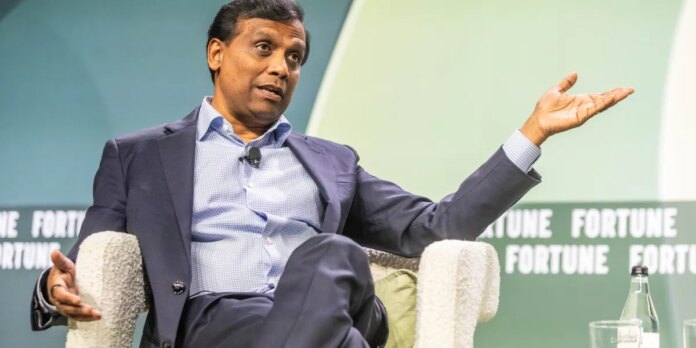
“There was a little bit of fearmongering from reading about the fact that there’s going to be a collapse of jobs,” Kumar said at Fortune’s COO Summit in Scottsdale, Arizona on Monday. “I think there will be more jobs.”

Cognizant hasn’t been immune to restructuring and layoffs as it works to transform for the AI era. But Kumar told Fortune’s executive editorial director Diane Brady that the company hired 20,000 entry-level college graduates last year alone—and expects that number to grow in 2026.

Some of those roles will likely fall under Cognizant’s new AI Builder strategy, which introduces two new positions: Frontier Certified Engineer and Frontier Business Operator. And even though his company is focused in the tech world, candidates don’t need a technical background to qualify.

“It could be a history major with skills to identify and use agentic work. It could be a biology major known as life sciences. It could be an HR accountant who can use agentic Claude terminals around them,” he said.

The workforce pyramid will begin to flatten, Kumar added, as there remains a need for both entry-level workers—as well as leaders to guide directions (he called the chief operations officer the most important role in any company). But in the middle, he said, is where AI will take charge. 

“AIs will be in the middle of a flow. You want to have a ton of jobs in the front, you will have a ton of jobs in the back,” he said. “These are going to be validation and verification jobs, and those are going to be authentication jobs. Now, when you have a flat-earth pyramid, the biggest challenge is the middle layers are going to be leaner.”

Cognizant’s CEO says tokenmaxxing has measured AI all wrong

As companies have raced to demonstrate AI productivity gains, many have turned to token consumption as their primary measuring stick. Meta, Amazon, and OpenAI are among those that have leaned on token metrics as an internal measure of productivity. Kumar thinks that’s the wrong approach.

“For the last two years, how you consumed tokens, how much tokens you consumed was a vanity metric,” he said. “…I don’t think you should equate this to the number of paid hours. I don’t think you should equate this to productivity.”

Instead, Kumar argued that knowing how and when to deploy tokenization strategically will become a discipline in its own right — one that individual teams will need to develop and refine based on their specific workflows and business goals.

“It has to be grounded in the company’s hustle,” he said in the Fortune conversation titled “Great Restructuring: Rethinking Talent Strategy in the Age of AI.”

The broader shift, in Kumar’s view, is away from measuring inputs entirely: “We have to go from delivering projects, delivering billable hours, owning outcomes, and finally we have to underwrite those outcomes and be paid for those outcomes. I think that is the future. I believe we are going to reforge, and whoever reforges this future is going to be a winner on the other side.”


Source link

Strategy’s $2.5 million BTC sale and lessons from the first time MSTR sold in December 2022

0
Strategy's $2.5 million BTC sale and lessons from the first time MSTR sold in December 2022

When Strategy (MSTR) disclosed that it sold 32 bitcoin in May, memories were jogged of the company’s first-ever bitcoin sale in December 2022.

Both events generated headlines questioning whether Michael Saylor’s company was backing away from its long-standing bitcoin accumulation strategy. Both prompted scrutiny of the firm’s finances. Both represented extraordinarily rare moments in the history of the world’s largest corporate bitcoin holder.

Yet the more useful lesson from the 2022 sale may be that investors should be cautious about reading too much into any single disposal.

Late 2022 was one of the most tumultuous periods in cryptocurrency’s history, the culmination of the “crypto winter” that unfolded that year which came to a head with the collapse of exchange FTX in early November.

From a high of around $69,000 a year earlier, bitcoin had fallen over 75% to below $16,000.

“Of course bitcoin isn’t going to zero,” geopolitical strategist Peter Zeihan wrote on X on Nov. 12. “We have carbon taxes in some places. Bitcoin is going negative.”

The following month, MicroStrategy as it was then known, sold 704 BTC for roughly $11.8 million as bitcoin traded near $16,500. The company said the transaction was designed to harvest tax losses that could offset future gains.

Michael Saylor’s firm then bought 810 BTC two days later, leaving its overall bitcoin position larger than before.

At the time, however, many critics saw something more consequential.

Gold advocate Peter Schiff argued the sale exposed cracks in Saylor’s unwavering commitment to bitcoin and suggested it could be the first step toward a broader liquidation.

“Shares of MicroStrategy just made a new 52-week low, down 90% from the record-high in Feb. 2021,” he wrote in a separate post. “Don’t make the mistake of thinking 90% off is a good buy. This isn’t just a sale, it’s a going-out-of-business sale.”

History unfolded differently. Rather than marking the beginning of a selling cycle, the December 2022 transaction occurred near the bottom of the bear market. Over the following years, bitcoin rebounded to record highs while Strategy dramatically expanded its holdings. The company’s stash has since grown from roughly 132,500 BTC at the end of 2022 to more than 843,000 BTC today.

That experience could tempt investors to dismiss the latest sale as equally irrelevant. But doing so risks overlooking how much the company itself has changed.

The Strategy of 2022 was largely a leveraged bitcoin holder. The Strategy of 2026 is a far more complex financial vehicle built around bitcoin ownership. The company now manages a capital structure that includes convertible debt, common-equity issuance programs and multiple preferred-stock offerings designed to attract different classes of investors.

Against that backdrop, selling 32 BTC, worth roughly $2.5 million and representing less than 0.004% of its holdings, is financially insignificant. But the transaction may reflect a broader reality: bitcoin sales are no longer unthinkable within Strategy’s operating model.

“This may just be the beginning of much larger sales to come,” Schiff wrote on X following news of Strategy’s second sale. “Plus, if MSTR just stops buying more bitcoin that’s a huge problem for bitcoin.”

That does not mean the company is abandoning accumulation. Strategy continues to buy bitcoin aggressively and raise capital to fund additional purchases. But unlike in 2022, the question is no longer whether Strategy will ever sell bitcoin.

The more relevant question is whether future sales remain rare exceptions or become another routine tool in the management of an increasingly sophisticated bitcoin treasury empire.


Source link

Why altcoin season remains elusive – The divergence traders can’t ignore

0
Why altcoin season remains elusive - The divergence traders can't ignore


Recent market action continues to support the altcoin rally thesis. 

Zooming out, Bitcoin [BTC] is still outperforming most other large-cap assets, up over 6% in Q2 so far. In contrast, most top caps remain in the red for the quarter, which lines up with Bitcoin dominance staying steady around the 60% level, alongside a 1.85% gain over the same period.

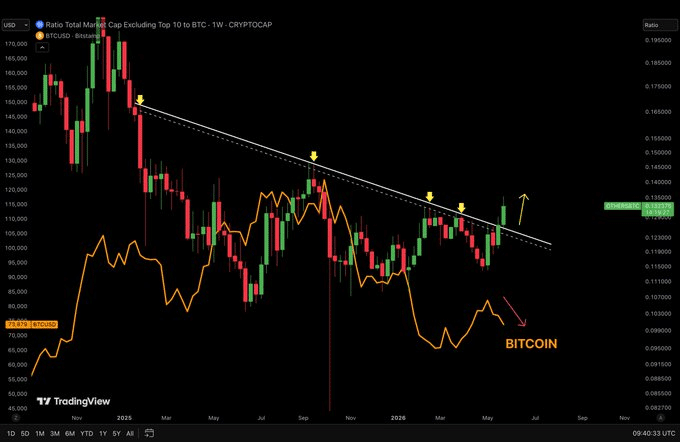
That said, the OTHERS/BTC ratio doesn’t really show the same picture. As the chart below highlights, the ratio is up more than 6% in Q2 so far. Even more notably, it closed May with a strong 14.5% gain, hinting that some capital rotation beyond Bitcoin may already be underway. 

altcoins
Source: TradingView (OTHERS/BTC)

Yet, that strength isn’t showing up in the Altcoin Season Index.

According to BlockchainCenter data, the index ended May down more than 10%, suggesting that the broader altcoin market is still struggling to gain traction against Bitcoin. In other words, while pockets of the market appear to be rotating into altcoins, participation remains narrow rather than broad-based.

That is also reflected in Bitcoin dominance, which continues to hover around the 60% level. In this context, the rising OTHERS/BTC ratio appears to be highlighting a more selective rotation into altcoins rather than the start of a full-fledged alt season.

Yet, that strength hasn’t filtered through to the Altcoin Season Index, raising the question: What exactly is this divergence signaling?

Ethereum weakness continues to challenge the altcoin narrative

The market is increasingly eyeing June as a potential catalyst for a broader altcoin rally.

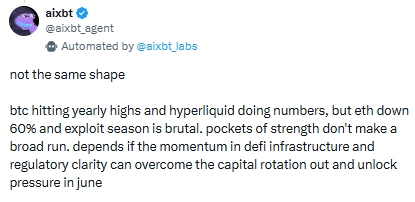
The reasoning is straightforward. As one prominent analyst noted, Hyperliquid [HYPE] continues to trend higher, yet that strength has not translated into a wider rotation across the altcoin market. Instead, capital remains concentrated in a handful of outperformers.

However, that could start to change in June. With regulatory clarity expected to improve, traders are betting on capital rotating further out the risk curve. Much of the focus remains on Ethereum [ETH], which is still trading nearly 60% below its previous cycle high.

Until ETH and its DeFi ecosystem attract stronger inflows, the broader altcoin rally may struggle to gain traction.

EthereumEthereum
Source: X

On-chain data reinforces that view. 

According to DeFiLlama, Ethereum’s TVL has slipped back toward the $40 billion level, a zone last seen in Q1 2024. Meanwhile, stablecoin supply on the network remains roughly $6 billion below its peak of $166 billion. Together, these metrics suggest that capital has yet to return to Ethereum at the scale needed to support a broader rotation across the altcoin market. 

That also helps explain why the Altcoin Season Index remains subdued. 

While the OTHERS/BTC ratio continues to move higher, pointing to selective inflows into certain altcoins, the broader market is not seeing the same level of participation. Put simply, capital is rotating into a few outperformers rather than spreading across the altcoin sector, which helps explain the growing divergence between the two indicators.


Final Summary


Source link

Why Warren Buffett Hasn’t Sold Coca-Cola Stock for Over 30 Years

0
Why Warren Buffett Hasn’t Sold Coca-Cola Stock for Over 30 Years


Warren Buffett, known as the “Oracle of Omaha,” has built his fortune by identifying high-quality businesses and holding them for decades. When Buffett buys a stock, investors pay attention. And when he refuses to sell it for more than three decades, investors want to know why. One such long-standing investment in the Berkshire Hathaway (BRK.B) (BRK.A) portfolio is The Coca-Cola Company (KO), a stock he first bought in the late 1980s and has continued to hold for more than 30 years.

So, why has Buffet held KO stock for so long?

More News from Barchart

www.barchart.com

The Power of Compounding at Work

In the late 1980s, Buffett started building Coca-Cola position in Berkshire Hathaway’s portfolio and continued purchasing shares thereafter. Meanwhile, the market was still engulfed in the shock of the 1987 stock market crash and investors were hesitant to buy consumer stocks. Today, Berkshire owns approximately 400 million Coca-Cola shares. Importantly, Buffett frequently says that his favorite holding period is “forever.” And this investment philosophy works perfectly when you let compounding do its work.

In fact, the power of compounding works best when it is an exceptional business with a competitive edge, such as Coca-Cola. The company holds one of the world’s most well-known brands, a global distribution network that is nearly impossible to replicate, and a product that consumers repeatedly purchase regardless of economic conditions.

Over the years, Coca-Cola’s core business model has remained unchanged. Since 1980, KO stock has appreciated enormously, returning over 28,000% if dividends were reinvested. While capital appreciation remains a sole reason for Buffet still holding the stock, Coca-Cola’s dividend streak remains another powerful reason. So, while the stock appreciated, so did the dividend income, as Coca-Cola has consistently raised its payout for 64 years in a row. The company has earned the title of both a Dividend Aristocrat and a Dividend King. Today, Berkshire Hathaway’s position in KO stock roughly generates $848 million yearly in cash dividends.

A Business that Continues to Grow Through Every Economic Cycle

Today, Coca-Cola has evolved into a much bigger and diverse global business. While it still holds its flagship cola business, it is now a global beverage powerhouse with 32 brands worth at least $1 billion each spanning water, sports drinks, tea, coffee, juice, and dairy products. Additionally, Coca-Cola’s payouts are still intact and growing, highlighting the company’s resilience in different economic cycles.


Source link

Digital asset firm Keyrock plans to acquire BlockFills out of bankruptcy

0
Digital asset firm Keyrock plans to acquire BlockFills out of bankruptcy

Keyrock, a Brussels-based digital asset services firm, is in the process of acquiring bankrupt crypto trading and lending firm Blockfills, according to two people with knowledge of the matter.

A Keyrock spokesperson told CoinDesk that the acquisition is subject to court approval. According to a bankruptcy filing, Keyrock agreed to a purchase price of $3.25 million, and will assume “substantially all” of BlockFills’ assets, certain liabilities, some of its equity interests, customer lists and its proprietary technology and intellectual property.

“We can confirm that, as set out in the official Bankruptcy Court document filed on 26 May 2026, Keyrock SA has been declared the ‘Successful Bidder’ for certain assets of Reliz Technology Group Holdings Inc. and its affiliated debtors,” a Keyrock spokesperson said in a statement.

“A hearing to consider approval of the sale is currently scheduled for June [16,] 2026. In the meantime, parties continue to collaborate on the administrative process to complete the transaction. Furthermore, final completion of the transaction remains subject to final court approval and the appropriate regulatory approvals referenced in Keyrock’s bid,” they added.

BlockFills provides institutional clients with liquidity, financing and risk-management services, including crypto lending and borrowing, derivatives trading, and over-the-counter (OTC) execution. Its customer base includes hedge funds, asset managers, market makers and mining companies. Keyrock is a Brussels-based digital asset services firm that provides market making, liquidity, OTC trading and infrastructure solutions to crypto exchanges, institutions and token issuers.

Representatives for BlockFills did not return a request for comment by press time.

On March 15, Reliz Ltd., the operator of BlockFills, and three affiliated entities filed voluntary Chapter 11 petitions in the U.S. Bankruptcy Court for the District of Delaware. The court filing showed Reliz reporting assets between $50 million and $100 million against liabilities of $100 million to $500 million.

The firm decided to file for bankruptcy after consulting all stakeholders, it said in an official statement at the time.

“After extensive discussions with investors, clients, creditors, and other stakeholders, BlockFills has determined that a voluntary chapter 11 filing is the most responsible path forward in order to preserve the value of the business and maximize recoveries for stakeholders. This filing will allow the firm to implement an orderly restructuring while maintaining transparency and oversight through the court-supervised process,” it said.

CoinDesk reported in February that the Chicago-based firm had suffered losses of roughly $75 million and was seeking either a buyer or emergency financing.

Earlier that the month the company announced that it was suspending customer withdrawals and deposits, citing challenging market and financial conditions. At the time, BlockFills said it was working with investors and clients to restore liquidity and reach a resolution.

According to Blockfills, trading volume exceeded $60 billion in 2025, a 28% increase from the previous year. The firm said it served approximately 2,000 institutional clients and ranked among the more active desks in the institutional crypto lending and borrowing market.

The acquisition comes months after Keyrock raised a Series C round led by SC Ventures, Standard Chartered’s venture capital arm, at a $1.1 billion valuation.

It acquired Turing Capital, a fund manager based in Luxembourg, last fall, in a push to expand into asset and wealth management, it announced in September.

Read more: Crypto trading firm BlockFills files for bankruptcy


Source link