Coinbase (COIN) CEO Brian Armstrong believes bitcoin BTC$66,197.49 may have bottomed near $60,000.
“My instinct is we probably have bottomed at this point, maybe at the sixty K number, but nobody can say for sure,” Armstrong said in a video posted on X on Monday. He added that he remains long bitcoin and expects prices to be significantly higher by 2030.
“I think bitcoin is the new digital gold,” he said.
Bitcoin traded above $66,000 on Monday, up nearly 3% over 24 hours, after the US and Iran reached a deal to reopen the Strait of Hormuz. The token touched a low near $59,743 on June 5, its weakest level since October 2024, before recovering.
Armstrong pointed to bitcoin’s four-year halving cycle, which has historically alternated between bull and bear markets at roughly regular intervals, as a framework for reading the current drawdown. Bitcoin is now roughly 50% below its October 2025 all-time high near $126,000.
The Coinbase chief also said last week that the drop in bitcoin’s price was masking broader health in the crypto market. “Derivatives, stablecoins, prediction markets are all up,” he wrote on X on June 5. “It will take some time for this to sink in.”
Zcash [ZEC] surged nearly 14% over the past 24 hours as traders returned aggressively and pushed the token back toward a major resistance zone. The rally coincided with a sharp increase in participation across the market, with the trading volume climbing 40.48% to $665 million.
These figures showed that fresh capital had entered the market rather than simply rotating within existing positions.
Price also advanced toward the psychological $500 level after recovering from recent weakness. As a result, buyers regained control of the short-term market structure.
The combination of rising volume and accelerating price action reflected strengthening conviction among participants.
Why leveraged traders piled into Zcash
Derivatives activity expanded rapidly as traders increased exposure alongside the rally.
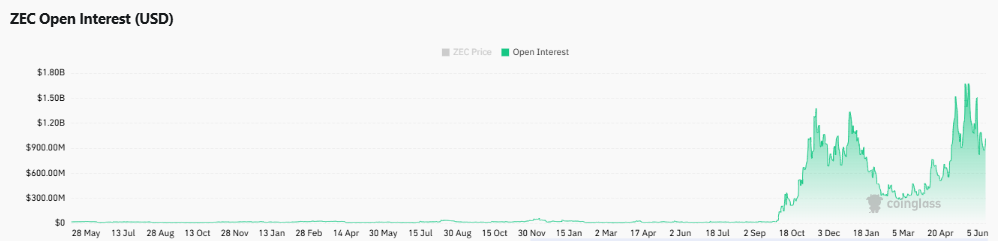
Open Interest [OI] rose 26.02% and reached $1.14 billion, highlighting a significant increase in leveraged positioning. This rise occurred while price continued climbing, which suggested that new positions had entered the market rather than existing positions closing.
Growing OI often signals a stronger conviction behind a move, especially when accompanied by rising volume.
In this case, both metrics advanced simultaneously and reinforced the bullish narrative.
Nevertheless, elevated leverage also increased the possibility of volatility if traders rushed to unwind positions.
Market participants, therefore, watched whether the price could sustain its advance above key resistance levels.
If buyers maintain control, the expanding derivatives activity could continue supporting further upside in the near term.
Source: CoinGlass
Zcash reclaims support as bulls regain control
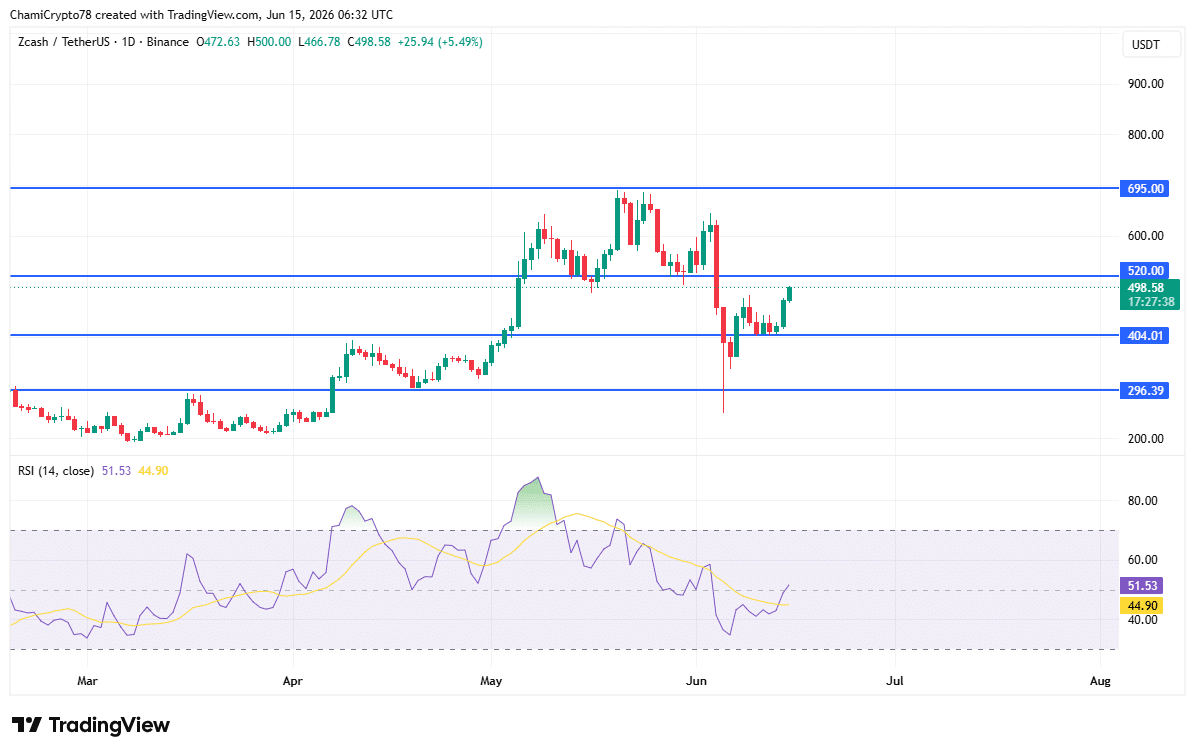
Technical conditions improved considerably after Zcash [ZEC] reclaimed the $404 support zone and established higher lows above that level.
Price then advanced toward the major $520 resistance area, which had previously acted as a key turning point. The daily chart showed buyers steadily rebuilding strength following the sharp decline witnessed earlier this month.
RSI climbed to 51.53 and moved above its signal line at 44.90, indicating improving bullish conditions.
This recovery pushed the indicator back above the neutral threshold and suggested growing buying interest.
Despite that improvement, Zcash still traded beneath the $520 resistance barrier.
A decisive move above that level would strengthen the recovery structure significantly.
Beyond $520, the next major resistance remained near $695, where sellers had previously regained control during earlier rallies.
Source: TradingView
Liquidity clusters gather above current price
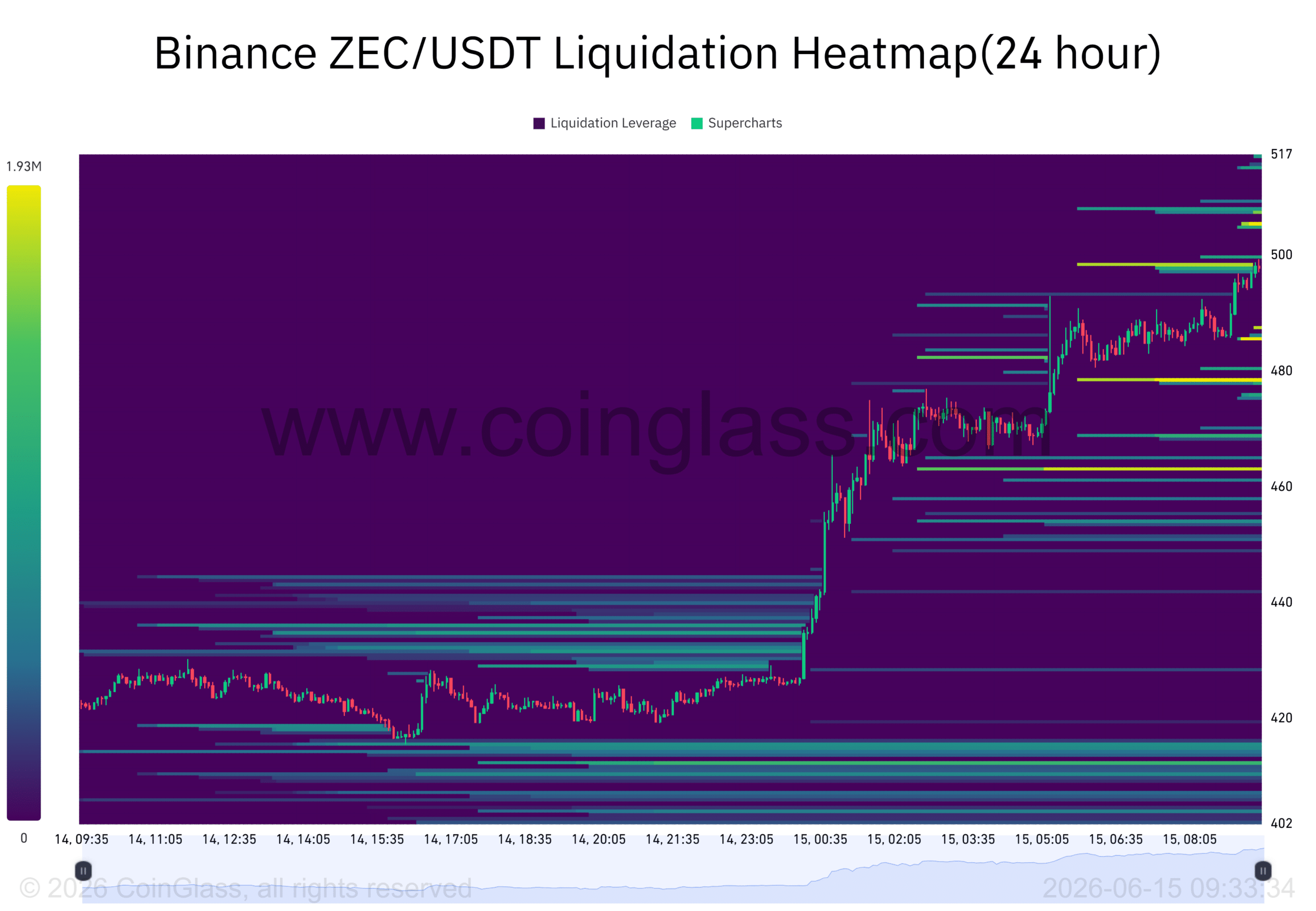
The Liquidation Heatmap revealed a concentration of liquidity directly above current market prices.
Several notable clusters emerged around $500, $505, and $515, creating potential attraction zones for price movement.
Markets often gravitate toward areas containing large pools of leveraged positions because liquidation events can accelerate directional moves.
As Zcash approached these levels, traders increasingly focused on whether short liquidations could fuel another leg higher.
While upside liquidity remained dominant, notable clusters also appeared below current prices.
Strong concentrations near $480 and deeper pockets around $460 represented potential downside targets if buyers lost control.
For now, liquidity positioning favored continued upward exploration.
However, traders remained cautious because liquidation-driven moves can reverse quickly once major clusters become exhausted.
Source: CoinGlass
To sum up, Zcash showed improving strength as price, volume, OI, and RSI all moved higher together.
Buyers successfully defended the $404 support level and pushed the price back toward major resistance.
If Zcash breaks above $520, the rally could extend toward $695. However, rejection at resistance could trigger a short-term pullback toward nearby liquidity zones.
For now, the broader structure favors buyers while the price remains above reclaimed support.
Final Summary
Zcash reclaimed key support while RSI recovered above neutral territory.
Rising Open Interest and volume showed traders increasing bullish exposure.
When it comes to earning more on your savings, money market funds (MMFs) and certificates of deposit (CDs) are often two of the first options savers consider. Both can offer higher returns than a traditional savings account, and both are generally considered lower-risk places to keep your cash. But despite their similarities, these accounts work differently.
If you’re looking for the best place to keep your cash, here’s what you need to know about money market funds versus CDs — and how to decide which option is right for you.
What is a money market fund?
A money market fund is a type of mutual fund that invests your money in short-term, low-volatility assets — meaning there’s very little risk of losing your money. In fact, MMFs are some of the safest types of investments available. They’re designed to preserve capital and liquidity while providing modest interest income.
Money market funds are offered by investment firms and brokerages. When you put cash into a money market fund, the fund then pools money from many investors to buy short-term securities. The interest earned is passed on to investors as dividends. The money pooled in MMFs is typically invested in:
These securities are all considered low risk because they tend to maintain their value, even when market conditions shift. However, as with other types of low-risk investments, MMFs have fairly low returns, which means they’re not good for long-term investing.
How to compare money market funds
Each brokerage offers different options for MMFs, including several categories you can choose from. How do you compare the accounts and choose which one is best? Here are a few details to look at:
Type: There are three categories of money market funds: municipal, prime, and government. Earnings on municipal MMFs are tax exempt, but prime and government are not.
Net expense ratios: The net expense ratio tells you what percentage of your returns will be held by the brokerage to cover fees. The lower the ratio, the more of your earnings you keep.
SEC yields: Also known as 7-day yields, SEC yields show you what your rate of return would be if you earned the past week’s average payout for a full year.
Currently, Vanguard offers SEC yields up to 3.56% (prime), Schwab offers up to 3.61% (government) and Merrill Edge offers up to 3.65% (prime). Rates are subject to change daily.
What is a CD?
A certificate of deposit is a type of savings account offered by most banks and credit unions that allows you to earn a guaranteed rate of return if you leave your money on deposit for a set period of time. CD terms can range anywhere from 28 days to 10 years, and you can currently find CD rates as high as 4%.
Like MFFs, CDS are low risk. In fact, the only way you can lose money on most CDs is by withdrawing your funds before the maturity date, or the date the CD term ends. When you do this, you usually have to pay an early withdrawal penalty.
Money market fund vs. CD: Key differences
Both MMFs and CDs are very low risk, and rates are higher than most traditional savings accounts.
However, there are enough differences between the two that it’s worth weighing the choice carefully. With MMFs, you’ll have to deal with expense ratios that eat into your earnings, and the interest rates aren’t fixed. By contrast, rates on CDs are generally higher, but you have to leave your money on deposit for a set period of time.
Here’s a closer look at how money market funds and CDs compare:
CDs and MMFs can both be useful financial tools. If you have money you’re setting aside for a few months or more, but you also want to earn interest with limited risk, a CD or an MMF can be a good choice.
So, how do you choose the right option? Consider the following.
A money market fund may be the better fit if:
You want easy access to your cash.
You’re building or maintaining an emergency fund.
You think interest rates may stay elevated or increase.
You’re saving for a goal that’s less than a year away but don’t know exactly when you’ll need the money.
A CD may be the better fit if:
You know you won’t need the money for a specific period.
Much of the activity has occurred on offshore exchanges, including fast-growing platforms such as Hyperliquid, which has attracted professional traders seeking deep liquidity and continuous access to leveraged markets. Prediction market Kalshi, which introduced perps on its platform earlier this month, saw over $1 billion in trading volume within just one week.
The debut comes weeks after the CFTC signaled that regulated platforms could offer perpetual futures. In May, the agency approved Kalshi’s bitcoin perpetual contracts and issued guidance that also cleared a path for Coinbase (COIN) to connect U.S. customers to global options and perpetual markets.
Kraken has been building toward the introduction through a series of derivatives-focused acquisitions and product releases. The company acquired NinjaTrader in May 2025 and Bitnomial a year later to gain regulated futures infrastructure. It recently added CME-listed crypto futures and margin trading for U.S. customers.
Kraken’s head of derivatives John Palmer told CoinDesk last week that adoption may mirror the trajectory of spot bitcoin exchange-traded funds (ETFs), with sophisticated traders entering first before investment advisers and asset managers follow after completing internal reviews.
At launch, Kraken’s perpetual futures cover major cryptocurrencies including BTC, ETH, SOL, XRP, ADA, LINK, DOGE, LTC and AVAX. The company said it plans to expand the range of contracts and collateral options over time.
Find out which banks are offering the top rates. Money market accounts (MMAs) can be a great place to store your cash if you’re looking for a relatively high interest rate along with liquidity and flexibility.
Unlike traditional savings accounts, MMAs typically offer better returns, and they may also provide check-writing privileges and debit card access. This makes these accounts ideal for holding long-term savings that you want to grow over time, but can still access when needed for certain purchases or bills.
Where are the best money market interest rates today?
Even though rates have been falling over the past several months, it’s still possible to find money market accounts that pay more than 4% APY.
Here is a look at some of today’s best money market account rates, Monday, June 15, 2026:
Historical money market account rates
Money market account rates have fluctuated significantly in recent years, largely due to changes in the Federal Reserve’s target interest rate.
In the wake of the 2008 financial crisis, for example, interest rates were kept extremely low to stimulate the economy. The Fed slashed the federal funds rate to near zero, which led to very low MMA rates. During this time, money market account rates were typically around 0.10% to 0.50%, with many accounts offering rates on the lower end of that range.
Eventually, the Fed began raising interest rates gradually as the economy improved. This led to higher yields on savings products, including MMAs. However, in 2020, the COVID-19 pandemic led to a brief but sharp recession, and the Fed once again cut its benchmark rate to near zero to combat the economic fallout. This resulted in a sharp decline in MMA rates.
But starting in 2022, the Fed embarked on a series of aggressive interest rate hikes to combat inflation. This led to historically high deposit rates across the board. By late 2023, money market account rates had risen substantially, with many accounts offering 4% or higher. However, the Fed finally began cutting rates in late 2024 and continued cutting rates in 2025.
So far in 2026, the Fed has left interest rates unchanged. MMA rates remain high by historical standards, though they’ve begun a downward trajectory following the Fed’s rate cuts in 2025. Today, online banks and credit unions tend to offer the highest rates.
What to consider when choosing a money market account
When comparing money market accounts, it’s important to look beyond just the interest rate. Other factors, such as minimum balance requirements, fees, and withdrawal limits, can impact the total value you get from the account.
For example, it’s common for money market accounts to require a large minimum balance in order to earn the highest advertised rate, as much as $5,000 or more in some cases. Other accounts may charge monthly maintenance fees that can eat into your interest earnings.
However, several MMAs offer competitive rates without any balance requirements, fees, or other restrictions. That’s why it’s important to shop around and compare accounts before making a decision.
Additionally, ensure that the account you choose is insured by the Federal Deposit Insurance Corporation (FDIC) or the National Credit Union Administration (NCUA), which guarantees deposits up to $250,000 per institution, per depositor. Most money market accounts are federally insured, but it’s important to double-check in the rare case the financial institution fails.
What is the interest rate in a money market account?
The national average interest rate for money market accounts is just 0.57%, according to the FDIC. However, the best money market account rates often pay around 4% APY — similar to the rates offered on high-yield savings accounts.
How much will $50,000 make in a money market account?
The amount you will earn on $50,000 in a money market account depends on the annual percentage rate (APY) and the time period you leave the money in the account. For example, if you deposit $50,000 into a money market account that pays 4.5% APY and left it in your account for one year, you’d earn $2,303 in interest.
Where can I get 5% interest on my money?
There are currently no money market accounts that pay 5% APY. However, some high-yield savings accounts from online banks can pay upwards of 4%. You can also check with your local bank or credit union to find out if they offer a 5% APY account that fits your needs.
By the time Justin Gaethje pummeled his bloodied foe to a pulp and celebrated a championship win with a backflip off the top of the wire-mesh cage, then shook hands with President Donald Trump — and even fist-bumped Melania — this much about his company’s future was clear to the ultimate boss of UFC: Just say no to the White House.
“It was an amazing, experience, this was a one-of-one,” UFC CEO Dana White said.
“It will never happen again.”
Oh, not because the show dubbed Freedom 250 and ostensibly held to celebrate Trump’s 80th birthday and the 250th anniversary of the Declaration of Independence’s signing wasn’t by White’s accounts a smashing success. He crowed about merchandise sales and streaming service subscriptions and how UFC surpassed its goals in every metric he could list at a news conference that stretched well into the dawn’s early light Monday.
And the setting?
Forget it, almost impossible to top on a night when fighters essentially treated their walkouts like they were kids on a class trip. The all-male lineup toured the West Wing, the Oval Office, walked past presidential portraits, through the Roosevelt Room, the Cabinet Room — and the winners even got a meet-and-greet with Trump.
Gaethje skimmed the copy of the Declaration of Independence that hangs in the Oval Office and said a prayer before he made the unusually long walk to the cage. Gaethje battered Spanish-Georgian fighter Ilia Topuria in the main event and won the UFC lightweight title.
“Usually, I kind of blank out when it comes to getting ready to walk to the cage,” Gaethje said. “It was pretty crazy, looking at the Declaration of Independence. The original one. Their language was different. I’m not smart enough to read that.”
Gaethje also banked a whopping $825,000 in bonus money for winning “Performance of the Night” and “Fight of the Night” honors.
Trump stayed until the end of the seven-card show and generally seemed engaged with the fights — at one point he put on a white “USA” baseball cap — and certainly was all smiles each time a fighter who had a hand raised in victory then used it on a handshake with the president.
Trump boasted on Truth Social the night was “PERFECT!”
There were few blips on the big night and the blemishes that did happen were at the expense of UFC’s two more problematic fighters.
UFC middleweight champion Sean Strickland was escorted out of the Ellipse watch party attended by thousands more fans by a group of police officers. Heavyweight Josh Hokit took it further with an extraordinary and unfounded attack based on a right-wing conspiracy theory about former first lady Michelle Obama.
For all the hand-wringing ahead of the card, the show delivered on the star-spangled smackdown that featured pulsating patriotism from the Marine Band, tributes to first responders, active military and other White House-designated heroes. Gaethje and Ciryl Gane were crowned champions inside a blood-splattered eight-sided cage plopped in the open air right in the people’s house backyard on the South Lawn.
Blood and guts were a mandate before an American fighter wrapped himself in the flag.
“Hopefully tonight created some unity,” White said as he put on his hyperbolic promoter’s hat. “Even for the people that thought this was going to be some big political statement or something, this wasn’t. This was Americans, all Americans celebrating the birthday. For people who tuned in for the first time, because it was at the White House, hopefully they liked the sport. They liked some of the guys’ stories.”
So maybe some new fans stick around.
After all, International Fight Week is right around the corner, with UFC 329 set to mark the return after a five-year break of the company’s biggest box office draw, Conor McGregor.
That fight will be held in a more traditional arena back on UFC’s home turf in Las Vegas, just as they will for years to come.
But despite all the pomp and pageantry, the eyerolls and angst, White stands by his claim that UFC is one-and-done in D.C.
The constant headaches over weather concerns in the rare outdoors show, the logistics of construction of the cage and staging events at federal landmarks and the soaring cost — UFC said it was footing the $60 million tab — made Freedom 250 a one-off for a company once dubbed “human cockfighting.”
“I can’t afford it,” White said. “I’ll never do the Sphere again and we’ll never do this again.”
Official Trump [TRUMP] fell 2.6% over the past 24 hours, bringing its market cap to $477 million. Daily trading volume dropped 32% to $271 million.
Even so, liquidity remained healthy. The volume-to-market cap ratio stood at 56.88%.
Last week’s breakout sparked bullish momentum, but the recent pullback exposed lingering weakness. This left traders focused on whether the breakout structure could survive the correction.
TRUMP price prediction: Will the $1.80 breakout level hold?
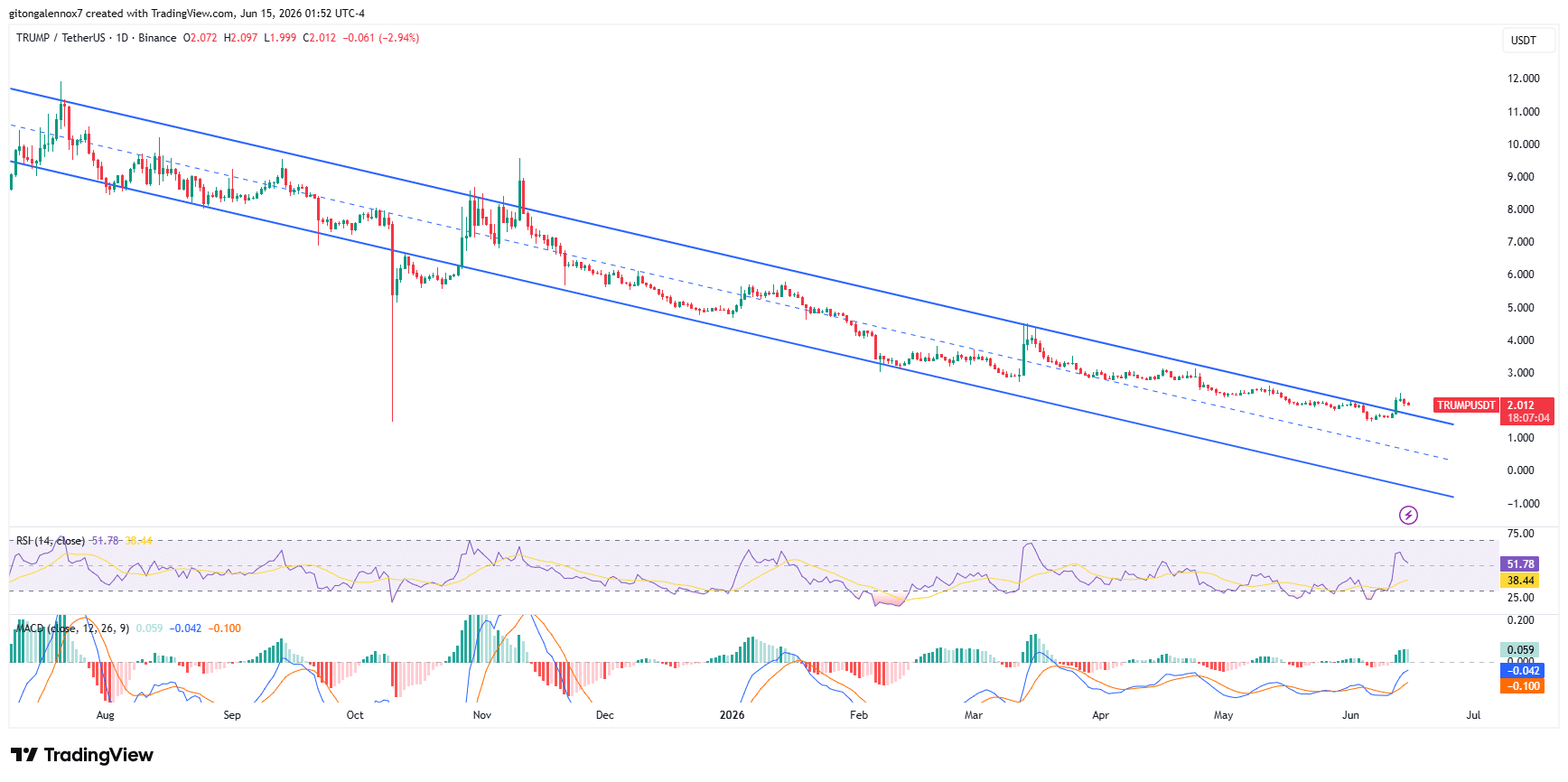
After breaking out of a descending channel, TRUMP rallied to $2.40 before entering a correction phase.
Before the breakout, the price consolidated near the channel’s upper boundary. That suggested sellers were gradually losing control.
The pullback remained in play at press time. If TRUMP held above $2, it could consolidate before attempting another move higher.
However, a break below that level could send the token toward $1.80, where the breakout originally occurred.
The Relative Strength Index (RSI) also retested the neutral zone after moving above it. At 51, the indicator reflected mild retracement rather than strong selling pressure.
Source: TRUMP/USDT on TradingView
Even during the pullback, buyers remained active. However, momentum appeared limited.
The MACD histogram stayed green, although the bars had begun fading. Meanwhile, the signal line continued pointing upward, hinting at possible continuation.
If support held, TRUMP could target the $2.60-$3 range, followed by the $3.50-$4 zone. Otherwise, the price could slide back into its previous channel.
Why is TRUMP correcting?
The ongoing pullback was not driven by technical factors alone.
Profit-taking after last week’s 25% rally likely added pressure. Broader risk-off sentiment across the crypto market may also have weighed on demand.
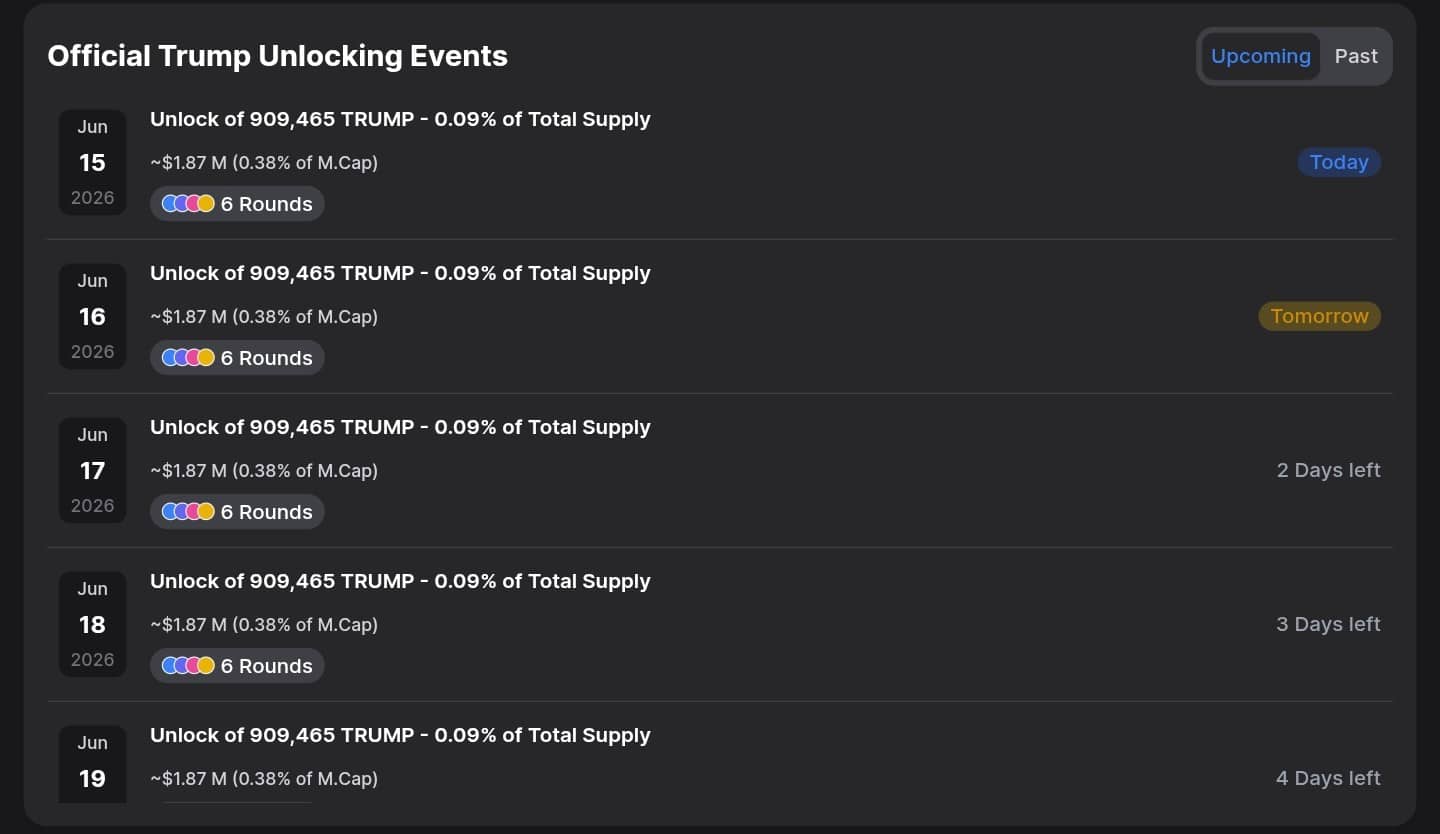
On top of that, traders faced an upcoming token unlock.
Around 6.3 million TRUMP tokens worth $13.8 million are scheduled for release next week. That represents roughly 0.63% of the circulating supply.
Daily releases of about $1.87 million, or 0.09% of supply, are also expected. Such events often increase short-term selling pressure.
Source: CoinMarketCap
Are whales buying the dip?
Having said that, some large holders appeared to be accumulating during the pullback.
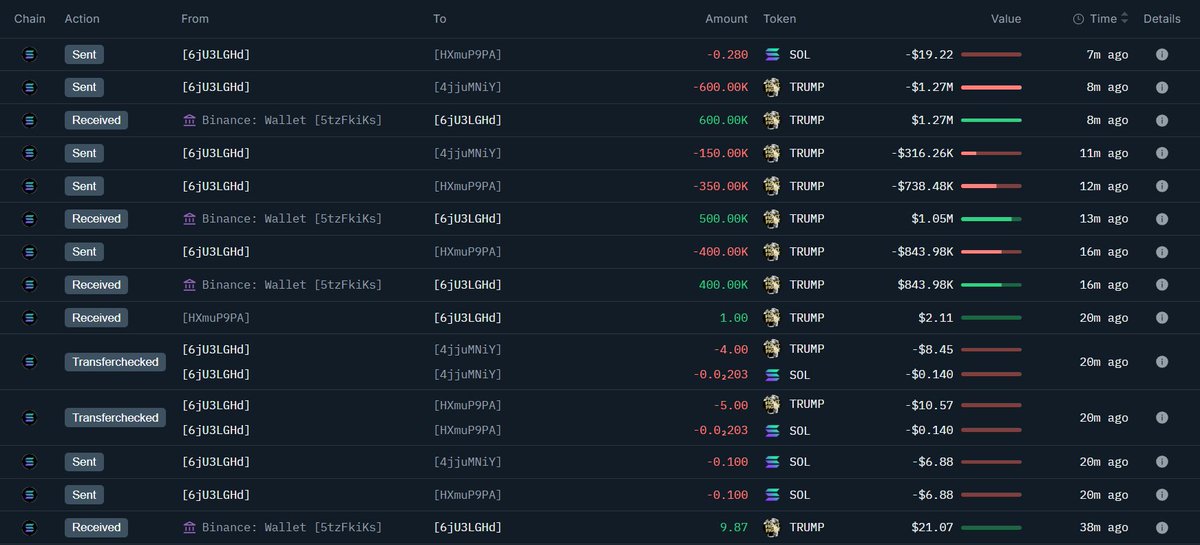
According to Onchain Lens, a whale withdrew 1.5 million TRUMP tokens worth $3.16 million from Binance. The largest single transfer involved 600,000 TRUMP tokens valued at roughly $1.27 million.
The tokens were moved to newly created wallets outside exchanges. Such transfers are often associated with accumulation rather than immediate selling.
Source: Onchain Lens
That accumulation could provide support if buying demand continues. Even so, bulls would still need to defend key levels to prevent a deeper correction.
Final Summary
TRUMP memecoin declined 2.6% over the past 24 hours as it moved deeper into a post-breakout correction.
Profit-taking and upcoming token unlocks added selling pressure. However, whale accumulation suggested some investors were positioning for a potential rebound.