Home Blog Page 41

‘Crypto spring’ is here, says one analyst after bitcoin’s key signals turn bullish

0
‘Crypto spring’ is here, says one analyst after bitcoin's key signals turn bullish

Standard Chartered’s head of digital assets research Geoffrey Kendrick says bitcoin may have already put in its low for the current market cycle, arguing that a combination of improving investor flows, corporate buying and easing macroeconomic pressures points to a stronger recovery ahead.

The latest call marks a shift in sentiment after several months in which crypto markets struggled with rising geopolitical tensions, concerns about inflation and persistent outflows from U.S. spot bitcoin exchange-traded funds (ETFs.)

Last Friday, Kendrick told clients he believed bitcoin’s decline to roughly $59,000 represented the cycle low. At the time, however, he outlined three developments he wanted to see before gaining more confidence in that view: renewed bitcoin purchases by Strategy (MSTR), a return to positive ETF inflows and continued weakness in oil prices.

By Monday, all three had materialized.

Strategy, the largest corporate holder of bitcoin, disclosed that it purchased another 1,587 BTC last week. U.S. spot bitcoin ETFs posted net inflows of $86 million on Friday after a stretch of notable redemptions. Oil prices also continued to move lower, reducing concerns that higher energy costs could push inflation and bond yields upward.


Source link

Forward Industries pushes Solana treasury consolidation as sector nears $1.4b

0
Forward Industries pushes Solana treasury consolidation as sector nears $1.4b


Forward Industries [NASDAQ: FWDI] is pushing to consolidate the rapidly growing Solana treasury-company sector after publicly revealing that Solana Company [NASDAQ: HSDT] rejected its acquisition proposal without discussion.

In a June 15 statement, Forward said it made a non-binding all-stock merger proposal to HSDT but received a response on June 12 indicating that HSDT’s board had voted to decline the offer and avoid further engagement.

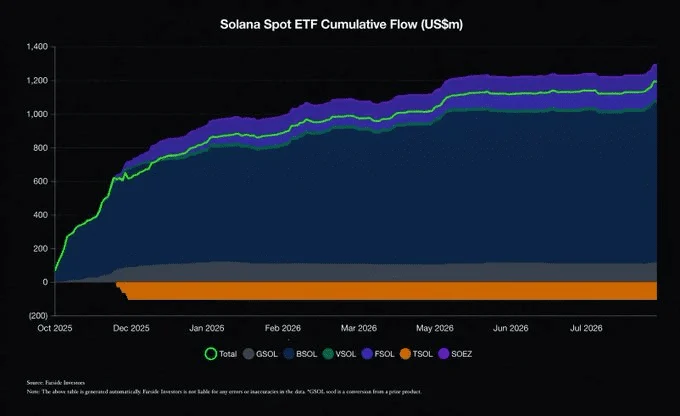
The proposal arrives as publicly traded Solana treasury firms continue expanding rapidly. According to CoinGecko data, 20 public companies now collectively hold more than 18.4 million SOL worth roughly $1.39 billion

Forward currently controls the sector’s largest treasury with more than 7 million SOL holdings.

Forward pitches itself as dominant Solana treasury platform

Forward said it approached HSDT because the current market environment requires “cooperation and strategic action” to maximize shareholder value and accelerate Solana ecosystem growth.

Under the proposal, HSDT shareholders would receive 0.386 newly issued Forward shares for each HSDT share. This represents a roughly 10% premium to HSDT’s closing stock price before the offer was submitted.

Forward framed the merger as part of a broader strategy to become what it called the “Berkshire Hathaway of Solana.”

The company said it has already expanded beyond passive treasury accumulation by staking most of its SOL through validator infrastructure. Also, it has launched the fwdSOL liquid staking token and deployed capital directly into Solana-based protocols.

“We believe that combining our efforts with HSDT’s would be mutually beneficial for both companies, their stockholders, and the broader Solana community,” said Forward Chief Investment Officer Ryan Navi.

Solana treasury sector becomes increasingly crowded

The proposal also highlights growing competition among public companies positioning themselves as institutional Solana exposure vehicles.

CoinGecko’s treasury tracker shows Forward holding roughly 7 million SOL, while HSDT holds approximately 2.06 million SOL.

Several other firms, including DeFi Development Corp., Upexi, and Sharps Technology, have also accumulated large Solana positions as treasury strategies tied to crypto ecosystems continue spreading beyond Bitcoin.

The data further suggests the market is beginning to differentiate between treasury-company structures.

Forward currently trades at roughly 0.69x mNAV, while some competing treasury firms trade at premiums above net asset value.

That divergence may increase pressure for consolidation as companies compete for liquidity, institutional relevance, and shareholder attention.

Treasury firms evolve beyond passive crypto exposure

The merger proposal reflects a broader shift occurring across crypto treasury companies.

Rather than functioning solely as passive asset holders, many treasury firms are increasingly positioning themselves as ecosystem capital allocators tied to validator infrastructure, staking systems, protocol investments, and blockchain-native financial services.

The trend has become particularly visible across Solana-focused firms, where companies are competing to establish themselves as the dominant institutional gateway for public-market SOL exposure.

Forward also noted that its shares are expected to join the Russell 2000 and Russell 3000 indices in the coming weeks, potentially strengthening its institutional-market positioning.


Final Summary

  • Forward Industries publicly announced that HSDT rejected its merger proposal amid intensifying competition among Solana treasury firms.
  • The Solana treasury-company sector now holds more than $1.39 billion worth of SOL across 20 public companies.


Source link

Nvidia joins Wall Street’s AI funding wave

0
Nvidia joins Wall Street's AI funding wave


Nvidia (NVDA) is looking to raise at least $20 billion in the bond market, turning the AI chip giant into the latest company to tap Wall Street for the boom it helped create.

The company is marketing bonds in seven parts, with maturities running from two years to 30 years, according to Bloomberg. It would be Nvidia’s first corporate bond sale since 2021.

This is not a distress signal. Nvidia is a cash machine. But the deal shows how large the AI build-out has become. Even the biggest winners are using capital markets — the markets for raising money through stocks and bonds — to preserve flexibility.

Selected 2026 debt and equity raises tied to the AI build-out. · Bloomberg, company filings, Reuters, Yahoo Finance analysis

Nvidia’s planned bond sale comes shortly after Alphabet’s (GOOG, GOOGL) planned $80 billion stock sale, which showed the same pressure from the equity side. That deal would be the largest equity raise in history — bigger than SpaceX’s $75 billion IPO.

The way these companies are raising money differs. Alphabet is using stock. Amazon (AMZN), Meta (META), and Nvidia are using bonds. Oracle (ORCL) and Supermicro (SMCI) have turned to a combination of both stocks and bonds.

The message is the same: The AI trade is becoming a funding story.

Part of the issue is capital expenditures — the money companies spend on long-term assets such as data centers, chips, servers, and power infrastructure. Yahoo Finance recently found that AI infrastructure is taking up a rising share of hyperscalers’ operating cash flow, with Amazon now spending nearly all of the cash it generates from operations on capital expenditures.

For Nvidia, the official use of proceeds is general corporate purposes, including repayment and refinancing of notes. So Nvidia is not borrowing directly for AI capital expenditures — but it now belongs to the wider AI financing wave.

The AI trade is no longer just about who has the best chip or model. It is also about who can keep paying for the machines behind it.

FILE PHOTO: The NVIDIA logo in this illustration taken June 11, 2026. REUTERS/Dado Ruvic/Illustration/File Photo
Nvidia is looking to raise at least $20 billion in the bond market. It would be the chipmaker’s first corporate bond sale since 2021. (Reuters/Dado Ruvic/Illustration/File Photo) · REUTERS / REUTERS

Jared Blikre is the global markets and data editor for Yahoo Finance. Follow him on X at @SPYJared or email him at jaredblikre@yahooinc.com.

Click here for in-depth analysis of the latest stock market news and events moving stock prices

Read the latest financial and business news from Yahoo Finance


Source link

World Cup Team Blames FIFA After Travel Chaos and Plane Mixup

0
World Cup Team Blames FIFA After Travel Chaos and Plane Mixup


One of the World Cup‘s most notable teams blamed FIFA after their travel to their first game was delayed.

Uruguay, which has won the tournament twice, was left waiting for the right permissions before its players and staff could fly to the US on Sunday.

The squad was training in Cancún, Mexico, ahead of its first game, set for Monday evening in Miami against Saudi Arabia.

However, the airplane scheduled to take them to Florida wasn’t authorized to enter the US because of paperwork issues, according to reports in the Uruguayan media.

“Due to problems beyond the control of the AUF, the departure from Mexico has been delayed,” the Uruguayan Football Association, or AUF, said in a statement to several outlets.

An AUF spokesperson also told The Athletic that the delay was FIFA’s fault.

FIFA said in a statement that the flight was delayed “due to an airline permitting error in Mexico.”

“The airline has apologized for the inconvenience caused,” it added. “FIFA remained in close contact with the Uruguay national team throughout their delay and worked alongside airport and operational partners to help expedite the process and minimize disruption to the team’s travel arrangements.”

The AUF did not immediately respond to a request for comment sent by Business Insider outside US working hours.

After the Uruguay team arrived in Florida on a different plane, the team’s coach downplayed the issue. At a press conference on Sunday night, Marcelo Bielsa told journalists: “No, the flight didn’t cause us any complications.”

The team’s captain, José María Giménez, added: “We had a little mishap, but nothing serious.”

“We took advantage of the situation and saw it as a good opportunity to rest at the hotel,” he said.

While the World Cup kicked off last Thursday, several travel issues have already been reported.

Omar Artan, a Somalian referee, was turned away after being interrogated at Miami Airport. Iran moved their base from Arizona to Tijuana, Mexico, as several members of its delegation were denied US visas. Ghanaian midfielder Thomas Partey will miss the team’s first game after being denied a visa by Canada. He has been charged with seven counts of rape in England and is awaiting trial.

Many fans have also said that their visas were withdrawn shortly before the tournament started.

With 48 teams playing 105 games in 14 host cities across North America over the next five weeks, there could be more travel difficulties to come.


Source link

If America wants to lead in crypto, it must protect the people who build it

0
If America wants to lead in crypto, it must protect the people who build it

The rest of the Clarity Act depends on that guarantee, because there is no digital asset market to regulate if the people who build it cannot afford to build it in the U.S. The provision survived the committee markup intact, despite a filed amendment that would have gutted it, and it must stay in through the final vote, fully and without dilution.

Here is why this matters to people who will never read a word of the statute. The engineers who write this software, from core Solana contributors to the designers of new DeFi protocols, publish code that anyone in the world can download and use. They hold no money. They cannot freeze an account or move funds, because they never touch them. Treating a software developer like a bank teller makes about as much sense as calling an email app’s engineer a mail carrier. Treasury’s 2019 FinCEN guidance already recognized that merely providing software or network tools used by money transmitters does not, by itself, make someone a money transmitter. The BRCA aligns the criminal code with that standard.

When laws are murky, regulators and prosecutors fill the gap. Treasury has pursued builders who wrote and released software but never held a customer’s assets. The conviction of Tornado Cash developer Roman Storm for conspiring to operate an unlicensed money transmitting business is the case people know, and it fits a pattern that should worry anyone who cares about American innovation. Cases like it are already pushing developers overseas.


Source link

SpaceX stock jumps for 2nd day, now up over 25% since debut

0
SpaceX stock jumps for 2nd day, now up over 25% since debut


SpaceX (SPCX) stock jumped nearly 8% in early trade, giving the shares a two-day pop of over 25% since the rocket company’s market debut on Friday. SpaceX had offered 555.6 million shares to investors, raising a record $75 billion.

The appetite for SpaceX shares seems unabated, with some commentators now likening it to a momentum stock, though one that could be volatile. 

“SpaceX going public is an important watershed moment for the broader tech sector in our view as this AI Revolution and data takes this next step forward,” Wedbush analyst Dan Ives wrote on Monday, predicting it will lead to more capital deployed at the companies and boost upcoming IPOs for Anthropic and OpenAI.

SpaceX’s growth after only 2 days is remarkable.

“Elon Musk’s SPCX is already $700 billion larger than Tesla (TSLA), and it’s more than twice the size of Berkshire Hathaway (BRK-B),” Bespoke Investment said in a note.

A big part of SpaceX’s return has been the enthusiasm from retail investors, and they may have been selling other stocks to raise for SpaceX buys.

Retail selling across single stocks just hit the heaviest level since November 2023, according to research from Vanda Research, with pressure concentrated in semiconductor names including Micron (MU) and Sandisk (SNDK), Yahoo Finance’s Jared Blikre noted. At the same time, retail buying of space stocks has climbed further, reaching its highest level since December 2024, according to Vanda.

Of course, institutional buying on SpaceX’s market debut was a big part of its move, in addition to purchases by large investors and family offices. 

A live feed shows SpaceX CEO Elon Musk on the day of SpaceX’s initial public offering (IPO) at the Nasdaq MarketSite, in New York City, U.S., June 12, 2026. REUTERS/Jeenah Moon · Reuters / REUTERS

Ron Baron, a longtime Elon Musk supporter, said he purchased an additional $1 billion in SpaceX stock during during the IPO process, increasing his firm’s position to $25 billion.

The Wall Street Journal reported on Monday that mining tycoon Gina Rinehart, Australia’s richest person, bought a more-than $1 billion stake in SpaceX. The Journal notes its the single largest outside investment made by her closely-held company, Hancock Prospecting, a giant in the steel sector. 

Pras Subramanian is Lead Transportation Reporter for Yahoo Finance. You can follow him on X and on Instagram.

Click here for the latest technology news that will impact the stock market

Read the latest financial and business news from Yahoo Finance


Source link

SIREN crashes 55% as pump-and-dump claims erupt – Is recovery possible?

0
SIREN crashes 55% as pump-and-dump claims erupt – Is recovery possible?


siren [SIREN] plunged more than 55% over the past 24 hours, with its market cap collapsing to $40.78 million.

At its peak, the memecoin was valued at $2.77 billion. Daily trading volume reached roughly $194 million, nearly five times its market cap.

Despite the crash, SIREN still had around 62,050 holders at press time. This left traders questioning whether the token was facing a temporary collapse or something more serious.

Uncovering SIREN’s textbook pump-and-dump scheme

Allegations that SIREN followed a pump-and-dump pattern gained traction after fresh on-chain findings emerged.

According to the data, a wallet linked to the token’s price action sold more than 95% of the total supply. The wallet offloaded roughly 670 million SIREN across Bybit, Bitget, Binance, KuCoin, and Gate.

That selling coincided with a drop from about $1.30 to $0.05, wiping out more than 90% of the token’s value. The wallet subsequently received over $64 million in USDT and transferred roughly $26 million to other addresses.

Such activity may indicate an effort to disperse funds across multiple wallets, making tracking more difficult.

SIREN
Source: Lookonchain

Even so, about $39 million remained on-chain. This left traders focused on whether the funds could be used in another market-moving event.

On top of that, whale participation also weakened.

The Whale vs. Retail Delta fell from 0.23 to 0.076, signaling a sharp decline in large-holder positioning.

SIRENSIREN
Source: CoinGlass

Is SIREN price action dead?

The sell-off pushed SIREN from $1.30 to $0.05, erasing roughly 97% of its market value.

Before the collapse, the token had rallied from $0.44 to $1.30, a move that now resembles a possible exit pump. Having said that, liquidity had not completely disappeared.

The liquidity-to-market-cap ratio stood at 7.96%, suggesting trading activity remained present despite the decline. The Bollinger Bands continued widening, highlighting elevated volatility across the market.

Moreover, the Accumulation/Distribution indicator dropped to negative 7.13 billion.

That reading suggested distribution dominated trading activity and aligned with the large-scale selling observed on-chain.

SIRENSIREN
Source: SIREN/USDT on TradingView

At press time, SIREN traded near its all-time low of $0.05. Notably, that same region previously preceded rallies toward $2.77 and $1.97.

If buying interest returns and the selling pressure subsides, a rebound could emerge from current levels.

However, if further manipulation or liquidity withdrawals occur, the token could remain under pressure and lose trading relevance altogether.


Source link