Home Blog Page 400

I Live in Houston and Earn $285,000 Each Year. Here’s How I Budget.

0
I Live in Houston and Earn $285,000 Each Year. Here's How I Budget.


This as-told-to essay is based on conversations with Morgan S., a 37-year-old strategy senior manager in Houston. It has been edited for length and clarity.

I’m from Houston, and I love it. My monthly take-home pay from my corporate job is just under $10,000 after taxes. I feel very financially secure here and ahead of my age.

One thing that outsiders may not know is that Houston’s property tax is among the highest in the country because we have no state income tax. A lot of people hate on Houston, but the city has so much to offer.

To afford the cost of living in Houston, I work to increase my income and live below my means. Regardless of how much money I bring in, I practice responsible spending.

I have multiple streams of income

I’ve worked in the energy industry for 15 years and currently work at a company with lucrative compensation benefits (e.g., a defined contribution plan and RSUs). I’m on a hybrid schedule, working in the office two to three days a week.

My commute is about 25 minutes each way. My healthcare comes with my job for $92 a month, and it’s pretty easy to set appointments.

For investments, I have a rental property that pays me $2,900 a month and a private equity investment that pays me $1,250 a month. I’ve also started to earn some side income from social media.

I started social media because there’s more to life than corporate work, and there’s so much to be made on these platforms. I currently have an agent pitching me for deals, and I believe in the value of building a monetizable personal brand.

I plan to sell the $465,000 3-bedroom townhouse I purchased in 2025

I live in the Rice Military neighborhood, which is five miles from downtown. It’s extremely walkable, there are multiple green spaces, and my family lives nearby.

My house payment is $3,186 a month, plus about $300 in utilities, and there’s no HOA. It’s my second home, and I turned my first into a rental.

Buying real estate is a huge commitment, and this one turned into a nightmare with tens of thousands of dollars in repairs. If I had just taken all the money I spent on this house and invested it in the market, I could’ve been much closer to my coast FIRE goal of $1.3 million. I’ll probably sell this house, invest the proceeds, and move back into my more modest rental later this year.

Here’s how I budget to live below my means

My net worth is $1.1 million in savings and investments. To get around, I drive a 2019 Mazda CX5 that I bought used. She gets me from point A to point B, and I plan to drive her until I can no longer do so. I have zero interest in upgrading.

I budget about $400 per month for groceries and rarely go out or order delivery. I don’t drink coffee every day, though on Saturday, I might walk to treat myself to a coffee.

My partner and I are currently debating whether we want to spend $50,000 for a wedding or save that for the future.

To save money, I believe in living below my means: a simple wardrobe made of natural fibers that lasts longer than a single wear, buying secondhand vintage, accepting hand-me-down furniture, and eating most meals at home. I also go without expensive hair and eyelash extensions.

I prefer the city over the suburbs

I’ve never lived in the suburbs, and don’t think I’d want to.

One trade-off to living in the city is the outdoors: my partner loves hiking and other outdoor activities, and we can’t really do that here. Also, the suburbs offer a better dollar-per-square-foot, but I like being able to walk everywhere, so I think that’s a better trade-off.

It’s possible that if I have kids, we might move to the suburbs for better schools. I’m still deciding on whether it’s worth it to have kids, which I think a lot of millennials are contemplating.

Living in Houston is worth it to me

In Houston, we have lots of high-paying jobs, access to great amenities, and sports teams. We’re even hosting the World Cup this summer. There’s a huge Vietnamese community with delicious food; it may be one of the most diverse cities in the country.

I’ve spent a good amount on dining out this past year and my gym membership. Another splurge is golf.

Still, I plan to invest over $100,000 this year and save or invest 53% of my gross income. It’s definitely worth it to me to live in Houston, and I have no plans on moving.

Do you want to share your cost of living with Business Insider? Email editor Tess Martinelli at tmartinelli@businessinsider.com.
Source link

BTC, ETH prices drop even as futures show growing taste for risk. XLM, HYPE gain: Crypto Markets Today

0
BTC, ETH prices drop even as futures show growing taste for risk. XLM, HYPE gain: Crypto Markets Today

June kicked off in the red for crypto markets as the U.S. and Iran exchanged fire and peace talks failed to translate into reduced tensions in the region. The CoinDesk 20 Index (CD20) fell 2% since midnight UTC, with bitcoin and ether (ETH) both losing about 1%.

At $72,700, bitcoin is currently negative for a sixth time in seven days, following a 3.5% slide last month, usually a period with positive returns. It averages a 7.4% rise in May, according to Coinglass data. A record 10 days of net withdrawals from spot bitcoin exchange-traded funds (ETFs) saw $2.97 billion leave the investment vehicles.

The CoinDesk DeFi Select Index led the day’s decliners, dropping 2.6% since midnight, with all six members lower. Ondo Finance’s ONDO token fell 2.8%, and has now lost 17% since founder Nathan Allman died unexpectedly last week.

Hyperliquid’s HYPE stood out, adding 1.26% since midnight. A five-day streak of gains took it to a record high $73.94, its fourth in four days, as capital enters newly introduced ETFs based on the token, which started trading only last month.

U.S. stock indexes replayed Friday’s divergence, with S&P 500 and Nasdaq 100 micro-futures both adding about 0.2%.

Derivatives positioning

  • BTC open interest sits at $19.5 billion, essentially level from a week ago, with speculative positioning also broadly unchanged.
  • Funding rates are positive across multiple venues at 0%–10% annualized, with the prior Deribit spike now back to normal. The three-month annualized basis is 2.8%, up from 2.2% last week, pointing to a mild improvement in institutional risk appetite.
  • Options positioning leans modestly bullish. Put/call volume over the past 24 hours splits 61/39 in favor of calls, while one-week 25-delta skew sits at 12.3% compared with 12.4% last week. Front-end implied volatility (DVOL) has ticked up to 37 from multi-month lows, suggesting the recent compression may be easing. The 1 month–6 month term structure remains in contango, with markets continuing to price near-term calm alongside longer-dated uncertainty.
  • Coinglass data shows $282 million in 24 hour liquidations, with a 60-40 split between longs and shorts. ETH (59 million) and BTC ($48 million) were the leaders in terms of notional liquidations.
  • The Binance liquidation heatmap indicates $72,280 as a core liquidation level to monitor in case of a price drop.

Token talk

  • Stellar’s XLM jumped 40.4% in 24 hours to $0.2862, lifting market cap above $9.6 billion, on the back of a May 27 announcement that DTCC, Wall Street’s central clearinghouse, will connect its tokenized securities platform to the Stellar network in the first half of 2027.
  • The deal makes Stellar the first public blockchain in DTCC’s multichain tokenization strategy.
  • Open interest (OI) in XLM perps rose 10.9% to about $361 million as the rally unfolded, CoinGlass data show, with roughly $12 million in derivatives liquidations across the move. The combination of expanding OI alongside rising spot volume points to fresh long positioning rather than short covering doing the heavy lifting, even with the short squeeze underneath.
  • Spot turnover hit about $2.3 billion on the day, up about 34%, showing the move was backed by real demand rather than a thin-liquidity spike. XLM outperformed every other top-20 token over the period.
  • The breakout cleared a monthslong descending channel that had constrained the token since late last year, with the rally running from long-term support near $0.14 through prior resistance at $0.20 and $0.26.
  • DTCC oversees more than $114 trillion in assets and processes about $2.5 quadrillion in securities transactions annually, putting Stellar’s selection at the center of how Wall Street brings tokenized stocks, ETFs and U.S. Treasuries onto a public blockchain.
  • The partnership sits on the SEC’s December 2025 No-Action Letter authorizing the firm to tokenize real-world assets it custodies, with production testing targeted for July, wider rollout in October, and broader availability in the first half of next year.


Source link

Sapiens secures ADIA investment and shifts base to London

0
Sapiens secures ADIA investment and shifts base to London


Sapiens International has secured backing from a wholly owned subsidiary of the Abu Dhabi Investment Authority (ADIA) and moved its headquarters to London.

This makes the investor a “significant minority shareholder”, according to a statement from the insurtech company. However, financial terms remain undisclosed.

The business, once listed in Tel Aviv and on New York’s Nasdaq, was taken private last year by US private equity group Advent in a $2.5bn (NIS7.03bn) deal.

Its new base is at Space House in Holborn.

The office will function as both the group’s global headquarters and an AI Customer Experience Lab.

Insurers will be able to work with Sapiens teams there to review and trial AI uses designed for the sector.

Sapiens supplies core operating systems to more than 600 insurers worldwide.

The company said its agentic platforms are used to reduce manual processes linked to those systems, covering policy underwriting, claims handling, pricing and risk management, and billing.

Its product range includes Agentic Claims, Agentic Underwriting and Agentic Policy. These sit on the Central Agentic Framework, which the company said links insurers’ core systems with their AI plans through a single, governed insurance ontology.

Sapiens said the London site is also expected to support recruitment of AI specialists as it expands its forward deployment group, which works with clients on the rollout and scaling of agentic systems.

The company also said it plans to open a second AI Customer Experience Lab in the US later this year, aimed at the North American insurance market.

Sapiens interim CEO and executive chairman Mike Ettling said: “AI-powered hyper-relevance is the new competitive advantage for insurers, and we are enabling this through agile intelligence and the ability to make decisions at the speed of thought. This will revolutionise how insurers compete, how they go to market, and ultimately, how they serve the people who buy their products.

“Our new offices are designed to deepen our collaboration with leading global insurance institutions at a time of enormous technological change for the industry.”

“Sapiens secures ADIA investment and shifts base to London” was originally created and published by Life Insurance International, a GlobalData owned brand.


The information on this site has been included in good faith for general informational purposes only. It is not intended to amount to advice on which you should rely, and we give no representation, warranty or guarantee, whether express or implied as to its accuracy or completeness. You must obtain professional or specialist advice before taking, or refraining from, any action on the basis of the content on our site.


Source link

MYX Finance breaks above KEY support – Is a move to $0.30 coming?

0
MYX Finance breaks above KEY support - Is a move to $0.30 coming?


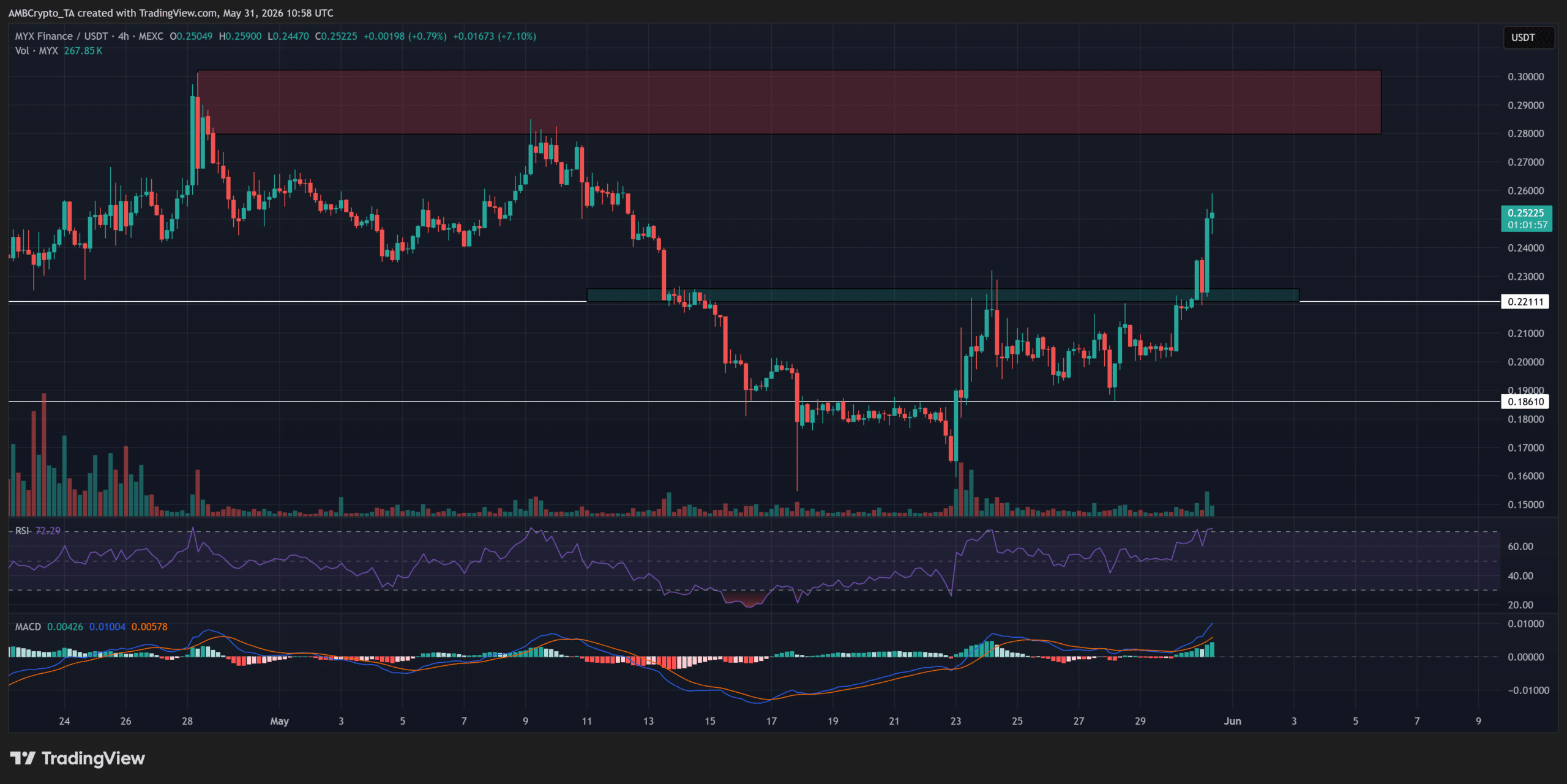
The capitulation low on the 23rd of May continues to  shape MYX Finance’s [MYX] recovery structure.

Earlier, the price collapsed from nearly $0.28 to a panic-driven low around $0.165, triggering a high-volume liquidity sweep that flushed weaker sellers from the market. However, selling pressure faded quickly afterward, allowing buyers to regain control.

That shift gradually transformed the trend. MYX reclaimed the $0.20 and $0.21 resistance levels before breaking decisively above the $0.215-$0.230 demand zone.

At press time, the price traded near $0.252, up 6.85% on the session, while pushing into open space beneath the major $0.28-$0.30 supply region.

Source: MYX/USDT on TradingView

Momentum also supports the advance. RSI has climbed to 72.3, reflecting strong buying pressure, while the MACD continued to accelerate higher with a bullish crossover. This behavior suggests accumulation has replaced the previous markdown phase as buyers steadily absorb available supply.

The broader implication remains constructive. Former resistance levels are now attracting demand on pullbacks, reinforcing the structural transition. Even so, the overhead supply zone remains the next major test.

A healthy retest of the $0.23 region could strengthen support further, while sustained buying pressure may eventually challenge the $0.28-$0.30 resistance band.

Can MYX break through $0.275-$0.295?

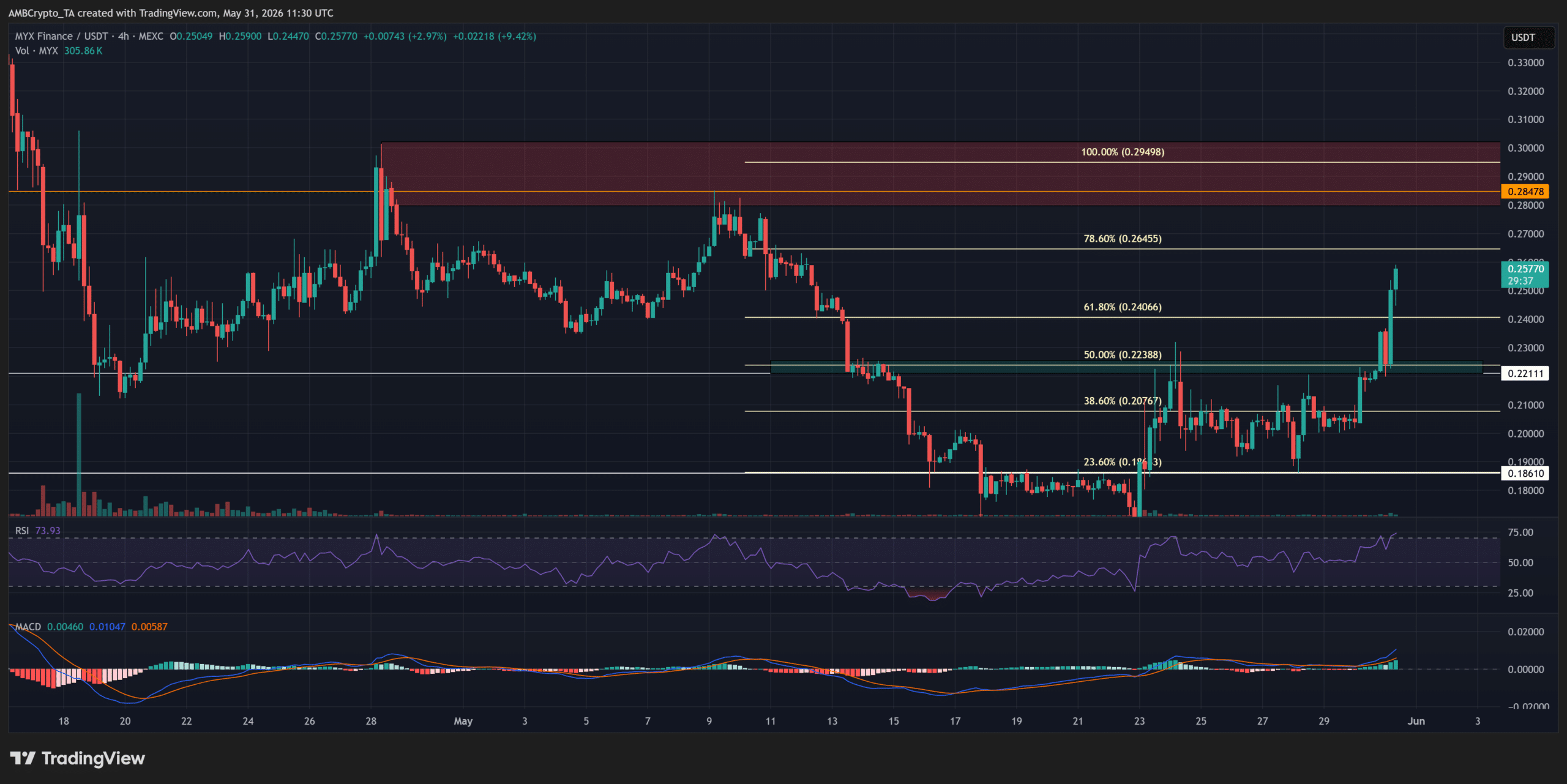
The recovery that began from MYX’s $0.159 capitulation low is now approaching a critical structural test. Following that liquidity sweep, buyers successfully defended the 23.6% ($0.188), 38.6% ($0.207), and 50% ($0.224) Fibonacci levels, establishing a foundation for sustained recovery.

That support gradually strengthened momentum. MYX has now reclaimed the 61.8% retracement at $0.241 and surged toward the 78.6% level at $0.265, trading near $0.257 after a 9.2% daily gain.

Notably, the 50% retracement aligned closely with the $0.222 demand zone, reinforcing buyer conviction during consolidation.

Source: MYX/USDT on TradingView

Momentum indicators continue to favor bulls. RSI has climbed to 73.9 without bearish divergence, while the MACD histogram keeps expanding higher. This suggests buyers remain firmly in control as supply absorption improves.

The broader implication is increasingly constructive. A successful break above the 78.6% retracement would place MYX directly beneath the major $0.275-$0.295 distribution zone.

That region capped rallies throughout April and May, making it the final obstacle before a complete structural recovery toward the previous $0.285 swing high.


Final Summary


Source link

Citi predicts the tokenized securities market will grow to $5.5 trillion by 2030

0
Citi predicts the tokenized securities market will grow to $5.5 trillion by 2030

Putting real-world investments onchain, a process called tokenization, is moving out of the testing phase and into everyday business.

Citi’s new report Tokenization 2030: Wall Street On-Chain shared with CoinDesk ahead of Proof of Talk in Paris, shows that the global market for thse digital investments sits at just $17 billion today.

However, Citi expects this market to increase to $5.5 trillion by 2030 in its base forecast. Depending on how fast adoption take place, that could land anywhere from a low end estimate of $2.7 trillion to a bullish forecast of $8.2 trillion, Citi said.

As the report points out, this is a major turning point: “You’re seeing the full weight of American financial power and the global reserve currency moving on change at scale,” Citi says in the report. “When DTCC and the NYSE embed tokenization into capital markets, this marks a tipping point.”

According to Citi, three big shifts are driving this trillions of dollars move.

First, the traditional companies that run the world’s stock markets are building this technology directly into their regular trading systems.

In early May, Wall Street giant Depository Trust & Clearing Corporation (DTCC) announced it would start limited production trades of tokenized securities in July, with a broader launch of its platform set for October. Nasdaq is working on a framework for companies to issue blockchain-based shares with a potential launch as early as 2027. Intercontinental Exchange, which owns the New York Stock Exchange, also has plans for tokenized stocks.

Nasdaq also received regulatory approval to allow certain stocks to be issued and traded in this digital onchain form.

Second, the rise of trusted digital cash is providing the missing piece to make thse trades settle instantly. Standard stablecoins are expected to grow to $1.9 trillion market by 2030, working alongside digital bank deposits to allow assets and cash to swap at the exact same moment. The report expects that the growth of stablecoins alone could create about $1 trillion in new demand for U.S. government bonds, because the companies issuing stablecoins back their digital cash with these real bonds.

Third, the government rules are getting clearer, with a key piece of U.S. digital asset legislation moving forward to a full U.S. Senate vote. On May 14, the Senate Banking Committee managed to end a four-month stall with a 15-9 bipartisan approval by the committee, which advanced the Clarity Act to its next step.

The Citi report notes that the growth they forecast will happen in mainstream public markets, such as U.S. stocks and government bonds, rather than private markets, which are harder to trade and change slowly.

Citi assumes that 10% of the U.S. Treasury bill market and 3% of the U.S. public stock market will be tokenized by 2030. If just 10% of everyday U.S. investors switch to these new digital trading platforms, it would create $2.6 trillion in demand for digital stocks.

On the other side, complex areas like private credit and private equity are each expected to reach a much smaller $100 billion globally by 2030.

The shift will not happen overnight, Citi noted, saying that instead, old and new financial systems will have to run side by side for a while.

The report compares this to how highways adopted electronic toll tags like E-ZPass. Toll roads did not become fully automated in one day. Instead, states built wider roads with parallel lanes for both cash and automated drivers, which added extra cost and confusion before everyone eventually switched over to the fully automated system.

Ultimately, this new setup will give a major advantage to “Structural Orchestrators”. These are the specific big banks and investment firms that control both the real assets and the digital cash rails used to pay for them, allowing them to handle the entire trade inside their own network.


Source link

Chevron Moves to Increase Mediterranean Footprint with Greece Offshore Deal

0
Chevron Moves to Increase Mediterranean Footprint with Greece Offshore Deal


With an annual dividend yield of 3.89% as of May 29, Chevron Corporation (NYSE:CVX) is included among the Dividend Aristocrats Ranked By Yield: Top 10 Stocks

Chevron Moves to Increase Mediterranean Footprint with Greece Offshore Deal

On May 28, Reuters reported that Chevron Corporation (NYSE:CVX) had filed a request to acquire a 70% stake in an offshore block southwest of Greece from Helleniq Energy. This move would expand the company’s footprint in the Mediterranean.

According to Greece’s energy ministry, Chevron would take over as the operator of Block 2 in the Ionian Sea if the request is approved. The company would lead gas exploration activities in the area, while Helleniq Energy would keep a 30% stake. The ministry also said Greece is considering giving the two companies additional time to review seismic data collected from the region before deciding whether to proceed with exploratory drilling.

Separately, Chevron announced on May 29 that Scott A. Keller has been appointed general counsel. Keller, 44, will join the company on July 1 and report to Chevron’s current chief legal officer, R. Hewitt Pate. The appointment comes as the company prepares for Pate’s expected retirement in mid-2027 after 17 years of service.

Chevron said Keller is expected to become chief legal officer on January 1, 2027. In that role, he will oversee the company’s legal affairs worldwide and report directly to Chairman and CEO Mike Wirth.

Chevron Corporation (NYSE:CVX) is an integrated energy company with operations spanning the energy sector. It produces crude oil and natural gas, manufactures transportation fuels, lubricants, petrochemicals, and additives, and develops technologies that support its business and the industry as a whole.

While we acknowledge the potential of CVX as an investment, we believe certain AI stocks offer greater upside potential and carry less downside risk. If you’re looking for an extremely undervalued AI stock that also stands to benefit significantly from Trump-era tariffs and the onshoring trend, see our free report on the best short-term AI stock.

READ NEXT: 10 Best Reddit Stocks to Buy According to Billionaires and Billionaire George Soros Stock Portfolio: 10 Best Stocks to Buy

Disclosure: None. Follow Insider Monkey on Google News.


Source link

XRP price news: Ripple-linked token hits 15-week low

0
XRP price news: Ripple-linked token hits 15-week low

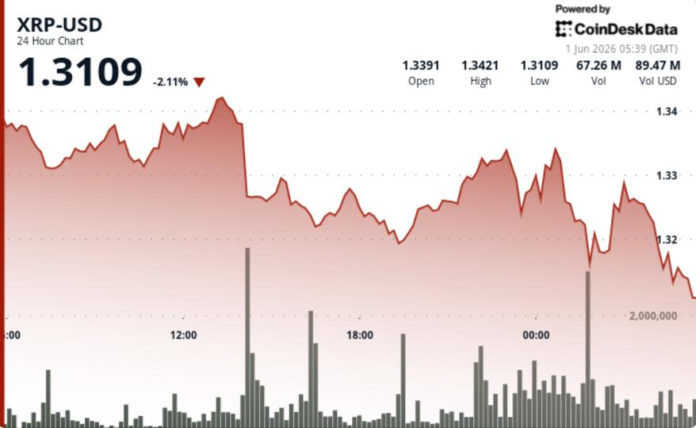
XRP slid to its weakest level in more than three months as heavy selling overpowered signs of exchange outflows, leaving the market stuck between two competing signals. Tokens moving off exchanges usually point to accumulation, but price action is saying sellers still have control whenever XRP tries to recover.

News Background

• More than 25 million XRP left exchanges after a large inflow earlier in the week, suggesting some investors used the drop to move tokens into longer-term storage.

• Spot XRP ETFs recorded fresh inflows, bringing cumulative flows to about $1.42 billion, though that demand has not yet been enough to reverse the downtrend.

• Leverage was heavily flushed during May, with most high-risk long positions already liquidated as XRP bounced from the $1.28 area.

Price Action Summary

• XRP dropped from $1.3384 to $1.3208, hitting a 15-week low during the session.
• The key breakdown came on 55.03 million in volume, which pushed price through support near $1.3320.
• Selling later extended toward $1.314 before a modest bounce brought XRP back toward $1.32.

Technical Analysis

• The key issue is that accumulation signals are not yet showing up in price. Exchange outflows are constructive, but XRP continues to get sold into recovery attempts.
• The breakdown below $1.3320 keeps the short-term structure weak, with $1.34 now acting as the first level buyers need to reclaim.
• A large short-liquidation cluster sits between $1.34 and $1.40, meaning a sharp move higher is possible if XRP can break back into that range.
• Until then, the tape remains defensive, with sellers still controlling the lower highs.

What traders should watch

• $1.31 is the immediate support. Losing it would put $1.28 and then $1.20 back in play.
• $1.34 is the first recovery level. A reclaim could trigger momentum toward $1.37 and $1.40.
• The setup is unstable because exchange outflows point one way while price action points the other. One side will have to give.


Source link