Stellar’s native token XLM rallied by 44% this week after the chain was selected by the Depository Trust and Clearing Corporation (DTCC) for its tokenization plans.
The DTCC is the clearing and trade settlement house for global financial markets. The firm’s custodied assets will be tokenized and made available on Stellar from early 2027.
Commenting on the update, Denelle Dixon, CEO and Executive Director of the Stellar Development Foundation, said the chain is meant for this. He added,
Stellar’s proven compliance-minded architecture, open infrastructure, and risk management capabilities are aligned with market demands and expectations.
What’s next for XLM?
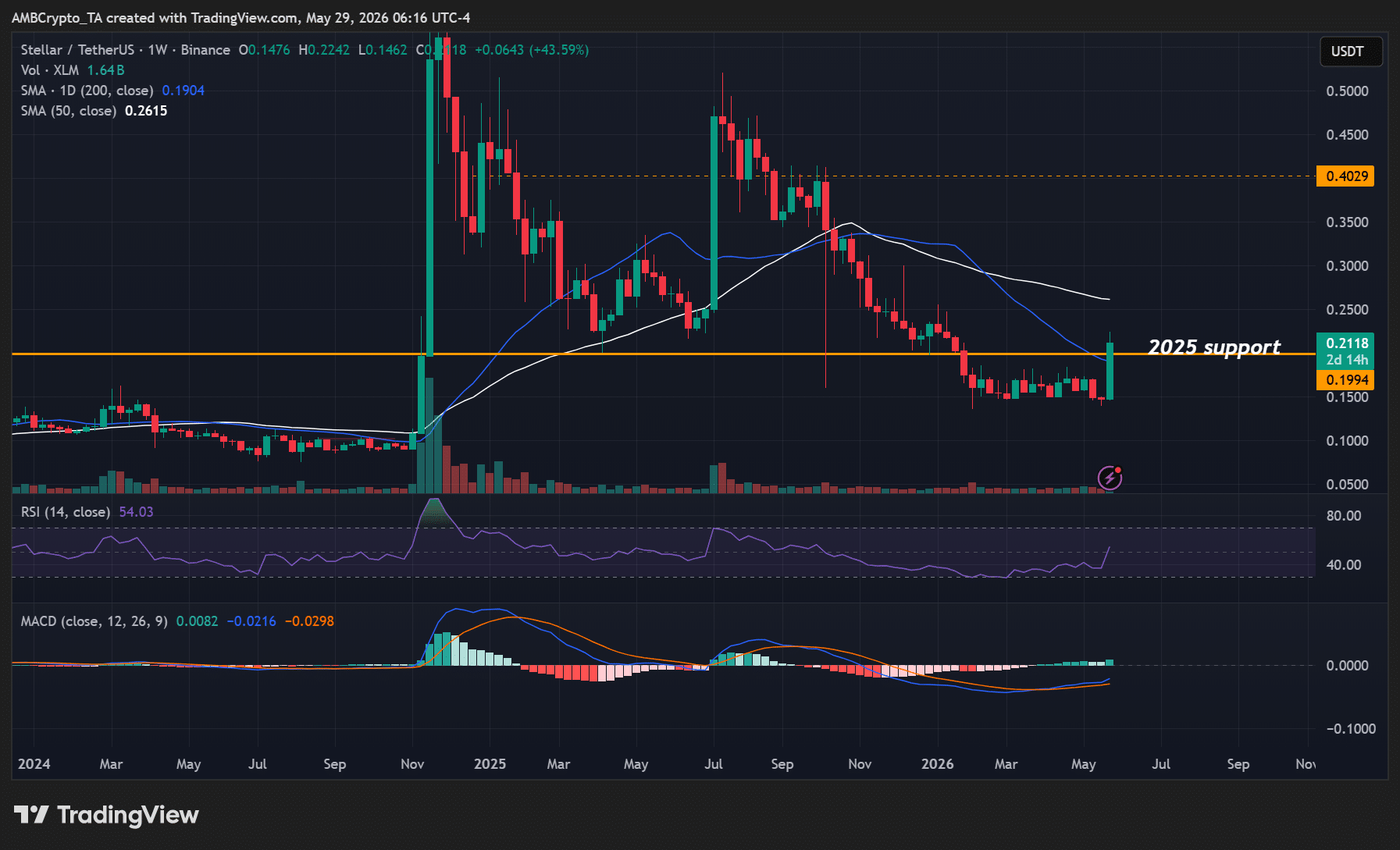
Following the update on Wednesday, XLM pumped by 11%. It has since extended the rally from $0.15 to over $0.20, bringing weekly gains to 44% at the time of writing.
Source: XLM/USDT, TradingView
On the daily chart, the rally had climbed above the 200-day SMA (Simple Moving Average), suggesting that the market structure had effectively been flipped to bullish.
However, this can only be confirmed if the weekly candle also closes above the key level, alongside the 2025 support at $0.21. If these levels are decisively flipped into support, then bulls could eye $0.26 or about 31% potential upside from the 2025 support level.
The bullish outlook would be invalidated if the price falters at the 2025 support level and weekly candlestick closes below the 200-day SMA (blue). Such a scenario would imply a profit-taking activity that could erase recent gains.
Possible XLM consolidation around $0.20
Based on the liquidations heatmap, there may be more liquidity pools below the current price action than above it. The immediate pools seemed to be at $0.19, which aligned with the 200-day SMA.
Another pocket of liquidity was at $0.15, the level that triggered this week’s rally. These are leveraged long positions, and could be levels of interest in case of volatility.
Source: Coinglass
For late bulls seeking a new entry, the cue would be if the 2025 support is decisively reclaimed and defended.
Otherwise, a weekly close below $0.19 could attract short sellers, especially if the current market correction extends into early June.
Final Summary
XLM has rallied by over 40% this week following the DTCC partnership for tokenization of its custodied assets.
Any extended uptrend momentum could only be confirmed if XLM bulls keep the price above $0.21.
Find out if now is the right time to put your money in a savings account. In 2024, the Federal Reserve implemented a series of cuts to the federal funds rate, and those rates continued on a downward trend throughout 2025. As a result, deposit interest rates have fallen from their historic highs.
So far in 2026, the Fed has kept interest rates unchanged. Still, it’s possible to find high-yield savings accounts paying above 4% APY. So, if you’re looking for the best rates available today, here’s a breakdown of where to find them.
What bank currently has the highest savings interest rate?
Although savings interest rates are elevated by historical standards, the national average rate for savings accounts is still just 0.38%, according to the FDIC. The good news: Top high-yield savings accounts offer more than 10 times the national average.
As of May 29, 2026, the highest savings account rate available from our partners is 4.10% APY. This rate is offered by CIT Bank.
Here is a look at some of the best savings rates available today from our verified partners:
Accounts enrolled in the Platinum Savings Annual Percentage Yield (APY) Boost promotion will receive a 0.35% APY boost on the Platinum Savings current standard APY tiers for 6 months following the opening of a new account or when an existing Platinum Savings account is enrolled in the promotion. The Platinum Savings APY boost will be applied on account balances up to $9,999,999.00. Account balances above $9,999,999.00 will earn the standard APY. If the standard-published APY should change during the promotion period, the APY boost will move with it, offering an account APY above the standard rate. The Promotion begins on February 13, 2026, and ends May 31, 2026. Customers enrolled in the promotion prior to the end date will receive the APY boost for the 6-month period outlined in the terms and conditions. The promotion can end at any time without notice.
Annual percentage yield (APY) is accurate as of the publish date. Interest rates and APYs are variable and may change without notice. Minimum to open account is $100. Fees could reduce earnings on the account. Member FDIC.
Remember, it’s important to shop around before opening a savings account. Interest rates vary widely, but there are several banks (in particular, online banks) and credit unions with highly competitive offers.
Do online banks have the best savings account rates?
Online banks operate exclusively via the web. This significantly reduces their overhead costs, so they’re able to pass those savings onto customers in the form of high deposit rates and low fees. In fact, many of the best high-yield savings accounts also come with zero monthly fees or minimum opening deposit requirements. If you’re searching for the best savings interest rates, online banks are a great place to start.
That said, online banks aren’t the only place you can find savings accounts with rates that range between 4% and 5% APY. Credit unions are not-for-profit financial cooperatives and are also known for providing competitive rates and fewer fees. Many credit unions have certain requirements that must be met in order to become a member, though there are some that allow just about anyone to join.
Should you open a savings account?
Savings accounts are one of the safest places you can put your money. They’re insured by the FDIC (or the NCUA in the case of credit unions), which means your deposits are protected up to $250,000 if your financial institution fails. They also can’t lose money due to market fluctuations.
However, a savings account isn’t always the right choice. Although today’s savings interest rates are high by historical standards, they still don’t offer the same returns you could achieve by investing your money in the market. For long-term savings goals such as retirement, you need to invest a bulk of your savings in higher-risk (but higher-reward) market investments such as stocks, index funds, and mutual funds to reach your target.
But if you’re saving for a shorter-term goal such as a down payment on a home, vacation, or even an emergency fund, a high-yield savings account is one of the best options. That’s especially true if you want to access your money as needed; other types of high-yield deposit accounts, including money market accounts and certificates of deposit (CDs) place more restrictions on how often you can make withdrawals.
This morning, the Commodity Futures Trading Commission (CFTC) took historic action to permit the listing of a true bitcoin perpetual contract by a CFTC-registered exchange. In doing so, the Commission charted a path for one of the most liquid segments of the crypto asset markets to exist within the U.S. regulatory framework. Having true perpetual contracts in the United States is a major step forward in delivering on President Trump’s goal of cementing America as the crypto capital of the world.
Unlike a traditional futures contract, which was designed for markets that close overnight and on weekends, a perpetual contract (also known as a “perpetual” or “perp”) is a type of derivative contract that has no fixed expiration date. Instead, counterparties periodically exchange a funding rate payment, similar to variation margin, that is designed to maintain relative price parity with the underlying asset’s spot price. In markets that operate 24/7, the lack of an expiration date allows market participants to maintain continuous price exposure without periodic expirations and the associated costs of rolling over contracts.
Perpetual contracts were first theorized in a discussion paper published in 1992 by Nobel-prize-winning economist Robert Shiller. Since then, perpetuals have become a foundational risk-management and price-discovery tool in the global crypto asset markets.
Yet, despite clear market demand and the CFTC’s statutory obligation to promote responsible innovation, the CFTC has – until now – failed to provide a workable pathway for crypto asset perpetuals to exist in a compliant manner in the United States.
As a result, perpetual trading activity has predictably occurred offshore. With liquidity fragmented across foreign platforms, American crypto asset firms were competitively disadvantaged, and U.S. market participants were effectively barred from accessing these markets.
Under my leadership, the CFTC has taken a different approach. One that is consistent with the CFTC’s mandate to promote responsible innovation and fair competition, and one rooted in the belief that responsible innovation requires regulatory clarity.
The Commission’s long-standing, principled oversight of the commodity derivatives market will now include a workable framework for true crypto asset perpetual contracts. This is a framework that can limit excessive leverage, volatility and systemic risk, rather than pushing those risks offshore to unregulated venues.
While today’s approval of the bitcoin perpetual may seem novel, history tells a different story.
For more than a century and a half, America’s commodity futures markets have functioned as a proving ground for innovation and evolved alongside technological progress. From agricultural futures in the nineteenth century, to electronic trading in the twentieth century and bitcoin futures under Trump 1.0, our markets have consistently adapted to new forms of commerce, risk transfer and capital formation. Crypto assets and blockchain-based financial infrastructure represent one of the many next chapters in that story.
In my view, the question was never whether crypto asset perpetual contracts would exist. Instead, the question was whether they would exist under American oversight, American standards and American rule of law.
For too long, bureaucratic regulators approached the new frontier of finance with the assumption that innovation itself represented a threat to the public interest. This decelerationist approach resulted in regulation by enforcement and forced American innovators to flee the U.S. and build beyond our borders.
Fortunately, thanks to the leadership of President Donald Trump, those days are behind us, and the U.S. is now the crypto capital of the world. Today’s action to onshore crypto asset perpetuals was the natural extension of this American achievement and reinforces U.S. leadership in digital financial technology.
Although the work is far from finished, today marks an important milestone.
For the first time, the world’s most sophisticated financial system has opened the door for crypto asset perpetuals to operate within its regulated framework. And while Congress has an important role to play in delivering long-term statutory clarity for crypto asset markets, the CFTC will continue advancing initiatives related to tokenized collateral, crypto asset market structure and prediction markets.
Innovation is coming onshore.
American crypto asset perpetuals are here, and the U.S. will continue to lead in this new frontier of finance.
Valued at a market cap of $613 billion, Exxon Mobil Corporation (XOM) is a Spring, Texas-based company that explores and produces crude oil and natural gas.
Companies worth $200 billion or more are typically classified as “mega-cap stocks,” and XOM fits the label perfectly, with its market cap exceeding this threshold, underscoring its size, influence, and dominance within the oil & gas integrated industry. The company’s primary strength lies in its unmatched corporate scale, industry-leading cost efficiency in premium assets such as Guyana and the Permian Basin, and massive cash flow that fuels heavy long-term investments.
More News from Barchart
Despite its notable strength, this energy company has dipped 16.7% from its 52-week high of $176.41, reached on Mar. 30. Moreover, shares of XOM have declined 3.6% over the past three months, underperforming the Dow Jones Industrial Average’s ($DOWI) 3.5% return during the same time frame.
www.barchart.com
Nonetheless, in the longer term, XOM has soared 43.9% over the past 52 weeks, outpacing DOWI’s 20.4% uptick over the same time period. Moreover, on a YTD basis, shares of XOM are up 22.1%, compared to DOWI’s 5.4% surge.
To confirm its recent bearish trend, XOM has been trading below its 50-day moving average since early April, with slight fluctuations. However, it has remained above its 200-day moving average since late August, 2025.
www.barchart.com
On May 1, XOM shares plunged 1% despite posting better-than-expected Q1 results. The company’s revenue of $85.1 billion increased 2.4% year-over-year and came in 4.5% ahead of analyst estimates. Additionally, its adjusted EPS of $1.16 surpassed consensus expectations of $1.07. The quarter reflected the company’s resilience amid ongoing volatility in global energy markets. Management noted that higher oil output from the Permian Basin and Guyana helped counterbalance external pressures, including geopolitical tensions in the Middle East and adverse weather conditions affecting key production areas.
XOM has also outperformed its rival, Chevron Corporation (CVX), which soared 34.6% over the past 52 weeks and 20.1% on a YTD basis
Despite XOM’s recent underperformance, analysts remain moderately optimistic about its prospects. The stock has a consensus rating of “Moderate Buy” from the 27 analysts covering it, and the mean price target of $164.56 suggests a 12% premium to its current price levels.
On the date of publication, Neharika Jain did not have (either directly or indirectly) positions in any of the securities mentioned in this article. All information and data in this article is solely for informational purposes. This article was originally published on Barchart.com
Peter Thiel appears to have found a new bug-out spot. He isn’t alone in looking beyond America’s shores.
The PayPal and Palantir cofounder and prominent libertarian has been spending more time in Argentina, The New York Times reported, where he has enrolled his children in school and bought a home in one of Buenos Aires’ wealthiest neighborhoods.
Among the ultrawealthy, that fits a larger pattern. The rich are treating their lives in America like part of an investment portfolio: still worth betting on, but increasingly in need of a hedge.
“There’s a clear trend toward sovereign diversification,” Charlie Garcia, founder of centimillionaire membership club R360, said, including “multiple passports, multiple tax regimes, and at least one ‘Plan B’ jurisdiction in the Southern Hemisphere.”
There are plenty of places competing to become the new billionaire hot spot. Last year, New Zealand saw a spike in American applications after relaxing rules around its golden visa investment program. Costa Rica and Thailand have also seen jumps in the number of high-earning migrants.
And some wealthy people are fully relocating their lives, rather than buying secondary homes abroad. Last year, a record 142,000 high-net-worth individuals — defined as people with over $1 million in liquid assets — migrated to new countries, according to private wealth research firm Henley & Partners. That number is expected to balloon past 165,000 this year.
But migration is only part of the story. For the richest families, the bigger play is optionality.
Garcia said taxes are a major motivator. In California, where many of America’s richest people built their companies, legislators are considering a ballot proposal that could impose a one-time 5% tax on the net worth of billionaires residing in the state. New York City just passed a pied-à-terre tax aimed at high-end secondary homes.
There are also darker, maybe chimerical concerns about political realignments and existential global threats, from artificial intelligence going sideways to nuclear escalation.
“It sounds melodramatic until you’ve sat through the off‑the‑record dinner conversations,” Garcia said. “For that crowd, the Southern Cone looks like a literal and figurative safe distance.”
Still, Argentina is an unusual hedge, Garcia said. The country has a long history of inflation, currency crises, capital controls, and abrupt legal changes — exactly the sort of instability wealthy families typically hate.
That tension may be the point. Argentina does not have to become the next Miami to matter. For the billionaire class, it’s another door they can keep open.
Representatives for Thiel didn’t immediately respond to a request for comment.
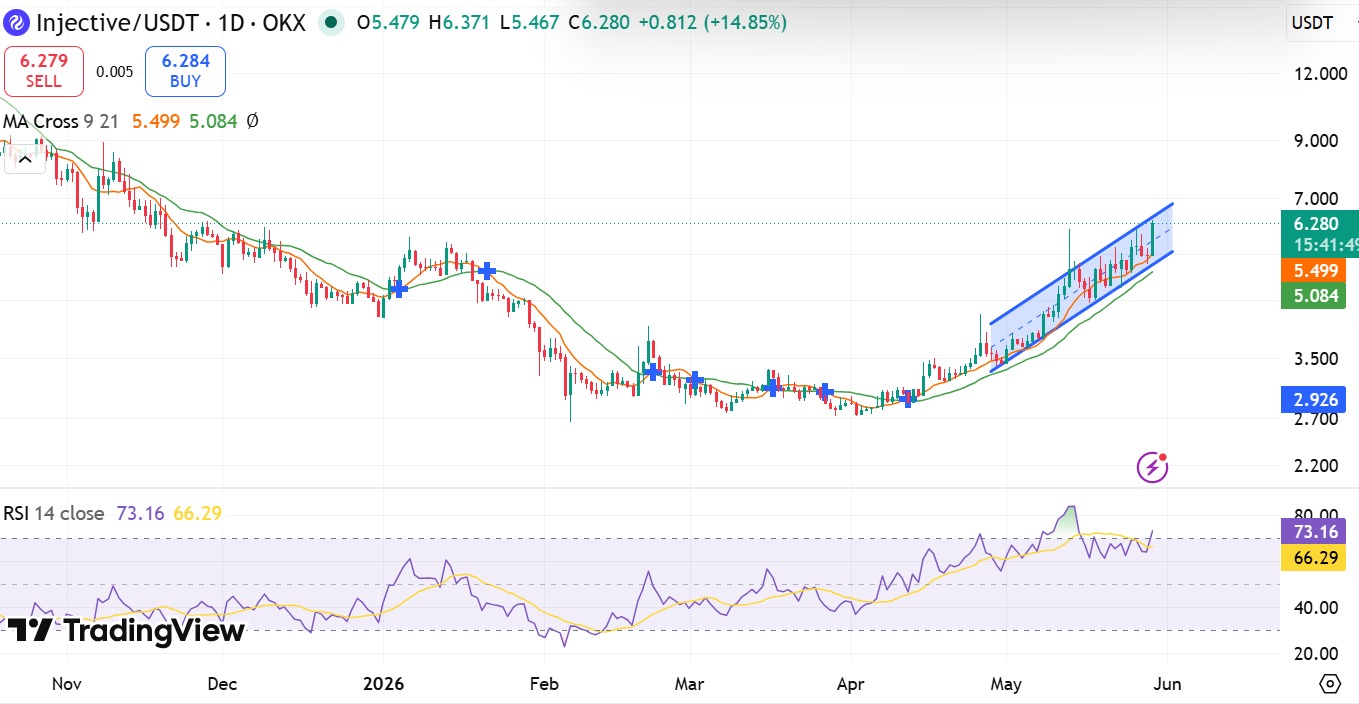
Injective made a strong comeback from a $5.2 slip. The altcoin successfully flipped $6 and jumped to $6.3, levels not seen since November 2025.
As of this writing, Injective traded at $6.1, up 14.4% on the daily charts. Over the same period, its market cap rose 12% to $628 million, a clear sign of steady capital inflow.
With the price pump, INJ made a clean jump above its short-term moving averages, the 21-day MA reflecting the upside strength.
What’s driving Injective’s price pump?
Injective [INJ] most likely pumped largely driven by increased speculative demand and short covering.
As the market suddenly reversed, over $441k worth of short positions were liquidated. The increase in short liquidations prompted some market players to cover their positions, while others opened new ones.
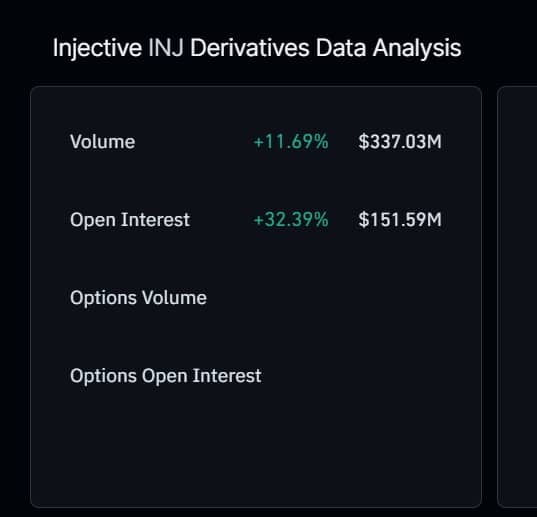
According to CoinGlass data, the altcoin’s Open Interest climbed 32.3% to $151 million, while Derivatives Volume rose 11% to $337 million.
Source: Coinglass
With OI and volume rising in tandem, it showed increased market participation and capital inflows into derivatives. This indicated that new positions, both short and long, were opened.
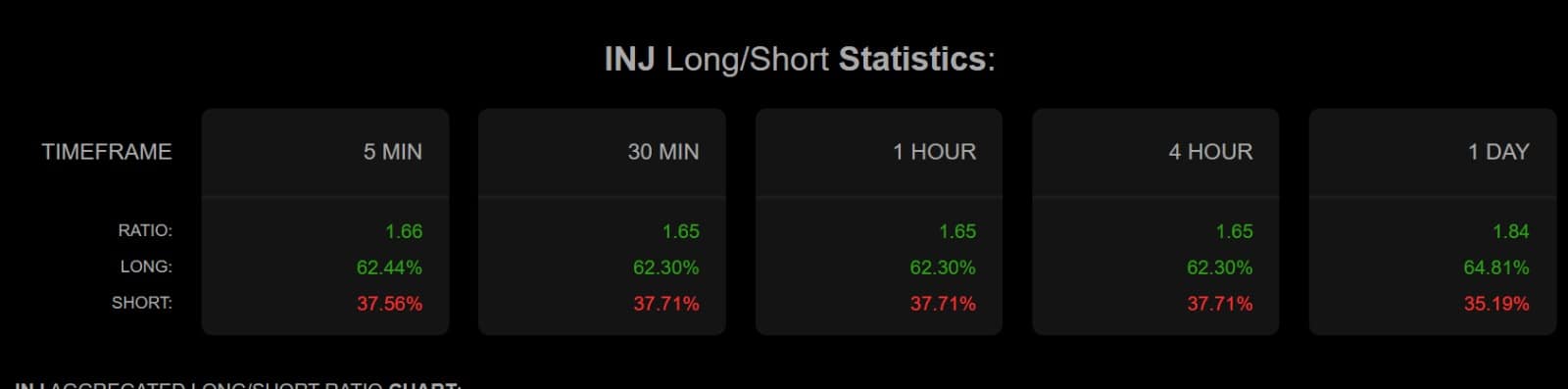
Meanwhile, the Long/Short Ratio rose to 1.8, where longs accounted for 64.8% of the total positions compared to 35% shorts. With longs dominating, it suggested that market participants were mostly bullish and chose to chase the rally.
Source: Coinalyze
As a result, the capital flowing into these positions strengthened the upward momentum, leading to more gains.
Profit taking reaches a record high
As expected, with Injective hitting a 6-month high, investors who have been underwater rushed into the market and cashed out.
As a result, the Spot Netflow turned positive after dropping into the negative zone the previous day. At press time, Netflow was $3.2 million, hitting levels not seen since August 2025, a massive jump from -$1.28 million recorded earlier.
Source: Coinglass
A positive Netflow indicated that more INJ flowed into exchanges than out of them. Thus, sellers dominated the spot market.
Historically, increased supply on exchanges has reduced scarcity, thus weakening the market structure. Often, such a setup has preceded market pullbacks.
Can the upside momentum hold?
Injective saw increased demand as market participants turned bullish, especially in derivatives. As a result, the upside momentum strengthened.
In fact, the altcoins’ Relative Strength Index (RSI) made a bullish crossover and jumped to 73, while the signal dropped to 66.
Source: Tradingview
At these levels, RSI indicated that buyers have strong control of the market, but with the signal line at 66, the margin is minimal. In essence, while buyers still control, their dominance is not a strong warning of market pressure risks.
Therefore, if demand holds and pushes RSI above 80, Injective could make further gains and flip $7. However, if buyers fail to hold pressure from profit takers, the market correction will follow, with $5.4 as immediate support.
Final Summary
INJ rallied 14%, successfully flipped $6, and reached a 6-month high of $6.3.
Injective rallied, mainly driven by renewed speculative demand, but profit-taking risks led to another drop towards $5.4.
The perp is a kind of derivative that allows the investor to speculate on future price movements in a crypto asset without putting an expiration date on that contract, allowing it to be held as long as the investor wants. With this first approval on a registered platform, the U.S. derivatives regulator with a long history overseeing traditional crypto futures now opens a U.S. path for the potentially lucrative and popular arena of crypto perps that have previously been pursued more in non-U.S. jurisdictions.
The CFTC announced Kalshi is approved for the first true bitcoin-referenced perp, BTCPERP, and the agency said the approval “requires, among other terms and conditions, that Kalshi list and maintain the BTCPERP Contract in compliance with all applicable provisions of the Commodity Exchange Act.” While Kalshi is best known in the public as a leading prediction markets platform, the registered exchange has been expanding its business footprint.
“This marks Kalshi’s evolution from prediction market leader to next-gen derivatives exchange,” said Tarek Mansour, CEO of Kalshi, in a post on the company’s website that called their event-contract business only the first chapter. “Onshore, safe and regulated perps will improve capital allocation and risk management for countless American businesses.”
In a letter sent to Coinbase on the same day, the CFTC said it would permit certain perpetual futures products that Coinbase intends to list through its CFM subsidiary. These perpetual futures will be routed through Coinbase Bermuda, so they’ll be treated as “foreign futures.” The no-action letter will allow CFM to post customers’ digital assets (including bitcoin, ether and stablecoins) as margin collateral for these products.
Paul Grewal, Coinbase chief legal officer, called it a “massive first for the industry” in a post on social media site X.
The CFTC announcements follow closely on the heels of President Donald Trump’s social-media post this week that cited perpetuals and argued that the previous administration’s regulators “nearly DESTROYED the American Crypto Industry by driving Bitcoin, Crypto Perpetuals, and INNOVATION offshore, but ‘TRUMP’ SAVED IT.”
Trump’s CFTC chairman, Mike Selig, argued that the contracts represent “a foundational risk management and price discovery tool in the global crypto asset markets.”
“Having true perpetual contracts in the United States is a major step forward in delivering on President Trump’s goal of cementing America as the crypto capital of the world,” Selig wrote in an opinion piece published Friday at CoinDesk. He said his agency is now providing “a workable framework for true crypto asset perpetual contracts.”
Perps, typically amplified with leverage, can be a way to cash in big on even minor price movements in assets such as bitcoin BTC$73,565.90 and Ethereum’s ether (ETH), but that also means they can go the other direction just as sharply, making them a volatile investment.
Selig had said in March that he has been trying to repair damage from the previous U.S. administration that “drove a lot of these firms and the liquidity offshore.” Some of the other crypto-native exchanges the agency oversees in the U.S. include Bitnomial (just acquired by Kraken) and Gemini, plus Kalshi’s prediction-market rival, Polymarket.
Selig wrote on Friday that his agency’s approach to perps would “limit excessive leverage, volatility and systemic risk.”
There are other dangers associated with perpetuals, too, as witnessed this week with the flash crash in the Hyperliquid SPACEX-USDH, a crypto perpetual contract for SpaceX’s market valuation, catching many investors off-guard and wiping out some $1.5 million in notional value within 30 minutes because of one outsized position that absorbed the market’s thin liquidity.
The CFTC’s new stance doesn’t yet carry the weight of a formal rule. The CFTC and its sister agency, the Securities and Exchange Commission, have been blazing a crypto policy trail with new statements, so-called no-action letters (like the one sent to Coinbase on Friday), approvals and guidance revealing their current stance on various aspects of the industry. But until the policies are set with formal rules or — even more durable — new laws, then they can be easily overturned by future agency leaders.
In March, the two agencies released highly consequential guidance that — for the first time — offered their definitions for classifying various crypto assets. The new taxonomy described a series of buckets the assets could be placed in that would establish how they’d be regulated and by whom, and it also set out standards for how a crypto security may eventually transition out of that classification as its project matures.
The SEC is also poised to release a wide-reaching new crypto policy meant to pave the way for the tokenization of securities by offering temporary exemptions from registration for digital asset innovations. The shift — a marquee project for SEC Chairman Paul Atkins — is planned as an interim measure to foster crypto activity while the industry awaits a more permanent law from Congress.