Home Blog Page 409

ICE CEO calls Hyperliquid bigger than NASDAQ, says he’s met its founders

0
ICE CEO calls Hyperliquid bigger than NASDAQ, says he's met its founders

Jeffrey Sprecher, the founder and CEO of Intercontinental Exchange (ICE), called the decentralized perpetual futures venue Hyperliquid “bigger than NASDAQ” at a Bernstein conference this week and disclosed his team has met its founders multiple times, a sign that U.S. exchange incumbents are no longer treating crypto-native trading platforms as fringe.

“This Hyperliquid that we’re talking, if you haven’t heard about it, it’s bigger than NASDAQ, okay? It’s 11 people. You look at it, you’re like, wow, that’s pretty something,” Sprecher said in a May 27 fireside chat with Bernstein analyst Chinedu Bolu, calling the team “very, very smart people.”

Hyperliquid’s HYPE token carries a market capitalization of roughly $15.1 billion against Nasdaq Inc.’s $50 billion as of Thursday, so the comparison doesn’t hold by company value.

On daily perpetual futures volume, though, Hyperliquid clears billions of dollars in notional turnover and holds more than 70% of the decentralized perp-DEX market, per industry data.

The “11 people” refers to Hyperliquid Labs, the core development entity, while the broader project draws on open-source contributors and a validator set that runs the underlying Layer-1 blockchain.

Sprecher said ICE took notice partly because Hyperliquid has been trading oil derivatives on weekends when ICE’s traditional energy markets are closed, an activity that surged during the recent stretch of Middle East tensions.

JPMorgan analysts have flagged the same pattern, noting non-crypto traders using Hyperliquid’s 24/7 markets for off-hours oil exposure. “There have been a lot of activity that happens, a lot of decisions and things happen on the weekend. So it’s gotten a lot of interest,” Sprecher said.

Under U.S. law, the perpetual futures Hyperliquid offers are swaps, subject to Title VII of the Dodd-Frank Act, the post-2008 legislation that prescribes reporting, margining and dealer registration. ICE operates under those rules, while Hyperliquid, an unregulated foreign-incorporated venue, does not.

“Why are you prohibiting us from doing this when it’s already happening? And can’t we have a level playing field? And by the way, this stuff is global,” Sprecher said.

He said he expected the next few months to produce clearer answers, with the choice being either a new category of regulated perpetual future or pulling offshore venues into Dodd-Frank and the European Union’s EMIR rules.


Source link

New Oriental Education & Technology (EDU) Net Revenue Climbs 19.8% in FQ3 2026

0
New Oriental Education & Technology (EDU) Net Revenue Climbs 19.8% in FQ3 2026


New Oriental Education & Technology Group Inc. (NYSE:EDU) is one of the best mid cap stocks to buy with highest upside potential. On April 22, New Oriental Education & Technology Group reported strong financial results for FQ3 2026. Total net revenues grew by 19.8% year-over-year to $1.417 billion, while net income attributable to the company rose by 45.3% to $126.8 million. Operating income also saw a significant increase of 44.8%, reaching $180.3 million.

Growth was driven by the expansion of new educational initiatives, including non-academic tutoring and intelligent learning systems, alongside steady performance in domestic and overseas test preparation. Leadership emphasized a focus on operational efficiency, AI integration across the education ecosystem, and the continued development of the East Buy platform. These efforts, combined with cost structure optimizations, resulted in an improved non-GAAP operating margin of 14.3%.

Barrington Raises its Price Target on Universal Technical (UTI) to $42

brooke-cagle-g1Kr4Ozfoac-unsplash

Regarding shareholder returns, the board of directors approved the second installment of a dividend for FY2026, amounting to $0.06 per common share or $0.6 per ADS, payable in June. Additionally, the company continued its share repurchase program, having bought back approximately $184.3 million worth of ADSs as of April 21, out of the authorized $300 million total.

New Oriental Education & Technology Group Inc. (NYSE:EDU) is a Beijing-based provider of private educational services. Founded in 1993, the company operates through four segments, including Educational Services and Test Preparation Courses, and Overseas Study Consulting Services.

While we acknowledge the potential of EDU as an investment, we believe certain AI stocks offer greater upside potential and carry less downside risk. If you’re looking for an extremely undervalued AI stock that also stands to benefit significantly from Trump-era tariffs and the onshoring trend, see our free report on the best short-term AI stock.

READ NEXT: 33 Stocks That Should Double in 3 Years and Cathie Wood 2026 Portfolio: 10 Best Stocks to Buy. 

Disclosure: None. Follow Insider Monkey on Google News.


Source link

DYDX’s next target – Here’s why channel resistance is the final test for traders!

0
DYDX's next target - Here's why channel resistance is the final test for traders!


dYdX [DYDX], the native token of the decentralized trading platform, has landed among the top gaining assets in the market.

In fact, on-chain metrics including trading fees and total value locked have remained largely unchanged according to DefiLlama data, with sentiment staying flat.

The main growth has been driven by off-chain activity. However, at press time, chart analysis revealed that the rally now faces a credible risk of a near-term pullback at a key technical level.

DYDX hits channel resistance

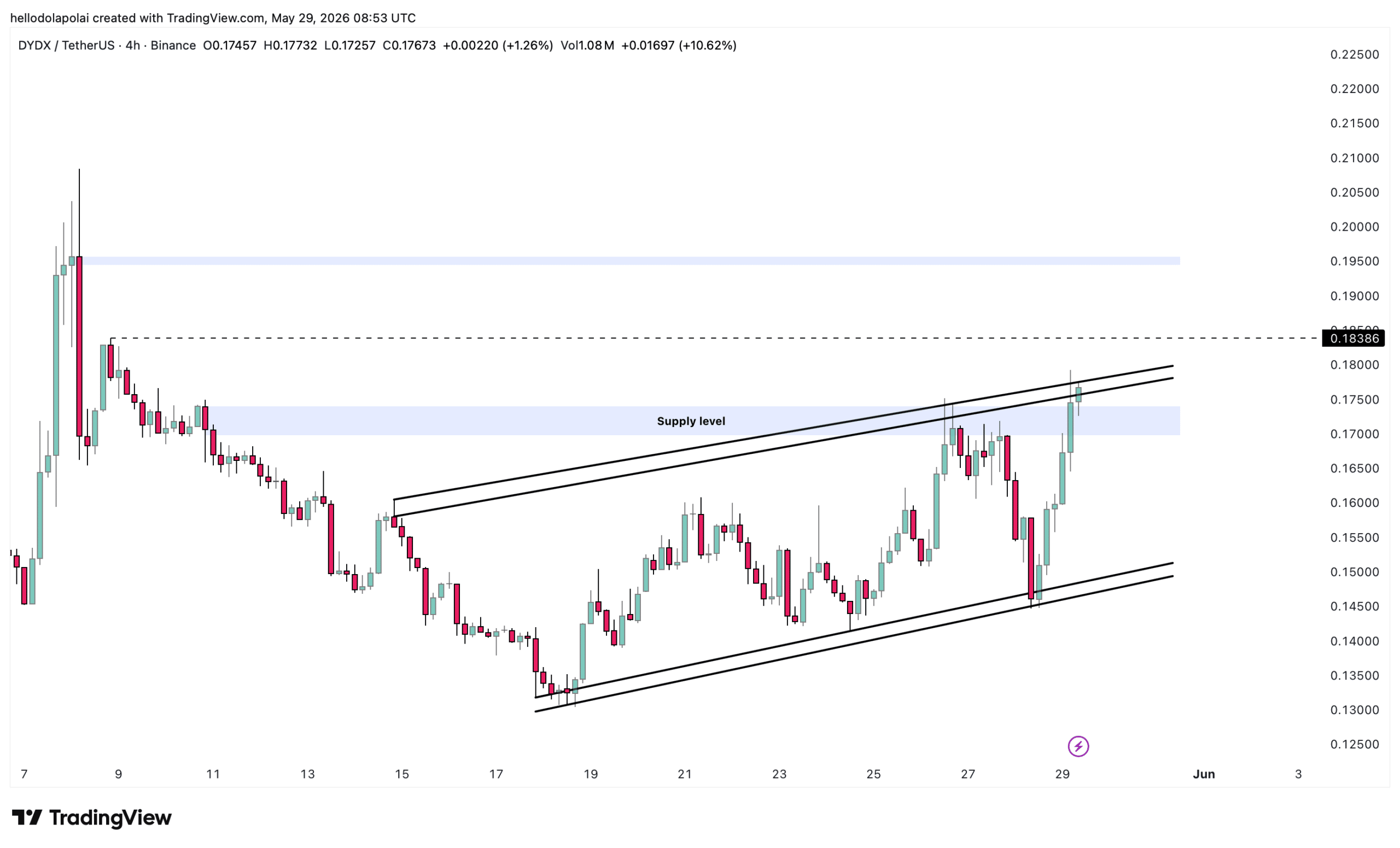
The continuation of DYDX’s northbound rally faced a significant hurdle as the asset hit the upper boundary of the ascending channel pattern it has been trading within.

The channel consists of two parallel upward-trending lines serving as support and resistance respectively, with price oscillating between them in an upward range.

DYDX technical price chart.
Source: TradingView

At press time, DYDX had hit the upper resistance line of this channel, meaning the sell pressure that typically builds at this level could force the asset lower towards the channel support if it holds.

The momentum picture, however, has been constructive.

DYDX overcame a key structural supply zone that previously acted as a major obstacle to price growth. Clearing this level adds weight to the case for a breakout above the channel resistance, rather than a rejection from it.

A/D reaches 40.8 million as MA Ribbon prints a bullish crossover

Market indicators seemed to be supporting the probability of a breakout to the upside, rather than a rejection at resistance.

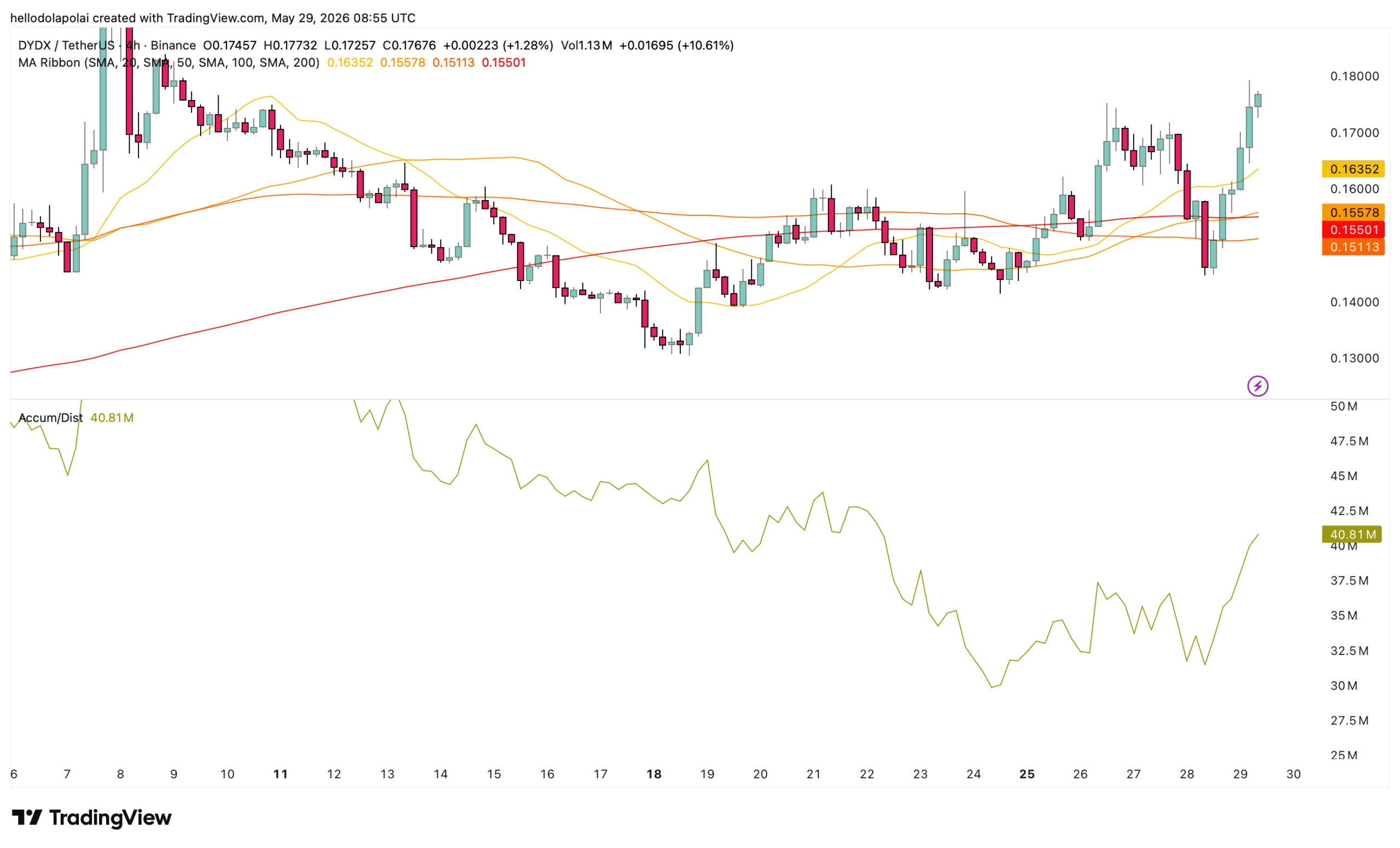
The Accumulation/Distribution indicator, for instance, highlighted rising accumulation, with total volume hitting 40.8 million in DYDX at the time of writing.

Traders have been actively adding to their positions, and the volume building behind this accumulation lends conviction to the bullish structure forming on the charts.

DYDX indicator chart.DYDX indicator chart.
Source: TradingView

At press time, the Moving Average Ribbon flashed the clearest bullish signal yet. With the 20-day MA sitting above the 50-day, 100-day, and 200-day averages in a bullish crossover formation, the short-term average seemed to be leading the longer-term ones – A configuration that reflected strong and building momentum.

The gap between the 20-day MA and the longer-term averages implied that the upward move might carry meaningful conviction. And, a sustained upswing alongside sustained accumulation would confirm investors are actively contributing to extending the rally.

What are Spot and Perpetual market buyers up to?

Finally, both the Spot and Perpetual markets have been reflecting a strong structural setup for an ongoing bullish move in DYDX.

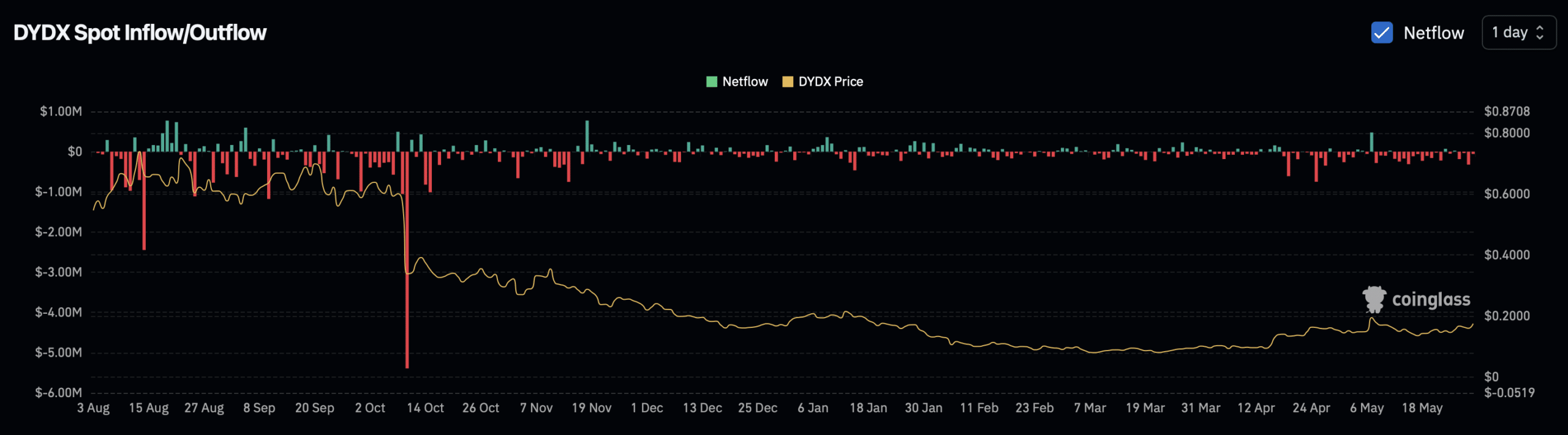
In fact, Spot market data revealed that traders accumulated $616,640 worth of DYDX over the last four days, reflecting consistent buying interest at press time levels.

DYDX spot netflow chart.DYDX spot netflow chart.
Source: CoinGlass

The Perpetual market seemed to mirror this trend too, with traders expanding leveraged capital to approximately $48.68 million in Open Interest. All while OI-weighted funding data confirmed that long positions accounted for most of this capital.

With both Spot and Perpetual markets holding a bullish position and accumulation building steadily, the conditions for DYDX to push further into an extended upswing might just strengthen.


Final Summary

  • The Moving Average Ribbon revealed a bullish crossover with the 20-day MA leading, while A/D rose to 40.8 million.
  • DYDX has been testing the upper channel resistance as Open Interest climbed to $48.68 million with positive funding.


Source link

Surging Treasury yields show America has no margin for error on its $31 trillion debt

0
Surging Treasury yields show America has no margin for error on its $31 trillion debt

In the days before the Memorial Day weekend, rates on 30 year Treasury bonds hit their highest level in 19 years at 5.2%, and the benchmark 10-year reached 4.7%, the top reading since mid-2007. If those kinds of yields take hold, the scenario for federal interest expense posited in the CBO’s “Budget and Economic Outlook: 2026 to 2036,” released in February, descends from dire to near-disastrous. Takeaway: America’s track to fiscal safety has lost all margin for error, and nothing demonstrates that better than the long-term impact of loftier than expected rates. America’s got so little room to maneuver that even yields that modestly exceed the CBO’s “baseline,” as the numbers compound in the years ahead, deliver a huge extra blow by crowding out big chunks of revenue that would otherwise go towards funding such essentials as Defense, Social Security and Medicare.

The CBO forecasts that yields on the 30 and 10-year Treasuries will respectively average about 4.65% and 4.15% through FY 2036. That’s roughly 55 basis points lower than the multi-year summit briefly notched in late May. Doesn’t sound like much of a difference, right? And if the interest expense on our gigantic and ballooning national debt of $39 trillion weren’t already running at nearly $1 trillion a year, bigger than Medicare spending and equaling two-thirds of Social Security outlays, the half-point upward shift would likely prove manageable.

But a recent report from the non-partisan Committee for a Responsible Federal Budget quantifies the deep damage even a continuation at the recent peaks would inflict. By 2036, interest expense would jump from absorbing 14% of all revenues to devouring 30%, five points more than under the CBO’s forecast. At $2.5 trillion, 2.5x today’s number, the carrying costs would become the second largest budget category, beating Medicare by one-third. Interest cost per household would soar from $7,900 last year to $17,000 a decade hence.

Much of today’s extreme vulnerability to even slightly higher rates arises from the need to both refinance existing debt, and shoulder trillions more in newly-issued bonds to cover deficits, at much higher cost. All told, the federal government will need to borrow almost $10 trillion in the next 12 months, equivalent to one-third our total debt. That amount consists of around $7.5 trillion to repay the Treasuries coming due, and $2 trillion for plugging the shortfall between revenues and spending. A major reason the U.S. accumulated so much debt in the first place was the lure of ultra-bargain yields orchestrated by the Fed’s easy money policy during and following the COVID crisis. In 2021 through early 2022, Treasury Bills, instruments that mature within a year, offered around a minuscule 0.2%. Today, that cost’s 18 times fatter at 3.7%.

Rates have also climbed for the Treasury Notes running 5 to 30 years that account for over half of all federal debt outstanding. Because we could borrow so cheaply for so long, the average rate on the Notes stands at just 3.23%. But the U.S. is refinancing the bonds that roll off for a lot more, 5.2% on the 30 year as of just before Memorial Day, and 4.7% on the 10-year.

In fact, the borrowing blowout that got the U.S. in so much trouble resembles the rush into “teaser” home loans in the 2007 runup to the housing meltdown; folks fell for temporary, super-low “teasers” rates that when they reset higher, saddled the borrowers with monthly payments they couldn’t afford. A similar dynamic’s at play as the U.S. refinances low-yielding Treasuries issued when it looked like a deal to finance huge government spending—at today’s much higher rates.

As of May 26, news that the Iran War may end soon pushed yields for the 30 and 10 year down slightly, so that they’re now sitting around 35 basis points above the CBO forecast. Still, the threat they’ll bounce back to the half-point-plus margin that’s so scary raises a stern warning for the new Fed chief Kevin Warsh. It’s encouraging that Warsh publicly favors tightening monetary policy by lowering the immense holdings of Treasuries on Fed’s balance sheet, a policy that involves unloading a big portion of its portfolio to the public. That gambit transforms trillions that would otherwise be spent into savings.

The Fed balance sheet shrink would also shrink what’s causing the problem: Extremely high “aggregate demand” across the economy that sends too many dollars chasing a volume of goods that’s growing far more slowly. (Noted economist Will Luther described this phenomenon in my recent story.) Warsh can also raise the Fed Funds rate, or even announce he has no plans for a reduction, to cool the still relatively-plentiful credit that’s fueling big spending by consumers and of course, humongous outlays for AI data centers. But the primary reason aggregate demand’s way too high is excessive levels of government spending that if left unchecked, could lead to even higher rates than the peak numbers that just unleashed such a jolt. Warsh can help by lifting the cost of credit to throttle both consumer and corporate spending, and sell bonds the Fed’s holding to target the latter. But he can’t control the big one, the runaway federal budget.

That responsibility falls on the President and on Congress. As the CRFB states in their analysis on the impact of rising yields, “The best way to accomplish these goals is through deficit reduction, which can help the Federal Reserve lower rates by reducing near-term inflationary pressures, put downward pressure on long-term rates by reducing economic crowd-out [that diverts money needed for budget must-pays to interest], and reduce the debt burden on which the government must pay interest.” The CRFB adds that yields that hang in the pre-Memorial Day range or push higher threaten to “spark a fiscal crisis.”

Nothing better illustrates that AMERICA IS BROKE than how an increase in yields that wouldn’t seem to matter much in most times could spell a cataclysm now that our fiscal state’s so fragile. Neither party wants to talk about how broke we really are, or do much to address the problem. Unfortunately, it may take an outbreak of unaffordable interest rates to force our lawmakers into facing the peril of their own making.


Source link

Bitcoin, ether, XRP, dogecoin lag a nine-week stocks rally as ETF demand cools

0
Bitcoin, ether, XRP, dogecoin lag a nine-week stocks rally as ETF demand cools

The S&P 500’s longest weekly winning streak since 2023 and Brent crude settling near $92 on U.S.-Iran ceasefire hopes have failed to pull bitcoin and ether (ETH) higher, with the two largest cryptocurrencies finishing the week down nearly 3% as cooling spot bitcoin ETF inflows reinforced the pullback.

The S&P 500 posted its ninth consecutive weekly gain on Friday, the longest such run since 2023 and a streak matched only a handful of times in the past four decades, putting the index up almost 20% from its March lows.

Brent crude settled around $92 a barrel and Treasuries climbed on the week, trimming some of their war-driven losses.

The macro tailwind has come on hopes the U.S. and Iran will sign off on a 60-day ceasefire extension. President Donald Trump said Friday he was ready to make a “final determination” on a preliminary agreement but restated his demand that any deal require Iran to abandon its nuclear program, surrender its enriched uranium and open the Strait of Hormuz.

Crypto did not move with the tape. Bitcoin slipped 2.6% over the past seven days to $73,445, ether 2.5% to $2,011, solana (SOL) 2.2% to $82.42 and TRON’s TRX 5.6%, its worst weekly drop in the top 10, according to CoinDesk data.

finished roughly flat. The slide came alongside softer spot bitcoin ETF inflows, which was flagged this week as adding to the downward pressure even as macro conditions improved.

The exception was the smaller side of the leaderboard. Hyperliquid’s HYPE token ripped 19.4% on the week to $65 as sentiment for the asset continues to grow. Intercontinental Exchange chief Jeffrey Sprecher praised the decentralized perpetuals venue at a Bernstein conference and calling it “bigger than NASDAQ.” BNB closed up 1.9% and XRP eked out a 0.7% weekly gain.

The Iran deal still needs Trump’s signature, and the red lines he restated on Friday sit well beyond what Iran has indicated it would accept publicly. The macro rally is one bad headline from reversing.


Source link

Clover Health (CLOV) Wins Lawsuit on Star Ratings, Soars to Record High

0
Clover Health (CLOV) Wins Lawsuit on Star Ratings, Soars to Record High


Clover Health Investments Corp. (NASDAQ:CLOV) is one of the 11 Stocks Racking Up Monstrous Gains.

Clover Health soared to a new 52-week high on Thursday, after earning the backing of a US Court over its legal battle with the Department of Health and Human Services (HHS) and the Centers for Medicare & Medicaid Services (CMS) in relation to what it deemed an unlawful reduction to its 2026 star ratings that could potentially slash millions worth of quality bonuses.

In intra-day trading, the stock jumped to a record high of $4.23 before trimming a few cents to end the day just up by 16.43 percent at $4.18 apiece.

5 Best Healthcare Penny Stocks to Buy According to Hedge Funds

Photo by Tima Miroshnichenko on Pexels

In a Court order released recently, the US District Court for the Southern District of Georgia, Brunswick Division, partially sided with Clover Insurance Company—a business unit of Clover Health Investments Corp. (NASDAQ:CLOV)—in relation to its 2026 Star Rating downgrade to 3.5 from 4.0, which could slash its statutorily mandated quality bonus and related payments by $120 million.

The Court judge rejected the HHS’ request to dismiss the case and ordered the CMS to recalculate the rating.

The lawsuit stemmed from what Clover Health Investments Corp. (NASDAQ:CLOV) believed to be improper use of quality measures and methodologies that allegedly reduced its rating to 3.5 from what would have been 4.0.

According to Clover Health Investments Corp. (NASDAQ:CLOV), the rating would reduce government reimbursement, hurt its competitiveness, and could weaken future growth.

As of writing, the CMS has yet to issue a comment on the Court order.

While we acknowledge the potential of CLOV as an investment, we believe certain AI stocks offer greater upside potential and carry less downside risk. If you’re looking for an extremely undervalued AI stock that also stands to benefit significantly from Trump-era tariffs and the onshoring trend, see our free report on the best short-term AI stock.

READ NEXT: 33 Stocks That Should Double in 3 Years and Cathie Wood 2026 Portfolio: 10 Best Stocks to Buy. 

Disclosure: None. Follow Insider Monkey on Google News.


Source link

Bitcoin’s biggest quantum risk may not be wallet keys. An early investor fears something bigger

0
Bitcoin’s biggest quantum risk may not be wallet keys. An early investor fears something bigger

A venture capitalist who has spent a decade backing deep-tech and quantum hardware startups says the bitcoin industry is fixated on the wrong half of the quantum problem, the wallet keys instead of the encrypted messages already moving between exchanges, bridges and custodians today.

“The financial system’s most dangerous vulnerability isn’t stored data, it’s the data
moving between institutions right now,” Andrew Gault, CEO of networking firm ZeroTier, told CoinDesk in a recent chat.

“Every interbank message, every payment authentication record, and every digital signature traveling across a network today is being collected by sophisticated adversaries who don’t need to read it yet,” he noted.

“CISOs and security teams have been trained to protect data at rest. What nobody wants to say out loud is that the adversary’s strategy has changed. They’re patient, they have storage, and they’re building a library of today’s encrypted traffic to decrypt the moment quantum capability crosses the threshold,” he added.

Gault is CEO of networking firm ZeroTier and a founding partner of 7percent Ventures, a London- and San Francisco-based deep-tech firm whose portfolio includes British quantum-computing startup Universal Quantum.

The Google Quantum AI research that rattled bitcoin in March showed a sufficiently powerful quantum computer could derive a bitcoin private key from an exposed public key in about nine minutes, came from outside his portfolio.

The conversation since that paper has centered on the roughly 6.9 million BTC sitting in addresses with exposed public keys and Bitcoin’s missing post-quantum migration plan.

But Gault says the more urgent exposure is the data already being collected off the open internet for decryption later, regardless of whether a working quantum computer exists yet.

Google’s own security engineers have moved the same direction. In a March post, the company set 2029 as its target for completing a post-quantum cryptography migration, citing progress on quantum hardware, error correction and factoring resource estimates.

The post, written by Google vice president of security engineering Heather Adkins and senior cryptography engineer Sophie Schmieg, said the company has reprioritized its internal threat model to focus on authentication services and digital signatures, the same wire-level signing infrastructure Gault has been pointing at.

“The threat to encryption is relevant today with store-now-decrypt-later attacks,” the post said.

The strategy driving that urgency is known in cryptography circles as “harvest now, decrypt later.” It assumes adversaries don’t need to read encrypted traffic today, only store it cheaply until a sufficiently powerful quantum computer arrives.

Citi modeled the bank-system version of the scenario in February, estimating a quantum-enabled attack on a single top-five U.S. bank’s access to the Fedwire Funds Service payment system could trigger a $2 trillion to $3.3 trillion cascade across the U.S. economy, equal to a 10% to 17% decline in real GDP.

The Global Risk Institute, cited in the same Citi report, puts the probability of a cryptographically relevant quantum computer arriving by 2034 at between 19% and 34%.

For crypto, the wire-level surface is broader than the wallet one. Cross-chain bridge proofs, exchange API authentication packets, signed transactions broadcast and archived in public mempools, and the back-channel signing traffic between cold storage and trading desks all sit on the same vulnerability spectrum as the bank-grade encryption Citi was modeling.

CoinShares argued in a February report that the wallet-key fear is overstated, estimating only about 10,200 BTC are concentrated enough to move markets if stolen.

Gault’s worry is a different one. “The particularly uncomfortable reality for financial institutions is that the authentication records being harvested aren’t just sensitive,” he said. “It’s the proof layer that determines who owns what, who authorized which transaction, and who bears legal liability.”

Ethereum (ETH) has launched a coordinated post-quantum migration, but Bitcoin has not done the same. Major crypto exchanges and custodians, where most of the signing traffic lives, have not publicly committed to one either.


Source link