Over the past three and a half years, the dominant U.S. equity themes have been tech, growth, semiconductors, and artificial intelligence (AI). Whether you look at performance or investment flows, it seems to be all anybody wants right now.
That means that a lot of themes that have traditionally worked quite well in the past are largely being ignored right now. One of those themes is dividend-paying stocks. Since the 1940s, dividends have accounted for about one-third of the S&P 500‘s (SNPINDEX: ^GSPC) total return. That’s very easy to overlook, since tech stocks have been driving returns and the S&P 500’s current yield of 1.05% is an all-time low.
Will AI create the world’s first trillionaire? Our team just released a report on the one little-known company, called an “Indispensable Monopoly” providing the critical technology Nvidia and Intel both need. Continue »
But being overshadowed doesn’t suddenly make dividend investing a subpar strategy. Dividend growers in particular can still be substantial wealth builders over time. The Vanguard Dividend Appreciation ETF(NYSEMKT: VIG), which happens to have a surprising growth component in its portfolio, is one of the better ways to accomplish this.
Image source: Getty Images.
Dividend growth as a long-term wealth-building strategy
Focusing one’s portfolio almost entirely on tech and growth stocks can unquestionably deliver extra returns. But over time, a portfolio like that usually features above-average volatility, deeper drawdowns, and longer recovery periods.
Plus, history shows that many people don’t ride out bear markets. They sell after stocks have fallen and only get back in once the recovery has happened. That makes more durable and defensive dividend stocks a potentially smoother path to long-term wealth creation.
That’s the biggest benefit of investing in long-term dividend growers. One study from Ned Davis Research covering more than 50 years of market return data found that dividend growers generated higher total returns with lower overall volatility than companies that pay but don’t grow dividends, non-dividend payers, and dividend cutters.
That type of finding tends to get lost in today’s growth-heavy market, but it clearly shows what these stocks can do in the longer term.
On the income front, that strategy helps ensure that shareholders see steady dividend increases from their investments. This ETF has increased its annual dividend for 12 straight years and has a 10-year dividend growth rate of about 7%. Its strategy does, however, eliminate the top 25% of dividend yields in order to help secure distribution stability. The ability to deliver consistent dividend growth is solid, but the 1.6% yield probably won’t get many people excited.
On the growth side, this fund currently benefits from the market cap-weighting methodology. That helps make Broadcom(NASDAQ: AVGO), Apple(NASDAQ: AAPL), and Microsoft(NASDAQ: MSFT) the fund’s top three holdings, with a combined weight of 13%. It also creates a 26% weighting in the tech sector as a whole. That gives the Vanguard Dividend Appreciation ETF a growth tilt that few dividend ETFs can match.
That’s why I believe this fund is one of the best combinations of growth and income in the marketplace. The yield isn’t particularly exciting, but the portfolio combines the long-term benefits of dividend growth investing with a tech overweight that helps it capture some extra upside in bull markets.
Should you buy stock in Vanguard Dividend Appreciation ETF right now?
Before you buy stock in Vanguard Dividend Appreciation ETF, consider this:
The Motley Fool Stock Advisor analyst team just identified what they believe are the 10 best stocks for investors to buy now… and Vanguard Dividend Appreciation ETF wasn’t one of them. The 10 stocks that made the cut could produce monster returns in the coming years.
Consider when Netflix made this list on December 17, 2004… if you invested $1,000 at the time of our recommendation, you’d have $463,900!* Or when Nvidia made this list on April 15, 2005… if you invested $1,000 at the time of our recommendation, you’d have $1,294,401!*
Now, it’s worth noting Stock Advisor’s total average return is 978% — a market-crushing outperformance compared to 211% for the S&P 500. Don’t miss the latest top 10 list, available with Stock Advisor, and join an investing community built by individual investors for individual investors.
David Dierking has positions in Apple and Vanguard Dividend Appreciation ETF. The Motley Fool has positions in and recommends Apple, Broadcom, Microsoft, and Vanguard Dividend Appreciation ETF. The Motley Fool has a disclosure policy.
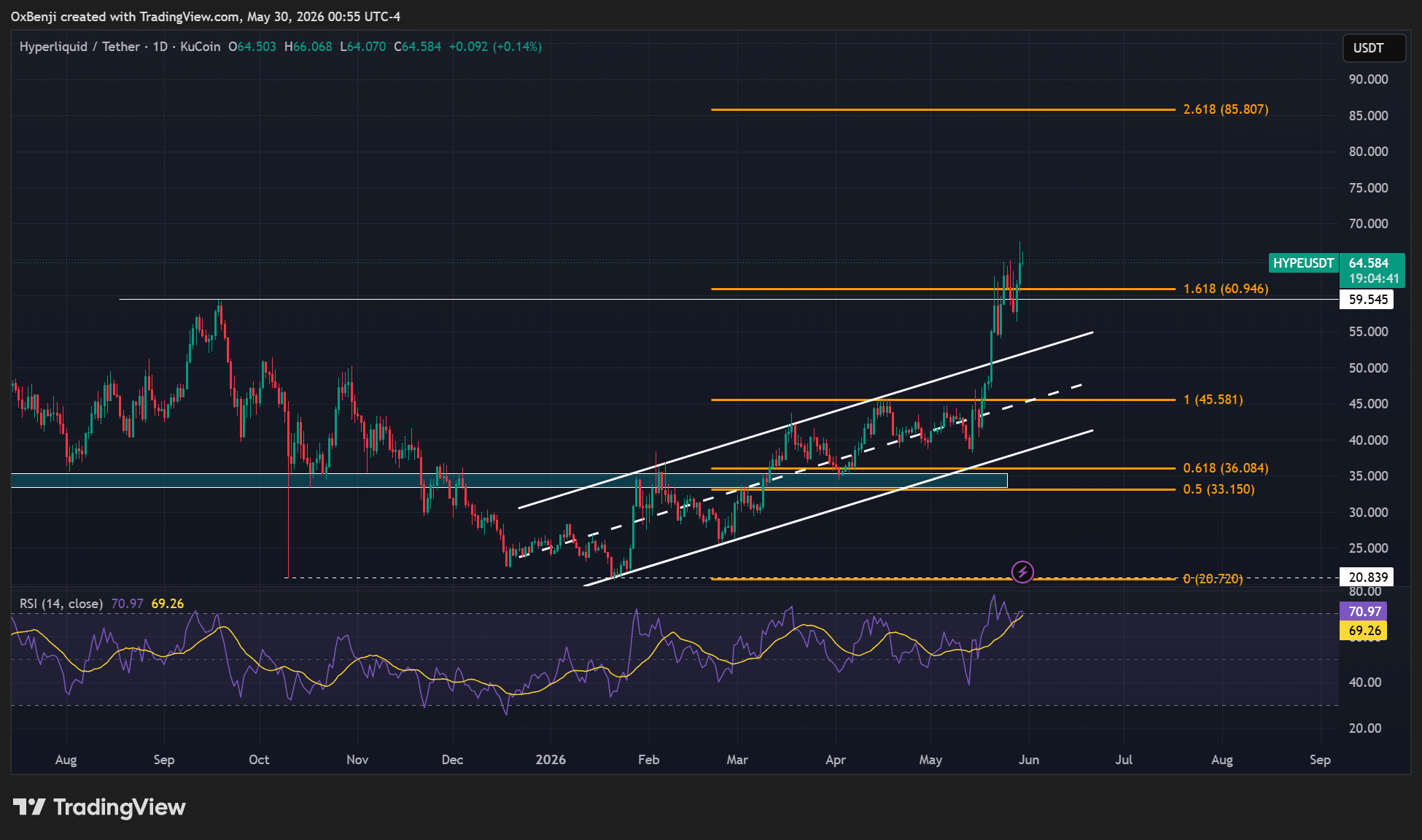
Hyperliquid [HYPE] hit a series of new all-time highs (ATH) on the price chart this week, thanks to media attention and ETF flows.
On the 29th of May, the altcoin climbed to another record high of $67.5, with the market cap surpassing $17B.
This briefly flipped Dogecoin [DOGE], as HYPE became the ninth-largest crypto by market cap and firmly joined the top 10 list. This would make Tron [TRX] and Solana [SOL] the next targets.
As of writing, however, the altcoin gave back some gains and traded at $64.5 and ranked 10th by market size on CoinMarketCap.
Source: HYPE/USDT
HYPE has rallied 70% since mid-May and surged 3X from the February lows of $20. The parabolic rally in May was triggered by Coinbase’s USDC deal and sustained by the strong ETF flows.
But Friday’s pump was a complete surprise.
Hyperliquid foresees DeFi perps in the U.S
Notably, on Friday, the U.S. Commodity Futures Trading Commission (CFTC) approved the first Bitcoin perpetual Futures contract (perps) for Kalshi and Coinbase. Perps allow users to gain exposure to assets with limited capital.
Hyperliquid’s breakout success was hinged on crypto perps. Later on, it diversified into commodities or RWA (real-world assets) perps, pre-IPO, and now prediction markets.
In fact, perps is the most dominant segment in terms of volume and Open Interest across the entire crypto market.
Hence, Hyperliquid’s moat quickly elevated it as a top challenger to Binance, Coinbase, and even top traditional players like Nasdaq. Some analysts claimed that since crypto perps were not legal, U.S. citizens were leveraging VPNs to use Hyperliquid.
Assuming this is true, the CFTC’s approved perps would have been deemed negative for Hyperliquid. This is because Coinbase and Kalshi are now regulated rivals.
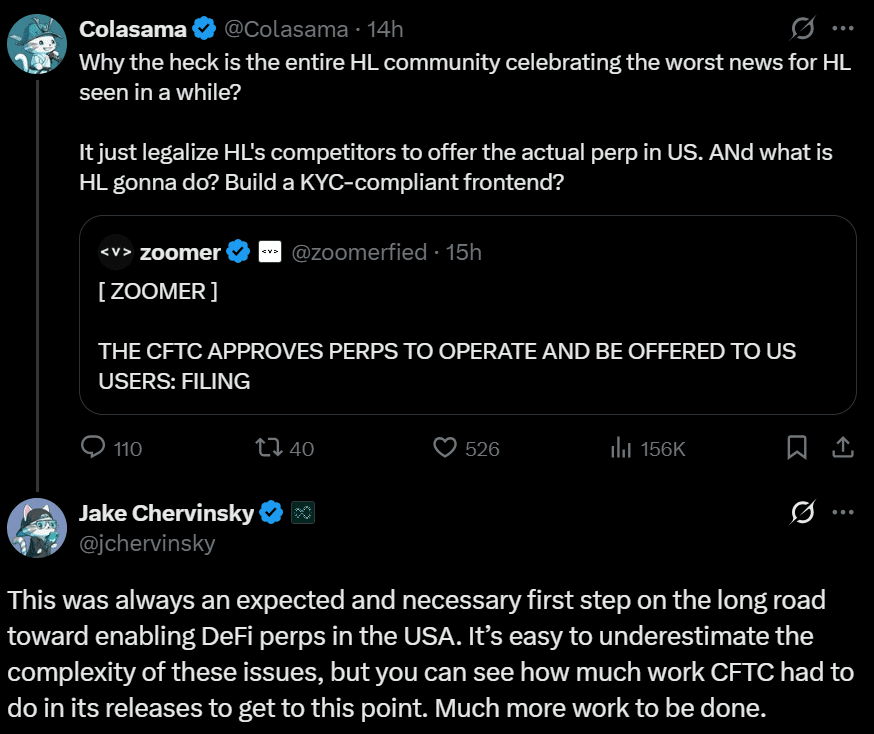
But Hyperliquid Policy Center (HPC), the research and lobby arm of the decentralized exchange (DEX), downplayed the threat. In fact, HPC’s CEO Jake Chervinsky saw it as a positive update and noted,
This was always an expected and necessary first step on the long road toward enabling DeFi perps in the USA.
Source: X
Currently, the rules apply to perps on centralized exchanges but not DEXes. Interestingly, the update, including a series of unstaked HYPE, didn’t deter bulls. Should bulls continue to defend $60 as support, the next upside targets could be $70 and $80.
Final Summary
HYPE briefly flipped DOGE as the ninth-largest crypto asset after climbing to a record high of $67.5.
Hyperliquid views the U.S. first CEX crypto perps as the ‘first step’ to DeFi perps and not a threat to the platform.
Hyperliquid (HYPE), a decentralized trading platform that began as a crypto perpetual futures exchange less than three years ago, is increasingly being viewed by Wall Street analysts as a broader financial infrastructure play that could challenge parts of traditional exchanges and derivatives markets.
In a new report, Grayscale described Hyperliquid as a fast-growing blockchain-based platform that generated roughly $800 million in revenue in 2025 while capturing meaningful market share in crypto perpetual futures, one of the largest segments of digital asset trading.
“Hyperliquid is not directly comparable to another project in either crypto or traditional finance,” Grayscale wrote. “If it continues to execute well … we think Hyperliquid could become a financial services juggernaut.”
Perpetual futures, or “perps,” are derivatives contracts that allow traders to speculate on asset prices without expiration dates. The market has become a cornerstone of crypto trading, averaging roughly $200 billion in daily volume this year, according to Grayscale.
Historically, the market has been dominated by centralized exchanges such as Binance and Bybit. Hyperliquid, however, earlier this year emerged as one of the first decentralized exchanges to compete at scale while offering self-custody and onchain transparency.
The platform processed roughly $2.9 trillion in perpetual futures volume in 2025 and now holds about $7 billion in open interest, according to the report.
Grayscale argued Hyperliquid’s ambitions now extend far beyond crypto trading.
The platform has expanded into tokenized equities, commodities and prediction-style markets through its HIP-3 and HIP-4 systems, allowing developers to launch new markets directly on the network. Grayscale said those products are increasingly functioning as round-the-clock trading venues for assets traditionally confined to Wall Street hours.
FalconX reached a similar conclusion in a separate report last week, saying Hyperliquid is beginning to compete with firms such as CME Group and prediction market operators including Kalshi and Polymarket.
“Hyperliquid is seeing traction as demand for its HIP-3 markets expands to include pre-IPO markets,” FalconX strategist Martin Gaspar wrote.
Both reports pointed to regulation as a critical factor for Hyperliquid’s future growth.
Hyperliquid currently blocks U.S. users because perpetual futures markets operate in a regulatory gray area under American law. But Grayscale said evolving guidance from regulators and growing interest from firms such as Coinbase (COIN), Robinhood (HOOD) and Kraken suggest regulated perpetual-style products could eventually enter the U.S. market.
Even so, risks remain. Grayscale noted that Hyperliquid’s token, HYPE, remains highly volatile and warned that the platform’s long-term growth depends heavily on future regulatory changes.
Still, both firms suggested Hyperliquid has moved beyond being viewed as just another crypto exchange.
Instead, analysts increasingly see it as an early attempt to build a 24/7 global financial market on blockchain rails.
At the turn of the century, investors might have found the idea of a company reaching a $1 trillion market cap as fairly outlandish.
Today, there are over a dozen companies that make the claim, with the artificial intelligence (AI) chip giant Nvidia now trading at a market cap of over $5 trillion. Unless valuations pull back sharply due to AI hitting a major roadblock, more companies are poised to surpass trillion-dollar market caps.
Missed Nvidia in 2009? This Rare Signal Is Flashing Again.In 2009, a “Double Down” signal flashed for a little-known chipmaker called Nvidia. For the first time in years, that same “Total Conviction” signal is flashing for a company 1/100th the size of Nvidia. Continue »
In fact, one just did. Meet this pick-and-shovel AI stock that just joined Meta Platforms, Tesla, and Broadcom in the $1 trillion club.
Image source: Getty Images.
Understanding Micron’s role in AI
What an incredible run the computer memory company Micron Technology(NASDAQ: MU) has been on. The stock is up over 227% this year and over 867% in the past year (as of May 28).
The big reason Micron and a few other related stocks have surged is due to tremendous demand for memory, which has become a big part of the AI story. Chipmakers like Nvidia need memory to sit directly on their graphics processing units (GPUs), which are key for training large language models. Memory is needed to feed the GPUs with data.
As Nvidia and other chipmakers have built more advanced GPUs and scaled GPU clusters, they need more memory to process data faster. There are different types of memory, but Micron makes a type called dynamic random-access memory (DRAM), which was commonly used in older technologies like computers and cellphones.
More recently, however, Micron has been developing a more complex memory product called high-bandwidth memory (HBM), which essentially stacks multiple DRAM chips. This is better for GPUs because it reduces the distance data has to travel to reach them.
In March, Micron announced that it had designed a new HBM model called the HBM4 with 36 gigabytes of 12-Gi memory, specifically made for Nvidia’s Vera Rubin GPU platform.
According to the market research firm Counterpoint, Micron held 23% of the global DRAM market share by revenue at the end of 2025, behind only Samsung (36%) and SK Hynix (32%). In the global HBM market, Micron had 21% market share at the end of last year, still behind SK Hynix (57%) and Samsung (22%).
However, Micron’s share had more than doubled from just 9% at the end of 2024.
Demand is through the roof right now
On Micron’s second-quarter earnings call for its fiscal year 2026 in March, CEO Sanjay Mehrotra told Wall Street analysts in prepared remarks that data center demand for DRAM and NAND flash memory, which Micron also makes, is expected to hit 50% of the industry’s total addressable market for the first time ever this year.
Furthermore, Mehrotra said that both DRAM and NAND demand this year is expected to be constrained by supply. DRAM shipments this year are projected to grow in the low-20s percentile, slightly above Micron’s previous outlook.
UBS analyst Timothy Arcuri recently shocked the market by more than tripling his price target on Micron from $535 per share to $1,625, the highest on Wall Street. The stock currently trades around $900.
In a research note, Acuri said he and his team expect DRAM supply to remain constrained until at least halfway through 2028, and NAND supply to remain constrained until the end of 2027.
“We believe the market will start to put a more ‘normal’ multiple on the stock and [Micron] will continue to rerate higher as more details emerge about the structural changes AI has driven to the entire memory complex,” Arcuri said.
How investors should play the stock
Micron currently trades at close to 42.5 times trailing earnings, above its 10-year average of roughly 22 times.
However, AI wasn’t in the picture a decade ago, like it is now, and Micron and other memory suppliers had likely never experienced this kind of demand. It’s a new day for this sub-sector, so the stock should trade at a multiple above its 10-year average.
That said, Micron trades at close to double its normal multiple and is tied to the AI trade, making it vulnerable if AI-related capital expenditures slow.
That’s why I wouldn’t necessarily make Micron a large position. I think investors can own it, but it’s probably a good idea at this point to start with a smaller position and slowly build it through dollar-cost averaging.
Should you buy stock in Micron Technology right now?
Before you buy stock in Micron Technology, consider this:
The Motley Fool Stock Advisor analyst team just identified what they believe are the 10 best stocks for investors to buy now… and Micron Technology wasn’t one of them. The 10 stocks that made the cut could produce monster returns in the coming years.
Consider when Netflix made this list on December 17, 2004… if you invested $1,000 at the time of our recommendation, you’d have $463,900!* Or when Nvidia made this list on April 15, 2005… if you invested $1,000 at the time of our recommendation, you’d have $1,294,401!*
Now, it’s worth noting Stock Advisor’s total average return is 978% — a market-crushing outperformance compared to 211% for the S&P 500. Don’t miss the latest top 10 list, available with Stock Advisor, and join an investing community built by individual investors for individual investors.
Bram Berkowitz has no position in any of the stocks mentioned. The Motley Fool has positions in and recommends Broadcom, Meta Platforms, Micron Technology, Nvidia, and Tesla. The Motley Fool has a disclosure policy.
Even if you’re relatively uninitiated to the new horror release, Backrooms, which is set to make an astonishing amount of money this weekend, you have probably at least heard that the genesis of the film is a series of YouTube videos. Those were made by Kane Parsons, who is now 20 and one of the youngest directors ever to make a film earning this much.
There are arguments for knowing nothing about Backrooms going in. That may make the weirdness even more pronounced, though you may think you’re missing something by not being familiar with the original work. While I do think it is not necessary to watch the series before the movie, if you do want to, there’s no real downside. And if you want to focus on the core of the experience, there are some specific videos, out of the 22 in total, that you may want to check out rather than just a random assortment or trying to get through literally all of them. Or, you’ve already seen the movie and you want more of this world, so you can watch these after the fact, your call.
There are a few lists of these, but in terms of the core structure and lore of Backrooms, we have:
1) The Backrooms (Found Footage) – The Original (80 million views now)
2) First Contact
3) Missing Persons
4) Pitfalls
5) Presentation
6) Found Footage #2
7) Damage Control
8) Found Footage #3
As you can see, these range from two minutes to a whopping 45 minutes. The Found Footage ones are the most widely viewed and interesting/scary. Some of the others will give you a deeper look at the lore surrounding the Backrooms and what exactly it is (though do not expect any firm answers, kind of a hallmark of the series).
If you do watch these, you’ll certainly be able to point at the screen and go “aha!” pretty often, but there are some pretty significant changes/additions for the film, especially in terms of how the monsters are handled/revealed. It will be interesting to see the difference from the original to the final film, certainly. And of course, none of these feature any Oscar-nominated actors.
With the blockbuster success of Backrooms in theaters, a sequel is no doubt coming, likely for the same low budget (the first one was $5 million) and getting deeper into at least some of the concepts we see here. So if you do want to get ahead of the game, and acquire Backrooms knowledge most average viewers may not have, there’s a good starter list. You can, of course, watch the full list of 22 videos if you want. Enjoy.
Ripple Labs is reportedly leading an effort to raise at least $1 billion for a new public-market vehicle that would accumulate XRP, per Bloomberg, testing whether the digital asset treasury trade still works beyond bitcoin.
The raise would be done through a special purpose acquisition company, the report citied to people familiar with the matter. The funds would sit inside a new XRP-focused digital asset treasury, and Ripple is expected to contribute some of its own XRP to the vehicle.
Terms are still under discussion and could change. Ripple did not immediately respond to CoinDesk’s requests for comment or confirmation.
If completed, the deal would be the largest known XRP treasury vehicle to date. XRP is the world’s fifth-largest token, with a market value of about $138 billion. It has gained 13% this year, compared with a 16% rise in bitcoin.
Digital asset treasury companies became one of crypto’s biggest stock-market trades in 2025, as listed firms used SPACs, reverse mergers and equity issuance to buy tokens. The model worked while crypto prices rose and investors paid premiums for balance-sheet exposure.
That trade has weakened, however. Shares of major token accumulators, including Strategy and Metaplanet, have fallen sharply in recent months as crypto prices turned choppy and investors started questioning how many public companies can run the same accumulation play at once.
Ripple’s plan would test whether XRP has enough institutional demand to support a similar structure.
XRP has not drawn the same treasury-company interest as bitcoin. One of the larger examples came in May, when VivoPower announced a $121 million raise to pivot toward XRP investing.
Ripple has its own reasons to back a larger vehicle. The company held 4.74 billion XRP in wallets as of July 31, worth about $11 billion at current prices, according to its website. Another 35.9 billion XRP were locked in on-ledger escrow accounts scheduled for monthly release.
A public XRP treasury company could create a new buyer for the token while giving Ripple another way to place part of its holdings with investors.
The cryptocurrency market suffered a significant capital exit over three days between the 26th and the 28th of May, with roughly $169 billion leaving the market.
Relative stability has since returned with minor inflows stepping back in, and select altcoins are positioned to benefit from this shift—BEAT being one of them.
In the past day, Audiera [BEAT] has extended its gains slightly into double-digit territory, reaching 10%, continuing a bullish trajectory that has seen the token accelerate 404% over the past 90 days.
Cup and handle forms within a broader bull flag
The technical structure for BEAT shows a combination of patterns hinting at a significant move in the coming days. The asset has formed a cup and handle pattern, characterized by price trending downward in a double-hollow fashion that resembles a cup and handle.
This formation has preceded a rally and breakout to the upside on multiple occasions. For the breakout to materialize, price would need to overcome the diagonal resistance lines that have formed on the chart to confirm an upward continuation.
Source: TradingView
Viewed on a broader scale, the cup and handle pattern appears to be forming within an overall bull flag—a structure that involves an expansive rally followed by a consolidation phase before another expansive move.
The cup and handle represents the consolidation phase within this larger pattern.
Notably, the Accumulation/Distribution indicator reflects a relative calm in buying pressure for now, moving along a measured range as the asset accumulates without yet sparking a major surge in buy pressure.
This type of quiet accumulation often precedes a more explosive directional move.
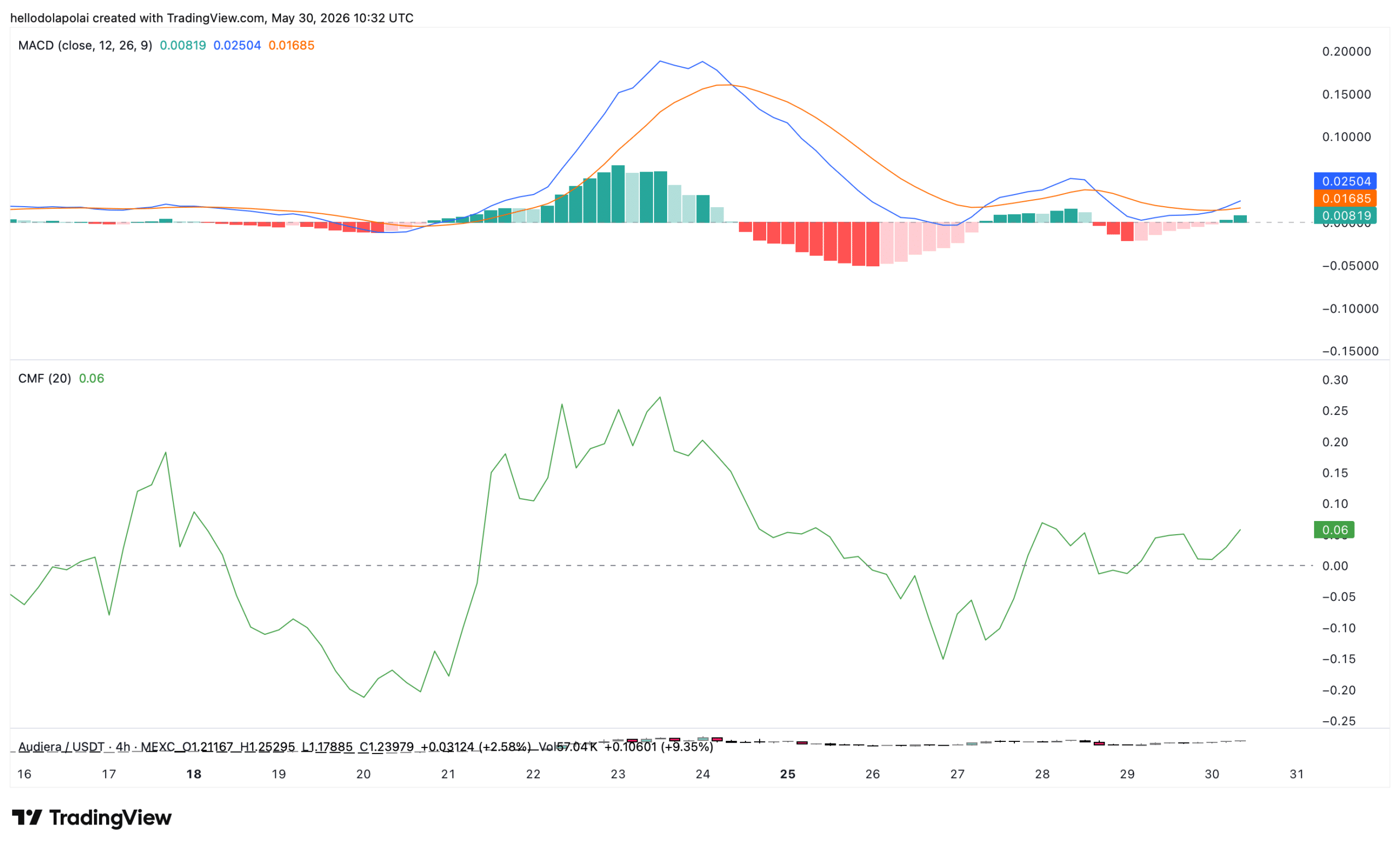
MACD Golden Cross forms as CMF holds neutral
The momentum indicators are giving clear signals that a bullish takeover could be building in the BEAT market.
The MACD has formed a Golden Cross pattern, with the MACD line—derived from the difference between the 12-day EMA and 26-day EMA—crossing above the 9-day signal line.
Source: TradingView
This formation typically precedes a significant move to the upside, reflecting active buyer participation in the market.
The Chaikin Money Flow adds further context. The CMF has maintained a positive level at the time of writing, having trended on the positive side for days prior.
This signals a balance between buying and selling volume in the market rather than a decisive lean in either direction.
$1.17 million in Spot selling emerges despite price holding
The main concern at this stage is the whale-versus-retail delta, which has turned red and negative, signaling that retail traders are gaining a stronger foothold in the market and are currently on the selling side.
Spot data shows $1.29 million in total selling over the past day, with a net outflow of $230,000 confirming that selling is outpacing buying at the moment.
Source: CoinGlass
For now, this represents a risk to the near-term outlook; the fact that BEAT has held its gains despite this sell pressure points to an underlying demand dynamic that is absorbing the retail exit.
Final Summary
BEAT has gained 404% over the past 90 days, with a MACD Golden Cross confirming bullish momentum is building.
Retail traders drive $1.17 million in Spot selling, with net outflow at $202,000 despite price holding its gains.







![Why Audiera [BEAT] is THE token to watch out for this weekend](https://moneyvests.com/wp-content/uploads/2026/05/Why-Audiera-BEAT-is-THE-token-to-watch-out-for-696x392.webp "Why-Audiera-BEAT-is-THE-token-to-watch-out-for.webp")