The United States has seized about $1 billion worth of cryptocurrency tied to Iran, Treasury Secretary Scott Bessent said, describing the action as part of a broader campaign to cut off funding channels used by Tehran.
Speaking in an interview on Fox Business, Bessent said U.S. authorities had “grabbed the wallets” and seized cryptocurrency connected to Iran.
He said the effort falls under Operation Economic Fury, an administration initiative aimed at restricting Iran’s access to overseas revenue, banking networks and digital-asset infrastructure.
“In addition, Treasury has cracked down on Tehran’s global shadow banking networks; designated networks supplying weapons and other military components to Iran; sanctioned a corrupt Iraqi official who has facilitated the sale of oil along with Iran-backed militias operating in Iraq,” a press release from the Treasury reads.
Bessent said the pressure campaign had contributed to worsening economic conditions in Iran. He added that large numbers of military personnel were not being paid, police officers were failing to report for duty, and inflation had exceeded 200%.
He also said Iranian authorities had resorted to food vouchers and internet shutdowns.
The Treasury secretary said the U.S. and its partners were also targeting overseas real estate and other assets that he described as proceeds diverted from the Iranian people.
He added that Iranian officials had previously moved hundreds of millions of dollars each month before Treasury intervention.
Soleus Capital Management disclosed a significant buy of Vericel(NASDAQ:VCEL), adding 1,785,079 shares in the first quarter—an estimated $63.40 million trade based on quarterly average pricing—according to a May 14, 2026, SEC filing.
What happened
According to a SEC filing dated May 14, 2026, Soleus Capital Management, L.P. increased its position in Vericel by 1,785,079 shares during the first quarter. The estimated transaction value was $63.40 million, calculated using the period’s average closing price. The quarter-end value of the stake increased by $54.49 million, a figure reflecting both new purchases and underlying price changes.
What else to know
The filing reflects a buy; Vericel now represents 3.32% of Soleus Capital’s 13F assets under management.
Top five holdings following the filing:
NASDAQ:KRYS: $297.87 million (12.1% of AUM)
NASDAQ:CELC: $146.60 million (5.9% of AUM)
NASDAQ:TGTX: $133.85 million (5.4% of AUM)
NASDAQ:PODD: $118.03 million (4.8% of AUM)
NASDAQ:NVCR: $114.37 million (4.6% of AUM)
As of Friday, Vericel shares were priced at $33.33, down about 20% over the past year and well underperforming the S&P 500, which is up 28%.
Company overview
Metric
Value
Price (as of Friday)
$33.33
Market Capitalization
$1.7 billion
Revenue (TTM)
$292.1 million
Net Income (TTM)
$21.5 million
Company snapshot
Vericel develops and markets autologous cell therapy products, including MACI for cartilage repair and Epicel for severe burn treatment; it also has NexoBrid in the preapproval stage for burn care.
The company generates revenue by manufacturing and distributing proprietary cellular therapies, primarily targeting sports medicine and burn care markets in the United States.
Its main customers are hospitals, clinics, and specialized medical centers treating orthopedic injuries and severe burns in adult and pediatric patients.
Vericel is a commercial-stage biopharmaceutical company specializing in advanced cell therapies for orthopedic and burn care indications.
What this transaction means for investors
While Vericel’s stock has struggled over the past year, the underlying business continues to post the kind of growth and margin expansion that long-term healthcare investors tend to look for.
The company’s latest results showed why. Second-quarter revenue climbed 20% year over year to $63.2 million, driven by 21% growth from its flagship MACI cartilage repair therapy. Gross margin expanded to 74%, up more than four percentage points from a year earlier, while adjusted EBITDA more than doubled to $13.4 million. The company also ended the quarter with roughly $164 million in cash and investments and no debt.
Management appears increasingly confident in the runway ahead. CEO Nick Colangelo highlighted continued momentum from the MACI Arthro launch and said the company expects “continued strong revenue growth and profitability” through the remainder of the year. Vericel also received FDA clearance to begin a Phase 3 study evaluating MACI for ankle cartilage defects, opening another potential growth avenue.
In other words, it seems Vericel is becoming a commercial-stage business with growing revenue, expanding margins, and multiple opportunities to deepen adoption of existing products. That combination likely explains why a specialist healthcare fund was willing to add aggressively despite recent stock weakness.
Should you buy stock in Vericel right now?
Before you buy stock in Vericel, consider this:
The Motley Fool Stock Advisor analyst team just identified what they believe are the 10 best stocks for investors to buy now… and Vericel wasn’t one of them. The 10 stocks that made the cut could produce monster returns in the coming years.
Consider when Netflix made this list on December 17, 2004… if you invested $1,000 at the time of our recommendation, you’d have $463,900!* Or when Nvidia made this list on April 15, 2005… if you invested $1,000 at the time of our recommendation, you’d have $1,294,401!*
Now, it’s worth noting Stock Advisor’s total average return is 978% — a market-crushing outperformance compared to 211% for the S&P 500. Don’t miss the latest top 10 list, available with Stock Advisor, and join an investing community built by individual investors for individual investors.
Jonathan Ponciano has no position in any of the stocks mentioned. The Motley Fool has positions in and recommends Insulet, Krystal Biotech, and NovoCure. The Motley Fool recommends TG Therapeutics. The Motley Fool has a disclosure policy.
DoorDash is hiring an “executive communications professional” who’s maybe not your typical PR person.
Specifically, the delivery service is looking for someone who embodies a “fight promoter meets growth hacker meets clip merchant.”
In a May job posting, DoorDash said it’s trying to build the “next generation of local commerce,” which includes autonomous robots, agentic commerce, and in-store software.
“These efforts require a nimble ‘build in public’ mentality to reach and engage with technical talent, the terminally online, policymakers, market observers, and prospective partners,” the company said.
DoorDash is looking for an experienced candidate who can help its social media accounts participate in real time conversations on X.
“This is not a traditional executive communications role. It is not press-office PR. It is not brand social,” DoorDash said. “It’s a judgment-heavy, social-first role at the intersection of corporate strategy and internet culture focused on influence, credibility, and distribution.”
Compensation for the new position ranges from $136,000 and $200,000 in addition to a benefits package.
For many companies, social media is an invaluable marketing tool that connects them with customers and gives them opportunities to shape the public’s opinion about their products.
Brands are increasingly becoming bolder with their social presence, using snark and sarcasm to capitalize on online conversations, especially on X.
Wendy’s was one of the first to embrace this strategy when, in the late 2010s, its X account regularly roasted other users and got into lighthearted spats with other companies.
Duolingo took a similar approach, replying to users with cheeky responses, participating in viral trends, and leaning into what some industry professionals describe as “unhinged marketing.”
Recently, the internet had a lot of opinions about fast-food chain cheeseburgers, for example, after McDonald’s CEO Chris Kempczinski took a devastatingly small bite of the Big Arch burger during a taste test in February.
Although social media users mocked Kempczinski — and a wave of rival CEOs jumped at the chance to join the conversation — the taste test sent McDonald’s online engagement skyrocketing. The footage has gained 16.5 million views on Kempczinski’s Instagram, not counting views from accounts that reshared the video.
DoorDash now appears to want a piece of that action. In its job posting, it notes that “traditional comms or PR experience is not required.”
The U.S. Securities and Exchange Commission (SEC) has sued Texas resident Nathan Fuller, alleging he raised about $12.3 million from roughly 150 investors through a crypto investment scheme built around false claims of AI-powered trading bots, guaranteed returns and insurance protections.
According to a complaint filed in the U.S. District Court for the Southern District of Texas, Fuller operated through Privvy Investments LLC and the assumed business names Privvy Investments and Gateway Digital Investments.
The SEC says he sold passive joint-venture interests in a purported crypto arbitrage trading operation from at least October 2022 through mid-2024.
The agency claims that Fuller told investors that proprietary AI-based trading bots could scan crypto markets, execute high-frequency arbitrage trades and limit losses through stop-loss coding.
The complaint alleges investors were promised returns of 40% to 50% within 30 to 45 days and, in some cases, exceeding 100% in less than a month.
The SEC says those representations were false. According to the complaint, only about $380,000, or roughly 3% of investor funds, was used to purchase cryptocurrency without the involvement of bots. The agency says those trades were conducted without the advertised bots and generated no profits.
Fuller, instead, allegedly misappropriated at least $6.2 million for personal expenses, including the purchase of a home, gambling, travel and vehicles, while using about $5.5 million to make “Ponzi-like payments” to investors.
As withdrawal concerns grew, the complaint says, Fuller created fabricated account statements showing gains, referenced fictitious entities, and used artificial intelligence to generate a letter from a purported auditing firm claiming investor accounts were under review and would later be liquidated into a trust.
The SEC charged Fuller with violating the registration and antifraud provisions of federal securities laws and is seeking permanent injunctions, disgorgement, civil penalties and a ban on participating in securities offerings.
The case follows a separate bankruptcy proceeding in which the Justice Department said Fuller was denied discharge of more than $12.5 million in debt after admitting he operated Privvy as a Ponzi scheme and fabricated documentation, according to court records cited by the DOJ.
Tom Lee’s Bitmine strengthened its Ethereum strategy after purchasing another 25,000 ETH worth $50.56 million.
The acquisition arrived during a period when ETH remained under pressure, highlighting growing institutional conviction despite recent price weakness.
Large treasury purchases often reduce immediately available supply, especially when buyers move assets into long-term holdings rather than exchanges.
This latest transaction also followed several weeks of corporate interest in digital asset treasuries. However, Ethereum [ETH] failed to reflect that demand in its short-term price structure.
Price action continued drifting lower, suggesting broader market participants remained cautious. Even so, Bitmine’s latest purchase reinforced the view that major investors still viewed current levels as attractive accumulation zones.
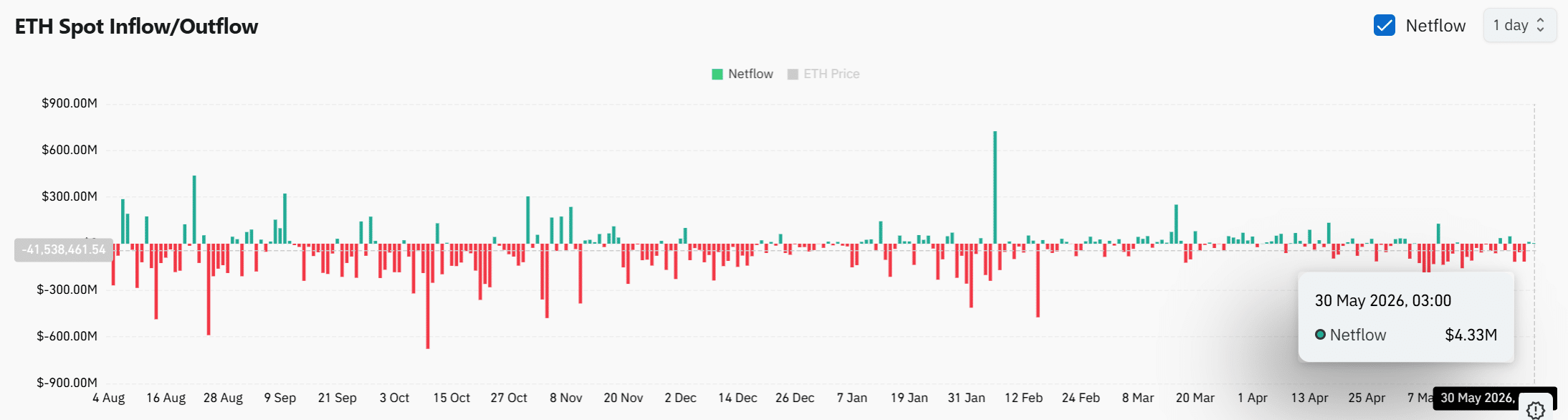
The latest netflow reading showed a modest inflow of approximately $4.33 million, a figure that appeared insignificant compared with the company’s $50.56 million acquisition.
Exchange participants neither rushed to deposit large amounts of ETH nor accelerated withdrawals during the same period.
Instead, flows remained largely neutral, reflecting a market that lacked strong directional conviction. This divergence created an interesting backdrop for Ethereum.
Institutional buyers continued accumulating meaningful amounts of ETH, yet broader exchange behavior failed to signal widespread accumulation.
As a result, market liquidity remained relatively stable. However, persistent treasury purchases could gradually tighten available supply if this trend continued.
Source: CoinGlass
Ethereum approaches a critical decision zone
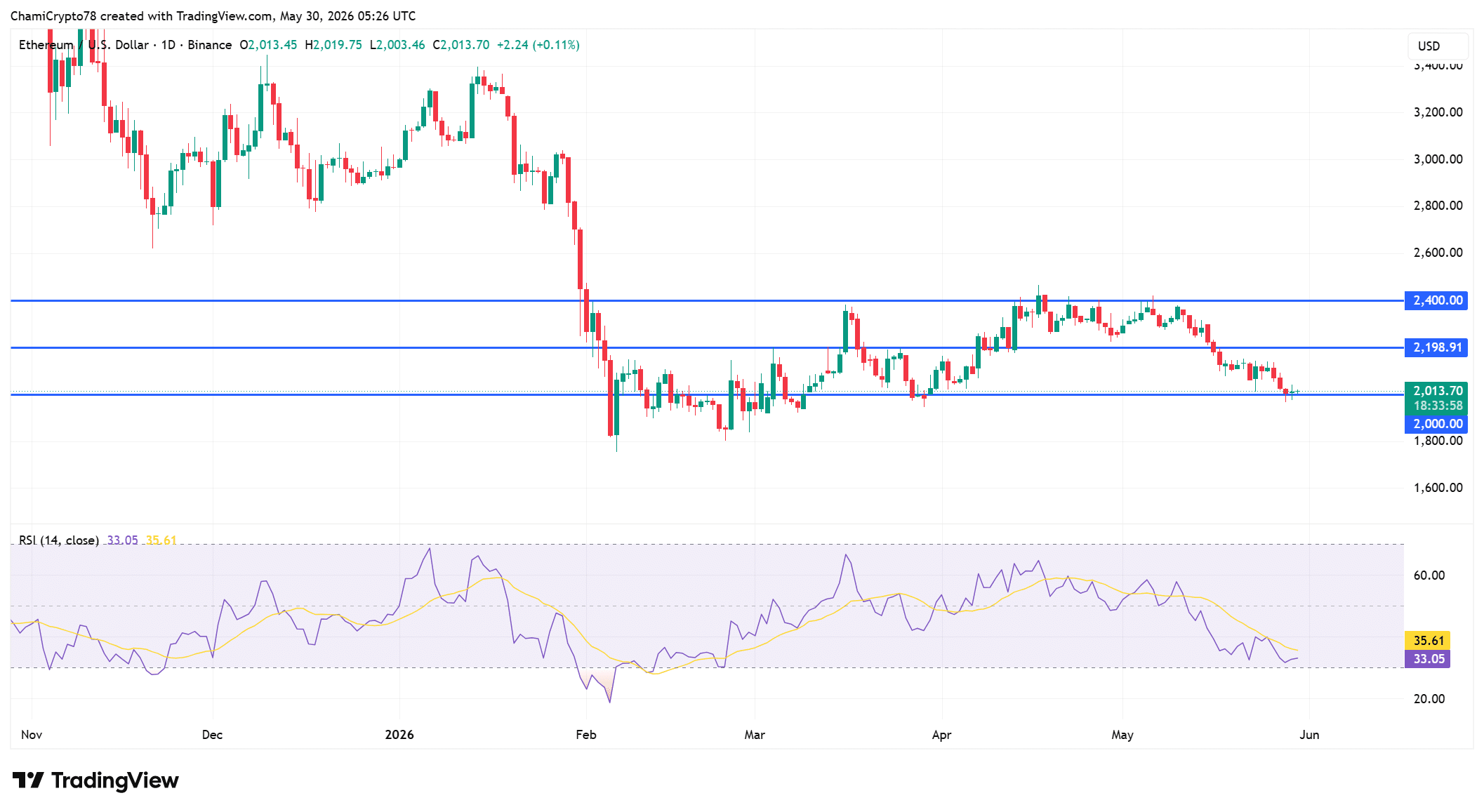
Ethereum traded near the crucial $2,000 support zone after failing to sustain strength above higher resistance levels.
The chart showed repeated rejection around $2,198 before sellers regained control and pushed the price back toward major demand.
Earlier advances also struggled near the $2,400 barrier, reinforcing its importance as a key resistance region. Price held near $2,013 on the daily chart, leaving little room before a deeper decline risk emerged.
Meanwhile, the Relative Strength Index weakened to 33.05, while its moving average stood at 35.61. The readings placed RSI close to oversold territory and reflected fading buying strength throughout May.
However, previous declines toward similar levels often preceded stabilization phases. If buyers defend $2,000 successfully, ETH could attempt a recovery toward $2,198. A breakdown below support would likely shift focus toward lower liquidity zones.
Source: TradingView
Where will liquidity pull ETH?
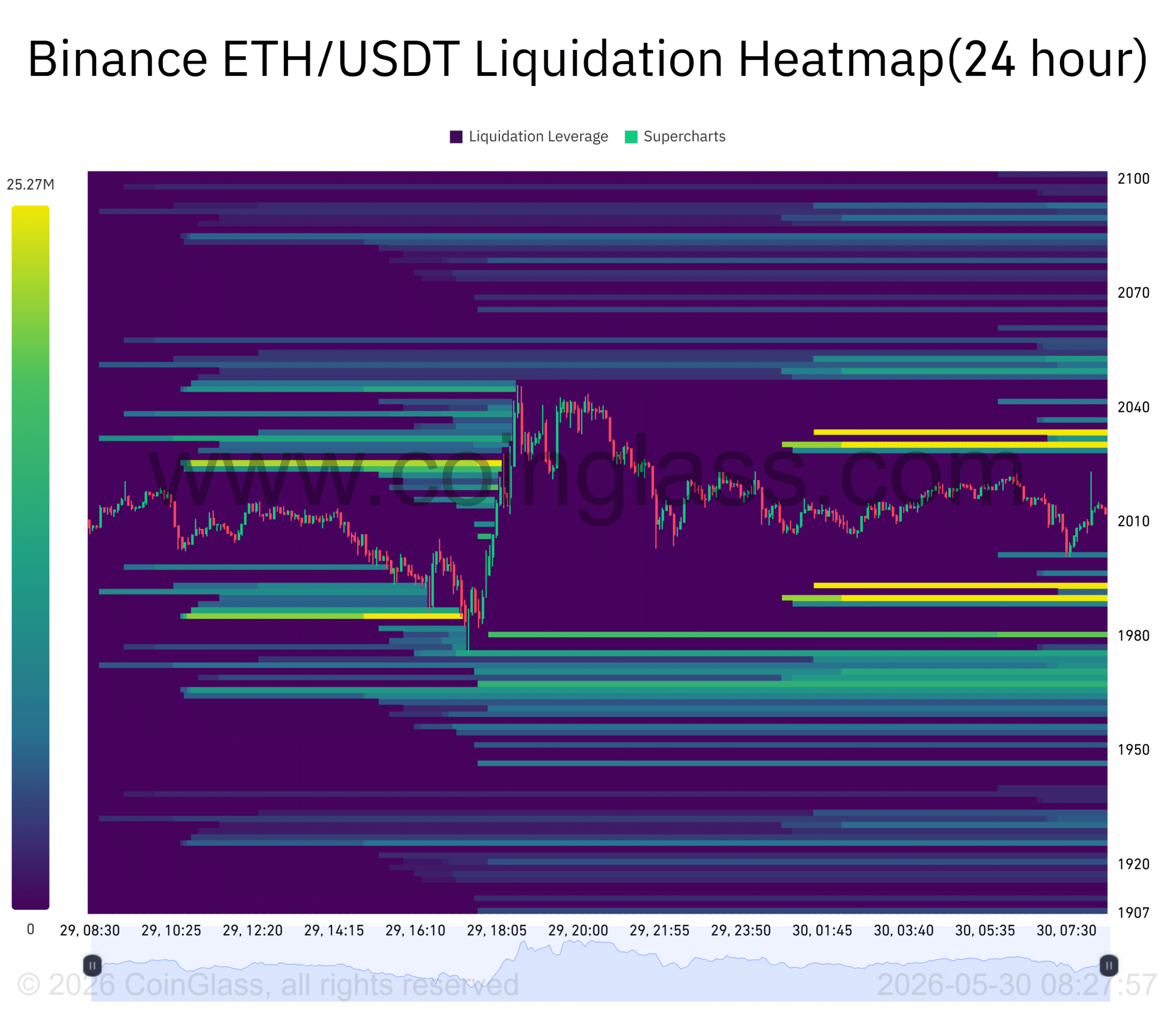
Liquidation data highlighted several key zones that could influence Ethereum’s next move. The heatmap showed dense short liquidation clusters concentrated around the $2,030 to $2,040 range.
These levels sat directly above the current price and represented attractive liquidity targets if buyers regained control. Meanwhile, substantial downside liquidity remained visible between $2,000 and $1,980.
Markets often gravitate toward heavily populated liquidation zones because they provide accessible liquidity. For that reason, both areas deserve close attention. A recovery above $2,030 could trigger a cascade of short liquidations and strengthen bullish pressure.
Alternatively, a break below $2,000 could pull the price toward the lower cluster before meaningful buying interest returned.
Source: CoinGlass
Final Summary
Bitmine continued accumulating ETH while exchange flows remained largely neutral.
Ethereum revisited $2,000 support as RSI approached oversold territory.
On May 14, 2026, Ripple Effect Asset Management disclosed a first-quarter purchase of 739,723 shares of NextDecade(NASDAQ:NEXT), an estimated $4.21 million trade based on quarterly average pricing.
What happened
In a SEC filing dated May 14, 2026, Ripple Effect Asset Management LP reported buying 739,723 additional shares of NextDecade(NASDAQ:NEXT) during the first quarter. The estimated transaction value was $4.21 million, calculated using the period’s average share price. The fund’s quarter-end position in NextDecade rose to 1,339,723 shares, with the value increasing by $7.10 million due to both the purchase and stock price changes.
What else to know
Top five holdings after the filing:
NYSE: XIFR: $26.96 million (18.8% of AUM)
NYSE: KGS: $26.71 million (18.6% of AUM)
NYSE: VST: $15.03 million (10.5% of AUM)
NYSEMKT: IE: $14.66 million (10.2% of AUM)
NYSE: WMB: $11.79 million (8.2% of AUM)
As of May 13, 2026, NextDecade shares were priced at $8.54, up 3% over the past year and well underperforming the S&P 500, which is up 28% in the same period.
Company overview
Metric
Value
Market capitalization
$2 billion
Net income (TTM)
($354.04 million)
Price (as of market close May 13, 2026)
$8.54
Company snapshot
NextDecade develops liquefied natural gas (LNG) export terminals and carbon capture and storage (CCS) projects, with the flagship Rio Grande LNG facility in Texas.
The firm engages in development, liquefaction, and sale of LNG, and in providing CO2 capture and storage solutions for industrial customers, but reported $0 in LTM revenue as of March 31, 2026.
It serves international LNG buyers and industrial clients seeking decarbonization, with operations focused on the U.S. Gulf Coast.
NextDecade is an energy infrastructure developer focused on LNG export and carbon capture projects, based in Houston, Texas. The company is active in the U.S. Gulf Coast and focuses on the development of the Rio Grande LNG terminal and CCS projects with third-party industrial facilities.
What this transaction means for investors
Though it’s important to note Ripple Effect also holds some put options for NextDecade, it appears the fund might believe the market hasn’t fully priced in the firm’s potential.
NextDecade’s Rio Grande LNG project continues moving steadily toward commercialization. As of March, Trains 1 and 2 were nearly 68% complete, while management said the broader Phase 1 project remains ahead of schedule. CEO Matt Schatzman expects the first gas to enter the facility during the second half of 2026 and the first LNG production in the first half of 2027.
Just as important, NextDecade has already started monetizing future production. Earlier this year, the company signed agreements covering more than 175 TBtu of LNG expected to be delivered in 2027 and 2028. Management said those cargoes are projected to generate margins exceeding $3.00 per one million British Thermal Units (MMBtu), providing an early glimpse of the earnings power the facility could eventually produce.
The longer-term opportunity may be even larger. Trains 1 through 5 are under construction, while the company is advancing development plans for Trains 6 through 8, which could add roughly 18 million tonnes per annum of additional liquefaction capacity. And ultimately, if NextDecade delivers Rio Grande LNG on schedule and secures additional long-term contracts, today’s valuation could look very different once the project begins generating meaningful cash flow.
Should you buy stock in NextDecade right now?
Before you buy stock in NextDecade, consider this:
The Motley Fool Stock Advisor analyst team just identified what they believe are the 10 best stocks for investors to buy now… and NextDecade wasn’t one of them. The 10 stocks that made the cut could produce monster returns in the coming years.
Consider when Netflix made this list on December 17, 2004… if you invested $1,000 at the time of our recommendation, you’d have $463,900!* Or when Nvidia made this list on April 15, 2005… if you invested $1,000 at the time of our recommendation, you’d have $1,294,401!*
Now, it’s worth noting Stock Advisor’s total average return is 978% — a market-crushing outperformance compared to 211% for the S&P 500. Don’t miss the latest top 10 list, available with Stock Advisor, and join an investing community built by individual investors for individual investors.
Jonathan Ponciano has no position in any of the stocks mentioned. The Motley Fool has no position in any of the stocks mentioned. The Motley Fool has a disclosure policy.
Traditional financial institutions are preparing to move trillions of dollars of assets onchain, but the risk of hacks and exploits is putting them off, according to blockchain security firm CertiK’s CEO Ronghui Gu.
“Right now, more and more institutions are trying to move assets onchain,” Gu told CoinDesk in an interview. “They imagine that, let’s say in 10 years, multiple trillion dollars — even tens of trillions of dollars — of assets are going to move onchain.”
The potentially massive migration of financial assets is hitting a wall because, although bankers and legacy institutions want to capture the efficiency of decentralized ledgers, the current operational reality is still too risky for conservative capital allocators.
“When they move assets onchain, they need to face all these AI attacks, smart contract vulnerabilities, oracle manipulation, and cross-chain bridge hacks,” Gu explained. “So, that’s being considered as one of the major blockers for all this TradFi to move trillions of dollars of assets onchain.”
Gu said their concerns are legitimate, noting that CertiK detected hacks nearly every day in April, making it the worst month in four years, fueled mostly by AI-driven attacks, notwithstanding “April was the worst month in four years with only three days without a hack,” Gu said, adding that CertiK believes this sudden rise could only be possible with AI.
Drift Protocol and Kelp Dao were hacked by North Korean cybercriminals in April in two exploits that drained nearly $600 million from the two lending crypto pools. In February 2025, Bybit suffered a $1.46 billion attack, described as the biggest hack of all time.
DefiLlama data recently showed more than $1.1 billion had been lost to DeFi hacks in a year, exposing how vulnerabilities in cross-chain infrastructure can quickly spill into the broader ecosystem.
Persistent operational failure is the primary symptom of what Gu calls an “unfair game” in favor of malicious actors, because they possess infinite resources.
Deep pockets
Hackers focus on highly lucrative protocols with massive total value locked (TVL), so they are economically incentivized to pump immense capital into their exploits.
A single protocol attacker can easily spend $10,000 to $20,000 worth of computer tokens to keep advanced engines running continuous vulnerability scans against a protocol for days or weeks on end. Conversely, Gu said, protocol defenders operate under strict, localized project budgetary constraints.
“We have 5,000 clients,” Gu explained. “When we receive a request from a client, there’s a budget. We will spend tokens plus human experts within that budget.” That creates a massive structural gap: while a defense team is bound by a strict commercial contract to scan a protocol over a few hours, the machines of a hacker or group of hackers never stop hunting for a single crack in the code.
Gu said exploits have increased in speed and efficiency with AI and what’s worse is that the nearly-daily trend seen in April could continue through to the end of this year.