Centrifuge [CFG] strengthened its position among the leading tokenized stock platforms. Its Total Value Locked (TVL) still trailed Securitize and Ondo Finance [ONDO].
CFG climbed more than 11% over the past 24 hours despite the SEC delaying tokenized stock trading approvals.
Even so, the token’s daily trading volume dropped 36% to around $25 million, according to CoinMarketCap.
Why is demand rising on Centrifuge?
Data from Centrifuge suggested demand growth continued outpacing capital inflows.
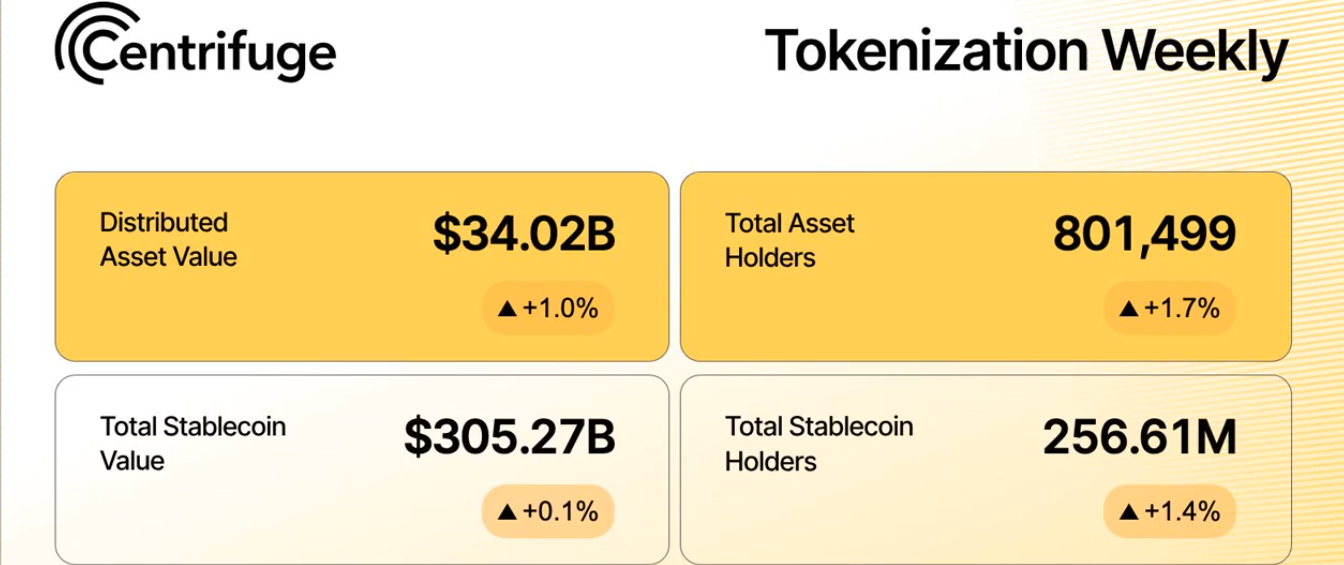
Total Asset Holders rose 1.7% this week to 801,499. At the same time, Total Stablecoin Holders climbed 1.4% to around 256.61 million.
The total number of CFG holders also reached a record 10,150, while Total Unique Addresses stood at 23,008 at press time.
On the other hand, Distributed Asset Value increased only 1% to $34.02 billion. Total Stablecoin Value gained just 0.1% to $305.27 billion.
Source: Centrifuge/X
This gap between holder growth and asset value suggested user demand remained ahead of capital expansion. That trend also hinted that tokenized assets were gradually integrating into platforms that users already transact on.
Why is DEX activity surging?
Apart from holder growth, daily DEX activity also reached new all-time highs.
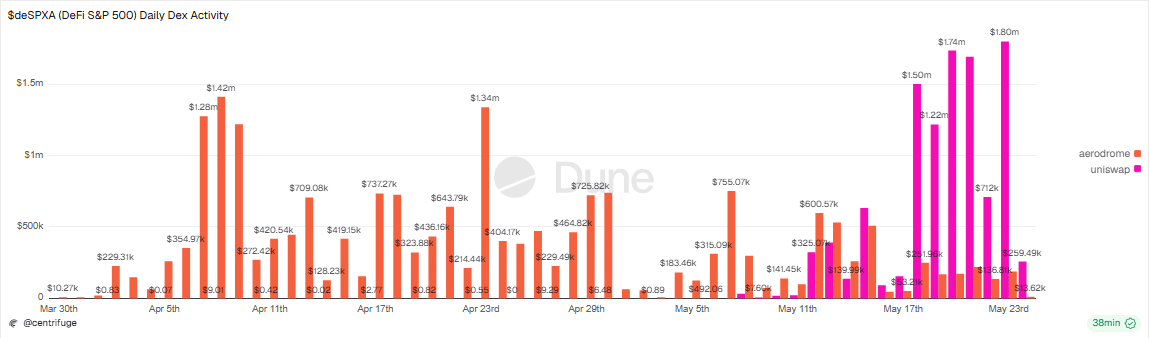
For example, Uniswap’s [UNI] DEX volume for tokenized S&P 500 [deSPXA] climbed to $1.80 million. That was nearly ten times higher than Aerodrome Finance’s [AERO] $189,000 volume.
Source: Dune Analytics
In total, Centrifuge’s deSPXA DEX volume surpassed $21.22 million despite the SEC delaying its tokenization decision.
Other tokenized assets, including JTRSY, JAAA, and ACDRX, held larger TVL than deSPXA. As a result, they also generated higher DEX volume.
Can CFG reclaim its ATH this week?
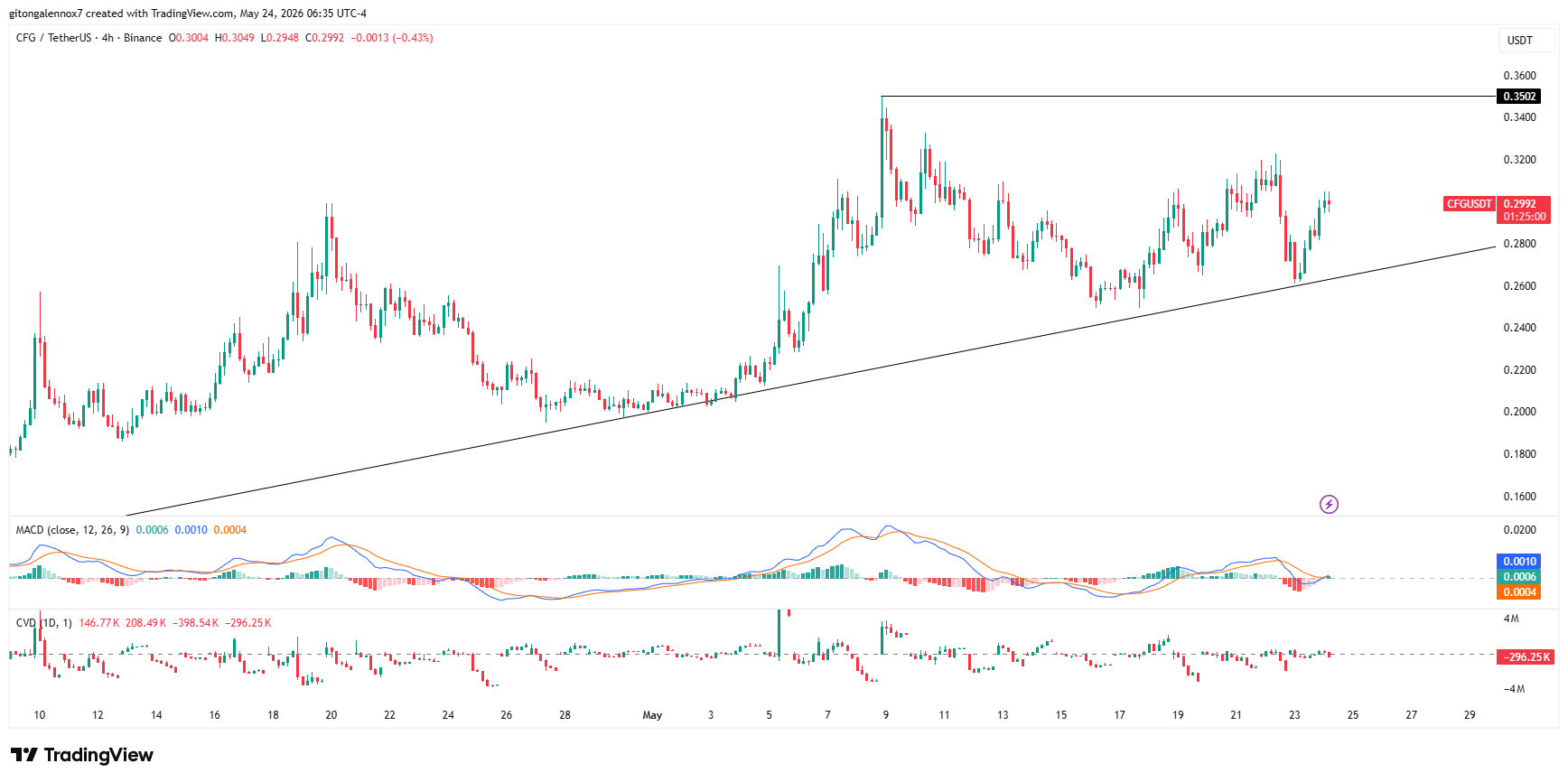
The weekly candle still needed to close near $0.30 to improve the chances of reclaiming CFG’s $0.35 peak. If that happens, Centrifuge could extend its rally next week.
The daily chart showed CFG respecting an ascending trendline support since launch. However, price continued consolidating near recent highs.
Source: CFG/USDT on TradingView
At the same time, MACD bars just turned green, suggesting buyer momentum started strengthening.
The Cumulative Volume Delta (CVD) remained red, showing sellers still held some control. Even so, weakening sell pressure hinted that bears could be losing momentum.
If bulls reclaim the $0.30-$0.32 range, CFG could retest $0.35. For now, the bullish structure remains intact unless the ascending trendline breaks.
Final Summary
Centrifuge rallies by more than 11% as demand surpasses capital inflow from assets and stablecoins.
CFG aims to reclaim its peak value of $0.35 unless the price breaks below the ascending trendline.
Coinbase is not at all concerned with the increasing competition from Wall Street giants or other traditional financial institutions, the crypto exchange’s head of Policy for Europe told CoinDesk on Friday.
“We have always said that a rising tide lifts all ships,” said Katie Harries, adding that Coinbase is “not at all” worried about the increasing involvement of financial institutions in the United States and around the world in crypto.
The company recently posted a loss of $1.49 per share, compared with analyst expectations for a $0.27 profit. Also in the first week of May, Coinbase announced a 14% workforce reduction.
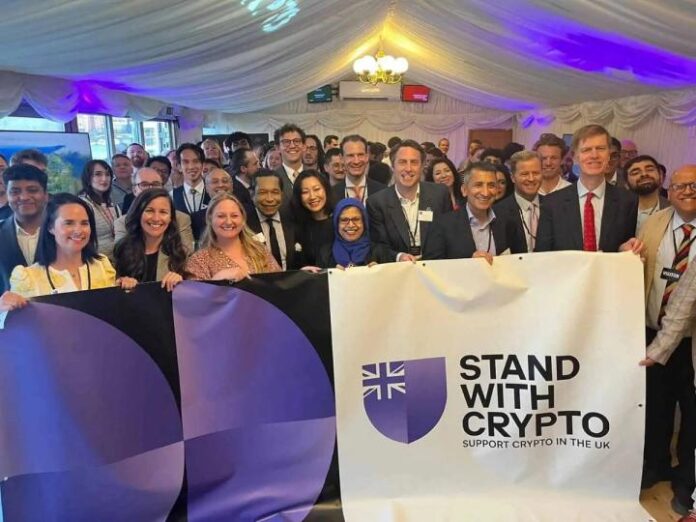
In a brief written interview regarding the Stand With Crypto (SWC) events on Friday, Harries said that the mobilization of people worldwide shows that the established crypto industry has a community behind it that no traditional financial institution can replicate.
“Millions of people around the world chose crypto because they believe in what it represents: open, accessible, peer-to-peer finance,” Harries said. “The people gathered today in London, Paris, New York, Sao Paulo and beyond are not here because a financial institution told them to be. They are here because they believe in this technology and want their governments to support it.”
‘Voters do care about crypto’
Harries also spoke of the American voter. While U.S. citizens do not have crypto top of mind going into the November midterm elections, voters do care about digital assets and have contacted their lawmakers millions of times to let them know, Harries said.
“Voters do care, and the numbers make that clear,” Harries said, refuting recent statements by senators expressing the contrary. “Stand With Crypto has over 3.7 million advocates across six markets. Its members have contacted their lawmakers more than 2.5 million times.”
The Coinbase executive also said that signals “the crypto voter is a permanent fixture in the political landscape, not just in the United States but across the world. Policymakers who have been slow to engage with this community should take note.”
A CoinDesk survey of 1,000 randomly selected U.S. voters across the country showed that just 1% ranked crypto as their top concern. The survey was evenly split between Republican and Democrat respondents (41% of respondents identified with each party to some degree), with a credibility interval of plus or minus 3.53%.
‘Time for sensible regulation is now’
Harries called on regulators worldwide to adopt sensible crypto frameworks, saying the time to do so is now. “The window to shape sensible crypto regulation is open, and the people gathering at the events on Friday are watching.”
SWC is, according to Coinbase, the world’s largest crypto-advocacy organization with over 3.7 million members globally.
Harries’ words come as SWC stages 500 events across four continents and six markets, including the United States, United Kingdom, Canada, Australia, Brazil and the European Union.
The events coincide with Bitcoin Pizza Day, said Coinbase in a statement shared with CoinDesk.
During the global event, a livestream will feature discussions on ecosystem and policy developments worldwide.
Coinbase’s statement notes the event takes place at a critical moment for crypto as market structure legislation advances through the U.S. Congress.
Faryar Shirzad, Chief Policy Officer at Coinbase, a Stand With Crypto partner, said that this Friday, the rally “proves that the crypto voter is a global phenomenon. People around the world want the freedom to exchange value peer-to-peer, and they want their governments to help make that a reality. This hunger for financial progress isn’t confined to any one nation.”
Shirzad also said that “getting crypto regulation right is one of the most critical policy challenges of our generation, and it requires a global effort, not just action in Washington. “
Bitcoin Pizza Day has become a celebrated moment for millions of crypto users, commemorating the first real-world bitcoin transaction. On May 22, 2010, Laszlo Hanyecz paid 10,000 BTC for two pizzas. That bitcoin at current prices is worth roughly over $770 million.
This week, crypto markets saw a clear return of volatility.
Several altcoins posted sharp rallies, while mid-cap tokens saw triple-digit moves on selective momentum and breakout narratives. At the same time, downside pressure hit parts of the market, with assets like Bitcoin Cash and Chiliz breaking key support levels.
Overall, the market shifted into a high-volatility mood driven by rotations rather than broad directional trend.
Weekly winners
Audiera [BEAT] – Ecosystem token topped the chart this week with a triple-digit rally
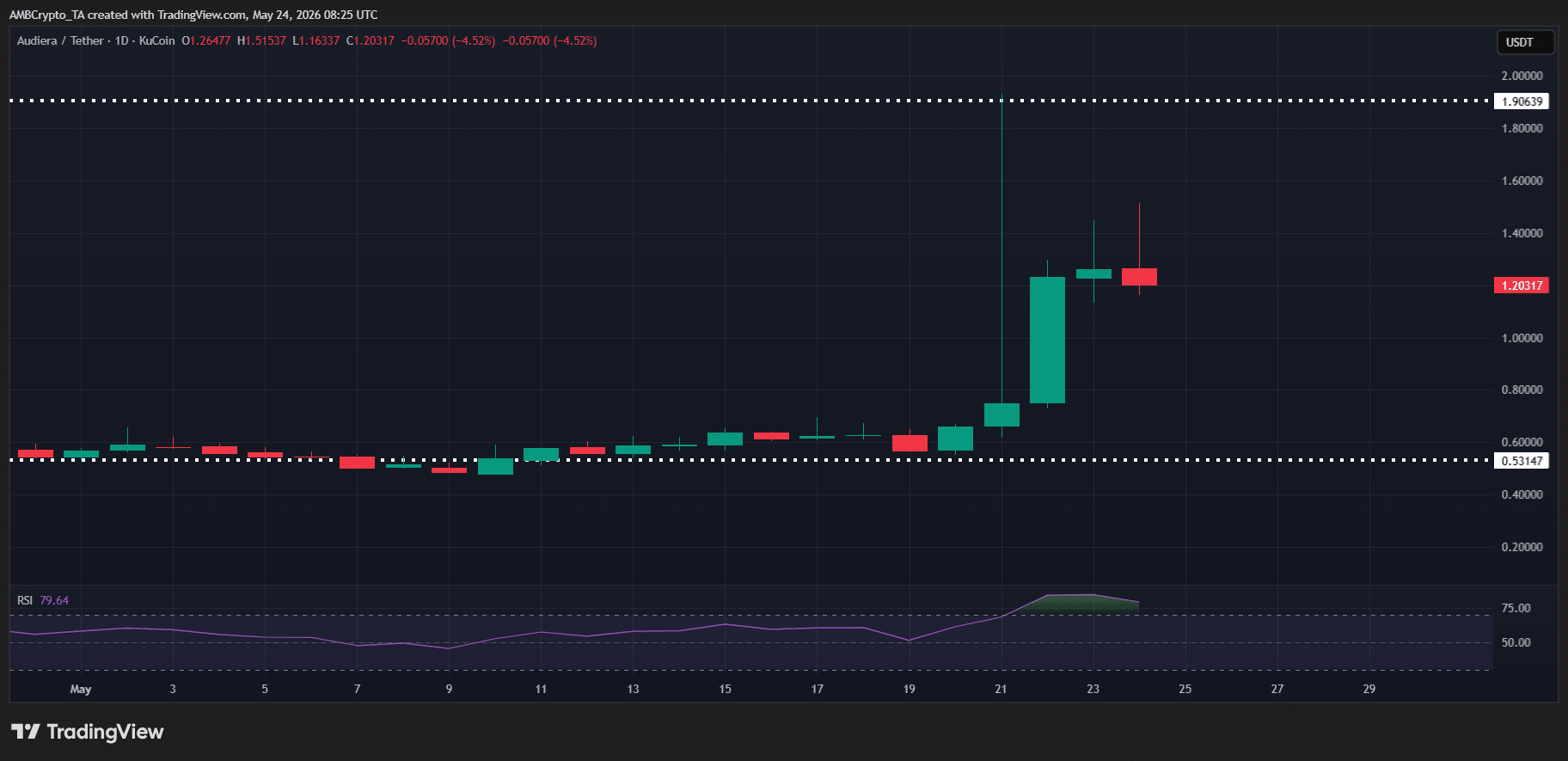
Audiera [BEAT] topped this week’s gainers with a strong 100%+ rally, its first major move since mid-December 2025, sparking clear FOMO and renewed bullish interest.
The key question now is whether bulls stay in control or start taking profits as the move cools off. From a technical standpoint, conditions still look relatively healthy. On the weekly chart, RSI is sitting near 60, which suggests momentum is strong but not overheated yet.
That said, the 4% intraday dip could just be a short-term shakeout rather than a trend reversal. The daily RSI is starting to edge higher, but not fully stretched, and after a 60%+ spike on May 22, some profit-taking from short-term holders is expected. Overall, momentum is still intact, with bulls not yet losing full control.
Source: TradngView (BEAT/USDT)
However, momentum is still intact, with bulls still in control for now.
If this trend continues, BEAT’s current correction could just be a short-term rotation phase, with selling pressure getting absorbed by stronger hands rather than signaling a breakdown. In that case, it could turn into a textbook bear trap, setting up a potential move back toward the $2 level over the next week.
NEAR Protocol [NEAR] – Smart contract platform broke a key psychological level
NEAR Protocol [NEAR] was the second-biggest winner this week with a 60% rally. However, unlike BEAT, its weekly RSI is now getting close to overextended levels.
Still, two bullish signals are worth noting. First, the rally came after a brief ~4% weekly dip that formed a second higher low since mid-February, suggesting underlying bullish strength has stayed intact.
Second, the price broke above the $2.4 resistance level this week, adding momentum and attracting fresh buyer interest. Overall, the structure still leans bullish. If momentum continues, NEAR could make a move toward $2.5 in the near term.
Hyperliquid [HYPE] – Decentralized token tied hit a new all-time high this week
Hyperliquid [HYPE] was the third-biggest gainer this week, up 35% and continuing its strong uptrend. Like NEAR, the price action shows bullish divergence supporting the overall structure.
The main driver behind the move is growing institutional interest, including reports of Bitwise ETF-related buying activity, along with improving network fundamentals. This helped HYPE break above $65. From a technical view, this is a breakout phase where price discovery takes over after resistance is cleared.
If momentum holds, the move could extend further, with dips getting bought as long as flow stays strong.
Other notable winners
Outside the majors, altcoin movers also stood out this week.
Block Street [BSB] led the action with a 169% surge, followed by Railgun [RAIL], which climbed 127.6%, while Bonfida [FIDA] gained 103.7%, rounding out the week’s strongest movers.
Weekly losers
Chiliz [CHZ] – Engagement token ended the week with bears regaining control
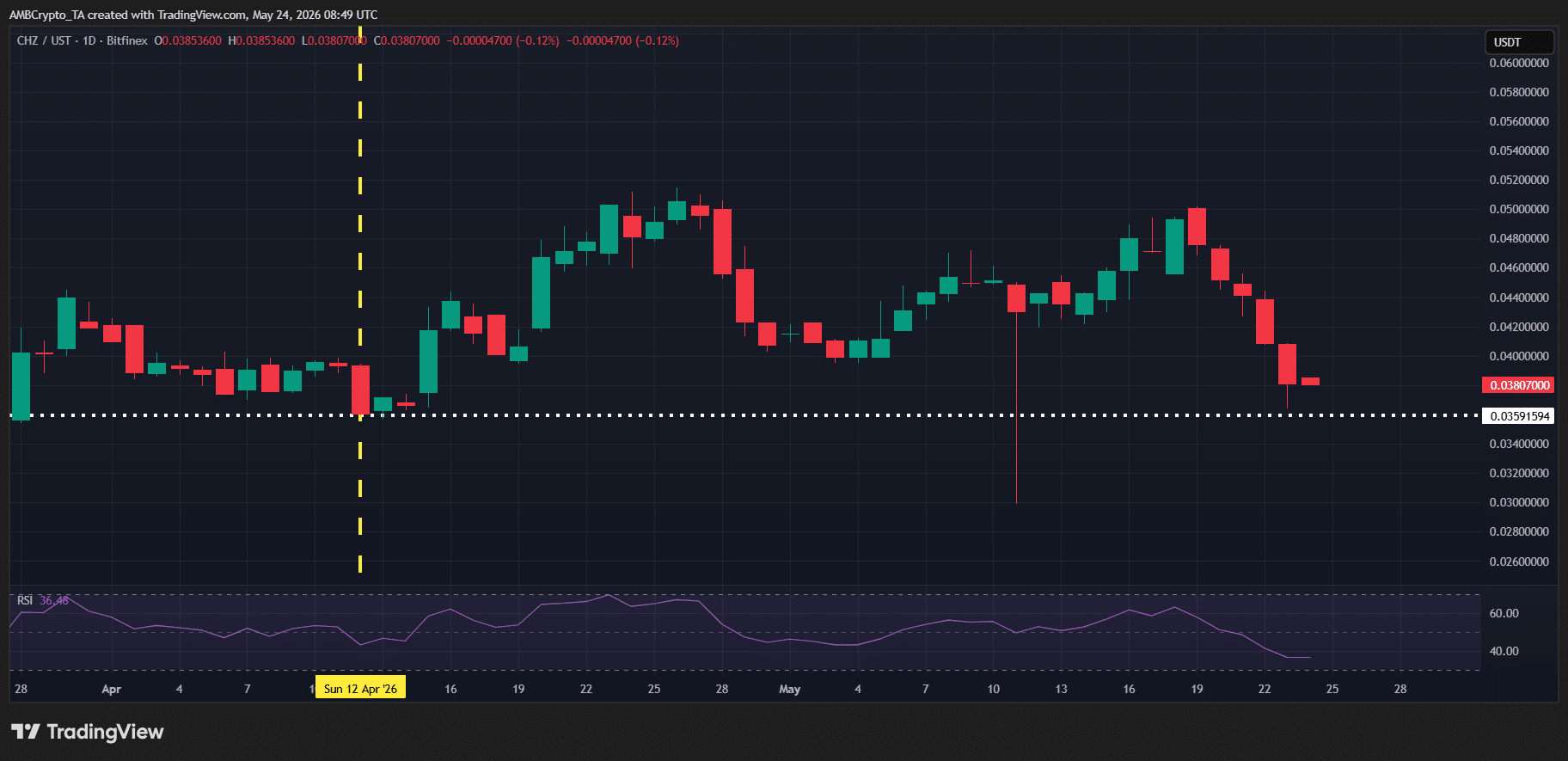
Chiliz [CHZ] was the worst performer this week, falling nearly 20%. On the daily chart, it has already slipped below the $0.04 support level, keeping the short-term structure bearish.
On the weekly view, CHZ is now nearing early April support around $0.035, where buyers previously stepped in. RSI is also getting closer to oversold territory, which could open the door for a bounce.
That said, momentum is still weak, with seven straight red daily candles showing consistent selling pressure. If buyers don’t step in soon, a break below the April support level becomes a real risk.
Source: TradingView (CHZ/USDT)
Naturally, this makes CHZ a high-risk setup for now.
For any recovery to build, the key things to watch are rising trading volume and early signs of bullish momentum. Until that happens, the structure stays weak and downside risk remains in control.
Bitcoin Cash [BCH] – Payment token slipped lower after breaking a key support
Bitcoin Cash [BCH] was the second-biggest weekly loser, down about 13%. Unlike some other coins, this looks like a more sustained breakdown, which makes it a riskier setup.
From a technical angle, the decline follows a similar ~12.8% pullback from previous weeks, but this time buyers have shown even less response.
More importantly, BCH has now slipped below the $450 level it had been holding since its mid-May 2025 rally. That shift turns the short-term bias bearish and raises the chance of a deeper correction if support doesn’t come back quickly.
Humanity [H] – Blockchain project saw a textbook post-rally cooldown
Humanity [H] was the third-biggest weekly loser, down 13.3%. However, unlike other altcoins, its structure hasn’t fully turned bearish yet.
On the weekly chart, this pullback comes after six straight weeks of gains that previously pushed price back toward early November 2025 levels. During that move, H also broke above the key $0.25 resistance zone, which is now acting as a key level where bulls and bears are fighting for control.
On the daily chart, price action is more of a consolidation than a sharp breakdown, suggesting buyers are still defending dips. If this holds, H could be setting up for a short squeeze, with a potential move back toward $0.30 in the coming weeks.
INI [INI] led the losers with a 70.4% decline, followed by BUILDon [B], which fell 34.3%, while CommonWealth [CWU] dropped 33.2% as market momentum cooled.
Conclusion
This week was a rollercoaster. Big pumps, sharp dips, and nonstop action. As always, stay sharp, do your own research, and trade smart.
Final Summary
Audiera [BEAT], NEAR Protocol [NEAR], Hyperliquid [HYPE] led the week in gains.
Chiliz [CHZ], Bitcoin Cash and Humanity [H] saw significant declines.
Your jaunt to the beach on Memorial Day will cost you.
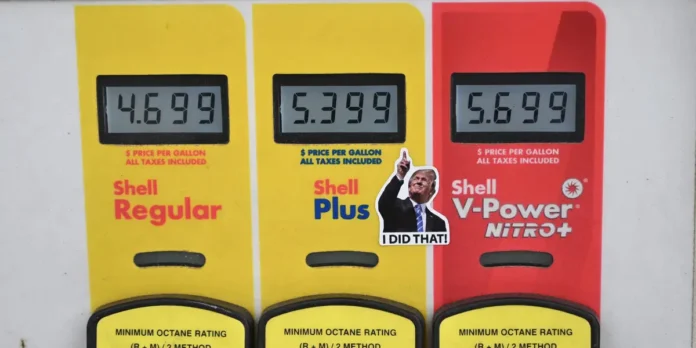
The current national average for regular gas is $4.51, the highest it’s been since 2022, when Russia launched its full-scale invasion of Ukraine, causing a spike in oil prices.
The current price of gas is 4 cents higher than a month ago and $1.32 higher than the same time last year. As of Sunday, California has the highest average at $6.11, while Indiana has the lowest at $3.93.
Memorial Day marks the unofficial start of summer, and millions of Americans will travel to cookouts, parties, and vacation destinations to celebrate. AAA projects almost 40 million people will drive at least 50 miles from home between Thursday and Monday.
That’ll now cost over $200 in most states.
“Travel demand remains strong, and despite higher fuel prices, many people are prioritizing leisure travel during holiday breaks,” Stacey Barber, vice president of AAA Travel, said in a statement.
This summer’s escalating prices are largely due to the US and Israel’s war on Iran. Iran all but closed the Strait of Hormuz — a waterway through which around 20% of the world’s oil supply and liquefied natural gas pass through — following those initial attacks. As a result, oil and gas prices have spiked worldwide, forcing some countries to enact energy-saving measures.
President Donald Trump said on Saturday that a deal between the US and Iran to reopen the Strait of Hormuz is “largely negotiated.”
“Final aspects and details of the Deal are currently being discussed, and will be announced shortly,” Trump wrote in a Truth Social post. “In addition to many other elements of the Agreement, the Strait of Hormuz will be opened.”
Investors shouldn’t doubt that Upstart(NASDAQ: UPST) is an innovative company. It has introduced what it believes is an upgrade to the traditional loan credit-rating system. The business leverages its machine learning and artificial intelligence (AI) capabilities to expand credit access to more borrowers. Since 2014, it has facilitated $57 billion in loan originations.
This platform model, though, hasn’t translated into a winning outcome for investors. This fintech stock currently trades 92% below its late-2021 high. Maybe there are better days ahead.
Will AI create the world’s first trillionaire? Our team just released a report on a little-known company, called an “Indispensable Monopoly,” providing the critical technology Nvidia and Intel both need.
Does Upstart have what it takes to double its current share price in five years?
Image source: Getty Images.
The business is hitting its stride again
During the first quarter of 2026 (ended March 31), Upstart posted strong year-over-year revenue growth of 44%. This top-line gain was driven by a 77% jump in loan volumes. The platform is clearly seeing robust demand for loans, of which 91% were completely automated from start to finish.
Upstart reported adjusted earnings before interest, taxes, depreciation, and amortization (EBITDA) of $40.5 million in Q1, good for a 13% margin. Management expects this margin to rise to 21% for the full year. Maybe this can lead to positive, generally accepted accounting principles (GAAP) earnings for Upstart, though expenses rose faster than revenue during the quarter.
This is welcome news for investors who might still have bad memories about the company’s poor performance not that long ago. In 2023, amid rising interest rates, Upstart’s revenue tanked 39% year over year. And it registered a worrying $257 million operating loss that year. The business appears to be hitting its stride again.
Shares may rise 100% by 2031
Between 2025 and 2028, consensus estimates from sell-side analysts call for Upstart’s revenue to grow at an annualized pace of 30.8%. This is an extremely encouraging outlook. Given the company’s ability to quickly expand, as it demonstrated last quarter, this sales prediction doesn’t look crazy.
So, this fintech stock may double over the next five years, particularly if revenue gains translate into a sizable earnings stream. Upstart operates in massive lending verticals that are collectively measured in the trillions of dollars in annual origination volume. The market size is large enough for durable growth.
And the valuation, currently at a price-to-sales ratio below 2.7, isn’t demanding. There’s upside simply because shares trade 92% off their peak. Improving market sentiment can boost the stock price.
But the issue is that Upstart has proven to be very cyclical. Its success depends on a favorable macro backdrop, which isn’t always the case. And it hasn’t demonstrated that it can report growth and profits in adverse scenarios.
The stock could double by 2031. The probability I’d assign to this outcome, though, is low.
Should you buy stock in Upstart right now?
Before you buy stock in Upstart, consider this:
The Motley Fool Stock Advisor analyst team just identified what they believe are the 10 best stocks for investors to buy now… and Upstart wasn’t one of them. The 10 stocks that made the cut could produce monster returns in the coming years.
Consider when Netflix made this list on December 17, 2004… if you invested $1,000 at the time of our recommendation, you’d have $477,813!* Or when Nvidia made this list on April 15, 2005… if you invested $1,000 at the time of our recommendation, you’d have $1,320,088!*
Now, it’s worth noting Stock Advisor’s total average return is 986% — a market-crushing outperformance compared to 208% for the S&P 500. Don’t miss the latest top 10 list, available with Stock Advisor, and join an investing community built by individual investors for individual investors.
Neil Patel has no position in any of the stocks mentioned. The Motley Fool has positions in and recommends Upstart. The Motley Fool has a disclosure policy.
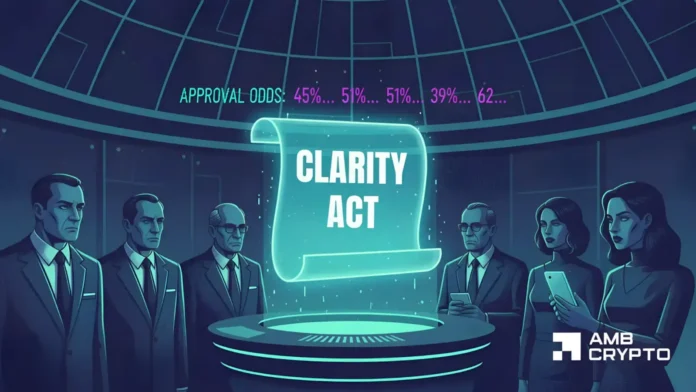
Efforts to pass the CLARITY Act have repeatedly stalled. Each time momentum builds for its approval, new obstacles emerge.
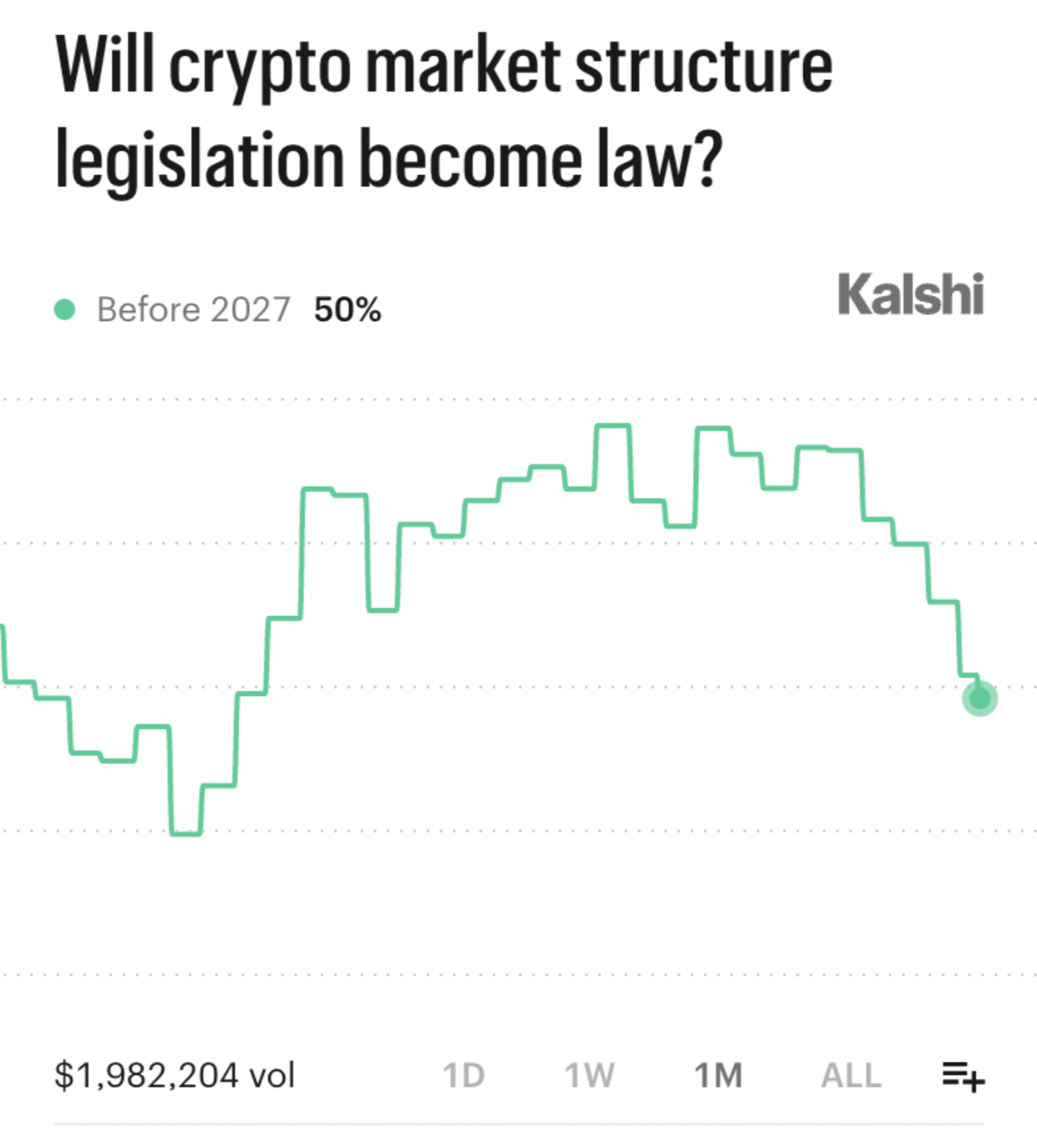
On the 23rd of May, Kalshi reported that the likelihood of the CLARITY Act passing before 2027 dropped from nearly 75% last week to 50%.
Source: Kalshi/X
The likelihood of approval before July 2026 has fallen to 14%, while the chances of passage before August have dropped to 37%.
Commenting on the delay, Senator Cynthia Lummis noted that Wyoming acted before the U.S. federal government could, underscoring the state’s proactive approach. She said,
Wyoming didn’t wait for Washington to figure out digital assets. We built the framework ourselves. I didn’t come to the U.S. Senate to slow that down, I came here to scale it—and that’s exactly what my bill, the Clarity Act, does.
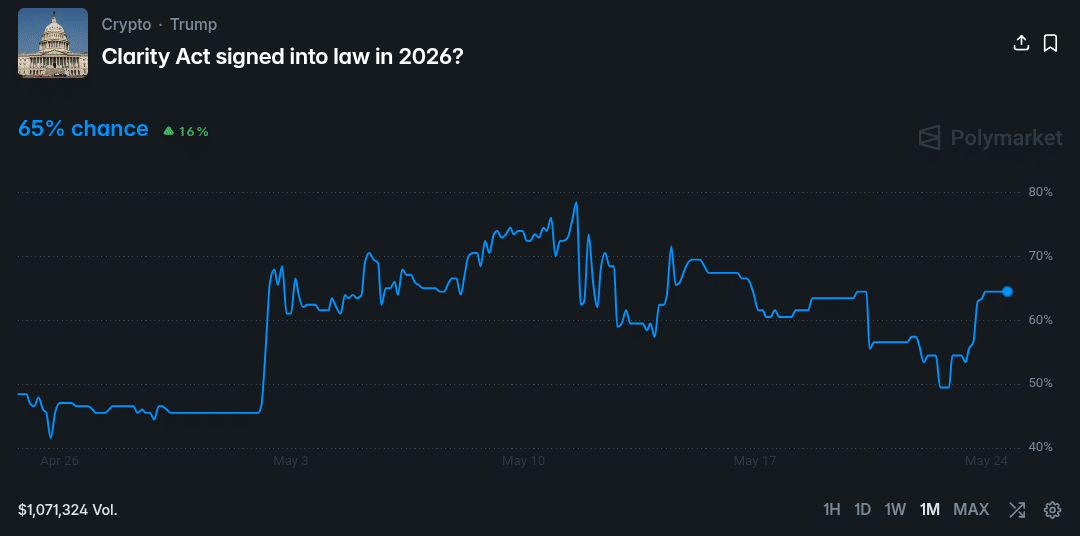
Interestingly, Polymarket odds appeared to show some positive movement shortly after her remarks. At the time of writing, the chances of the law being passed in 2026 had increased by 16% over the previous month, to 65% once more.
Source: Polymarket
What is driving the disparity?
That said, there could be several reasons for these disparate approval odds related to the CLARITY Act.
On the 14th of May, during a markup session, the Senate Banking Committee passed the CLARITY Act by a vote of 15 to 9. However, numerous amendments are to be made before the final floor vote. Meanwhile, the influential banking lobby continues to push for a ban on stablecoin yield and raises complex ethical concerns.
More recently, analysts have raised concerns about the possible effects of “yield-bearing” stablecoins, stating that they may upset established banking models. JPMorgan Chase CFO Jeremy Barnum echoed this caution, emphasizing the risks of allowing stablecoins to generate yield.
Final Summary
The CLARITY Act odds on prediction market declines suggest losing optimism around the approval.
Senator Lummis’s stance on Wyoming suggests that some are still optimistic of the CLARITY Act.
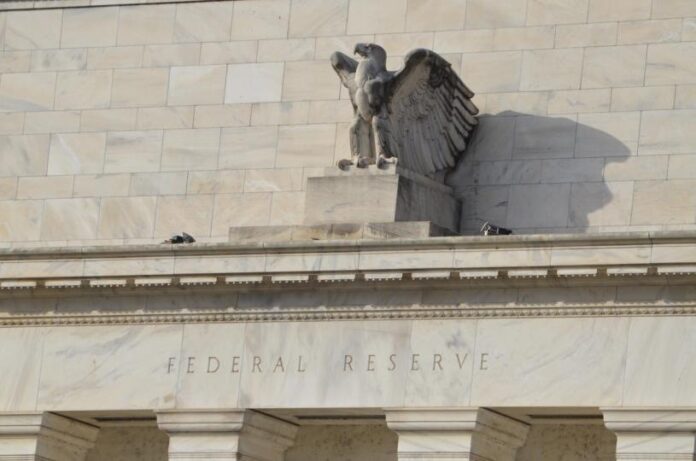
The Federal Reserve published the latest version of its proposal to create a “skinny” master account, updating the proposal first published last December. In the same week, President Donald Trump signed an executive order directing the greater integration of digital assets with existing payment networks.
You’re reading State of Crypto, a CoinDesk newsletter looking at the intersection of cryptocurrency and government. Click here to sign up for future editions.
The narrative
U.S. President Donald Trump signed two executive orders this past Tuesday. One directed the broader government to update existing regulations to better integrate crypto into payment systems, while the other directed the Treasury Department and regulators to strengthen Bank Secrecy Act regulations. The next day, the Federal Reserve Board published its updated proposal for a skinny master account, laying out more detail about its approach to granting crypto firms access to its payment rails.
Why it matters
The crypto industry’s integration with the broader federal payments system is certainly a goal for the industry at large. Last week’s proposals may bring that a step closer.
Breaking it down
The Federal Reserve’s proposal on Wednesday updates its skinny master account request for information first published in December 2025, laying out how the central bank envisions granting fintech and crypto firms access to its payment rails without requiring them to be full fledged, Office of the Comptroller of the Currency-chartered banks.
The fintech-focused order directed federal regulators to review their existing policies to evaluate how they regulate financial institutions and identify rules that might block fintech firms from partnering with regulated entities.
The order also directed the Fed to review how it handles uninsured depository institutions and their access to payment accounts.
Part of that review includes having the Federal Reserve member banks evaluate if they can independently grant payment accounts to entities.
The Fed cannot necessarily do all of this on its own; Congress may need to pass legislation further detailing what types of entities may be qualified for an account.
The BSA-focused order directs the U.S. Treasury Department and regulators to issue guidance to banks and other entities.
“My Administration will not tolerate national security and public safety risks caused by illicit cross-border financial activity, nor will it permit risks to our financial system posed by the extension of credit or financial services to the inadmissible and removable alien population,” Trump’s order said.
This would include an advisory that notes “payroll tax evasion,” shell companies and “the strategic use of unregistered money services businesses, third-party payment processors, or peer-to-peer platforms to facilitate ‘off-the-books’ wage payments intended to bypass Bank Secrecy Act reporting thresholds or tax obligations,” among other types of entities.
While the order did not explicitly mention cryptocurrency or decentralized finance trading platforms, they could get caught up in any ultimate guidance, said Nicholas Anthony, a research fellow at the Cato Institute.
The next question is what might be in the guidance and advisory.
“Right now it’s in the hands of the Treasury, and the Treasury is able to apply it not only however it sees fit, but also to whoever it sees fit, because of the broader power that the Treasury has under the Bank Secrecy Act,” he said.
Senate shenanigans
The Senate Banking Committee voted to advance the Clarity Act just over a week ago.
The expectation was the overall Senate might get to this sometime in the next month, to sort out ethics and other outstanding issues and then vote on whether to send the bill to the House of Representatives. That timeline took a bit of a hit Thursday, when the Senate left town for the Memorial Day recess without voting on a reconciliation bill to fund the Department of Homeland Security, among other things.
The issue is this: There’s really only so much time to get stuff done on the Senate floor. There are 19 working days in June and 15 in July. There’s another five in August and then everyone’s gone for the rest of the summer.
In that time, the Senate has to sort through reconciliation, a renewal of the Foreign Intelligence Surveillance Act (which will expire in mid-June) and possibly a housing bill.
Adding to the tension is the reason why the Senate left town. President Donald Trump’s administration wanted $1 billion for his planned East Wing ballroom and more recently another $1.8 billion for a weaponization fund, which members of both parties have referred to as a “slush fund.” The Senate had already dropped the ballroom funding from the bill, but the other $1.8 billion appeared to be too much to negotiate this week.
Negotiations over these issues — if there isn’t any backroom dealing through the recess — can draw out the negotiation process, further limiting floor time for Clarity. And of course, there’s still the ethics provision itself in the market structure bill. The White House hasn’t yet indicated what exactly it might accept, so that’s another negotiation to watch out for.
This week
The House and Senate are on recess this week.
If you’ve got thoughts or questions on what I should discuss next week or any other feedback you’d like to share, feel free to email me at nik@coindesk.com or find me on Bluesky @nikhileshde.bsky.social.
You can also join the group conversation on Telegram.