Home Blog Page 422

Morgan Stanley sends clear message on Take-Two stock ahead of GTA VI

0
Morgan Stanley sends clear message on Take-Two stock ahead of GTA VI


Take-Two Interactive (TTWO) just delivered one of the cleanest earnings beats the company has posted in years, and Morgan Stanley isn’t changing its tune.

The Wall Street firm maintained its Overweight rating and $280 price target on TTWO after Take-Two’s fiscal fourth quarter results, which landed on May 21.

Bookings beat estimates by 3%, and EPS came in 77% above Morgan Stanley’s own forecast, driven by broad strength across GTA Online, NBA 2K, Red Dead Redemption, and the Zynga mobile segment.

The bigger signal, though, isn’t the quarter. It’s what Morgan Stanley said about the six months ahead.

The firm sees GTA VI’s confirmed November 19 launch as a structurally rare setup for TTWO shares, one where investor attention is rising while near-term execution risk remains limited.

That combination has historically been a meaningful tailwind for gaming publisher stocks.

GTA VI launches November 19, 2026, in what Morgan Stanley calls one of the largest entertainment releases in history.Bloomberg / Getty Images

What Morgan Stanley’s $280 target actually means for TTWO investors

Morgan Stanley’s $280 price target is based on a discounted cash flow model that assumes a roughly 8% weighted-average cost of capital and 3% long-term growth.

At the current share price of $238.08, that implies approximately 18% upside to the base case. The bull case sits at $360, a 51% premium, while the bear case is $170, reflecting a 29% downside.

Overweight, in Morgan Stanley’s rating system, means the firm expects TTWO’s total return to exceed the average for its coverage universe over the next 12 to 18 months, on a risk-adjusted basis.

More Entertainment Stocks:

It is not a Buy rating in the traditional sense, but it carries similar directional conviction.

Notably, 96% of analysts tracked by Investing.com currently rate TTWO as a Strong Buy, with consensus price targets ranging from $170 to $320. The average sits at $279.51, roughly in line with Morgan Stanley’s view.

What the bull thesis requires to hold up

For Morgan Stanley’s base case to play out, four conditions need to stay on track:

  • GTA VI launches on November 19 with no further delays.

  • Unit sales reach approximately 40 million in fiscal year 2027, matching Morgan Stanley’s base estimate.

  • Zynga mobile continues recovering, after posting its highest bookings since the acquisition in Q4.

  • In-game monetization remains healthy across GTA Online and NBA 2K.

The historical pattern that’s driving Morgan Stanley’s confidence

Morgan Stanley’s analysis of prior major game launches shows a consistent pattern: publisher stocks average 18% appreciation in the six months preceding a highly anticipated release, as Morgan Stanley Research reports.


Source link

AI agents are starting to pay with crypto as Coinbase, Stripe and Visa want in, Keyrock report says

0
AI agents are starting to pay with crypto as Coinbase, Stripe and Visa want in, Keyrock report says

Artificial intelligence (AI) agents autonomously spending money online is still a tiny market, but some of the world’s largest tech, payments and crypto firms are already racing to build the infrastructure for it, Keyrock said in a new report.

The crypto trading and investment firm estimated that AI agents settled over $73 million across roughly 176 million transactions on blockchain rails between May 2025 and April 2026.

The volumes remain negligible compared to traditional finance (TradFi). Visa, for example, alone processes $14.5 trillion annually. But the significance lies less in the headline U.S. dollar value and more in how quickly the infrastructure stack is forming, the report argued. Global firms such as Coinbase (COIN), Stripe, Google (GOOG) and Visa (V) all rolled out competing systems for machine-to-machine payments.

The broader idea behind agentic payments is that software increasingly consumes digital services autonomously rather than through human-managed subscriptions and accounts. An AI trading agent, for example, could continuously purchase market data, cloud computing or AI-generated analysis in tiny increments throughout the day without a human authorizing each payment manually.

That potential is driving ambitious forecasts how big the agentic payment sector could grow. Gartner projects AI agents could intermediate $15 trillion in purchases by 2028, while McKinsey estimated retail agentic commerce could reach $3 trillion-$5 trillion by 2030, according to the Keyrock report.

Those projections imply growth rates even faster than stablecoins experienced during their breakout years, the report said, but said the pace of infrastructure deployment already signals the market is moving beyond its experimentation phase.

Coinbase’s x402 protocol has emerged as one of the leading crypto-native systems. The protocol allows AI agents to pay directly with USDC for services such as blockchain analytics or cloud infrastructure without creating accounts or subscriptions.

Stripe, with its Tempo blockchain, launched a competing framework called Machine Payments Protocol (MPP), while Google introduced AP2, a system focused on delegated spending authorization for AI agents. Visa has extended its card network with tokenized credentials designed for AI-driven commerce.

Crypto rails and stablecoins are emerging as the preferred settlement layer, and the economics help explain why.

Some 76% of agent transactions fall below the 30 cent fixed-fee floor common in card payments, according to the report. Most payments ranged between one and 10 cents, making traditional rails impractical for automated software agents buying data, AI inference or API access. Meanwhile, stablecoin settlement on some blockchains like Base and Tempo costs fractions of a cent.

Currently, 98.6% of machine payments settle in USDC, the stablecoin issued by Circle (CRCL). That solidifies Circle’s position in crypto payments, but also introduces risk of concentration, creating dependency on a single issuer.

Regulation could be a source of constraint for the growth. MiCA in Europe, the U.S. GENIUS Act and the EU AI Act are all expected to take effect around mid-2026, yet none of them directly address autonomous machine-to-machine transactions or questions around liability and agent identity, the report noted.


Source link

ONDO rebounds 10%, but traders still lean bearish – Can $0.4 hold?

0
ONDO rebounds 10%, but traders still lean bearish – Can $0.4 hold?


With geopolitical tensions potentially easing and hopes of a U.S./Iran peace deal building, the crypto market saw renewed demand.

Amid this shift in sentiment, Ondo Finance [ONDO] rebounded from a $0.37 dip, defended the $0.4 support level, and climbed to $0.44.

At press time, ONDO traded at $0.42, up 10.45% on the daily chart. However, trading volume dropped 32%, signaling lower market participation.

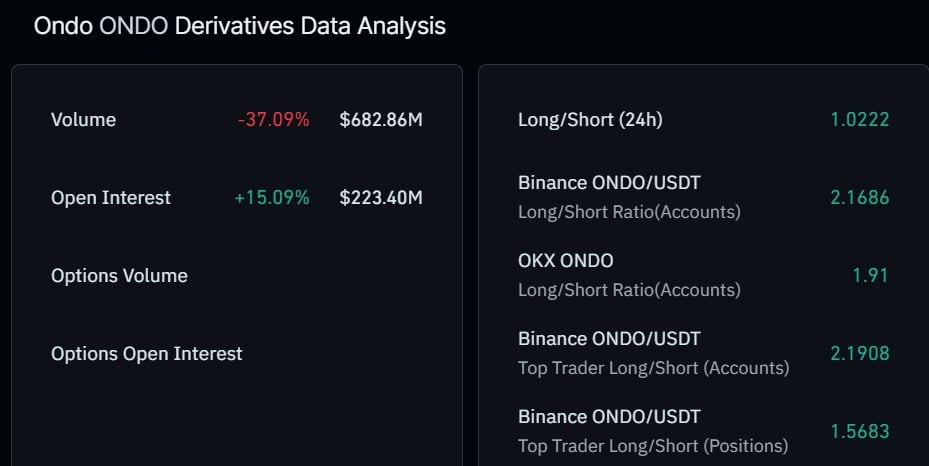
As the market recovered, traders opened new leveraged positions. Open Interest [OI] jumped 15% to $223 million, while Derivatives Volume fell 37% to $682 million.

ONDO Open Interest
Source: CoinGlass

The rise in OI suggested leverage was building quietly, but traders remained cautious. Higher OI alongside weaker Derivatives Volume often preceded stronger breakouts or sharper pullbacks.

For now, ONDO’s market structure still reflected hesitation.

Why are ONDO spot traders still selling?

Despite the rebound, ONDO spot investors remained largely skeptical. Traders continued cashing out even small gains.

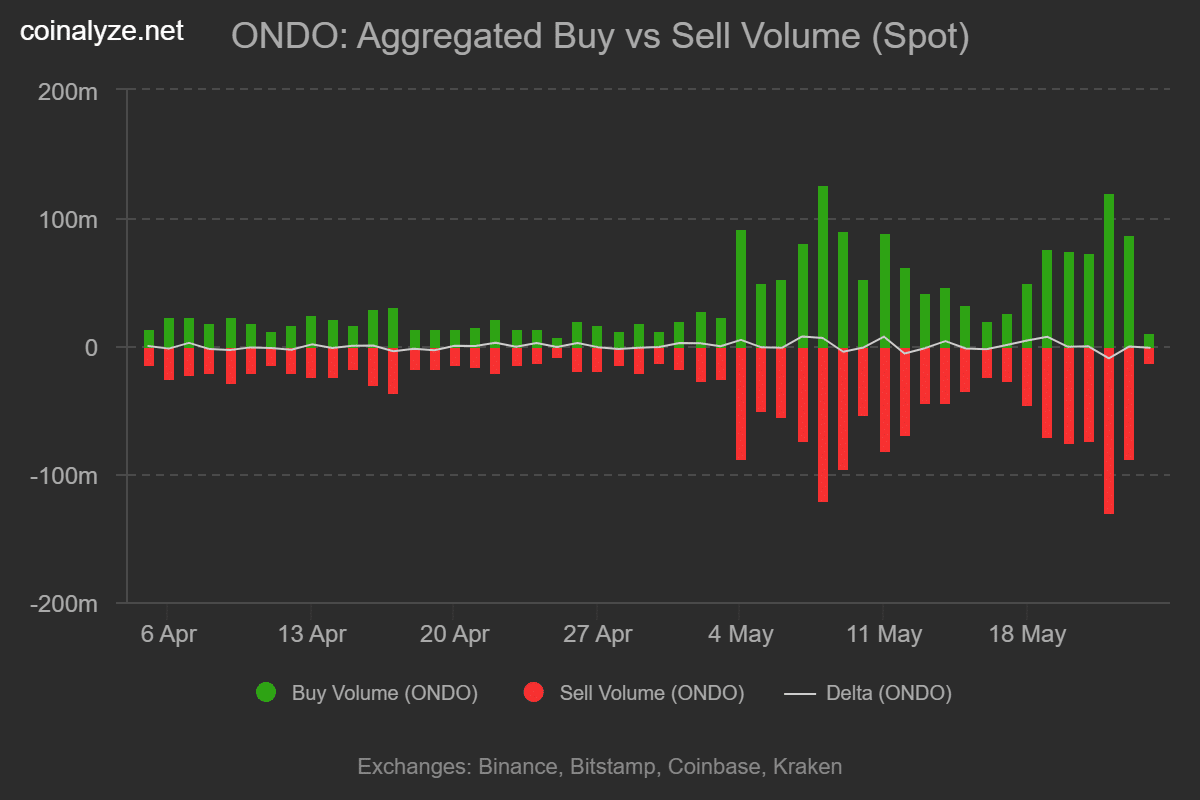
According to Coinalyze data, sellers dominated the market for five consecutive days. Sales volume reached 101 million over the past 24 hours.

ONDO buy sell volumeONDO buy sell volume
Source: Coinalyze

At the same time, buy volume dropped to 99 million, leaving the market with a negative delta. This trend persisted over several sessions, signaling aggressive Spot selling pressure.

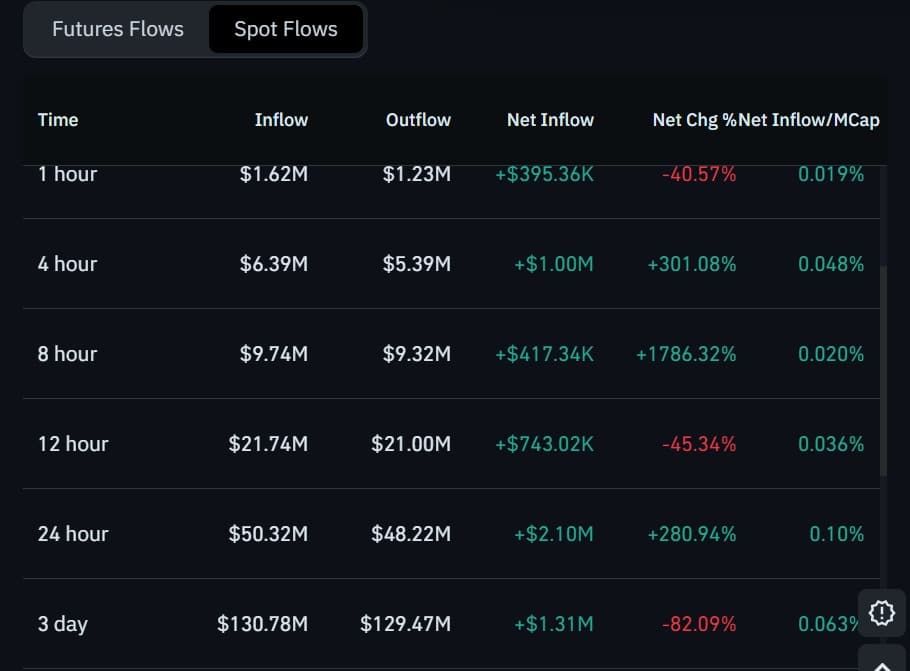
On top of that, exchange flows reinforced the same bearish pattern. Over the past 24 hours, $50.32 million moved into exchanges compared to $48.2 million in outflows.

ONDO spot flowsONDO spot flows
Source: CoinGlass

As a result, Spot Netflow rose 280% to $2.1 million, confirming continued selling pressure. Historically, rising Spot Netflow weakened market structure and increased downside risk.

Can ONDO sustain this rebound?

ONDO showed signs of recovery as market sentiment improved and investor fears cooled.

Even so, traders remained cautious and continued taking profits into strength. That kept both bulls and bears active around key resistance.

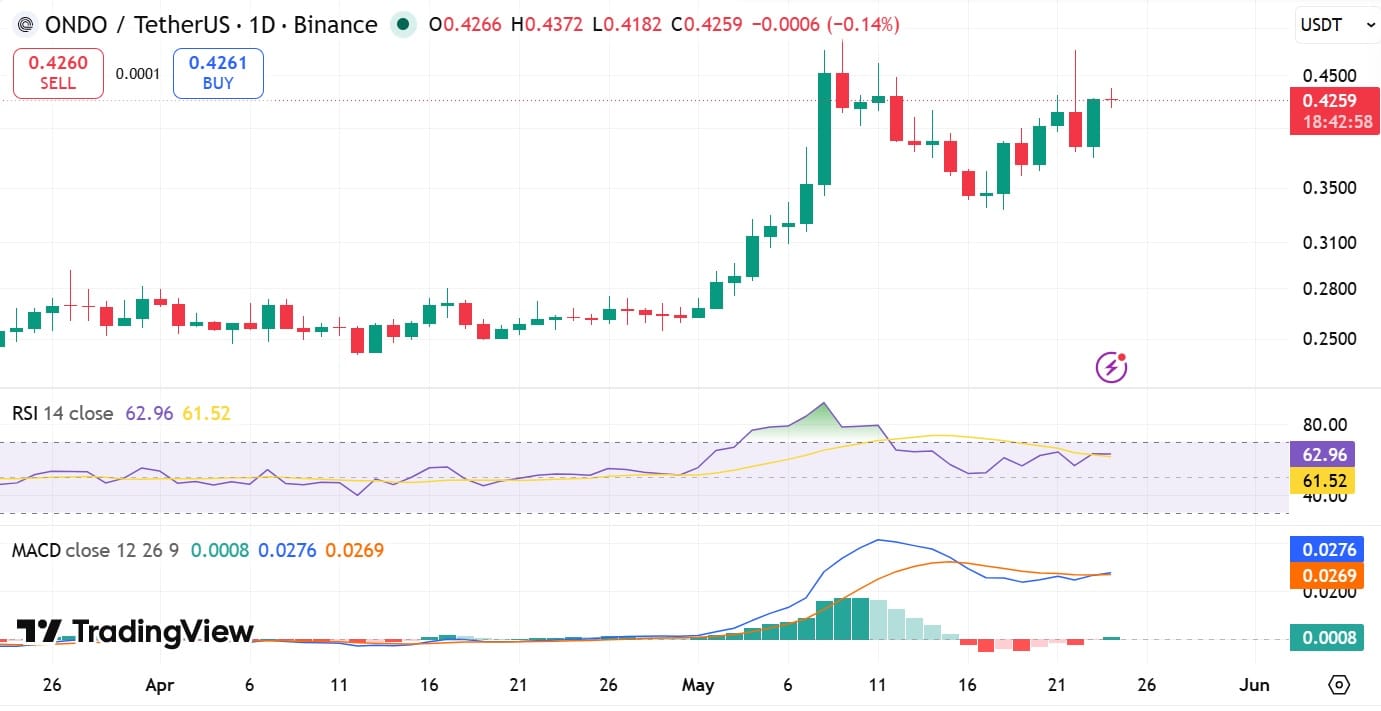
The Relative Strength Index (RSI) remained elevated at 63, while its signal line stood at 61. This showed that both buying and selling activity remained intense.

ONDO RSI & MACDONDO RSI & MACD
Source: TradingView

Likewise, the MACD line rose to 0.027, while the signal line climbed to 0.26. That alignment reflected an ongoing battle for short-term control.

These indicators suggested the next move could depend on which side gained momentum first.

If demand strengthens further, ONDO could reclaim the $0.47 resistance and target $0.5 next. By contrast, continued profit-taking could drag the altcoin below $0.4 and back toward $0.37.


Final Summary

  • Ondo Finance [ONDO] rebounded 10.45% after defending the $0.4 support level.
  • Open Interest rose 15% to $223 million, signaling growing leveraged positioning in the market.


Source link

Amtrak California Zephyr Journey: What I’d Do Differently Next Time

0
Amtrak California Zephyr Journey: What I'd Do Differently Next Time


Another way to save money on my next California Zephyr journey would be to travel with a friend or family member. When booking my trip, I checked the price of the bedroom for two travelers, and it was only $300 more. So splitting the total cost would have saved me hundreds.

More importantly, though, I think having company would make the journey more fun.

Don’t get me wrong, I enjoyed passing the time by reading, playing video games, and listening to music and podcasts. But for me, these hours might be better spent having conversations or playing cards with someone I love.


Source link

Remitly Global (RELY) Launches Remitly Business in Canada Following Over 30% Send Volume Growth

0
Remitly Global (RELY) Launches Remitly Business in Canada Following Over 30% Send Volume Growth


Remitly Global Inc. (NASDAQ:RELY) is one of the best new tech stocks with highest upside potential. On May 12, Remitly announced the general availability of Remitly Business in Canada, making it the platform’s third live market alongside the US and UK. Designed specifically for small and medium-sized business owners rather than corporate treasury teams, the B2B cross-border payment platform has seen rapid adoption. In Q1 2026, Remitly Business experienced a sequential send volume growth of over 30%, with more than 20,000 active businesses using the service.

To further streamline operations for its users, Remitly Global Inc. (NASDAQ:RELY) is introducing two new features for its US customers: Bulk Payments and Send by Link. Bulk Payments allows business owners to pay multiple international contractors and suppliers simultaneously within a single workflow. Send by Link minimizes transfer errors and data security risks by allowing senders to initiate payments using only a recipient’s email and phone number, leaving the recipient to securely input their own sensitive banking information.

Remitly Global (RELY) Launches Remitly Business in Canada Following Over 30% Send Volume Growth

The expansion into Canada builds on a decade of local operations, supported by a Vancouver-based office, registration under Canada’s Retail Payment Activities Act, and a localized payment network that includes Interac e-Transfers. Currently, Remitly Business is active across the US, UK, and Canada, while Send by Link is generally available in the US, and Bulk Payments is undergoing a phased rollout to select US clients.

Remitly Global Inc. (NASDAQ:RELY) provides financial services, specifically cross border remittance services, globally. The company is based in Seattle, Washington.

While we acknowledge the potential of RELY as an investment, we believe certain AI stocks offer greater upside potential and carry less downside risk. If you’re looking for an extremely undervalued AI stock that also stands to benefit significantly from Trump-era tariffs and the onshoring trend, see our free report on the best short-term AI stock.

READ NEXT: 33 Stocks That Should Double in 3 Years and Cathie Wood 2026 Portfolio: 10 Best Stocks to Buy. 

Disclosure: None. Follow Insider Monkey on Google News.


Source link

How the StablR exploit drained $10.4M via unbacked stablecoin issuance

0
How the StablR exploit drained $10.4M via unbacked stablecoin issuance


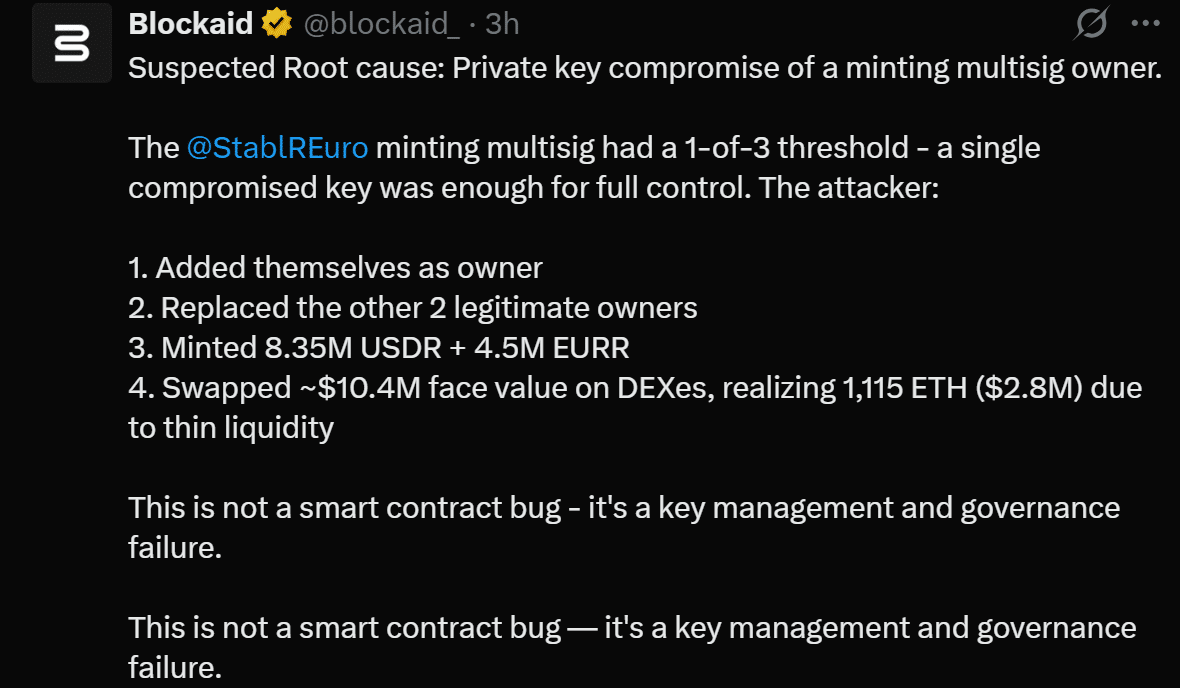
Stablecoin governance risks have resurfaced after the StablR exploit exposed deeper weaknesses in administrative issuance infrastructure. Market participants also became cautious once attackers bypassed collateral safeguards through compromised multisig authority access beneath weaker controls.

Attackers later exploited the vulnerable 1-of-3 minting structure and gained effective control over EURR minting permissions. That breach allowed unauthorized minting of unbacked stablecoins without requiring equivalent euro collateral deposits underneath.

Shortly after the compromise was disclosed, on-chain activity revealed abnormal signer behavior and rapid mint flows. That sequence reflected how weaker multisig thresholds can quietly transform administrative access into broader systemic issuance risk.

Still, reserve backing systems remained intact despite growing concerns around governance-layer fragility and stablecoin integrity.

What appeared designed as distributed protection ultimately behaved like centralized control once operational safeguards started failing beneath real market stress.

StablR multisig breach pressures stablecoin confidence

Governance-layer fragility first exposed StablR’s core weakness once attackers compromised the low-threshold 1-of-3 minting multisig structure. From there, they gained effective control over issuance authority without exploiting the underlying smart contracts directly.

That access later allowed attackers to bypass collateral verification and mint roughly 8.35 million USDR alongside another 4.5 million EURR without matching reserves underneath.

Source: X

Selling pressure accelerated immediately once the unbacked supply entered circulation across thinner decentralized liquidity pools. EURR then collapsed toward roughly $0.86, while USDR slipped beneath the broader $0.80 region as traders rushed toward exits.

Attackers eventually swapped nearly $10.4 million worth of newly minted tokens and extracted around 1,115 ETH beneath deteriorating liquidity conditions.

The exploit reinforced how weaker operational safeguards can destabilize stablecoin trust faster than traditional code vulnerabilities during stressed market environments and volatile liquidity conditions.

Stablecoin trust shifts toward governance security

The StablR exploit had already exposed how weak governance controls can quickly damage stablecoin confidence during active market conditions. Institutions later became more cautious once repeated exploits exposed deeper weaknesses across minting and approval systems.

Peg stability now hinges on how securely issuers manage token creation and reserve access. Capital is shifting toward stablecoins with stronger wallet protections and stricter approval rules.

While reserve backing continues to support confidence, long‑term trust and institutional participation increasingly depend on robust operational safeguards across global stablecoin markets.


Final Summary


Source link

Clarity Act could usher in a new era of crypto ‘yield-as-a-service’

0
Clarity Act could usher in a new era of crypto ‘yield-as-a-service’

The Clarity Act’s biggest outcome may be the creation of an entirely new market for “yield-as-a-service,” according to Joe Vollono, chief commercial officer at stablecoin infrastructure firm STBL.

At the center of the debate is Section 404 of the proposed legislation, which would prohibit Digital Asset Service Providers (DASPs) and their affiliates from offering yield solely as a function of holding a digital asset.

The provision could fundamentally reshape how crypto users earn returns, pushing the market away from passive “hold-to-earn” products and toward more active, compliant yield-generation strategies.

“What this effectively does is shift the industry from a hold-to-earn market to a use-to-earn market,” Vollono told CoinDesk in an interview. “You’re going to need compliant yield strategies to generate rewards on what would otherwise be idle capital.”

The Clarity Act has already cleared the Senate Banking Committee and is now expected to move into the full Senate to be merged with the Senate Agriculture Committee version of the bill before House reconciliation, with an optimistic timeline pointing to a full vote as early as July. Regulators would then have roughly 12 months to implement the framework.

Vollono, who spent more than seven years at Morgan Stanley and served at SIFMA, where he worked on industry advocacy and market structure issues, said the implications of the Clarity Act extend far beyond yield products themselves. Regulatory clarity, he argued, could finally unlock large-scale institutional participation in crypto markets.

“Once these issues are resolved, it allows capital at scale to enter the market,” he said. “That’s the real catalyst here.”

Passage of the Clarity Act is widely viewed as a potential inflection point for crypto markets because it would establish the first comprehensive U.S. regulatory framework for digital assets, ending years of uncertainty over whether and how tokens fall under Securities and Exchange Commission (SEC) or Commodity Futures Trading Commission (CFTC) jurisdiction.

The legislation would create clearer rules for exchanges, brokers, stablecoin issuers and decentralized finance platforms, a move many analysts say is necessary before large institutional investors, banks and asset managers can commit capital at scale. Supporters argue that regulatory clarity could reduce legal risk, improve consumer protections and give traditional financial firms the compliance framework needed to build crypto products and services in the U.S. rather than offshore.

The role of AI

The likely result, Vollono said, is the emergence of a middle layer of infrastructure providers focused on compliant yield generation. He said he expects many of those services to be powered by artificial intelligence acting as an orchestration layer for regulated capital flows.

Among the potential beneficiaries are decentralized finance (DeFi) infrastructure providers, vault curators, collateral management platforms, automated treasury services, lending markets and rewards systems.

“All of this can be automated by AI in a regulated market,” he said.

The underlying technology stack already exists, Vollono said, pointing to smart contracts, oracles, DeFi rails and API-based infrastructure that could be adapted to fit within a regulated framework.

“This creates a whole new world,” he said.

Legislation

The debate around the legislation has also exposed tensions between traditional banks and the crypto industry, particularly over stablecoins and deposit migration.

“There’s a lot at stake,” Vollono said. “Banks are worried about deposit flight, but I think that concern is largely overstated.”

He said that the traditional fractional reserve banking model depends on banks maintaining large capital bases that can be lent out to create credit and liquidity. If deposits migrate into tokenized dollars or yield-bearing blockchain products, that model could come under pressure.

Still, Vollono said he sees the eventual compromise as beneficial for incumbents rather than existentially threatening.

“Smart incumbents are going to compete,” he said. “Banks don’t necessarily have to give up market share.”

He suggested banks could eventually collateralize reserves to issue their own stablecoins and generate compliant yield under the Clarity framework, opening the door to entirely new business models.

Stablecoin 2.0

That dynamic is central to STBL’s own pitch.

The company describes itself as “stablecoin 2.0,” arguing for a shift away from the traditional centralized issuer model that dominates the market today.

Instead, STBL is building infrastructure that allows users to mint real-world-asset-backed stablecoins while retaining the economics generated by the underlying reserves.

“Users that provide value into the ecosystem should participate in the economics,” Vollono said.

The company’s infrastructure is designed to support compliant yield management while allowing users, rather than centralized issuers, to capture the yield generated by reserve assets.

For Vollono, the Clarity Act could provide the regulatory framework needed to accelerate that transition. “I’ll tell you what the Act makes clear: money-as-a-service has arrived,” he added.

Read more: Crypto Clarity bill has 30% chance of passing this year, Wintermute’s Hammond says


Source link