
Stablecoin governance risks have resurfaced after the StablR exploit exposed deeper weaknesses in administrative issuance infrastructure. Market participants also became cautious once attackers bypassed collateral safeguards through compromised multisig authority access beneath weaker controls.
Attackers later exploited the vulnerable 1-of-3 minting structure and gained effective control over EURR minting permissions. That breach allowed unauthorized minting of unbacked stablecoins without requiring equivalent euro collateral deposits underneath.
Shortly after the compromise was disclosed, on-chain activity revealed abnormal signer behavior and rapid mint flows. That sequence reflected how weaker multisig thresholds can quietly transform administrative access into broader systemic issuance risk.
Still, reserve backing systems remained intact despite growing concerns around governance-layer fragility and stablecoin integrity.
What appeared designed as distributed protection ultimately behaved like centralized control once operational safeguards started failing beneath real market stress.
StablR multisig breach pressures stablecoin confidence
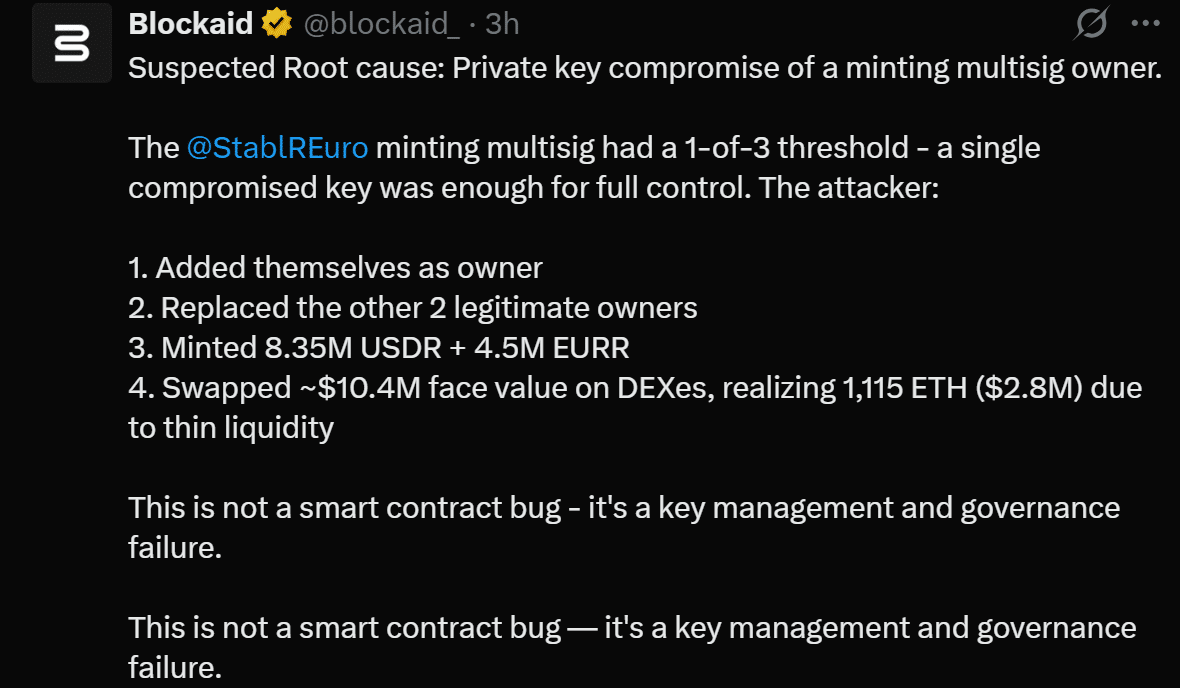
Governance-layer fragility first exposed StablR’s core weakness once attackers compromised the low-threshold 1-of-3 minting multisig structure. From there, they gained effective control over issuance authority without exploiting the underlying smart contracts directly.
That access later allowed attackers to bypass collateral verification and mint roughly 8.35 million USDR alongside another 4.5 million EURR without matching reserves underneath.
Selling pressure accelerated immediately once the unbacked supply entered circulation across thinner decentralized liquidity pools. EURR then collapsed toward roughly $0.86, while USDR slipped beneath the broader $0.80 region as traders rushed toward exits.
Attackers eventually swapped nearly $10.4 million worth of newly minted tokens and extracted around 1,115 ETH beneath deteriorating liquidity conditions.
The exploit reinforced how weaker operational safeguards can destabilize stablecoin trust faster than traditional code vulnerabilities during stressed market environments and volatile liquidity conditions.
Stablecoin trust shifts toward governance security
The StablR exploit had already exposed how weak governance controls can quickly damage stablecoin confidence during active market conditions. Institutions later became more cautious once repeated exploits exposed deeper weaknesses across minting and approval systems.
Peg stability now hinges on how securely issuers manage token creation and reserve access. Capital is shifting toward stablecoins with stronger wallet protections and stricter approval rules.
While reserve backing continues to support confidence, long‑term trust and institutional participation increasingly depend on robust operational safeguards across global stablecoin markets.