Home Blog Page 423

Crypto liquidations reach $941.76 mln amid geopolitical uncertainty – A bloodbath ahead?

0
Crypto liquidations reach $941.76 mln amid geopolitical uncertainty - A bloodbath ahead?


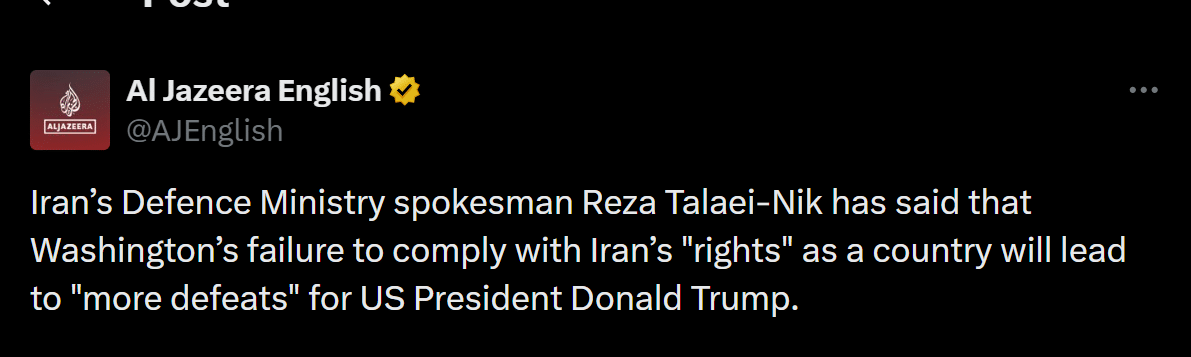
Geopolitical tension recently intensified after Iran warned Washington against challenging its national rights during fragile nuclear negotiations.

Markets also turned increasingly defensive as traders began anticipating stronger sanctions risks and broader regional instability.
Source: X

Bitcoin [BTC] slipped by roughly 5.6% across the past week, while Ethereum [ETH] and broader altcoins also weakened beneath rising uncertainty.

That pressure increasingly reflected growing fears around stricter AML enforcement and heavier scrutiny across offshore crypto liquidity venues.

Bitcoin ETFs also recorded nearly $1.26 billion in weekly outflows, while Ethereum ETFs lost roughly $215 million beneath softer institutional sentiment. Still, Solana [SOL] and Ripple [XRP] products continued attracting selective inflows despite broader market weakness.

That divergence increasingly suggested investors are reducing risk exposure carefully rather than fully abandoning crypto-market participation.

Rising oil prices deepen crypto’s macro vulnerability

Broader geopolitical tension had already weakened crypto sentiment before rising oil prices added fresh pressure across global liquidity markets.

Earlier sanctions fears and stalled US-Iran negotiations had already pushed traders toward increasingly defensive positioning across risk assets.

Brent crude later climbed toward the broader $103–105 region as supply disruption concerns continued strengthening beneath escalating macro uncertainty.

That environment increasingly fueled inflation fears while reducing appetite for liquidity-sensitive assets like crypto and technology equities.

Bitcoin and Ethereum also experienced sharper volatility during recent geopolitical escalation windows beneath weakening market confidence.

Ethereum remained more vulnerable because higher-beta assets usually weaken faster once liquidity conditions tighten globally. Still, Bitcoin continued showing relatively stronger stability despite elevated macro sensitivity and broader institutional caution.

That balance increasingly suggested crypto markets remain heavily tied to geopolitical and liquidity-driven macro conditions.

Crypto liquidations surge beneath geopolitical market stress

Geopolitical pressure had already weakened crypto sentiment before cascading liquidations accelerated volatility across leveraged derivatives markets.

Oil price shocks and sanctions fears also pushed traders toward increasingly defensive positioning beneath softer liquidity conditions.

Liquidation data later showed nearly $941.76 million erased across crypto markets within 24 hours. Long positions absorbed roughly $871.44 million of those losses, while short liquidations remained near only $70.31 million.
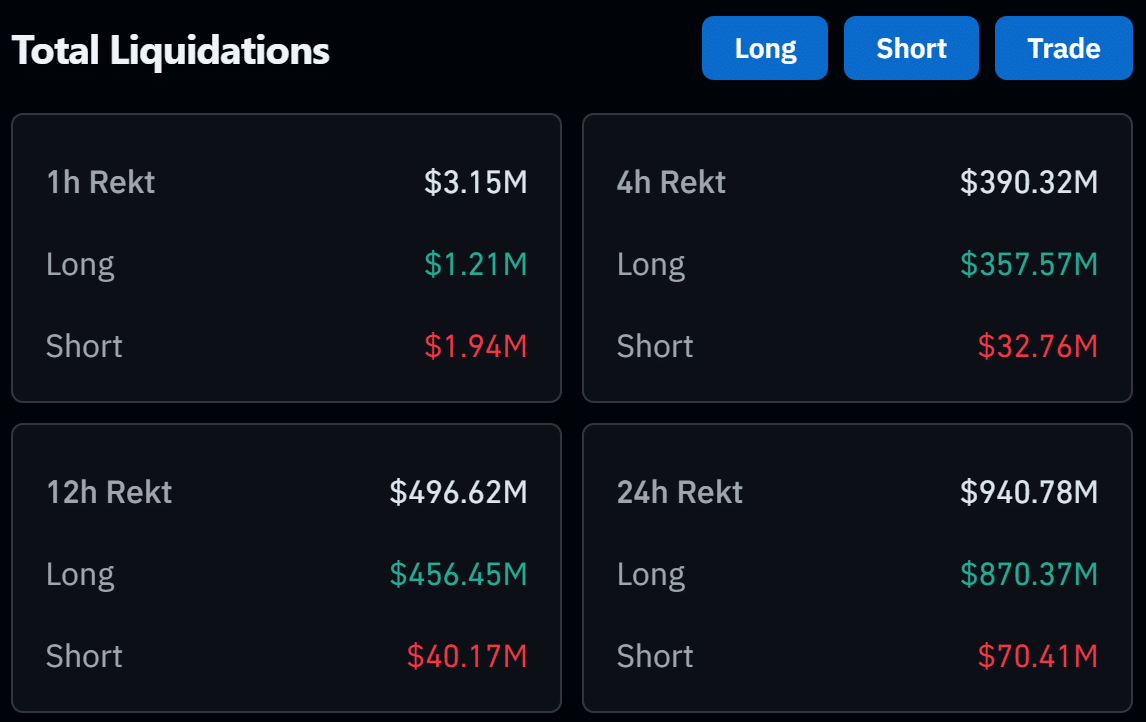
Source: CoinGlass

That imbalance increasingly reflected how overly aggressive bullish positioning collapsed once market momentum weakened beneath macro uncertainty.

Still, Bitcoin continued stabilizing near major support regions despite rising leverage destruction and softer speculative participation.

Growing liquidation pressure increasingly signaled traders remain highly reactive to geopolitical stress and tightening liquidity conditions.


Final Summary

  • Crypto markets remain increasingly sensitive to geopolitical tension, oil-price volatility, and tightening liquidity conditions.
  • Selective participation persists, though liquidations and macro uncertainty continue amplifying broader crypto-market volatility.


Source link

Bitcoin price analysis: BTC set to outperform after long, difficult stretch versus traditional assets

0
Bitcoin price analysis: BTC set to outperform after long, difficult stretch versus traditional assets

Bitcoin may be entering a new period of outperformance against traditional assets as inflation pressures persist and bond markets weaken, according to Risk Dimensions chief investment officer Mark Connors.

Connors, who spent years as the global head of portfolio management at Credit Suisse, said bitcoin recently broke out of what had been its longest stretch of underperformance against the S&P 500 in history, a 142-day period that ended in early May.

“I think bitcoin’s underperformance versus markets is over,” Connors said in an interview. “It’s in the consolidation phase [that] has shifted into an outperformance phase.”

The shift comes as investors grapple with stubborn inflation, rising oil prices and uncertainty around interest rates. Connors argued that bonds, traditionally viewed as defensive assets, are increasingly under pressure as markets adjust to a “higher-for-longer” rate environment.

“Bitcoin, as it always does, takes it on the chin early, but then it always comes out first,” he said, adding that bitcoin could continue outperforming both equities and fixed income “as we grind through the straits of poor news and oil persistently being high.”

Connors tied much of the current macro environment to persistent geopolitical tensions and elevated energy prices. Oil has remained structurally high this year, he said, fueling inflation concerns while forcing markets to look toward technology and productivity gains as a counterweight.

He argued that AI and blockchain are becoming increasingly linked as businesses look for decentralized systems to support machine-driven transactions and automation.

“The only way to punch through that inflationary pressure is through technology,” Connors said.

He also pointed to shifting investor preferences between gold and bitcoin. Connors compared the current environment to 2020, when gold initially outperformed during the early stages of the pandemic before bitcoin began a strong resurgence.

“Gold has had its run,” he said. “Bitcoin is now on its resurgence.”


Source link

U.S. Congress launches insider trading probe into Polymarket, Kalshi

0
U.S. Congress launches insider trading probe into Polymarket, Kalshi


The U.S House Oversight and Governance Reform Committee has launched an investigation into prediction markets for alleged insider trading. 

In a CNBC interview, Congressman James Comer (R-Kentucky), Chair of the Oversight Committee, claimed that prediction markets are “the wild west.” He added, “this is so new, and there are no written laws. Prediction markets have never been a problem until recent months.”

Comer cited the U.S soldier who profited by over $400K after betting on Venezuelan President Nicolás Maduro’s capture using insider intelligence.

He also mentioned the insiders who benefited from bets on the U.S-Iran war, alongside politicians trying to manipulate markets tied to their election races. 

 He continued, 

We launched the investigation to see how widespread this (insider trading) is. But also to prove a case that we’ve got to pass some type of legislation like banning members of Congress, government employees, and people in the President’s administration from prediction markets.

In fact, a recent report showed that insiders on Polymarket made over $2.4 million on Iran bets. For Comer, the widespread insider trading activity is a sign that “Congressional action may be necessary.”

House press Kalshi, Polymarket for internal controls against insider trading

Kalshi is one of the largest prediction markets regulated by the Commodity Futures Trading Commission (CFTC). Its rival, Polymarket, has gotten approval to re-enter the U.S market, but has a massive global market share thanks to its lack of KYC (Know Your Customer) requirements.   

Similarly, Kalshi has expanded to 120 global markets. However, the lack of KYC provisions for offshore markets is now raising concerns about bad actors gaming the markets. In a letter to Kalshi’s CEO Tarek Mansour, the Committee pressed, 

The rapid global expansion of Kalshi’s platform raises questions about whether internationally placed event contracts are subject to equivalent identity verification and insider trading prohibitions as domestic event contracts.

A similar letter was sent to Polymarket’s CEO Shayne Coplan. Now, the Committee wants to know their KYC systems, whether it applies to global users, the trading history of any U.S government employee, including military officers, among others. 

Worth noting though that regulatory pressure is also building overseas. 

For example, India has banned prediction markets under the Promotion and Regulation of Online Gaming Act (PROGA). Recently, the Ministry of Electronics and Information Technology (MeiTY) flagged VPNs (virtual private networks) being used to bypass domestic restrictions on these betting markets.


Final Summary

  • The U.S Congress has officially launched an investigation into Polymarket and Kalshi for insider trading to help inform policy formulation. 
  • India is cracking down on prediction markets and their enablers (VPNs), underscoring heightened global regulatory pressure. 


Source link

Lawyers, Policy Experts React to Trump’s Green Card Crackdown

0
Lawyers, Policy Experts React to Trump's Green Card Crackdown


President Donald Trump’s latest immigration crackdown is triggering alarm, confusion, and fierce debate among lawyers, advocates, and many in the business world who rely on visa holders for skilled labor.

On Friday, US Citizenship and Immigration Services announced it would grant “adjustment of status” — the process that allows some immigrants already in the US to apply for a green card without leaving the country — “only in extraordinary circumstances,” potentially forcing many applicants to return to their home countries and wait abroad while their cases are processed.

While a USCIS spokesperson told Business Insider that applicants who “provide an economic benefit or otherwise are in the national interest” may still qualify for exemptions, it remains unclear how broadly the administration plans to enforce the new restrictions or how many immigrants could ultimately be affected.

The administration has framed the move as a return to the original intent of immigration law, while critics warn it could upend the lives of foreign workers, mixed-status families, and long-term visa holders who have relied on the process for decades.

Here’s what smart people are saying about the sweeping policy shift.

Blake Scholl


Blake Scholl, seated

Blake Scholl 

Bloomberg/Getty Images


Blake Scholl, founder and CEO at Boom Supersonic, a company developing a supersonic airliner, said on X that he understands why “we don’t want people to come to the US to be criminals” and “mooch on welfare.”

“But I don’t understand why we make it harder for motivated, ambitious, hardworking people to come to the land of opportunity,” Scholl added.

Nick Davidov

Nick Davidov, the founder of Davidovs Venture Collective, a VC that supports repeat AI founders at the seed level, called the changes in the green card application rules “the biggest bullshit move by DHS in its history” and the “worst imaginable way to disrupt important work for the country.”

“So everyone on a O1 or H1B visa would have to stop working legally in the US, go back to their country and wait for years of backlog?” Davidov wrote on X on Friday. “This includes top scientists in our universities, founders of billion dollar companies.”

Davidov added in subsequent tweets that Iranians and Ukrainians can’t really return to their home countries for safety reasons, and that immigrants such as Elon MuskJensen Huang, and Sergey Brin have created some of the country’s most valuable companies.

Andrew Ng


Andrew Ng, seated

Andrew Ng 

Big Event Media/Getty Images for HumanX Conference


Andrew Ng, AI entrepreneur and cofounder of Coursera, called asking green card applicants to apply outside the US only “a capricious attack on legal immigration.”

“It will hurt families, leave us with fewer doctors, teachers and scientists, and hurt American competitiveness in AI,” Ng wrote on X on Friday.

Reid Hoffman


A headshot of Reid Hoffman

Reid Hoffman 

Bloomberg/Getty Images


Reid Hoffman, cofounder of LinkedIn and a prominent Trump critic in Silicon Valley, wrote on X that the DHS’s new policies are a “harmful move for tech, business, and America broadly.”

“Does this mean AI Researchers, employees, and students will now have to leave the country and wait through a backlog process to continue their work?” Hoffman wrote.

Yvette Clarke


A headshot of Rep. Yvette Clark

Rep. Yvette Clarke 

Bill Clark/CQ-Roll Call, Inc via Getty Images


Rep. Yvette Clarke, a Democrat from New York, called the new green card policies “a disgrace.”

“It will rip talented, hardworking immigrants out from America and our economy, congest an already overburdened backlog, and further break an already broken immigration system,” said Clarke on X.

“And that’s by design,” Clarke added. “This administration has made the pain of immigrants a priority, and that won’t change until there’s no one left to hurt.”

David J. Bier


David Bier holding a stack of documents

David J. Bier 

Kayla Bartkowski/Getty Images


David J. Bier, the director of immigration studies at the Cato Institute, a libertarian think tank, called for new leadership of USCIS in a series of posts on X on Friday, where he said that the new policies show “total malice against the applicants.”

“The policy is a radical expansion of DHS’s ‘quiet quitting’ on legal immigration that has been going on for months,” Bier also wrote in a blog post. “Now USCIS’s new memorandum details a plan for mass denials. USCIS has gone from the ‘quiet-quit’ to walking out on 1.2 million green card applicants.”

“Forcing green card applicants to leave will render many green card applicants ineligible because, when they leave the United States, they will trigger the 3- or 10-year bars on receiving an immigrant visa based on accrual of unlawful presence,” Bier added.

Yann LeCun


Yann Lecun

Yann LeCun 

Yui Mok – Pool/Getty Images


Yann LeCun, a pioneer in AI research and the former Chief AI Scientist at Meta, had a very curt and perplexed response to the change in green card policy.

“Why?” wrote the ACM Turing Award Laureate on X, who reposted an article detailing the DHS’s announcement.

LeCun was born in France and immigrated to the US in the late 1980s.

Garry Tan


Garry Tan, Y Combinator CEO, at SXSW in 2026

Y Combinator CEO Garry Tan 

Hutton Supancic/SXSW Conference & Festivals via Getty Images


Garry Tan, the CEO of the startup accelerator Y Combinator, called the new guidance “bad and misguided.”

“We need to keep smart people in the country to build the future and build tomorrow’s businesses that employ millions of people,” he wrote on X.

Ash Jogalekar

Ash Jogalekar, a Microsoft senior project manager working on agentic AI, described the memorandum as “self-sabotage” in an X post on Friday.

“As a scientist and immigrant who loves this country, I cannot think of worse ways to cripple American scientific competitiveness while other countries surge ahead,” Jogalekar wrote. “It is completely pointless. Between the funding cuts and rash, irrational policies like these, China could not have done worse if they had decided to sabotage science in the U.S.”

Jason Calacanis


Jason Calacanis

Investor and All-In podcast co-host Jason Calacanis 

Bridget Bennett/Bloomberg via Getty Images


Jason Calacanis, investor and co-host of the All-In podcast, said in an X post on Saturday that the US should encourage more immigration in response to the administration’s new green card policy.

“America’s goal should be to expand our Empire,” he wrote. “Be it immigration, acquisition or invitation, if you believe we have the best system then you should embrace expansion.”

The investor also posted a clip of an interview All-In did with Trump in 2024, during which the president said college graduates should “automatically” get a green card.

“More green cards for extremely talented immigrants!” Calacanis wrote in the post. “Strong agree President Trump.”


Source link

Jamie Dimon has bad news for JPMorgan bankers

0
Jamie Dimon has bad news for JPMorgan bankers


Every generation of Wall Street workers learns the same lesson the hard way. The bank you joined is rarely the bank you retire from. Roles get reshuffled, divisions get sold off, and the career path that looked rock-solid on day one almost never matches the one that pays out at year 30.

For decades, the safe play inside a giant like JPMorgan Chase (JPM) was simple. Learn the products, build a book of business, climb the ladder. The senior bankers who shepherded clients through deals, financings, and downturns were the ones who got promoted, paid, and protected when the cycle turned.

That model still works. But it is being quietly rewritten in real time, and the man running the rewrite has spent the past few years warning anyone who would listen that the next decade in finance would look nothing like the last.

Now Jamie Dimon has put a sharper edge on what he means. The JPMorgan chief executive told Bloomberg Television that the bank will hire more artificial intelligence specialists and fewer traditional bankers in certain categories as automation accelerates across Wall Street.

Jamie Dimon said JPMorgan plans to reduce headcount, shift hiring

Speaking at JPMorgan’s China Summit in Shanghai on May 21, Dimon was direct about where headcount goes next.

“I think it will reduce our jobs down the road,” he said in the interview, according to Bloomberg.

“There will be all different types of jobs, and I think we will be hiring more AI people and fewer bankers in certain categories, and it will make them more productive,” Dimon added.

More AI:

Dimon’s framing matters. He is not talking about a sudden wave of pink slips. He is talking about a steady reshaping of who gets a job offer in the first place, while existing staff get retrained, redeployed, or pushed toward early retirement.

JPMorgan’s annual attrition runs at roughly 10%, or about 25,000 to 30,000 employees a year, which gives leadership real room to shift the mix without dramatic layoffs, reported Bloomberg.

When I look at what JPMorgan has been quietly building over the past 18 months, the math behind Dimon’s comment becomes obvious. The bank’s tech budget sits near $20 billion, with roughly $2 billion of that earmarked specifically for AI, reported Fast Company. JPMorgan has also started tracking and ranking its engineers on internal dashboards based on how heavily they use AI tools.

That is not a bank trying to manage AI on the side. That is a bank rebuilding its operating model around it.


Source link

Bitcoin prices news: BTC heads back to $77,000 on Middle East peace deal

0
Bitcoin prices news: BTC heads back to $77,000 on Middle East peace deal

After crumbling about 4% late Friday into early Saturday, bitcoin has more than retraced those losses in the past few minutes after President Trump announced a coming agreement with Iran and other Middle Eastern countries.

“An Agreement has been largely negotiated, subject to finalization between the United States of America, the Islamic Republic of Iran, and the various other Countries,” wrote Trump in a Truth Social post.

“In addition to many other elements of the Agreement, the Strait of Hormuz will be opened,” the president continued.

The news sent bitcoin sharply higher to $76,700 after having fallen to nearly $74,000 earlier on Saturday.


Source link

Pudgy Penguins down 14% after 712 mln token unlock: Can PENGU rebound?

0
Pudgy Penguins down 14% after 712 mln token unlock: Can PENGU rebound?


Pudgy Penguins [PENGU] is down 14% in the past 24 hours. PENGU had the biggest loss among CoinMarketCap’s top 100 crypto tokens during this period.

A couple of factors influenced this sudden crash, which occurred after a week of positive gains across the crypto sector.

Monthly unlocks fuel selling pressure

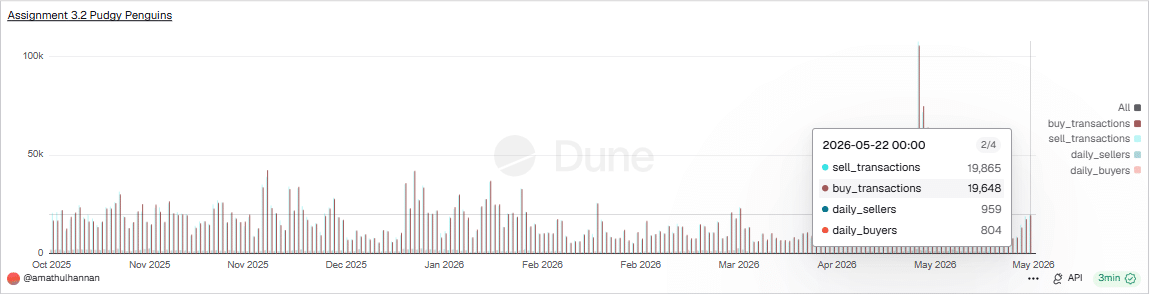
The number of transactions was growing, but sellers dominated them more. According to Dune Analytics, sell transactions were 19,865, while those of buyers were 19,648. However, the difference was not that big.

Additionally, the number of daily sellers was 959, while the number of buyers was 804.

Source: Dune Analytics

This sale came as a result of monthly unlocks of 712.4 million PENGU worth $6.25 million.

Of this amount, 279.3 million PENGU worth $2.45 million was meant for the company, while 433.1 million tokens valued at $3.80 million went to the current and future teams.

Network data from Arkham showed the teams distributed their tokens this week, valued at $3.40 million. Hence, this development potentially sparked sell pressure from on-chain traders.

PENGUPENGU
Source: Arkham

Furthermore, capital was leaving the broader altcoin market, and trending tokens like PENGU were taking the hardest hit. An increase in daily trading volume by 17% to around $181 million affirmed the sell pressure.

Additionally, the decline in collections like Bored Apes spread into PENGU because it is intertwined with the NFT sector. The memecoin is highly sensitive to sentiment shifts away from digital collectibles.

Can PENGU bounce off the 0.618 Fib level?

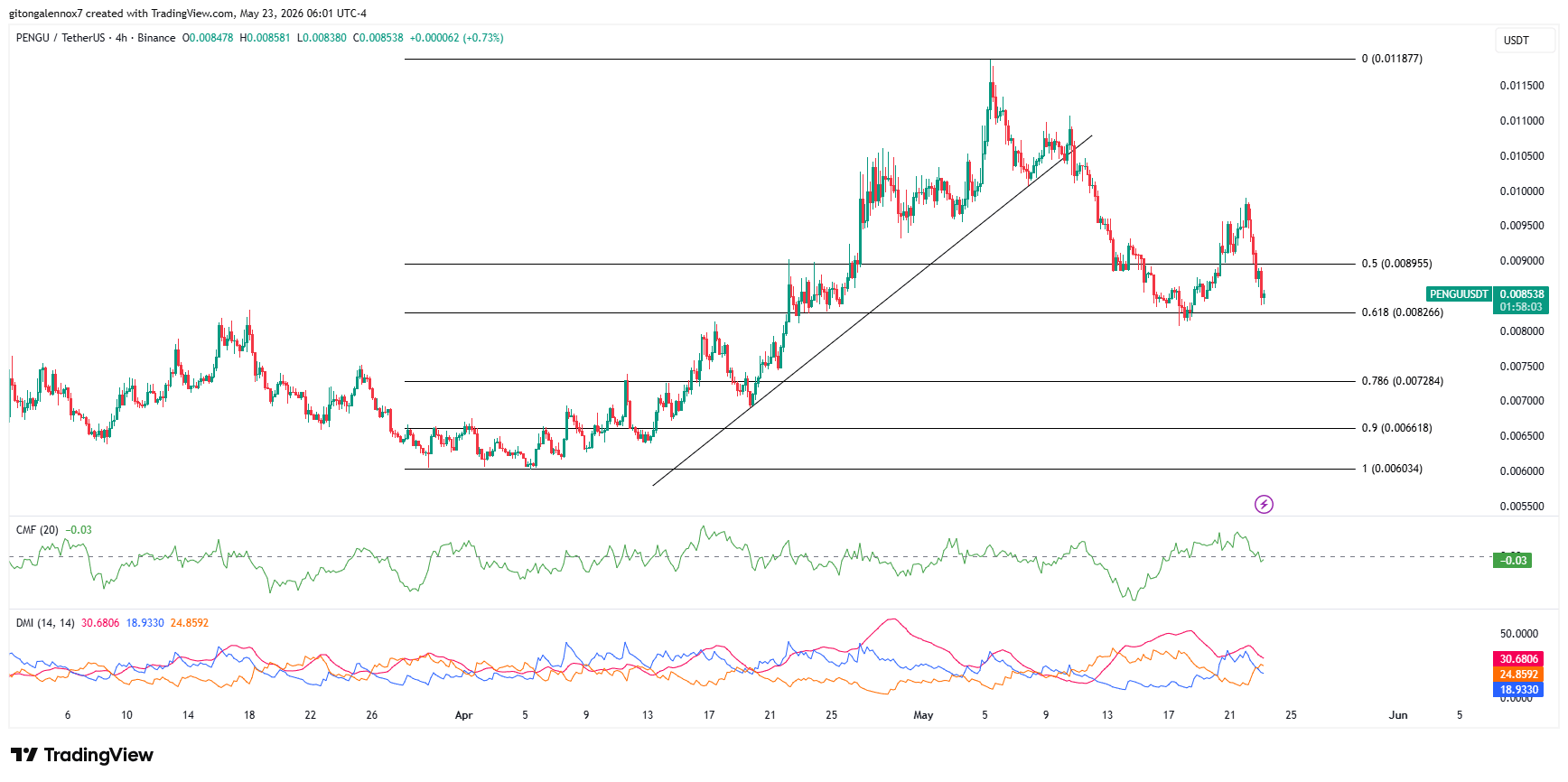
PENGU broke a rising trendline support and dropped to the 0.618 Fibonacci Retracement level. At this level, the memecoin has recovered half of the 31% crash but is approaching the level for the second time.

Bulls are returning at this level even though capital flows are negative. The Chaikin Money Flow is -0.02, as well as a declining Directional Movement Index (DMI). The DMI lines are all pointing downwards.

As price forms a potential turning point at $0.008266, the second touch of the 0.618 Fib level could spark a rebound. This would need PENGU breaking above $0.009846 to confirm an uptrend continuation.

Otherwise, if sellers maintain their momentum, they might break the level down. As a result, the next targets would be at $0.007284 or lower.

PENGUPENGU
Source: PENGU/USDT on TradingView

Therefore, the crash may not last, especially if the market prices in the unlocked tokens of this month.


Final Summary

  • PENGU loses 14% in the past 24 hours amid broader crypto market correction and massive monthly token unlock. 
  • Price approaches the 0.618 Fib level for the second time, which, if defended, could ignite a reversal.  


Source link