Home Blog Page 425

KITE plunges 18% amid growing risk-off sentiment: More losses ahead?

0
KITE plunges 18% amid growing risk-off sentiment: More losses ahead?


With the broader crypto market retracing, KITE posted one of the largest declines, ranking among the top losers. The altcoin extended its slip, breaching the $0.2 support and dropping to a low of $0.18 before slightly rebounding. 

As of this writing, KITE traded at $0.19, down 18.2% on the daily charts. Over the same period, its trading volume rose 112%  to $81 million, suggesting increased sell-side activity. 

KITE traders adopt a risk-off stance

As Kite [KITE] extended its decline, exacerbated by market-wide breakdown, investors in the Futures flipped bearish. 

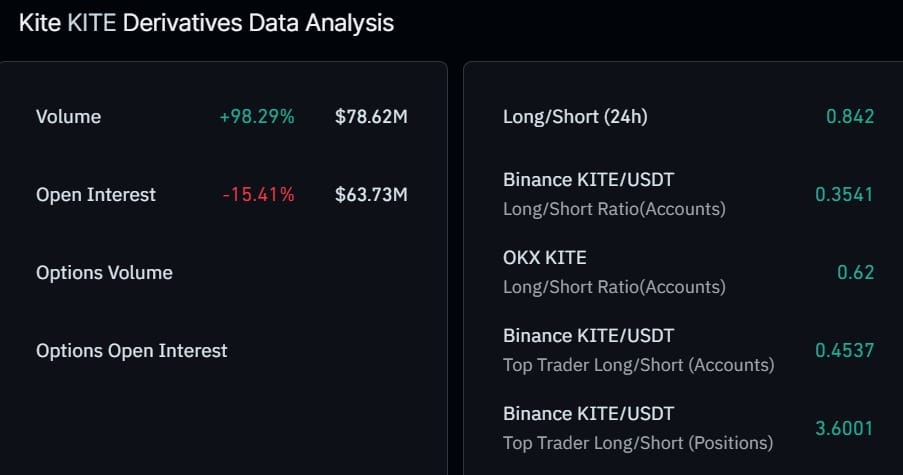
As a result, most market participants either scaled back or closed their positions entirely. CoinGlass data showed that KITE’s Open Interest dropped 15.4% to $63 million, while Derivatives Volume rose 98% to $78 million. 

KITE derivatives data
Source: Coinglass

A drop in OI while volume rose suggested that traders aggressively closed their Futures positions. As such, there was increased market participation, but on the Futures side. 

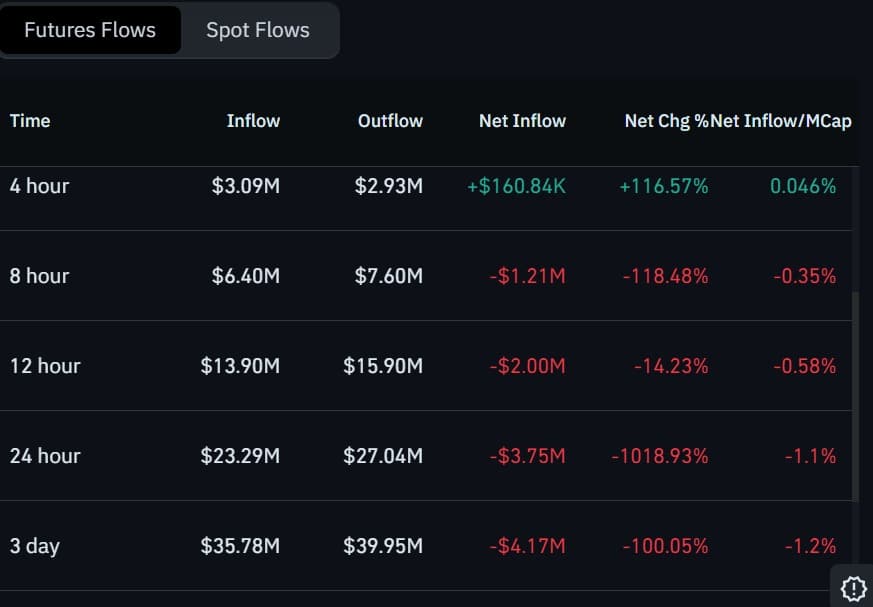
In fact, Futures Outflow rose to $27 million while inflow dropped to $23 million. As a result, Futures Netflow dropped 1018% to -$3.73 million. 

KITE futures inflowsKITE futures inflows
Source: CoinGlass

As the market retraced, speculators panicked and exited, fearing further losses. Traditionally, if the market rallied on increased leverage and those positions closed, the market tended to decline.

Downside momentum strengthens; more losses?

With sentiment flipping bearish in Futures, KITE’s downside momentum strengthened considerably.

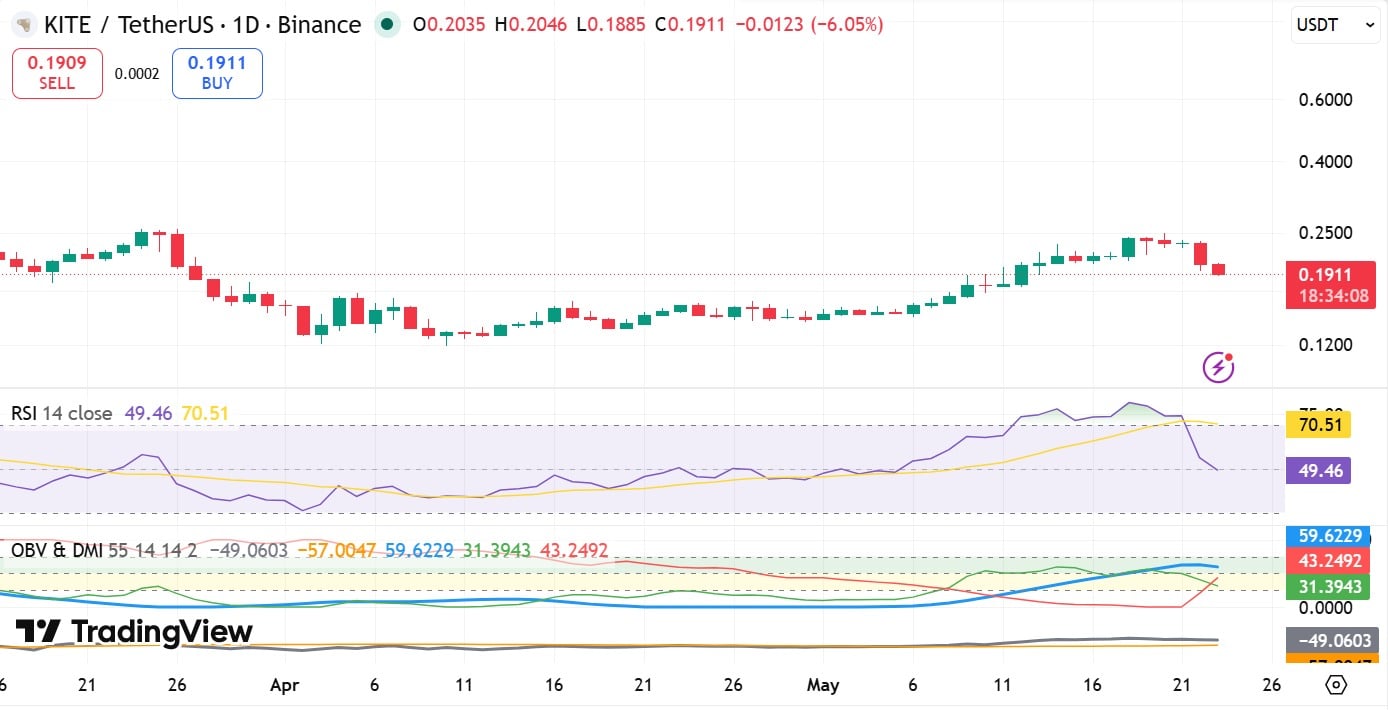
The altcoin’s Relative Strength Index (RSI) fell sharply, dropping from 74 to 49 and entering the bearish zone. Such a drop suggests that KITE faced intense selling pressure.

KITE RSI & DMI ADXKITE RSI & DMI ADX
Source: TradingView

At the same time, the positive index (+DI) of the DMI dropped to 31, while the negative index (-DI) rose to 43. With ADX rising to 59, it indicated a strong downtrend.

With these momentum indicators set this way, it suggests bears have total control of the market, and KITE could drop further. Therefore, if capital continues to flow out, the altcoin could lose its $0.18 support and drop to $0.16.

The Spot remains optimistic

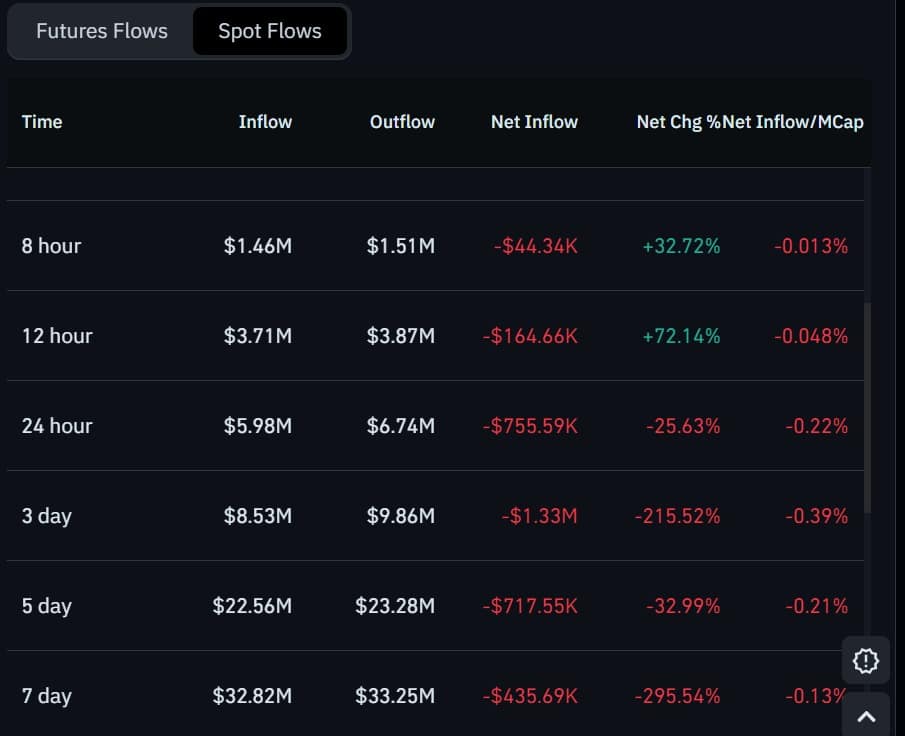
As the altcoin dropped, Spot investors took the opportunity and continued to buy the dip. CoinGlass data showed that $6.74 million worth of KITE flowed out of the exchanges, compared to $5.94 million in flow.

Kite spot netflowKite spot netflow
Source: CoinGlass

As a result, Spot Netflow dropped 25% to -$755k, extending a week-long trend. A negative Netflow suggests buyers remain active in the market.

Their presence gives the market hope for a potential recovery from the slip. If demand holds during this period, the altcoin will reclaim $0.20 and set a path for a significant rebound.


Final Summary

  • KITE dropped 18%, breaching $0.20 support, hitting a low of $01.8. 
  • Futures traders aggressively closed their positions, but Spot demand remains steady, offering the altcoin a chance to rebound. 


Source link

Alaska Bets on Premium Flights As Airlines Absorb 50% of Fuel Costs

0
Alaska Bets on Premium Flights As Airlines Absorb 50% of Fuel Costs


Despite rising fuel costs, Alaska Airlines is pushing ahead with its plan to attract more premium passengers as it celebrated the launch of its newest route atop a London skyscraper on Thursday evening.

The Seattle-to-London service is part of a rapid European expansion, following last month’s launch of Alaska’s first-ever transatlantic route, to Rome. A third service, to Iceland, is set to begin next week.

But it comes at a cautious time for the industry since the Iran war sent jet fuel prices skyrocketing.

“You’ve seen a very significant drive to get airfares up,” Andrew Harrison, Alaska’s chief commercial officer, told Business Insider. “I think on average, most carriers, even what we’re selling today, are still only covering 50, 60, 70% of the increased cost of fuel.”

While most European airlines hedge against fuel costs using financial derivatives, most US carriers do not, leaving them more exposed to the surge in prices. Fuel is typically an airline’s second-highest expenditure, after labor.

United Airlines plans to “fully offset the increase in fuel prices,” but that would require an extra 8.5 percentage points of revenue for each seat it flies, CEO Scott Kirby said in March.

Even with higher airfares and checked bag fees, Harrison’s comments show how fuel costs are still eating into most airlines’ profits.

“What we tell ourselves at Alaska is just control what we can control. We are an industry that faces crises all the time. If it’s not one thing, it’s another,” Harrison told Business Insider.

“So we just feel actually very good about our expansion and what we’re doing here. In fact, it gives us even greater wind in our sails to continue and work hard during these difficult times.”

Jet fuel prices change summer vacation habits


Alaska Airlines staff stand by one of the company's planes to celebrate its new route from Seattle to Rome.

Alaska Airlines staff stand by one of the company’s planes to celebrate its new route from Seattle to Rome. 

Alaska Airlines


Despite rising prices, many people are still keen to fly — especially those rich enough to fly in premium cabins, which are particularly profitable for airlines.

Around 30% of people won’t change their summer travel plans due to rising gas prices, according to a Bank of America survey of 4,000 people conducted in April. Plus, the survey found middle- and higher-income households are seeing stronger travel spending.

Alaska is leaning into the trend with new international business-class suites, including sliding privacy doors and lie-flat beds. By 2028, it also plans to introduce a premium economy cabin on its long-haul widebody aircraft, like the Boeing 787 operating the London route.

Starlink’s high-speed in-flight WiFi also helps attract premium travelers. Alaska has equipped some planes with Starlink, but it isn’t yet certified for the 787. Harrison said the airline expects it to be ready in the fall.

Alaska has expanded to long-haul transatlantic flights thanks to its acquisition of Hawaiian Airlines, which had a fleet and order book of 787s. It’s timely, given the popularity of Europe with American travelers.

The Bank of America survey found Europe remained the most attractive location for vacationers this year. Compared to 2025, it’s become at least 10% more popular with middle- and higher-income households — but less popular with lower-income households, according to the survey.

On the other hand, this means strong competition. British Airways and Delta Air Lines already fly between Seattle and London, although Virgin Atlantic is suspending its route for the winter season.

Harrison pointed to Alaska’s “state-of-the-art aircraft” on the route, manufactured in the last 12 months, as well as its Seattle hub with 105 destinations.

To bypass Heathrow’s capacity constraints, Alaska is leasing its slot at the London airport from American Airlines, a fellow member of the Oneworld alliance.

“Working together with our Oneworld partners has just given us amazing opportunity in what we know is a very highly congested and competitive airport,” Harrison said.

BA is also a Oneworld member, so Alaska customers can connect on its flights to other destinations on the continent.

Surging fuel prices have made it a testing time for aviation, but Alaska isn’t too concerned, backing its international expansion.

It’s going to build a new foundation for growth, long term, for the airline,” Harrison said. “These are large investments, don’t get me wrong, but we’re building the company for the future, we’re building the brand for the future, and this is one area where we’re going to just keep going.”

Alaska is aiming for 12 international destinations out of Seattle by 2030, and plans to announce more later this year.


Source link

Mortgage and refinance interest rates today, May 23, 2026: Rates falling again today

0
Mortgage and refinance interest rates today, May 23, 2026: Rates falling again today


According to rates from the Zillow lender marketplace, compared to yesterday, the current 30-year fixed rate fell 12 basis points to 6.34%, the 15-year fixed rate fell by 7 basis points to 5.90%, and the 5/1 ARM fell by 19 basis points to 6.29%.

READ MORE: Weekly survey of mortgage lenders with the best rates: Another move higher above 6% APR

Today’s mortgage rates

Here are the current mortgage rates, according to the latest Zillow data:

  • 30-year fixed: 6.34%

  • 20-year fixed: 6.26%

  • 15-year fixed: 5.90%

  • 5/1 ARM: 6.29%

  • 7/1 ARM: 6.46%

  • 30-year VA: 5.98%

  • 15-year VA: 5.65%

  • 5/1 VA: 5.68%

Remember, these are the national averages and rounded to the nearest hundredth.

Discover 8 strategies for getting the lowest mortgage rates

Today’s mortgage refinance rates

These are today’s mortgage refinance rates, according to the latest Zillow data:

  • 30-year fixed: 6.38%

  • 20-year fixed: 6.06%

  • 15-year fixed: 5.84%

  • 5/1 ARM: 6.29%

  • 7/1 ARM: 6.22%

  • 30-year VA: 5.89%

  • 15-year VA: 5.58%

  • 5/1 VA: 5.58%

Again, the numbers provided are national averages rounded to the nearest hundredth. Mortgage refinance rates are often higher than rates when you buy a house, although that’s not always the case.

Want to refinance your mortgage in 2026? Here’s what to do.

Free mortgage calculator

Use the mortgage calculator below to see how today’s interest rates would affect your monthly mortgage payments.

You can bookmark the Yahoo Finance mortgage payment calculator and keep it handy for future use, as you shop for homes and the best mortgage lenders. You also have the option to enter costs for private mortgage insurance (PMI) and homeowners’ association dues, if applicable. These details result in a more accurate monthly payment estimate than if you simply calculated your mortgage principal and interest.

30-year fixed mortgage rates: Pros and cons

There are two main advantages to a 30-year fixed mortgage: Your payments are lower, and your monthly payments are predictable.

A 30-year fixed-rate mortgage has relatively low monthly payments because you’re spreading your repayment out over a longer period of time than with, say, a 15-year mortgage. Your payments are predictable because, unlike with an adjustable-rate mortgage (ARM), your rate isn’t going to change from year to year. Most years, the only things that might affect your monthly payment are any changes to your homeowners insurance or property taxes.

The main disadvantage of 30-year fixed mortgage rates is the mortgage interest, both in the short and long term.

A 30-year fixed term comes with a higher rate than a shorter fixed term, and it’s higher than the intro rate to a 30-year ARM. The higher your rate, the higher your monthly payment. You’ll also pay much more in interest over the life of your loan due to both the higher rate and the longer term.

15-year fixed mortgage rates: Pros and cons

The pros and cons of 15-year fixed mortgage rates are basically swapped with those of the 30-year rates. Yes, your monthly payments will still be predictable, but another advantage is that shorter terms come with lower interest rates. Not to mention, you’ll pay off your mortgage 15 years sooner. So you’ll save potentially hundreds of thousands of dollars in interest over the course of your loan.

However, because you’re paying off the same amount in half the time, your monthly payments will be higher than if you choose a 30-year term.

Dig deeper into 15-year vs. 30-year mortgages

Adjustable mortgage rates: Pros and cons

Adjustable-rate mortgages lock in your rate for a predetermined amount of time, then change it periodically. For example, with a 5/1 ARM, your rate stays the same for the first five years and then goes up or down once per year for the remaining 25 years.

The main advantage is that the introductory rate is usually lower than what you’ll get with a 30-year fixed rate, so your monthly payments will be lower. (Current average rates might not necessarily reflect this, though — in some cases, fixed rates are actually lower. Talk to your lender before deciding between a fixed or adjustable rate.)

With an ARM, you have no idea what mortgage rates will be like once the intro-rate period ends, so you risk your rate increasing later. This could ultimately end up costing more, and your monthly payments are unpredictable from year to year.

But if you plan to move before the intro-rate period is over, you could reap the benefits of a low rate without risking a rate increase down the road.

Learn whether now is a good time to get an adjustable-rate mortgage

Is now a good time to buy a house?

First of all, now is a good time to buy a house compared to a couple of years ago. Home prices aren’t spiking like they were during the height of the COVID-19 pandemic. So, if you want or need to buy a house soon, you should feel pretty good about the current housing market.

Plus, despite the recent uptick, mortgage rates are lower than they were this time last year.

The best time to buy is typically whenever it makes sense for your stage of life. Trying to time the real estate market can be as futile as timing the stock market — buy when it’s the right time for you.

Which is more important, your home price or mortgage rate?

Today’s mortgage rates: FAQs

Why do 30-year mortgage rates vary by the source reporting them?

According to Zillow, the national average 30-year mortgage rate is 6.34% right now. Why are Zillow’s rates usually different than those reported by Freddie Mac (which reported 6.51% this week) and elsewhere? Each source compiles rates by different methods, and rates are reported for different time frames. Zillow obtains rates from its lender marketplace and reports them daily, while Freddie Mac pulls information from loan applications submitted to its underwriting system and averages them for the week. However, mortgage rates vary by state and even ZIP code, by lender, loan type, and many other factors. That’s why it’s so important to shop with multiple mortgage lenders.

Are interest rates expected to go down?

According to May forecasts, the MBA expects the 30-year mortgage rate to be between 6.4% and 6.5% through 2026. Fannie Mae predicts a 30-year rate of 6.3% through the end of the year.

Are mortgage rates dropping?

Yes! Compared to yesterday, the 30-year fixed rate fell 12 basis points to 6.34%, the 15-year fixed rate fell by 7 basis points to 5.90%, and the 5/1 ARM fell by 19 basis points to 6.29%.

How do I get the lowest refinance rate?

In many ways, securing a low mortgage refinance rate is similar to when you bought your home. Try to improve your credit score and lower your debt-to-income ratio (DTI). Refinancing into a shorter term will also land you a lower rate, though your monthly mortgage payments will be higher.


Source link

SEC Commissioner Peirce counters views that crypto rule will foster synthetic tokens

0
SEC Commissioner Peirce counters views that crypto rule will foster synthetic tokens

The long-awaited U.S. Securities and Exchange Commission rule to begin allowing tokenization of securities — a change that could have profound effects on the financial markets — has been facing the contentious perception it’ll allow synthetic tokens, but a commissioner has taken the unusual step to post statements about the unpublished rule to potentially counter those views.

SEC Commissioner Hester Peirce, who had pushed for safe harbors for tokenization well before the arrival of the new chairman under President Donald Trump, issued a pair of statements on social media site X on Thursday and Friday to clarify what she expects from the rule that’s set to emerge soon. Her posts suggested that the proposed rule won’t pave the way for synthetic tokenized securities — third-party tokenization that references a security but doesn’t carry the equity, voting and other rights associated with the security.

Peirce, the commissioner behind the SEC’s Crypto Task Force, wrote that she expects the coming rule — now potentially delayed — would be “limited in scope & would facilitate trading only of digital representations of the same underlying equity security that an investor could purchase in the secondary market today, not synthetics.”

Peirce posted again to explain what she meant by synthetics, directing people to read the SEC’s January statement on tokenized securities, “which distinguishes tokenized versions of issuer-sponsored stocks and of stocks that SEC-registered firms hold for their customers from synthetic instruments that provide exposure to stocks.”

The flames had been fanned by Bloomberg News reporting this week that predicted the agency was leaning toward including a path for synthetic tokens tradeable on decentralized crypto platforms. Peirce said she appreciates the public’s keen interest in the rule “but not the hyperbole” about it.

Peirce did not return a request for comment about her posts.

Bloomberg had also predicted that the rule could come as early as this week, but it reported in a subsequent story on Friday that the release was being further delayed.

The consequential rule will represent the most meaningful step the SEC has taken to-date to forge a new regulatory approach to crypto trading in the U.S. Chairman Paul Atkins has been saying for months that his agency is poised to release the wide-ranging proposals to provide regulatory exemption in the crypto space.

He outlined some of the effort in a March speech at the DC Blockchain Summit, saying the agency was contemplating safe harbors from certain regulatory demands for various crypto activities, including giving startups something like four years of registration exemption “provide developers with a regulatory runway during which they could work to reach maturity”; a “fundraising exemption” for certain crypto assets in which “entrepreneurs could raise up to a defined amount (say $75 million) during any 12-month period”; and an “investment contract safe harbor” to keep certain crypto assets from being defined as a regulated security, with the safe harbor triggering when the issuer finishes all their managerial efforts.

Atkins said at the time that Commissioner Peirce’s “fingerprints are all over” the SEC’s rulemaking.

While the SEC — alongside its sister agency, the Commodity Futures Trading Commission — has been writing crypto rules, Atkins and CFTC Chairman Mike Selig have said they’re doing so with the understanding that Congress is right behind them with the Digital Asset Market Clarity Act to put some of the same ideas into permanent law.

“Only Congress can ensure that regulation in this area is future-proofed through comprehensive market structure legislation,” Atkins said in March.

UPDATE (May 22, 2026, 18:53 UTC): Adds delay of the rule release.


Source link

All about RIVER’s 11% surge and the bull trap risk traders should watch out for

0
All about RIVER's 11% surge and the bull trap risk traders should watch out for


RIVER recorded gains of 11% over the past day as capital inflows rose, driven specifically by activity across the perpetual market.

A notable aspect of this recent surge, however, was that it carried significant risk of a bull trap. Especially since the underlying conditions behind the rally did not form in an entirely bullish scenario.

Perpetual inflows drive RIVER higher

The surge in River [RIVER] marks a notable turnaround for investors who have largely been offloading the asset.

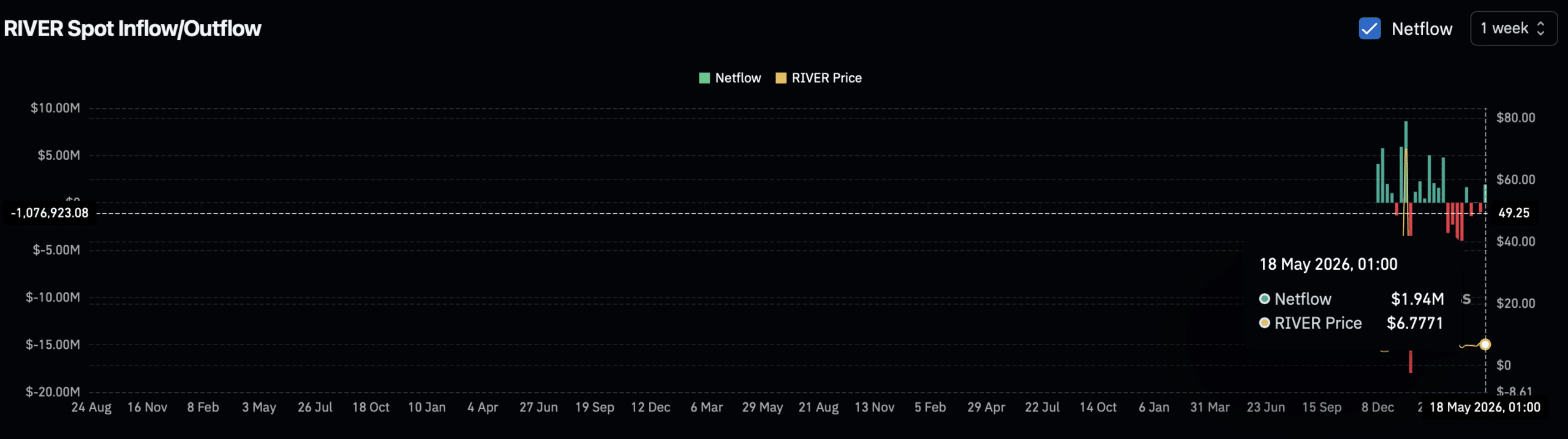
This week has been dominated by significant sell pressure, with $1.94 million in net selling recorded – Meaning sell volume outweighed buy volume across the spot market.

The reversal that has since pushed RIVER higher came from capital inflows in the perpetual segment of the market. This indicated that buying activity from this cohort supported the press time price move.

River spot exchange netflow.
Source: CoinGlass

Open interest rose by 3% over the past day, hitting approximately $76 million at the time of writing.

The funding rate turned positive too, implying that the fresh capital entering the market has been concentrated on the long side of contracts.

And yet, despite everything, risk appeared to be elevated in the market. Especially since data pointed to a high tendency for a drawdown from this phase.

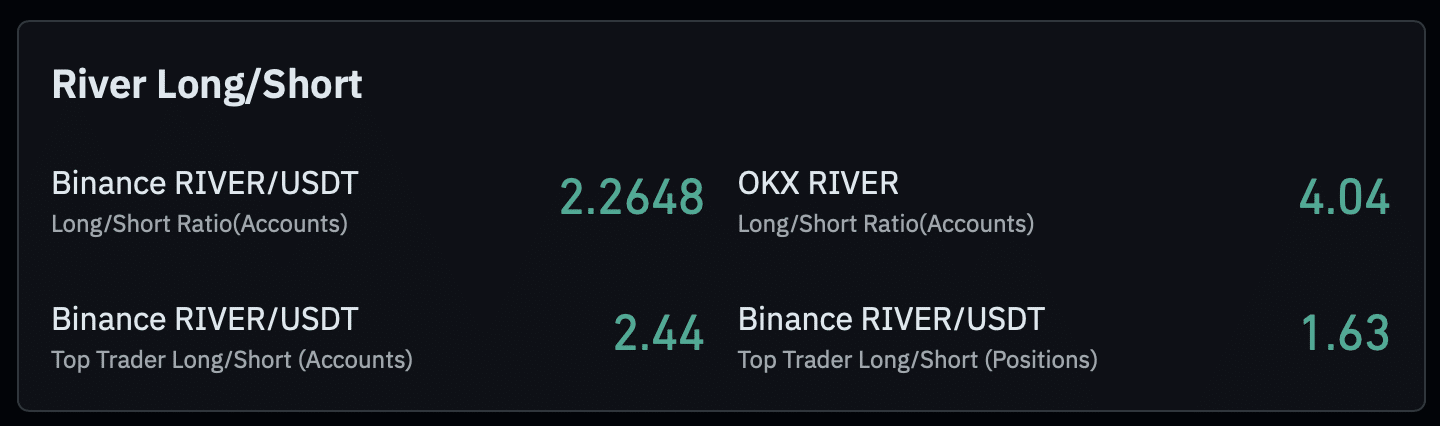
Binance long-to-short ratio hits 2.24

Volume data across the perpetual market revealed a split between Binance traders and the broader market.

Binance traders have continued to trade more buy volume in the RIVER perpetual market, with the long-to-short ratio on the platform reaching 2.26 at the time of writing. This, against a total RIVER perpetual volume of $50.70 million.

Binance traders long-to-short ratio.Binance traders long-to-short ratio.
Source: CoinGlass

A long-to-short ratio above 1 signals that buy volume is dominant, and the further the reading sits above 1, the stronger the buying concentration in the market.

The broader perpetual market for RIVER told a different story, however, with the overall long-to-short ratio dropping below 1 to a reading of 0.97. This indicated that sell volume has been dominant across other exchanges.

This split between Binance and the rest of the market seemed to add to the risk profile of the ongoing rally.

Bull and Bear Power shows minimal buying pressure

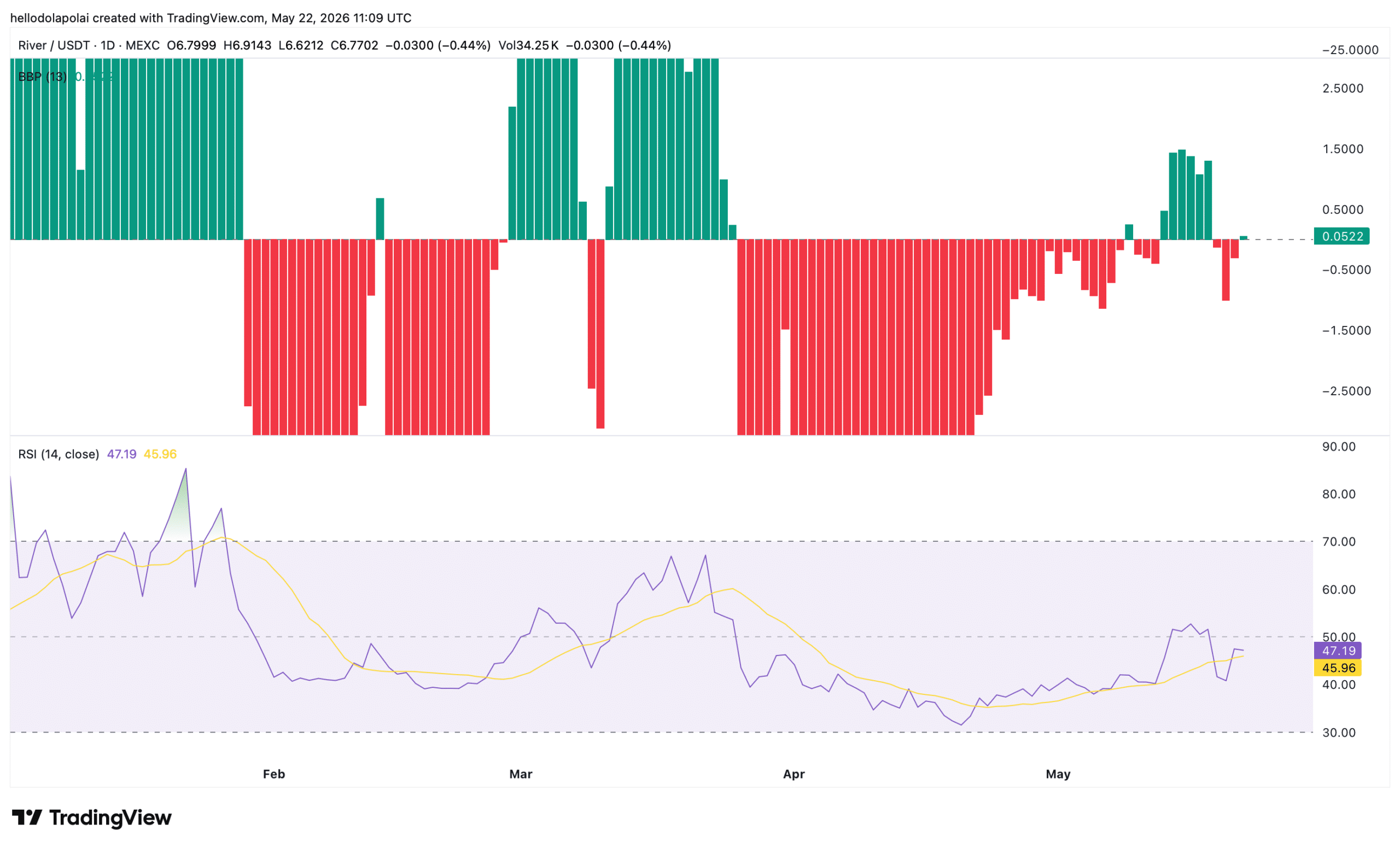
Finally, market analysis warned that momentum has not yet peaked in favor of the bulls, with bears holding a higher probability of taking control.

The Bull and Bear Power indicator tracks whether buyers or sellers are driving the market through histogram bar formations. At press time, buyers seemed to be showing clear signs of limited commitment.

River BBP and RSI chart.River BBP and RSI chart.
Source: Tradingview

The chart revealed only a very small green bar forming, suggesting that buying power in the market has been minimal and that the probability of a sustained upswing might be low.

The Relative Strength Index reinforced this reading too, remaining in negative territory while continuing to trend south.

A declining RSI usually alludes to the build-up of selling pressure, placing RIVER at significant risk of a reversal from its elevated levels.


Final Summary

  • RIVER’s latest surge came as a surprise to those who have been offloading the asset.
  • Perpetual inflows have been critical to RIVER’s recent performances. 


Source link

‘Mandalorian And Grogu’ Projected To Have Lowest Disney ‘Star Wars’ Opening

0
‘Mandalorian And Grogu’ Projected To Have Lowest Disney ‘Star Wars’ Opening


The Mandalorian and Grogu just opened in theaters, and it’s already projected to make less money in its debut than 2018’s Disney Star Wars misfire Solo: A Star Wars Story.

Officially titled Star Wars: The Mandalorian and Grogu, the film is directed by Jon Favreau, while Pedro Pascal returns as the title character from the Disney+ streaming series The Mandalorian. In the film, Pascal’s Din Djarin, aka the Mandalorian, is recruited along with his diminutive but powerful sidekick Grogu by the New Republic to apprehend an Imperial warlord and rescue Rotta the Hutt (voice of Jeremy Allen White), the long-lost son of the villainous Jabba the Hutt.

Forbes‘Mandalorian And Grogu’ Rotten Tomatoes Reviews Narrowly Avoids ‘Rotten’ Score

Alien and Avatar film icon Sigourney Weaver also stars in The Mandalorian and Grogu as Rebel Alliance Colonel Ward, while legendary Oscar-winning filmmaker Martin Scorsese voices Hugo Durant, an alien street vendor who supplies Mando and Grogu information on where they can find Rotta the Hutt.

The Mandalorian and Grogu played in preview screenings on Thursday before opening in theaters nationwide on Friday. Deadline is projecting that The Mandalorian and Grogu will earn about $34 million on Friday, an amount that includes the $12 million the film made in Thursday previews.

By Friday night, Deadline had already projected The Mandalorian and Grogu’s three-day and four-day opening takes — since the film is opening on Memorial Day weekend— and both fall short of the final domestic tallies Solo made over the same holiday weekend in 2018.

Forbes‘Obsession’ Star Inde Navarrette Discusses Her Spellbinding Performance In Hit Horror Thriller

As such, Deadline is projecting the new Mando movie — which is playing in 4,300 North American theaters — to make $80 million in its first Friday to Sunday frame and $90 million over the four-day holiday period.

By contrast, 2018’s Solo made $84.4 million from 4,381 North American theaters from Friday to Sunday, May 25-28, and a total of $103 million over the four-day period, including Memorial Day, on May 29.

Solo, which was beleaguered with issues during its production — including the firing of directors Phil Lord and Christopher Miller, who were replaced by Ron Howard — went on to earn $213.7 million domestically and $179.3 million internationally for a worldwide box office tally of $393.1 million. The film, however, had a net production budget of $298.8 million before marketing costs.

Forbes‘Obsession’ Projected To Drop Only 1% In 2nd Weekend Business At Box Office

The upside is, while The Mandalorian and Grogu is projected to earn less than Solo in its opening holiday Friday, the film is in better shape out the gate, financially, than the 2018 Star Wars release. According to The Hollywood Reporter, The Mandalorian and Grogu had a production budget of $165 million, with a global marketing spend of “at least $100 million.”

How Did Other Disney ‘Star Wars’ Films Do In Their Opening Weekends?

While Solo: A Star Wars Story and The Mandalorian and Grogu (unless it miraculously overperforms) are at the bottom of the heap of Star Wars films released by Disney in their opening weekends, the studio has had much better luck with theatrical debuts of their other four films from “a galaxy far, far away.”

The best domestic opening weekend for a Disney Star Wars movie is Star Wars: Episode VII – The Force Awakens, which $247.9 million in its opening weekend Dec. 16-19, 2015. Star Wars: Episode VIII – The Last Jedi, is next with a $220 million domestic opening weekend, Dec. 13-15, 2017.

ForbesRevealed: The True Cost Of Disney’s Star Wars Spinoff ‘Solo’

Third on the list is Star Wars: Episode IX – The Rise of Skywalker, which earned $177 million in its opening weekend frame of Dec. 18-20, 2019, which is followed by Rogue One: A Star Wars Story, which earned $155 million at the North American Box office in its opening weekend, Dec. 14-16, 2016.

Rated PG-13, Star Wars: The Mandalorian and Grogu are new in theaters.

Note: This box office report will be updated throughout the Memorial Day weekend holiday. Final numbers for the four-day weekend will be released on Tuesday.

Forbes‘The Boys’ Creator Says He Tried To Get Queen Maeve To Appear In Season 5


Source link

Intuit earnings put Morgan Stanley stock forecast to the test

0
Intuit earnings put Morgan Stanley stock forecast to the test


Intuit’s latest earnings report gave investors fresh evidence for the bull case Morgan Stanley laid out before the company’s fiscal third-quarter results, while also leaving some of Wall Street’s biggest concerns around TurboTax and artificial intelligence unresolved.

The company reported fiscal third-quarter revenue of $8.56 billion, up 10% from a year earlier, while GAAP diluted earnings per share rose 11% to $11.09. Non-GAAP diluted earnings per share climbed 10% to $12.80, as Consumer revenue increased 8% and Global Business Solutions revenue rose 15%.

More Intuit

Those results landed after Morgan Stanley framed the quarter as a key test for Intuit. In a note given to TheStreet by Morgan Stanley, analyst Keith Weiss kept an Overweight rating on Intuit, named it a Top Pick in large-cap software, and set a $580 price target on the stock. The note said shares had fallen about 40% year to date before the report and traded at 19 times calendar 2027 GAAP EPS, creating what Morgan Stanley viewed as a favorable risk-reward setup.

Intuit raised its full-year fiscal 2026 revenue outlook to a range of $21.34 billion to $21.37 billion, representing growth of about 13% to 14%. It also raised its outlook for non-GAAP operating income and non-GAAP EPS, with the company now expecting non-GAAP EPS of $23.80 to $23.85.

TurboTax still carries the debate

In the quarter, Intuit said Consumer revenue rose to $5.3 billion, while TurboTax revenue grew 7% to $4.4 billion. Credit Karma revenue increased 15% to $631 million, driven by strength in personal loans, auto insurance, and home loans, while ProTax revenue was flat from the prior year.

The company’s full-year tax guidance showed both the strength and the pressure in the business. Intuit expects TurboTax Live revenue to grow 36% to $2.8 billion and represent about 53% of total TurboTax revenue, with TurboTax Live customers expected to grow 38%. At the same time, the company expects total TurboTax Online units to decline about 2%, TurboTax share of e-files to decline about 1 point, and pay-nothing customers to fall to roughly 7 million from 8 million last year.

The note said investors were worried that lower-cost tax options and AI-native entrants could pressure TurboTax units and average revenue per customer, especially among simple DIY filers. Morgan Stanley argued TurboTax still has advantages in consumer trust, prior-year continuity, tax-form imports, integrated filing workflows, refund visibility, and access to expert help when returns become more complex.


Source link